Publication – Benjamin Pohl, « Abbatial Authority and the Writing of History in the Middle Ages »

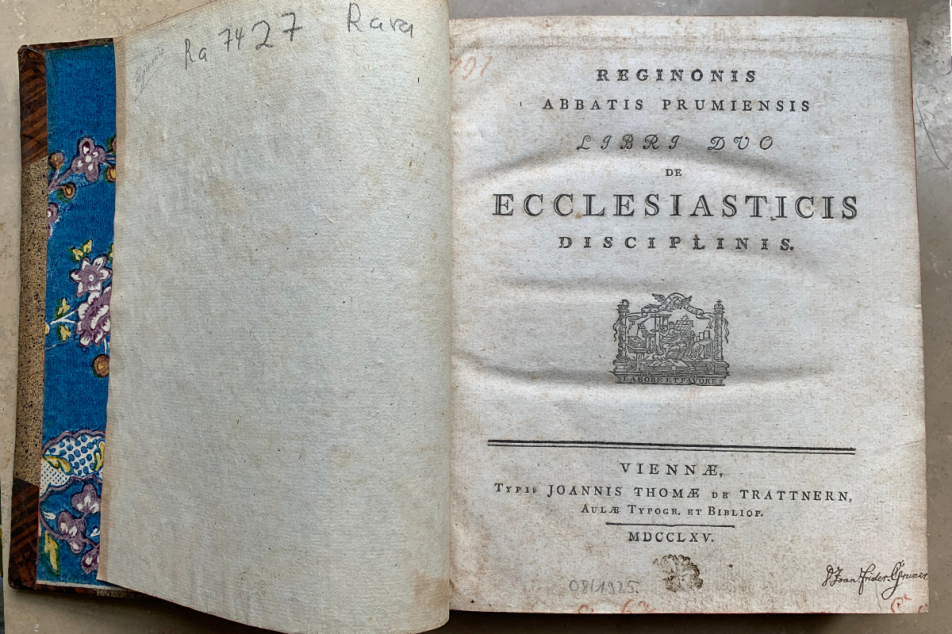
This book argues that abbatial authority was fundamental to monastic historical writing in the period c.500-1500. Writing history was a collaborative enterprise integral to the life and identity of medieval monastic communities, but it was not an activity for which time and resources were set aside routinely. Each act of historiographical production constituted an extraordinary event, one for which singular provision had to be made, workers and materials assigned, time carved out from the monastic routine, and licence granted. This allocation of human and material resources was the responsibility and prerogative of the monastic superior. Drawing on a wide and diverse range of primary evidence gathered from across the medieval Latin West, this book is the first to investigate systematically how and why abbots and abbesses exercised their official authority and resources to lay the foundations on which their communities’ historiographical traditions were built by themselves and others. It showcases them as prolific authors, patrons, commissioners, project managers, and facilitators of historical narratives who not only regularly put pen to parchment personally, but also, and perhaps more importantly, enabled others inside and outside their communities by granting them the resources and licence to write. Revealing the intrinsic relationship between abbatial authority and the writing of history in the Middle Ages with unprecedented clarity, Benjamin Pohl urges us to revisit and revise our understanding of monastic historiography, its processes, and its protagonists in ways that require some radical rethinking of the medieval historian’s craft in communal and institutional contexts.

Benjamin Pohl is Associate Professor in Medieval History with research interests in monastic history, manuscript studies, palaeography and codicology, book history, historical writing, and cultural memory studies. He has published widely on the history of medieval Normandy, England, and other parts of Europe (including Germany and Italy). Having received his PhD from the University of Bamberg, he held postdoctoral research fellowships at Bamberg, Cambridge, and Ghent before being appointed at Bristol in 2015. He has won numerous awards and scholarships and is a fellow of the Alexander von Humboldt Foundation, the Royal Historical Society, and the Higher Education Academy.

Table des matières :

Introduction
1:Abbatial Authorship
2:Abbatial Patronage
3:Abbatial Book Provision and Library Building
4:’In studio abbatis’
Conclusion
Appendix: The Abbots of Flavigny and Their Deeds (Series abbatum Flaviniacensium)

Informations pratiques :

Benjamin Pohl, Abbatial Authority and the Writing of History in the Middle Ages, Oxford, Oxford University Press, 2023 ; 1 vol., 432 p. ISBN : 9780198795377. Prix : GBP : 120,00.

Source : Oxford University Press

Publié dans Publications | Laisser un commentaire

Journée d’étude – Journée d’étude du réseau d’information sur la céramique médiévale et moderne

Le Laboratoire Archéologie et Territoires (UMR 7324 CITERES-LAT), l’Institut National de Recherches Archéologiques Préventives (INRAP), le laboratoire TRAME (UR 4284), le Ministère de la Culture (Service régional de l’archéologie DRAC Hauts-de-France) et le musée de l’Hospice Comtesse de Lille organisent les journées d’études du réseau d’information sur la céramique médiévale et moderne les 15, 16 et 17 novembre 2023 au Musée de l’Hospice Comtesse à Lille.

Programme :

MERCREDI 15 NOVEMBRE
(sur inscription)
17h15-17h30 – Accueil dans le Hall de la Gare Lille Flandres pour un départ groupé en métro – ligne 2 (ticket pris en charge).
17h45-18h45 – « Pots sur table » : Présentation de la céramique de la région (Lilloise notamment) au Centre archéologique Inrap à Villeneuve-d’Ascq (11 rue des Champs – 59 350 Villeneuve d’Ascq). Arrêt métro Les Prés –
Edgar Pisani.
19h – Apéritif dinatoire offert au « Black Lab », situé juste en face de la base (8 rue des champs)

JEUDI 16 NOVEMBRE
9h30 – Accueil des participants
10h00-10h20 – Philippe Husi (UMR CITERES-LAT), Vaiana Vincent (Inrap), Présentation du programme des journées, organisation pratique
Modérateur : Philippe Husi (UMR CITERES-LAT)
10h20-10h40 – Sandrine Mouny (Université de Picardie), Vaiana Vincent (Inrap) & coll., Présentation du PCR : Production, caractérisation et diffusion de la céramique du haut Moyen Âge à l’époque
moderne en territoires Belges et des Hauts-de-France
10h40-11h00 – Etienne Louis (conservateur en chef du patrimoine, honoraire, UMR 8529), Freddy Thuillier (UMR 799 CJI), Éric Compagnon (Direction de l’Archéologie de Douaisis Agglo), Les ateliers de potiers de Douai – L’Arsenal (13e et 14e s.), reprise des données des fouilles de 1988-1994.
11h00-11h20 – Lauriane Miellé (Service archéologique de Beauvais), Les centres de production céramique dans le Pays de Bray picard (Beauvaisis), du Moyen-Age à l’époque moderne : vers une synthèse des données ?
11h20-11h40 – Irvin Speurt (Service archéologique du Grand Calais Terres et Mer), Production potière à Arras au XIVe siècle. Identification et caractérisation d’un faciès local par l’étude d’un atelier aux portes de la ville »
11h40-12h00 – Sylvie De Longueville (Agence Wallonne du Patrimoine), La vaisselle en céramique du premier Moyen Age à Huy (prov. de Liège, Belgique). Etat des lieux et recherches récentes
12h00-12h20 – Lionel Venries (Inrap), Le corpus céramique 5e-12e siècles d’un hameau perçu dans son intégralité, Croixrault (Somme)
12h20-12h30 – discussion autour des interventions

12h30-14h00 – Repas au restaurant « L’Arrière-Pays » – 47 rue Basse (sur réservation)

Modérateur :  Alban Horry (Inrap Auvergne-Rhône-Alpes)
14h00-14h20 – Koen De Groote (Agence du Patrimoine de Flandres), Typologie de la céramique des 13e et 14e siècles à Ypres (Flandre occidentale, Belgique)
14h20-14h40 – Hélène Agostini, Marion Szurhaj (Direction de l’archéologie – CD62), Céramiques et sabotage : un lot du milieu du XVIe s mis au jour à la forteresse de Guînes (Pas-de-Calais)
14h40-15h00 – Camille Caloin, Vaiana Vincent (Inrap), Deux ensembles exceptionnels découverts dans le château de la Phalecque, près de Lille
15h00-15h20 – Virginie Pilard (Service archéologique du département du Nord), Nouvelles données sur la faïencerie lilloise : découverte de rejets de fabrication du début du XIXe s. lors des
travaux de rénovation de la Maison natale Charles de Gaulle
15h20-15h40 – Carole Hardy (Chargée de recherches, Espace muséal d’Andenne, EMA), Bilan de 3 campagnes d’archéologie préventive dans le hameau d’Andenelle (commune d’Andenne) réputé pour avoir livré des ateliers mosans du 11e au 14e siècle.
15h40-16h00 – Geert Verbrugghe, Estelle Delmont (coll.) (Inrap), Des mortiers en pierre dans les Hauts-de-France : du portus de Quentovic (Pas-de-Calais) et du site castral de Boves (Somme) aux premiers indices d’import maritime au bas Moyen Âge dans le Nord
16h00-16h20 – Elise Arnold (Archéologie Alsace), Les latrines de la rue de la Question à Strasbourg : un dépotoir exceptionnel du 17e siècle lié à l’hôpital des syphilitiques ?
16h20-16h40 – Rachel Prouteau (Inrap, UR 1132 HisCant-MA Université de Lorraine), La céramique peinte de la fin du premier Moyen Âge en Lorraine
16h40-16h50 – discussion autour des interventions
16h50-17h30 – Manipulation de tessons
17h30 – Visite libre du musée de l’Hospice Comtesse

20h – Restaurant à « L’Estaminet du welsh » – 45 rue de Gand (sur réservation)

VENDREDI 17 NOVEMBRE

Modérateur : Yves Henigfeld (UMR 6566 CReAHH – LARA)
9h00-9h20 – Aurore Noël, (Eveha, UMR 7324 C I T E R E S), La céramique de la fin du Ve et du VIe siècle de la Zone Nord-Ouest de l’aéroport du Bourget (Bonneuil-en-France, Val d’Oise)
9h20-9h40 – Sarah Grenouilleau-Abuoudeh (UMR 6566 CReAHH – LARA), Poteries horticoles et autres céramiques locales et importées du milieu du XVIIIe siècle au début du XIXe siècle à Guérande (Loire-Atlantique) sur le site de la Porte de Saillé
9h40-10h00 – Jean Catalo (Inrap, UMR Traces), La céramique à décor incisé dans la région toulousaine aux XVIe-XVIIe siècles
10h00-10h20 – Alban Horry (Inrap Auvergne-Rhône-Alpes), DE DESVRES A LYON, 1900-1930, Céramiques “exotiques” et décoratives des dépotoirs domestiques et collectifs entre Alpes et Massif Central
10h20-10h40 : pause
Modérateur : Jean Catalo (Inrap, UMR Traces)
10h40-11h00 – Clémence Mège (Service archéologique de la Ville de Lyon, ArAr – UMR 5138), Le mobilier céramique des fouilles de l’Hôtel-Dieu à Lyon de la fin du Moyen Âge à la période moderne : contribution à la connaissance des faciès régionaux
11h00-11h20 – Camille Meunier (Mosaïques Archéologie, ArAr – UMR 5138), Le Vialat, Boissières (30) : deux faciès céramiques médiévaux en contexte agraire (fin Ve-1e moitié VIe siècle et fin IXe-début XIe siècles)
11h20-11h40 – Fabrice Casagrande, Fabienne Ravoire (Inrap, UMR CRAHAM), Un assemblage céramique européen utilisé à Saint Barthélémy durant la période suédoise (1784-1877), les données du site de la rue Oscar II
11h40-12h00 – Catherine Richarté (Inrap Méditerranée), La céramique de la fouille au laboratoire. Etudes archéometriques appliquées aux mobiliers de terre cuite
12h00-12h20 – Elisabeth Lecler (Inrap, UMR CRAHAM) et Nicolas Thomas (Inrap), Cucurbites et alambics dans un atelier de potier normand du XVIe siècle
12h20-12h30 – discussion autour des interventions
12h30-14h00 – Repas libre
14h00-14h30 – Philippe Husi (UMR CITERES-LAT), ICERAMM, bilan 2023 et perspectives 2024
14h30 – Clôture des journées

Pour télécharger le programme complet des journées, cliquez ici.

Source : Nordoc’Archéo

Publié dans Colloque | Laisser un commentaire

Publication – Christophe Furon, « Les écorcheurs. Violence et pillage au Moyen Âge, 1435-1445 »

Monthermé, 17 mai 1445. La petite ville des Ardennes s’est paisiblement endormie, blottie dans un méandre de la Meuse. Soudain, en pleine nuit, des guerriers déferlent au cœur de la cité. Ils hurlent : « Tue ! Tue ! Tuons tout ! », forcent les portes des habitations, défoncent les fenêtres, violentent les habitants et s’emparent férocement du moindre objet de valeur. Enfin, ils rançonnent les familles et les torturent pour accélérer le paiement. Gilesson Raigniel, « ung jeune enfant aagé de dix ans ou environ », est pendu dans le conduit de la cheminée jusqu’à ce que ses parents donnent douze francs. Girard Teteig, cent ans, est attaché à la queue d’un cheval et traîné dans les rues de la ville, tandis que ses tortionnaires crient « Avant ! Avant, viellart ! » avant de l’égorger. Monthermé est saignée à blanc, sa population brisée et ruinée. Ce déferlement de violence n’est qu’un épisode de la dernière chevauchée qui a ravagé le royaume, la dernière d’une longue séquence de près de dix ans que les contemporains appellent avec effroi « Écorcherie ».  Au coeur d’un royaume de France déchiré par la lutte contre les Anglais et les Bourguignons, ces écorcheurs se livrent à un pillage en règle de populations déjà durement fragilisées par la guerre. Ils deviennent dès lors un enjeu de taille pour le pouvoir royal.

Christophe Furon est enseignant, docteur en histoire médiévale et chercheur associé du Centre de recherches en histoire internationale et atlantique de Nantes Université.

Informations pratiques :

Christophe Furon, Les écorcheurs. Violence et pillage au Moyen Âge, 1435-1445, Paris, Arkhé, 29023 ; 1 vol., 272 p. (Homo historicus). ISBN : 978-2383411154. Prix : € 21,00.

Publié dans Publications | Laisser un commentaire

Exposition – Home Advantage: Paintings from Flanders at Home in Aachen

Exhibition: 26 October 2023 – 14 April 2024

Suermondt-Ludwig-Museum
Wilhelmstraße 18
52070 Aachen
Germany

Together with the art of Italy, painting in the Burgundian Netherlands (today’s Belgium, Luxembourg, the Netherlands, and northern France) led the way in the history of European art during the period of transition from the late Middle Ages to the early modern times. Like Masaccio, Botticelli, Leonardo and Raphael in the South, it was the Van Eyck brothers, Rogier van der Weyden, Hans Memling or Joos van Cleve in the North who fundamentally influenced painting throughout Europe.

With more than fifty paintings from the fifteenth and sixteenth centuries, the Suermondt Ludwig Museum in Aachen owns an impressive collection of Old Flemish and Old Dutch paintings, which has international significance. For the first time in the museum’s history, this unique collection, which has been accumulated over centuries by several generations of Aachen collectors – from Barthold Suermondt to Peter and Irene Ludwig – is now being highlighted in an exhibition and presented to local and international audiences.

The Suermondt Ludwig Museum is one of the institutions where research is tansformed into knowlegde: the latest results, which are the results of years of art-historical and painting-technological research carried out at the museum and in cooperation with numerous partners, are now vividly presented to a large audience. In particular, the findings on the creation process of individual paintings and on the division of labor in the painting workshops of Antwerp, Bruges, Brussels, Ghent, Utrecht, Leyden, and Amsterdam shed new light on the realization of artistic ideas. It also allows to address the wishes and needs of the original patrons and owners of the paintings, which were mostly executed on wooden panels, but occasionally also on canvas. In some cases it is now possible for the first time to reconstruct the former function of individual paintings, which originally were part of larger picture ensembles or, as individual panels, were intended to enhance the spiritual qualities of private devotion.

In addition to masterpieces from the workshops of Hans Memling, Ambrosius Benson, Albrecht Bouts, and Joos van Cleve, as well as paintings from Flemish art centers such as Antwerp, Brussels, Bruges, and Ghent, the Suermondt Ludwig Museum also owns a large number of panel paintings originating from art centers in the northern Netherlands. There, the surviving stock of late medieval paintings is much smaller than in Flanders due to iconoclasm and the Reformation, and our collection in Aachen is or primordial importance for the history of Dutch painting. Paintings by, among others, Cornelis Engebrechtsz. and his pupil Lucas van Leyden, the anonymous Master of Delft and Jacob van Oostsanen, who worked in Amsterdam, complement the paintings of the Flemish masters and thus allow a comprehensive insight into the most diverse manifestations of painting between 1450 and 1550 in the entire Netherlands.

The exhibition is curated by Till-Holger Borchert, Sarvenaz Ayooghi and Ulrike Villwock.

For more information, please visit suermondt-ludwig-museum.de

Source : Codart

Publié dans Exposition, Le réseau | Laisser un commentaire

Colloque – Lungo la via Tiburtina Valeria nel Medioevo

Convegno di studi « Lungo la via Tiburtina Valeria nel Medioevo »
A cura di Gaetano Curzi, Claudia D’Alberto, Manuela Gianandrea ed Eleonora Tosti
Chieti nelle giornate del 14 e del 15 Novembre e a Roma il 16 e 17 Novembre.

Programme : ici

ENTI ORGANIZZATORI
Dipartimento di Lettere, Arti e Scienze Sociali,

Università degli Studi “G. d’Annunzio”
di Chieti-Pescara, ERC Graff-IT
Dipartimento Storia Antropologia Religioni Arte Spettacolo, Sapienza Università di Roma Società romana di storia patria – ETS

COMITATO SCIENTIFICO-ORGANIZZATIVO Gaetano Curzi, Claudia D’Alberto,
Manuela Gianandrea, Eleonora Tosti

Publié dans Colloque | Laisser un commentaire

Journée d’étude – Ruusbroecdag 2023: Contemplatie en Actie

Ieder jaar herdenkt het Ruusbroecgenootschap de sterfdag van Jan van Ruusbroec, 2 december 1381, met de organisatie van de Ruusbroecdag. Op een vrijdagnamiddag rond 2 december wordt dan in samenwerking met UCSIA een klein colloquium georganiseerd.

Datum: vrijdag 1 december 2023 (14.00-18.00)

Locatie: De Tassiszaal, Hof van Liere – Prinsstraat 13 – 2000 Antwerpen

Tijdens de Ruusbroecdag zullen vier sprekers het thema elk vanuit een andere invalshoek belichten. Tussen de lezingen is er een artistiek intermezzo.

Programma :

  • 14.00u     John Arblaster (Universiteit Antwerpen): Inleiding op het thema en eerbetoon aan Prof. em. dr. Rob Faesen
  • 14.30u     Rob Faesen (Universiteit Antwerpen/KU Leuven/Universiteit Tilburg): Actie en contemplatie bij Hadewijch en Jan van Ruusbroec
  • 15.00u     Poëtische voordracht door Kristof Smeyers (KU Leuven/KADOC/Ruusbroecgenootschap)
  • 15.05u     Koffiepauze
  • 15.40u     Poëtische voordracht door Kristof Smeyers (KU Leuven/KADOC/Ruusbroecgenootschap)
  • 15.45u     Lieke Wijnia (Museum Catharijneconvent): De iconografische voorstelling van Maria Magdalena
  • 16.15u     Dries Bosschaert (KU Leuven): De geschiedenis van de priester-arbeiderbeweging, met speciale aandacht voor Egied Van Broeckhoven
  • 16.45u     Panelgesprek met de sprekers
  • 17.15u     Receptie

Inschrijven

Deelname is gratis, maar inschrijven is verplicht.

Klik hier om in te schrijven

Source : Universiteit Antwerpen

Publié dans Colloque | Laisser un commentaire

Journée d’étude – Humain et animal dans la sculpture et l’orfèvrerie au Moyen Âge: coexistence, confrontation, hybridation

Le rapport entre l’humain et l’animal durant la période médiévale est complexe. Il est établi sur un lien de proximité, de crainte et d’apprivoisement. Durant cette journée d’étude, nous tenterons de faire le point des connaissances actuelles sur la représentation des créatures animales, hybrides et monstrueuses. Nous interrogerons plus précisément la fonction communicative de ces images ainsi que la perception de la société médiévale à l’égard de la bestialité. Il s’agira en particulier d’évaluer l’hybridité comme processus de métamorphose et comme rhétorique de dualité.

Programme :

9h00 Accueil et mots de bienvenue : Laurence Terrier Aliferis
9h15 Introduction : Bruno Boerner

9h45 Les hybrides de la Grande Châsse de Saint-Maurice d’Agaune
Pierre Alain Mariaux, Université de Neuchâtel

10h30 Morsure et hybridation : les hybrides sculptés du palais épiscopal d’Angers
Nathalie Le Luel, Université catholique de l’Ouest (Angers)

11h15 La dualité nu – dévêtu comme signe de l’hybridation
Laurence Terrier, Université de Neuchâtel

14h00 Le Tentateur de Strasbourg : l’animal derrière les apparences humaines
Denise Borlée, Université de Strasbourg

14h45 Monstres et chimères dans l’anthropologie de l’image
Sara Petrella, Université de Fribourg

15h30 Table ronde et conclusion

Informations pratiques :

Journée d’étude
Université de Neuchâtel, Faculté des Lettres et des Sciences Humaines
salle SE 46
vendredi 24 novembre 2023

Organisation: Bruno Boerner, Université de Rennes (UR Histoire et critique des arts), Laurence Terrier Aliferis, Université de Neuchâtel (IHAM)

Publié dans Colloque | Laisser un commentaire

Appel à contribution – Ecologies of Visual Culture in the Global Middle Ages

Association for Art History 2024
Annual Conference, University of Bristol
Deadline 10 November 2023

2024 marks the fiftieth anniversary of the Association for Art History. We are delighted to announce that next year’s conference will be held in collaboration with the History of Art department at the University of Bristol.

Proposals are invited for the conference session ‘Ecologies of Visual Culture in the Global Middle Ages’.

The study of medieval art and visual culture has recently seen a flourishing of ecocritical and environmental approaches that invite us to explore new ways of thinking about objects, buildings and landscapes. Drawing on the material, spatial, and post-human turns in humanities research, these have highlighted the complex ways in which human creativity and acts of making are entangled with non-human processes and agency. One aspect emphasises the landscape as integral to sacred space, placing built structures within their topographical and ecological contexts, and attending to other kinds of material intervention. Another focuses on materiality, the ‘stuff’ of the natural world from which both buildings and objects were crafted, to better understand their making and meaning. Across the globe, such interactions were inflected by different environments and cultural frameworks. This panel thus aims to bring together new research on visual cultures of the natural world, as these relate to any medium and geographic region, c.500-1500.

Proposals for papers are invited on topics including, but not limited to: visual representations and perceptions of the natural world; the materiality of objects and buildings, whether animal, vegetable or mineral in origin; the impact of cultivating and extracting such materials on landscapes and ecosystems; lasting interventions in the natural world, from free-standing buildings and monuments to rock-cut structures and gardens; ephemeral engagement with natural environments, through ritual and performance, mobile objects and temporary creations; the relationship between the non-human world and the human body, including sensory experience; intersections between environmental science and visual culture. We welcome submissions that together represent a variety of methodologies and perspectives, and a range of cultural contexts.

Advertisements

about:blank

Report this adPrivacy

To offer a paper:

  • Please email your paper proposals direct to the session convenor(s).
  • You will need to provide a title and abstract (250 words maximum) for a 20-minute paper, your name and institutional affiliation (if any).
  • Deadline for submissions: 10 November 2023

Session convenors:

Source : Medieval Art Research

Publié dans Appel à contributions | Laisser un commentaire

Podcast – Louis Genton, « L’institution et l’écrit. Une histoire documentaire de l’abbaye de Saint-Germain-des-Prés (XIe-XVe siècle) »

Cette conférence présente les résultats issus de la thèse de doctorat de Louis Genton, rédigée avec l’appui de la Fondation des Sciences du Patrimoine et récemment soutenue à l’université de Paris-Saclay.

L’abbaye de Saint-Germain- des-Prés fait partie des grands monastères bénédictins parisiens qui disposent d’un vaste corpus de documents médiévaux produits entre les IXe et XVe siècles, aujourd’hui conservés aux Archives nationales et à la Bibliothèque nationale de France.

Cette enquête sur ce riche ensemble d’archives montre comment les moines sangermaniens, confrontés à une multiplicité de concurrences, sont amenés au cours de deux épisodes de réforme, à la fin du XIIe siècle et à partir du milieu du XIIIe siècle, à faire de l’écrit un élément incontournable de la stabilité institutionnelle de l’abbaye. En retour, ce travail insiste sur la capacité des pratiques d’écriture à faire évoluer les fondements du pouvoir monastique.

Publié dans Podcast | Laisser un commentaire

Publication – Gaelle Bosseman, « Eschatologie et discours sur la fin des temps dans la péninsule Ibérique (VIIIe-XIe siècle) »

L’intérêt pour l’eschatologie dans les sources altomédiévales est encore souvent interprété comme significatif d’une croyance plus ou moins largement partagée en l’imminence de la fin des temps. Cette hypothèse ne semble pas parfaitement rendre compte de la diversité du contenu des sources, tant textuelles qu’iconographiques : de nombreux textes ou images abordent la fin des temps dans une optique sinon érudite ou contemplative, du moins dénuée de toute urgence apocalyptique. Ils émanent, d’autre part, de milieux lettrés, généralement monastiques. Dans le débat sur la réalité des peurs millénaristes à l’approche de l’an 800 et de l’an 1000, et à partir du cas d’étude central de la péninsule Ibérique, ce livre propose une relecture des sources à la recherche du sens, mais aussi des fonctions de l’eschatologie pour les chrétiens de cette époque.

Table des matières : ici

Informations pratiques :

Gaelle Bosseman, Eschatologie et discours sur la fin des temps dans la péninsule Ibérique (VIIIe-XIe siècle), Madrid, Casa de Velázquez, 2023 ; 1 vol., 445 p. (Bibliothèque de la Casa de Velázquez, 89). ISBN : 9788490964071. PRix : € 46,00.

Source : Casa de Velázquez

Publié dans Publications | Laisser un commentaire