Colloque – Mendicants and Political Power(s) in the Middle Ages

International Conference organized by Robert Friedrich, M. Ed. und Professor Dr. Cornelia Linde (both Greifswald)

With the emergence of the mendicant orders at the beginning of the thirteenth century, Europe’s religious landscape changed fundamentally. Soon these new orders had spread across the entire continent and beyond, founding convents in numerous cities, and quickly establishing themselves in the vicinity of political centres of power. There, the mendicants served not only as confessors and chaplains, but also as diplomats and advisors, as translators and spies. These positions allowed them to exert significant influence on political decision-making processes and also on the decisions themselves.

This international conference will assess these relationships between potentates and mendicant orders by bringing together internationally renowned scholars to explore this field of interaction between religion and politics in late medieval Europe from a comprehensive comparative perspective for the very first time. In addition to the actual connections between orders and rulers, representations and ideas of these links to power will also be examined. For this purpose, papers will draw on, for instance, sermons and visions, thus taking into consideration two important genres for the popular communication of knowledge, news, and ideas in the Middle Ages. With this conference, we hope to generate new insights into such diverse fields as the history of political ideas, of religious orders, of diplomacy, of piety, and of rulership more broadly.
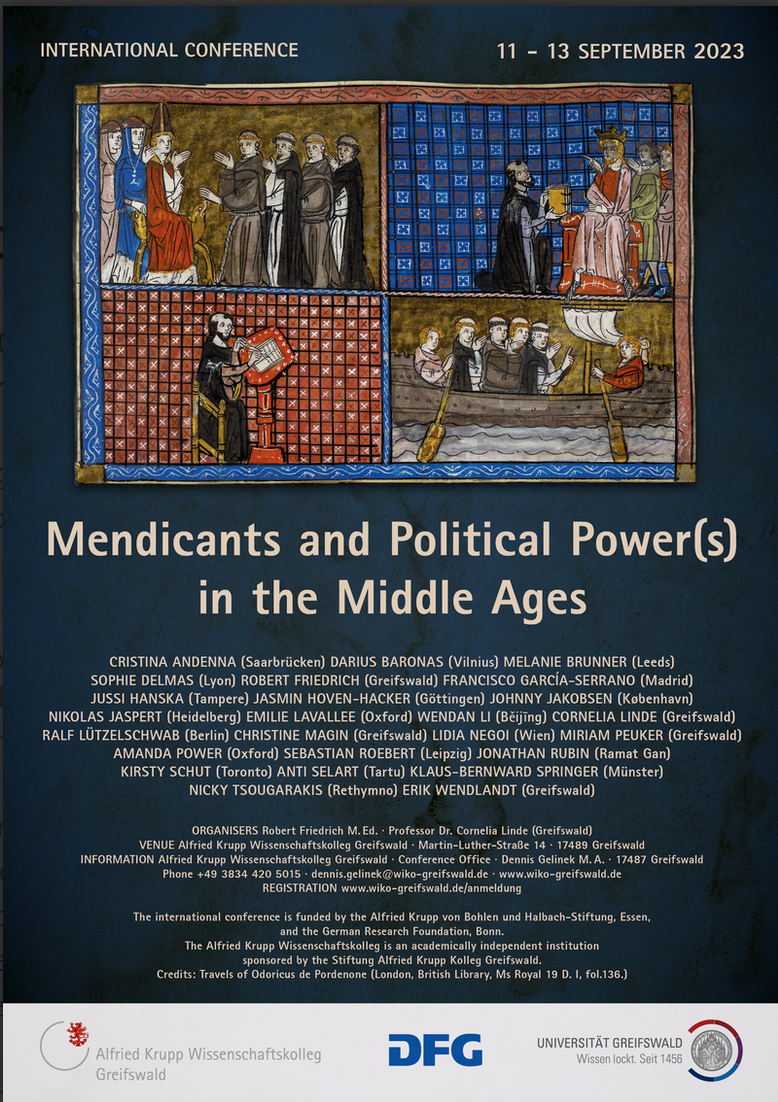
Programme :

Monday, 11th September 2023

10.30 – 12.30
Excursion to Eldena monastery

14.30 – 15.00
Registration
15.00 – 15.15
Welcome by the Alfried Krupp Wissenschaftskolleg and the organizers of the conference
15.15 – 16.45
Entangled Powers in the Medieval Anthropocene: Roger Bacon and the Governance of the Earth
Amanda Power (Oxford)
Should it fall to us to give advice: Addressing the Powerful in Mendicant Texts of the Later Thirteenth Century
Emilie Lavallee (Oxford)
Rulership in the Sermons of the Dominican Friar Nicholas Eymeric (d. 1399)
Lidia Negoi (Vienna)

16.45  – 17.30
Coffee Break


17.30  – 18.30
Mendicant Diplomatic Agents in the Baltic, 13th–14th c.
Anti Selart (Tartu)
Diplomat Friars and Informal Diplomacy in the Western Mediterranean (ca. 1300–1340)
Robert Friedrich (Greifswald)

18.30  – 19.00
Break

19.00
Public Key Note Lecture
Gastfreundlich aufgenommen und wohlwollend behandelt – Inschriften aus Bettelordensklöstern in Mecklenburg und Pommern
Christine Magin (Greifswald)
Moderation: Isabelle Dolezalek (Greifswald)

Tuesday, 12th September 2023

9.00 – 10.00
Guided tour through Greifswald

10.00 – 11.00
Dominican Tertiaries as Court Prophetesses in Renaissance Italy
Cornelia Linde (Greifswald)
Mendicants’ Preaching at the Court of Philippe III of France (1270–1285)
Sophie Delmas (Lyon)

11.00 – 11.30
Coffee Break

11.30 – 12.30
Friars Minor in Late Medieval Lithuania: Missionaries, Martyrs, Intercessors and Scribes
Darius Baronas (Vilnius)
Envoys, Translators and Ethnographers: Mendicants in the Service of Western Rulers in and around the Kingdom of Jerusalem
Jonathan Rubin (Ramat Gan)

12.30 – 14.00
Lunch Break

14.00 – 15.00
On Sermons and Sinners. Mendicant Confessors and the Royal Courts of England and France
Ralf Lützelschwab (Berlin)
Emperor’s Confessor and Murderer? Narratives about Dominicans and the Death of Henry VII, Holy Roman Emperor
Erik Wendlandt (Greifswald)

15.00 – 15.30
Coffee Break

15.30 – 16.30
Peter IV and the Infant Peter OFM. A Difficult Symbiosis
Sebastian Roebert (Leipzig)
Between Nobility and Royalty: Castilian Mendicants beyond the Convent in the Thirteenth and Fourteenth Centuries
Francisco García-Serrano (Madrid)

16.30 – 17.00
Coffee Break


17.00 – 18.00
Mendicants and Royal Rule: The Example of King Rudolf von Habsburg and the Dominicans
Klaus-Bernward Springer (Münster)
Johnny Jakobsen (Copenhagen): Whereas Formerly Those in the Houses of Kings Were in Soft Garments, Now They are Clothed in Base Attire. Mendicant Orders and Rulers in Medieval Scandinavia

Wednesday, 13th September 2023

9.30 – 10.30
The Venetian Authorities of Crete and the Establishment of the Franciscan Observants
Nicky Tsougarakis (Rathymno)
Mendicants and Rulers in Southern Italy
Cristina Andenna (Saarbrücken)

10.30 – 11.00
Coffee Break

11.00 – 12.30
Sed sicut Deus dedit manui diversos digitos …: The Mendicants before the Mongol Khans
Wendan Li (Beijing)
Franciscans in the Service of the Papacy: Conflict and Cooperation at the Curia in Avignon
Melanie Brunner (Leeds)
Clemens Ragvaldi OFM, Inquisitor – At the Service of the Church or the Crown?
Jussi Hanska (Tampere)

12.30 – 14.00
Lunch Break

14.00  – 15.30
Ecce haereditas mihi ablata. Dominican Nunneries in Saxonia and Their Relations with Their Territorial Lords
Miriam Peuker (Greifswald)
Daughters of Principes in Mendicant Convents in Late-Medieval Germany
Jasmin Hoven-Hacker (Göttingen)
Saint Factories, Prisons, Graveyards, and Retreats: Functions of Mendicant ‘Celestial Courts’ in Thirteenth- and Fourteenth-Century Europe
Kirsty Schut (Toronto)

15.30  – 16.00
Coffee Break

16.00  – 18.00
Conclusion & Concluding Discussion

Informations pratiques :

International Conference organized by Robert Friedrich, M. Ed. und Professor Dr. Cornelia Linde (both Greifswald)

Date:
11 – 13 September 2023

Closing date for in person participation registration:
September 1st 2023

Conference venue:
Alfried Krupp Wissenschaftskolleg Greifswald
Martin-Luther-Straße 14
17489 Greifswald 

Source : Universität Greifswald

Publié dans Colloque | Laisser un commentaire

Appel à contribution – L’expérience de la crise urbaine au Moyen Âge

La ville médiévale est régulièrement la scène des crises populaires : le peuple se plaint d’une nouvelle taxe, s’inquiète du manque de blé, rejette une minorité locale, fulmine d’une innovation religieuse, frémit de l’imminence d’une attaque ou d’une catastrophe, dénonce une mesure officielle ou refuse carrément l’autorité en place… Ces crises peuvent être d’ampleur et de conséquences très variables mais la plupart de sources, tant de l’Occident que de l’Orient, confirment en général ce que disait déjà Platon : le peuple (la foule surtout) réagit toujours de façon intense, bruyante, agitée et « irraisonnée ». Ce corps social est un corps en mouvement, en sensation et en émotion. Ces mises en (ré)action de la population urbaine ont suscité de nombreuses études car elles jalonnent l’histoire de la ville tout en éclairant les dynamiques socio-politiques, les modes d’expression politique et les outils utilisés pour rétablir l’ordre. Néanmoins, la plupart de ces études restent concentrées autour de quelques événements et périodes particulièrement « turbulents ». La fabrique et l’expérience de la crise dans/de la ville restent encore assez inexplorées.

Par essence une crise populaire est avant tout une expérience publique et du public dans la ville. À cette occasion, on crie, hurle des insultes, chante des chants parodiques et pousse des cris de bête ; on gesticule, applaudit, brandit le poing ou des armes ; on court, bouscule, moleste, frappe, casse et incendie, ou encore on panique, pleure à chaudes larmes, chante des hymnes sacrées et supplie Dieu d’accorder sa protection… Toute crise urbaine est caractérisée par un « paysage sensible » particulier, une expérience sensible partagée, forgée, alimentée et amplifiée par des émotions, des sensations, et des gestes intenses. En fait, on reconnaît la situation de crise, et on peut la situer dans le temps comme dans l’espace, précisément parce que l’on entend, voit et ressent ce « régime sensible » de violence, de colère ou de désespoir, de désordre, de pulsion et d’immodération qui impose à la ville une nouvelle façon d’être. On vit la crise publique bien plus que l’on peut l’expliquer, la raconter, la décrire. Elle peut spontanément s’étendre, enfler et s’intensifier par l’effet de foule, l’entraînement et l’excitation. Cette dimension sensible quasi-organique est d’ailleurs ce qui inquiète le plus les autorités et les élites : les chroniques, les archives urbaines et les textes de loi s’attardent bien plus longuement sur l’expérience publique ainsi créée que sur les causes et les revendications elles-mêmes. Nous proposons donc de réfléchir à ce qui construit cette expérience partagée et à ce qui la rend si puissante.

Cependant, l’étude de l’expérience publique médiévale soulève un biais méthodologique car les sources utilisées émanent des lettrés qui méprisent la foule, notamment pour ses turbulences. La documentation disponible éclaire donc plus leur expérience étique de la crise que l’expérience émique de ceux qui y participent. En outre, ces textes révèlent la façon dont les élites se représentent et perçoivent la population urbaine. Par conséquent, si l’on s’intéresse à la nature, à l’intention et au contexte de fabrication des sources médiévales, il convient de questionner la phénoménologie de l’expérience de crise. Notre compréhension peut-elle être modelée par des descriptions émiques, fournies par les participants eux-mêmes, ou repose-t-elle uniquement sur des regards étiques, fournis par des élites lettrées qui regardent avec mépris cette foule agitée ? De fait, étudier l’expérience publique incite à réserver une des sessions de ce panel aux sources et aux méthodes.

Pour répondre au thème annuel du congrès (« Crisis »), nous proposons d’étudier la crise urbaine pour elle-même, comme une expérience sensible — celle de ceux qui font la crise et celle de ceux qui l’observent et qui la décrivent. Nous étudierons les propositions explorant les thèmes suivants :

  • Paysage sonore de la crise : insultes, chants contestataires/parodiques, obscénités, musiques…
  • Émotions de et dans la crise (collectives et individuelles) : colère, mépris, peur, haine, douleur, désespoir…
  • Corps en crise : vocalisation, gestes exaltés, jets de pierre, violences, lynchage, hooliganisme, larmes, arrachage de cheveux…
  • Agentivité de la crise : mode d’action et de constitution des corps collectifs
  • Genre de/dans la crise : présence et gestes des femmes, des enfants…
  • Inducteurs de crise : rumeur, claque, agitateurs, prédicateur, « dialogue » public…
  • Mise en récit de la crise : verbes, adverbes, adjectifs, topoi littéraires…

Nous accueillons des contributions portant sur toutes les sociétés médiévales (Byzance, Islam, Nord et Occident), et encourageons vivement les perspectives comparatives, interdisciplinaires, ainsi que les réflexions méthodologiques.

Modalités de soumission

Les propositions de communication (15-20 min), contenant titre, résumé de 300 mots et mots-clefs, affiliation actuelle, adresses électronique et postale, équipement et accessibilité requis, et court cv, sont à envoyer à experiencecrisis@gmail.com

d’ici le 20 septembre 2023.

Organisation

  • Prof. Piroska Nagy — Université du Québec à Montréal (GRHS) & AMU (TELEMMe)
  • Marie-Em. Torres — Aix-Marseille Université (LA3M)

Contact experiencecrisis@gmail.com

Source : Calenda

Publié dans Appel à contributions | Laisser un commentaire

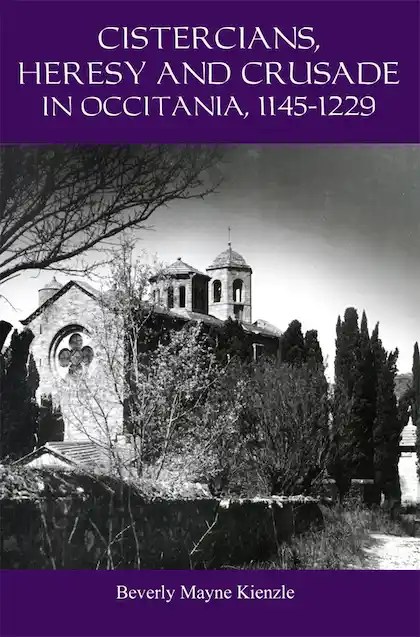
Publication – Beverly Kienzle, « Cistercians, Heresy and Crusade in Occitania, 1145-1229. Preaching in the Lord’s Vineyard »

A study of the involvement of the Cistercian Order in the events surrounding the outbreak of heresy – particularly that of the Cathars and the resulting Albigensian Crusade – in southern France.

Led by the example of Bernard of Clairvaux, Cistercian monks turned their attention to the world outside the monastery walls in response to the threat posed by heretical Christians, in particular the Cathars. The white monks, withother intellectuals, turned to pen, pulpit and popular preaching to counteract heresy, some accepting posts as bishops and papal legates, helping and even directing the Albigensian crusade, and contributing to the formulation ofprocedures for inquisition. Kienzle examines this important but little-studied aspect of Cistercian history to discover how and why the Order undertook endeavours that drew the monks outside their monastic vocation. The analysis of texts about the preaching campaigns and their contexts illuminate the ways in which medieval monastic authors perceived heresy, preached, and wrote against it.

Professor BEVERLY MAYNE KIENZLE teaches at Harvard Divinity School.

Informations pratiques :

Beverly Kienzle, Cistercians, Heresy and Crusade in Occitania, 1145-1229. Preaching in the Lord’s Vineyard, York, York Medieval Press, 2023 ; 1 vol., 278 p. ISBN : 978-1-90315-300-0. Prix : GBP 115,00.

Source : Boydell & Brewer

Publié dans Publications | Laisser un commentaire

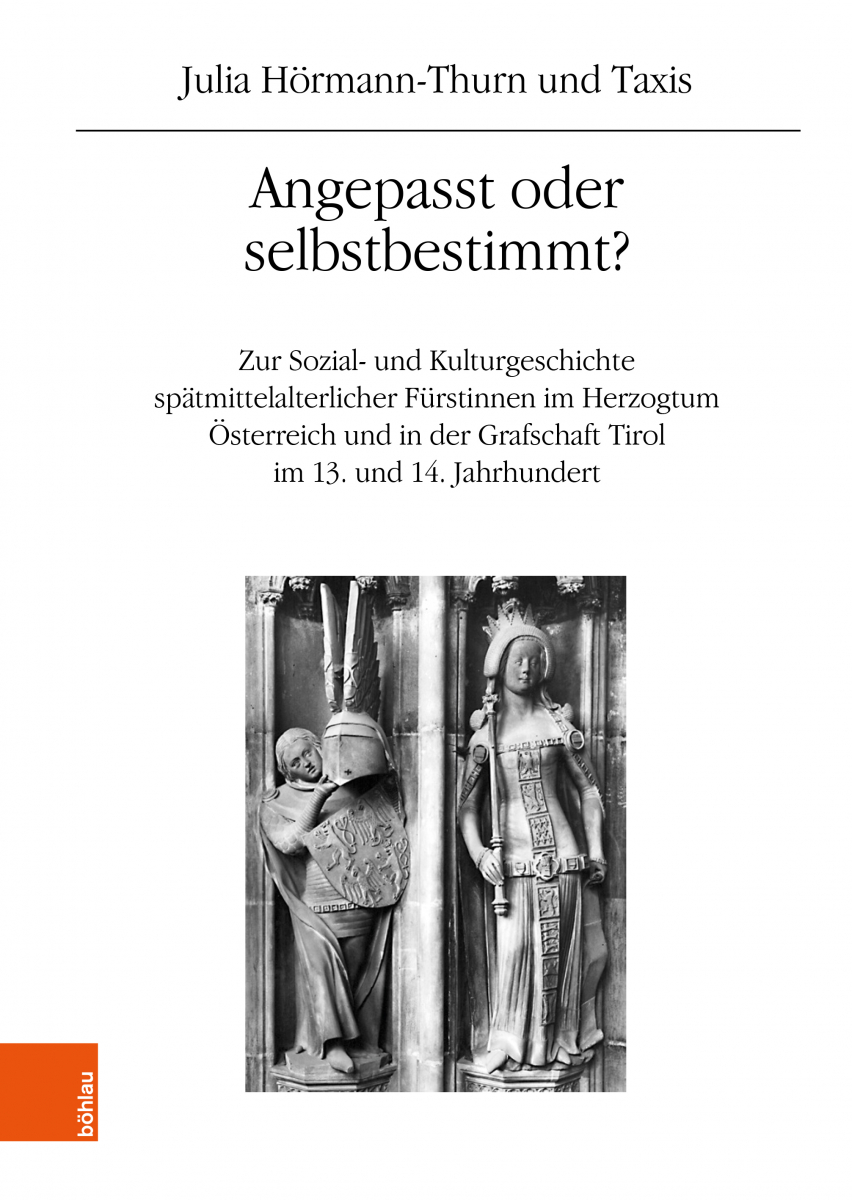
Publication – Julia Hörmann-Thurn und Taxis, « Angepasst oder selbstbestimmt? Zur Sozial- und Kulturgeschichte spätmittelalterlicher Fürstinnen im Herzogtum Österreich und in der Grafschaft Tirol im 13. und 14. Jahrhundert »

Die systematische Analyse der Geschichte fürstlicher Frauen schließt eine wichtige Lücke in der mittelalterlichen Eliten- und Residenzenforschung, die vermehrt auch das Zusammenspiel der Geschlechter in den Blick nimmt. Die kollektive Erfassung öffnet neue Zugänge zur Lebenswirklichkeit der sozialen Gruppe „Fürstin“. Anhand von 22 Fürstinnen, die im 13. und 14. Jahrhundert in die Dynastien der Habsburger und der Grafen von Tirol-Görz einheirateten, werden die Interdependenzen von gesellschaftlich definierten Handlungsmustern und individuellen Gestaltungsmöglichkeiten diskutiert.

Julia Hörmann-Thurn und Taxis arbeitet als Historikerin am Institut für Geschichtswissenschaften und Europäische Ethnologie an der Universität Innsbruck.

Informations pratiques :

Julia Hörmann-Thurn und Taxis, Angepasst oder selbstbestimmt? Zur Sozial- und Kulturgeschichte spätmittelalterlicher Fürstinnen im Herzogtum Österreich und in der Grafschaft Tirol im 13. und 14. Jahrhundert, Göttingen, Vandenhoeck und Ruprecht, 2023 ; 1 vol., 792 p. (Mitteilungen des Instituts für Österreichische Geschichtsforschung. Ergänzungsbände, 67). ISBN: 978-3-205-21728-2. Prix : € 120,00.

Source : Vandenhoeck und Ruprecht

Publié dans Publications | Laisser un commentaire

Publication – « Les Héritiers du tournoi de Noauz. Les tournois des dames, Hem, Chauvency », éd. Madeleine Jeay

L’ouvrage présente dix récits de tournois qui vont du XIIe au XIVe siècle et en offre la traduction en français moderne. Leur originalité tient au fait qu’ils ne se limitent pas à la description des assauts, mais qu’ils en énumèrent les participants, des personnes connues et identifiées.

Table des matières : ici

Informations pratiques :

Les Héritiers du tournoi de Noauz. Les tournois des dames, Hem, Chauvency, éd. Madeleine Jeay, Paris, Classiques Garnier, 2023 ; 1 vol., 854 p. (Recherches littéraires médiévales, 39). ISBN : 978-2-406-15013-8. Prix : € 65,00.

Source : Classiques Garnier

Publié dans Publications | Laisser un commentaire

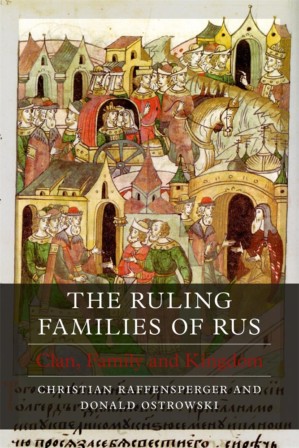
Publication – « The Ruling Families of Rus. Clan, Family and Kingdom », éd. Christian Raffensperger, Donald Ostrowski

This is a new history of the region known as Kyivan Rus’, a state in eastern and northern Europe from the late ninth to the mid-sixteenth century that encompassed a variety of polities and peoples, including Lithuanian, Polish, Ottoman and others. This account for the first time focuses on the history of the region via families, which allows the discussion of a wider region and a larger group of people than has been possible before. The book examines the development of Rus, Lithuania, Muscovy and Tver, and their relations and interconnections with the Mongols, Byzantines and many other peoples. This readable yet thoroughly scholarly book will appeal to anyone with an interest in the history of eastern Europe, a region that is crucial in world politics today.

Informations pratiques :

The Ruling Families of Rus. Clan, Family and Kingdom, éd. Christian Raffensperger, Donald Ostrowski, Londres, Reaktion Books, 2023 ; 1 vol., 320 p. (Dynasties) ISBN : 978-1-78914-715-5. Prix : GBP : 25,00.

Source : Reaktion Books

Publié dans Publications | Laisser un commentaire

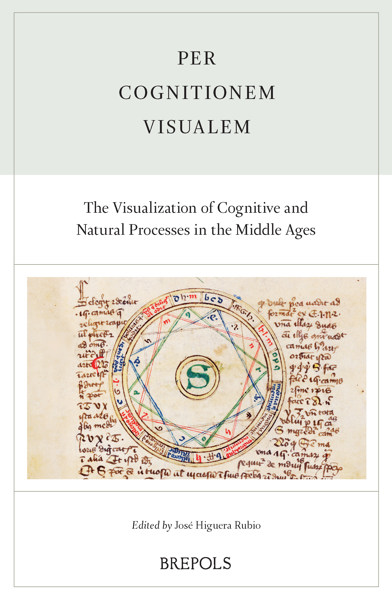
Publication – « Per cognitionem visualem. The Visualization of Cognitive and Natural Processes in the Middle Ages », éd. José Higuera Rubio

Visual representations were deeply involved in medieval traditions related to the dissemination and teaching of philosophy and science. Consequently, they were not only examples of theological or philosophical interpretation, but rather brought together manifold intellectual activities, illuminating various perceptual, cognitive, and spiritual concerns. Visual tools, which appear frequently in medieval manuscripts, have often been considered as “illustrative material” intended to facilitate the comprehension and interpretation of texts. These “visual aids” offer something more than a straightforward correspondence between a conceptual interpretation and its figurative depiction. They are, in fact, key to understanding the methods of acquiring and shaping knowledge through visual frameworks with didactical, disputational or heuristic purposes. The aim of this volume is to deepen our understanding of medieval visual tools that represented and demonstrated philosophical and scientific knowledge and, to an extent, the accumulation of empirical information.

Table des matières :

José Higuera (UNED), Introduction

Diagrams & Graphics

Roberto Hofmeister Pich (PUCRS), Dialectics, Visual Tools, and the Methods of Learning: Exploring “Visual Cognition” in Manuscripts on Logic by Jesuits Masters from Ecuador (17th-18th Centuries)

Pippa Salonius (Monash University), Ordo and Nature: The Trees of Sculpted Narrative at Orvieto Cathedral

Albert Soler (UB), Ramon Llull and the Ars Diagrammatica

Astrology & Geomancy: Visual Tools

Arianna Dalla Costa (Warburg Institute), Lunar Mansions as Celestial Images in the Thirteenth-century De signis Astronomicis

Alessandro Palazzo (Univeristà di Trento), Images and Visual Tools in the Geomantic Treatise Estimaverunt Indi

Visio et cognitio

Maria Manuela Brito Martins (Universidade Católica Portuguesa), Représentations et schémas graphiques de la species visibilis dans le De homine d’Albert le Grand

Peter John Hartman (Loyola University), John Pouilly and John Baconthorpe on Reflex Acts

Paula Oliveira e Silva & João Rebalde (IF-UP), The Diagram of minima naturalia in Marcos Jorge’s Commentary on Aristotle’s Physics (Physics, I, 4)

Nicolás Vaughan (Universidad de los Andes), Ockham and Wodeham on Perceptual Experience

Tamar Tsopurashvili (Ilia State University), Eckhart’s Metaphysics: The Example of Predigt 9

Luciano Micali, Visual Perception and Knowledge of God in Jean Gerson’s Tractatus de oculo

Visio et experientia

Yael Barash (Cohn Institute-Tel Aviv University), Using Visual Conventions to Depict a Visionary Experience: The Illustration of Vision II of Hildegard’s Liber divinorum operum in Lucca Codex

Francesca Galli (Università della Svizzera Italiana) Through the Mirror. (Super-)natural Properties of Reflecting Surfaces in 13th-Century Scientific and Theological Thought (Open Access)

José Higuera (UNED) The Visualization of Motion: Averroes and Albertus Magnus

Informations pratiques :

Per cognitionem visualem. The Visualization of Cognitive and Natural Processes in the Middle Ages. Acts of the XXV Annual Colloquium of the Société Internationale pour l’Étude de la Philosophie Médiévale, Porto, 14–15 and 21–22 June 2021, éd. José Higuera Rubio, Turnhout, Brepols, 2023 ; 1 vol., X–377 p. (Rencontres de Philosophie Médiévale, 27). ISBN : 978-2-503-60340-7. Prix : € 75,00.

Source : Brepols

Publié dans Publications | Laisser un commentaire

Colloque – Du traité de Verdun à l’an Mil : frontières, pouvoirs, économies. Regards croisés de l’histoire et de l’archéologie

La programmation d’un colloque scientifique dans la ville de Mâcon s’inscrit dans la suite des fouilles réalisées à Mâcon en 2019 à la hauteur du jardin de l’ancien couvent des Minimes. L’opération archéologique a mis en évidence une très importante occupation carolingienne qui pourrait être datée de la deuxième moitié du IXe siècle. Les premières conclusions poussent à envisager que la ville de Mâcon connait dès cette époque une première extension vers le sud, depuis le castrum en direction de la nécropole antique et médiévale dite « des Cordiers ». Ce développement de la ville, précoce, associant habitats et lieux artisanaux orientés en particulier autour de la métallurgie pourrait avoir été voulu par les pouvoirsen place, ceux de l’évêque ou/et du comte de Mâcon. La mise en place d’une importante fortification comportant un large fossé de défense et une palissade est très symptomatique de cette volonté des édiles d’assurer la protection de nouveaux espaces, pôles de production et gages de prospérité. Le glissement de la ville en dehors du secteur du castrum ne marquerait-il pas le dynamisme économique du lieu qu’il faudrait éventuellement pouvoir généraliser à d’autres lieux ? Il paraissait opportun suite aux découvertes de Mâcon mais aussi suite aux résultats de plusieurs fouilles et travaux récents (Entrains-sur-Nohain, Sevrey, Collonges-les-Premières, Coulanges-les-Nevers, Cluny, Molles…) de se donner l’occasion de faire un point sur cette période de l’histoire médiévale. Les travaux mettront l’accent à la fois sur les traditions mais aussi sur les facultés d’évolution de la société carolingienne dans cette période peu connue et souvent dépréciée de l’histoire. Les innovations techniques comme lepassage de la céramique à cuisson oxydante à la cuisson en atmosphère réductrice, le développement économique incarné vraisemblablement par un développement plus général de la ville, des campagnes, le rôle des édiles dans ce dynamisme, l’augmentation possible de machines productives comme le moulin hydraulique sont autant de signes, souvent à l’interprétation difficile, qui permettent cependant d’apprécier un peu plus ce moment du Moyen Âge où s’organisent et se structurent les nouveaux territoires, et où s’élaborent d’autres rapports socio-économiques.

Programme prévisionnel : ici

Informations pratiques :

Le colloque Du Traité de Verdun à l’an Mil est prévu entre le mercredi 16novembre et le vendredi 18 novembre 2022 à Mâcon, Saône-et-Loire.Celui-ci se déroulera dans l’amphithéâtre Guillemin (220 places) situé dansles locaux de l’Ecole municipale d’Arts Plastique, Cours Moreau, 71000 Mâcon. 

Frais d’inscription à la manifestation : 15 euros, pour les étudiants : 10 euros

Déjeuner du jeudi 9 et du vendredi 10 novembre : 18 euros par repas

Fiche d’inscription : ici

Source : Calenda

Publié dans Colloque | Laisser un commentaire

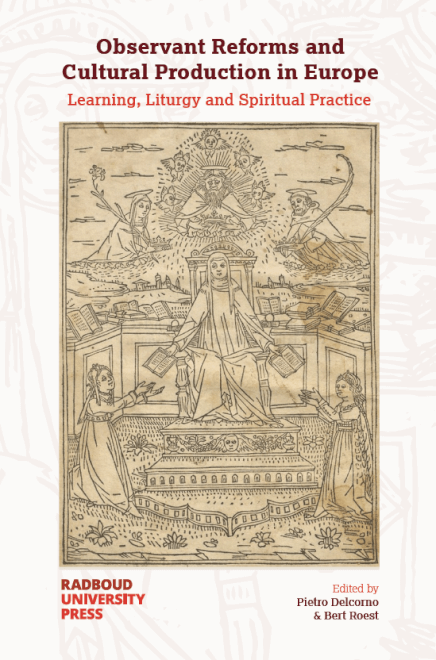
Publication – « Observant Reforms and Cultural Production in Europe Learning, Liturgy and Spiritual Practice », éd. Pietro Delcorno, Bert Roest

The impetus of religious reform between ca. 1380-1520, which expressed itself in a variety of Observant initiatives in many religious orders all over Europe, and also brought forth the Devotio moderna movement in the late medieval Low Countries, had considerable repercussions for the production of a wide range of religious texts, and the embrace of other forms of cultural production (scribal activities, liturgical innovations, art, music, religious architecture). At the same time, the very impetus of reform within late medieval religious orders and the wish to return to a more modest religious lifestyle in accordance with monastic and mendicant rules, and ultimately with the commands of Christ in the Gospel, made it difficult to wholeheartedly embrace the material consequences of learning, literary and artistic prowess, as the very pursuit of such pursuits ran against basic demands of evangelical poverty and humility. This volume explores how this tension was negotiated in various Observant and Devotio moderna contexts, and how communities connected with these movements instrumentalized various types of writing, learning, and other forms of cultural expression to further the cause of religious reform, defend it against order-internal and external criticism, to shape recognizable reform identities for themselves, and to transform religious life in society as a whole.

Table des matières : ici

Informations pratiques :

Observant Reforms and Cultural Production in Europe Learning, Liturgy and Spiritual Practice, éd. Pietro Delcorno, Bert Roest, Nimègue, Radboud University Press, 2023 ; 1 vol., 304 p. ISBN : 9789493296084. Prix : € 24,95.

Source : Radboud University Press

Publié dans Publications | Laisser un commentaire

Publication (en ligne) – Brent Miles, « An Introduction to Middle Welsh: A Learner’s Grammar of the Medieval Language and Reader »

Accès : ici

An Introduction to Middle Welsh: A Learner’s Grammar of the Medieval Language and Reader presents a complete course in reading Middle Welsh. The course is intended both for those who are working with a teacher and for self-learners, and assumes no prior knowledge of any Celtic language. A Learner’s Grammar introduces the grammatical constructions and vocabulary required for the person who wishes to read medieval Welsh prose, with exercises from authentic Welsh texts in each unit. The Reader in the second part presents long excerpts from texts from medieval Welsh literature and history. A full Glossary is included.

Informations pratiques :

Brent Miles, An Introduction to Middle Welsh: A Learner’s Grammar of the Medieval Language and Reader, Toronto, University of Toronto Press, 2023 ; 1 vol., XX–619 p. Accès : https://hdl.handle.net/1807/128582

Source : University of Toronto

Publié dans Publications | Laisser un commentaire