Publication – Paolo Squatriti, « Weeds and the Carolingians Empire. Culture, and Nature in Frankish Europe, AD 750–900 »

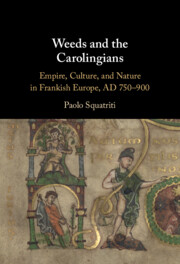
Why did weeds matter in the Carolingian empire? What was their special significance for writers in eighth- and ninth-century Europe and how was this connected with the growth of real weeds? In early medieval Europe, unwanted plants that persistently appeared among crops created extra work, reduced productivity, and challenged theologians who believed God had made all vegetation good. For the first time, in this book weeds emerge as protagonists in early medieval European history, driving human farming strategies and coloring people’s imagination. Early medieval Europeans’ effort to create agroecosystems that satisfied their needs and cosmologies that confirmed Christian accounts of vegetable creation both had to come to terms with unruly plants. Using diverse kinds of texts, fresh archaeobotanical data, and even mosaics, this interdisciplinary study reveals how early medieval Europeans interacted with their environments.

Paolo Squatriti is Professor of History at the University of Michigan. His previous publications include Water and Society in Early Medieval Italy (Cambridge, 1998) and Landscape and Change in Early Medieval Italy (Cambridge, 2013). The latter won a prize from the American Association for Italian Studies.

Table des matières :

  1. Weeds, nature, and empire
  2. Weeds on the ground
  3. The time of weeds
  4. The worst of weeds
  5. The botany of paradise in Carolingian Rome
  6. The uses of weeds
  7. The politics of weeding in the Carolingian Empire
    Epilogue.

Informations pratiques :

Paolo Squatriti, Weeds and the Carolingians Empire. Culture, and Nature in Frankish Europe, AD 750–900, Cambridge, Cambridge University Press, 2022. 280 p. ISBN : 9781316512869. Prix : GBP 75.

Source : Cambridge University Press

Publié dans Publications | Laisser un commentaire

Publication – Jennifer Awes Freeman, « The Ashburnham Pentateuch and its Contexts. The Trinity in Late Antiquity and the Early Middle Ages »

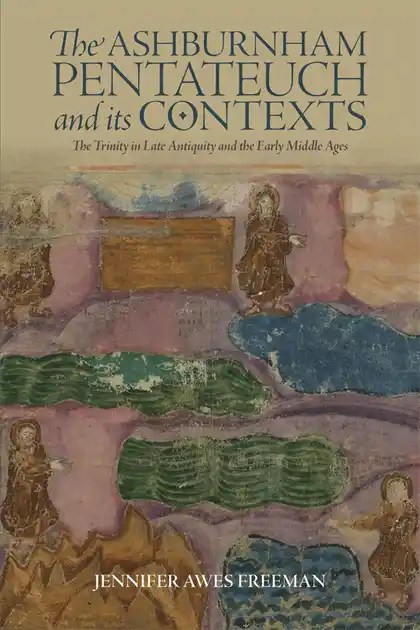
The Ashburnham Pentateuch is an early medieval manuscript of uncertain provenance, which has puzzled and intrigued scholars since the nineteenth century. Its first image, which depicts the Genesis creation narrative, is itself a site of mystery; originally, it presented the Trinity as three men in various vignettes, but in the early ninth century, by which time the manuscript had come to the monastery at Tours, most of the figures were obscured by paint, leaving behind a single creator. In this sense, the manuscript serves as a kind of hinge between the late antique and early medieval periods. Why was the Ashburnham Pentateuch’s anthropomorphic image of the Trinity acceptable in the sixth century, but not in the ninth?

This study examines the theological, political, and iconographic contexts of the production and later modification of the Ashburnham Pentateuch’s creation image. The discussion focuses on materiality, the oft-contested relationship between image and word, and iconoclastic acts as « embodied responses ». Ultimately, this book argues that the Carolingian-era reception and modification of the creation image is consistent with contemporaneous iconography, a concern for maintaining the absolute unity of the Trinity, as well as Carolingian image theory following the Byzantine iconoclastic controversy. Tracing the changes in Trinitarian theology and theories of the image offers us a better understanding of the mutual influences between art, theology, and politics during Late Antiquity and the early Middle Ages.

Jennifer Awes Freeman is Assistant Professor and Program Director of Theology and the Arts at United Theological Seminary of the Twin Cities.

Table des matières :

Introduction: Losing and Finding the Ashburnham Pentateuch

  1. Early Trinitarian Texts and Debates
  2. The Trinity in Early Christian Images
  3. Carolingian Conceptions of the Trinity
  4. Carolingian Image Theory
  5. The Carolingian Reception of the Ashburnham Pentateuch
    Conclusion: Possible Motivations for the Ashburnham Pentateuch Erasures[TS1]
    Coda: The Afterlife [TS2] of the Ashburnham Pentateuch

Informations pratiques :

Jennifer Awes Freeman, The Ashburnham Pentateuch and its Contexts. The Trinity in Late Antiquity and the Early Middle Ages, Woodbridge, Boydell and Brewer, 2022 (Boydell Studies in Medieval Art and Architecture). 244 Pages, 23.4 x 15.6 cm, 8 colour; 39 b/w illus. ISBN : 9781783276844. GBP 75.

Source : Boydell & Brewer

Publié dans Le réseau | Laisser un commentaire

Colloque – Italia – Cuba nei secoli XV-XX: confini culturali ed esperienze di circolazione, ricezione, ibridazione.

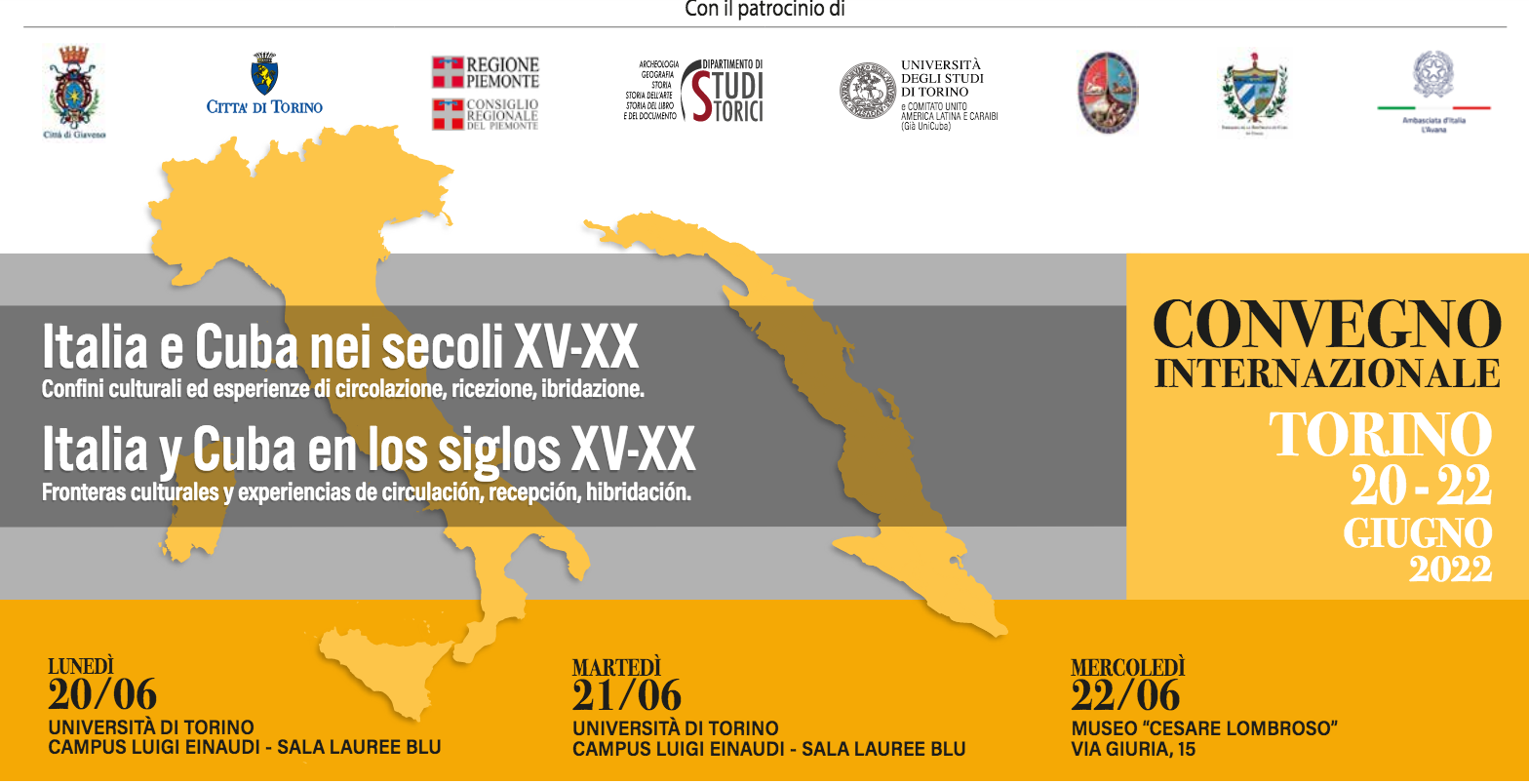
Convegno Internazionale
Torino, Campus Luigi Einaudi
20-22 giugno 2022

Programme : ici

Il fenomeno dell’emigrazione italiana a Cuba è databile dalla seconda metà dell’Ottocento nel contesto di un processo migratorio promosso dalle autorità coloniali ai fini del cosiddetto “sbiancamento” della popolazione dell’Isola. Benché numericamente inferiore sia all’emigrazione spagnola sia agli altri flussi migratori italiani in sud America, l’emigrazione italiana a Cuba avviò nuove relazioni familiari non solo all’interno della stessa comunità italiana ma anche con la popolazione autoctona, contribuendo a modificare l’assetto sociale dell’isola. In questo contesto, un emigrante di eccezione fu senz’altro il piemontese Dino Pogolotti, nato a Giaveno nel 1879 da Francesco e Maria Carnino, ed emigrato a New York nel 1895. Sbarcato poi a Cuba in qualità di segretario del console americano Frank Steinhart, Dino fu protagonista dello sviluppo industriale e urbanistico dell’isola, in particolare attraverso la costruzione del celebre Barrio Pogolotti: https://paradapogolotti.it/osservatorio/

Il Convegno che l’Università di Torino ospiterà il 20-21-22 giugno 2022 presso il Campus Luigi Einaudi costituisce una tappa importante di un progetto del Dipartimento di Studi Storici di Torino volto a indagare la circolazione culturale tra Italia e Cuba dal XV sec. ai giorni nostri.

L’ampia diacronia trova supporto nella storiografia più recente che data la formazione di uno spazio atlantico a prima del 1492. La chiave di lettura unitaria del progetto è l’interpretazione della rete di relazioni tra Italia e Cuba come middle ground di un interscambio culturale di lunga durata che ha modificato nei secoli i parametri dell’eurocentrismo e della modernità.

Il Convegno prende avvio dal principio di tutto, cioè dalla scoperta di Cristoforo Colombo che Tzvetan Todorov definì l’incontro «più straordinario della nostra storia» [T. Todorov, La conquista dell’America. Il problema dell’“altro”, Torino, Einaudi 2015, 1ª Ed. Paris 1982], che svelò all’Europa un “altro da sé” completamente sconosciuto e a lungo incomprensibile. Dopo quel principio e le sue prime narrazioni/rappresentazioni quattro-cinquecentesche, il Convegno affronterà le tante variabili di una relazione che ha senz’altro cambiato drammaticamente i destini di quei popoli, ma anche i destini europei e italiani nei diversi ambiti della storia culturale, politica e sociale dalla prima modernità fino al nostro presente.

Il Convegno si svolge sotto il patrocinio dell’Università di Torino, del Dipartimento di Studi Storici e del Comitato UniTo America latina e Caraibi (già UniCuba), delle Ambasciate di Cuba in Italia e dell’Italia a Cuba, della Regione Piemonte e del Consiglio Regionale del Piemonte, del Comune di Torino, del Comune di Giaveno.  Nel contesto dell’accordo-quadro di Cooperazione Internazionale tra l’Ateneo di Torino e l’Università de La Habana, e dell’accordo specifico tra il Dipartimento di Studi Storici e la Facoltà di Filosofia e Storia della stessa Università de La Habana, il Convegno rappresenta una tappa fondamentale del dialogo tra le due Università e del confronto tra le metodologie della ricerca storica nei due paesi, oltre che della tutela della memoria dell’emigrazione piemontese nelle Americhe e nei Caraibi, rispondendo quindi agli obiettivi strategici dell’Ateneo in merito sia all’internazionalizzazione sia al dialogo con il territorio e le sue memorie.

Publié dans Colloque | Laisser un commentaire

Publication – « Chartularium Sangallense – Band II : 841 – 999 », éd. Peter Erhart, Karl Heidecker, Rafael Wagner et Bernhard Zeller

Die im zweiten Band des »Chartularium Sangallense« enthaltenen Urkunden aus dem Stiftsarchiv St. Gallen sind aufgrund ihrer Rarität von höchster Bedeutung für die Erforschung des Frühmittelalters. Für rund tausend Orte im Bodenseeraum liefern sie den ersten schriftlichen Nachweis ihrer Existenz und werfen Licht in die andernorts »dunklen Jahrhunderte« von den Merowingern über die Karolinger bis hin zu den Ottonen.

Es handelt sich um die erste kritische Neubearbeitung des »Urkundenbuchs der Abtei Sanct Gallen« von 1863/1866. Der zweite Band enthält ein Personennamen-, Orts- und Sachwörterregister, das auch die Urkundentexte von Band I erschließt, sowie eine großformatige Karte mit dem Besitz des Klosters St. Gallen.

Informations pratiques :

Chartularium Sangallense – Band II : 841 – 999, éd. Peter Erhart, Karl Heidecker, Rafael Wagner et Bernhard Zeller, Sigmaringen, Patmos, 2022. 597 p. 20 x 28 cm. ISBN : 978-3-7995-6070-2. prix : 20 euros.

Source : Patmos

Publié dans Publications | Laisser un commentaire

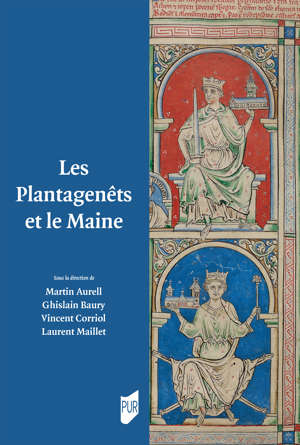
Publication – « Les Plantagenêts et le Maine », dir. Maillet Laurent, Corriol Vincent, Aurell Martin, Baury Ghislain

Situé sur un axe assurant la jonction entre l’Aquitaine au sud et le pôle anglo-normand au nord, le comté du Maine, contrôlé par la dynastie Plantagenêt depuis le début du XIIe siècle, occupe paradoxalement une place marginale dans l’économie et le pouvoir des comtes d’Anjou, devenus rois d’Angleterre avec Henri II. Son statut est paradoxal car, en dépit de sa situation périphérique, ce comté revêt une importance capitale lors de l’affrontement entre Philippe Auguste et les souverains anglais.

Les études réunies ici permettent d’éclairer les différents aspects de l’implantation, de la circulation et de la représentation d’un pouvoir qui ne fait bien souvent que traverser le comté mais n’y réside jamais de manière durable. L’exemple du comté du Maine permet de porter un regard neuf sur l’exercice du pouvoir dans l’ensemble plantagenêt. Il invite aussi à réexaminer les pratiques du pouvoir en termes de représentation locale et de négociations avec les pouvoirs en place, révélant un équilibre subtil des forces en présence que les Plantagenêts s’efforcent de maintenir en leur faveur. C’est enfin l’occasion de révéler les dernières recherches concernant les éléments majeurs du patrimoine manceau, comme l’abbaye de l’Épau, l’hôtel-Dieu de Coëffort ou le portail royal de la cathédrale Saint-Julien du Mans, qui constituent autant de jalons matériels de leur pouvoir.

Table des matières : ici

avec le soutien de Le Mans Université et en partenariat avec la Société Historique et Archéologique du Maine

Martin Aurell est professeur à l’université de Poitiers et directeur du Centre d’études supérieures de civilisation médiévale.

Ghislain Baury et Vincent Corriol sont enseignants-chercheurs à l’université du Mans et membres du laboratoire Temps, mondes, sociétés (TEMOS).

Laurent Maillet, docteur en histoire, est membre associé de TEMOS.

Informations pratiques :

Les Plantagenêts et le Maine, dir. Maillet Laurent, Corriol Vincent, Aurell Martin, Baury Ghislain, Rennes, Presses universitaires de Rennes, 2022. 320 p. ISBN : 9782753582859. Prix : 30 euros.

Source : Presses universitaires de Rennes

Publié dans Publications | Laisser un commentaire

Offre d’emploi – PhD position (M/F) Digital Palaeography / Contrat doctoral (H/F) Paléographie numérique

Assurez-vous que votre profil candidat soit correctement renseigné avant de postuler. Les informations de votre profil complètent celles associées à chaque candidature. Afin d’augmenter votre visibilité sur notre Portail Emploi et ainsi permettre aux recruteurs de consulter votre profil candidat, vous avez la possibilité de déposer votre CV dans notre CVThèque en un clic !

General information

Reference : UPR841-DOMSTU-008
Workplace : AUBERVILLIERS
Date of publication : Friday, June 3, 2022
Scientific Responsible name : Dominique STUTZMANN (UPR 841 IRHT) / Mathieu AUBRY (UMR8049 LIGM)
Type of Contract : PhD Student contract / Thesis offer
Contract Period : 36 months
Start date of the thesis : 1 October 2022
Proportion of work : Full time
Remuneration : 2 135,00 € gross monthly

Description of the thesis topic

Features of medieval scripts (CrEMe “Caractérisation des écritures médiévales” research project).

The PhD candidate will be primarily a humanities student and will have to develop a connection to both project teams (IRHT and LIGM), as well as to two scholarly fields, medieval history and the study of scripts, on the one hand, and computer vision and machine learning, on the other.

As their main scholarly target, the PhD candidate will characterise the diverse Latin scripts of the Middle Ages and study their evolution mechanisms based on the morphology of their signs and letter forms.

They will first adapt existing tools to create “prototypes-based descriptions”, i.e. an average shape and a description of its variations, of the letter forms, and validate their output against palaeographical literature. Based on discussions on the relevance of corpora and script types and applicability of techniques with both supervisors, they will be able to choose their corpora according to their previous expertise or fields of interest. Synchronic studies and comparisons may be relevant (e.g. textualis, cursiva, hybrida, semitextualis), as well as diachronic ones (uncial, semi-uncial, Caroline, praegothica). Depending on the results in this first phase, an additional annotation phase may be required to create valid prototypes. The scope of additional annotations will be informed by the palaeographical literature and the analysis of existing hyperdiplomatic editions, which have identified relevant phenomena to analyse scripts.

In a further development, the PhD candidate will propose a strategy to apply and develop the relevant tools and exploit their outputs by creating prototypes and measuring the formal transformations, based on already available corpora. They will aim at proposing weighted metrics for the palaeographical analysis, integrating the metrics generated by artificial vision (distance between prototypes and between prototypes and their instances) and existing criteria of palaeographical analysis.

From then on, the PhD candidate will extend their study to still unannotated corpora in order to be able to characterise and classify the diverse script types at the scale of the medieval millennium.

The PhD candidate will have the opportunity and required scholarly freedom to devise their own experiments and transfer their colleagues’ outputs to their own research.

Additional information: https://oriflamms.hypotheses.org/1885

Work Context

The PhD position is part of the CrEMe Caractérisation des écritures médiévales research project which gathers two CNRS labs in an interdisciplinary research: Institut de Recherche et d’Histoire des Textes (UPR841) and Laboratoire d’informatique Gaspard Monge (UMR8049).
The project is funded by the MITI (Mission for Transverse and Interdisciplinary Initiatives).
CrEMe gathers researchers and teams pertaining to INSHS (Institute for Humanities and Social Sciences) and INS2I (Institute for Information Sciences) for an interdisciplinary study on handwritten scripts of the Middle Ages.
We will study the evolution of Latin scripts and their mechanisms thanks to deep learning and its application to characterize the features of handwritten artifacts, in a multilingual environment, as well at the level of individual scribes as at the collective level and on a long period. We wish to understand how script types emerge, are canonised, and how script families influence each other. With this aim, we will isolate signs and letter forms as if they were iconographic motives.
In the Humanities field, this research will formalize applicable analysis criteria and thus modify our understanding of script history (script classification, dating, evolution process, morphology and formality). For Information Sciences, this research will contribute to enhance the unsupervised learning techniques of neural networks, so as to produce traceable and interpretable decisions – a major challenge in developing deep learning capabilities well beyond this project.

Constraints and risks

Screen work

Additional Information

Knowledge and Skills
– Solid knowledge on the history medieval book scripts, ability to read them (including cursive instances).
– Basic knowledge of Latin and middle French
– Programming languages: Python ; optional : R.

Source : CNRS

Publié dans Offre d'emploi | Laisser un commentaire

Appel à contribution – Transactions of the Royal Historical Society

Transactions is the flagship academic journal of the Royal Historical Society. First published in 1872, Transactions has been publishing the highest quality scholarship in history for 150 years.

The journal welcomes submissions dealing with any geographical area from the early middle ages to the very recent past, and is interested in articles that cover entirely new ground, thematically or methodologically, as well as those that engage critically on established themes in existing literatures. In line with the RHS’s commitment to supporting postgraduate and early career historians, the journal encourages submissions from younger scholars and seeks to engage constructively and positively with new authors

Transactions welcomes proposals from all historians. If you’re currently working on a research article or a think piece, please consider Transactions as the journal in which to publish your work.

Transactions from 2022

From January 2022 the journal is edited by Dr Kate Smith (Birmingham) and Dr Harshan Kumarasingham (Edinburgh). They are supported by 25 historians who make up the journal’s new appointed UK Editorial and International Advisory Boards.

Transactions is also broadening its range of article formats and the subject areas it covers, to include studies in historical methodologies, pedagogies, policy debates and roundtable discussions. In this way Transactions will more closely reflect the interests of the RHS as a learned society with a membership from within and beyond higher education.

Recently published Transactions articles are available on Cambridge First View.

Submitting an article to Transactions

We welcome submissions of scholarly articles for publication in future issues of the journal. Please read carefully our Guidelines for Authors which provide information on the journal, the format in which to submit an article, and our complaints & appeals procedure.

In addition, the journal’s publisher, Cambridge University Press, provides information concerning its Open Access policy for Transactions and the option that may be available to you an author if your article is accepted for publication.

When ready, please submit your completed article for review here

For general enquiries regarding submissions to Transactions, please email: trhs@royalhistsoc.org.

Latest volume of Transactions (6th series, vol. 31, 2021)

Transactions is currently published each November as a collected volume, by Cambridge University Press. The latest volume (31 in the Sixth Series) was published in November 2021. First view articles are also available via the CUP site.

Volume 31 includes articles by:

Source : Royal Historical Society

Publié dans Le réseau | Laisser un commentaire

Publication – Flore Verdon, « Le Royaume arthurien au XIIe siècle. La quête d’une eutopie »

Ce travail analyse le rôle fondamental et nodal du royaume arthurien dans le récit breton du XIIe siècle. Ce motif clé est associé à une problématique royale, qui ouvre sur la création d’un nouveau royaume, proposant le bien-être de tous : eutopique.

Informations pratiques :

Flore Verdon, Le Royaume arthurien au XIIe siècle. La quête d’une eutopie

Source : Classiques Garnier

Publié dans Le réseau | Laisser un commentaire

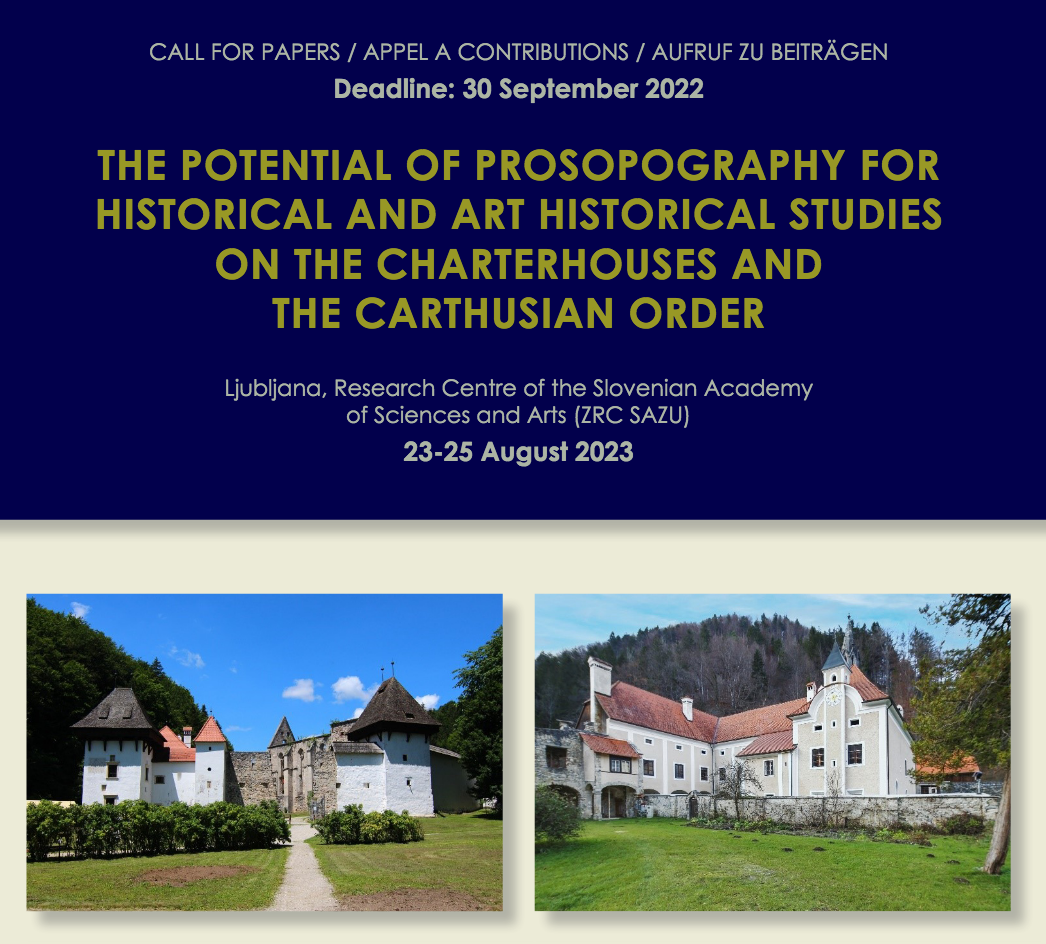
Appel à contribution – The Potential of Prosopography for Historical and Art Historical Studies on the Charterhouses and the Carthusian Order

Appel à contributions : ici

The Research Centre of the Slovenian Academy of Sciences and Arts (France Stele Institute of Art History), the University of Vienna and the University Jean-Monnet in Saint-Étienne cordially invite you to submit your proposals for the international conference The Potential of Prosopography for Historical and Art Historical Studies on the Charterhouses and the Carthusian Order. The conference will be held in Ljubljana on August 23-25, 2023. Please find all the information attached.

Le Centre de recherché de l’Académie slovène des sciences et des arts (Institut France Stele d’histoire de l’art), l’Université de Vienne et l’Université Jean-Monnet à Saint-Étienne vous invitent cordialement à soumettre vos propositions pour le colloque international La prosopographie et ses divers usages dans les études d’histoire et d’histoire de l’art sur les chartreuses et l’ordre cartusien. Le colloque aura lieu à Ljubljana du 23 au 25 août 2023. Veuillez trouver ci-joint toutes les informations concernant le conférence.

Das Forschungszentrum der Slowenischen Akademie der Wissenschaften und Künste (France Stele Institut für Kunstgeschichte), die Universität Wien und die Universität Jean-Monnet in Saint-Étienne laden Sie herzlich ein, Ihre Vorschläge für die internationale Konferenz Prosopographie in Geschichte und Kunstgeschichte der Kartausen und des Kartäuserordens. Die Vielfalt der Zugänge einzureichen. Die Konferenz findet vom 23. bis 25. August 2023 in Ljubljana statt. Alle Informationen finden Sie im Anhang.

Ass. Prof. Mija Oter Gorencic, PhD, ZRC SAZU, France Stele Institute of Art History, Ljubljana, and University of Maribor, Faculty of Arts

Prof. Meta Niederkorn, PhD, Department of History, University of Vienna

Sylvain Excoffon, PhD, Lecturer in Medieval History, Université Jean-Monnet, Saint-Étienne, UMR CNRS 8584 LEM-CERCOR, France (for CERCOR and co-editors of the Analecta Cartusiana)

Publié dans Appel à contributions | Laisser un commentaire

Publication – « Hagiographica hispana regnorum Aragonum et Castellae Legionisque saeculorum IX-XIII. Vitae sanctorum, Inuentiones et translationes, Libri miraculorum, Hymni », éd. J. C. Martín-Iglesias, P. Henriet, Á. Cancela Cilleruelo, A. Castro Correa, C. Esteban Martínez

Ce volume réunit un grand nombre d’œuvres hagiographiques, en prose et en vers, d’origine essentiellement monastique, rédigées dans l’Espagne des IXe-XIIIe siècle. Elles comportent plusieurs vies (notamment d’ermites), une passion (saint Zoïle de Cordoue), des récits de translation de reliques (comme celle de saint Indalèce, l’un des sept évangélisateurs mythiques de l’Espagne) et des recueils de miracles soit in uita soit post mortem ; la notice de la vie ou du transfert du corps du saint est souvent suivie des miracles survenus sur sa tombe ou à proximité. Ces textes ont été composés dans les monastères de San Juan de la Peña (Huesca: Aragon), San Millán de la Cogolla (La Rioja/Castille) et San Zoilo de Carrión (Palencia: Castille). La Vita s. Vrbici confessoris (BHL 8408m) a sans doute été écrite dans un monastère aragonais non identifié au IXe s., tandis que le Liber de uita et miraculis s. Isidori agricolae (BHL 4494-4495) est l’œuvre d’un diacre de l’église Santa María de la Almudena de Madrid (XIIIe s.), avec des continuations d’abord, quelques années plus tard, par un franciscain, puis ensuite par d’autres auteurs jusqu’au XVe s.

José Carlos Martín-Iglesias (professeur), Carmen Codoñer (professeur émérite), Carmen Esteban Martínez (chercheuse doctorante), de l’Université de Salamanque, et Álvaro Cancela Cilleruelo, maître de conférences stagiaire à l’Université Complutense de Madrid, s’intéressent à la langue et la littérature latines de l’Espagne tardo-antique et médiévale. Ainoa Castro Correa, paléographe et maître de conférences à l’Université de Salamanque, est spécialiste en manuscrits écrits en écriture wisigothique. Patrick Henriet, directeur d’études à l’École Pratique des Hautes Études, est historien et travaille sur l’hagiographie latine médiévale.

Table des matières :

Vita sancti Vrbici (BHL 8408m)
Hymnus de sancta Eulalia
Translatio s. Indalecii ep. Vrcensis (BHL 4270) auctore Ebretmo Cluniacensi monacho
Lectiones in translatione s. Indalecii ab Ebretmo Cluniacensi monacho duobus miraculis auctae
Hymni de sancto Indalecio
Vita s. Voti et Felicis fratrum Caesaraugustanorum (BHL 8733)
Vita s. Voti et Felicis fratrum Caesaraugustanorum (BHL 8734: Recensio I seu originalis)
Vita s. Voti et Felicis fratrum Caesaraugustanorum (BHL 8734/8734B: Recensio IIA)
Vita s. Voti et Felicis fratrum Caesaraugustanorum (BHL 8732)
Hymnus de sancto Voto et Felice fratribus Caesaraugustanis (Díaz 1499)
Hymnus de domo sancta Pinnatensi
Translatio et miracula sancti Felicis presbyteri (BHL 2861-2862), auctore Grimaldo Aemilianensi monacho
Translatio et liber miraculorum sancti Aemiliani Cucullati (BHL 102-104), auctore Fredinando Iohannis Aemilianensi monacho
Translatio sancti Aemiliani Cucullati (BHL 102)
Liber miraculorum sancti Aemiliani Cucullati: Recensio breuior (BHL 103)
Liber miraculorum sancti Aemiliani Cucullati: Recensio longior (BHL 103-104)
Miracula III sancti Zoili Cordubensis, in codice Matritensi Bibliotheca Nationalis 11556 adseruata
Passio, translatio et miracula sancti Zoili Cordubensis, auctore Rodulfo monacho Casae Dei, Carrionensi dicto
Hymni in festiuitate beati Zoili martyris
Miraculum sancti Zoili Cordubensis in fine mutilum ut in codice Matritensi Bibliothecae Nationalis 11556 adseruatum
Liber de uita et miraculi sancti Isidori Agricolae (BHL 4494-2295)

Informations pratiques :

Hagiographica hispana regnorum Aragonum et Castellae Legionisque saeculorum IX-XIII. Vitae sanctorum, Inuentiones et translationes, Libri miraculorum, Hymni, éd. J. C. Martín-Iglesias, P. Henriet, Á. Cancela Cilleruelo, A. Castro Correa, C. Esteban Martínez, Turnhout, Brepols, 2022 (Corpus Christianorum Continuatio Mediaevalis, 310). CCCLX+304 p., 7 b/w tables, 155 x 245 mm, 2022 ISBN: 978-2-503-59774-4. Prix : 380 euros.

Source : Brepols

Publié dans Publications | Laisser un commentaire