Formation – Mmmonk School 2025

Learn how to analyse, date and describe

medieval Books of Hours

Free webinars by international experts

Mmmonk School offers free webinars on the book in medieval Flanders. The sessions are aimed at “advanced beginners” who want to learn the basics of other disciplines in the field of medieval book history.

Programme

11 december (4–6 PM CET, online)

Art historical analysis of Books of Hours

  • Lieve De Kesel (Ghent University): An Introduction to the Art Historical Analysis of Books of Hours
  • Jessica Savage (Princeton University): An Introduction to The Index of Medieval Art

18 December (4–6 PM CET, online)

Dating and localising Books of Hours

  • Dominique Stutzmann (IRHT Paris): An Introduction to the Analysis of Liturgical Use in Books of Hours
  • Gregory T. Clark (Sewanee, University of the South): An Introduction to Beyond Use and other useful tools

Programme and registration: www.mmmonk.be/en/news/mmmonk-school-2025  

Organizers: Bruges Public Library & Henri Pirenne Institute for Medieval Studies Ghent University

Mmmonk.be unites the circa 820 medieval manuscripts from the Flemish abbeys of St Bavo, St Peter, Ten Duinen and Ter Doest. Discover an intellectual and artistic treasure trove, going back to as early as the 6th century!

Recordings of previous Mmmonk School sessions are available at https://www.mmmonk.be/en/discover/videos/mmmonk-school.

Publié dans Enseignement | Commentaires fermés sur Formation – Mmmonk School 2025

Colloque – Der mitteldeutsche Raum und das Königtum vom Interregnum bis zu Kaiser Karl IV. (1250–1378)

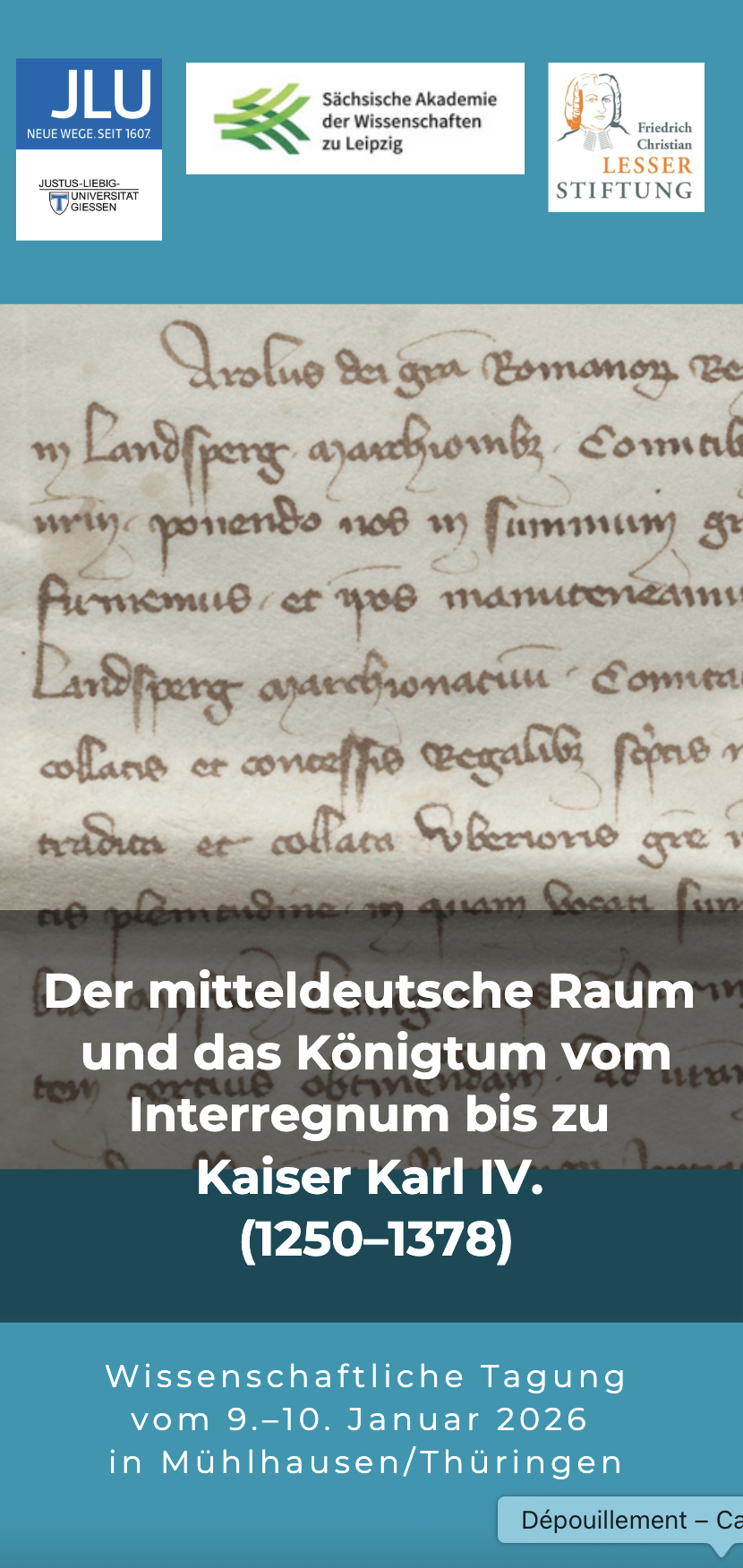
Wie „königsfern“ oder „königsnah“ war der thüringisch-sächsische Raum in den rund 120 Jahren zwischen dem Ende der Staufer und der Herrschaft Karls IV. wirklich? War das Engagement der Könige in Thüringen und Meißen nur ein temporäres Zwischenspiel, das mit der Durchsetzung der wettinischen Ansprüche 1307 endete? Oder war die politische Entwicklung in Mitteldeutschland nach dem sog. Interregnum offen für verschiedene Herrschaftskonzepte, etwa ein „Königsland“? Welche Rolle spielten neben den römisch-deutschen Königen und den Wettinern die Grafen und Herren sowie die Städte? Und wie wandelten sich die politischen Interessen des Königtums gegenüber den verschiedenen Akteuren in diesem Raum?

Die Tagung widmet sich diesen Schwerpunkten im Zeitraum von der Mitte des 13. Jahrhunderts bis in die zweite Hälfte des 14. Jahrhunderts. Im Zentrum steht dabei die Frage nach den Bindungen zwischen dem mitteldeutschen Raum und dem Königtum. Ziel ist es dabei, eine neue Verortung der mitteldeutschen Akteure in ihren Beziehungen zum Königtum zu ermöglichen.

Die Tagung wird von der Professur für Mittelalterliche Geschichte der Justus-Liebig-Universität Gießen in Kooperation mit der Friedrich Christian Lesser-Stiftung und dem Editionsprojekt ‚Codex diplomaticus Saxoniae‘ der Sächsischen Akademie der Wissenschaften zu Leipzig veranstaltet.

Anmeldungen richten Sie bitte bis spätestens 30.11.2025 per Email an Josephine Blum: Mittelalterliche-Geschichte@geschichte.uni-giessen.de

Eine Teilnahmegebühr wird nicht erhoben. Der Abendvortrag am 09.01.2026 ist öffentlich.

Freitag, 9. Januar 2026

14.00 Uhr Begrüßung und Einführung
Stefan TEBRUCK (Gießen)

Moderation: Mathias KÄLBLE (Dresden)
14.30 Uhr Eine „königsferne“ Landschaft? Der mitteldeutsche Raum 1246–1273
Ingrid WÜRTH (Halle)

15.30 Uhr Pause

16.00 Uhr Die mitteldeutschen Reichsstädte im Interregnum
Helge WITTMANN (Mühlhausen)

17.00 Uhr Zwischen Konflikt und Kooperation – Der mitteldeutsche Raum unter Rudolf I., Adolf von Nassau und Albrecht I. (1288–1307)
Christina MÖLLER (Gießen)

18.00 Uhr Abendessen

Moderation: Stefan TEBRUCK (Gießen)
19.30 Uhr Öffentlicher Abendvortrag:
König, Fürsten und Reich zwischen Rudolf von Habsburg und Karl IV.
Christian HESSE (Bern)

Samstag, 10. Januar 2023

Moderation: Felicitas SCHMIEDER (Hagen)
9.00 Uhr Der mitteldeutsche Raum als Aktionsfeld der letzten Přemysliden
Martin WIHODA (Brno)

10.00 Uhr Ludwig IV. („der Bayer“) und der mitteldeutsche Raum
Doris BULACH (München)

11.00 Uhr Pause

Moderation: Matthias WERNER (Jena)
11.30 Uhr Von römisch zu böhmisch. Die Transformation der herrschaftlichen Bindungen des nichtfürstlichen Hochadels im mitteldeutschen Raum durch Kaiser Karl IV.
Uwe TRESP (München)

12.30 Uhr Das Gegenkönigtum Graf Günthers XXI. von Schwarzburg-Blankenburg
Petra WEIGEL (Gotha)

13.30 Uhr Pause mit Mittagsimbiss

14.00 Uhr Abschlussdiskussion: Einleitendes Statement von Gabriele ANNAS (Frankfurt/Main)

15.00 Uhr Abschluss der Tagung

09.01.2026 – 10.01.2026

Logenhaus, Puschkinstraße 3
Mühlhausen

Source : H-Soz-Kult

Publié dans Le réseau | Commentaires fermés sur Colloque – Der mitteldeutsche Raum und das Königtum vom Interregnum bis zu Kaiser Karl IV. (1250–1378)

Publication – « Peindre en France. Trente ans de recherche sur les manuscrits à peintures (1440-1520) », éd. Frédéric Elsig, Samuel Gras, Dominique Vanwijnsberghe

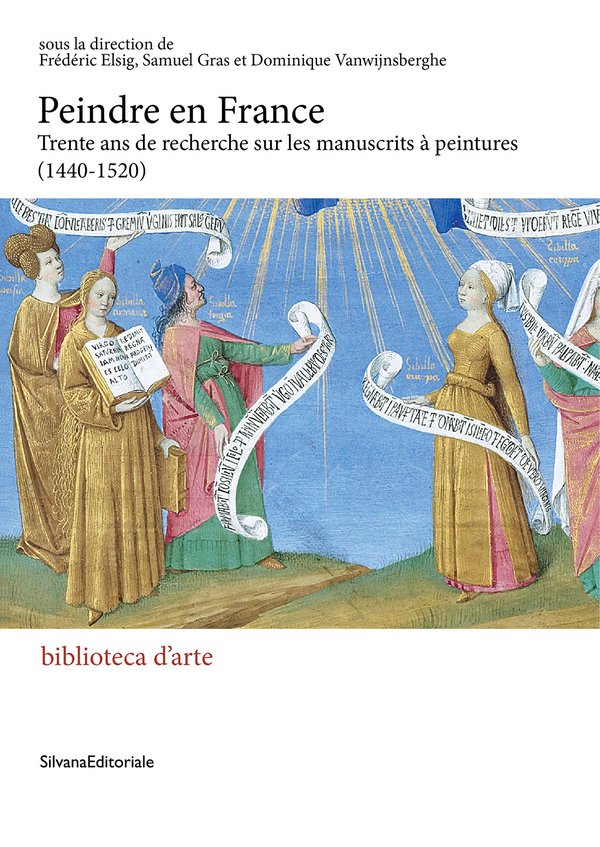
Organisée à la Bibliothèque nationale de France du 16 octobre 1993 au 16 janvier 1994, l’exposition Quand la peinture était dans les livres a fortement marqué les esprits. Son catalogue, rédigé par François Avril et Nicole Reynaud, Les manuscrits à peintures en France, 1440-1520, s’est imposé comme une référence incontournable. En renouvelant en profondeur l’étude de la peinture française à la charnière du Moyen Âge et de la Renaissance, cet ouvrage a ouvert de nouvelles voies à la recherche.
Trente ans plus tard, le présent volume, issu d’un colloque organisé à l’Université de Genève, revient sur l’héritage scientifique de ce catalogue monumental. Il éclaire son influence durable, présente un état de la question sur les recherches menées dans les principales régions distinguées en 1993 et les nombreuses découvertes et pistes de recherche qu’il a fait émerger dans l’étude de l’enluminure et de la peinture françaises.

Un hommage critique et passionné à une publication fondatrice, pour tous ceux que fascine la peinture des livres.

Avant-propos
Frédéric Elsig, Samuel Gras et Dominique Vanwijnsberghe

Entretien avec François Avril

John Plummer et la réalisation de l’exposition The Last Flowering
Gregory T. Clark

L’enluminure française ou l’enluminure en France ?
Une perspective historiographique
Hanno Wijsman

Le Nord
Dominique Vanwijnsberghe

Paris 1440-1480
Nicolas Oget

Paris 1480-1520
Ariane Adeline et Isabelle Delaunay

La Normandie
Samuel Gras, avec la contribution de Rachel Chenu

La Bretagne
Marie Jacob

L’Anjou et le Maine
Samuel Gras

Tours 1440-1480
Samuel Gras

Tours 1480-1520
Rafaël Villa

Le Poitou
Samuel Gras

Le Berry et le Bourbonnais
Marie Mazzone

Le Limousin
Samuel Gras

Le Languedoc
Aurélia Cohendy

La Champagne
Maxence Hermant

La Lorraine
Ilona Hans-Collas

La Bourgogne et la Franche-Comté
Frédéric Elsig

Lyon
Mireia Castaño

La Savoie
Alix Buisseret

La Provence
Constantin Favre

ANNEXES

Bibliographie

Liste des abréviations

Ocelli Nominum

Index des manuscrits et autres œuvres

Index des lieux

Index des personnalités et personnes nées avant 1920

Informations pratiques :

Peindre en France. Trente ans de recherche sur les manuscrits à peintures (1440-1520), éd. Frédéric Elsig, Samuel Gras, Dominique Vanwijnsberghe, Cinisello Balsamo, Silvana Editoriale, 2025 ; 1 vol., 345 p. (Biblioteca d’arte, 92). ISBN : 978-8-83665-676-9. Prix : € 35,00.

Source : Silvana Editoriale

Publié dans Publications | Commentaires fermés sur Publication – « Peindre en France. Trente ans de recherche sur les manuscrits à peintures (1440-1520) », éd. Frédéric Elsig, Samuel Gras, Dominique Vanwijnsberghe

Formation – Doctoral and Postdoctoral Spring School: Arabo-Byzantine Workshop: Towards a Cross-Disciplinary Analysis of Eastern Mediterranean Sources

Rome, 18–22 May 2026
Application Deadline: 19 December 2025, 12:00 noon (CET)


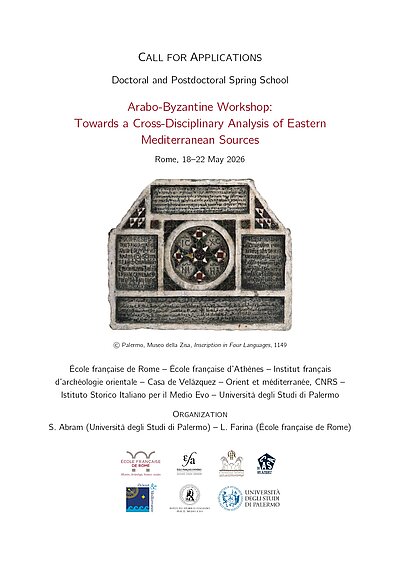
A fresh understanding of medieval Eastern Mediterranean history requires a careful and integrated reading of a wide range of primary sources. Textual, documentary, and material sources (such as manuscripts, papyri, coins, and seals) all offer distinct perspectives, yet they are often studied in disciplinary and linguistic isolation. An effective historical analysis demands not only philological precision, but also a solid methodological approach that includes close attention to the materiality of these objects: their format, script, language, and context of production. Such features can reveal much about circulation of objects and knowledge, as well as its transmission and usage. This is especially vital when working with sources in Arabic and Greek, the two dominant languages of administration, culture, and daily life across much of the medieval Eastern Mediterranean. Moreover, bilingual or multilayered sources (such as Graeco-Arabic manuscripts and papyri, or Arabo-Byzantine coinage) provide invaluable insight into contact zones and hybrid identities. A critical and comparative reading across both source typologies and linguistic traditions thus allows historians to reconstruct cultural and event-driven history in a more comprehensive and dynamic way, uncovering layers of meaning that would remain hidden in a monolingual or single-source approach.


The aim of this workshop is to equip participants with both a nuanced understanding of the different typologies of medieval sources and the methodological tools necessary to address their diversity and fluidity in a rigorous way. In addition, the workshop seeks to foster dialogue between experts and early-career researchers from a range of disciplines (including Classical, Byzantine, and Islamic Studies) who have often worked in isolation within the boundaries of their respective fields.

The workshop will be organized over five thematic days, each dedicated to a specific category of sources for the study of medieval Eastern mediterranean history (paleography/codicology, diplomatics, sigillography/numismatics, papyrology, and philology) and their critical and comparative analysis. Each afternoon, two participants will present their own work (30-minute presentations followed by 15 minutes of discussion). Each day will conclude with either a case study or a practical session designed to build on and integrate the material covered in the morning sessions.

Practical Information
1. Eligible Participants: Doctoral and early-career researchers in Classics, Islamic Studies, or History (broadly intended) from any university and of any nationality. Training in Greek or Arabic paleography or philology is not required, but it is welcome. A working knowledge of both Greek and Arabic is required.
2. Venues: Rome — École française de Rome [Piazza Navona 62]; Istituto Storico Italiano per il Medio Evo [Piazza dell’Orologio 4].
3. Costs: Registration, lunches, and accommodation are free of charge. Participants are responsible for their own travel and dinner expenses.
4. Language: English.
5. Application Deadline: 19 December 2025, 12:00 noon (CET).

Requirements
Applications must include the following documents (in English):
1. A Curriculum Vitae;
2. A one-page summary of the doctoral dissertation or postdoctoral project;
3. A one-page motivation letter outlining the candidate’s future projects and explaining their interest in the workshop.

Applications must be submitted as a single PDF file by 19 December 2025 at 12:00 noon (CET) to the following addresses: luca.farina@efrome.it and sara.abram@unipa.it.
The selection will be made by a joint committee from the École française de Rome, the Università degli Studi di Palermo, and the Istituto Storico Italiano per il Medio Evo. The results will be communicated no later than 30 January 2026.

Admitted participants will be accommodated at the École française de Rome (in shared or individual rooms) located in Piazza Navona, and lunches will be provided. Travel to/from Rome and dinners will be at the expense of the participants or their home institutions.

For any practical or logistical inquiries, please contact: luca.farina@efrome.it or secrma@efrome.it.

Source : École française de Rome

Publié dans Enseignement | Commentaires fermés sur Formation – Doctoral and Postdoctoral Spring School: Arabo-Byzantine Workshop: Towards a Cross-Disciplinary Analysis of Eastern Mediterranean Sources

Appel à contribution – Marc Bloch : Histoires croisées et engagement franco-allemand

À l’occasion de la panthéonisation de Marc Bloch, le Centre Marc Bloch organise un colloque scientifique le 28 mai 2026 pour explorer l’actualité et la postérité de son œuvre dans un cadre franco-allemand. Cet événement réunira des chercheur·es français·es, allemand·es et européen·nes autour de thématiques clés de l’œuvre de Marc Bloch, en dialogue avec les défis contemporains des sciences humaines et sociales.

Thématiques privilégiées :

  • La place de Marc Bloch dans l’histoire médiévale et les débats actuels
  • L’Alsace dans la biographie et l’œuvre de Marc Bloch
  • L’ancrage territorial de l’École des Annales
  • L’histoire comparée européenne et ses résonances contemporaines
  • Le dépassement du nationalisme méthodologique
  • Le dialogue entre histoire, économie et sciences sociales
  • L’engagement des savant·es dans la Cité
  • Les relations franco-allemandes aujourd’hui, inspirées par Marc Bloch

Modalités de soumission :

  • Propositions (1 page max.) en français ou en allemand + CV court (200 mots)
  • Date limite : 15 janvier 2026
  • Réponses : mars 2026
  • Prise en charge des frais de déplacement

pantheonisation@cmb.hu-berlin.de

Publics visés : Chercheur·es confirmé·es et jeunes chercheur·es (toutes disciplines des SHS).

Ort: Centre Marc Bloch, Berlin

Source : Centre Marc Bloch

Publié dans Appel à contributions | Commentaires fermés sur Appel à contribution – Marc Bloch : Histoires croisées et engagement franco-allemand

Colloque – ‘Image of Devotion’, a Concept to Be Deconstructed? Historiographical Approaches to Devotional Images in Europe (14th-18th Centuries)

26-28 november 2025
Salle polyvalente du Learning
Center Christine de Pizan
31 place Cardinal Mercier
1348 Louvain-la-Neuve

Bringing together researchers from various disciplines, the research group
“Essais de terminologie(s). Images, littérature, spiritualité” initiated at
GEMCA in 2022, aims to collectively question our understadings of terms
relating to the use of images and literature in the field of spirituality
between the late Middle Ages and the early modern period. We are
collectively examining our uses of this vocabulary in order to define our
research topics more precisely and propose more informed terminology.
This exploration is based on two main types of corpus, which we are careful
to cross-reference: secondary literature and primary sources.
During these study days, we hope to broaden our collaborative work and
our network by focusing on the notion of the “devotional image”
(Andachstbild) and related practices (devotion, piety, prayer, meditation,
etc.). Drawing on a variety of approaches and corpora (both geographical
and chronological), the study days aim to collectively examine the generic
concept of devotional images from a historiographical, epistemological,
and terminological perspective.

The full program can be accessed here.

Registration is free, but for practical reasons, please inform us of your participation at one of the following addresses: elise.philippe@uclouvain.beingrid.falque@uclouvain.besolene.lecuivre@uclouvain.be.

We prefer on-site participation to facilitate and encourage discussion, but given that a strike has been announced in Belgium on 26 November, it will be possible to attend the conference remotely. If you would like to receive the Zoom link, please write to one of the three email addresses mentioned above.

Source : Historians of the Netherlandish Art

Publié dans Colloque | Commentaires fermés sur Colloque – ‘Image of Devotion’, a Concept to Be Deconstructed? Historiographical Approaches to Devotional Images in Europe (14th-18th Centuries)

Publication – « Disability and War in the Late Middle Ages. Becoming, Surviving, Managing », éd. Ninon Dubourg, Christophe Masson

Issues relating to disability and war remain largely overlooked by military and disability historians. This exclusion is all the more striking since there was hardly a more likely place for receiving permanent injury than a battle, and we can barely imagine a worse place for disabled people than a battlefield. This volume aims to shed new light on a topic pertaining to multiple fields of research: social history, technical medical history, disability history, military history, and the Genesis of the Modern State.

This book gathers specialists of premodern history to bring together new research from a variety of disciplines—history, archaeology, literature, and modern medicine—and working with diverse sources, such as account books, biographies, poems, romance texts, Icelandic sagas, petitions and pardon letters, post-battle records, prostheses, skeletons and funerary treatments, chronicles, and theoretical treatises.

Ninon Dubourg is an Alexander von Humboldt Fellow based at the University of Cologne. She studies physical and mental disability, as well as old age, among lay and clerical individuals in late medieval Europe.

Christophe Masson is a Permanent Researcher for the Fund for Scientific Research (FNRS) in Belgium. His work addresses the social, cultural, institutional, and technical dimensions of late medieval warfare. 

List of Illustrations

Preface

Introduction. « Disability and War: Becoming, Surviving, Managing » by Ninon Dubourg and Christophe Masson

Chapter 1. « The Recidivists: Healed Cranial Trauma from Conflicts in the Late Medieval Period » by Christopher J. Knüsel

Chapter 2. « Disability and Trauma in Battle in the Medieval Icelandic Sagas » by Yoav Tirosh

Chapter 3. « Hungry for Love: Disabling the Knightly Body and Mind through Starvation in Sir Thomas Malory’s Le Morte Darthur » by Kristina Hildebrand

Chapter 4. « A Vulnerable Military Masculinity: Soldiers and Disability in Late Medieval Pardon Letters (France, England, and the Low Countries) » by Quentin Verreycken

Chapter 5. « Traumatic Repercussions: Warfare and Disability in the French Countryside » by Aleksandra Pfau

Chapter 6. « Investigating the Lifecycle of the Medieval English Soldier: Disability, Mental Trauma, and Medicine in Connection with War in Late Medieval English Records » by Wendy J. Turner

Chapter 7. “’What pain I suffered at that time, anyone can well imagine…’: Experiences of War, Injury, and Pain in Fifteenth- and Sixteenth-Century Germany and Switzerland » byBianca Frohne

Chapter 8. « Mechanism/Organism: The Premodern Iron Hand as Conceptual Interface » by John Gagné

Chapter 9. « After Combat: War Wounds, Soldiers’ Benefits, and Dynastic Policies in the Burgundian–Habsburg Armies (1363–1506) » by Michael Depreter

Select Bibliography

Index

Informations pratiques :

Disability and War in the Late Middle Ages. Becoming, Surviving, Managing, éd. Ninon Dubourg, Christophe Masson, Leeds, ARC Humanities Press, 2025 ; 1 vol., 256 p. (War and Conflict in Premodern Societies). ISBN : 978-1-80270-164-7. Prix : GBP 119,00.

Source : ARC Humanities Press

Publié dans Publications | Commentaires fermés sur Publication – « Disability and War in the Late Middle Ages. Becoming, Surviving, Managing », éd. Ninon Dubourg, Christophe Masson

Bourse – Chercheurs invités en résidence 2026. ERC Advanced Grant AGRELITA

Please scroll down for an English version

Dans le cadre du Projet ERC Advanced Grant AGRELITA n° 101018777, « The reception of ancient Greece in pre-modern French literature and illustrations of manuscripts and printed books (1320-1550): how invented memories shaped the identity of European communities », dirigé par Prof. Catherine Gaullier-Bougassas (Principal Investigator), des résidences de chercheurs invités sont à pourvoir.

Cet appel à candidature s’adresse à toute personne, française ou étrangère, titulaire d’un doctorat en lettres, histoire de l’art ou histoire, dont les travaux portent sur l’histoire du livre, l’histoire culturelle et politique, les visual studies ou encore les memory studies, et dont les compétences sont complémentaires à celles de l’équipe. En effet, le but de ces résidences est d’ouvrir les réflexions menées par l’équipe, d’élargir son activité scientifique par une interaction avec d’autres chercheurs et d’autres universités. Les chercheurs invités auront quant à eux l’opportunité de participer à un projet d’ampleur, de mener des activités au sein d’une équipe dynamique dont les activités sont très variées et au sein de l’Université de Caen Normandie et du laboratoire CRAHAM-CNRS où exercent de nombreux spécialistes de l’Antiquité, du Moyen Âge et de la Renaissance. Leurs travaux pourront enfin être publiés dans un cadre prestigieux.

Le projet AGRELITA est basé à l’Université de Caen Normandie (www.unicaen.fr). Située à 2h de train de Paris, la ville de Caen offre la possibilité de découvrir le riche patrimoine médiéval de la Normandie et d’effectuer des recherches dans les bibliothèques, musées et archives avoisinants, aux fonds patrimoniaux très fournis (Caen, Bayeux, Avranches, Rouen…).

Projet ERC Advanced Grant AGRELITA

L’histoire de la réception de la Grèce antique en Europe occidentale pré-moderne s’est concentrée jusqu’ici presque exclusivement sur la transmission des textes de l’Antiquité grecque. Pourtant, bien avant la renaissance de l’enseignement du grec, de nombreux ouvrages vernaculaires, souvent illustrés, contenaient des représentations élaborées de la Grèce antique. AGRELITA étudie un large corpus d’œuvres littéraires de langue française (historiques, romanesques, poétiques, didactiques) produites de 1320 à 1550 en France et en Europe, avant les premières traductions directes du grec au français, ainsi que les images offertes par leurs manuscrits et livres imprimés. L’examen de ces œuvres et de leurs illustrations (dialogue du texte et de l’image et pouvoirs spécifiques de chacun) permet d’analyser les représentations de la Grèce antique dans la perspective encore inexplorée de l’élaboration d’une nouvelle mémoire culturelle. Elles sont ainsi étudiées en lien avec leur contexte politique, social et culturel, ainsi qu’en lien avec les œuvres des littératures européennes proches et leurs illustrations. Se situant aux frontières des études littéraires, de l’histoire du livre et de l’histoire de l’art, des visual studies, de l’histoire culturelle et politique et des memory studies, AGRELITA propose une réévaluation du rôle joué par la Grèce antique dans les processus de formation des identités en Europe occidentale. Le projet vise également à contribuer à une réflexion générale sur la formation des mémoires, des héritages et des identités.

Missions des chercheurs invités

Le projet ERC Advanced Grant AGRELITA est financé pour six ans (2021-2027) et dispose d’un budget dédié à l’accueil de chercheurs invités. Il est basé à l’Université de Caen Normandie, dans la faculté des Humanités et Sciences sociales (https://ufr-hss.unicaen.fr/) et le laboratoire CRAHAM-CNRS (Centre Michel-de-Boüard, Centre de Recherches Archéologiques et Historiques Anciennes et Médiévales / CRAHAM – UMR 6273, www.unicaen.fr/laboratoire/umr-6273-centre-de-recherches-archeologiques-et-historiques-anciennes-et-medievales-craham/), domiciliés sur le campus 1 au centre de la ville de Caen, tout près du château de Caen.

Les séjours à l’Université de Caen peuvent être d’une durée de 4 à 6 semaines, et en 2026 pourront avoir lieu en mai-juin-début juillet.

Les chercheurs invités travailleront avec la Principal Investigator et l’équipe AGRELITA.

Les chercheurs invités s’engageront à produire une recherche pour le projet dans l’un des axes mentionnés ci-dessous. Il s’agira de :

  • rédiger un article de 50 000 signes qui paraîtra dans l’un des volumes ERC AGRELITA chez Brepols publishers, ou dans l’un des dossiers publiés en revues ;
  • présenter le sujet de l’article ou un autre sujet lié à AGRELITA lors d’une séance du séminaire de l’équipe ou lors d’une manifestation organisée par l’équipe ;
  • contribuer à l’alimentation du carnet Hypothèses.

Les axes de recherche du projet pour l’année 2026 sont :

  • « Cultures de la violence et résistances féminines : les réceptions des mythes grecs antiques du XIVe au XXIe siècle, en Europe et au-delà »
  • « La réception de la Grèce ancienne en Europe par le dialogue entre textes et images dans et hors du livre (XIVe-XVIe siècle) »
  • un axe beaucoup plus large : « Usages et exploitations des mémoires de l’Antiquité, du début de notre ère jusqu’au XXIe siècle ».

Conditions de défraiement des frais de mission

Les chercheurs invités seront défrayés sous la forme de frais de mission pour leur résidence à Caen, sur présentation des justificatifs (factures de logement, repas et transport dans la région Normandie) et dans la limite d’un montant de 2000 euros maximum par mois. S’ajoutera le remboursement de leurs frais de voyage entre la résidence d’origine et Caen (pour le voyage d’aller et de retour) :

  • 400 € maximum pour un voyage depuis un pays européen (sur la base de justificatifs) ;
  • 1200 € maximum pour un voyage depuis un pays hors Europe (sur la base de justificatifs).

Le défraiement se fera à l’issue de la mission. AGRELITA ne s’occupera pas des démarches de visas.

Modalités pour candidater

Le dossier de candidature doit comporter les pièces suivantes :

  • le formulaire de candidature, comportant les dates du séjour (durant la période indiquée plus haut) ;
  • un curriculum vitae ;
  • un projet de recherche (2 pages) en lien avec les thématiques des sujets traités par l’équipe AGRELITA durant ce séjour, à partir duquel le/la chercheur entend rédiger l’article demandé, à rendre à la fin du séjour. Le titre provisoire de l’article est exigé.

Nous vous prions d’envoyer votre candidature au format PDF aux adresses suivantes : catherine.gaullier-bougassas@unicaen.fr et lorene.bellanger@unicaen.fr

Les dossiers doivent être soumis au plus tard le 15 février 2026.

télécharger l’appel


Call for applications “Visiting researchers” 2026

The ERC Advanced Grant AGRELITA Project n° 101018777, “The reception of ancient Greece in pre-modern French literature and illustrations of manuscripts and printed books (1320-1550): how invented memories shaped the identity of European communities”, directed by Prof. Catherine Gaullier-Bougassas (Principal Investigator), opens guest researchers residences.

This call for applications is open to anyone, of French or foreign nationality, who holds a PhD in literature, art history, or history, whose work focuses on the history of books, cultural and political history, visual studies, or memory studies, wherein the competence and project are deemed to be complementary to the ones of the AGRELITA team.

These residencies indeed aim to open the reflections carried out by the team, to enhance its scientific activity through interactions with other scholars and other universities. The guest researchers will have the opportunity to contribute to a major project, to work with a dynamic team that conducts a wide range of activities at the University of Caen Normandie and within the research laboratory CRAHAM where many Antiquity, Medieval and Renaissance times specialists work. They will also be able to publish in a prestigious setting.

The AGRELITA project is based at the University of Caen Normandie (https://www.unicaen.fr/). Caen is a city in the heart of Normandy, located only 2 hours from Paris by train. Residing in this city offers the chance to discover the rich medieval heritage of Normandy and to carry out research in nearby libraries, museums, and archives, with very rich collections (Caen, Bayeux, Avranches, Rouen…).

The ERC Advanced Grant AGRELITA Project

Until now the reception history of ancient Greece in pre-modern Western Europe has focused almost exclusively on the transmission of Greek texts. Yet well before the revival of Greek teaching, numerous vernacular works, often illustrated, contained elaborate representations of ancient Greece. AGRELITA studies a large corpus of French language literary works (historical, fictional, poetic, didactic ones) produced from 1320 to the 1550s in France and Europe, before the first direct translations from Greek to French, as well as the images of their manuscripts and printed books. These works and their illustrations – exploring texts/images interactions as well as the distinctive impact they have – show representations of ancient Greece we can analyze from a perspective that has never been explored until now: how a new cultural memory was elaborated. AGRELITA thus examines this corpus linked with its political, social, and cultural context, but also with the literary and illustrated works of nearby countries from Europe. Situated at the crossroads of literary studies, book history and art history, visual studies, cultural and political history, and memory studies, AGRELITA’s ambition is to explore how the role played by ancient Greece was reassessed in the processes of shaping the identity of European communities. The project also aims to contribute to a general reflection on the formation of memories, heritages, and identities.

Missions of visiting researchers

The ERC Advanced Grant AGRELITA Project is funded for six years (2021-2027) and has budgetary support available in order to invite researchers at the University of Caen Normandie (France), in the Faculty of Humanities and Social Sciences (https://ufr-hss.unicaen.fr/), and attached to the CRAHAM laboratory (Centre Michel-de-Boüard, Research Centre of Ancient and Medieval Archaeological and Historical / CRAHAM – UMR 6273, https://craham.unicaen.fr/), housed in the Campus 1, right in the city centre of Caen, very close to the castle of Caen.

Stays at the University of Caen Normandie may be 4 to 6 weeks length, and during the year 2026 may take place in May/June/early July.

Visiting researchers will work with the Principal Investigator and the AGRELITA team.

Visiting researchers undertake to produce research for the project during their stays in Caen as follows:

  • they will write one paper (which must not exceed 50 000 characters, including spaces) published in one of the volumes edited by ERC AGRELITA (Brepols ed.), or in one of the team’s files published in an academic journal;
  • they commit to present the topic of the paper or another topic dealing with AGRELITA’s research during a seminar session organized by the team;
  • they will contribute to the Hypotheses academic blog. 

In 2026, the AGRELITA project will focus on these lines of research:

  • “Cultures of violence and female resistance: receptions of ancient Greek myths from the 14th to the 21st century, in Europe and beyond”;
  • “The reception of ancient Greece in Europe through the dialogue between texts et images inside and outside the book (14th-16th century)”;
  • a broader line of research: “Uses and exploitations of Antiquity memories, from the beginning of our era until the 21th century”.

Conditions for defraying mission expenses

Visiting researchers will receive, in the form of mission expenses, a maximum fixed amount of 2000 euros per month, based on all necessary receipts of the costs of stay in Caen (accommodation, transport in the Normandy region, and meal costs). A further maximum fixed amount is added to cover their travel expenses from their place of residence to Caen (round trip):

  • travel from a European country (based on proof of expenses): 400 €;
  • travel from a country outside Europe (based on proof of expenses): 1200 €. 

The expenses will be paid following the mission. AGRELITA will not arrange visas.

How to apply

The application file must include the two following documents:

  • a completed and signed application form, including the dates of the stay (during the period specified above);
  • a curriculum vitae;
  • A scientific project (2 pages) the candidate will be working on during his stay, dealing with the AGRELITA team’s research, from which the researcher intends to write the required article, due at the end of the stay. The provisional title of the paper is required.

Please send your application in a PDF document to the following addresses: catherine.gaullier-bougassas@unicaen.fr and lorene.bellanger@unicaen.fr. 

Application deadline: by February 15th, 2026.

Source : ERC Agrelita

Publié dans Bourse | Commentaires fermés sur Bourse – Chercheurs invités en résidence 2026. ERC Advanced Grant AGRELITA

Journée d’étude – Recherches actuelles sur l’histoire de l’ordre cistercien en France

Le Collège des Bernardins, qui a retrouvé sa fonction d’enseignement depuis 2008, accueille pour la troisième fois une demi-journée d’étude, le samedi 29 novembre 2025 (9h-13h), consacrée à l’histoire de l’ordre cistercien.

Comme la précédente, cette nouvelle réunion a pour but de présenter des recherches en cours ou encore inédites. Cette rencontre sera l’occasion de faire dialoguer des chercheurs de plusieurs générations, historiens et historiens de l’art.

Le grand public est convié et des temps de discussion sont prévus.

9h – Accueil des participants.

  • 9h15 – Cécile Caby (Sorbonne Université, Centre Roland Mousnier), « Jean de Montmirail, chevalier et cistercien à Longpont ».
  • 10h15 – Marion Alvergnat (Université Paul- Valéry Montpelllier-3, CEMM), « Les établissements monastiques cisterciens du Languedoc méditerranéen et du Roussillon au Moyen Âge. Architecture et décor sculpté ».

11h15 – Pause

  • 11h30 – Philippe Plagnieux (Université Paris-1, HiCSA), « L’abbatiale de Fontenay : retour sur sa datation et son maître d’ouvrage ».

Informations pratiques :

29/11/2025 – 09:00

Collège des Bernardins, Cellier (Niveau -1)
20, rue de Poissy
75005 Paris

Source : IRHT

Publié dans Le réseau | Commentaires fermés sur Journée d’étude – Recherches actuelles sur l’histoire de l’ordre cistercien en France

Publication – « How the Holy Cross came from Antioch to Brogne. A Critical Edition and Translation of Quomodo Sancta Crux ab Antiochia allata sit in Broniense cenobium », éd. Nicholas L. Paul, Wolfgang P. Mueller

In 1152, a knight from the southern Low Countries named Manasses of Hierges returned home after eleven years spent crusading in the Holy Land. He carried with him a precious relic, said to be a fragment of the True Cross that had belonged to the princes of Antioch. Nearly sixty years later, a writer associated with a nearby monastery composed a new Latin narrative, hagiographical, and liturgical textual programme known as Quomodo Sancta Crux ab Antiochia allata sit in Broniense cenobium (How the Holy Cross Came from Antioch to the Monastery of Brogne). It tells the story of Manasses, his career in Europe and the Near East, and of the conflict that broke out over possession of the relic after his death.

This volume provides the first critical edition and English translation of a source that contributes greatly to our knowledge of the medieval world, from crusading to material religion to relations between the lay aristocracy and religious communities. The work of a learned author with ambitions to a high literary and homiletic style, it offers a fresh perspective on the question of what motivated crusaders and on the history of the Holy Land under crusader occupation, providing critical new details to the story of the civil war between Queen Melisende of Jerusalem and her son, King Baldwin III. The sustained account of the conflict over a relic provides a window into the importance of sacred objects, and competing notions of sacrality, legal possession, and value. Previously unknown to historians, this work provides a rich illustration of the place of crusading in the memory of a local community. A detailed critical apparatus establishes what can be known about the work’s composition and the author’s reliance on Classical, Patristic, and Scriptural authorities, while an introduction gives an account of the work’s political, cultural, and intellectual context.

NICHOLAS L. PAUL is Professor of History at Fordham University.

WOLFGANG P. MÜLLER is Professor of History at Fordham University.

Table des matières :

List of Figures
Acknowledgments
Abbreviations
Introduction
Note on the Edition
Note on the Translation
Edition and Translation
Appendix I: Original Sources of Quomodo
Appendix II: Transcription and English Translation of the Qualiter Fragment
Appendix III: Agreements Between Manasses of Hierges and the Abbey of Brogne (February-March 1140)
Bibliography
Index

Informations pratiques :

How the Holy Cross came from Antioch to Brogne. A Critical Edition and Translation of Quomodo Sancta Crux ab Antiochia allata sit in Broniense cenobium, Woodbridge, The Boydell Press, 2025 ; 1 vol., 256 p. (Crusading in Context, 8). ISBN : 978-1-83765-323-2. Prix : GBP 85,00.

Source : Boydell and Brewer

Publié dans Publications | Commentaires fermés sur Publication – « How the Holy Cross came from Antioch to Brogne. A Critical Edition and Translation of Quomodo Sancta Crux ab Antiochia allata sit in Broniense cenobium », éd. Nicholas L. Paul, Wolfgang P. Mueller