Offre d’emploi – PhD vacancy in Latin Patristic Literature/Theology KU Leuven

Project description

The research units History of Church and Theology (Faculty of Theology and Religious Studies) and Latin Literature (Faculty of Arts) of the University of Leuven (KU Leuven) invite applications for a 4-year PhD position in the field of Latin Patristics. The successful candidate will conduct research within the framework of the research project ‘An early witness to the ‘construction’ of (Semi-)Pelagianism? Critical edition, content analysis, and reception study of the Ps.- Augustinian Hypomnesticon’, supervised by Prof. Anthony Dupont and Prof. Gert Partoens.
Running from 2023 to 2029, the project studies the Hypomnesticon contra Pelagianos et Caelestianos. This late antique treatise consists of six books, which systematically refute the teachings of so-called (Semi-)Pelagianism. The anonymous author heavily depended on Augustine’s anti-Pelagian treatises and on the latter’s teachings about original sin, grace and predestination. Despite its clear impact and widespread reception, the work has received little attention in scholarship.

The project consists of two parts:

  1. Analysis of the work’s manuscript transmission and preparation of a new critical edition (to be published in the Series Latina of the Corpus Christianorum). This part of the project has started in 2023 (drs. Lode Moens, supervisors: G. Partoens, M. Giani (University of Milan), A. Dupont).
  2. Study of the authorship, historical context, sources, structural and rhetorical aspects, theological argumentation, and Medieval reception of the work. This part of the project constitutes the object of the PhD vacancy.

More information on the project: https://research.kuleuven.be/portal/en/project/3H230287

Objectives

The PhD candidate will be based within the research unit History of Church and Theology or the research unit Latin Literature at KU Leuven, and supervised by Prof. Anthony Dupont, Prof. Gert Partoens, and Dr. Nicolas De Maeyer. The candidate’s main objective is to produce a dissertation (in English or French) relating to the research questions formulated in the second part of the project description. Additionally, the candidate will disseminate research findings through academic publications and conference papers. Participation in teaching duties and administrative tasks at KU Leuven will also form part of the position.

What KU Leuven offers

  • Full-time, four-year PhD position, with a competitive salary in line with KU Leuven’s regulations (approx. 2.600 – 2.700 EUR net/month).
  • Access to KU Leuven’s research infrastructure, including libraries, archives, and academic networks.
  • Opportunities to engage with an interdisciplinary community of scholars and participate in national and international conferences.
  • Position start date: early 2026 (subject to the candidate’s availability and KU Leuven’s HR procedures).

Requirements

  • Master’s degree in a relevant discipline, such as Latin literature, ancient history, theology, or religious studies.
  • Strong knowledge of Latin (language and literature), with demonstrated proficiency in reading, interpreting, and critically analyzing Latin texts.
  • Solid knowledge of early Christian thought and literature, with a particular focus on the intellectual and theological traditions of Late Antiquity and the Early Middle Ages.
  • Strong command of English and/or French. Reading proficiency in German and Italian. Knowledge of Dutch is an added advantage.
  • Ability to work both independently and as part of a team.
  • Commitment to contribute to the academic community at KU Leuven through teaching assistance and other activities.
  • Candidates must have their principal residence in Belgium for the entire duration of the appointment.

How to apply

The application must include (in a single PDF)

  • Letter of motivation (max. 3 pp.)
  • Curriculum vitae and (if applicable) list of publications
  • Copy of MA-degree (including course grades)
  • Names and contact information of two academic references

Applications should be sent to Prof. Anthony Dupont and Prof. Gert Partoens by 15 December 2025 at the latest. Shortlisted candidates will be invited to participate in an online interview.

Source : KU Leuven
Publié dans Offre d'emploi | Commentaires fermés sur Offre d’emploi – PhD vacancy in Latin Patristic Literature/Theology KU Leuven

Offre d’emploi – ERC PROXISENSES. Call for applications (two postdoctoral positions in Ottoman History and digital literary and linguistic studies)

Opening of two postdoctoral positions within the ERC Consolidator project PROXISENSES – Entangled Histories of the Proximal Senses (1350-1650): A Mediterranean History of (Subjective) Knowledge (application deadline: 14 November 2025; start date: 1 January 2026 [negotiable]). This project offers an innovative approach to the history of science by placing the so-called proximal senses of taste, touch, and smell at the core of premodern scientific and cultural practices. The first position is open in the field of ottoman history, and the second in digital literary and linguistic studies.

In addition, please note that a call for three fully funded PhD positions will be launched in spring 2026, with the positions starting in September 2026 (also negotiable). These doctoral projects will focus, respectively, on the history of salt, grapes, and fish in the Mediterranean. I would also be very grateful if you could inform potential candidates. 

Informal inquiries about all positions are welcome.Further details can be found in the attached file.

Call for applications 1 : ici

Call for applications 2 : ici

Publié dans Offre d'emploi | Commentaires fermés sur Offre d’emploi – ERC PROXISENSES. Call for applications (two postdoctoral positions in Ottoman History and digital literary and linguistic studies)

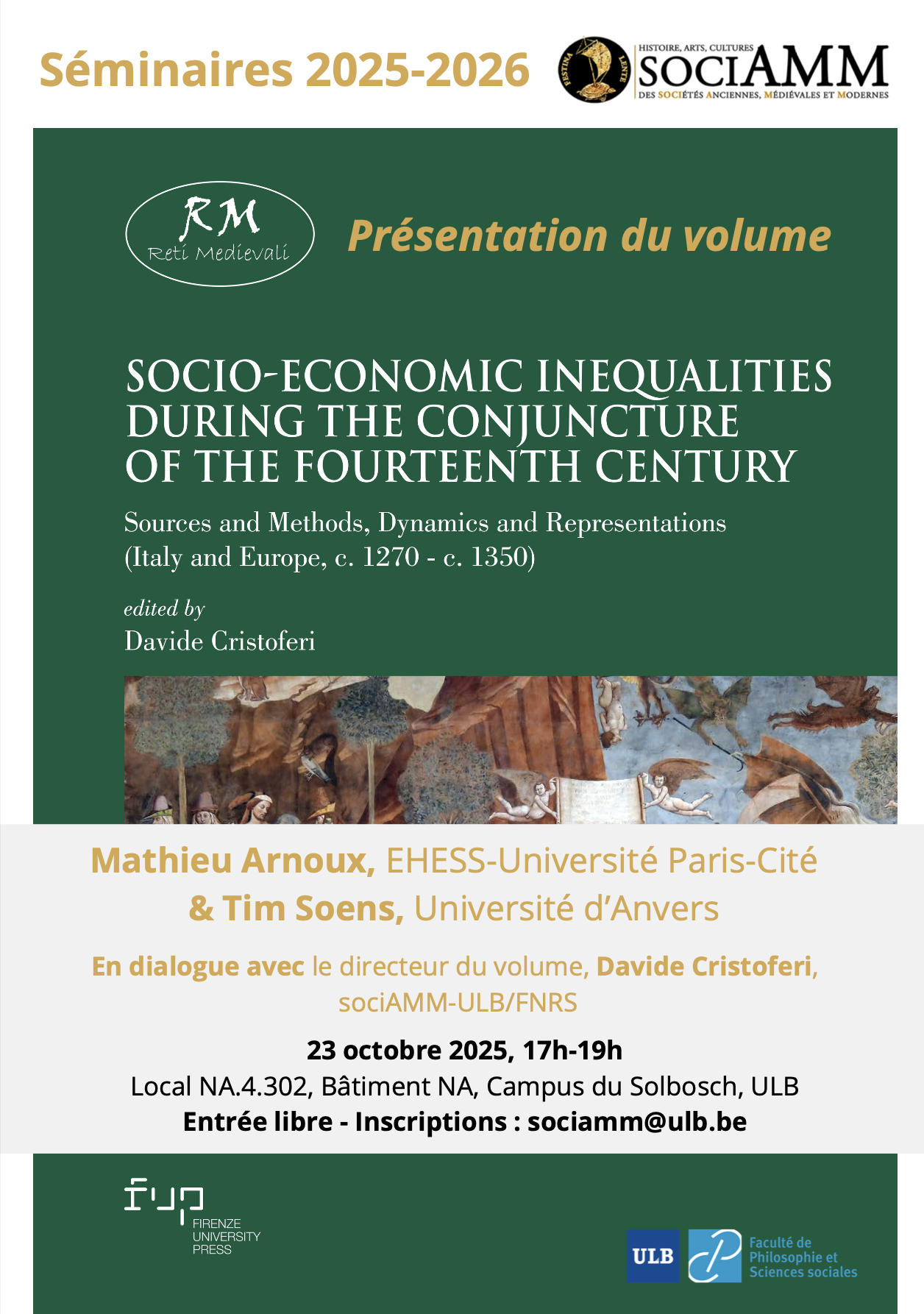
Table ronde – Présentation du livre « Socio-Economic Inequalities during the Conjuncture of the Fourteenth Century », avec Mathieux Arnoux, Tim Soens et Davide Cristoferi

Davide Cristoferi (éd.), Socio-Economic Inequalities during the Conjuncture of the Fourteenth Century: Sources and Methods, Dynamics and Representations (Italy and Europe, c. 1270-c. 1350). Reti Medievali E-Book, 52. Florence : Firenze University Press, 2025. DOI : 10.36253/979-12-215-0705-8.

Résumé :

Cet ouvrage vise à rassembler, discuter et approfondir les conclusions et les perspectives de deux débats importants de l’histoire médiévale et économique — la conjoncture du XIVe siècle et les inégalités préindustrielles — à travers dix-neuf contributions originales et de pointe, en anglais et en italien, rédigées par des chercheurs confirmés et de jeunes chercheurs prometteurs. Se concentrant sur le centre et le nord de l’Italie ainsi que sur l’Europe occidentale entre 1270 et 1350 environ, il vise à comprendre pourquoi, comment et dans quelle mesure la société médiévale était inégalitaire au cours des soixante-dix années précédant la Grande Peste de 1347-1352. Pour ce faire, il présente un large éventail de sources et de méthodes, explore et discute les mécanismes causaux des inégalités socio-économiques et examine la manière dont ces différences étaient perçues, représentées et traitées à la fin du Moyen Âge. Dans certains cas, l’enquête est étendue à la période postérieure à la peste noire.

Mots-clés : 

Moyen Âge, XIIIe-XIVe siècles, Europe occidentale, Italie centrale et septentrionale, inégalités socio-économiques.

Accès libre en ligne :

Le volume peut être téléchargé dans son intégralité ou par contribution individuelle sur le site officiel de la Firenze University Press – Reti Medievali. E-Book :

https://books.fupress.com/catalogue/socio-economic-inequalities-during-the-conjuncture-of-the-fourteenth-century/15946

Présentation publique :

La première présentation publique de ce livre aura lieu à l’Université libre de Bruxelles le jeudi 23 octobre à 17 heures, avec Mathieu Arnoux (Université Paris Cité-EHESS) et Tim Soens (Université d’Anvers).

Local NA.4.302, Bâtiment NA, Campus du Solbosch, ULB

Entrée libre – Inscriptions : sociamm@ulb.be

Publié dans Colloque | Commentaires fermés sur Table ronde – Présentation du livre « Socio-Economic Inequalities during the Conjuncture of the Fourteenth Century », avec Mathieux Arnoux, Tim Soens et Davide Cristoferi

Offre d’emploi – Offre d’emploi (postdoc 18 mois) en histoire médiévale, Université libre de Bruxelles

L’équipe QuaDiHum recrute un chercheur ou une checheuse postdoctoral(e) en histoire médiévale pour une durée de 18 mois à partir de janvier 2026.


Nous cherchons un ou une spécialiste de l’hagiographie dans le cadre du projet de recherche « HagioQuant : Une approche quantitative globale de l’hagiographie médiévale latine » (financement ARC de la FWB), qui a pour but d’étudier la littérature hagiographique de l’Occident médiéval latin de façon globale, en rassemblant, préparant et analysant à l’aide de méthodes quantitatives un corpus de plus de 4.000 textes.

Il s’agit d’un recrutement en mobilité internationale : la personne engagée doit avoir défendu sa thèse de doctorat il y a au plus huit ans, et ne pas avoir résidé ou exercé son activité principale (emploi, études, …) en Belgique pendant plus de 24 mois au cours des trois dernières années.

La personne engagée sera principalement chargée d’analyser les résultats obtenus à l’aide des méthodes quantitatives (elle ne sera pas chargée de développer ou d’implémenter ces méthodes, mais bien de dépouiller, interpréter et étudier les résultats produits) et d’effectuer la numérisation d’éditions scientifiques de textes hagiographiques à l’aide d’outils mis à disposition par l’équipe de recherche.

Le dossier de candidature doit m’être transmis le 15/11/2025 au plus tard sous format électronique à l’adresse sebastien.de.valeriola@ulb.be. N’hésitez pas à m’écrire si vous avez des questions à ce sujet. Voir aussi les fiches de poste en français (https://quadihum.ulb.be/wp-content/uploads/2025/10/2025_postdoc_HagioQuant_FR.pdf) et en anglais (https://quadihum.ulb.be/wp-content/uploads/2025/10/2025_postdoc_HagioQuant_FR.pdf).

Venez travailler avec nous à Bruxelles, au sein d’une équipe assez neuve mais très dynamique !

Publié dans Offre d'emploi | Commentaires fermés sur Offre d’emploi – Offre d’emploi (postdoc 18 mois) en histoire médiévale, Université libre de Bruxelles

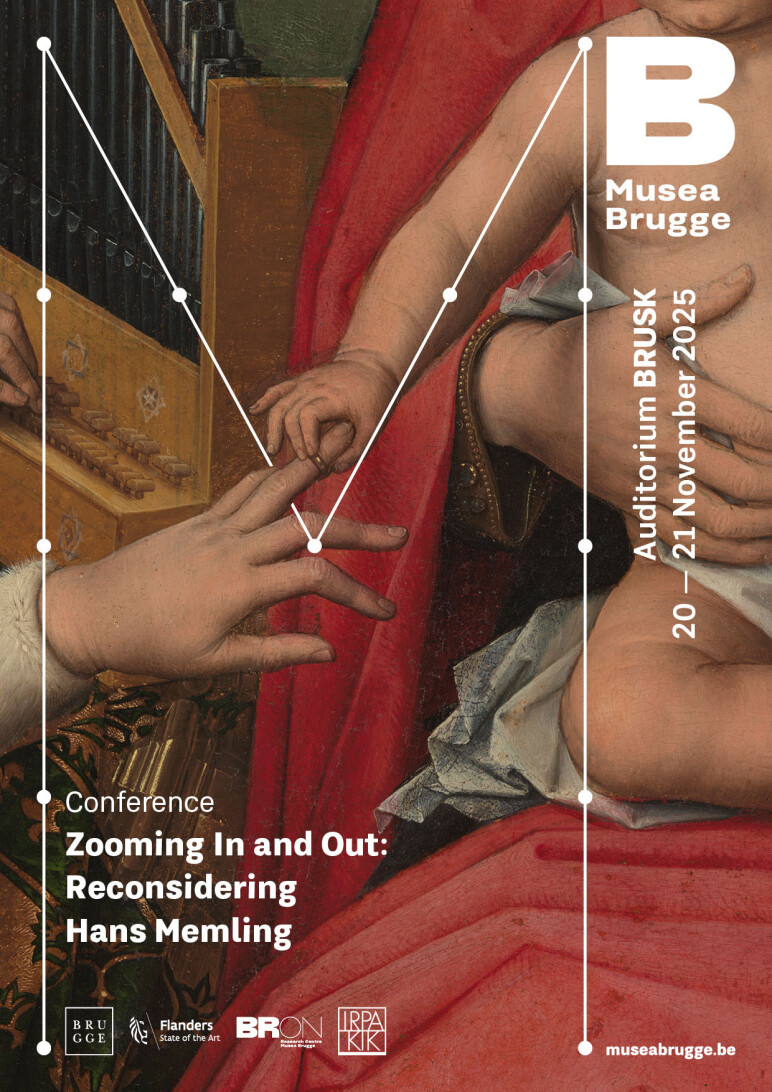
Colloque – Zooming In and Out: Reconsidering Hans Memling

In 2023 the first phase of the research project Closer to Memling commenced. Closer to Memling is a project initiated by Musea Brugge in collaboration with other institutions to thoroughly examine the 9 works by Hans Memling in its collection. The aim of this project and conference is to contextualise previous studies and stimulate new research on the painter in an interdisciplinary exchange between leading and new scholars in the field.

Programme : ici

Informations pratiques :

20-21 November 2025

Auditorium BRUSK, Musea Brugge (Bruges, Belgium)

Scientific Committee : Dr. des. Melis Avkiran (KIK-IRPA/UCLouvain), Dr. Bart Fransen (KIK-IRPA), Dr. Christina Currie (KIK-IRPA), Joyce Klein Koerkamp (Musea Brugge), Dr. Anna Koopstra (Musea Brugge), Anne van Oosterwijk (Musea Brugge)

Registration for the conference is now open.

Tickets: €125 / €50 for students*

Conference (walking) dinner: €55

*In order to register for the student fee, please send proof of your enrolment at a university to symposium@brugge.be. After validation you will receive a unique discount code to register for the student fee of €50.

Source : Musea Brugge

Publié dans Colloque | Commentaires fermés sur Colloque – Zooming In and Out: Reconsidering Hans Memling

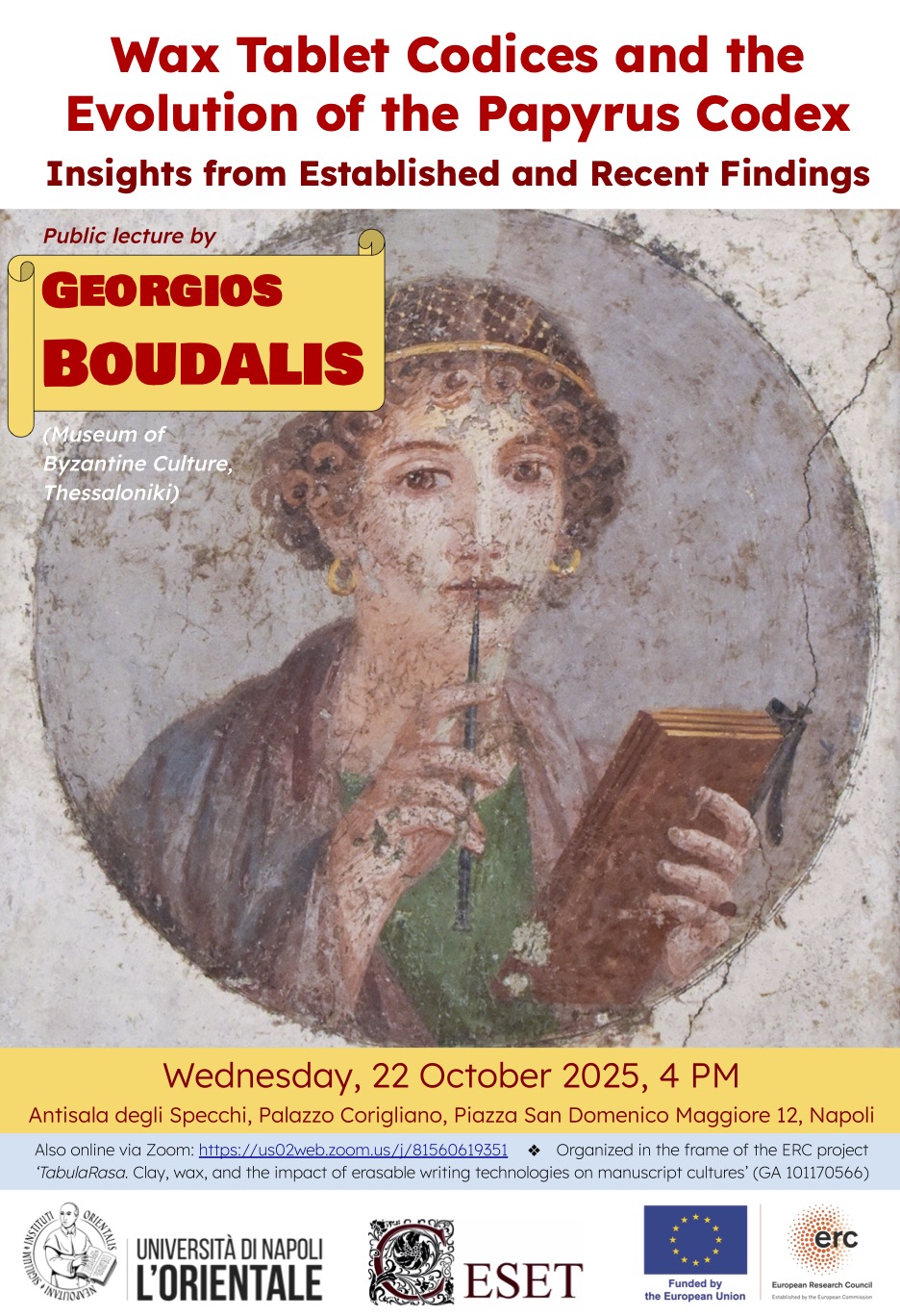
Conférence – Wax Tablet Codices and the Evolution of the Papyrus Codex: Insights from Established and Recent Findings

Antisala degli Specchi, 4th floor of Palazzo Corigliano, Piazza San Domenico Maggiore 12, Naples
22 Ottobre 2025, 16.00

Dr Georgios Boudalis, Senior Book Conservator at the Museum of Byzantine Culture in Thessaloniki (Greece), will give a hybrid public lecture on “Wax Tablet Codices and the Evolution of the Papyrus Codex: Insights from Established and Recent Findings” at the University of Naples “L’Orientale” on Wednesday, 22 October 2025, at 4 PM CET.

The lecture is organized within the framework of the ERC project “TabulaRasa. Clay, wax, and the impact of erasable writing technologies on manuscript cultures” (GA 101170566; for provisional information see https://sites.google.com/view/ductulivesuviani/neverending-manuscript/tabularasa), and part of the activities of the Centro per lo studio e l’edizione dei testi (CESET).

You are warmly invited to join us in person at the Antisala degli Specchi, 4th floor of Palazzo Corigliano, Piazza San Domenico Maggiore 12, Naples, or online via Zoom (https://us02web.zoom.us/j/81560619351). Everybody is welcome!

Source : Università di Napoli – L’Orientale

Publié dans Le réseau | Commentaires fermés sur Conférence – Wax Tablet Codices and the Evolution of the Papyrus Codex: Insights from Established and Recent Findings

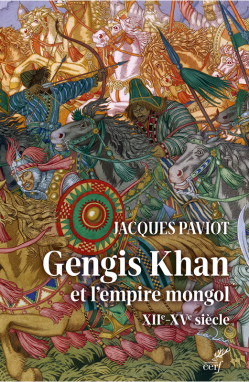
Publication – Jacques Paviot, « Gengis Khan et l’empire mongol »

Quel fut le destin de Gengis Khan ? Comment les Mongols ont-ilssubjugué le monde ? Voici, à travers les guerres et les conquêtes, l’histoire totale du plus vaste empire jamais vu et le récit captivant de la plus grande des épopées. Rarement un individu aura autant bouleversé son époque. Retraçant l’ascension fulgurante de Gengis Khan qui, triomphant des luttes de pouvoir et s’imposant à tout un peuple, est parvenu à soumettre l’Asie, Jacques Paviot explore la vie et l’héritage d’un stratège visionnaire. Depuis les premières campagnes du fondateur de l’empire jusqu’aux derniers feux de la Horde d’or, ce livre raconte plus de trois siècles d’invasions et de sièges, de massacres et de pillages. Trois siècles au cours desquels les grands khans que furent Ögödei et Möngke, Hülegü et Qubilai, ont étendu leur domination de la Terre sainte à la Corée et de l’Inde à la Pologne.

Exhumant les rapports des chroniqueurs, des missionnaires, des marchands, Jacques Paviot dévoile aussi la réalité d’un territoire structuré au commerce florissant dans lequel les hommes, les idées, les croyances ont pu circuler comme jamais auparavant. Et nous offre une plongée fascinante dans l’histoire d’un empire hors norme dont les armées, parties de la steppe, auront déferlé jusqu’aux confins du monde.

Une fresque saisissante. Un ouvrage magistral.

Professeur émérite d’histoire médiévale à l’Université Paris-Est Créteil, Jacques Paviot a publié de nombreux ouvrages sur le Moyen Âge et plusieurs études sur les contacts entre Européens et Mongols.

Informations pratiques :

Jacques Paviot, Gengis Khan et l’empire mongol, Paris, Éditions du Cerf, 2025 ; 1 vol., 336 p. ISBN : 978-2-20416-117-6. Prix : € 24,90.

Source : Éditions du Cerf

Publié dans Publications | Commentaires fermés sur Publication – Jacques Paviot, « Gengis Khan et l’empire mongol »

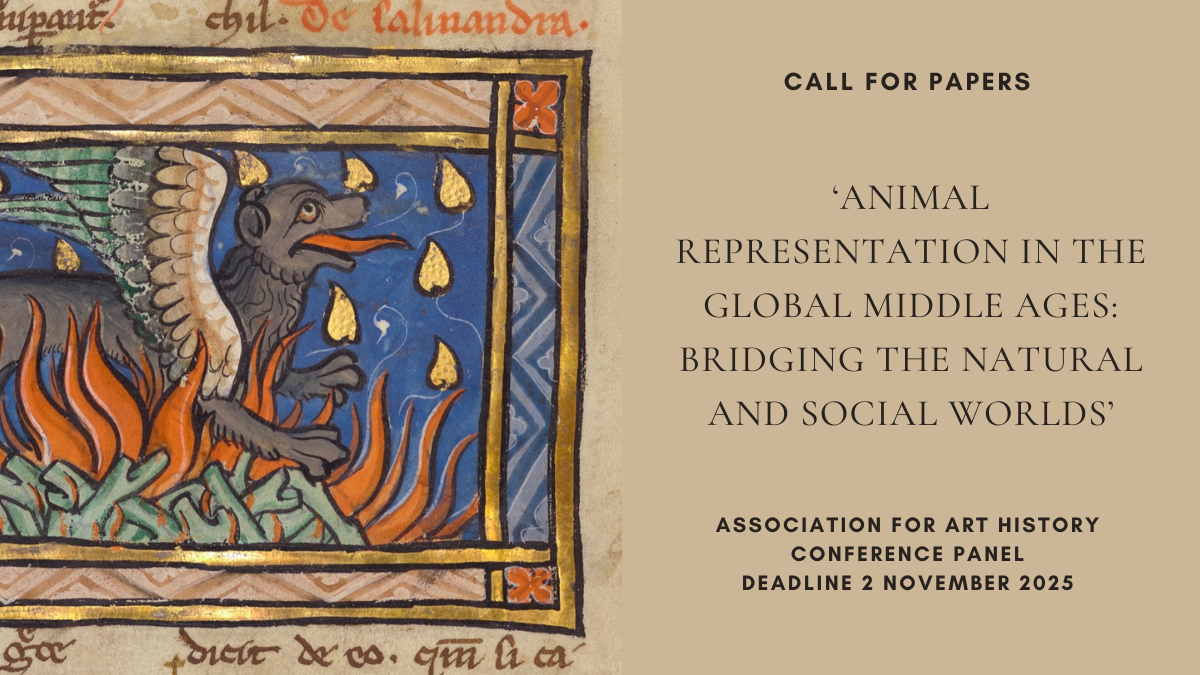
Appel à contribution – Animal Representation in the Global Middle Ages: Bridging the Natural and Social Worlds

Animals occupied a multivalent space in the medieval world. As part of nature, they were embedded in ecological systems, yet they were also abstracted into symbols of power, religious allegory, and medicinal knowledge—ultimately serving as a nexus between human societies and the natural environment. This panel explores the representation of animals across the global Middle Ages (c. 500–1500 CE), examining how diverse cultures imbued fauna with meaning through their representation. Moving beyond Eurocentric frameworks, we investigate how animal representations functioned as dynamic sites of meaning-making, from the meticulously rendered beasts in Islamic manuscripts, the symbolic menageries of Chinese paintings and prints, to the creatures that materialised along the Afro-Eurasian trade routes.

How did artists and patrons deploy animal iconography to articulate political authority, spiritual ideologies, or ecological knowledge? In what ways did the circulation of creatures, whether real or imagined, confer social prestige or negotiate cultural encounters? How did depictions of animals reflect or shape premodern environmental consciousness? Adopting a global perspective, we seek to illuminate the interconnectedness of medieval visual cultures while challenging anthropocentric narratives in art history. Of particular interest are studies that demonstrate how animals, as living beings and symbolic constructs, actively participated in shaping artistic traditions across regions. We welcome submissions focusing on understudied geographies and encourage interdisciplinary approaches bridging art history and environmental humanities. Ultimately, this panel aims to reconsider the global Middle Ages through its creaturely representations, revealing how such species—real, mythical, and metamorphic—fundamentally shaped medieval visual knowledge.

The session will include between three and eight 20-minute research papers, each followed by 5 minutes for questions.

Submit your Paper via this form. Please download, complete and send it directly to the Session Convenor(s) below by Sunday 2 November 2025: Yuxi Pan, SOAS University of London, 714232@soas.ac.uk

Source : Medieval Art Research

Publié dans Appel à contributions | Commentaires fermés sur Appel à contribution – Animal Representation in the Global Middle Ages: Bridging the Natural and Social Worlds

Exposition – Marche s/Meuse. La mémoire des dames

La Société archéologique de Namur présente, aux Archives de l’Etat à Namur, le second volet de sa nouvelle exposition consacrée à une abbaye cistercienne féminine namuroise : l’Abbaye Notre-Dame du Vivier de Marche-les-Dames. 

L’exposition retrace l’histoire de l’abbaye Notre-Dame du Vivier par le biais des archives conservées (chartes, procès, comptes, obituaires, plans, titres…).

Ces documents révèlent la vie quotidienne, spirituelle, juridique et économique d’une communauté de cisterciennes fondée au 13e siècle.

Ces sources nous renseignent autant sur la vie monastique et celle des religieuses que sur la liturgie cistercienne et l’administration d’un patrimoine exceptionnel. 

Boulevard Cauchy 41 à B-5000 Namur. 

Du 28/11/2025 au 01/03/2026 du mardi au vendredi de 9h à 16h30. Fermé les 24, 25, 31/12/23 et 01/01/24.

+32(0)81 65 41 98 – archives.namur@arch.be.

Entrée libre.

Source : Société archéologique de Namur

Publié dans Exposition | Commentaires fermés sur Exposition – Marche s/Meuse. La mémoire des dames

Formation – Stage de sensibilisation à l’étude des restes osseux humains

Ce stage est destiné à sensibiliser les étudiants·es en archéologie à l’étude d’une collection ostéologique issue d’une nécropole médiévale (Val-d’Oise) et à ses enjeux afin de les orienter au mieux dans leur parcours de formation.

Il est destiné à leur faire acquérir par la pratique les premières clés de compréhension d’un ensemble funéraire, en complément des enseignements universitaires.

Stage théorique et pratique proposé par le Service départemental d’archéologie du Val d’Oise, l’Université de Paris 1 Panthéon Sorbonne et l’UMR 7206 éco-anthropologie ethnobiologie.

Il se tiendra dans les locaux du Service départemental d’archéologie du Val d’Oise/SDAVO à Pontoise (CY Cergy Paris Université, site Saint-Martin) du lundi 16 au vendredi 20 février 2026.

Lundi 16 au vendredi 20 février

  • Lundi 9h-12h : Principes anatomiques.
  • Lundi 13h-16h45 : De l’os au fragment (travaux pratiques axés sur la détermination osseuse).
  • Mardi 9h-12h : Principes anatomiques.
  • Mardi 13h-16h45 : De l’os au fragment (travaux pratiques axés sur la détermination osseuse).
  • Mercredi 9h-12h : Nombre minimum d’individus.
  • Mercredi 13h-16h45 : Détermination des os humains fragmentés par le feu. Pour quoi faire ?
  • Jeudi 9h-12h : L’os coxal, sexe.
  • Jeudi 13h-16h45 : L’os coxal, âge.
  • Vendredi 9h-12h : Les dents. Principes anatomiques et âge dentaire.
  • Vendredi 13h-16h45 : Fragmentés et déformés par la maladie, problèmes de reconnaissance.

Le nombre de participants étant limité, la demande d’inscription ne vaut pas acceptation. Merci de la motiver par un courrier d’accompagnement.

Demande d’inscription à retourner par mail à jean-gabriel.pariat@valdoise.fr (Service départemental d’archéologie du Val d’Oise) précisant le prénom, nom, mail, diplôme préparé et université.

Avant le 31 octobre 2025.

Le stage n’implique pas de frais d’inscription.

Modalités de sélection : Jean-Gabriel Pariat, le responsable de l’équipe pédagogique, sera en charge de la sélection des candidatures.

Équipe pédagogique

  • Jean-Gabriel PARIAT (SDAVO, UMR 7206 coordination)
  • Vanessa BAYARD (Service Archéologique du Val de Marne, UMR 7206)
  • Frédéric BOURSIER (Médecin, associé UMR 7206)
  • Charlotte BOYER (Doctorante, Université Paris 1)
  • Isabelle LE GOFF (INRAP, UMR 7206)
  • Utpala ROUSSELOT (Doctorant MNHN, UMR 7206)

Source : Calenda

Publié dans Enseignement | Commentaires fermés sur Formation – Stage de sensibilisation à l’étude des restes osseux humains