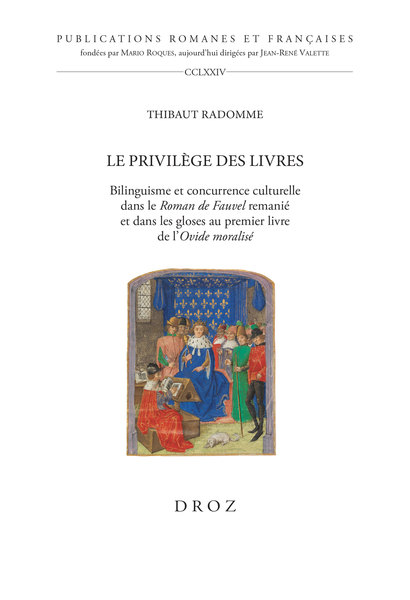
Dans le processus d’émancipation de la langue vernaculaire face au latin, le XIVe siècle est généralement considéré comme le moment où le français achève d’imposer son statut de nouvel idiome de référence. Composés dans les années 1310, le Roman de Fauvel et l’Ovide moralisé se distinguent de la production de l’époque : rédigés initialement en français, ils sont tous deux le théâtre d’une surprenante réapparition du latin au gré de l’insertion de pièces musicales ou de gloses marginales bilingues dans certains de leurs témoins, manuscrits de luxe manifestement destinés à la haute aristocratie laïque. En se fondant sur l’analyse des interactions entre le texte français et les sections latines, le présent ouvrage suggère d’interpréter le bilinguisme du corpus à la lumière du dilemme occupant les clercs sous le règne des derniers Capétiens, partagés entre le désir d’instruire utilement les laïcs et l’ambition de préserver leur privilège sur les livres.
Ouvrage couronné par l’Académie royale de Belgique : Prix Joseph Houziaux 2020
Prix de français 2020 de la Société académique vaudoise
Informations pratiques :
Thibaut Radomme, Le privilège des livres. Bilinguisme et concurrence culturelle dans le Roman de Fauvel remanié et dans les gloses au premier livre de l’Ovide moralisé, Genève, Droz, 2021 (Publications Romanes et Françaises, 274). 904 p. ISBN : 978-2-600-06245-9. prix : 42,65 euros.
Bishops were powerful individuals who had considerable spiritual, economic, and political power. They were not just religious leaders; they were important men who served kings and lords as advisers and even diplomats. They also controlled large territories and had significant incomes and people at their command. The nature of the international Church also meant that they travelled and had connections well beyond their home countries, were players on an increasingly international stage, and were key conduits for the transfer of ideas.
This volume examines the identities and networks of bishops in medieval Europe. The fifteen papers explore how senior clerics attained their bishoprics through their familial, social, and educational networks, their career paths, relationships with secular lords, and the papacy. It brings together research on bishops in central, southern, and northern Europe, by early career and established scholars. The first part features five case-studies of individual bishops’ identities, careers, and networks. Then we turn to examine contact with the papacy and its role in three regions: northern Italy, the archbishopric of Split, and Sweden. Part III focuses on five main issues: royal patronage, reforming bishops, nepotism, social mobility, and public assemblies. Finally Part IV explores how episcopal networks in Poland, Sigüenza, and the Nidaros church province helped candidates achieve promotion. These contributions will thus enhance of our understanding of how bishops fit into the religious, political, social, and cultural fabrics of medieval Europe.
Dr Sarah E. Thomas was the principal investigator on the AHRC project ‘A Prosopographical Study of Bishops’ Careers in Northern Europe’. Her research focuses on the interaction of the late medieval Church with ordinary people and on the identities of the individuals who served as priests and bishops. She is currently writing up her research from the Bishops’ project into a monograph provisionally titled Becoming a Bishop in Late Medieval Scotland, England, and Norway.
Table des matières :
List of Illustrations
Acknowledgements
Introduction – SARAH E. THOMAS
Part I. Cohorts of Bishops
Understanding the Appeal of the Courtier Bishop in Thirteenth-Century England — KATHERINE HARVEY
Bishops, Kings, and Grievances in Medieval Portugal (1268–1289) — HERMÍNIA VASCONCELOS VILAR
Bishops, Nepotism and Social Mobility in Central and Northern Italy in the Fourteenth Century — STEFANO G. MAGNI
The Bishops of Meaux, 1197–1510: From Chapter’s Men to King’s Men — CHRISTINE BARRALIS
Part II. Episcopal Networks
Premeditation and Determination on the Way to the Polish Episcopacy in the Thirteenth and Fourteenth Centuries — JACEK MACIEJEWSKI
Bishop, Chapter and Social Networks in Castile: The Cathedral Chapter at Sigüenza (Fourteenth – Fifteenth Centuries) — AÍDA PORTILLA GONZÁLEZ
The Nidaros Church and the Insular Parts of its Province: Metropolitan Authority and Relations with Their Suffragans — STEINAR IMSEN
Part III. Individual Bishops
The Scolari Family at the Head of the Bishopric of Volterra (1261–1269) — JACOPO PAGANELLI
Pedro Pérez de Monroy (1310–1324): A New Bishop for a New Era in Salamanca — FERNANDO GUTIÉRREZ BAÑOS
Power, Culture, and Ecclesiastical Reform in Late Medieval Castile: The Bishop of Burgos, Luis de Acuña (1456–1495) — SUSANA GUIJARRO
Part IV. Bishops and the Papacy
Episcopal Appointments in Northern Italy during the Papacy of John XXII — FABRIZIO PAGNONI
Episcopal Appointments and Careers of the Archbishops of Split (1294–1426) — MIŠO PETROVIÆ
Between Uppsala and Rome: Swedish Bishops’ Contacts with the Papal Curia in the Late Middle Ages — KIRSI SALONEN
Index
Informations pratiques :
Sarah E. Thomas, Bishops’ Identities, Careers, and Networks in Medieval Europe, Turnhout, Brepols, 2021 (Medieval Church Studies, 44). IX+312 p., 6 b/w ill., 10 b/w tables, 156 x 234 mm, 2021. ISBN: 978-2-503-57910-8. Prix : 85 euros.
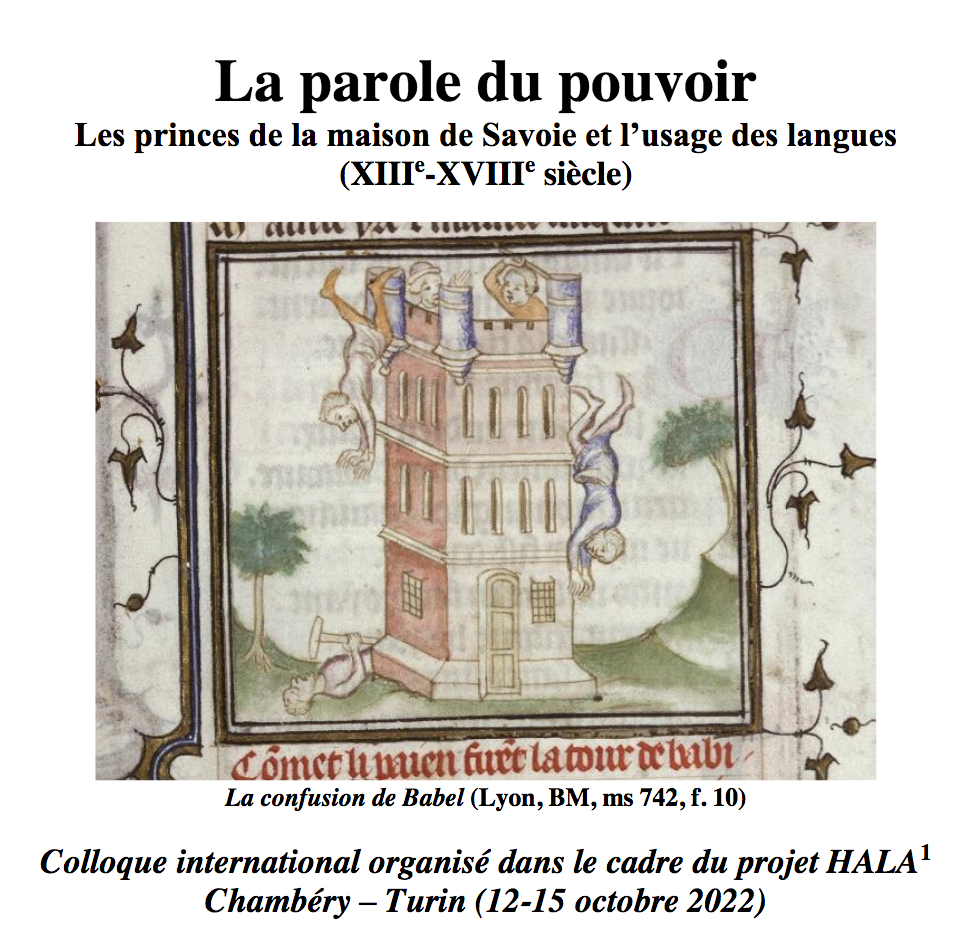
Colloque international organisé dans le cadre du projet HALA Chambéry – Turin (12-15 octobre 2022)
La problématique des politiques linguistiques conduites par les pouvoirs médiévaux a déjà fait l’objet de plusieurs études publiées durant la première décennie du XXIe siècle. Le colloque « La parole du pouvoir » entend examiner ces thématiques de politique linguistique en les situant dans un cadre territorial précis et une perspective de longue durée. Bénéficiant d’une excellente tradition archivistique désormais bien explorée, les États de Savoie nous apparaissent comme particulièrement pertinents pour une telle étude de cas ; ils n’ont pour l’instant été que très peu étudiés dans cette perspective, si l’on excepte quelques articles. Situées de part et d’autre des Alpes occidentales, ces régions ont été soumises dès le XIe siècle à l’action unificatrice des comtes (puis ducs) de Savoie qui a débouché au XVe s. sur un État princier, élevé ensuite à la dignité royale au début du XVIIIe s. en tant que royaume de Piémont-Sardaigne.
Conditions pratiques : le colloque aura lieu à Chambéry (12 et 13 octobre 2022) puis se déplacera à Turin (14 et 15 octobre 2022) ; les organisateurs souhaitent que les congressistes puissent se libérer pour assister à l’ensemble de ces 4 journées et participer à l’ensemble des discussions. Les frais de transport, de logement et de restauration seront pris en charge par les organisateurs. Les actes du colloque seront publiés. Télécharger l’appel à communication complet : Appel à communication_La parole du pouvoir En savoir plus sur le projet HALA : http://ciham-digital.huma-num.fr/hala/
Early Medieval Britain was more Roman than we think. The Roman Empire left vast infrastructural resources on the island. These resources lay buried not only in dirt and soil, but also in texts, laws, chronicles, charters, even churches and landscapes. This book uncovers them and shows how they shaped Early Medieval Britain. Infrastructures, material and symbolic, can work in ways that are not immediately obvious and exert an influence long after their creators have gone. Infrastructure can also rest dormant and be reactivated with a changed function, role and appearance. This is not a simple story of continuity and discontinuity: It is a story of adaptation and transformation, of how the Roman infrastructural past was used and re-used, and also how it influenced the later societies of Britain.
Mateusz Fafinski is a medievalist, digital humanist, and translator. His PhD thesis at Freie Universität Berlin focused on the uses of the material past in early medieval Britain. He is a Postdoctoral Fellow at Stanford Text Technologies and teaches medieval history at Freie Universität Berlin.
Informations pratiques :
Mateusz Fafinski, Roman Infrastructure in Early Medieval Britain. The Adaptations of the Past in Text and Stone, Amsterdam, Amsterdam University Press, 2021 (The Early Medieval North Atlantic). 240 p. ISBN : 9789463727532. Prix : 99 euros.
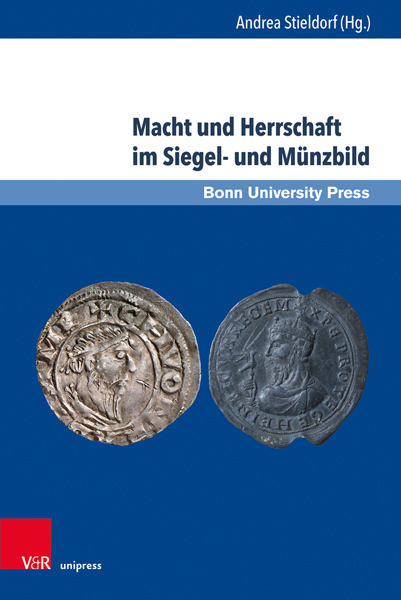
Bilder von Kaisern, Königen und Fürsten auf Siegeln und Münzen aber auch in literarischen Texten geben wichtige Aufschlüsse über allgemeine Herrschaftsvorstellungen ebenso wie über repräsentative Strategien einzelner Herrscherpersönlichkeiten. Bei diesen »Bildern« kann es sich um Abbildungen des Herrscherkörpers in festlichen Gewändern und ausgestattet mit Insignien handeln, aber auch um zeichenhafte Repräsentationen wie Wappen. Indem auch der Bezug zum Geschriebenen hergestellt wird, in Form von Siegel- und Münzinschriften und literarischen Texten, werden hier erstmals die Umschriften der hochmittelalterlichen Siegel der deutschen Könige analysiert. Der Band zeigt beispielhaft, welche Chancen ikonographische Fragestellungen bei der Analyse von Münzbildern bieten, aber auch wie weibliche Herrschaft im Bild umgesetzt werden kann. Immer wieder wird deutlich, dass die visualisierten Herrschaftskonzepte medienübergreifend funktionieren bzw. adressiert werden.
Images of emperors, kings and princes on seals and coins, but also in literary texts can provide important insights into common ideas of Herrschaft as well as into strategies used to represent certain rulers. While these images may be depictions showing the sovereign’s body in festive garments and with his insignia, they may also be emblematic representations such as coats of arms. However, very often there is a connection between these images and textual elements, such as literary texts in manuscripts which are accompanied by illustrations or the legends on seals and coins. For instance, this volume provides the first in-depth analysis of the inscriptions and legends on the royal German seals of the high middle ages. It demonstrates the opportunities afforded by an iconographic approach, for example when analysing coin designs or the ways in which female Herrschaft may be depicted in a visual medium. Again and again, it becomes apparent that visualising concepts of Herrschaft works in similar ways across the different media in which they are addressed.
Prof. Dr. Andrea Stieldorf lehrt Mittelalterliche Geschichte und Historische Grundwissenschaften an der Universität Bonn. Sie ist Leiterin des Teilprojektes »Bilder vom König. Macht und Herrschaft der ostfränkisch-deutschen Könige im Siegel und Münzbild (936–1250)« des SFB 1167.
Informations pratiques :
Macht und Herrschaft im Siegel- und Münzbild, dir. Andrea Stieldorf, Göttingen, Vandenhoeck und Ruprecht, 2021 (Studien zu Macht und Herrschaft, 14). 317 Seiten, mit 95 Abbildungen, gebunden. ISBN: 978-3-8471-1279-2. Prix : 39,99 euros.
Les villes lorraines sont tributaires de la géopolitique complexe de l’espace lorrain. La partie orientale de la région fait partie de l’Empire, mais l’ensemble de la région est plus ou moins soumise à l’influence de la monarchie française ; par ailleurs, la région participe à la construction de monarchies composites d’échelle européenne (Empire des Luxembourg, Etats angevins). Que les villes lorraines soient libres ou territoriales, insérées dans une principauté laïque ou ecclésiastique, villes marchandes ou de résidence du prince, elles ne sont pas que des acteurs passifs : la capacité de la principale d’entre elles, Metz, à tenir tête aux armées des princes lorrains, le montre bien. Quelle peut être, dans ces conditions, leur place dans la construction étatique prise dans son acception la plus large ? Cette journée d’étude entend mettre en avant, dans la lignée des thématiques proposées pour le programme de la session 2022 de l’agrégation externe d’histoire, l’espace lorrain comme théâtre de ces relations entre villes et construction étatique. On pourra ainsi notamment évoquer :
Les villes comme lieu de construction de pouvoirs associés au phénomène étatique, en matière juridique (autonomie législative), politique (construction d’institutions propres), fiscale ou diplomatique, notamment dans le cas des villes d’Empire : comme beaucoup d’autres villes épiscopales de l’Empire, elles conquièrent une autonomie de droit et de fait qui entraîne des évolutions dans les pratiques administratives comme dans les usages de l’écrit.
Les villes des principautés (duché de Lorraine, duché de Bar, principautés des évêques de Metz, Toul et Verdun) enjeux et acteurs de la construction étatique des principautés, qu’il s’agisse des lieux de résidence des princes (Vic-sur-Seille, Bar-le-Duc…) ou de villes plus modestes.
Les villes lorraines, enjeux et acteurs des rivalités entre Etats monarchiques : quelle politique française en Lorraine ? quelle présence de l’Empire ? Comment les pratiques diplomatiques des villes s’adaptent-elles aux pratiques étatiques nouvelles, entre résistance et coopération ?
Tous ces thèmes pourront être étudiés à la fois du point de vue des villes et du point de vue des entités plus vastes dans lesquelles elles s’insèrent ou avec lesquelles elles sont en contact ; on pourra ainsi voir aussi bien les attentes et les craintes des villes face aux principautés que la manière dont les princes et souverains font des villes des enjeux de leurs politiques.
Modalités d’organisation
Les propositions de contribution (résumé de 500 mots maximum) devront être envoyées
Early medieval Britain saw the birth of England, Scotland and of the Welsh kingdoms. Naismith’s introductory textbook explores the period between the end of Roman rule and the eve of the Norman Conquest, blending an engaging narrative with clear explanations of key themes and sources. Using extensive illustrations, maps and selections from primary sources, students will examine the island as a collective entity, comparing political histories and institutions as well as societies, beliefs and economies. Each chapter foregrounds questions of identity and the meaning of ‘Britain’ in this period, encouraging interrogation and contextualisation of sources within the framework of the latest debates and problems. Featuring online resources including timelines, a glossary, end-of-chapter questions and suggestions for further reading, students can drive their own understanding of how the polities and societies of early medieval Britain fitted together and into the wider world, and firmly grasp the formative stages of British history.
Rory Naismith has published extensively on early medieval history, including Money and Power in Anglo-Saxon England: the Southern English Kingdoms 757–865 (2012), Medieval European Coinage 8: Britain and Ireland c. 400–1066 (2017) and Citadel of the Saxons: the Rise of Early London (2018).
Table des matières :
Preface and Acknowledgements List of Source Boxes List of Methods and Analysis Boxes List of Illustrations List of Maps
Introduction
Part I. Conceiving Early Medieval Britain:
An Island in the Ocean: The Idea of Britain
On the Edge of the World: Britain and Europe
Legend, Myth and History
Migrations and Peoples
Fragments of the Past
Part II. Making Early Medieval Britain:
Britain c. 500
‘Fertile of Tyrants’: Britain 500–650
‘What the Outcome Will Be, a Future Age Will See’: Britain 650–850
‘God Help Us!’: Britain 850–1000
Part III. Living in Early Medieval Britain:
Kingship in Action
Building a Christian Society
Maintaining Belief: The Church as an Institution
Family, Friend, Lord, Slave: The Basis of Society
Land, People and Settlement
Getting and Giving: Acts and Settings of Exchange
Language and Communication
‘As Far as the Cold Waves Reach’: Conclusion
Glossary Index.
Informations pratiques :
Rory Naismith, Early Medieval Britain, c. 500–1000, Cambridge, Cambridge University Press, 2021. 490 p., 242 x 173 x 23 mm. ISBN : 9781108440257. Prix : 22,99 £.
Jeudi 30 septembre et vendredi 1er octobre 2021 UCLouvain, Auditoire More 55 Sous la direction de Thalia Brero (Université de Neuchâtel) et Gilles Lecuppre (UCLouvain) Informations : gilles.lecuppre@uclouvain.be
Amplement étudiés par les spécialistes de la littérature et les ethnologues, les contes n’ont jusqu’ici intéressé que marginalement les historien-ne-s. Ce colloque se propose de leur donner la parole, afin d’interroger sous un angle proprement historique l’ancrage médiéval de ces récits. Il se focalisera plus particulièrement sur la place qu’occupent dans ces textes les cours royales et princières. En effet, nombre de contes classiques se déroulent dans ce cadre et leurs ressorts narratifs s’articulent souvent autour d’éléments spécifiques au milieu curial – questions successorales, légitimité de l’héritier, alliances matrimoniales, tournois, etc.
Deux axes de réflexion seront privilégiés lors de cette rencontre. Le premier s’intéressera aux origines et à la circulation de ces textes : et si certaines de ces histoires de cours, attribuées souvent au folklore, étaient en fait nées dans l’espace curial qu’elles décrivent ? Comment ces motifs voyagent-ils à travers le temps et l’espace – en Europe et peut-être au-delà ?
La deuxième piste que nous explorerons portera sur la part éventuelle d’éléments historiques dans cet ensemble. Peut-on déceler la trace d’épisodes ou de personnages réels au sein de ces textes ? La folie, l’infertilité, l’adultère des gouvernants médiévaux imprègnent-ils toujours les contes modernes ?
Patrick Zutshi, The Avignon Popes and Their Chancery. Collected Essays, Firenze, Sismel, 2021 (mediEVI, 30). PB pp. XIV-466; 1 tav. f. t., € 68,00. iSBN : 978-88-9290-064-6. Prix 68 euros.
Table des matières :
TABLE OF CONTENTS Preface
INTRODUCTION 1. The papal chancery: Avignon and beyond Selected Bibliography
PETITIONS AND REGISTERS
2. Petitions to the Pope in the Fourteenth Century 3. Fiat A: the Earliest Known Roll of Petitions Signed by the Pope (1307) (with P. A. Linehan) 4. The Origins of the Registration of Petitions in the Papal Chancery in the First Half of the Fourteenth Century 5. Inextricabilis curie labyrinthus: the Presentation of Petitions to the Pope in the Chancery and the Penitentiary During the Fourteenth and First Half of the Fifteenth Century 6. Changes in the Registration of Papal Letters Under the Avignon Popes (1305-1378)
THE CHANCERY AND ITS PRODUCTION
7. Some Early Letters of Pope Clement V (1305-14) in the National Archives 8. The Office of Notary in the Papal Chancery in the Mid-Fourteenth Century 9. At the Point of Death: Licences to Choose a Confessor in mortis articulo issued by the Avignon Popes
THE ROLE OF THE POPE
10.The Personal Role of the Pope in the Production of Papal Letters in the Thirteenth and Fourteenth Centuries 11. The Political and Administrative Correspondence of the Avignon Popes, 1305-1378: a Contribution to Papal Diplomatic 12. Autograph Letters of the Avignon Popes
PAPAL LETTERS AND ENGLISH HISTORY
13. The Letters of the Avignon Popes (1305-1378): a Source for the Study of Anglo-Papal Relations and of English Ecclesiastical History 14. Proctors Acting for English Petitioners in the Chancery of the Avignon Popes (1305-1378) 15. The Papal Chancery and English Documents in the Fourteenth and Early Fifteenth Centuries 16. The Publication of Entries in the Papal Registers Concerning Great Britain and Ireland 17. Collective Indulgences from Rome and Avignon in English Collections
PAPAL LETTERS FOR THE UNIVERSITY OF CAMBRIDGE
18.When did Cambridge Become a studium generale? 19. Some Inedited Papal Documents Relating to the University of Cambridge in the Fourteenth Century 20. The Mendicant Orders and the University of Cambridge in the Fourteenth and Early Fifteenth Centuries
INDICES Index of manuscripts Index of persons and places Index of subjects
Circé. Histoire, Savoirs, Sociétés est une revue semestrielle (deux numéros par an : publications en automne et au printemps), qui publie des articles et notes critiques sur tous les aspects de l’histoire, des lettres, des civilisations et des sciences humaines et sociales en général. Elle fut créée en 2011 par des étudiants de master d’histoire à la suite de la fondation de l’Institut d’Études Culturelles (aujourd’hui IECI) à l’Université de Versailles Saint-Quentin-en-Yvelines. Elle répond à une volonté de ses étudiants de s’inscrire dans le dynamisme de cette jeune université en proposant un projet, porté par ceux qu’elle forme et qui valoriserait son activité de recherche dans les sciences humaines.
Avec le soutien du FNRS, du CRHiDI (UCLouvain – Saint-Louis, Bruxelles), d'INCAL (UCLouvain), de PraME (UNamur), de sociAMM (ULB) et de Transitions (ULiège)









Vous devez être connecté pour poster un commentaire.