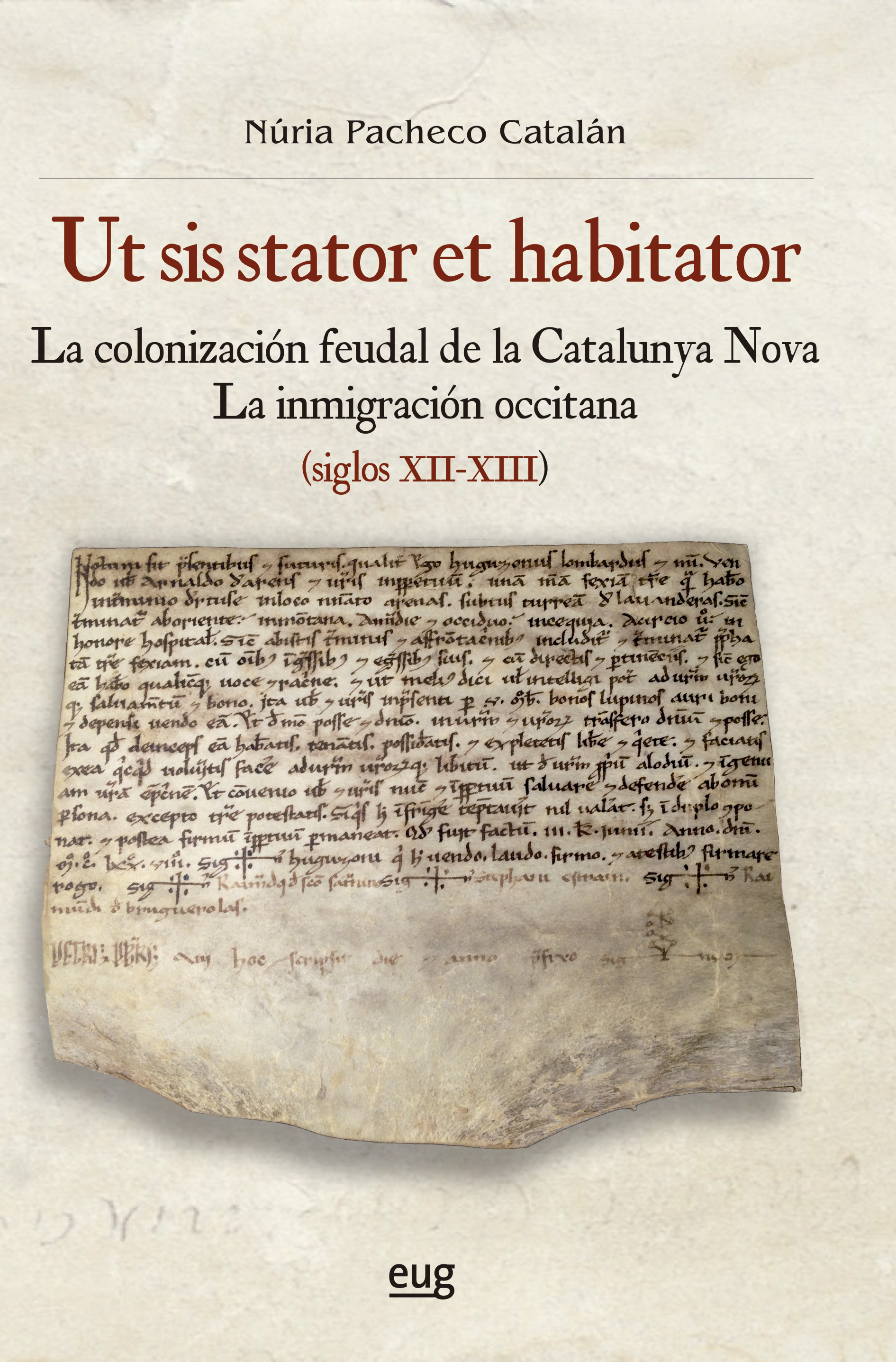
Publication – Núria Pacheco Catalán, « Ut sis stator et habitator. La colonización feudal de la Catalunya Nova. La inmigración occitana (siglos XII-XIII) »

Tortosa y Lleida, las principales plazas de la Catalunya Nova, fueron conquistadas en 1148 y 1149. Estos hitos forman parte del proceso de expansión de la cristiandad latina que venía desarrollándose a escala europea desde el siglo XI. En el caso de la Catalunya Nova, tras los episodios militares tuvo lugar una substitución de población mediante la cual los indígenas fueron remplazados por colonos cristianos procedentes de las regiones de origen de los conquistadores. Estos colonos se ocuparon de implementar el orden feudal en el territorio.

El objetivo de este libro es estudiar el proceso de construcción de una nueva sociedad feudal en la Catalunya Nova a través de los agentes del cambio, los colonos. El análisis de la documentación generada por los procesos de conquista y colonización, unido a una aproximación prosopográfica centrada en el colectivo occitano han permitido reconstruir la gestión y transformación del entorno urbano y rural, los lazos familiares e interpersonales entre colonos y la organización social de una comunidad emergente. En última instancia, esta obra contribuye al estudio de los movimientos de migración y colonización medievales.

Informations pratiques :

Núria Pacheco Catalán, Ut sis stator et habitator. La colonización feudal de la Catalunya Nova. La inmigración occitana (siglos XII-XIII), Grenad, Editorial Universidad de Granada, 2025 ; 1 vol., 368 p. ISBN : 978-84-338-7506-8. Prix : € 28,00.

Publié dans Publications | Commentaires fermés sur Publication – Núria Pacheco Catalán, « Ut sis stator et habitator. La colonización feudal de la Catalunya Nova. La inmigración occitana (siglos XII-XIII) »

Appel à contribution – Historians among the White Monks: Cistercians and their Records of the Past

Leeds International Medieval Congress, 6-9 July 2026

Medieval Cistercians appear to have had a strong interest in history. Their libraries housed Classical and Medieval historical texts, and members of the Order authored annals and chronicles about their abbeys, universal chronicles, hagiographies of Cistercian saints, collections of Cistercian stories, and more. But what does it mean to write “Cistercian history”? What are the structural and thematic features that reveal how authors gave expression to the Order’s concerns and priorities? And are these features always present?

Our aim is to gather case studies from a variety of Cistercian contexts across Europe in order to explore the multiple strategies by which authors of historical texts reimagined the Order’s past, engaged with its historical tradition, and responded to the political, social, and religious challenges it faced – both locally and more broadly. We are particularly interested in works that, although written by authors belonging to the Order, may not appear, at first glance, to convey a distinctly Cistercian perspective: texts that omit references to the history of the author’s abbey, refrain from offering a specifically Cistercian interpretation of major events, or seem more invested in national self-definition or in compiling all available sources regardless of their non-Cistercian origin.

Possible themes may include, but are not limited to:

• Cistercian continuations and adaptations of existing chronicles
• Accounts of the founding of Cistercian abbeys in Cistercian chronicles
• Representations of other monastic communities in Cistercian historical writing
• Cistercian historians’ perspectives on secular affairs and political events
• Cistercian worldview and ideas in universal chronicles
• Cistercian historiography in “non-historical” texts (hagiography, exempla, etc.)

Please submit an abstract (max. 100 words), with your name, email address and academic affiliation, to Antoni Grabowski (agrabowski@ihpan.edu.pl) and Elisa Lonati (elisa.lonati@chartes.psl.eu) by 15 September 2025.

Publié dans Appel à contributions | Commentaires fermés sur Appel à contribution – Historians among the White Monks: Cistercians and their Records of the Past

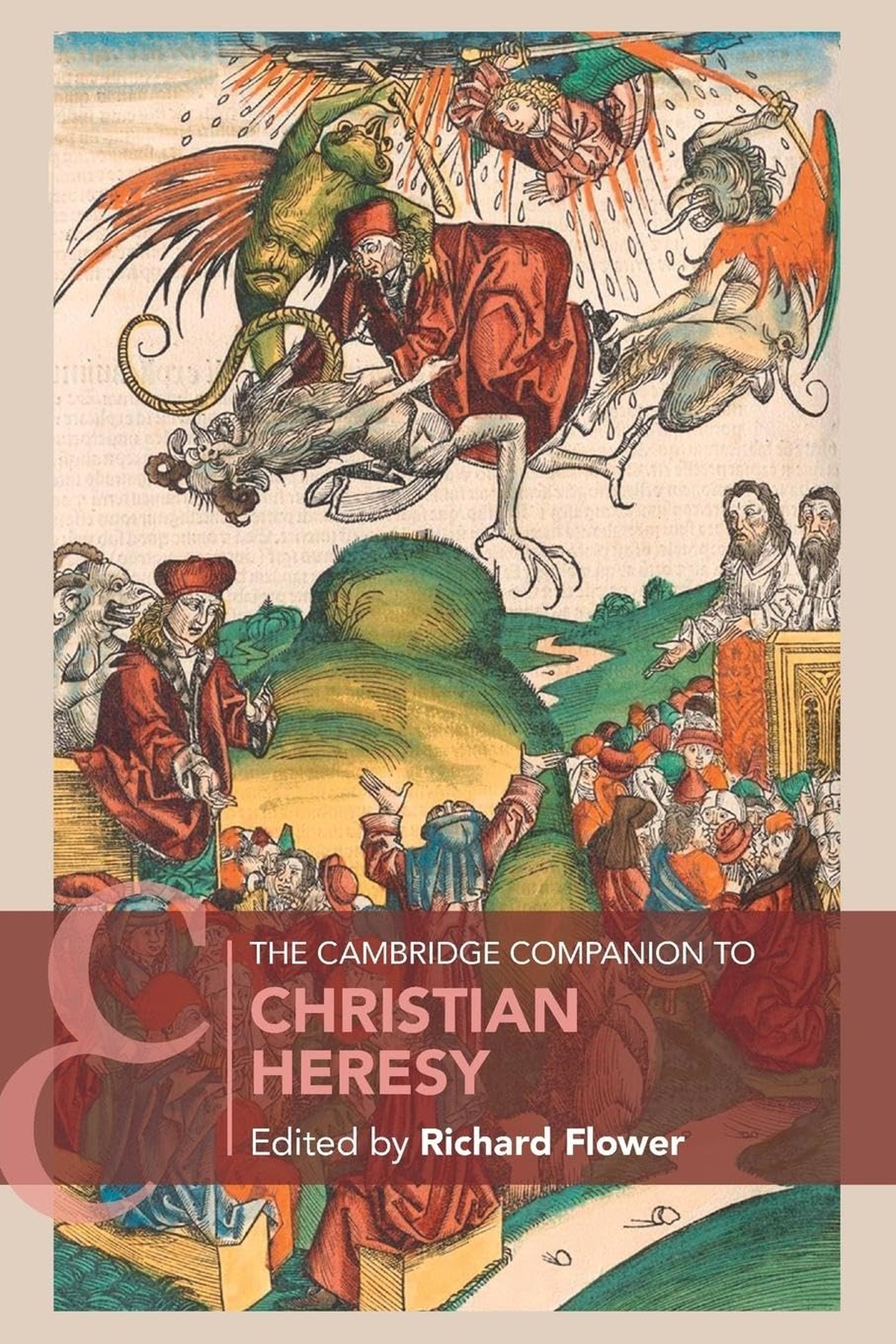
Publication – « The Cambridge Companion to Christian Heresy », éd. Richard Flower

The concept of heresy has played a major role across Christian history. Traditionally, heretical sects have been regarded as distinct, real-life groups of people who had departed from the stable orthodox traditions of Christianity and who posed a threat that needed to be addressed, sometimes through violent repression. More recently, scholarship has focused on the notion of heresy as discourse, placing particular emphasis on its literary construction and the social and cultural contexts in which it was deployed. This literature has generated significant debates about the nature and historicity of many heresies. The Cambridge Companion to Christian Heresy provides a systematic and up-to-date guide to the study of this topic and its methodological challenges. The opening chapters explore different forms of written material that have played vital roles in historical disputes and in modern scholarly accounts. These are followed by case studies of thirteen notable heresies, ranging from the Gnostics through to the Hussites at the dawn of the Reformation.

  • Focuses on the label and discourse of ‘heresy’ over time, rather than merely narrating the details of particular theological disagreements
  • Includes separate chapters on methodologies and types of source, as well as case studies of individual heresies
  • Covers a broad chronological span of around 1,500 years

Richard Flower is Professor of Classics and Late Antiquity at the University of Exeter. A scholar of religious conflict, he is the author of Emperors and Bishops in Late Roman Invective (2013) and co-editor (with Morwenna Ludlow) of Rhetoric and Religious Identity in Late Antiquity (2020).

Table des matières :

Introduction Richard Flower

Part I. Approaches and Evidence:

1. Theories and definitions of heresy John H. Arnold
2. Dialogue literature Richard Lim
3. Heresiological catalogues Richard Flower
4. Councils, popes and canon law Rebecca Rist
5. Inquisition and trial records Christine Caldwell Ames

Part II. Case Studies:

6. Gnosticism Michael A. Williams
7. Manichaeism Jason BeDuhn
8. Arianism and other Christological disputes Robin Whelan

Informations pratiques :

The Cambridge Companion to Christian Heresy, éd. Richard Flower, Cambridge, Cambridge University Press, 2025 ; 1 vol., 472 p. (Cambridge Companions to Religion). ISBN : 978-1-10845-485-8. Prix : GBP 30,99.

Source : Cambridge University Press

Publié dans Le réseau | Commentaires fermés sur Publication – « The Cambridge Companion to Christian Heresy », éd. Richard Flower

Publication – « Les obituaires des collégiales du diocèse de Limoges et de Saint-Martin de Tulle », éd. Jean-Loup Lemaître

Les obituaires des collégiales du diocèse de Limoges et de Saint-Martin de Tulle, éd. Jean-Loup Lemaître, Paris, Académie des Inscriptions et Belles Lettres, 2025 ; 1 vol., X–266 p. (Recueil des Historiens de la France: Obituaires. Nouvelle Série, 32). ISBN : 978-2-87754-721-5. Prix : € 40,00.

Table des matières : ici

Source : Peeters

Publié dans Publications | Commentaires fermés sur Publication – « Les obituaires des collégiales du diocèse de Limoges et de Saint-Martin de Tulle », éd. Jean-Loup Lemaître

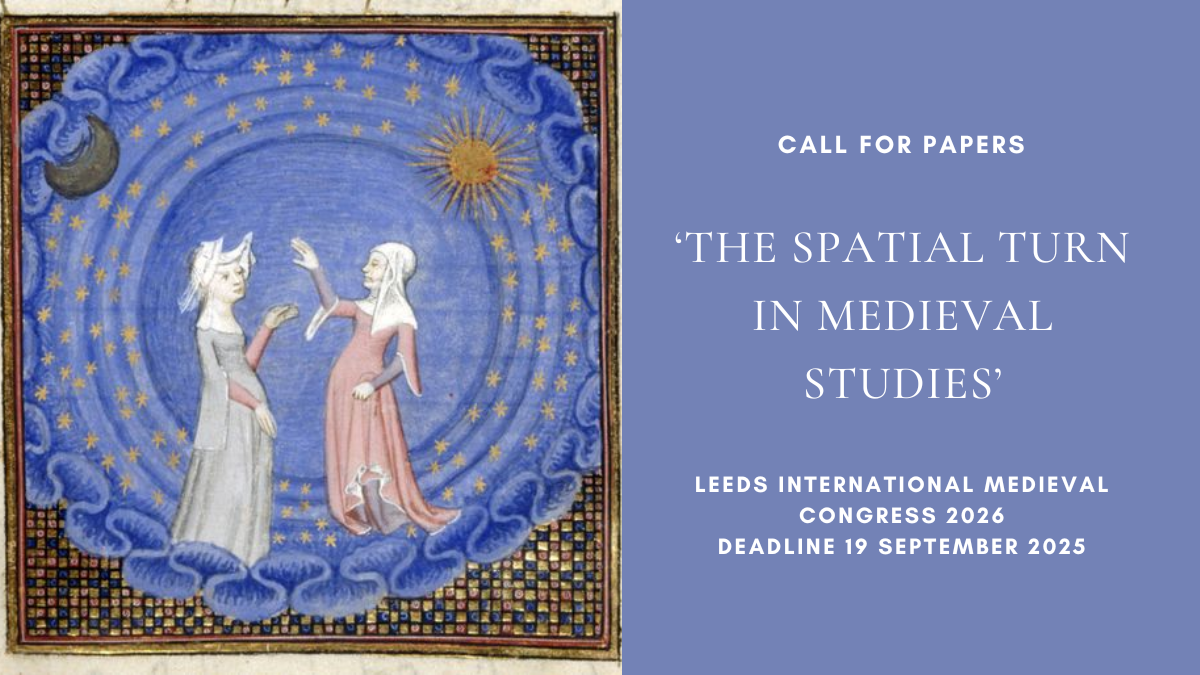
Appel à contribution – The Spatial Turn in Medieval Studies

Leeds International Medieval Congress 2026
Deadline : 19 September 2025

Space offers a valuable lens through which to rethink the practices in which religious rituals, material objects and written narratives, such as hagiography and historiography, were embedded. Scholars working within the spatial turn have emphasized that the location and physical spatial contexts of events are inseparable from the way in which they unfolded and the outcomes they produced. Space, both physically and socially constructed, plays a critical role in shaping human experiences, alongside other historical and social factors. This session explores how spatial configurations impacted medieval ways of knowing, by examining how space was conceptualized, structured, and transformed. In doing so, it aims to shed light on the ways in which spatial experience shaped the perceptions and actions of those who occupied it.

Potential topics include, but are not limited to, the following:

  • Digital reconstruction of medieval objects in their historical space
  • Performative actions within the context of their space in which they were performed
  • Medieval liturgy and its spatial dimensions and signs for meaning-making
  • Space and locations and its influence on medieval audiences
  • Descriptions of the use of space in medieval written narrative sources
  • Spatial dimensions in medieval manuscripts and its effect on its reader
  • Depictions of space in medieval visual images and artworks
  • The influence of space and location on the practices surrounding material (ritual) objects

If you are interested in joining these sessions, please send an abstract of max. 250 words, a short bio with affiliation details (institution, department, email address) and an indication if you are joining online or in-person, to Anne Sieberichs (Utrecht University) a.p.sieberichs@uu.nl and Imke Vet (Yale University) imke.vet@yale.edu. Deadline: 19 September 2025

Please note that the organisers are unable to contribute to participants’ travel or registration costs. Participants without sources of conference funding are encouraged to apply for the IMC bursary scheme.

Source : Medieval Art Research

Publié dans Appel à contributions | Commentaires fermés sur Appel à contribution – The Spatial Turn in Medieval Studies

Appel à contribution – IA et innovations numériques : usages et enjeux en archéologie

9e séminaire scientifique et technique de l’Inrap organisé en collaboration avec la direction de l’archéologie de la Ville de Chartres / Chartres Métropole, les jeudi 6 et vendredi 7 novembre 2025. Il portera sur les apports et les enjeux de l’usage de l’intelligence artificielle (IA) et des nouveaux outils numériques en archéologie.

Ces dernières années, ces innovations numériques impactent fortement l’archéologie à toutes les étapes de la chaîne opératoire : de la détection des sites à la restitution scientifique des résultats, en passant par l’analyse des données. Ces transformations touchent autant les outils que les pratiques.

Parmi les technologies particulièrement mobilisées, la vision par ordinateur est exploitée pour la reconnaissance automatique de motifs décoratifs, la détection de sites ou de structures (LiDAR, images satellitaires), l’appariement et le classement automatique (par ex. en numismatique, en bioarchéologie), la reconstitution virtuelle de bâtiments ou d’objets, la segmentation automatisée, ou encore le déchiffrement assisté de textes anciens.

Le traitement automatique des langues (TAL) est quant à lui fréquemment utilisé à des fins d’extraction d’information, notamment pour pratiquer de la fouille de texte ou de la reconnaissance des entités nommées, facilitant ainsi l’indexation et l’exploitation de larges corpus textuels. Il ouvre la voie à de nouveaux outils de recherche, de structurations de données, d’analyse et d’aide à la rédaction.

L’intelligence artificielle offre également de nouvelles perspectives pour la modélisation en archéologie. Qu’il s’agisse de restituer des structures, de simuler des dynamiques d’occupation ou de modéliser des réseaux, les approches basées sur l’apprentissage automatique permettent d’exploiter de grands volumes de données de manière inédite. Ces modèles suscitent toutefois des questions cruciales sur la validité des hypothèses, la transparence des processus et l’interprétation des résultats, invitant à un dialogue étroit entre spécialistes des données et archéologues.

Au quotidien, les usages de l’intelligence artificielle générative se démocratisent : traduction de textes, génération de résumés, mise en forme de bibliographie… Ces usages soulèvent des enjeux épistémologiques, méthodologiques, juridiques et éthiques : transparence des données d’entraînement, reproductibilité des résultats, fiabilité/qualité des résultats générées, place de l’IA dans la chaîne de production scientifique.

Ce séminaire propose de réfléchir à l’évolution des méthodes et à son impact sur la discipline, à travers toutes les étapes de la chaîne opératoire de l’archéologie, du terrain à la publication. Différents cas pratiques et retours d’expérience, en France comme à l’international, seront présentés. Les débats porteront également sur la qualité, l’accessibilité et la nature des jeux de données disponibles, les questions de droits d’auteur et d’usage, les actions de sensibilisation et de formation, ainsi que la diffusion des bonnes pratiques. Les échanges permettront enfin d’évaluer les forces et limites des outils existants et d’envisager les cadres à mettre en place dans les institutions pour encadrer et optimiser leur usage.

Appel à communication et à poster

Les exemples présentés pourront concerner les domaines suivants :

  1. Détection et cartographie des sites
  2. Acquisition, traitement et analyse des données
  3. Rédaction des rapports et valorisation scientifique
  4. Déontologie, normalisation, enjeux de formation et d’accompagnement

Cet appel s’adresse largement aux personnes impliquées dans les domaines de l’archéologie (Inrap, collectivités territoriales, ministère de la Culture, établissements de recherche ou d’enseignement supérieur), mais aussi à celles et ceux d’autres disciplines (par ex. sciences informatiques) susceptibles d’apporter un éclairage pertinent sur les thématiques abordées. Les contributions pourront porter sur des études de cas, des retours d’expérience, des développements méthodologiques, des analyses critiques ou des réflexions théoriques. Les approches interdisciplinaires seront particulièrement bienvenues.

Comité d’organisation

  • Carpentier Carine (Direction scientifique et technique, Inrap)
  • Dupuis Mathias (Direction de l’archéologie, Ville de Chartres, Chartres Métropole)
  • Féret Sophie (Direction scientifique et technique, Inrap, UMR 7041 ArScAn)
  • Lamy Pierre-Antoine (Direction de l’archéologie, Ville de Chartres, Chartres Métropole)
  • Sindonino Stéphane (Inrap Grand Est)

Comité scientifique

  • Bouiron Marc (Direction scientifique et technique, Inrap – UMR 7264 CEPAM)
  • Bryas Emmanuelle (Direction scientifique et technique, Inrap)
  • Charpier Marion (École nationale des chartes)
  • Corneli Marco (Université Nice Côte d’Azur, UMR 7264 CEPAM)
  • Lorho Thierry (Service régional de l’archéologie, Drac Centre-Val de Loire)
  • Menu Ariane (Direction scientifique et technique, Inrap)
  • Nicolas Théophane (Inrap Grand Ouest, UMR 8215 Trajectoires)
  • Pinhède Anaïs (Direction de l’archéologie, Ville de Chartres, Chartres Métropole)
  • Sagory Thomas (Musée d’Archéologie nationale)
  • Szabados Anne-Violaine (CNRS, UMR 7041 ArScAn, Équipe ESPRI&LIMC)

Source : INRAP

Publié dans Appel à contributions | Commentaires fermés sur Appel à contribution – IA et innovations numériques : usages et enjeux en archéologie

Appel à contribution – The Sixth Symposium on Crusade Studies

The Symposium on Crusade Studies, April 10 – 11, 2026, St. Louis, MO Saint Louis University, Missouri Campus.

​In celebration of the Twentieth Anniversary of the Crusade Studies Forum, the Sixth Symposium on Crusade Studies(April 10-11, 2026) hosted by Saint Louis University will take place on its Missouri campus in St. Louis, MO. Meeting in the vibrant city on the Mississippi River, the Symposium offers scholars the opportunity to present research, visit cultural locations, and engage in historical discussion. The goal of the Symposium is to promote serious scholarly investigation into all topics and disciplines associated with crusading and the Latin East. 

The Symposium invites proposals for papers, complete sessions, and roundtables. Any topics regarding the scholarly investigation of medieval crusading are welcome. Papers are normally twenty minutes each and sessions are scheduled for ninety minutes. 

Submissions are currently open and the deadline for all proposals is December 31st, 2025. Late submissions will be considered if space is available. Decisions will be made by the end of January and the program will be published in February.

Individual papers are expected to be 20 minutes in length. You should submit a title and abstract of no more than 250 words.  Session proposals have much more latitude regarding paper times and structure. Note: All sessions, round-tables, or seminars are required to have participants from at least two or more institutions.

Source : Crusade Studies

Publié dans Appel à contributions | Commentaires fermés sur Appel à contribution – The Sixth Symposium on Crusade Studies

Appel à contribution – Kaisertochter und Klosterstifterin: Mathilde – Leben und Wirken in Brauweiler

LVR-Kulturzentrum Abtei Brauweiler
25.11.2025

Anlässlich des tausendsten Todestages von Mathilde, Stifterin der Abtei Brauweiler und Tochter von Kaiser Otto II. und Kaiserin Theophanu, möchte das LVR-Kulturzentrum Abtei Brauweiler den Rahmen für einen oder mehrere Vorträge bieten, die sich mit dem Leben und Wirken von Mathilde auseinandersetzen. Dieser Call for Papers richtet sich primär an Nachwuchswissenschaftler:innen (Masterstudierende, Promovierende und Postdocs).

Der Landschaftsverband Rheinland (LVR) arbeitet als Kommunalverband mit rund 22.000 Beschäftigten für die etwa 9,8 Millionen Menschen im Rheinland. Mit seinen 41 Schulen, zehn Kliniken, 20 Museen und Kultureinrichtungen, vier Jugendhilfeeinrichtungen, dem Landesjugendamt sowie dem LVR-Verbund für WohnenPlusLeben erfüllt er Aufgaben, die rheinlandweit wahrgenommen werden.

Das LVR-Kulturzentrum Abtei Brauweiler befindet sich in den Räumlichkeiten der ehemaligen Benediktiner Abtei Brauweiler. Das Kulturzentrum hat es sich zur Aufgabe gemacht hat, die Geschichte und das kulturelle Erbe des Ortes aufzuarbeiten und zu vermitteln.

Mathilde – Tochter Kaiser Ottos II. und der Byzantinerin Theophanu – und ihr Ehemann Pfalzgraf Ezzo stifteten im 11. Jahrhundert die Abtei Brauweiler. Der Legende zufolge offenbarte sich Mathilde im Traum eine göttliche Vision, die sie dazu inspirierte, auf dem Brauweiler Hofgut ein Kloster zu stiften. Angetrieben durch diese Vision, pilgerten Mathilde und ihr Mann nach Rom und erhielten im Jahr 1023 durch den römischen Papst Reliquien sowie ein Kreuz für eine Klostergründung. Die Wahl des Standortes Brauweiler wird in der vor 1100 verfassten Fundatio monasterii Brunwilarensis, der Gründungsgeschichte des Klosters Brauweiler, mit Mathildes Vision begründet.

Anlässlich Mathildes Tod im November 1025, der sich in diesem Jahr zum tausendsten Mal jährt, möchte das LVR-Kulturzentrum Abtei Brauweiler am 25. November 2025 einen Vortragsabend zu Ehren der Klosterstifterin ausrichten. Die Veranstaltung findet in klösterlichem Ambiente, in den Räumlichkeiten der Abtei statt. An den Kölner Westen grenzend, spricht der Standort Brauweiler insbesondere die Universitäts- und Wissenschaftsstandorte Köln, Bonn und Düsseldorf an.

Mögliche Vortragsthemen:
Mathilde soll im Mittelpunkt des Vortrags stehen. Hinsichtlich der Einbettung dieses Themas in größere Zusammenhänge gibt es bei sinnvoller Argumentation keine Beschränkungen. Interdisziplinäre Ansätze sowie Verbindungen zwischen Ihrer eigenen Forschung und dem gesetzten Thema des Vortrags sind willkommen.

Mögliche Fachrichtungen:
Geschichtswissenschaften (mit mittelalterlichem Schwerpunkt); Germanistische Mediävistik; Kunstgeschichte (mit mittelalterlichem Schwerpunkt); Theologie bzw. Kirchen- und Theologiegeschichte

Wir freuen uns über Vorschläge im Umfang von maximal einer Seite (500 Wörter) mit einem Titel und kurzen biografischen Angaben. Diese senden Sie bitte bis zum 21. September 2025 an Lina Zwania (Lina.Zwania@lvr.de).

Source : H-Soz-Kult

Publié dans Appel à contributions | Commentaires fermés sur Appel à contribution – Kaisertochter und Klosterstifterin: Mathilde – Leben und Wirken in Brauweiler

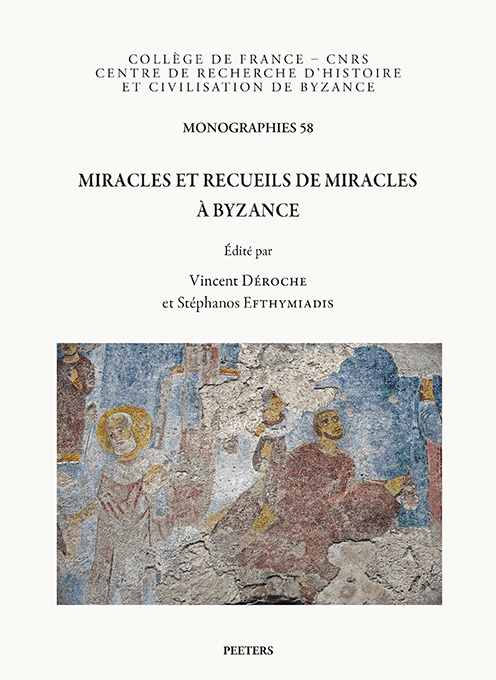
Publication – « Miracles et recueils de miracles à Byzance », éd.Vincent Déroche, Stéphanos Efthymiadis

Les récits de miracles dans la littérature hagiographique en général et les recueils de miracles en particulier ont toujours été à Byzance un indicateur privilégié de l’évolution des cultes, des représentations et même de la société dans son ensemble, à travers un foisonnement d’indices parfois inattendus: le récit de miracle a beau avoir ses règles propres, il est souvent plus proche des realia que les constructions hagiographiques des Vies de saints. Les études rassemblées ici, tantôt dans le temps long, tantôt sur un texte ou un dossier particulier, tantôt transversalement sur une thématique commune à plusieurs textes, illustrent les riches possibilités de ces sources.

Tales of miracles in hagiographical literature in general and in collections of miracles more specifically were always at Byzantium an outstanding testimony on the evolution of the cults, and even of the whole society itself, through a plenty of cues, sometimes unexpected: although the tale of miracle has its own rules, it is often closer to realia than the hagiographical constructions in the Lives of saints. The studies collected here, aiming at the “temps long”, or at a specific text or dossier, or transversally at a theme common to a group of texts, give a hint of the rich potential of those sources.

Table des matières : ici

Informations pratiques :

Miracles et recueils de miracles à Byzance, éd.Vincent Déroche, Stéphanos Efthymiadis, Paris–Louvain, Collège de France–Peeters, 2025 ; 1 vol., VIII–151 p. (Monographies du Centre de Recherche d’Histoire et Civilisation de Byzance – Collège de France, 58). ISBN : 978-9-04295-520-2. Prix : € 38,00.

Source : Peeters

Publié dans Publications | Commentaires fermés sur Publication – « Miracles et recueils de miracles à Byzance », éd.Vincent Déroche, Stéphanos Efthymiadis

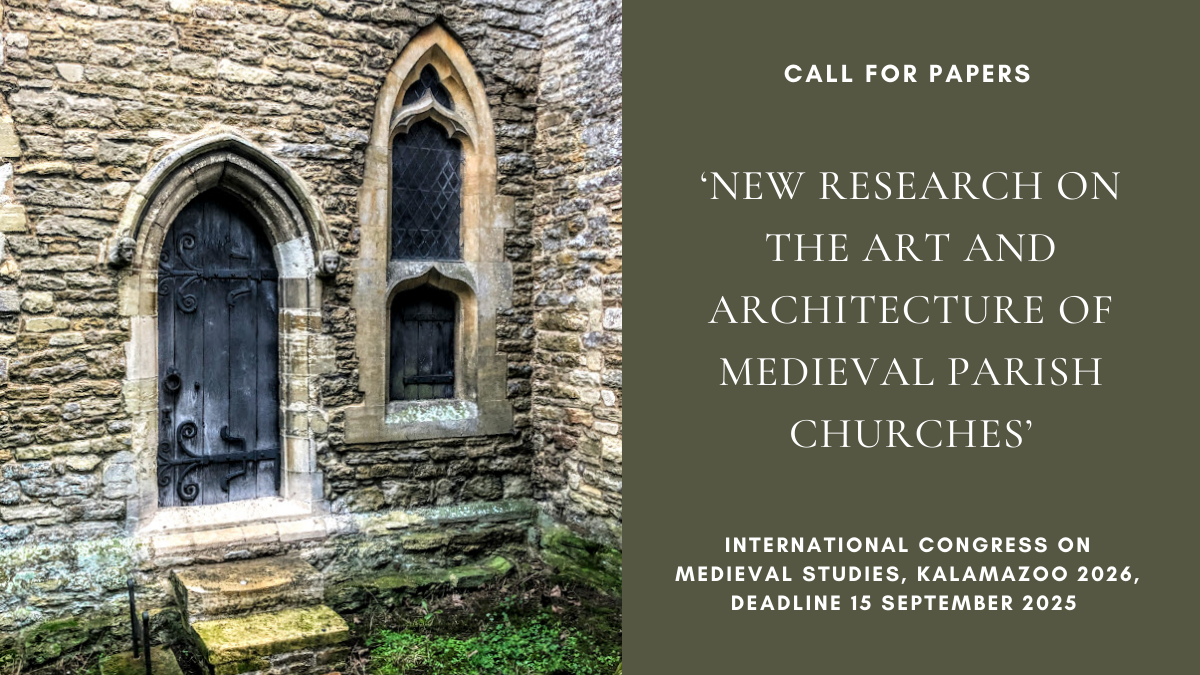
Appel à contribution – New Research on the Art and Architecture of Medieval Parish Churches

Scholars are invited to propose presentations on any aspect of the art and architecture of the medieval parish church. Possible research questions include, but are not limited to: How did the architecture, art, or visual culture of the parish define the medieval worship experience? How did individual churches change over time—and what can these changes reveal about each parish community? How can in-depth study of a local parish church expand or contradict broader national narratives? What new methodologies can twenty-first century scholars use to tell the story of the medieval parish?

To submit a proposal for the in-person session: https://icms.confex.com/icms/2026/prelim.cgi/Session/7517.

To submit a proposal for the virtual session: https://icms.confex.com/icms/2026/prelim.cgi/Session/7653.

Proposals should consist of a title, an abstract (300 words or less), and a short description (50 words or less) which may be made public if the proposal is accepted. Please also include the author’s name, affiliation and contact information.

For general information on the International Congress on Medieval Studies CFP process, see https://wmich.edu/medievalcongress/call

For questions related to this panel, contact the session presider, Catherine E. Hundley: chundley[at]wesleyseminary.edu.  

Proposals are due September 15, 2025.

Source : Medieval Art Research

Publié dans Appel à contributions | Commentaires fermés sur Appel à contribution – New Research on the Art and Architecture of Medieval Parish Churches