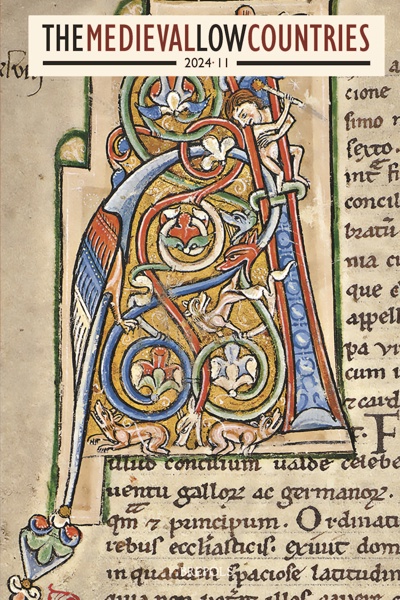
Publication – Scandinavia and the Low Countries (The Medieval Low Countries, 11, 2024)

The Medieval Low Countries (MLC) is a peer-reviewed journal featuring articles on the Low Countries (viewed in its broadest sense as the estuaries of Scheldt, Meuse, Rhine and IJssel with their corresponding hinterlands), from the start of the fifth century to the second half of the sixteenth century. During these centuries, this region was one of the major centers of economic, cultural, religious and social development in Europe. By publishing the best of new scholarship concerning the region over the course of the Middle Ages, The Medieval Low Countries makes these achievements more visible and highlights the connections between changes in each domain. At the same time, the journal provides a forum for exchange and cooperation between established and upcoming scholars in several disciplines, whether in Europe, the United States, or beyond. The MLC is a continuation of the journals Millennium, Jaarboek voor Middeleeuwse Geschiedenis, and Medieval and Modern Matters: Archaeology and Material Culture in the Low Countries.

Saints of the Low Countries in Scandinavia. Manuscript evidence from twelfth-century Lund and Nidaros – Synnøve Midtbø Myking

Books from the Low Countries in high-medieval Scandinavia. A two-part manuscript from Saint-Omer in Denmark, its decorative practices, and their reflections in some Nordic fragments – Jaakko Tahkokallio

Recognising Manuscripts from the Low Countries. Cases from Nordic Fragment Collections – Åslaug Ommundsen

The Legend of Marie of Oignies and its Early Dissemination in the North – Lotte Devoldere

The Dane saga of Breda. A Late Medieval Account of Viking Endeavour and Vernacular Devotion – Christian Cooijmans

Informations pratiques :

Scandinavia and the Low Countries, The Medieval Low Countries, t. 11, 2024 ; 1 vol., 236 p. ISBN : 978-2-503-60871-6. Prix : € 93,00.

Source : Brepols

Publié dans Publications | Commentaires fermés sur Publication – Scandinavia and the Low Countries (The Medieval Low Countries, 11, 2024)

Publication – Wolfgang Giese, « Hugo von Arles und Vienne – König im Regnum Italiae. Nachforschungen zu Leben und Wirken einer Herrscherpersönlichkeit in der Wendezeit vom 9. bis in die Mitte des 10. Jahrhunderts »

Das Buch behandelt einen Abschnitt aus der Zeit der Auflösungssphase des karolingischen Großreichs, die sich zwischen dem ausgehenden 9. und der Mitte des 10. Jahrhunderts vollzogen hat. Während sich damals aus diesem Herrschaftsgebilde nördlich der Alpen nur langsam das deutsche und das französische Reich herausentwickelten, etablierte sich südwärts davon zwischen 888 und 951/62 ein eigenes „italisches“ Königreich (Regnum Italiae). In ihm dominierte ein selbstbewusster Adel, der schnell mit Einsetzungen und Verlassungen seiner Könige bei der Hand war, wobei er diese mit Vorliebe aus anderen Ländern berief. Ein solcher Ruf erging 925 an den Grafen Hugo von Arles und Vienne, der sich als Rex Italiae dann am längsten – nämlich von 926–945 – an der Macht gehalten hat. Den Verlauf und die Eigenart dieser Regierungszeit versucht das Buch nachzuverfolgen und zu charakterisieren, einschließlich eines Blickes auf die letzten, in der Provence verbrachten Lebensjahre Hugos. Diesem Darstellungsteil vorangestellt ist ein Kapitel, das sich seiner politischen Karriere und Aktivität im Königreich Provence bis zu seinem Weggang nach Italien widmet, wodurch der vorliegende Band den Charakter einer Monographie zu Hugo erhält.

Table des matières : ici

Informations pratiques :

Wolfgang Giese, Hugo von Arles und Vienne – König im Regnum Italiae. Nachforschungen zu Leben und Wirken einer Herrscherpersönlichkeit in der Wendezeit vom 9. bis in die Mitte des 10. Jahrhunderts, Munich, Utzverlag, 2025 ; 1 vol., 382 p. ISBN : 978-3-8316-7811-2. Prix : € 84,00.

Source : utzverlag

Publié dans Publications | Commentaires fermés sur Publication – Wolfgang Giese, « Hugo von Arles und Vienne – König im Regnum Italiae. Nachforschungen zu Leben und Wirken einer Herrscherpersönlichkeit in der Wendezeit vom 9. bis in die Mitte des 10. Jahrhunderts »

Web – La « Carte archéologique de la Gaule » dans Gallica

Accès : ici

La Carte archéologique de la Gaule recense les découvertes archéologiques en France, de la Protohistoire à Charlemagne. Publiée par département, elle inclut cartes, synthèses et notices illustrées classées par commune selon la richesse du patrimoine local.

En 2025, l’Académie des Inscriptions et Belles-Lettres a établi un partenariat avec la BnF afin de numériser la Carte Archéologique de la Gaule (CAG), l’une de ses collections parmi les plus emblématiques. Créée en 1930 par l’Académie des Inscriptions et Belles-Lettres, puis relancée en 1988, la CAG fournit le pré-inventaire des trouvailles archéologiques survenues sur le territoire français, de la Protohistoire jusqu’au règne de Charlemagne. Le cadre de la publication est strictement départemental, à raison d’un ou de plusieurs fascicules pour chaque département, en fonction de la richesse de leur patrimoine archéologique.

À ce jour, 140 volumes ont été publiés, sans compter les nombreuses rééditions mises à jour, grâce aux efforts de M. Michel Provost, directeur scientifique de la CAG. Cette collection qui couvre l’intégralité du territoire national constitue assurément une ressource précieuse pour les recherches historiques et archéologiques le concernant ; c’est d’ailleurs le seul projet de ce type qui ait abouti, en Europe.

Source : Bibliothèque nationale de France

Publié dans Web | Commentaires fermés sur Web – La « Carte archéologique de la Gaule » dans Gallica

Publication – « Towards an Accessible Academy. Perspectives from Disabled Medievalists », éd. Alexandra R.A. Lee, E.R.P. Champion, Hope Doherty-Harrison

Higher Education is a rich and diverse environment which allows so many different types of people and disciplines to flourish. Medieval Studies is a particular confluence of this, with the meeting of history, literature, history of art, archaeology, and more. The contributors describe their lived experience of disability and how this intersects with the discipline of Medieval Studies, embracing both the challenges and the joy this can bring. They discuss teaching, research, and just existing within the university, bringing in theoretical approaches as well as linking to medieval texts. Towards an Accessible Academy provides a unique perspective on the state of accessibility within this field and in the university environment more broadly. 

This volume sits between work which centers the experience of disabled academics and which provides guidance for supporting disabled students. While providing real-life testimonies of disability in the academy, many chapters also include practical advice on best practice in supporting disabled scholars and students, as well as how the authors feel connected to the medieval sources we study. 

The book is also a call to action for all of its readers to actively practise allyship, providing clear examples of how we might all implement the advice given by contributors to improve the accessibility of our academy.

Alexandra R.A. Lee, NYU London, UK; Hope Doherty-Harrison, History of Art, University of Edinburgh, UK; E.R.P. Champion, independent scholar, UK.

Table des matières : ici

Informations pratiques :

Towards an Accessible Academy. Perspectives from Disabled Medievalists, éd. Alexandra R.A. Lee, E.R.P. Champion, Hope Doherty-Harrison, Berlin–Boston, De Gruyter, 2025 ; 1 vol., X–228 p. (Premodern Transgressive Literatures, 2). ISBN : 978-1-50152-109-6. Prix : € 99,95.

Source : De Gruyter

Publié dans Publications | Commentaires fermés sur Publication – « Towards an Accessible Academy. Perspectives from Disabled Medievalists », éd. Alexandra R.A. Lee, E.R.P. Champion, Hope Doherty-Harrison

Publication – Lorenzo Pubblici, « La Rus’ di Kiev. Un crocevia fra Europa e Asia nel Medioevo »

Il volume propone un viaggio in uno dei crocevia culturali, politici ed economici più significativi del medioevo. Attraverso una narrazione serrata e rigorosa l’autore ripercorre la storia della Rus’ dalle origini alla frammentazione, esplorandone le dinamiche sociali, le istituzioni, i rapporti coi poteri vicini: Bisanzio, l’Europa e le steppe dell’Asia. Il testo offre una visione delle vicende della Rus’, dai principi Rjurikidi alla cristianizzazione, dalle rotte commerciali ai conflitti dinastici, tracciando il ritratto di una società complessa, un ponte fra Oriente e Occidente, le cui eredità culturali e politiche risuonano ancora oggi. Una lettura che permette di comprendere le radici dell’Europa orientale e l’evoluzione di un’entità statuale che ha dato un contributo decisivo al medioevo europeo, e non solo.

Table des matières :

Introduzione
1. Le origini. Dalla nascita della Rus’ alla morte di Vladimir i (850-1015)
Prima della Rus’. Forme insediative e organizzazione sociale delle popolazioni slave orientali/La Rus’ fra il khaganato cazaro e l’islam/Origini della Rus’: la versione della Povest’/Lenta espansione del Nord: Igor’/Primi rudimenti di politica estera e morte di Igor’/Consolidamento delle alleanze: l’età di Ol’ga/Verso una nuova Rus’: gli anni di Svjatoslav e la fine dell’egemonia cazara/Il cerchio si chiude: l’età di Vladimir il Grande/Letture consigliate
2. La Rus’ nell’XI secolo: una questione familiare
La dinastia come fonte di legittimità politica/La Rus’ all’alba dell’XI secolo. Il “problema” della successione/Mstislav e la diarchia/Affermazione e consolidamento del sistema della successione laterale/Il centro guarda alla periferia. La Rus’ alla fine dell’XI secolo e l’accordo di Ljubeč/L’età di Vladimir Monomaco/La Rus’ e i poteri esterni: dal Nord ai nomadi/Religione e cultura nella Rus’ dell’XI secolo/Letture consigliate
3. Il XII secolo: alleanze, conflitti e divisioni
La Rus’ nel XII secolo: quadro d’insieme e dibattito storiografico/Eredità di Vladimir Monomaco/Morte di Jaropolk e nuovi conflitti/Jurij Dolgorukij: polarizzazione del potere e nuove egemonie/Crisi politiche e restaurazioni: gli anni di Andrej Bogoljubskij/Fine del secolo e nuove configurazioni di potere/Letture consigliate
4. La fine della Rus’
La Rus’ alla vigilia dell’invasione mongola: una sconfitta evitabile?
L’invasione mongola: cronologia degli eventi/Conseguenze immediate dell’invasione/Una dominazione a geometria variabile/Verso un’altra Rus’/Ascesa e affermazione di Mosca/Letture consigliate
5. Dalla Rus’ alla Russia
Da Vladimir a Mosca/Principato di Ivan ii e crisi dell’Orda d’oro/Centralità di Novgorod/Da Kulikovo alla Moscovia/La Chiesa e il principe durante la dominazione mongola/L’eredità. Rus’, Russia e “giogo tartaro”/Letture consigliate
6. Istituzioni, società ed economia nella Rus’ di Kiev
Il principe e il metropolita/Ceti egemoni e ceti subalterni/La gestione dello spazio agrario: proprietari, contadini e gli altri/Manifattura e commercio nella Rus’/Il sistema giudiziario: la Russkaja Pravda/Letture consigliate
Conclusioni
Glossario
Genealogie
Cronologia
Bibliografia
Indice dei nomi e delle cose notevoli

Informations pratiques :

Lorenzo Pubblici, La Rus’ di Kiev. Un crocevia fra Europa e Asia nel Medioevo, Rome, Carocci, 2025 ; 1 vol., 204 p. (Quality paperbacks). ISBN : 978-8-82903-043-9. Prix : € 19,00.

Source : Carocci

Publié dans Publications | Commentaires fermés sur Publication – Lorenzo Pubblici, « La Rus’ di Kiev. Un crocevia fra Europa e Asia nel Medioevo »

Publication – « Au Moyen Âge et par-delà : Passeurs, échanges et transferts en Méditerranée. Hommage à John Tolan », éd. Philippe Josserand, Annick Peters-Custot

Passé d’une rive à l’autre de l’Atlantique, d’Occident en Orient, John Tolan est depuis son arrivée à Nantes, à la fin du XXe siècle, l’un des historiens qui, au plan international, s’est le plus consacré aux transferts et aux échanges dans la Méditerranée médiévale et aux échos contemporains de cette histoire complexe. Pour lui rendre hommage, une vingtaine de chercheurs a souhaité mettre en relief et interroger des figures de passeurs. Au fil des pages, dans des contextes fort différents, se dessinent individus, groupes ou institutions et, à travers eux, les interrelations, toujours riches et éventuellement conflictuelles, qu’ils ont permises. Une temporalité ample, dépassant le Moyen Âge placé au coeur du livre, et un cadre géographique large s’imposaient, propres à souligner les changements de contexte que John Tolan, dans ses travaux, a si bien analysés en opérant à sa suite une approche pluridisciplinaire qui réunit l’histoire, l’étude des langues et l’ensemble des sciences sociales.

Table des matières : ici

Informations pratiques :

Au Moyen Âge et par-delà : Passeurs, échanges et transferts en Méditerranée. Hommage à John Tolan, éd. Philippe Josserand, Annick Peters-Custot, Rennes, Presses universitaires de Rennes, 2025 ; 1 vol., 226 p. (Enquêtes et Documents). ISBN : 979-1-04130-454-7. Prix : € 22,00.

Sources : Presses universitaires de Rennes

Publié dans Publications | Commentaires fermés sur Publication – « Au Moyen Âge et par-delà : Passeurs, échanges et transferts en Méditerranée. Hommage à John Tolan », éd. Philippe Josserand, Annick Peters-Custot

Offre d’emploi – Assistant Professor, Tenure-Track, Medieval History (Global), Department of History

Deadline : Sep 15, 2025 at 11:59 PM Eastern Time

The Department of History at Baylor University seeks to fill a tenure-track position in the history of the medieval world at the Assistant Professor level, effective August 2026. Any geographic specialization welcome to apply. We are particularly interested in those with research and/or teaching experience in the fields of history of science, medicine, and technology.

Baylor University is located in Waco, Texas and is the oldest college in the state. It has a diverse student population of 21,000 and is recognized as one of the top universities in the nation, achieving R1 institution status by the Carnegie Classification in January 2022. Baylor also made it to the honor roll of « Great Colleges to Work For » from The Chronicle of Higher Education. It offers competitive salaries and benefits, allowing faculty and staff to live in one of the fastest-growing parts of the state. Baylor’s new strategic plan, Baylor in Deeds, guides the University as it continues to fulfill its mission of educating men and women for worldwide leadership and service by integrating academic excellence and Christian commitment within a caring community.

Qualifications

REQUIRED 

Applicants must possess and/or demonstrate the following:

  • an earned doctorate in History or a related field by the time of appointment;
  • academic interest and specialization in the Global Middle Ages;
  • potential for success in scholarly publications commensurate with an R1 History department;
  • potential for success in effective teaching and mentoring at both the undergraduate and graduate levels;
  • potential for success in seeking external funding.

PREFERRED

We welcome applicants with all academic interests in Medieval History, any geographic specialization, but are particularly interested in those with research and/or teaching experience in the history of science, medicine, and technology. 

Application Instructions

To apply, please submit the following materials electronically via Interfolio: 

  1. Letter of application/cover letter
  2. Curriculum vitae
  3. Contact information for three references who will provide letters of recommendation at a later time
  4. Transcript of highest degree earned

Additionally, all applicants must complete the self-disclosed Religious Affiliation Form in Interfolio.

Selected candidates will be asked to furnish additional materials including the aforementioned three letters of recommendation and a chapter- or article-length writing sample. Candidates invited for a campus interview will need to provide an official transcript of highest degree earned or in progress. Finalists may be asked to submit additional writing samples. 

Complete applications must be submitted by 11:00 p.m. Central Daylight Time (CDT) on September 15, 2025, after which time review of applications will begin. Any questions about the position may be directed to the Search Committee Chair, Dr. Daniel J. Watkins, at Daniel_Watkins@baylor.edu. Any questions about Interfolio may be directed to Dianne Schmidt at Dianne_Schmidt@baylor.edu

Source : Baylor University

Publié dans Offre d'emploi | Commentaires fermés sur Offre d’emploi – Assistant Professor, Tenure-Track, Medieval History (Global), Department of History

Appel à contribution – Turn On, Tune In, Drop Out: Psychedelic Approaches to Medieval Objects

Psychedelic art, an outgrowth of mid-century counterculture, features numerous motifs that may resonate with medievalists. Surreal imagery, animation, bright colors, and the cross-pollination of disparate media all conspire to evoke a hallucinogenic or heightened response in the viewer. We invite proposals for 20-minute papers considering medieval material culture through a psychedelic lens, or vice versa.

A sampling of topics may include devotional objects and visionary or mystical encounters; medievalism in 1960s fashion and design; artistic representations of or, artifacts associated with, psychoactive plant and fungi cultivation; or the synesthetic/multisensory impact of objects.

This session will be held in person in Kalamazoo. Please submit an abstract of no more than 300 words through the Confex proposal portal by September 15, 2025.

For questions about this session, please contact Sophie Durbin (sophiekhdurbin@gmail.com) and Clara Poteet (clara.poteet@yale.edu).

Source : Medieval Art Research

Publié dans Appel à contributions | Commentaires fermés sur Appel à contribution – Turn On, Tune In, Drop Out: Psychedelic Approaches to Medieval Objects

Publication – Valentin Machut, « La royauté au Xe siècle en Francie occidentale. Selon Richer de Reims et Gerbert d’Aurillac »

Le Xe siècle, marqué par une rupture dynastique, voit les Carolingiens céder la place aux Capétiens, transition cruciale pour l’histoire des Francs en Francie occidentale. Cette période, riche en vicissitudes, offre une perspective idéale pour analyser la distribution du pouvoir entre le roi et l’aristocratie à l’aube de l’an mille. Le rex Francorum, réduit à un rôle symbolique, lutte pour préserver son autorité, tandis que le dux Francorum prend progressivement le contrôle. En Germanie, la dynastie ottonienne, issue des Ludolphides saxons, devient la force dominante en Occident. Elle étend son influence, contrastant avec les crises internes des derniers Carolingiens.

Ce tournant décisif de l’histoire européenne témoigne d’une royauté privée de son éclat d’antan, où le pouvoir royal dépend davantage de la stratégie que de la légitimité dynastique. Ce livre plonge le lecteur dans ce crépuscule du haut Moyen Âge, s’appuyant sur des témoignages clés : Richer de Saint-Rémi de Reims, auteur de l’Historia Francorum, et la Correspondance de Gerbert d’Aurillac, futur pape Sylvestre II, apportent des perspectives sur les réalités sociales et politiques de l’époque.

Diplômé en science politique et en histoire européenne à l’université de Lille, Valentin Machut se passionne pour le monde franc et germanique du haut Moyen Âge (Ve-Xe siècle). Ce premier livre, issu de ses recherches universitaires, se présente comme une amorce dans le monde de la recherche historique.

Informations pratiques :

Valentin Machut, La royauté au Xe siècle en Francie occidentale. Selon Richer de Reims et Gerbert d’Aurillac, Paris, L’Harmattan, 2025 ; 1 vol., 216 p. (Historiques). ISBN : 978-2-336-53449-7. Prix : € 24,00.

Source : L’Harmattan

Publié dans Publications | Commentaires fermés sur Publication – Valentin Machut, « La royauté au Xe siècle en Francie occidentale. Selon Richer de Reims et Gerbert d’Aurillac »

Appel à contribution – Presentologies. Using Time in the Medieval Worlds

This session series invites contributions that explore the medieval present as a category of knowledge, narration, and power: How was the present conceptualised, made intelligible, and put to use? What models, scripts, and strategies shaped the temporal regimes of medieval actors and texts? We propose to explore these dynamics under the umbrella term ‘presentologies’—that is: ways of thinking, constructing, and mobilising the present as a distinct temporal regime.

Time is not neutral—and never has been. Rather, it is narrated, charged, measured, ritualised or even silenced. The present in medieval contexts, too, was not simply a moment between past and future but a site of orientation, intervention, and temporal authority: For it reveals time as a productive epistemic mode—capable of structuring the past, anticipating futures, and legitimising decisions.

This session series invites contributions that explore the medieval present as a category of knowledge, narration, and power: How was the present conceptualised, made intelligible, and put to use? What models, scripts, and strategies shaped the temporal regimes of medieval actors and texts? We propose to explore these dynamics under the umbrella term ‘presentologies’—that is: ways of thinking, constructing, and mobilising the present as a distinct temporal regime. Presentologies attend to how medieval actors (and modern scholars) conceptualise the ‘here and now’ not as a neutral point in linear time but as a site of epistemic productivity, strategic positioning, and imaginative expansion.

Rather than viewing the time that we generally call ‘the Middle Ages’ as trapped in eschatological stasis or prophetic timelessness, we ask how actors—whether lay or clerical, individuals or collective—produced knowledge through and about time. What interpretive techniques, narrative strategies, or theological models were used to render the past meaningful, the present intelligible, and the future imaginable? What forms of contingency, anticipation, or temporal agency are visible in medieval sources? And what can such perspectives tell us about the (contested) politics of time in medieval societies?

We invite contributions that examine the temporal logics and narrative strategies through which medieval actors made sense of their world. Contributions may focus on the epistemology of time, the uses of the past, present, and future or the politics of temporal representation. Topics may include (but are not limited to):

– temporal epistemologies and the uses of the present and future in medieval texts
– prognostic and anticipatory modes in narrative, visionary, legal, or ritual sources
– time as a framework for authority, legitimation, and political negotiation
– strategies for managing uncertainty, contingency, or unstable futures
– intersections of eschatology, prediction, and temporal planning
– techniques of shaping the future through representations of the present
– synergies of the topics mentioned above

We especially welcome theoretical and interdisciplinary contributions from a variety of sources, as well as work that engages critically with modern temporal assumptions projected onto the Middle Ages. Contributions may include case studies, conceptual reflections, teaching examples or work-in-progress. Each speaker will be allotted 15–20 minutes and will be invited into a collective discussion following the session.

Please send your proposal with a 250-word abstract and a short CV (and any questions you might have) to maria.kammerlander@geschichte.uni-freiburg.de and rike.szill@geschichte.uni-tuebingen.de by 31 August 2025 at the latest. We will get in touch by the end of September.

Source : H-Soz-Kult

Publié dans Appel à contributions | Commentaires fermés sur Appel à contribution – Presentologies. Using Time in the Medieval Worlds