The Department of Literary Studies at Ghent University is pleased to announce that it will host an international conference on the Ten Commandments in medieval and early modern culture on April 10-11, 2014. Selected papers will be published in a volume to be included in the peer-reviewed series Intersections. Interdisciplinary Studies in Early Modern Culture (Brill Publishers).
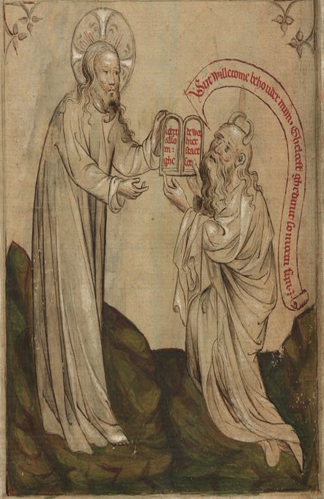
The rise to prominence of the Ten Commandments dates back to the 12th century. In that period exegetes such as Hugh of Saint Victor emphasized the importance of the Decalogue as a list of moral principles. A century later the Ten Commandments permeated scholastic learning as well as catechetical teaching. They became a useful instrument for the examination of conscience in preparation for the mandatory annual confession introduced by the Fourth Lateran Council (1215). By the second half of the 15th century, the Commandments were omnipresent in religious culture. Their diverse textual and visual manifestations were found in a variety of media, from manuscripts and printed books, to wall paintings and wooden panels. The prominence of the Decalogue continued amongst the Protestants, albeit with a different emphasis than in Catholic teaching.
The heterogeneity of the preserved Decalogue material inspires numerous research questions, many of which are vital and yet largely unexplored. It also poses methodological challenges to scholars who seek to explore and understand the role of the Ten Commandments within a broader context of medieval and early modern culture. Bearing this in mind, we invited papers that elaborate on various aspects of textual – both Latin and vernacular – and visual manifestations of the Decalogue in the Middle Ages and the Early Modern period. The proposed papers put emphasis on the broader cultural context in which the Decalogue functioned, as well as on the methodological and theoretical aspects of the discussed piece of research.
Programme :
Day 1: Thursday, April 10, 2014
9:00-9:30 : Registration, coffee
9:30-9:45 : Opening of the conference, a word of welcome from the organisers
9:45-11:15 Session 1: Theological perspectives on the Decalogue in the middle ages and the early modern period
Luca Gili, Catholic University Leuven, Belgium – ‘Who will inherit the Kingdom of God’? Thomas Aquinas and Dante on the insufficiency of the observance the Decalogue in order to be saved
Marta Bigus, Ghent University, Belgium – Theology of the Decalogue in fourteenth-century vernacular texts from the Low Countries
David Kim, University of Seoul, South Korea – The coveting of the Decalogue in Luther’s Large Catechism
11:15-11:30 Coffee break
11:30-13:00 Session 2: The Decalogue in religious instruction 1: sermons
Greti Dinkova-Bruun, Pontifical Institute of Medieval Studies Toronto, Canada – The Ten Commandments in the thirteenth-century pastoral manual Qui bene presunt
Krzysztof Bracha, Jan Kochanowski University, Kielce / Institute of History, Polish Academy of Sciences, Warsaw, Poland – The Ten Commandments in preaching in the late medieval Poland: Sermo de praeceptis from the ms. 3022 at the National Library in Warsaw
Fabrizio Conti, Central European University, Budapest, Hungary – Shaping religious identities through the Ten Commandments. The Franciscan Observant pastoral approach in the fifteenth-century Milan
13:00-14:00 : Lunch
14:00-15:30 Session 3: The Decalogue in religious instruction 2: other textual tools for religious instruction
Michael Madrinkian, Hertford College, University of Oxford, UK – The Decalogue and the reform of the late fourteenth century: an unpublished prose text of Oxford, Bodleian Library, Laud Misc. 656
Lucie Dolezalova, Charles University, Prague, Czech Republic – The Ten Commandments and the Ten Plagues: a curious poem in the context of late medieval Latin biblical mnemonics in Central Europe
Jonas Carlquist and Virginia Langum, Umeå University, Sweden – Narrating the Ten Commandments and Seven Sins in Middle English and Old Swedish
15:30- 15:45 : Coffee break
15:45-17:15 Session 4: The Decalogue in medieval and early modern literature 1
Joachim Yeshaya, Johann Wolfgang Goethe-University, Frankfurt am Main, Germany – The Ten Commandments in late Byzantine and early Ottoman Karaite-Jewish poetry and Bible exegesis
Charlotte Cooper, St. Edmunds Hall, University of Oxford, UK – Christine de Pizan’s Epistre Othea: the Ten Commandments allegorised
Stefania Gargioni, University of Kent, UK/Freie Universität Berlin, Germany – Between text and image: the representation of the Decalogue in 1560s Calvinist French texts
17:15-18:30: Keynote Lecture: Lesley Smith, Harris Manchester College, University of Oxford, UK – The Ten Commandments in the Medieval Schools: Conformity or Diversity?
19:00-…. : Conference diner for invited speakers
Day 2: Friday, April 11, 2
9:30-11:20 Session 1: The Decalogue visualised
Lucy Wooding, King’s College London, UK – Visualizing vice and virtue: images of the Decalogue in late medieval and reformation English culture
Jonathan Willis, University of Birmingham, UK – Picturing the Ten Commandments in the post-reformation English parish church
Henk van den Belt, University of Groningen, The Netherlands – The law illuminated: biblical illustrations of the Commandments in Lutheran Catechisms
11:20-11:35 : Coffee break
11:35-13:00 Session 2: The Decalogue in medieval and early modern literature 2
Alexander Roose, Ghent University, Belgium – Les commandements d’Amour – Le Roman de la Rose and the Decalogue
Gregory Haake, Stanford University, USA – Loving neighbor before god: the first commandment in early modern lyric poetry
Michele De Benedictis – I could set my Ten Commandments in your face. Dramatization of the Decalogue in early modern England
13:00-14:00 : Lunch
14:00-15:30 Session 3: The Decalogue in reformatory and contra-reformatory movements
Stephen Lahey, University of Nebraska-Lincoln, USA – The Decalogue as revolutionary text in Hussite Bohemia
Jameson Tucker, University of Plymouth, UK – What He commands: the Ten Commandments in a late Vaudois confession of faith
Waldemar Kowalski, Jan Kochanowski Universiteit, Kielce, Poland – Man and God: The First Three Commandments in the Polish Catholic Catechisms of the 1560s-1570s
15:30-15:45 : Coffee break
15:45-17:00 : Keynote Lecture 2: Robert J. Bast, University of Tennessee, Knoxville, USA – The Ten Commandments and pastoral care in late-medieval and early modern Europe: an inquiry into expectations and outcomes
17:00-… : Drinks
Informations pratiques :
Ghent University Conference Centre Het Pand
Onderbergen 1
9000 Ghent
Belgium
+32 9 264 83 05
Abstracts : here
Registration : here
Organising Committee :
Prof. dr Youri Desplenter, Ghent University [more info]
youri.desplenter@ugent.be
Prof. dr Jürgen Pieters, Ghent University [more info]
jurgen.pieters@ugent.be
Marta Bigus, MA, Ghent University [more info]
marta.bigus@ugent.be
Contact :
Marta Bigus, MA
marta.bigus@ugent.be
Source de l’information : UGent