
Vendredi 28 mars, à 17h
Salle du Conseil FIAL, Place Cardinal Mercier 1, 1348 Louvain-la-Neuve
Université catholique de Louvain
Centre d’études orientales – Institut orientaliste de Louvain (CIOL)
Troisième séance du cycle de conférences Oriental Lecture Series

Jos Schaeken
Universiteit Leiden
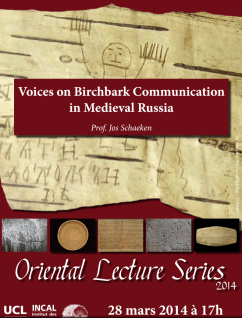
« Voices on Birchbark. Communication in Medieval Russia »
When Vladimir Putin last week claimed Crimea as a part of Russia, he started his speech before the Duma by recalling the early history of Orthodox Christianity in Russia, Ukraine and Belarus, and he particularly highlighted the baptism of Prince Vladimir the Great (prince of Novgorod, grand prince of Kiev and ruler of Kievan Rus from 980 to 1015).
The obvious implications of such a politicized reference to medieval history in a speech followed by millions around the globe should remind the international public of the considerable relevance of that very same history in the countries in question. They should also make us realize the importance of understanding the details of this history and its sources, which can only be done outside the realm of politics and in a dispassionate academic setting, by consulting competent specialists in the field.
Such an interface between a general public of interested citizens and specialists in the languages and cultures of the East is precisely what the Institut orientaliste de Louvain (CIOL) intends to provide, by organizing the Oriental Lecture Series (OLS). By insisting on written or material sources as carriers of information and as meaningful artifacts for their own sake, these lectures aim at explaining the social, cultural and historical contexts in which such material was produced, used and conserved (or discarded).
In this week’s lecture, Dr Jos Schaeken (Professor of Slavic and Baltic Languages and Cultural History, Leiden University and Dean of Leiden University College in The Hague) will explore the major role of writing on birchbark in Novgorod and other cities of medieval Russia.
Writing on birchbark was integrated into a huge variety of activities, ranging from simple household concerns such as the recipe for malt-pies to military intelligence of international importance. Such writing had a broad social base; it was used extensively not only by the clergy but by the laity, by women as well as men, by peasants as well as masters. It was so commonplace in Novgorodian society that the letters were often tossed away on the streets when the recipients were done with them. In sum, birchbark literacy was crucial to the organization of Novgorodian society in the age of its independence, prior to the annexation by the Muscovite state.






 L'Agenda des Médiévistes