
We all visualize a witch as an ugly woman, who flies out of the chimney of her house on a broomstick. Above her open hearth she has a giant cauldron, in which she brews her magic potions, while her black cat warms itself against the heat of the fire. It is less well-known that this almost universal image was actually invented in the Netherlands – and that Pieter Bruegel was one of the artists most responsible. He was the first to show the witch with her cauldron at the fireside. And while witches previously flew on all sorts of different objects, Bruegel deliberately and repeatedly opted for the broom, a choice that was frequently copied by others. In fact, his witch theme was often adopted as a whole. Some painters, such as Cornelis Saftleven, literally reproduced scenes from Breugel’s engravings. Others, like Frans Francken II, supplemented Bruegel’s witch images with details from local trials and witch-related events. David Teniers the Younger also became so inspired by the witch theme that that more than thirty works by him on the subject of witches and their diabolical practices are still known to exist.
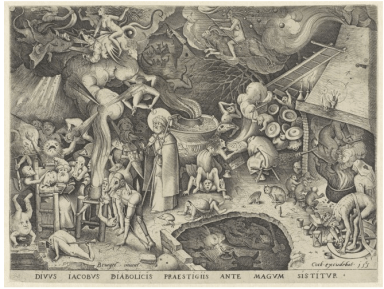
This exhibition brings together more than forty images of sorcery and witchcraft by great Dutch and Flemish masters, including Pieter Bruegel and David Teniers the Younger. Images of witchery are also inextricably bound up with the witch trials. The first of these trials took place around 1430. This gave rise to a trend for the colourful depiction of witches in the art studios of Bruges. Little flying witches embellished the margins of manuscripts; full-page miniatures showed witches celebrating the Sabbath. Climate changes also influenced the way witches were depicted. From the end of the sixteenth century onwards, northern Europe was afflicted by a century-long period of extremely cold winters and relatively cold summers, nowadays known as the Little Ice Age. This period coincided with the Eighty Years’ War in the Netherlands, when there was also great famine. In times of misfortune, people always need a scapegoat, and it was widely assumed that the witches had caused the bad weather and the scarcity of food through their sorcery. This led to an increase in witch persecution and prosecution. Later, the witch’s image changed yet again. In this way, witches and wizards continue to fascinate us all: just consider the world-wide success of Harry Potter!
Informations pratiques :
Sint-Janshospitaal, Musea Brugge
(Saint John’s Hospital, Musea Brugge)
Dijver
B-8000 Bruges
Belgique
Source : Codart






Vous devez être connecté pour poster un commentaire.