
Université de Lausanne
22-24 avril 2026
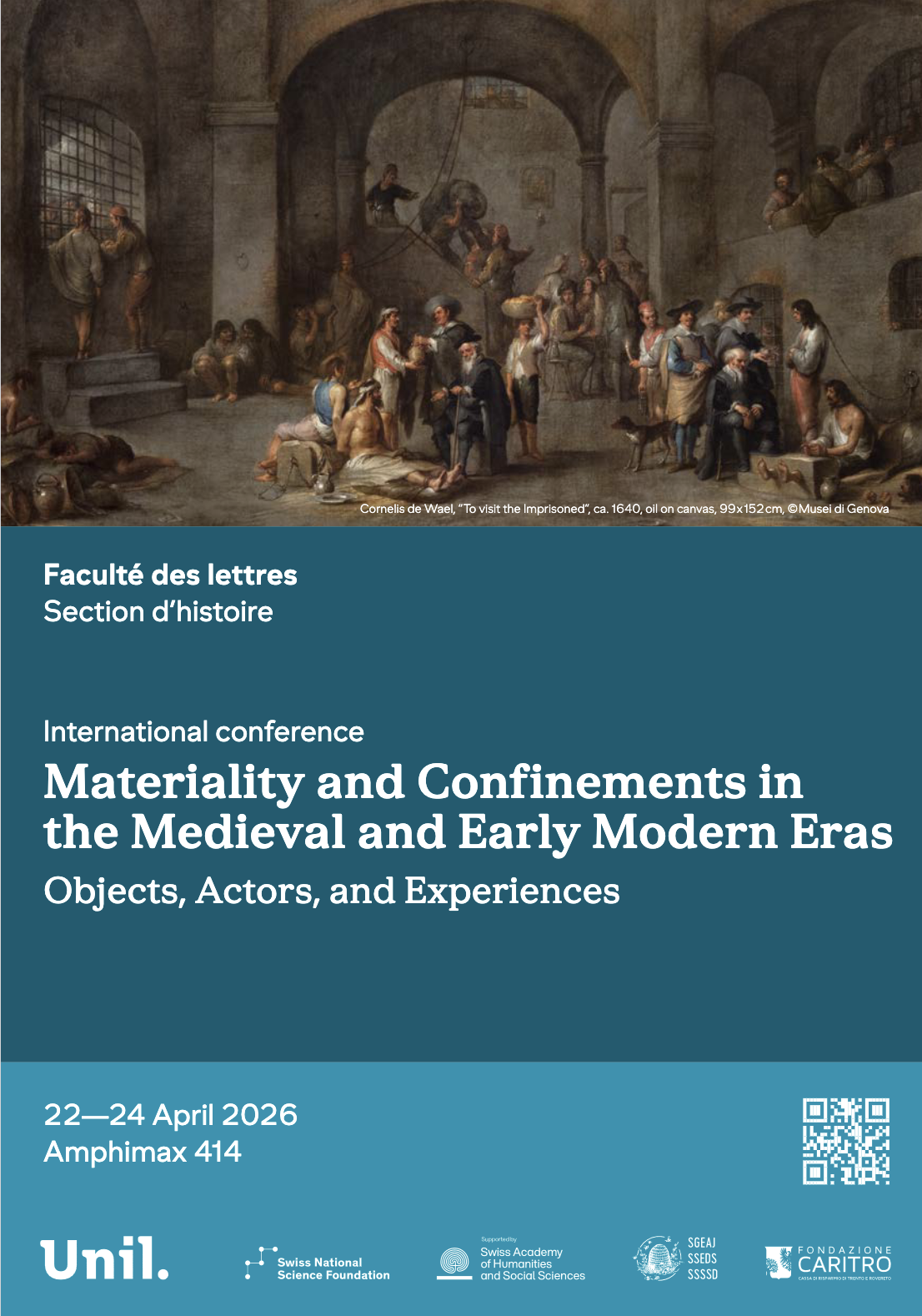
This international conference examines the history of confinements through the lens of their materiality. Indeed, confinement is defined by walls that separate individuals from society. Beyond the mere walls, daily interactions between confined individuals, institutional authorities, and staff are largely paved and defined by a variety of things : food, water, books, graffiti, clothes, money, letters, official registers, medicine, punishment objects, etc. In this regard, and drawing on the material turn in history since the early 2000s, things – whether “tangible” things physically available to historians or “textual” things described in written sources – might offer an additional perspective on the history of confinements more broadly, especially when addressing forms of “prison before the prison”. Drawing on a recent historiographical broadening of the field, the conference aims to address various forms of medieval and early modern confinement, both judicial and non-judicial : prisons, galleys, hospitals, workhouses, cloisters, monasteries, and the like. At the same time, it seeks to reflect on methodological questions pertaining to material history as an approach and to the sources that underpin it.
Programme :
Wednesday 22 April 2026
13.15-13.45 – Welcome coffee
13.45-14.00 – Introduction
- Nathalie Dahn-Singh (Université de Lausanne), Anna Clara Basilicò (Istituto Storico Italo Germanico)
14.00-15.00 – Keynote lecture
- Sophie Abdela (Université de Sherbrooke), If These Walls Could Speak ! An Incursion in Paris’ Jailbreaks (1700-1790)
15.00-15.30 – Coffee break
15.30-17.00 – Panel 1. Spaces, Escapes, and Power Relations Chair : Nathalie Dahn-Singh (Université de Lausanne)
- Lucie Guignet (Université de Paris-Cergy) : Les objets de la résistance : rescousses et évasions des prisonniers du Lyonnais (XIVe-XVe siècles)
- Noëmi Schöb (Universität Bern, Stadtarchiv und Vadianische Sammlung der Ortsbürgergemeinde St. Gallen) : Escapes from the Zucht- und Waisenhaus St. Leonhard in St. Gallen, 1663–1798
- Vincent Meyzie (Université Paris Nanterre) : Le juge et le prisonnier. Proximités et promiscuités des espaces judiciaires et carcéraux (France, XVIIIe siècle)
Thursday 23 April 2026
9 :00-10.30 – Panel 2. Graffiti and Prisoners’ Voices Chair : Anna Clara Basilicò (Istituto Storico Italo Germanico)
- Fanny Lalande (Laboratoire de Recherche Historique Rhône-Alpes) : “S’ils se taisent, les pierres mêmes crieront” : les graffitis, une source de l’expérience carcérale des Huguenots, sous le régime de la Révocation de l’Édit de Nantes
- Marco Albertoni (Università “G. D’Annunzio” di Chieti-Pescara) : Bones, Hair, Statuettes, Graffiti : Preliminary Remarks for an Archaeology of Magical Practices in Italian Prisons (17th–18th Centuries)
- Giuseppe Mrozek Eliszezynski (Università “G. D’Annunzio” di Chieti-Pescara) : Nobility, Commoners, Bandits : the Identities of Prisoners through Graffiti
10.30-11.00 – Coffee break
11 :00-12 :30 – Panel 3. Objects and Forced Labor in Mediterranean Galleys Chair : Giorgio Riello (European University Institute)
- Teresa Peláez-Domínguez (Universitat de València) : La chiourme, les statuts et les choses dans les galères d’Espagne (XVIe siècle)
- Luca Lo Basso (Università di Genova) : Les chaînes des galériens : matérialité de la peine et vie quotidienne sur les galères méditerranéennes (XVIe-XVIIIe siècles)
- Alexander Luca Coscarella (Università di Bologna) : “The Worthy Refreshment of Those Turks Enchained in the Galleys” : Selling and Consuming Coffee in an Early Modern Mediterranean Port City
12.30-14.00 – Lunch break
14.00-15.30 – Panel 4. Gender, Agency, and Materiality
Chair : Natalia Muchnik (École des Hautes Études en Sciences Sociales)
- Maria Adank (Università di Verona) : Visible but Constrained. Material Culture and the Dogaressa’s Role in Venetian Politics
- Claudia Stella Geremia (Università Ca’ Foscari) : Objects of Proof, Bodies in Exile : African and Afro-descendant Women before the Inquisition in the Canary Islands (16th–18th c.)
- Francesca Ferrando (Università di Verona) : Correcting Women : Gender, Discipline and Space in Genoa’s Charitable Institutions
15.30-16.00 – Coffee break
16.00-17.30 – Round table
- Frances Andrews (University of St Andrews)
- Renaud Morieux (University of Cambridge)
- Natalia Muchnik (École des Hautes Études en Sciences Sociales)
- Giorgio Riello (European University Institute)
19.30 – Conference dinner
Friday 24 April 2026
9.00-10.30 – Panel 5. Materiality and Confinement in Medieval and Early Modern Cloisters Chair : Élisabeth Lusset (CNRS, Université Paris I Panthéon Sorbonne)
- Micol Long (Università di Milano) : “I Pace the Floor, Walking Round and Round” : Approaching the Role of Materiality in the Cloistered Experience Through Comparative Textual Analysis (12th–13th Century)
- Cristina Setti (Università di Padova) : Inside and Outside the Cloister : A Geography of Latin Devotion and of the Social Entanglements of the Franciscan Friars in 15th-century Venetian Crete
- Michèle Steiner (Universität Basel) : The Materiality of Confinement : Gift-Giving and Conventual Networks in Early Modern Solothurn (17th and 18th Centuries)
10.30-11.00 – Coffee break
11.00-12.30 – Panel 6. Health, Disease, and Everyday Life, Between Administration and Practices
Chair : Xavier Rousseaux (Université catholique de Louvain)
- Alessandra Celati (Università di Torino) : Everyday Materiality in Venetian Inquisition Prisons
- Fleur Beauvieux (Aix-Marseille Université) : “Vingt-une paillasses, deux tours pour la soie, un fauteuil de bois de noyer…”. Une histoire des femmes de l’hôpital de l’Entrepôt à travers les registres d’inventaire
- Stefano Tomassetti (Università del Molise / Laboratoire de Recherche Historique Rhône-Alpes) : Air, soleil, murs. Enfermement et protection de la santé dans les Carceri Nuove de Rome (XVIIIe siècle)
12.30-14.00 – Lunch break
14.00-15.30 – Panel 7. Between the Inside and the Outside : Prisoners’ Experiences From Below
Chair : Renaud Morieux (University of Cambridge)
- Lorenzo Bonvicini (Università di Torino) : The Price of Guilt. Material Culture, Economy, and Power Relations in the Prisons of the Duchy of Modena and Reggio Emilia (17th–18th Centuries)
- Kiran Metha (University of Leicester) : Prison Letters : a History from Below in Eighteenth-century England
- Leïla Cheurfa (Université Paris 1 Panthéon-Sorbonne) : Dans les tolbooths du nord de l’Écosse : matérialité et expériences de l’enfermement pour dette au XVIIIe siècle
15.30-16.00 – Coffee break
16.00-17.30 – Panel 8. Between the Inside and the Outside : Circulations and the Management of Places of Confinement
Chair : Frances Andrews (University of St. Andrews)
- Lorenzo Paveggio (Università di Padova / Institut de Recherche et d’Histoire des Textes de Paris) : Objects of Exile : The Materiality of Theodulf of Orléans’s Confinement (c. 818–821)
- Hayrettin Yücesoy (Washington University in St. Louis) : Solace of the Imprisoned : Abbasid Ethical Discourses on Incarceration
- Nabhojeet Sen (Bonn Center for Slavery and Dependency Studies) : Confinement(s) and Circulation : Prisons in Early Modern South Asia, 1600-1818
17.30-17.45 – Conclusion
- Xavier Rousseaux (Université catholique de Louvain)






Vous devez être connecté pour poster un commentaire.