
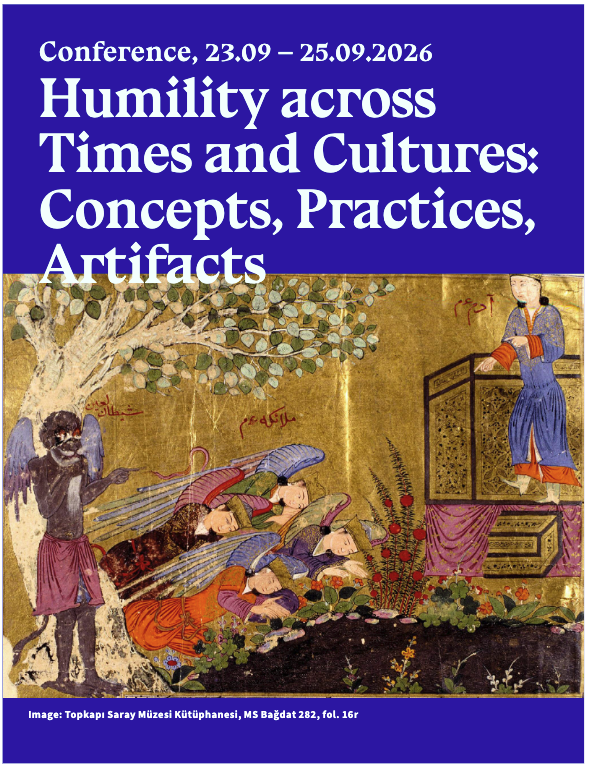
The conference aims significantly to broaden both the geographical and chronological scope of the inquiry into historical conceptions and practices of humility. The focus spans the period from 250 CE to 1500 CE and draws on sources from a wide geographical area, including Western Europe, Byzantium, and the Middle East. By centering these regions, we seek to map humility within a space that, for all its cultural diversity, was shaped in significant ways by the three Abrahamic religions: Judaism, Christianity, and Islam. While we do not assume that humility was exclusively or primarily a religious value, there is reason to believe that within the Abrahamic traditions, it was indeed upheld as a virtue, frequently positioned in opposition to pride, which was often viewed as the most dangerous and diabolical of vices.
Conference panels will be organized along both chronological and thematic lines, encompassing European Christian regions, Byzantium, Jewish communities, and Islamic territories. Special attention will be given to the physical and social spaces in which humility was conceived and enacted, as well as to the interplay between humility and gender.
The conference is organized by Silvia Negri (Universität Zürich, Historisches Seminar) and James Weaver (University of Oxford), within the framework of the project “Humility in theory and practice. Historical approaches across cultures”.
Programme :
Wednesday, 23.09.2026
16:30–17:30 Introduction
Silvia Negri (Universität Zürich)
James Weaver (University of Oxford)
18:15–19:45 Evening Lecture
Beth Williamson (University of Bristol): Making Humility Visible: The Madonna Seated on the Ground, the Sacred Reimagined
Thursday, 24.09.2026
9:30–10:30 Panel 1
Katharina Heyden (Universität Bern): Humility as a Religious Core Virtue and a Social Force in the “Sayings of the Fathers”
Karen Bauer (IIS London): Mental, Bodily, and Social Spaces of Humility in the Qur‘an
10:30–11:00 Coffee break
11:00–12:30 Panel 2
Felix Maier (Universität Zürich): The Politics of Humility: How Late Roman Emperors Reimagined Power
Maxim Venetskov (University of Glasgow): The Highest Virtues and Their Contrary Vices in the Ladder of Divine Ascent and Its Manuscript Reception
Maria Parani (University of Cyprus): A Contradiction in Terms? Humility and the Expression of Piety in Medieval Byzantium
12:30–14:00 Lunch break
14:00–15:00 Panel 3
Rebecca Sauer (Universität Zürich): Humility in Medieval Arabic Dream Interpretation Manuals and Beyond
Antonella Ghersetti (Università Ca’ Foscari, Venezia): Humility, Modesty (and Haughtiness) in Arabic Literature of the Mamluk Period
15:00–15:30 Coffee break
15:30–16:30 Panel 4
Marion Katz (New York University): Humility, Dignity and Status in Mamluk-era Islamic Sources
Gowaart van den Bossche (Universität Zürich): Historical Memory and the Imposition of Humility on non-Muslims in Late Medieval Egypt
18:15–19:45 Evening Lecture
Christopher Melchert (University of Oxford, ret.): The Humility of the Ideal Muslim Scholar in the Earlier Middle Ages
Friday, 25.09.2026
08:30–09:30 Panel 5
Catherine Hezser (SOAS, University of London): The Torah Is Not Preserved by the Haughty, But With Someone Whose Spirit is Humble: Humility as a Rabbinic Value in Late Antiquity
Lennart Lehmhaus (Universität Tübingen): Torah, Distress and Poverty – the Ideal of Humility and Morality between Elites, Scholars and the Unlearned in Seder Eliyahu
09:30–10:30 Panel 6
Annette Kehnel (Universität Mannheim): Humilitas – a Remedy for Pleonexia?
Matthias Tischler (ICREA, Barcelona): Gentle, Quiet, and Effective: The Subtle ‘Monastic Reform’ of the Post-Visigothic World Reflected in Carolingian Paraenetic Literature and Its Concept of Humility, Ninth to Thirteenth Centuries
10:30–11:00 Coffee break
11:00–12:30 Panel 7
Roberto Leggero (Università della Svizzera italiana): Make Space. Occupy Space. Renegotiating the Individual Social Positioning through Humility, Communication and Performance (12th c.)
Christopher M. Bellitto (Kean University): Pierre d’Ailly’s Examination of Conscience: Humility, Grace, and Free Will
Isabella Lazzarini (Università di Torino): The Lexis of Humility in Political Correspondence (Italy, 1450–1520 ca.)
12:30–14:30 Lunch break
14:30–16:00 Discussants
Letizia Osti (Università degli Studi di Milano)
Miri Rubin (Queen Mary University of London)
Simon Teuscher (Universität Zürich)
16:00–16:30 Coffee break
16:30–17:30 Conclusion
Silvia Negri (Universität Zürich)
James Weaver (University of Oxford)
Informations pratiques :
Date: 23–25 September 2026
Location: UZH, RAA-G-01, Rämistrasse 59, 8001 Zürich
Source : Universität Zurich






Vous devez être connecté pour poster un commentaire.