
SPONSORED BY : The Route des Normands
DEADLINE : 14 September 2026
IMC Leeds 2027
The mobility of Norman communities was one of the historical phenomena that most profoundly shaped medieval Europe. The sessions aim to reconstruct its material consequences by examining monuments and objects within a transregional and transnational framework and by identifying networks of patronage, religious devotion, production, and exchange. Through an interdisciplinary approach, they seek to reconsider the interconnected sites, forms of artistic and artisanal production, landscapes, and cultural practices that are essential to a fuller understanding of the establishment and development of Norman communities across Europe, from the Atlantic to the Mediterranean.
The sessions will focus on historically identifiable itineraries and networks, including court itineraries, monastic and episcopal connections, pilgrimage circuits, maritime routes, commercial exchanges, and diplomatic contacts.
They will explore how these connections shaped architectural patronage, artistic production, manuscript culture, liturgical and funerary practices, and the diffusion of transregional cults.
The sessions do not seek to define a homogeneous “Norman style” or to reconstruct a linear diffusion of forms from Normandy. Rather, they will examine how buildings, monumental complexes, manuscripts, liturgical furnishings, tombs, and portable objects were produced within specific local contexts while also responding to the circulation of patrons, ecclesiastical personnel, craftsmen, materials, texts, relics, rites, and technical knowledge.
This approach builds on recent research into the agents and mechanisms of cultural transfer, as well as the political, ritual, and social functions of material culture in the Norman worlds.
In keeping with the IMC theme of “Communities,” the sessions will examine networks of patronage associated with Norman communities and their role in the production, use, and circulation of material culture.
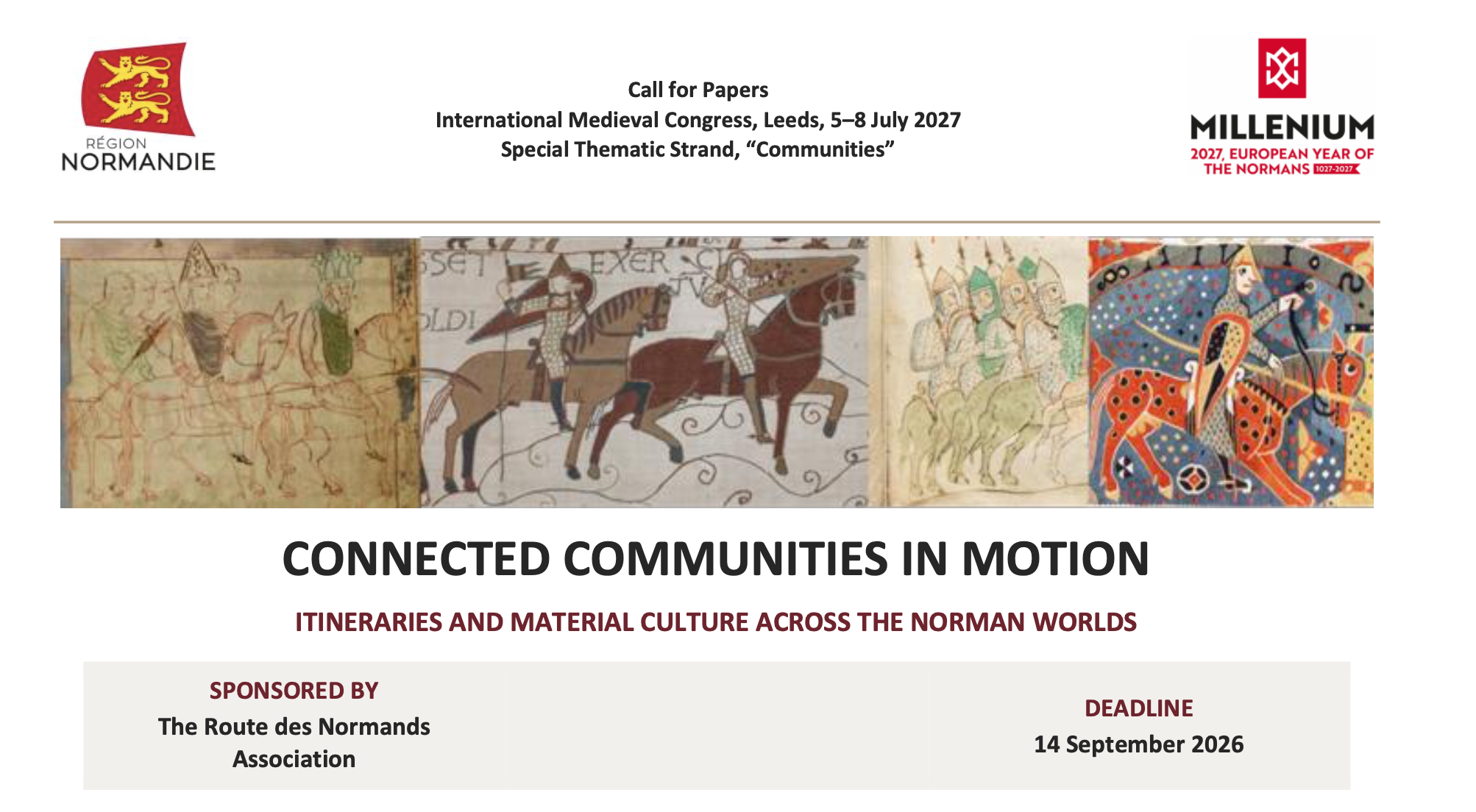
SESSION I – Architecture, Patronage, and Networks of Construction
This session will examine how political authority, ecclesiastical organisation, pilgrimage, and economic exchange shaped the foundation, transformation, and use of buildings and monumental complexes.
Possible topics include
• royal, aristocratic, episcopal, and monastic patronage;
• court itineraries and the geography of architectural commissions;
• the movement of builders, craftsmen, materials, and technical knowledge;
• construction sites and the organisation of labour;
• the relationship between land routes, maritime routes, shrines, settlements, and monumental foundations;
• the adaptation or reuse of Roman, Byzantine, Islamic, Anglo-Saxon, Lombard, and other local structures;
• the impact of political and economic networks on architectural production.
SESSION II – Images, Manuscripts, and Material Exchange
This session will investigate the circulation, adaptation, and local reworking of artistic and technical knowledge in sculpture, painting, manuscript production, monumental decoration, and the decorative arts.
Possible topics include
• architectural sculpture, mural painting, mosaics, pavements, and stained glass;
• illuminated manuscripts, liturgical books, cartularies, chronicles, and Exultet rolls;
• relationships between monumental decoration, manuscript illumination, and portable objects;
• the movement of scribes, illuminators, sculptors, painters, mosaicists, and specialised craftsmen;
• workshops, communities of practice, and the transmission of techniques;
• textiles, ivory carving, metalwork, reliquaries, seals, coins, and liturgical furnishings;
• artistic commissions prompted by diplomacy, dynastic marriage, trade, gift exchange, warfare, or the translation of relics;
• the movement and availability of stone, marble, timber, metals, pigments, parchment, and luxury materials.
SESSION III
Sacred Routes, Liturgy, Cult, and Monumental Memory
This session will consider how the movement of clergy, books, relics, rites, and devotional practices shaped religious buildings and the material organisation of worship, burial, and commemoration.
Possible topics include
• relationships between liturgical practice and the architectural arrangement of churches;
• altars, choirs, crypts, chapels, screens, ambulatories, and processional spaces;
• the circulation of liturgical books, chants, calendars, ceremonial practices, and monastic customs;
• episcopal and monastic networks as channels for the transmission of ritual and architectural practices;
• pilgrimage routes, relic translations, shrines, and transregional saints’ cults;
• the material consequences of devotion to saints such as Michael, Nicholas, Thomas Becket, and Catherine of Alexandria;
• royal, aristocratic, episcopal, and monastic burial practices;
• monumental tombs, mausolea, burial chapels, inscriptions, and funerary imagery;
• dynastic memoria, anniversaries, necrologies, commemorative foundations, and the liturgy of the dead.
The Route des Normands ssociation, founded at the initiative of the Normandy Region, is a French non-profit association governed by the Law of 1 July 1901, formally declared to the French prefectural authorities in mars 2026 and headquartered at the Abbaye-aux-Dames in Caen. Its founding members are the Normandy Region, the British Council, Ireland’s National Monuments Service, Jersey Heritage Trust, and Guernsey Museums. Building on Millennium 2027 – European Year of the Normans, the Association is establishing the historical, scientific, and institutional foundations of the Route des Normands, with a view to its certification as a Cultural Route of the Council of Europe. The initiative also benefits from the support and prospective involvement of regions in southern Italy, whose historical and cultural heritage forms an essential component of the wider Norman world. Its Scientific Committee brings together university professors with recognised expertise in Norman studies and related fields, drawn from participating institutions across France, England, Wales, Ireland, Northern Ireland, Scotland, and Italy.
The sessions will contribute to the historical and scholarly foundations of the Route des Normands as a network of interconnected sites, collections, sacred landscapes, and cultural practices.
Submission of Proposals
Proposals are invited from scholars working on the history, material culture, and religious life of the Norman worlds. Papers may focus on a building, work of art, manuscript, patron, institution, burial site, or cult, provided that the case study is situated within a clearly defined itinerary or network, or linked to a historically plausible mechanism of transmission.
Submissions should include a title, an abstract of no more than 350 words, a short biography of no more than 100 words, institutional affiliation, contact details, and four or five keywords.
Papers will be either 15 or 20 minutes long. Selected proposals will be organised into linked 90-minute sessions and submitted to the IMC Programming Committee.
Please send proposals by 14 September 2026 to:
Giacomo D’Andrea
Session Organiser :
Route des Normands Association, Normandy Region
giacomo.dandrea@normandie.fr




Vous devez être connecté pour poster un commentaire.