
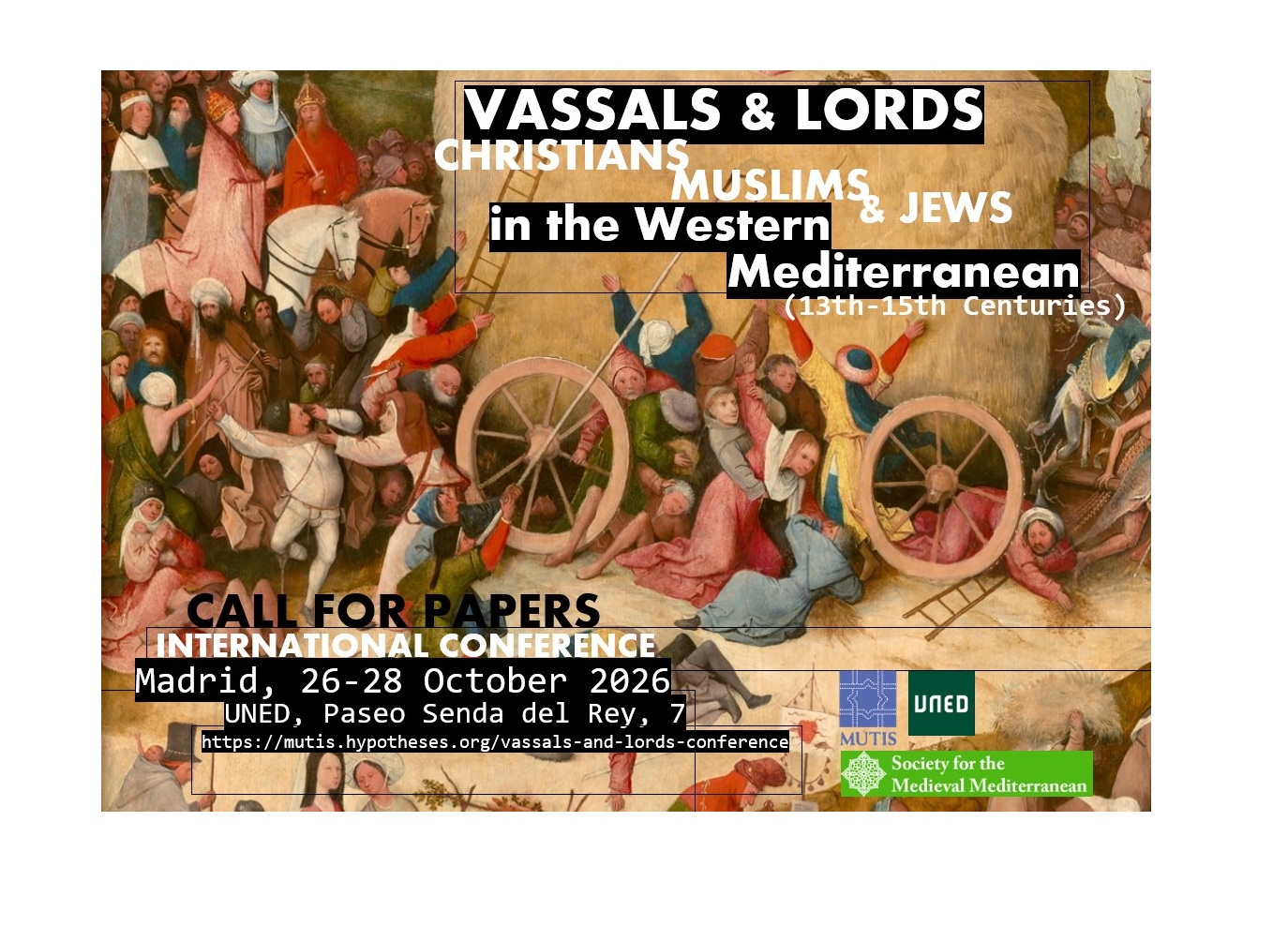
Although the study of the Middle Ages has traditionally been approached through the prism of kingship and influenced by a State-centric nationalist logic, the decentralized nature of medieval power obliges the historian to broaden the scope of analysis, add nuance to conceptual terminology, and remain mindful of this inherent trait. The conference focuses specifically on examining the relations between vassals of different religions and their lords, rather than the more common focus of relations between nobility and monarchy, although this interdependent dynamic must not be ignored, as it also conditions interactions with vassals.
The geographical framework of the conference will consist of the Iberian kingdoms: Portugal, Castile, Navarre, as well as the Crown of Aragon with its extensive Mediterranean possessions. Despite important variations in jurisdiction and lordly authority throughout these regions, they offer certain common historical features that allow for a coherent comparison. Furthermore, the conference focuses on the late Middle Ages –from the thirteenth to the fifteenth centuries– to encompass the period in which the seigneurial system came to fruition. In the context of the late medieval western Mediterranean, there were many types of lordships –noble, ecclesiastical, military orders– and the jurisdiction vested in the lords varied considerably by kingdom and according to royal concessions. Similarly, the social and legal standings of vassals were also shaped by various parameters, notably religious identity and the authority the town councils exerted over them. The category of vassals encompasses both rural peasantry and town-dwellers who were structured hierarchically, with a Christian elite that slowly came to monopolize most offices in municipal councils and took precedence over the Muslim and Jewish communities. These town councils functioned as institutionalized actors that –at least in theory– represented the interests of the vassals while simultaneously mediating the commands of their lords. Similar dynamics are to be found in the relationship between lords and their Muslim and Jewish vassals –where these exist, as well as within their political organizational entities known as aljamas or comunas. Collectively, these factors defined the complex relationships between lords and their subjects that are still insufficiently studied.
Debating the dynamics that arose between vassals of different religions and their lords can shed light on the multifaceted nature of power in the late medieval western Mediterranean. What constituted the legal and symbolic foundations of lordly power in this period? Through what mechanisms and rituals did lords display and enforce their authority? How did lords negotiate authority with Christians, Muslims and Jews? To what extent did vassals of each religion exercise agency, whether individually or collectively? To what degree were community institutions –be they Christian, Jewish or Muslim– vehicles for community representation or instruments of seigneurial control? How did horizontal dynamics –including cooperation and conflict between town councils and minority communities– shape or constrain lordly authority over their vassals?
This international conference aims to explore these issues and establish a dialogue among senior scholars and early-career researchers from various disciplines, privileging a multidisciplinary focus.
This conference is sponsored by the Society for the Medieval Medierranean (Simon Barton Prize 2026), the Facultad de Geografía e Historia (UNED), and the Vicerrectorado de Internacionalización y Multilingüismo (UNED).
Programme :
lunes, 26 de octubre
15:00-15:30 h. WELCOME AND INTRODUCTION
Presentation by the Head of the Department of Medieval History and Paleography (UNED) and the Organizing Committee
José Manuel Rodríguez García Prof. contratado doctor, Dpto. de H.ª Medieval y CC. y TT. HH., UNED
Marina Girona Berenguer Investigadora postdoctoral, Dpto. de H.ª Medieval y CC. y TT. HH., UNED
Gonzalo Carrasco García Investigador postdoctoral, Dpto. de H.ª Medieval y CC. y TT. HH., UNED
15:30-16:30 h. OPENING LECTURE
Ana Echevarría Arsuaga Catedrática, Dpto. de H.ª Medieval y CC. y TT. HH., UNED
15:30-16:30 h. El encuadramiento señorial de la población musulmana en el reino de Valencia
Josep Torró i Abad Universidad de Valencia
16:30-17:00 h. Coffee-break
17:00-18:30 h. PANEL 1: UNDER SEIGNEURIAL JURISDICTION
Gonzalo Carrasco García Investigador postdoctoral, Dpto. de H.ª Medieval y CC. y TT. HH., UNED
17:00-17:20 h. When Service Goes Wrong: Disservice and Disloyalty in Portugal in the 15th Century
André Madruga Coelho Universidade de Évora
17:20-17:40 h. Negotiating Lordship across Political Borders: Samuel Abolafia, the Aljama of Molina and the Transfer of Seigneurial Allegiance to the Crown of Aragon (1369-1375)
Alexander Mimoun Sorbonne Université
17:40-18:00 h. La actividad económica de los mudéjares en la frontera sur valenciana: los lugares de señorío del término de Orihuela
Manuel Carlos Culiáñez Celdrán Universidad de Murcia
18:00-18:30 h. Discussion
martes, 27 de octubre
10:00-11:30 h. PANEL 2: ECCLESIASTICAL LORDSHIPS
Enrique Cantera Montenegro Catedrático, Dpto. de H.ª Medieval y CC. y TT. HH., UNED
10:00-10:20 h. A comuna dos judeus e o Cabido da Sé de Braga. Negociações e resistências
José Alberto Rodrigues da Silva Tavim Universidade de Lisboa
10:20-10:40 h. Musulmanes y judíos en la corte de los arzobispos de Toledo (1200-1482)
Francisco de Paula Cañas Gálvez UCM
10:40-11:00 h. Musulmanes como vasallos de los primados de Castilla
Yolanda Moreno Moreno Profesora-tutora, UNED-Talavera de la Reina
11:00-11:30 h. Discussion
11:30-12:00 h. Coffee-break
12:00-13:30 h. PANEL 3: LORDSHIPS OF THE MILITARY ORDERS
José Manuel Rodríguez García Prof. contratado doctor, Dpto. de H.ª Medieval y CC. y TT. HH., UNED
12:00-12:20 h. La Orden del Hospital como entidad señorial en la Corona de Castilla durante los siglos XII y XIII
Carlos Barquero Goñi Prof. contratado doctor, Dpto. de H.ª Medieval y CC. y TT. HH., UNED
12:20-12:40 h. Military Orders as Administrators of Justice for Muslims
Clara Almagro Vidal Investigadora postdoctoral senior, Dpto. de H.ª Medieval y CC. y TT. HH., UNED
12:40-13:00 h. Los mudéjares en la Orden de Santiago: estrategias fiscales y explotación agraria en el entorno del castillo de Socovos (siglos XIII-XV)
Raquel Bujalance Silva INAPH, Universidad de Alicante
Lorena C. Barco Cebrián Universidad de Málaga
Arturo García-López Instituto de Arqueología de Mérida, CSIC-Junta de Extremadura
Marina Piña Moreno Archaeologist
Iván Soto Cardesín Archaeologist
13:00-13:30 h. Discussion
13:30-15:00 h. Lunch
15:00-16:30 h. PANEL 4: NOBLE LORDSHIPS
Clara Almagro Vidal Investigadora postdoctoral senior, Dpto. de H.ª Medieval y CC. y TT. HH., UNED
15:00-15:20 h. Muslim Vassals of the Marquisate of Villena: The Case of Castillo de Garcimuñoz
Gonzalo Carrasco García Investigador postdoctoral, Dpto. de H.ª Medieval y CC. y TT. HH., UNED
15:20-15:40 h. Las minorías étnico-religiosas en un señorío particular: el condado de las Montañas de Prades (siglos XIV-XV)
Eduard Juncosa Bonet UCM
15:40-16:00 h. Jews and Muslims between Kings, Councils, and Lords in Medieval Portugal. The Case of Beja (15th century)
Beatriz da Silva Felício CIDEHUS, Universidade de Évora
16:00-16:30 h. Discussion
16:30-17:00 h. Coffee-break
17:00-18:30 h. PANEL 5: ROYAL POWER AND LORDS
17:00-17:20 h. Los pecheros de Toledo y la ruptura del vasallaje señorial en 1449
Montserrat Piera Temple University
17:20-17:40 h. L’octroi de sauf-conduits par la baile general de Valence à ses minorités mudéjares au cours du XVe siècle : l’exemple d’une mobilité de prestige ou de nécessité?
Sonia Armand Université d’Aix-Marseille
17:40-18:00 h. As discussões de Cortes como espelho da presença judaica nas finanças portuguesas (séculos XIV-XV)
Ana Marques CITCEM, Universidade do Porto-ILC, CSIC
18:00-18:30 h. Discussion
miércoles, 28 de octubre
10:00-11:30 h. PANEL 6: EXPRESSIONS OF SEIGNEURIAL POWER: WRITING AND LITERATURE
Irene Pereira García Profa. ayudante doctora, Dpto. de H.ª Medieval y CC. y TT. HH., UNED
10:00-10:20 h. El uso de la metáfora feudal en la lírica amorosa catalana y valenciana de finales de la Edad Media
Marion Coderch Profa. permanente laboral, Dpto. Filología Clásica, UNED
10:20-10:40 h. Los notarios de la terra de Toroño en la Edad Media como agentes del poder jurisdiccional
Adrián Ares Legaspi Prof. contratado doctor, Dpto. de H.ª Medieval y CC. y TT. HH., UNED
10:40-11:00 h. Gobierno señorial y escritura. La cancillería de la Casa de los Guzmán, condes de Niebla y duques de Medina Sidonia (siglos XIV–XV)
Javier E. Jiménez López de Eguileta Universidad de Cádiz
11:00-11:30 h. Discussion
11:30-12:00 h. Coffee-break
12:00-13:30 h. PANEL 6: EXPRESSIONS OF SEIGNEURIAL POWER: ART AND ARCHITECTURE
Antonio García Espada Prof. ayudante doctor, Dpto. de H.ª Medieval y CC. y TT. HH., UNED
12:00-12:20 h. Negotiating Aragonese Rule in Late Medieval Malta
Charlene Vella University of Malta
12:20-12:40 h. “La bela mostra quell dit castell fa”: Alfons d’Aragó i Foix (†1412), señor y castillos a caballo entre reinos
María Teresa Chicote Pompanin UCM
12:40-13:00 h. Dominando desde lo alto: la relación entre el castillo y la villa de Turégano (Segovia)
Silvia Olmos Arranz Independent Researcher
Manuel de la Peña Borreguero Independent Researcher
13:00-13:30 h. Discussion
13:30-15:00 h. Lunch
15:00-16:00 h. CLOSING LECTURE
Marina Girona Berenguer Investigadora postdoctoral, Dpto. de H.ª Medieval y CC. y TT. HH., UNED
15:00-16:00 h. Rois, seigneurs et vassaux dans la Biblia de Alba (1422–1430). L’image biblique au service d’un discours politique
Sonia Fellous CNRS-IRHT, Institut de recherche et d’histoire des textes
16:00-17:00 h. FINAL REMARKS
Gonzalo Carrasco García Investigador postdoctoral, Dpto. de H.ª Medieval y CC. y TT. HH., UNED
Marina Girona Berenguer Investigadora postdoctoral, Dpto. de H.ª Medieval y CC. y TT. HH., UNED
Asistencia
Esta actividad permite participar con asistencia presencial o asistencia online en directo o en diferido, sin necesidad de ir al centro.
Inscripción
congreso.medieval.uned@hotmail.com



Vous devez être connecté pour poster un commentaire.