
International conference
University of Liège, March 25–26, 2027
Historians of knowledge have increasingly turned their attention to the embodied, material, and practical dimensions of knowing. Research on artisanal expertise, food, medicine, agriculture, trade, and material culture has brought into view forms of knowledge that were produced not only through texts and learned institutions, but also through sustained encounters between bodies, materials, and environments. Yet the senses involved in such encounters have not received equal attention. Taste, touch, and smell – senses dependent upon proximity to and often direct physical engagement with things – have historically been associated with the body, subjectivity, and socially marginalized forms of experience.
Focusing on these senses therefore offers an opportunity to reconsider where knowledge was produced, by whom, and through which practices. The ERC-funded project PROXISENSES – Entangled Histories of the Proximal Senses (1350–1650): A Mediterranean History of (Subjective) Knowledge* at the University of Liège invites scholars to explore these questions at an international conference devoted to the people, practices, and forms of knowledge connected to taste, touch, and smell.
How did people use their senses to investigate, evaluate, classify, transform, and understand the worlds around them? Under what circumstances did tasting, touching, or smelling become ways of knowing, and how were such sensory skills acquired, communicated, or recognized as expertise? Attention to these practices also raises questions about their practitioners. What knowledge was produced by farmers, gardeners, fishers, miners, bakers, wine makers, merchants, artisans, healers, members of religious communities, domestic practitioners, and others whose expertise may be difficult to recover from conventional histories of knowledge? How did sensory knowledge move between different social groups and between learned, artisanal, commercial, religious, and domestic settings? And how did travel, trade, migration, translation, conquest, and cross-cultural encounters reshape sensory practices and expertise?
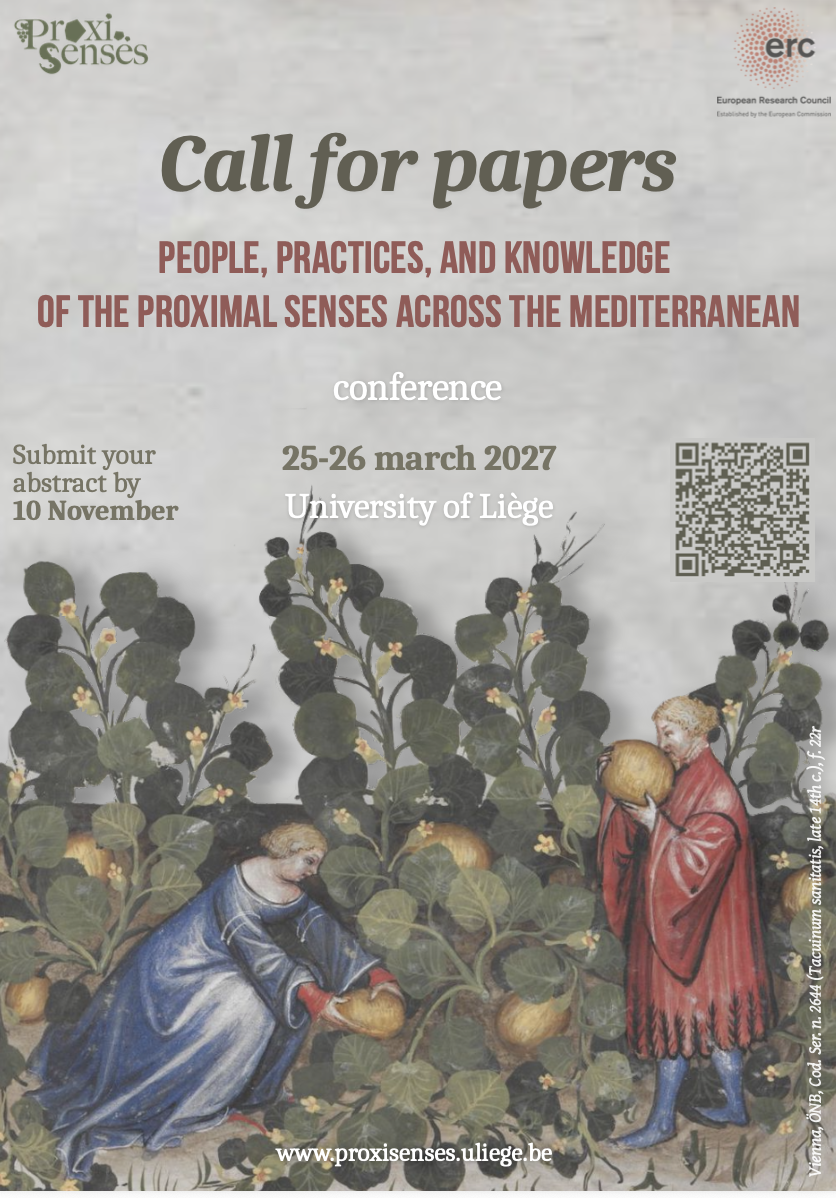
PROXISENSES approaches these questions in the context of the Mediterranean, understood as a space of permanent movement, exchange, negotiation, and conflict. The conference, however, takes the Mediterranean as a point of departure rather than a fixed geographical limit. We welcome scholars working on the thirtheenth through seventeenth centuries in different regions of the world and particularly encourage global, connected, comparative, and transregional perspectives. Contributions may draw upon a wide range of written sources, both manuscript and printed, including trial records, travel accounts, documents related to 1customs and trade, professional and monastic regulations, notebooks, letters, health regimens, recipe books, manuals on trade, agriculture, and hunting, dissertations, treatises, dictionaries, and other reference works across relevant disciplines. Papers based on visual and material sources are also invited. Contributions may take the form of case studies or historiographical and methodological reflections. We also welcome work in the digital humanities, especially research exploring how digital methods can help identify, analyze, map, or visualize sensory vocabularies, practices, people, networks, and the circulation of expertise across heterogeneous historical sources. The PROXISENSES project itself combines archival, microhistorical, and digital methodologies in order to recover sensory knowledge dispersed across diverse bodies of evidence.
We particularly encourage submissions from doctoral, postdoctoral, and other early-career researchers, including presentations about work in progress. Proposals may take the form of either a 15–20-minute paper or a poster presentation. Possible topics include, but are by no means limited to, sensory practices in medicine, agriculture, food production, trade, and craft; embodied and artisanal expertise; overlooked or marginalized knowledge-makers; the transmission and circulation of sensory knowledge; cross-cultural encounters and sensory expertise; sensory vocabularies and concepts; material and environmental knowledge; and digital approaches to the history of sensory practices.
Please submit a paper or poster title, an abstract (maximum 2000 characters including spaces), and a short biographical note using this form by November 10, 2026. The applicants may expect to be informed of the decision by mid-December. The conference will take place in-person at the University of Liège, Belgium, on March 25–26, 2027. The working language of the conference is English. Economy-class airline or train tickets and accommodation for selected participants can be covered by the organizers.
If you have any questions about the conference or problems with the submission form, please contact us at proxisenses@uliege.be.
*The project is funded under the European Research Council (ERC) Consolidator Grant (Grant agreement ID: 101171391).






Vous devez être connecté pour poster un commentaire.