
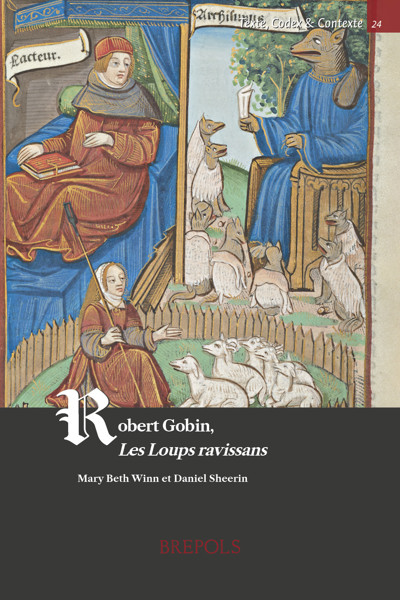
Robert Gobin’s prosimetrum, Les Loups ravissans, reports an Acteur’s dream vision of New Year’s Eve 1505, in which Saincte Doctrine, as a saintly shepherdess representing ‘nostre mere Saincte Eglise’ refutes Archilupus, leader of a band of ravenous wolves, ‘qui est le dyable d’enfer, et nostre Ennemy’. First published in Paris by the renowned libraire Anthoine Vérard, the text is called a ‘doctrinal moral’, and it is framed as a grammar manual modeled on Alexander de Villa Dei’s Doctrinale. In it, Archilupus, master rhétoriqueur, turns grammar into subversive lessons and scathing examples that entice his pupils by their dazzling French verse. Only Saincte Doctrine can rectify his perversions of Christian moral teaching through ponderous prose, buttressed by extensive Latin citations from religious authorities, Gobin having been a priest and canon lawyer. Archilupus is necessarily vanquished and slain at the end of the prosimetrum, and in an ensuing danse macabre, composed entirely in verse, humans who imitate the wolves are punished according to their sins, inescapably propelled by Accident and Death toward the Last Judgement. For his editio princeps of Gobin’s text, Vérard commissioned two sets of striking woodcuts, and almost immediately three different printers copied the danse macabre illustrations for use in their books of Hours. Crystallizing multiple strands of literary, religious, political, and artistic traditions into a vast critique of human actions and institutions in early Renaissance France, this critical edition of Gobin’s Loups ravissans is accompanied by a study of the text, its illustrations, printing history, and influence.
Robert Gobin, priest, legal counsel in ecclesiastical courts, and dean in Laigny-sur Marne, offered Les Loups ravissans in 1505 as a New Year’s gift to the University of Paris where in 1502 he received a baccalaurate degree. Published by Anthoine Vérard with striking woodcut illustrations, the prosimetrum concludes with a danse macabre. Gobin also composed a Confession generalle en rime, issued without date by Michel Le Noir. No manuscript is known for either work.
Mary Beth Winn is Professor emerita of French Studies at the University at Albany, State University of New York. Her research focuses on 15th– and 16th– century literature and the history of the book, especially the work of the Parisian libraire Anthoine Vérard. Text editor for the chansons of Renaissance composers Thomas Crecquillon and Jean Mouton, she has just published the critical edition of Tristan, chevalier de la Table ronde (1489) which, like the Loups ravissans, was issued by Vérard.
Daniel Sheerin is Professor emeritus at the University of Notre Dame. In addition to articles on patristics, medieval Latin, and liturgy, he has published translations of patristic texts on the Eucharist (Message of the Fathers of the Church 7) and of Erasmus’ controversy with Alberto III Pio of Carpi (Collected Works of Erasmus 84). He is currently conducting research on Erasmus’ Liturgia and on early printed missals.
Table des matières :
Preface
Acknowledgements
List of Abbreviations
Introduction
Composition and Publication
Robert Gobin, priest and poet
Les Loups ravissans, Part I
Les Loups ravissans, Part II
The Printed Editions of the Loups ravissans
Literary, Historical, and Linguistic Features of the Text
Editorial principles: Transmission and Treatment of the Text
Synopsis
Robert Gobin, Les Loups ravissans
Appendices
Glossary
Bibliography
Index of Names
Informations pratiques :
Robert Gobin, Les Loups ravissans, éd. Mary Beth Winn, Daniel Sheerin, Turnhout, Brepols, 2026 ; 1 vol., 824 p. (Texte, Codex & Contexte, 24). ISBN : 978-2-503-60857-0. Prix : 149,00.
Source : Brepols






Vous devez être connecté pour poster un commentaire.