Appel à contribution – New Pespectives on Medieval Rome

Location: International Congress on Medieval Studies, University of Western Michigan, Kalamazoo, MI (USA)
Submission Deadline: 15 sept 2015

Sponsored by the Italian Art Society, http://www.italianartsociety.org
Organizers: Marius B. Hauknes, Andrew W. Mellon Postdoctoral Fellow, Johns Hopkins University

Alison Locke Perchuk, Assistant Professor of Art History, California State University Channel Islands

Digital, environmental, material, Mediterranean, sensory, spatial: these are among the recent “turns” taken by the medieval humanities, including art history. The new perspectives on the past opened by these approaches, many of which are informed by interdisciplinary research and contemporary cultural interests in the natural and built world, are fundamentally reshaping how we conceive of and study medieval art and architecture. In the field of medieval art, the city of Rome has traditionally been a key site for the formulation of innovative avenues of approach, but what are its current status and its potential in relation to the discipline’s new discourses? These two linked sessions seek to assess the impact of recent methodological developments on the study of the art, architecture, and urban forms of Rome during the long middle ages, ca. 300–1500. We invite papers that offer new research on, and new ways of thinking about, the visual and material culture of medieval Rome.

Please direct inquiries/submissions to the organizers at mhaukne1@jhu.edu and alison.perchuk@csuci.edu. Information about the conference, including proposal submission forms, may be found at http://wmich.edu/medieval/congress/submissions/index.html.

Source : Episcopus

Publié dans Appel à contributions | Laisser un commentaire

Exposition – Aurea Vallis : Archives et manuscrits

Une exposition exceptionnelle par la qualité et la quantité des pièces réunies se tiendra à l’abbaye d’Orval du 5 septembre au 8 novembre 2015, tous les jours de 10h à 18h. Organisée par la communauté cistercienne d’Orval et par l’asbl Aurea Vallis & Villare, en collaboration avec les Archives de l’État à Arlon, elle marque la continuité spirituelle entre l’ancienne et la nouvelle Orval.

Orval-AUREA-VALLIS--ARCHIVES-ET-MANUSCRITSLa longue histoire de l’abbaye y est magnifiquement illustrée par une sélection de manuscrits anciens ayant appartenu à l’ancienne abbaye et à présent dispersés dans plusieurs bibliothèques publiques et privées d’Europe, et par des archives prêtées pour la plupart par les Archives de l’État à Arlon. Parmi les pièces d’archives remarquables figure le plus ancien document conservé aux Archives de l’État à Arlon, la charte de confirmation par Louis, comte de Chiny, des donations faites à l’abbaye par ses prédécesseurs. Elle est datée de 1173 et porte le sceau comtal, magnifiquement conservé. On y verra aussi les registres de comptes, des plans anciens des biens de l’abbaye et d’autres documents qui suggèrent ce que l’on peut découvrir dans le reste du fonds conservé aux Archives de l’État à Arlon : des pièces concernant la gestion des propriétés et des droits, remplies d’informations sur la vie économique de l’abbaye et des très nombreuses localités belges et françaises où elle était possessionnée parmi lesquelles Huy, Oteppe, Fexhe et plusieurs autres villages de la hesbaye hutoise. L’exposition s’intitule Aurea vallis : manuscrits médiévaux et chartes.

Source : Archives de l’État

Publié dans Exposition | Laisser un commentaire

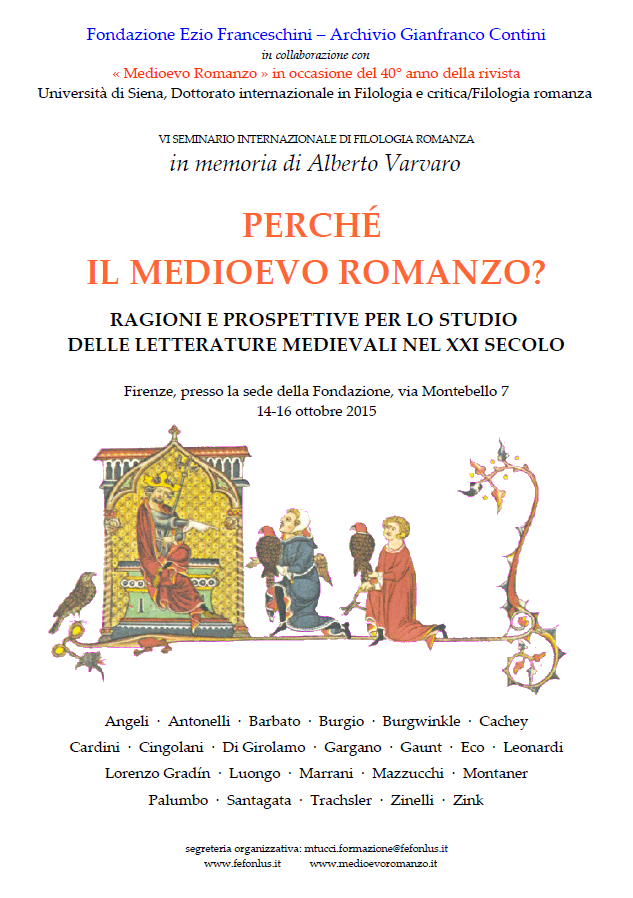
Colloque – Perche’ il Medioevo Romanzo ? Ragioni e prospettive per lo studio delle letterature medievali nel XXI secolo

Firenze, presso la sede della Fondazione, via Montebello 7
14-16 ottobre 2015

Fondazione Ezio Franceschini
Archivio Gianfranco Contini
in collaborazione con
« Medioevo Romanzo » nel 40° anno della rivista
Università di Siena – Dottorato internazionale
in Filologia e critica / Filologia romanza

VI Seminario internazionale di Filologia romanza
in memoria di Alberto Varvaro

Medioevo RomanzoProgramme :

14 ottobre 15,30 – Il Medioevo romanzo nel XXI secolo
Presiede Lino Leonardi (Firenze/Siena), discutono Umberto Eco (Bologna), Franco Cardini (Firenze)
Relazioni: Michel Zink (Paris), Roberto Antonelli (Roma)

15 ottobre 9,30 – Area iberica
Presiede Marcello Barbato (Napoli), discute Antonio Gargano (Napoli)
Relazioni: Alberto Montaner (Zaragoza), Pilar Lorenzo Gradin (Santiago), Stefano Cingolani (Barcelona)

15 ottobre 15,30 – Area francese
Presiede Giovanni Palumbo (Namur), discute Richard Trachsler (Zurich)
Relazioni: Giovanna Angeli (Firenze), Simon Gaunt (London)

Area provenzale
Presiede Fabio Zinelli (Paris), discute Costanzo Di Girolamo (Napoli)
Relazioni: Dietmar Rieger (Giessen), Bill Burgwinkle (Cambridge)

16 ottobre 9,30 Area italiana
Presiede Giuseppe Marrani (Siena), discute Theodor J. Cachey (Notre Dame/Roma)
Relazioni: Andrea Mazzucchi (Napoli), Marco Santagata (Pisa)

Tavola rotonda conclusiva
Eugenio Burgio (Venezia), Lino Leonardi (Firenze/Siena), Salvatore Luongo (Napoli)

Source : Medioevo Romanzo

Publié dans Colloque | Laisser un commentaire

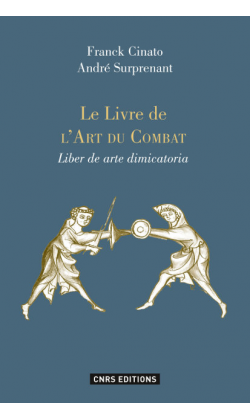
Publication – Franck Cinato et André Surprenant (éd.), « Le livre de l’art du combat »

Le plus ancien livre de combat connu en Occident. Un manuscrit unique, composé d’aquarelles dessinées à la plume et commentées en latin : la leçon d’un maître d’armes au tournant des XIIIe et XIVe siècles, enseignant à ses élèves une synthèse originale des pratiques de combat ancestrales de l’Europe romane, germanique ou celtique. Une oeuvre inachevée, énigmatique, traversée d’un souffle puissant. Voici la première édition critique, traduite en français et enrichie d’une analyse pluridisciplinaire éclairante, de cette oeuvre déjà célèbre sous le nom de Royal Armouries MS. I.33. Le maître d’armes est un ecclésiastique, héritier d’une pensée scolastique qui déborde sur l’éducation du corps. Centré sur le maniement raisonné de l’épée et du bouclier, son enseignement renverse les préjugés relatifs à la brutalité des pratiques de combat médiévales. Et montre que l’escrime de cette époque n’a rien à envier, en termes de richesse, aux arts martiaux traditionnels d’Orient.

le-livre-de-l-art-du-combat

Franck Cinato, docteur de l’École Pratique des Hautes Études (4e section, sciences historiques et philologiques), est aussi un praticien des Arts Martiaux Historiques Européens (membre de l’HEMAC), co-fondateur des ateliers d’escrime de la Compagnie médiévale de Montréal (1994) et de l’association Lugdunenses de Lyon (2004).n L

André Surprenant (1946-2012), chercheur indépendant formé à l’Institut d’études médiévales de l’Université de Montréal, s’intéressa en particulier à l’histoire des connaissances.

Informations pratiques :
Franck Cinato et André Surprenant (éd.), Le livre de l’art du combat. Liber de arte dimicatoria, CNRS éditions, 2015 (Sources d’histoire médiévale). 15.0 x 24.0 cm, 360 p. ISBN : 978-2-271-08607-5. Prix : 34,90 euros.

Source : CNRS Éditions

Publié dans Publications | Laisser un commentaire

Appel à contribution – The Matter of Mimesis

Cambridge, CRASSH, December 17 – 18, 2015
Deadline-CFP: 15 sept. 2015

Sponsored by:
CRASSH (Centre for Research into the Arts, Social Sciences and Humanities)
NWO (The Netherlands Organisation for Scientific Research)

Organized by:
Dr Emma Spary (University of Cambridge) and Dr Marjolijn Bol (University of Amsterdam and the Max Planck Institute for the History of Science, Berlin)

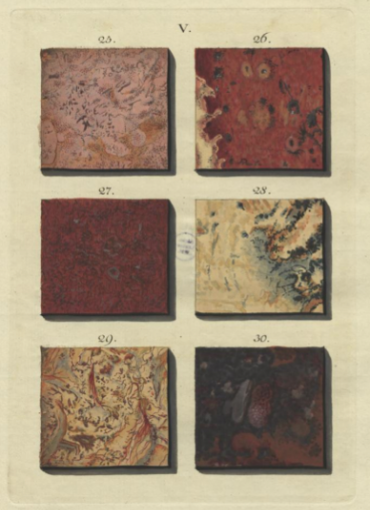
Screen_Shot_2015-07-13_at_16.37.35This interdisciplinary conference aims to bring together scholars from the sciences, social sciences and humanities in order to address material practices of mimesis. Aristotle, in one of the first definitions of the concept, argues that mimesis, or the imitation of nature, refers to both form and material. Thus far, scholarship has mostly focused on the role of form in mimetic practices, while the mimetic role of materials, despite the many disciplines in which these are central to making and knowing, remains significantly understudied.

Materials play a fundamental role in mimetic practices, from the earliest known examples to some of the most recent. Ancient ceramic vessels, for instance, some nearly four millennia old, imitate the visual appearance of other materials like metal or straw, while medieval artisans gave wood the costly appearance of marble, or made paper seem like gilded leather. The industrial revolution and chemical innovation created many new opportunities for material mimesis, crowned with the invention of plastics, which can be transformed into almost anything imaginable. Today, computer science allows us to flip pages of digital paper and navigate the visible world in three dimensions, while material science has invented biomaterials that replace the cells of our bodies, smart materials that can assume the appearance of their surroundings, and drugs that imitate the material of neurotransmitters, to name but a few. The role of materials in mimesis is by no means limited to the past: the practice will continue to have an impact in the future which cannot be foreseen.

The conference invites papers that explore the different roles played by materials in mimetic practices. The notion of substitution raises questions about the new techniques invented by artisans for making one material resemble another, as well as about the politics of the Ersatz in diet and medicine. Replication has united historians and anthropologists in attempts to reconstruct past materials and techniques, as well as engaging historians of science with the issue of ‘tacit knowledge’. Forgery, from banknotes to paintings, creates a competition to establish expertise over materials and mimetic processes between forgers and their opponents, who each have to become increasingly expert in order either to produce, or to detect, fraudulent objects. Nachahmung, the question of likeness and verisimilitude, is particularly interesting in material mimetic practices where artisans attempt to materialize the impossible, to give marble the weight of silk and hair, or have paper take on the appearance of a solid block of gold. Similarly interesting in this respect is the discussion over which representations of animal and plant materials most successfully capture ‘Nature’. Preservation is also a form of material mimesis, not only in recreations of life and the body after death in mummies, effigies and relics, but also as a way of stabilising a lasting value in certain material objects, either through technologies of preventing change or through reuse. Lastly, the question of disguise engages with material mimesis in important ways, from animal camouflage to smart materials that can assume the appearance of their surroundings and debates about bio-engineering where artificial tissues and organs are made to become one with our bodies.

Participants from different fields are welcome, including, but not limited to, archaeology, philosophy, art history and technical art history, history of science, technology and medicine, materials science, biology, anthropology and sociology.

Deadline for submissions: 15 September 2015 – Abstracts and proposals of 300 words (max), a short biography of 100 words (max). Please reply to: materialmimesis@gmail.com

Source : ArtHist

Publié dans Appel à contributions | Laisser un commentaire

Offre d’emploi – Contrat d’enseignement en Histoire médiévale (Université de Cergy-Pontoise)

L’université de Cergy-Pontoise recherche pour la rentrée une personne susceptible d’être intéressée par un CDD (du 1er novembre 2015 au 31 aout 2016), dont l’essentiel des cours (TD) seront en Histoire médiévale (Ve-XVes). Le volume horaire est de 313 heures.

Pour plus de détails sur le contenu pédagogique et le profil des enseignements vous pouvez contacter Valérie Toureille : valerie.toureille@u-cergy.fr

Source : AJCH

Publié dans Offre d'emploi | Laisser un commentaire

Colloque – Medicine of Words: Literature, Medicine, and Theology in the Middle Ages

St Anne’s College, Oxford
11-12th September 2015

Words, whether in poetry or prose, have a power beyond their meaning. They are capable not simply of expression but also of action; they can hurt or they can heal. Throughout the Middle Ages the potency of words, their effect and force upon the mind, body, and soul is explored and engaged with, poured over and focused upon not simply by the arts of grammar and rhetoric, but by poetry and theology, by medicine and psychology. Medieval texts are pieces of linguistic craft and intention, their words chosen and arranged with a purpose in mind. Poems in this period can be as crafted as theological treatises, their meters and rhymes as intentional and purpose driven as any medical instrument. Words, whether spoken or heard, emerge from the mind and feed back into it through the senses. They possess a power over the body as well as the soul, and can manipulate the emotions as easily as speaking can manipulate the breath. Potentially medicinal or malign, words in the Middle Ages are seen as tools to be used to persuade, to please, to heal or to harm.

This conference will explore the interconnection between literature, medicine, and theology throughout the Middle Ages. Possible texts for exploration include prayers, charms, narratives of illness and health, medical manuals, texts of contemplation and religious instruction, devotional materials, accounts of conversion and healing, saints lives and prognostications, and texts that evoke and direct the emotions in Old and Middle English.

Medicine of Words 2Programme :

Friday the 11th of September

10:00 – 11:00 – Registration
11:00 – 11:10 – Conference Welcome

11:10 – 12:00 – Plenary One – Styling Cure
Chair: Marion Turner

Mary Carruthers, New York University/Oxford University: Stylistic effects and bodily health in the aesthetics of the Middle Ages
12:00 – 13:00 – Buffet Lunch in St Anne’s College

13:00 – 14:30
Parallel sessions A & B

A – Text and Image: The Wounded Page
Chair: Ralph Hanna

Sara Öberg Strådal, University of Glasgow: The use of religious diagrams in medical manuscripts, a case study of Ashmole MS 789.
Michael Leahy, (Independent): What is a Naked Body Doing in a Surgical Text? The Medical Humanities and the Stockholm Roll
Jack Hartnell, Columbia University, New York: Wound as Word, Wound Man as Word Man.

B – Anglo-Saxon Attitudes to Medicine
Chair: Francis Leneghan

Sarah Gilbert, Durham University: Anglo-Saxon Medical Recipes in Non-medical Manuscripts: Matters of Culture, Context and Community
Emily Kesling, Oxford University: True Medicine and Forbidden Practices in Anglo-Saxon England
Kate Thomas, University of York: Names of healing: poetry and prayer in the Anglo-Saxon Lacnunga
14:30 – Tea and Coffee Break

15:00 – 16:30
Parallel sessions C & D

C – Metaphorical Medicine One
Chair: Kantik Ghosh

Catherine Batt, University of Leeds: Metaphors we Believe By: Spiritual and Medical Resources of the Heart
Teresa Tavormina, Michigan State University: “Ignotum per notiora »: Colour Terms and Similes in Middle English Uroscopies
Greti Dinkova-Bruun, Pontifical Institute of Mediaeval Studies, Toronto: Healing God’s Creation: Mary as Medicine in Two Devotional Poems from the Late Middle Ages

D – Medical Discourses
Chair: Kylie Murray

Naoë Kukita Yoshikawa, Shizuoka University, Japan: Women and the Medicine for the Soul in The Booke of Gostlye Grace
Jennifer M. Rampling, Princeton University: Paradise and the Purgation of Bodies in Medieval Alchemical Poetry
Laura Kalas Williams, University of Exeter: Painful Healing in The Book of Margery Kempe
16:30 – Tea and Coffee Break

17:00 – 18:30 – Plenary Two: Cura Animarium
Chair: Daniel McCann

Denis Renevey, Lausanne University: ‘ »In myn ere heuenly sown »: the Healing Power of the Name of Jesus’

Vincent Gillespie, Oxford University: Seek, Suffer, and Trust: Ease and Disease in Julian of Norwich

Respondent: Catherine Batt

18:45 – 19:15 – Wine Reception
19:30 – Conference Dinner in St Anne’s College

Saturday the 12th of September

09:00 – 10:45 – Parallel sessions E & F

E – Confession and Penance
Chair: Michael Leahy

Imogen Volkofsky University of Sydney: Psalmody, Penance and the Healing of Souls: the Meaning and Purpose of the Book of Cerne’s Abbreviated Psalter.
Francis Leneghan, Oxford University: I Just Can’t Get You Out Of My Head: Hearing Voices in The Wanderer
Winston Black, Assumption College, Massachusetts: Penitential Theology and Scholastic Medicine, (1150-1250)
Nicole Archambeau, Colorado State University: A Need for Consolation: Spiritual Suffering and the Sacrament of Confession

F – Charming Words:
Chair: Teresa Tavormina

Sara Ritchey, University of Louisiana in Lafayette: Hagiographic Healing: Performative Reading and Personal Change in Thirteenth-Century Miscellanies
Matthew Klemm, Ithaca College: The “Power of Things:” The Effect of Words, Thoughts, and Intentions on the Body According to Peter of Abano (d. 1316)
Katherine Hindley, Yale University: ‘Let It Be Made Secretly’: The Medicine of Unread Words
Erica R. Machulak, University of Notre Dame: The Leech and the Philosopher: Theorizing Practical Medicine in þe Priuyté of Priuyteis
10:45 – Tea and Coffee Break
11:00 – 12:30

Parallel sessions G&H

G – Metaphorical Medicine Two
Chair: Catherine Batt

Chris Tuckley (Independent): Making ‘preaching more powerful and more horrible to hear’? The manuscript settings of Malachy of Ireland’s Tractatus de veneno
Helen F. Smith, The University of Edinburgh: Medicine and Metaphor in Late-Medieval Drama

H – Narrating Cure
Chair: Peregrine Horden

Peter Murray Jones, Kings College Cambridge: Surgical narrative in England in the later Middle Ages
Daniel McCann, Oxford University: Soule-Hele: Therapeutic Reading in the Middle Ages
Rebecca Maryan, University of Nottingham: ‘Spiritual Regimen’: Language of the Four Humors in Fourteenth and Fifteenth Century Middle English Spiritual Guidance Texts
12:30 – 13:30 Buffet Lunch in St Anne’s College

13:30 – 15:00 Plenary Three – Healing Words
Chair: Corinne Saunders

John Thompson, Queen’s University Belfast: Medieval English Healing Places of the Soul
Ralph Hanna, Oxford University: Dramaturgy/Thaumaturgy: The York Palm Sunday Pageant

Respondent: Sara Ritchey

15:00 – Tea and Coffee Break

15:30 – 17:00 Plenary Four – Hearing the Voice Project
Chair: Mishtooni Bose

Hilary Powell, Durham University: ‘“Once more with feeling”: Dispelling Demons Through Song

Charles Fernyhough and Corinne Saunders, Durham University: Reading Margery Kempe’s Inner Voices

17:30 – 18:10 Plenary Five – Regimen Animarum
Chair: Emilie Savage-Smith

Peregrine Horden, Royal Holloway: A Healing Afterword: Conclusions and Prospects

18:30: Conference Close.

Source : University of Oxford

Publié dans Colloque | Laisser un commentaire

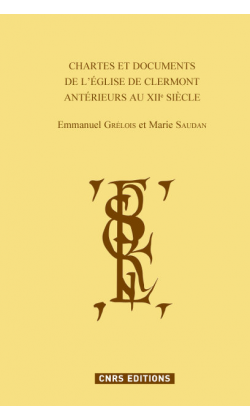
Publication – Emmanuel Grélois et Marie Saudan (éd.), « Chartes et documents de l’église de Clermont antérieurs au XIIe siècle »

Le fonds du chapitre cathédral de Clermont conserve, sous forme majoritairement d’originaux mais aussi de copies anciennes, une petite centaine de documents d’origine laïque ou ecclésiastique (chartes, notices, inventaires, contrats divers, convenienciae, copies dans un cartulaire en rouleau) que produisirent ou reçurent les évêques et les chanoines de Clermont aux Xe et XIe siècles. Quantitativement modeste au regard des masses documentaires laissées en Basse-Auvergne par les cartulaires monastiques de Brioude et de Sauxillanges, le corpus se caractérise par une grande variété typologique (nature, format, écriture, langue) et permet d’apercevoir la nature et le fonctionnement du siège épiscopal de Clermont (Arvernis), ses « dignitaires » (abbé, doyen, prévôt, capiscole), la desserte d’églises à Clermont et dans ses environs par le clergé cathédral, le patrimoine commun (communia fratrum) et la vie des chanoines, ainsi que la topographie de la cité à la veille de la « crise grégorienne » et avant la cristallisation institutionnelle, à l’orée du XIIe siècle, du capitulum (nommé « chapitre cathédral » seulement après 1250), distinct de l’« évêché ». Outre les institutions ecclésiastiques de la cité et du diocèse, les actes originaux donnent un aperçu des paysages, des structures matérielles de l’habitat, des conditions juridiques des exploitations rurales, voire de la civilisation matérielle aux alentours de l’an mil. Ils constituent aussi un témoignage linguistique direct de la scripta latina rustica, dont émerge l’ancien occitan écrit, mais qui est évincée dans le corpus par le latin restauré et normalisé dès la seconde moitié du XIe siècle. Dotée d’index qui recensent séparément personnes, lieux et matières, l’édition entend satisfaire aux normes tant diplomatiques que philologiques.

chartes-et-documents-de-l-eglise-de-clermont-anterieurs-au-xiie-siecleEmmanuel Grélois est maître de conférences à l’université Rennes 2.

Marie Saudan, agrégée d’histoire, docteur en histoire médiévale est professeur au collège Roger-Ruel à Saint-Didier-en-Velay.

Informations pratiques :
Emmanuel Grélois et Marie Saudan (éd.), Chartes et documents de l’église de Clermont antérieurs au XIIe siècle, Paris, CNRS éditions, 2015 (Documents, études et répertoires). Format : 19.0 x 26.0 cm. ISBN : 978-2-271-08676-1. Pagination : 256. Prix : 59,00 euros.

Source : CNRS éditions

Publié dans Publications | Laisser un commentaire

Appel à contribution – Holy Hero(in)es. Literary Constructions of Heroism in Late Antique and Early Medieval Hagiography

International conference at Ghent University (Belgium), Thursday 18th to Saturday 20th February 2016

The ERC research group Novel Saints (Ghent University) builds on and contributes to a recent trend in scholarship of studying late antique and early medieval hagiography (4th-12th cent.) as literature.

We welcome paper proposals for our first, international conference, which will deal with literary constructions of characters as hero(in)es in different types of late antique and early medieval hagiographical narrative (Lives, Martyr Acts, hagiographical romances, etc.). We envisage contributions on hagiography from different linguistic traditions (Latin, Greek, Syriac, Georgian, Coptic, Armenian, Persian and Arabic).

The conference aims to explore definitions of and aspects/concepts relevant to heroism in Christian narrative. What does it mean to be a hero(ine) in these narratives? Are there different types of hero(in)es (and of heroism)? To what extent can narratological concepts provide useful tools for evaluating hagiographical constructions of heroism? The other central question is how saints (and/or, possibly, other characters) are characterized, shaped, imagined and/or constructed as hero(in)es.

This last, broad question comprises a number of important sub-questions:

  • Which literary and/or rhetorical techniques underlie such constructions? To what extent and how do these narratives employ techniques rooted in ancient rhetoric (e.g. ecphrasis, syncrisis, ethopoeia, etc.), and to what purpose?
  • Does the notion of heroism imply specific behavioural patterns and/or speech acts?
  • What is the relevance of other literary traditions, such as biblical narrative, Acts of the Apostles (both canonical and apocryphal), ancient biography, historiography and fiction (pagan and/or Jewish novels)? To what extent do these traditions offer models of heroism that are adopted/adapted in hagiographical narratives? To what extent and
    how, for example, do ancient fictional strands of heroism persist in hagiographical constructions of martyrs and saints, as they are well known to do, for example, in the Apocryphal Acts of the Apostles (e.g. Paul & Thecla) and other early Christian narrative such as the Ps.-Clementines and a few pre-Nicean Martyr Acts?
  • How do hagiographical narratives adopt/rework authentication strategies common in biography or historiography in order to construct its hero(in)es?
  • To what extent and how do constructions of heroism in saints/martyrs in different cultures develop over time and cross-fertilize other such constructs throughout late antiquity and the middle ages?

In relation to this, the conference also aims to explore issues like the following:

  • heroism and definitions of sainthood and holiness;
  • heroism and explorations of moral/ethical dimensions of character;
  • heroism and development (is one a hero(ine) or does one become one?);
  • saints, self-presentation and performance: constructions of heroism and/or reenactments of earlier models by saints themselves (rather than by the narrators of their narratives);
  • heroism and ego-narration;
  • heroic constructions in collective v. individual life-writing;
  • impact of depictions of hero(in)es/heroic behaviour on audiences;
  • heroism and meta-literary approaches: ‘heroic’ qualities of both saints and texts;
  • types of saints (e.g. desert saints, military saints, converted prostitutes, holy fools, etc.) v. character individuation.

Abstracts (in English or French) should contain 300-350 words and should be sent to novelsaints@ugent.be before 20 September 2015. Notifications about acceptance (or not) will be sent out by 20 October 2015. Not only senior scholars but also PhD students are welcome to submit abstracts.

For further queries, please contact klazina.staat@ugent.be or julie.vanpelt@ugent.be.

Prof. dr. Koen De Temmerman
Klazina Staat
Julie Van Pelt

Source : Henri Pirenne Institute for Medieval Studies

Publié dans Appel à contributions | Laisser un commentaire

Appel à contribution – Essor et renouveau de la bibliothèque (XVe‒XVIIe siècle)

Journée d’étude »Essor et renouveau de la bibliothèque (XVe‒XVIIe siècle)« organisée par le CNRS-IRHT, Biblissima, Paris (Gilbert FOURNIER), l’université de Namur; PraME (Xavier HERMAND) et l’Institut historique allemand (Rolf GROSSE), Paris, Institut historique allemand, vendredi 17 juin 2016

Appel à communications

La seconde moitié du XVe siècle marque le renouveau matériel et intellectuel de la capitale du royaume de France. Les finances rétablies, le patrimoine consolidé, les institutions qui accueillent la vie de l’esprit sont à nouveau florissantes. Elles le doivent pour beaucoup à une nouvelle génération d’hommes, plus bâtisseurs que grands clercs. S’il est un indice de ce nouvel essor, c’est bien l’attention dont les bâtiments des bibliothèques font l’objet. Partout on pallie aux outrages du temps, on répond à de nouveaux besoins, on anticipe l’afflux de livres imprimés. Ces opérations donnent toujours lieu à un redéploiement des collections et à la rédaction de nouveaux instruments. Tel est le cas des catalogues alphabétique et topographique des ouvrages enchaînés dans la nouvelle salle de lecture de l’abbaye de Saint-Victor composés par Claude de Grandrue en 1514. Au milieu du XVIe siècle, le collège de Sorbonne dote sa bibliothèque commune d’un catalogue imprimé qui atteste la montée en puissance des livres imprimés dans les bibliothèques institutionnelles. Héritiers d’une longue tradition bibliothéconomique, ces catalogues continuèrent à être utilisés et à recevoir des additions pour certains jusqu’au milieu du XVIIe siècle.

Pour succinctes qu’elles soient, les lignes qui précèdent invitent à une réflexion sur l’essor et le renouveau des bibliothèques à l’automne du Moyen Âge. Le grand nombre de catalogues de bibliothèque conservés à travers l’Occident latin n’est qu’un indice parmi d’autres. A Paris, le rayonnement de l’université et le redéploiement d’une partie de son activité dans les collèges en sont les causes immédiates. Ailleurs, il s’agit du développement et de l’affirmation des institutions politiques, de la réforme des ordres ou de l’avènement de nouveaux modes de cohabitations religieuses. Partout les bibliothèques, leur vocation, leurs instruments et leurs hommes, sont investis de significations nouvelles qui annoncent l’époque moderne. Citons à titre d’exemple la figure du bibliothécaire qui sort de son anonymat et concentre sur sa personne plusieurs fonctions. Ainsi n’est-t-il pas rare qu’il cumule les fonctions de libraire, de maître des novices, de rédacteur de traités de dévotion et de propagateur de la réforme dans les établissements religieux. Ou encore l’apparition de nouveaux publics, en particulier laïcs, dans le sillage des bibliothèques urbaines ou d’ordres et de communautés réformés.

Notre propos est donc de cerner quelques une des significations nouvelles dont sont investies les bibliothèques à partir du XVe siècle et qui perdurent à l’époque moderne. Notre démarche est comparatiste. Pour l’occasion, elle privilégie le Saint Empire. Outre de favoriser le dialogue entre médiévistes et modernistes, notre projet vise à réunir des historiens de langue française et allemande et à confronter leurs historiographies respectives.

Les communications (en français, allemand ou anglais) dureront 20 minutes. Les propositions de communications devront être envoyées pour le 15 octobre 2015 par mail à Gilbert Fournier (gilbert.fournier@dbmail.com).

Elles devront comporter environ 500 mots et être accompagnées d’un CV détaillé.

Comité scientifique: Gilbert Fournier, Rolf Große, Xavier Hermand

Contact:
Gilbert Fournier
Institut de recherche et d’histoire des textes
40 avenue d’Iéna
75116 Paris
gilbert.fournier@dbmail.com

Publié dans Appel à contributions | Laisser un commentaire