Colloque – Medieval Graduate Conference 2015: Colour. Aspects and approaches

The Eleventh Oxford Medieval Graduate Conference

St. Edmund Hall, Oxford
17th – 18th April 2015

We are pleased to open registration for Colour, the eleventh Oxford Medieval Graduate Conference, to take place at St. Edmund Hall, Oxford, on Friday 17th and Saturday 18th April 2015.

Conference registration only is £10. Registration with a place at the Conference Dinner (three courses with half a bottle of wine),  at St. Hilda’s College on the evening of the 17th, is £40. The Society is also offering , to conference attendees only, one year’s membership of the Society (2 years for graduate students), combined with conference registration, at the special price of £25; and combined with conference registration and dinner at the special price of £55.( For more information on membership, please click here.)

In addition, all conference subscribers will receive free membership of the Society’s online Graduate Conference Space, 2015, launching in March, which will provide a range of services running alongside the conference proper.

If you are a speaker and would like to apply for a bursary for conference-related expenses, please indicate this on the form at the end of the sign-up process.

There are two ways to subscribe: please click here
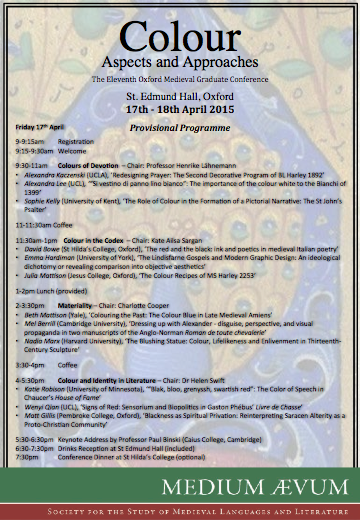
Colour Medieval GraduateProgramme :

Friday 17th April

9-9:15am Registration
9:15-9:30am Welcome

9:30-11am Colours of Devotion – Chair: Professor Henrike Lähnemann

Alexandra Kaczenski (UCLA), ‘Redesigning Prayer: The Second Decorative Program of BL Harley 1892’
Alexandra Lee (UCL), ‘”Si vestino di panno lino bianco”: The importance of the colour white to the Bianchi of 1399’
Sophie Kelly (University of Kent), ‘The Role of Colour in the Formation of a Pictorial Narrative: The St John’s Psalter’

11-11:30am Coffee

11:30am-1pm Colour in the Codex – Chair: Kate Ailsa Sargan

David Bowe (St Hilda’s College, Oxford), ‘The red and the black: ink and poetics in medieval Italian poetry’
Emma Hardiman (University of York), ‘The Lindisfarne Gospels and Modern Graphic Design: An ideological dichotomy or revealing comparison into objective aesthetics’
Julia Mattison (Jesus College, Oxford), ‘The Colour Recipes of MS Harley 2253’
1-2pm Lunch (provided)

2-3:30pm Materiality – Chair: Charlobe Cooper

Beth Mattison (Yale), ‘Colouring the Past: The Colour Blue in Late Medieval Amiens’
Mel Berrill (Cambridge University), ‘Dressing up with Alexander – disguise, perspective, and visual propaganda in two manuscripts of the Anglo-Norman Roman de toute chevalerie’
Nadia Marx (Harvard University), ‘The Blushing Statue: Colour, Lifelikeness and Enlivenment in Thirteenth-Century Sculpture’

3:30-4pm Coffee

4-5:30pm Colour and Iden7ty in Literature – Chair: Dr Helen Swie

Kathe Robison (University of Minnesota), ‘“Blak, bloo, grenyssh, swar0sh red”: The Color of Speech in Chaucer’s House of Fame’
Wenyi Qian (UCL), ‘Signs of Red: Sensorium and Biopolitics in Gaston Phébus’ Livre de Chasse’
Mao Gillis (Pembroke College, Oxford), ‘Blackness as Spiritual Privation: Reinterpreting Saracen Alterity as a Proto-Christian Community’

5:30-6:30pm Keynote Address by Professor Paul Binski (Caius College, Cambridge)

6:30-7:30pm Drinks Reception at St Edmund Hall (included)
7:30 : Conference dinner at St Hilda’s College (optional)

Saturday 18th April

9:30-10:30am Colourlessness – Chair: Dr Jenni Nuball

Anya Burgon (Cambridge University), ‘French Cistercian Grisaille Glass c. 1175-1250: Colourlessness, Transparency and White’
Jennifer Rushworth (St John’s College, Oxford), ‘Burial and the Black Death, Or, Petrarch and ‘the Dark Ages’
10:30-11am Coffee

11-1pm Gold – Chair: Dr Julia Walworth

Alexandra Bauer (University of Toronto), ‘Golden Idols and Golden Saints: Ælfric’s use of gold as a metaphor for conversion in the Life of Saint Eugenia’
Shan Morgain (University of Swansea), ‘The Golden Thread: an example of Mabinogi subtlety’
Claire Harrill (University of Birmingham), ‘A Study in Gold: St Margaret’s Gospel-Book Reconsidered’
Sophia Rochmes (University of California-Santa Barbara), ‘D’or, d’argent, de blanc et de noir: Material references in Flemish grisaille manuscripts’
1-2pm Lunch

2-3:30pm Colour Theory – Chair: Dr Emily Guerry

Anselm Oelze (University of Berlin), ‘Colours and Philosophers: Roger Bacon on the Psychology of Seeing and the Judgments of Sense’
Arthur Hénaff (EPHE, Paris), ‘Colours, cosmology and the making of scien0fic manuscripts: the Tübinger Hausbuch (Würbemberg, XVth century)’
Sheri Chriqui (Royal Holloway) – TBC
3:30-4pm Coffee

4-5pm Architectural Colours – Chair: Karl Kinsella

Harry Stirrup (University of York), ‘The Four Colours of the Tabernacle: Symbolism in the Vulgate and its Role in Tweleh-Century English Illumination’
Lydia Hansell (Courtauld Institute), ‘Colours for a Cardinal: Artistic Provisions for Religious Foundations in Avignon and Beaune’

5-6pm Closing remarks by Prof Eric Stanley

We are grateful for the sponsorship of St Edmund Hall, and of the Oxford Medieval Studies Network

Source : Medium Aevum
Publié dans Colloque | Laisser un commentaire

Offre d’emploi – Labex RESMED (Religions et sociétés dans le monde méditerranéen) : Ouverture de 3 contrats postdoctoraux d’un an

Le Labex (Laboratoire d’excellence) RESMED (Religions et sociétés dans le monde méditerranéen) lance un appel à candidatures de trois contrats postdoctoraux d’un an à partir du 1er septembre 2015.

Date limite des candidatures : 15 April 2015.

Éligibilité

Le projet de chaque candidat devra clairement s’inscrire dans le programme scientifique du Labex RESMED.

Le candidat aura soutenu son doctorat en France ou à l’étranger depuis moins de 5 ans au sein d’une université différente des institutions fondatrices du Labex RESMED (Paris-Sorbonne, Panthéon-Sorbonne, École pratique des hautes études).

Dossier de candidature
Formulaire de renseignement à télécharger.
Lettre de motivation.
Curriculum vitae.
Projet postdoctoral (5 pages au plus).
Deux lettres de recommandation.
Copie électronique de la thèse si celle-ci n’a pas été publiée à la date de la candidature.
Une publication significative sous format électronique.
Le dossier pourra être présenté en français ou en anglais.

Dépôt du dossier
Le dossier doit être envoyé au format pdf avant le 15 avril 2014 à minuit au Directeur et au Secrétaire général du Labex RESMED (Jean-Claude.Cheynet@paris-sorbonne.fr, olivier.delouis@labex-resmed.fr). L’admission sera décidée sur dossier à la fin du mois de mai 2015.

Date de début du contrat
1er septembre 2015

Rémunération
2000 €/mois.

Un rapport final sera fourni à l’issue du contrat présentant la contribution du postdoctorant aux programmes du Labex RESMED.

Profils

Le projet de chaque candidat devra clairement correspondre à un des profils ci-après.

Profil 1. Axe A1. Conversions et controverses : entre mondes sémitiques et monde gréco-romain

Cette recherche portera sur les échanges et influences entre la culture gréco-romaine et le monde sémitique, notamment dans le domaine de la religion : réflexion théologique, prières, liturgie, littérature religieuse en général, formes et lieux de culte. Elle devra mettre en avant la confrontation des différents modes de pensée religieuse (incompréhensions ou contre sens) et ses conséquences sur l’évolution des traditions religieuses (construction des identités, des doctrines ou des croyances nouvelles).

Une attention particulière sera portée aux projets consacrés au passage d’une culture religieuse à une autre (ses modalités, ses enjeux, ses conséquences) et aux formes de la polémique qui en résultent.

Profil 2. Axe A1. L’image de l’Islam à Byzance sous les Paléologues (13e-15e siècle)

L’étude de l’image de l’Islam forgée par Byzance du 13e au 15e siècle demeure un sujet peu traité. Par l’étude de documents historiques (par exemple les œuvres historiques de Jean VI Cantacuzène et de Nicéphore Grégoras, le registre patriarcal de Constantinople, les archives du Mont Athos, les Vies de saints athonites, les lettres de captivité de Grégoire Palamas, les textes pastoraux et épistolaires des métropolites Matthieu d’Ephèse et Théophane de Nicée, etc.), il s’agira d’analyser comment les événements militaires, les contacts avec les Musulmans (Turcs, Mamelouks ou Mongols) et l’expérience directe de personnages illustres, ont modifié la perception du problème musulman – turc en particulier – auquel la tradition apologétique et polémique byzantine avait jusque-là tenté de répondre.

Plusieurs axes pourront être explorés, tels que : – la condition des communautés chrétiennes dans les provinces orientales de l’empire, les plus exposées à l’avancée turc-ottomane ; – la gestion des monastères athonites pillés ou des moines capturés lors des fréquentes incursions pirates ou encore le maintien de leurs privilèges fiscaux ; – la production polémique contre l’Islam et son écho à l’intérieur de la société byzantine.

Profil 3. Axe C2. Les mots de la paix. Programme de lexicographie historique

Ce thème de recherche a pour ambition d’explorer le champ lexical de la paix dans plusieurs cultures de la Méditerranée orientale et de l’Orient pour l’Antiquité et le Moyen-Âge. En effet, si son antinome, la guerre, a fait l’objet de nombreuses recherches, la paix est un concept difficile à saisir, et une étude lexicographique permettra d’appréhender les représentations que l’on s’en est fait dans différentes civilisations et religions (notamment à travers des sources en arabe, grec archaïque et classique, grec biblique, patristique, byzantin, slavon ancien, bulgare, serbe, sumérien, akkadien, égyptien ancien, copte, arabe, turc, persan).

Il s’agira d’explorer des textes de différents genres littéraires pour rendre compte, grâce à des études terminologiques, de ces conceptions dans différentes épistémès, sur la longue durée, et plus largement dans l’histoire des mentalités. En outre, ces voyages terminologiques nous permettront d’examiner si les conceptions véhiculées par les lexiques passent d’une culture à l’autre.

Source : Labex RESMED

Publié dans Offre d'emploi | Laisser un commentaire

Appel à contribution – Emotional and Affective Narratives in pre-Modern Europe/ Late-Medieval and Renaissance France

In contemporary thought, the field of emotion studies represents a very potent framework that allows anthropologists, historians, neuroscientists and philosophers to think of the possible ways in which subjects engage with their own sensory experience and with larger practices that enable them to articulate such experiences in in meaningful ways. Nevertheless, « How do I feel? » is a question that was equally quintessential in the pre-modern Western system of thought even if the contemporary significations of the word « emotion  » did not become concrete until the 17th century. In their attempt to capture pre-modern emotional modes and systems of feelings, contemporary medievalists, especially under the influence of poststructuralism, considered emotions primarily as discursive entities that shape collective and individual subjectivities. Barbara Rosenwein’s influential notion of « emotional communities,” which inaugurates this trajectory in medieval studies, turns away from the Cartesian split between mind and body and, instead, presents emotions as discursive regimes consisting of strategies, tactics and the conscious ways in which subjects engage with these. However, while emotions are indeed discursive cultural constructs producing collective subjectivities they also possess a sensorial aspect that simultaneously escapes being captured by the social while being constitutive of it. This was the special contribution of the affective “turn” in contemporary theory: the epistemological need to distinguish between emotions as discursive constructs, and affects as flashes of sensory experience and feelings.

This volume aims at complicating Rosenwein’s existing notion of emotion as discursive practice and, at the same time, investigating how medieval subjects talked about their somatic, sensorial and affective practices. If emotions belong to the complexities of social dynamics, we ask how are they incorporated in textual artifacts and cultural productions stemming from often conflicting social events, groups and discourses? How do they act as facilitators between the author and its audience, between the period and its meaning, between the genre and its writing? The emotional and affective dimension of a text cannot be rationalized as either its objective or its point of origin. It is more a textual and factual paradigm around which the author develops her intellectual environment, creating the cultural and political dimension for the text. However, it is within this territory of the text, as a socio-cultural entity orchestrated by the auctorial persona, that a whole archive of emotions and affects is disseminated.

We are interested in essays that investigate the constituency of such “archives of feelings” (Cvetkovich) through the study of the affectivity and emotionality of both literary and non-literary texts, such as political and theological treatises, mystical texts, medical works, scientific tracts and pamphlets, hagiographies and encyclopedic compendiums. While we welcome submissions of articles dealing with such topics in different geographic areas, we are particularly interested in late-medieval and Renaissance French texts.

Articles may examine, but are not limited to questions related to:

– discourses and practices of emotions and affect
– the somatization of the emotional act
– affect and emotions in poetry
– emotions, affect and gender
– queer emotions and affects
– emotions, affect and race
– psychogeographies of emotions and affect
– rhetorics of affect or emotions
– emotional rewritings of historical events

Please send 300-word abstracts in English, as well as a short biography with university affiliation and email address, to Andreea Marculescu (marculescu.andreea@gmail.com or amarcule@uci.edu) and Charles-Louis Morand Métivier (cmorandm@uvm.edu) before June 1st . Selected abstracts will be notified on July 1st, and the complete papers will be due on November 1st.

Publié dans Appel à contributions | Laisser un commentaire

Conférence et appel à contribution – Lectio Chair 2015 : The Uses and Communication of the Past in the Middle Ages

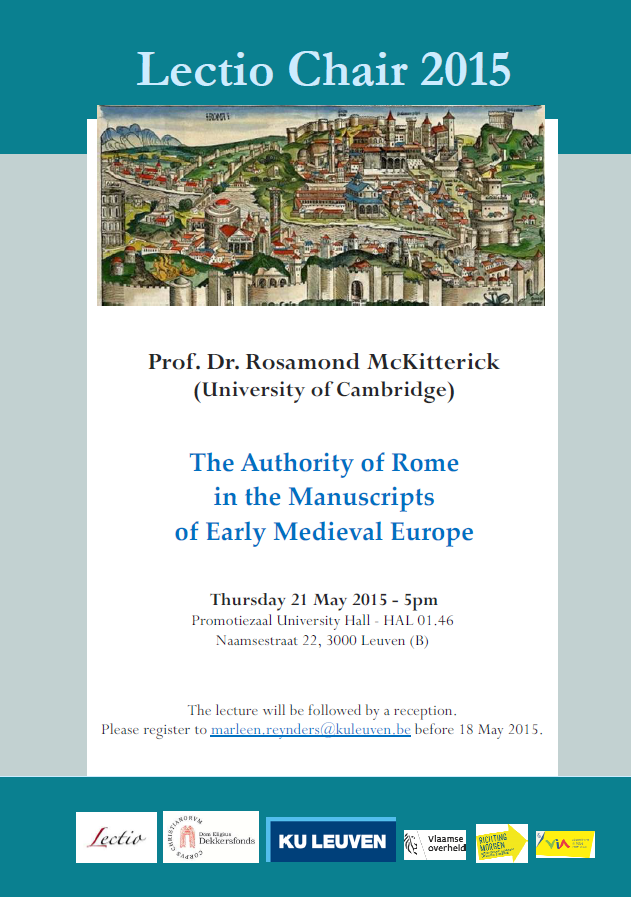
Lectio chair 2015
Prof. Dr. Rosamond McKitterick (University of Cambridge)
The Authority of Rome in the Manuscripts of Early Medieval Europe

21 May 2015 at 5 pm
Promotiezaal – University Hall – Naamsestraat 22, 3000 Leuven

The special place of the Roman past in the memory of Europe as a whole has been considered by many scholars from many different perspectives. The reception, assimilation and adaptation of texts from ancient and early Christian Rome was undoubtedly a creative process. This process involved not only the adoption and promotion of written culture for administrative, legal, religious, and educational purposes and the universal use of Latin, but also the transmission into new contexts of secular, scientific and early Christian texts and knowledge from the classical and late antique Greek and Roman traditions. Study of the role of such cultural models in the early middle ages in both the barbarian successor states of western Europe and North Africa, and throughout the Frankish realm created by Charlemagne, enables us to see how both the knowledge of the past and of earlier texts could be appropriated.

Yet the transmission of texts and knowledge raises the overall question of the status and authority of Rome and Roman texts – both secular and religious. This lecture, therefore, will address the questions of how and why the authority of Rome was communicated and established in the various contexts of politics, ideology, law, the organisation of knowledge, language, and religious orthodoxy in early medieval Europe.

The lecture will be followed by a reception. Registration is required. Please send an email to marleen.reynders@kuleuven.be before 18 May 2015.

McKitterick - Authority of RomeDoctoral seminar – The Uses and Communication of the Past in the Middle Ages

Friday 22 May 2015
Museumzaal MSI 02.08 10am-6pm
Mgr. Sencie-Institute, Erasmusplein 2, Leuven (B)

Professor Rosamond McKitterick is the holder of the 2015 LECTIO Chair. In addition to her public lecture on Thursday 21 May entitled “The Authority of Rome in the Manuscripts of Early Medieval Europe”, she will give on 22 May a Doctoral Seminar “The Uses of the Past in Early Medieval Francia and Italy: Narrative Strategies and Manuscript Witnesses”.

On the occasion of this seminar, a selection of early career scholars in the fields of history, art history, palaeography and manuscript studies, law, theology, music, philosophy, literary studies, architecture and archaeology are given the opportunity to present their research and to discuss it with the chair holder, the scientific committee and other colleagues.

The selected scholars are asked to consider the different ways in which medieval writers, scribes, artists, thinkers and composers used and communicated the past and thus, effectively or less effectively, contributed to the construction of identity, memory and commemoration, political arguments and intellectual debates.

Paper givers are invited to think about how such examples were communicated, what was being communicated and how effective such examples might have been. We invite early career researchers (PhD students and postdocs) to submit proposals for a paper in one of the aforementioned domains. Selected researchers are expected to give a 20-minutes presentation in English. A one-page description of the proposed paper and a short CV should be submitted no later than 20 April 2015 to lectio@kuleuven.be.

Scholars who want to attend the seminar without presenting a paper are also asked to register before that date.

Provisional program

Thursday 21 May 2015

17.00 Public lecture (Lectio Chair) – Prof. Dr. Rosamond McKitterick (University of Cambridge)
Promotiezaal – University Hall 01.46 – Naamsestraat 22 Leuven
‘The Authority of Rome in the Manuscripts of Early Medieval Europe’

Friday 22 May 2015

10.00 Introduction – Prof. Dr. Brigitte Meijns (KU Leuven)
10.05 Doctoral Seminar – Prof. Dr. Rosamond McKitterick (University of Cambridge) – “The Uses of the Past in Early Medieval Francia and Italy: Narrative Strategies and Manuscript Witnesses”.
12.00 Lunch

13.00 Paper session 1 ‘The Uses and Communication of the Past in the Middle Ages’ (5 papers)
15.00 Coffee break

15.30 Paper session 2 ‘The Uses and Communication of the Past in the Middle Ages’ (5 papers)
17.30 Final conclusions

Scientific & organizing committee :
KU Leuven : Brigitte Meijns, Pieter De Leemans, Marleen Reynders
U Antwerpen : Veerle Fraeters
U Gent : Steven Vanderputten

In collaboration with The Institute for Medieval and Renaissance Studies (KU Leuven)

Conference poster
Lectio chair – CFP

Publié dans Appel à contributions, Colloque, Séminaire | Laisser un commentaire

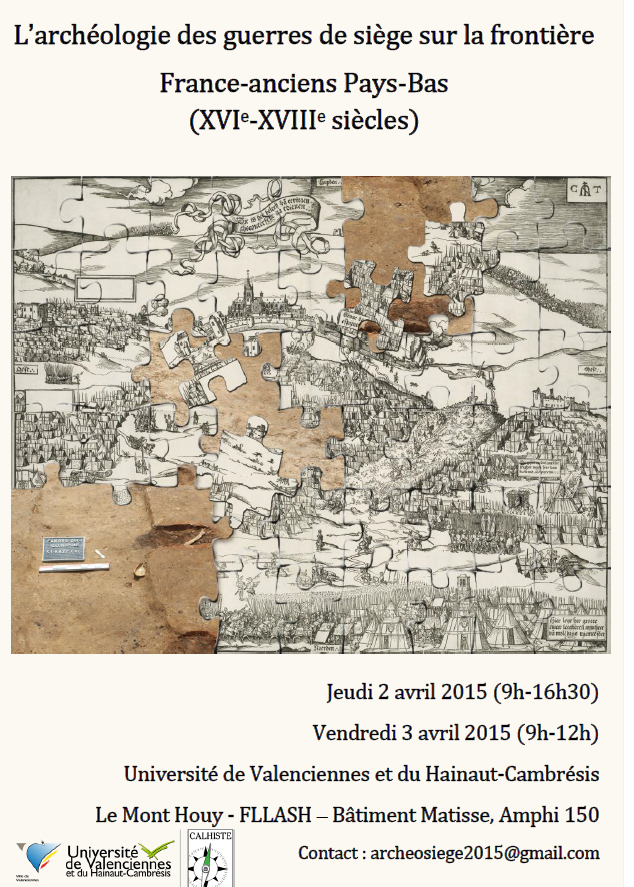
Colloque – L’archéologie des guerres de siège sur la frontière France-anciens Pays-Bas (XVIe-XVIIIe siècles)

Jeudi 2 avril 2015 (9h-16h30) et vendredi 3 avril 2015 (9h-12h)
Université de Valenciennes et du Hainaut-Cambrésis
Le Mont Houy – FLLASH – Bâtiment Matisse, Amphi 150

Contact : archeosiege2015@gmail.com ou Yves.Junot@univ-valenciennes.fr

Comité d’organisation : Jacques Heude (UVHC), Yves Junot (UVHC), Jean-Christophe Largillière (Service archéologique, Ville de Valenciennes), Arnaud Tixador (Service archéologique, Ville de Valenciennes)

Comité scientifique : Philippe Beaussart (Service archéologique, Ville de Valenciennes), Philippe Bragard (Université catholique de Louvain)

Archéologie des guerres de siègeProgramme :

Jeudi 2 avril 2015 :

9h30 Accueil des participants
9h45 – Introduction aux journées d’études par les organisateurs

Présidence de la matinée : Philippe Bragard, professeur d’histoire de l’architecture et de l’urbanisme, Université catholique de Louvain

Avant la campagne : l’entraînement des troupes

10h00 – Samuel Guérin (INRAP Centre/Ile-de-France), Les « camps de Compiègne »: découverte de vestiges de manoeuvres militaires à Margny-lès-Compiègne dans l’Oise, 1666-1847.
10h25 – Séverine Hurard (INRAP Ile-de-France), Le fort Saint-Sébastien de Saint-Germain-en-Laye : la préparation des troupes de Louis XIV à la guerre de siège, vers 1669.
10h50 questions / pause

Archéologie des camps militaires

11h15 – Arnaud Tixador (Service Archéologique de Valenciennes), Michel Siebrand (Service Public de Wallonie, Namur), Marceline Denis (Service Public de Wallonie, Mons), Vestiges de campements et de bivouacs militaires en Hainaut, Namur et Valenciennes, XVIe-XVIIIe siècles.
11h40 – Laurent Brou et Robert Wagner (CNRA, Luxembourg), Des campements et aménagements du siège de 1684 par l’armée de Louis XIV : Une exceptionnelle découverte d’archéologie militaire.
12h05 – Pauline Lhommel (EVEHA), Auxi-le-Chateau : exemple d’un espace funéraire atypique, XVIe-XVIIe siècles.
12h30 questions
13h00 Déjeuner

Présidence de l’après-midi : Philippe Beaussart, directeur du Service archéologique, Ville de Valenciennes

Les dispositifs d’attaque

14h00 – Maxime Poulain (Université de Gand), Une archéologie de la Guerre de Quatre-Vingts Ans (1568-1648): le siège d’Ostende et le fort Saint-Isabelle.

Le tissu urbain au prisme de la guerre de siège

14h25 – Mathieu Lançon (INRAP Villeneuve d’Ascq), Contraction ou dilatation de l’espace urbain dans deux places fortes du Nord de la France : Les données archéologiques des villes de Béthune et Dunkerque (XVIe-XVIIIe siècles).
14h50 questions / pause

L’armement dans la guerre de siège

15h15 – Dominique Prévôt (Musée de l’Armée, Invalides, Paris), L’armement portatif utilisé dans la guerre de siège entre 1650 et 1750.
15h40 – Christophe Pommier (Musée de l’Armée, Invalides, Paris), Les batteries d’artillerie dans la guerre de siège : implantations, rôles et composition (guerre de Louis XIV).
16h05 questions

Vendredi 3 avril 2015

La naissance de la place forte frontalière

9h00 – Jean-Denis Laffite (INRAP Metz), La forteresse de Rodemack, « sentinelle de Luxembourg », archéologie des conflits entre le royaume de France et le duché de la fin du XVe au XVIIIe siècle (fouilles 2012-2014)
9h25 – Karine Berthier (EA 4284 – TRAME, Université de Picardie – Jules Verne), Le système défensif de la porte Montrescu (Amiens) dans les conflits du XVIe siècle
9h50 – Wim Dijkman (Centre Céramique, Maastricht), Maastricht vaut le détour : L’intérêt stratégique d’une ville mosane des anciens Pays-Bas (XVIe-XVIIIe siècle)
10h15 questions / pause

Nouvelles perspectives de recherche sur la guerre de siège

10h45 – Yann Lorin, Yves Créteur, Guillaume Pâques (INRAP Achicourt et Halma Ipel), Les sièges de la place forte d’Aire sur la Lys au cours des XVIIe et XVIIIe siècles : contribution de l’archéologie préventive sur la ZAC Saint-Martin
11h10 – Alain Henton et Yves Créteur (INRAP Nord-Picardie), La guerre de succession d’Espagne (1701-1714) vue…d’avion. Retranchements de sièges et de mouvements de troupes mis en évidence sur ortho-photographies aériennes de haute altitude en Nord-Pas-de-Calais. Nouvelles perspectives de recherche.
11h30 questions / conclusions des journées

Programme au format PDF : ici

Publié dans Colloque | Laisser un commentaire

Offre d’emploi – Lecturer in Historic Landscapes and Environments (University of Chester)

University of Chester – Department of History and Archaeology

Location: Chester
Salary: £32,277 to £35,256 per annum
Hours: Full Time
Contract Type: Contract / Temporary
Placed on: 9th March 2015
Closes: 26th March 2015
Job Ref: HR14211

Fixed term contract from 1st September 2015 until July 2017

uoc-logo-2-e1354631573132Candidates are sought for a Lectureship in Historic Landscapes and Environments in the Department of History and Archaeology at the University of Chester. The successful candidate will have a proven track record as a teacher and researcher in Historic Landscapes and Environments. They may have a research specialism in any period of history and their research may fall under any of the following themes:

  • The History of Landscapes
  • Historic Conceptions of Place and Space
  • Urban History
  • The History of Architecture and the Built Environment
  • The History of Material Culture

You will have a good Honours Degree (normally 2.1 or First or equivalent) in History and a Ph.D. in Historic Landscapes and Environments. You will have considerable HE teaching experience and a proven capacity to deliver a range of undergraduate and postgraduate modules in Historic Landscapes and Environments. You may have experience of supervising undergraduate history dissertations as well as an ability to enhance the MA and MRes postgraduate provision. You will have evidence of either publications on Historic Landscapes and Environments, or demonstrable evidence of work-in-progress towards such publications.

Candidates may download further details from our website at http://www.chester.ac.uk/jobs and apply for the post via our Online Recruitment Website quoting reference number HR14211.

Interviews are expected to be held in April 2015.

Source : jobs.ac.uk

Publié dans Offre d'emploi | Laisser un commentaire

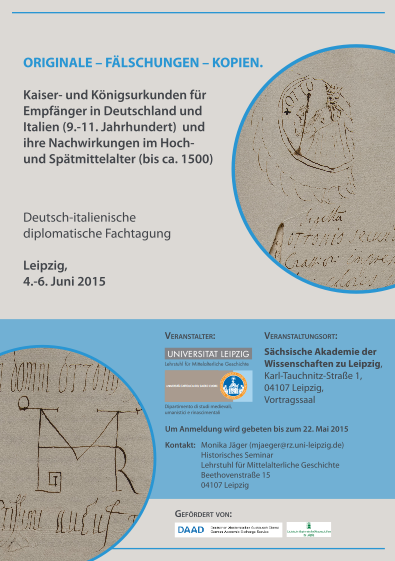
Colloque – Originale – Fälschungen – Kopien. Kaiser- und Königsurkunden für Empfänger in Deutschland und Italien (9.-11. Jahrhundert) und ihre Nachwirkungen im Hoch- und Spätmittelalter (bis ca. 1500)

Leipzig, 4.-6. Juni 2015

Säschische Akademie der Wissenschaften zu Leipzig
Karl-Tauchnitz-Strasse 1,
04107 Leipzig
Vortragssaal

Kontakt : Monika Jäger – mjaeger@rz.uni-leipzig.de

Deutsch-italienische diplomatische Fachtagung

Programme : ici

Coll. LeipzigArgumentaire :

Herrscherdiplome sind vielschichtige Zeugnisse ihrer Vergangenheit und können durch geschicktes Befragen mehr enthüllen, als es bisher von der Forschung erkannt wurde. Sie verdienen daher eine Untersuchung unter neuen Perspektiven, wie sie die Leipziger diplomatische Fachtagung vom 4. bis 6. Juni 2015 aufzeigen will.

Kaiser- und Königsurkunden waren einerseits rechtliche Dokumente von höchster Beweiskraft für Besitzungen und Herrschaftsrechte der Urkundenempfänger. Andererseits waren Diplome politische Dokumente. Sie spiegeln die jeweils aktuellen Beziehungen zwischen dem Herrscher und den geistlichen und weltlichen Großen wider, die mit ihm gemeinsam das Imperium formten und prägten. In der jüngeren Forschung beurteilt man ein Diplom nicht mehr – wie vor allem im 19. Jahrhundert – als einseitigen hierarchischen königlichen Akt, sondern als Ergebnis eines Kommunikationsprozesses zwischen der Aussteller- und der Empfängerseite, in den häufig noch Vermittler (Intervenienten) eingeschaltet waren. Diplome waren also mehrseitige Dokumente und damit Bestandteil der periodischen Kommunikation zwischen Großen und Herrschern.

Diplome waren weiterhin exklusive Dokumente, die nur innerhalb der sozialen Führungsgruppen der König- und Kaiserreiche zirkulierten. Diplome waren auch deshalb exklusive Dokumente, weil sie nicht in Massenproduktion im Sinne von Verwaltungsschriftgut hergestellt wurden, sondern als Einzelstücke, was ihrem Charakter als mehrseitigen Dokumenten ebenfalls entsprach. Dieser Exklusivität wurde auch durch das äußere Erscheinungsbild der Urkunden Rechnung getragen. Sie wirkten visuell durch ihre außergewöhnliche Größe, die man für die Texte nicht benötigte, sondern aus repräsentativen Gründen wählte. Die Textgestaltung erfolgte durch spezielle Schriften. Hinzu kamen graphische Zeichen wie die symbolische Invocatio am Beginn eines Diploms sowie das Herrschermonogramm, das zusammen mit dem Siegel den jeweiligen Aussteller der Urkunde repräsentierte.

Schließlich wurden die Diplome unter den Bedingungen einer Gesellschaft mit reduzierter Schriftlichkeit in die üblichen mündlichen und demonstrativen Kommunikationsformen zwischen dem Herrscher und den Fürsten des Reiches integriert. In der Regel wurden die in Latein verfassten Kaiser- und Königsurkunden mindestens zweimal in einem öffentlichen Rahmen gezeigt und verlesen: zuerst beim Abschluss der Beurkundung am Herrscherhof und dann nach dem Eintreffen am Empfängersitz. Sie entfalteten dabei eine audiovisuelle Wirkung. Zugleich demonstrierten sie die Herrschernähe der Großen, die am Verhandlungs- und Beurkundungsprozess beteiligt waren und deshalb in den Diplomen namentlich aufgeführt wurden.

Mit dem angesprochenen Perspektivwechsel befasst sich das deutsch-italienische Forschungsprojekt „Italia Regia“. Theoriegeleitete Untersuchungen werden auf den Prüfstand gestellt anhand diplomatischer Grundlagenforschung, die hin und wieder auch ein bisher unbekanntes Original zutage fördert. Bisher fanden im Rahmen dieses Forschungsvorhabens bereits zwei Tagungen statt: Im Jahr 2009 lag der Schwerpunkt noch auf der Vorstellung des Projektes im Allgemeinen, mit Betonung der Relevanz der Empfängerseite und der Notwendigkeit zur systematischen Einbeziehung der äußeren Urkundenmerkmale für eine Neubewertung der Stücke. 2011 widmete man sich bereits Detailfragen wie dem Mehrseitigkeitscharakter der Diplome, der unterschiedlichen Funktionen und Merkmale der Stücke und wie sich diese in den verschiedenen Stadien und Formen niederschlugen.

Einige der hier angesprochenen Aspekte sollen nun im Juni während der dritten Tagung vertieft werden. Im Mittelpunkt stehen diesmal zwei Hauptfragen:

1. Welche Funktionen sollten die Diplome in verschiedenen Stadien und Formen ihrer Existenz erfüllen?
2. Wie ist die Relevanz der äußeren und inneren Merkmale im Hinblick auf die verschiedenen Funktionen der Diplome zu beurteilen?

Um diese Fragen zu beantworten, müssen zwei Stadien in der „Biographie“ der Königs- bzw. Kaiserurkunden in den Blick genommen werden: ihr gegenwartsbezogenes Bedeutungsspektrum zu Lebzeiten von Aussteller, Empfänger und Vermittler sowie ihr künftiges nach dem Tode der an ihrer Herstellung beteiligten Personen bzw. aus der Sicht nachfolgender Generationen. Die Untersuchung der Funktionen und Formen des „Nachlebens“ von karolingischen, ottonischen und salischen Originaldiplomen in den Gesellschaften späterer Generationen bildet den inhaltlichen Schwerpunkt der Fachkonferenz. In der älteren Forschung begnügte man sich in der Regel mit der Edition und Interpretation der Originale. Abschriften wurden nur dann wichtig, wenn die Originale verloren waren. Im Unterschied dazu soll die Fachtagung die Fragen klären helfen, welche Originale spätere Generationen für welche Zwecke und in welchen Formen kopieren ließen. Zudem wird danach gefragt, welche Veränderungen der inneren und äußeren Merkmale zwischen Originalen und Abschriften zu konstatieren sind. Dabei beschränkt sich die Tagung auf zwei Hauptgruppen der kopialen Überlieferung: auf die beglaubigten Abschriften sowie auf die Anfertigung von Kopialbüchern. Für beide Gruppen ist zu untersuchen, inwieweit und weshalb auch Fälschungen von Originaldiplomen die Grundlagen für Abschriften bildeten. Des Weiteren werden Nachurkunden, die Diplome späterer Herrscher berücksichtigt, in denen karolingische, ottonische oder salische Diplome als Vorurkunden genannt werden.

Diese Ausrichtung der Tagung erfordert die Auswertung von Archivbeständen, in denen sowohl Originale und Falsifikate als auch verschiedene Formen der kopialen Überlieferung vorhanden sind. Bezüglich der Fälschungen ist zu prüfen, ob es sich um die Fälschung oder Verfälschung von einzelnen Diplomen oder um ganze Serien gefälschter Urkunden auf die Namen verschiedener Herrscher handelt. Hinsichtlich der gefälschten Diplome ist von Interesse, welche Kaiser oder Könige man in späteren Zeiten auswählte, um als Autorität und Aussteller gefälschter Diplome zu dienen.

Ein Hauptziel der Tagung besteht im Vergleich zwischen der Nachwirkung von Originaldiplomen nördlich und südlich der Alpen und damit in jenen beiden Ländern, die einst in Form einer bilateralen Union im Rahmen des westlichen Imperiums miteinander verbunden waren. Die Relationen zwischen den verschiedenen Überlieferungsformen sind bisher noch nicht auf breiterer Grundlage und vor allem nicht komparatistisch analysiert worden. Das Interesse galt in der Regel entweder den Originalen oder den Kopialbüchern. Die Beziehungen zwischen Originalen, Fälschungen, beglaubigten Abschriften und Kopialbüchern wurden bisher nicht eigens erforscht.

21 Forscherinnen und Forscher aus Italien, Deutschland und Frankreich nähern sich in ihren Beiträgen den verschiedenen Überlieferungsformen. Sie schauen dabei den Kopisten ebenso über die Schulter wie den Fälschern und fragen „cui bono?“

Source : Mittelalter.de

Publié dans Colloque | Laisser un commentaire

Publication – Perspective. La revue de l’INHA – 2014-2 Antiquité/Moyen Âge

L’équipe de Perspective est heureuse de vous annoncer la parution du numéro 2014-2 Antiquité/Moyen Âge, dont vous trouverez le sommaire ci-dessous.

Une version en ligne du numéro est accessible à tous les abonnés de la revue (http://perspective.revues.org/4441) et le numéro est en vente sur le site du Comptoir des presses d’universités (http://www.lcdpu.fr/livre/?GCOI=27000100365420) ou peut être commandé chez tous les libraires.

2014_2_vignettes-small250Table des matières :

Johanne Lamoureux – La migration d’Erwin Panofsky

Tribune

Jean-Claude Schmitt – Jacques Le Goff (1924-2014)

Antiquité

Débat

Tonio Hölscher, François Lissarrague et Emmanuelle Rosso – Entretien avec Tonio Hölscher
Zainab Bahrani, Jaś Elsner, Wu Hung, Rosemary Joyce et Jeremy Tanner – Questions on “world art history”

Travaux

Jean-Charles Moretti – L’architecture des théâtres en Grèce antique avant l’époque impériale : un point de vue sur les études publiées entre 1994 et 2014
Patrick Degryse, Rebecca B. Scott et Dieter Brems – The archaeometry of ancient glassmaking: reconstructing ancient technology and the trade of raw materials

Actualité

Pascal Butterlin – L’archéologie orientale entre Babel imaginée et cités invisibles
Caroline Vout – The end of the “Greek Revolution”?
Sandra Nessah – Études sur le corps et le vêtement à partir de l’imagerie antique
Valérie Huet – À propos de figures de dieux dans l’Antiquité grecque et romaine, ou comment (et pourquoi) rendre visible l’invisible

Moyen Âge

Débat

Michele Bacci, Carola Jäggi, Bianca Kühnel, Rafał Quirini-Popławski, Avinoam Shalem et Gerhard Wolf – Qu’est-ce que l’espace méditerranéen au Moyen Âge ?
Marc Gil, Laurent Hablot, Robert A. Maxwell, Maria do Rosário Morujão, Markus Späth et Ambre Vilain – L’héraldique, la sigillographie et l’emblématique au regard de l’histoire de l’art : nouvelles perspectives de recherches

Travaux

Bruno Klein – Le premier gothique dans le Saint-Empire romain germanique : nouvelles questions, méthodes, résultats et lacunes de la recherche

Actualité

Fabrizio Crivello – L’âge d’or de l’opus lemovicense : quelques considérations sur les émaux méridionaux
Christian Heck – Entre dissemblance et incarnation : l’image du corps dans l’art du Moyen Âge
Marek Walczak – L’Europa Jagiellonica a-t-elle existé ? Quelques nouvelles de la recherche sur l’art en Europe centrale et orientale (1386-1572)

Source : INHA

Publié dans Publications | Laisser un commentaire

Colloques – « Mortuary archaeology, methodology and theory » & « Merovingian mortuary studies in an interdisciplinary perspective »

Date: April 22-24, 2015
Venue: Leiden University, Van Steenis building, Einsteinweg 2 in Leiden, room F1.04
Cost: €20 per day
Registration deadline: April 3rd

Arceological dialoguesThe first day of this three-day conference will be dedicated to a general discussion about theory and methodology of mortuary archaeology. The two consecutive days will focus specifically on early medieval cemetery archaeology in the Netherlands. For more details, please see the prelimenary programme and abstract booklet for the first day and the second and third day.

The form (here)allows you to register for each day of the conference. Please note that your registration will not be processed until you have paid the conference fee (speakers and international attendees excepted). The conference fee is €20 for one day, €40 for two days and €60 for three days. After registering, please transfer your fee to Stichting Archaeological Dialogues IBAN: NL33INGB0002309869, mentioning your name and the number of days you registered for.

This fee covers coffee breaks, lunch and evening drinks at the Archaeology Faculty in Leiden. ARCHON students are eligible for reimbursement. The registration deadline is March 22nd.

Here you can find list of hotels near the conference location for your convenience.

If you are unable to register due to a malfunction in the form, please contact archaeologicaldialogues(at)gmail(dot)com

Source : Archeological Dialogues

Publié dans Le réseau | Laisser un commentaire

Colloque – François Ier imaginé

Parce que l’imagerie constituée autour de la figure de François Ier est un mythe et qu’elle fait partie de notre patrimoine, sa constitution mérite d’être étudiée comme un fait historique.

Le propos de ce colloque est d’étudier la constitution de l’image du roi de son vivant à partir des attentes mais aussi des déceptions que suscite sa figure, centrale dans le devenir du royaume et des équilibres européens.

Il s’attachera à décrire son évolution, à étudier les facteurs qui ont influé au fil du règne sur la « fabrique du roi François », qu’elle soit voulue par le prince, souhaitée par son entourage ou imposée par les circonstances.

AFF_FRANCOIS_1er_EXE.inddProgramme :

Jeudi 9 avril
BnF | François-Mitterrand | Petit auditorium | Quai François Mauriac, Paris 13e 9h30 – 13h

9h30 : Accueil des participants
10h : Ouverture du colloque – Bruno Petey-Girard (Président de la SFDES)

I – Le roi et la représentation du pouvoir
Présidence : Giovanni Ricci (université de Ferrare, Italie)

1. Christine Benévent (CESR, université François-Rabelais, Tours) – L’image du roi François Ier dans les différentes versions de l’Institution du prince de Guillaume Budé
2. Charlotte Bonnet (CESR, université François-Rabelais, Tours) – L’invention du roi protecteur et justicier par son précepteur François Demoulins
Pause

Présidence : François Rouget (Queen’s University, Kingston, Canada)

3. Charlotte Bonnet (CESR, université François-Rabelais, Tours) – Traités diplomatiques et chartes royales sous François Ier : la renaissance d’une tradition ?
4. Denis Bjaï (université d’Orléans) – De adventu Regis in urbem Aureliam : Orléans sous François Ier, au rythme des entrées royales et impériales

18h30 Grand auditorium | Concert

20h : Musique pour la Chambre de François Ier par l’ensemble Doulce Mémoire dirigé par Denis Raisin Dadre

Vendredi 10 avril

Salle Giorgio Vasari (1er étage) | INHA | entrée 2 rue Vivienne ou 6 rue des Petits-Champs, Paris 2e

Matin

Le roi et la représentation du pouvoir (suite)
Présidence : François Cornilliat (Rutgers University, New Jersey, États-Unis)

1. Giovanni Ricci (université de Ferrare, Italie) – Le corps du roi et l’Italie
2. Charles Giry-Deloison (université d’Artois) – François Ier et la construction de l’image d’Henri VIII
Pause

3. Mathieu Ferrand (université de Bourgogne) – Le roi joué. François Ier et le théâtre satirique des étudiants
4. Yves Pauwels (CESR, université François-Rabelais, Tours) – Le roi est mort, vive le roi ! Le tombeau de François Ier à Saint-Denis

Après-midi
II – La cour et l’image du roi : les lettres et les arts
Présidence : Jean Balsamo (université de Reims)

1. Christelle Cazaux (université de Poitiers) – François Ier : la musique au service de l’image d’un roi
2. François Rigolot (Princeton University, États-Unis) – La fabrique marotique du roi François
3. Béatrice Beys (université de Montpellier 3) – L’hommage du livre à François Ier : des lettrés promoteurs de leur carrière et « acteurs » de l’image royale
Pause

Présidence : Gilles Polizzi (université de Haute-Alsace)

4. François Rouget (Queen’s University, Kingston, Canada) – François Ier poète, d’après les albums de poèmes manuscrits
5. Frédérique Lemerle (CESR, université François-Rabelais, Tours) – François Ier et les antiquités gallo-romaines

Samedi 11 avril
Auditorium Colbert (rez-de-chaussée) | INHA | entrée 2 rue Vivienne ou 6 rue des Petits-Champs, Paris 2e 9h – 12h / 14h – 18h

III – Humanisme et spiritualité
Présidence : Isabelle Garnier (université de Lyon 3)

1. Marie Barral-Baron (université de Paris-Sorbonne) – François Ier et l’humanisme évangélique : le rêve brisé d’un prince idéal
2. James K. Farge (Pontifical Institute of Mediaeval Studies, Toronto, Canada) – Francis I : From Tolerance of Innovation to Persecutor of Heretics
3. Margherita Romengo (University of British Columbia, Canada / université catholique de Louvain, Belgique) – François et Marguerite : fraternité et spécularité dans l’œuvre de la reine de Navarre
Pause

IV – Le roi et la guerre
Présidence : François Rigolot (Princeton University, États-Unis)

1. Séverin Duc (université de Paris-Sorbonne) – « Il faisoyt office de Roy, de capitaine et de gendarme ». (Dé)composition ultramontaine des figures guerrières de François Ier
2. Sandra Provini (université de Rouen) – L’image de François Ier dans les longs poèmes français et néo-latins composés sur la victoire de Marignan

IV – Le roi et la guerre (suite)
Présidence : Christine de Buzon (Présidente de RHR, université de Limoges)

3. Elsa Kammerer (université de Lille 3) – La fabrique allemande du roi François
4. Roland Béhar (École normale supérieure de Paris) – La fureur française défaite : François Ier dans la poésie de circonstance espagnole au lendemain de Pavie (1525)
Pause

Présidence : Christine Bénévent (CESR, université François-Rabelais, Tours)

5. François Cornilliat (Rutgers University, New Jersey, États-Unis) et Laurent Vissière (université de Paris-Sorbonne) – Regards croisés sur le Panegyric du Chevallier sans reproche de Jean Bouchet
6. Catherine Langlois-Pézeret (CESR, Tours) – François Ier chef de guerre au prisme de trois poètes néo-latins

Conclusions : Jean-Marie Le Gall (université de Paris 1 – Panthéon Sorbonne) (sous réserve)

Informations pratiques :

Organisé par
la Société Française d’Étude du Seizième Siècle (SFDES) & l’association Réforme, humanisme, Renaissance (RHR)

> jeudi 9 avril 2015
Bibliothèque nationale de France I – Le roi et la représentation du pouvoir
> vendredi 10 avril 2015
Institut national d’histoire de l’art
I – Le roi et la représentation du pouvoir (suite)
II – La cour et l’image du roi : les lettres et les arts
> samedi 11 avril 2015
Institut national d’histoire de l’art
III – Humanisme et spiritualité IV – Le roi et la guerre

Source : Université Paris-Est

Publié dans Colloque | Laisser un commentaire