Appel à contribution – The Reading Room: A Journal of Special Collections

The Reading Room: A Journal of Special Collections is now accepting manuscript submissions for its inaugural issue, volume 1(1). The submission deadline for manuscripts for the first issue is March 15th, 2015.

The Reading Room is an open-access, scholarly journal committed to providing current research and relevant discussion of practices in a special collections library setting. The Reading Room seeks submissions from practitioners and students involved with special collections in museums, historical societies, corporate environments, galleries, public libraries, and academic libraries. We are particularly interested in Narrative Feature articles. Full submission policies and information for authors, including student scholarship, can be viewed at http://readingroom.lib.buffalo.edu/readingroom/

The journal features single-blind, peer-reviewed research articles and case studies related to all aspects of current special collections work.

The editors strongly encourage queries from authors regarding potential articles for The Reading Room. Please email thereadingroomjournal@gmail.com before submitting your manuscript.

For more information, please visit the journal’s website: http://readingroom.lib.buffalo.edu/

Source de l’information : The Medieval Academy blog

Publié dans Appel à contributions | Laisser un commentaire

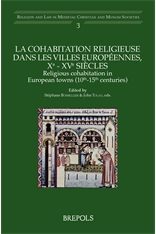
Publication – John Tolan et Stéphane Boissellier (éd.), « La cohabitation religieuse dans les villes Européennes, Xe – XVe siècles »

Medieval towns, from Portugal to Hungary to Egypt, were places of contact between members of different religious communities, Muslim, Christian and Jewish, who rubbed shoulders in the ports and on the streets, who haggled in the markets, signed contracts, and shared wells, courtyards, dining tables, bath houses, and sometimes beds. These interactions caused legal problems from the point of view of the Jewish, Christian and Muslim judicial scholars of the middle ages, not to mention for the rulers of these towns. These legal attempts to define and solve the problems posed by interreligious relations are the subject of this volume, which brings together the work of seventeen scholars from nine countries (France, Italy, Spain, Hungary, Portugal, Lebanon, Israel, Tunisia, USA), specialists in history, law, archeology and religion.

John Tolan is professor of Medieval History at the University of Nantes and author of numerous articles and books in medieval history and cultural studies. He currently is director of a major project funded by the European Research Council, “RELMIN: The legal status of religious minorities in the Euro-Mediterranean world (5th-15th centuries)” (www.relmin.eu).

Stéphane Boissellier is full professor of medieval history at the University of Poitiers (France) ; author of books and articles about medieval social and economic history. He leads a scientific program (« Espagne-Méditerranée : Normativité et territorialité des faits sociaux ») within the Centre d’Etudes Supérieures de Civilisation Médiévale (U. Poitiers-CNRS)

dIS-9782503552521-1Table des matières :

Stéphane Boissellier, Introduction

Le cadre légal des minorités religieuses dans les villes médiévales—fondations textuelles / The Legal Context of Religious Minorities in Medieval Towns—Textual Foundations
Alejandro García Sanjuán, Limitaciones en las relaciones entre musulmanes y ḏimmíes en la tradición legal malikí: las normas sobre el saludo
Diego Quaglioni, Entre Italie et Allemagne. Les relations judéo-chrétiennes à la fin du Moyen Age: l’affaire de Trento (1475-1478)
Tahar Mansouri, Les dhimmis dans les documents de chancellerie de l’époque mamelouke – Farid Bouchiba, Cohabitation religieuse et pratiques alimentaires à Cordoue au XI-XIIe siècles d’après le grand Qādī Ibn Rušd al-ğadd (m. 520/1126)

La géographie religieuse des villes médiévales : aljama et ghetto / Religious Geography in Medieval Towns : Aljama and Ghetto
Aleida Paudice, Religious Identity and Space in Venetian Candia
Dominique Valerian, La présence des musulmans étrangers dans les ports chrétiens
Pierre Moukarzel, La législation des autorités religieuses et politiques sur les marchands européens dans le sultanat mamelouk (1250-1517)
Brian Catlos, Is It « Country Air » that Makes Infidels Free? Religious Diversity in the Non-Urban Environment of the Medieval Crown of Aragon and Beyond

La promiscuité urbaine et ses implications pour le droit religieux / Urban Promiscuity and its Implications for Religious Law
Elisheva Baumgarten, « These are Their Holy Days »: Jewish Conceptions of the Christian Ritual Cycle in Medieval Germany and Northern France
Olivia Constable, Cleanliness, Godliness, and Urban Bathhouses in Medieval Spain
Filomena Barros, Les musulmans portugais: la justice entre la normativité chrétienne et la normativité islamique

Justice et régulation de conflits dans les villes médiévales / Justice and Conflict Resolution in Medieval Towns
Ahmed Oulddali, L’accusation d’outrage envers les musulmans à travers une fatwa rendue à Tlemcen en l’an 849/1445
Katalin Szende, Laws, Loans, Literates: Jewish-Christian Contacts in the Towns of Medieval Hungary from the Mid-Thirteenth to the Mid-Fifteenth Century
Youna Masset, Les relations interconfessionnelles à Tortose, entre norme et pratique (2ème moitié du XIIIe siècle-premier quart du XIVe siècle)
Rena Lauer, Jewish Women in Venetian Candia: Negotiating Intercommunal Contact in a Premodern Colonial City, 1300-1500

John Tolan, Conclusion

Informations pratiques :
John Tolan et Stéphane Boissellier (éd.), La cohabitation religieuse dans les villes Européennes, Xe – XVe siècles, Turnhout, Brepols, 2014 (Religion and Law in Medieval Christian and Muslim Societies, 3). 326 p., 3 b/w ill., 156 x 234 mm. ISBN: 978-2-503-55252-1. Prix : 75,00 euros.

Source de l’information : Brepols

Publié dans Publications | Laisser un commentaire

Appel à contribution – Art & Law : Art in Peril

23 June 2015
University of Cambridge, Pembroke College

Art & Law : Art in Peril is an interdisciplinary conference convened to discuss varying perspectives on questions of art and law and to break down the barriers of specialization. « Art & Law : Art in Peril » intends to improve communication and promote an exchange on the most pressing issues at the juncture of art and law. We aim to compose panels of speakers from a variety of disciplines, grouping papers by theme, geographic or temporal location, rather than by academic department. We encourage submissions from scholars and professionals in art history, law, archeology, history, public policy, museum studies, classics, art conservation, and beyond. Suggested topics include, but are by no means limited to :

  • Historical perspectives on the interrelationship between art and law
  • Consequences of current conflicts on art and cultural heritage sites and objects in the Middle East (or elsewhere)
  • Perspectives towards notions of originality and authenticity of artwork
  • The legal aspects of the conservation of objects, sites, and/or structures
  • International dispute resolution of cultural property whose ownership is disputed
  • The relationship between cultural property and intellectual property
  • Human remains, collections, and the law
  • The digitization of artwork and visual culture

Please email abstracts of no more than 300 words to Sarah Rabinowe at art.law.cambridge@gmail.com by 28 February 2015. Along with the abstract please include your name, institution, paper title and a brief biography. Successful applicants will be notified by 13 March 2015. Selected speakers will be given further information about the Travel Fund available to offset transportation and accommodation costs.

We intend to publish proceedings from the conference in either a journal, or as a stand-alone anthology.

« Art & Law: Art in Peril » will take place at the University of Cambridge, Pembroke College with an evening reception at the Sedgwick Museum of Earth Sciences. Upon request, assistance with accommodation reservations will be provided.

Source de l’information : ApAhAu

Publié dans Appel à contributions | Laisser un commentaire

Conférence-débat – Nicole Hochner, « Émouvoir la cité. Un examen des émotions en politique »

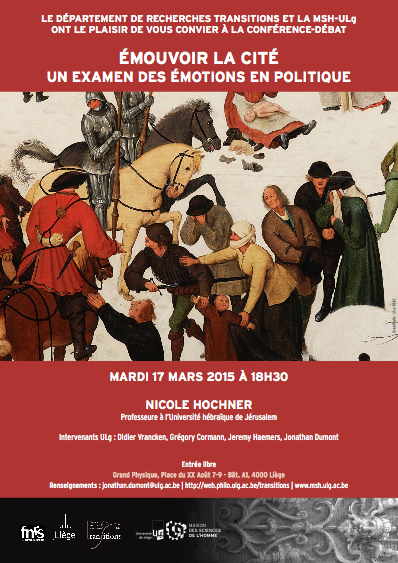
Le mardi 17 mars 2015 à 18h30, Nicole Hochner (Professeure à l’Université hébraïque de Jérusalem) présentera une conférence intitulée Émouvoir la cité. Un examen des émotions en politique. La conférence donnera lieu à un débat au cours duquel interviendront Didier Vrancken, Grégory Cormann, Jeremy Haemers et Jonathan Dumont. La conférence-débat est organisée par le département de recherches Transitions et la MSH-ULg.

Hochner - ULg

Informations pratiques :
Mardi 17 mars 2015, 18h30

Université de Liège
Grand Physique, Place du XX Août 7-9 – Bât. A1, 4000 Liège

Renseignements : jonathan.dumont@ulg.ac.be | http://web.philo.ulg.ac.be/transitions | http://www.msh.ulg.ac.be

Publié dans Colloque | Laisser un commentaire

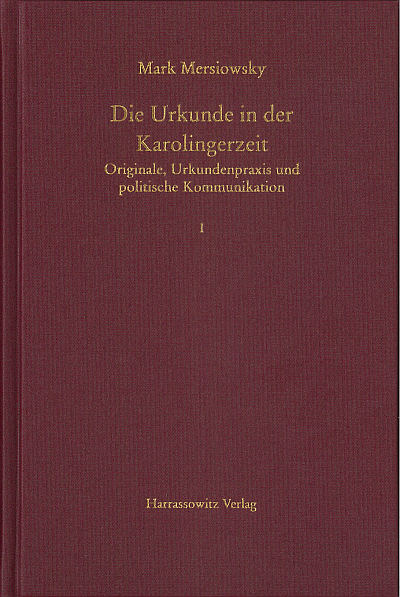
Publication – Mark Mersiowsky, « Die Urkunde in der Karolingerzeit. Originale, Urkundenpraxis und politische Kommunikation »

Mark Mersiowsky, Die Urkunde in der Karolingerzeit. Originale, Urkundenpraxis und politische Kommunikation, Wiesbaden, 2015 (MGH, Schriften 60). XCVIII, VIII und 1114 S. mit Tab. in zwei Bänden. 8°. ISBN 978-3-447-10079-3 Ln. EUR 148, —

Mersiowsky_U1Wurden Urkunden in der traditionellen Forschung bisher in erster Linie als Rechtssicherungsinstrumente betrachtet, versucht der metadiplomatische Ansatz des vorliegenden Werkes, den durch die Reduzierung der Urkunde auf ihren Text bedingten Dimensionsverlust auszugleichen. Die Urkunde tritt somit in einer neuen Sicht als visuelles Medium, dessen äußere Form nicht bedeutungslos ist, zutage. Aus dieser erweiterten Perspektive sind selbst für die Karolingerzeit nochmals neue Quellenhorizonte zu erschließen. Denn die Quellen sind zwar dem Text nach seit langem bekannt, aber neben der Deutung der Urkunden als Herrschaftszeichen ist nun auch auf deren Memorialcharakter zu verweisen. In vorliegendem Buch werden zunächst die Originale karolingischer Kaiser- und Königsurkunden vom Jahre 751 bis 911 vorgestellt. Diese Stücke sind direkte Zeugnisse des Kommunikationsprozesses und expliziter Ausdruck herrscherlichen Willens – gerade in Bezug auf die äußeren Formen. Danach werden auch die Privaturkunden in einzelnen Regionen analysiert, und diese Ergebnisse dann mit denen der Herrscherurkunden konfrontiert. Der erstmalige Ansatz dieses Werkes, die karolingische Urkundenpraxis – also in erster Linie ihre Entstehungs- und Gebrauchssituation – als Ganzes darzustellen, verfolgt das Ziel, einen Beitrag zur semiotischen Grammatik des Hoheitszeichens Urkunde in der Karolingerzeit zu leisten. Ausführliche Register und Graphiken erschließen dieses monumentale Werk.

Table des matières : ici

Source de l’information : Monumenta Germaniae Historica

Publié dans Publications | Laisser un commentaire

Appel à contribution – Changer, rénover, restaurer : la réforme au fil de l’histoire et de l’actualité

Avec l’annonce de la réforme territoriale, la France des Régions va changer de visage : tel est le fruit d’une volonté de modifier le paysage et les habitudes dans le pays à l’aune d’une modernisation vue comme nécessaire. Cette actualité ne doit pas voiler une réalité : l’esprit de réforme – de changement – n’est évidemment pas chose nouvelle. Depuis la structuration des sociétés sous la tutelle d’États et d’institutions, désireux d’avoir la maîtrise d’un territoire et d’individus, des réformes ont été engagées. Il suffit de penser, dans le cas français, aux tentatives de réformes effectuées par la monarchie au cours du XVIIIe siècle ou bien encore aux profondes réformes structurelles entreprises dès les premiers temps de la Révolution française. De même, le développement et la modernisation des États ont engendré de nécessaires réformes dans le domaine territorial, fiscal, administratif. La réforme est dès lors entrevue comme une modernisation, un changement à considérer dans une quête de progrès. Toutefois, l’esprit de réforme mais aussi la nécessité de restaurer un ordre ou un esprit considérés comme perdus ou pervertis ont poussé très tôt religieux et institutions ecclésiales à réformer des pratiques, donnant ainsi naissance à de nouvelles pratiques. On l’a compris, l’idée de réforme engage la réflexion autour d’un possible triptyque : changement, rénovation et restauration. Dès lors, si l’idée de réforme s’applique aux sphères de l’État et de l’Église, il convient de la mettre en questionnement dans bien d’autres domaines, tels l’école, le monde politique, le monde des arts, l’économie, etc. Ces universités d’hiver invitent ainsi à ouvrir la réflexion autour de la réforme dans plusieurs champs d’investigation et appellent à des travaux, notamment en histoire et en géographie, sur le territoire, les institutions, les idées, les pratiques dans une sphère nationale et internationale.

Date : 19 au 21 novembre 2015
Lieu : ville de Saint-Mihiel
Date de retour des propositions : 1er juin 2015

Contact :

Laurent Jalabert, Maître de conférences en histoire moderne à l’Université de Lorraine.
Mail : laurent.jalabert@univ-lorraine.fr
Tél : 03.54.50.51.44

Jean El Gammal, Professeur en histoire contemporaine à l’Université de Lorraine.
Mail : jean.el-gammal@univ-lorraine.fr

Angèle Témoin, Ingénieur d’étude chargée de la valorisation de la recherche à l’Université de Lorraine.
Mail : angele.temoin@univ-lorraine.fr
Tél : 03.54.50.51.66

Source de l’information : CRULH

Publié dans Appel à contributions | Laisser un commentaire

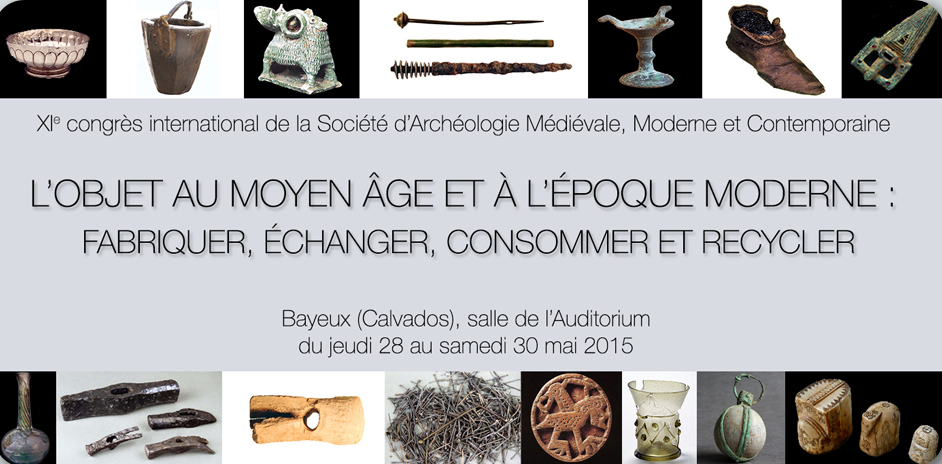
Congrès – L’objet au Moyen Âge et à l’époque moderne : fabriquer, échanger, consommer et recycler. XIe Congrès international de la Société d’Archéologie médiévale, moderne et contemporaine

Trente ans après le premier congrès organisé par la Société d’Archéologie médiévale sur le mobilier céramique, ce colloque international a pour objectif de remettre la culture matérielle et l’objet archéologique au cœur du débat historique. Il vise à dresser un état de la recherche pour les périodes médiévale, moderne et contemporaine en n’excluant aucune catégorie d’objet (céramique, métal, matériaux organiques, verre). Cette approche est envisagée sous quatre angles thématiques (la fabrication, les échanges, la consommation et le recyclage) qui feront chacun l’objet d’une session alimentée par des présentations de synthèse.

Congrès SAM 2015Sessions :

  1. Fabriquer : les lieux, les hommes et les techniques.
  2. Echanger : les circuits de distribution et d’approvisionnement
  3. Consommer : quels objets pour quel(s) usage(s) et pour quelle(s) population(s) ?
  4. Recycler : l’objet réparé ou la seconde vie des objets.

Programme complet : ici

Informations pratiques :
Bayeux (Calvados), Salle de l’Auditorium
Du jeudi 28 au samedi 30 mai 2015

Coordination :
Yves Henigfeld

(Univ. Nantes, UMR 6566-LARA)
Philippe Husi
(CNRS, UMR 7324 – CITERES – LAT)

Fabienne Ravoire
(Inrap, UMR 6273 – Craham)

Le congrès est organisé en partenariat avec le Centre Michel de Boüard – Craham (UMR 6273) (CNRS/Université de Caen)

Source de l’information : SAM2015

Publié dans Colloque | Laisser un commentaire

Colloque – Renaissance sculptors and their impact abroad

This two-day conference will explore materials, techniques and artistic interconnections across Europe, including the role played by those who commissioned or sought sculptural works of art from foreign artists.

Programme :

Friday 20 March

10.00-10.30 : Coffee and Registration
10.30 Welcome: Paul Williamson, Keeper, Sculpture, Metalwork, Ceramics & Glass, V&A

10.40 Session One – Introduction: Disseminating Artistic Ideas
Chair: Amanda Lillie, University of York

Eckart Marchand, The Warburg Institute, University of London – Image and Thing: the distribution and impact of plaster casts in Renaissance Europe
Cinzia Sicca, University of Pisa – The Tuscan sculpture and marble trade with Europe in the 16th century
11.40 Refreshments

12.00 Session Two – Italian Sculpture in Northern Art
Chair: Susie Nash, The Courtauld Institute of Art

Jens Burk, Bayerisches Nationalmuseum, Munich – “Conrat Meit von Worms“- court sculptor of Margaret of Austria
Paula Nuttall, V&A – Memling and Italian Renaissance sculpture
13.00 Lunch (provided)

14.15 Session Three – The Netherlands and Spain
Chair: Léon Lock, University of Leuven, Brussels

Arie Pappot, The Rijksmuseum, Amsterdam (co-author), and Lisa Wiersma, University of Amsterdam – The sculptural work of Jacques Jonghelinck (1530-1606)
Kim Woods, The Open University – The activation of the image: expatriate carvers and kneeling effigies in late Gothic Spain
15.15 Refreshments

15.45 Session Four – Exporting Italian Sculpture to Spain and France
Chair: Carmen Fracchia, Birkbeck, University of London

Johannes Röll, Bibliotheca Hertziana, Max Planck Institute for Art History, Rome – Sculpture in Italy and Spain around 1500.
Kelley Helmstutler Di Dio, University of Vermont – Pietro Tacca’s bronze equestrian monuments for Spain
16.45 Discussion
17.15 Drinks reception
18.15 Close

Saturday 21 March

10.00 Coffee and Registration
10.20 Welcome and Summary of Day One: Glyn Davies, V&A

10.30 Session One – English Renaissance Sculpture
Chair: Phillip Lindley, University of Leicester

Peta Motture, V&A – Making connections and asking questions around the transmission of bronze techniques.
Kent Rawlinson, Royal Institute of British Architects – Giovanni da Maiano: revisiting the English career of a Florentine sculptor (1520-42)
11.30 Refreshments

12.00 Session Two – Exchanges between Italy and the North
Chair: Marika Leino, Oxford Brookes University

Thierry Crépin-Leblond, Musée National de la Renaissance, Château d’Écouen – Francesco Scibec da Carpi, an Italian woodcarver at the French Court
Robert van Langh, The Rijksmuseum, Amsterdam – The influence of bronze casting techniques from north of the Alps on Florentine bronzes in the third quarter of the 16th century
13.00 Lunch (provided)

14.15 Session Three – Hungary: Patronage and Artistic Interconnections
Chair: Peter Dent, University of Bristol

Péter Farbaky, Budapest History Museum – The relationship between architecture and sculpture in Hungarian early Renaissance art patronage
Alison Luchs, National Gallery of Art, Washington DC – The relief of Alexander the Great in the National Gallery of Art: the Hungarian connection
15.15 Refreshments

15.45 Session Four: Panel Discussion
Chair: Holly Trusted (formerly known as Marjorie Trusted), V&A

Jeremy Warren, The Wallace Collection
Alison Wright, University College London

16.30 Close

Informations pratiques :
When: Fri 20 March 2015 – Sat 21 March 2015
Where: The Lydia & Manfred Gorvy Lecture Theatre – London

Free, booking essential (here)

Source de l’information : Victoria and Albert Museum

Publié dans Colloque | Laisser un commentaire

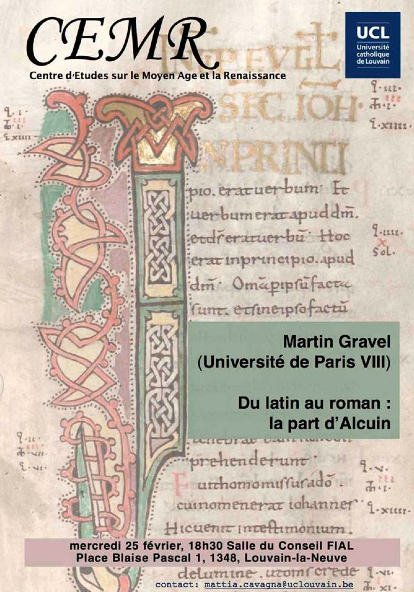
Conférence – Martin Gravel, « Du latin au roman : la part d’Alcuin »

Le mercredi 25 février, Martin Gravel (Université Paris-VIII) présentera une communication intitulée Du latin au roman : la part d’Alcuin dans le cadre du cycle annuel de conférences organisé par le CEMR – Centre d’études sur le Moyen Âge et la Renaissance (Université Catholique de Louvain).

Gravel - CEMRInformations pratiques :
Date : Mercredi 25 février 2015, 18h30.
Lieu : Salle du Conseil FIAL – Université Catholique de Louvain (1, place Blaise Pascal – 1348 Louvain-la-Neuve).
Organisateur(s) : CEMR – Centre d’études sur le Moyen Âge et la Renaissance

Contact : mattia.cavagna@uclouvain.be

Source de l’information : CEMR

Publié dans Colloque | Laisser un commentaire

Offre d’emploi – Lecturer in Medieval Literature

Department : English and Related Literature
Based at University of York – Heslington Campus
Hours of work : Full-time
Contract status : Open
Salary : £37,394 – £45,954 a year
Apply by : 04/03/2015
Documents : Candidate-brief 4066.pdf

Role Description

The Department of English and Related Literature is among the strongest in the UK. In the 2014 Research Excellence Framework it was ranked second. In the category 4* (‘world leading’) it was ranked first. It was rated excellent in the most recent Teaching Quality Assessment.

As part of the Department’s commitment to teaching and research across all historical periods of literature in English, we are now seeking to appoint to the post of Lecturer in Medieval Literature, as well as to a Lectureship in Modern Literature and Lecturer in Eighteenth-Century Literature.

For this post, you will have research and teaching interests in any area of medieval literature (English or any European literature, or both) written between 1100 and 1500. You will be expected to participate in the Department’s research and teaching, joining with other members of the Medieval School in teaching and research relating to language and literature in this period. Although you need not be a specialist in medieval English literature, you will need to demonstrate ability and willingness to teach English literature of the Middle Ages at undergraduate and postgraduate levels. You will also be a member of the Centre for Medieval Studies and will be expected to participate fully in its lively research culture, including offering Masters’ level teaching in its interdisciplinary modules or ancillary skills modules (medieval languages, paleography).

You will be expected to play a full part in the normal pattern of the Department’s teaching,

to take an active role in the teaching of medieval literature at undergraduate level, and to collaborate in the recruitment, teaching and supervision of MA and MPhil/PhD students in the Medieval School of the Department of English and Related Literature and the Centre for Medieval Studies (see the Website for the Centre for Medieval Studies at http://www.york.ac.uk/medieval). You will also participate in the setting and marking of assessed essays and examinations, undertake the duties of supervisor to undergraduate students, and carry out administrative tasks in the Department and Centre. S/he will be expected to undertake and publish research of the highest standard.

You will hold a PhD in English or a relevant discipline.

The post is available from 1 September 2015.

About York

The University of York is one of Britain’s leading universities, with an excellent reputation in teaching and research. An employer of choice, the University offers a range of competitive benefits including excellent holidays and a generous pension seldom seen in other sectors.

Source de l’information : University of York

Publié dans Offre d'emploi | Laisser un commentaire