Appel à contribution – ‘Namque ego suetus eram hos libros legisse frequenter’: Early Medieval Practices of Reading and Writing

Place: Den Haag, The Netherlands
Date: 3-4-5 June 2015
Organized by: Mariken Teeuwen, Irene van Renswoude and Evina Steinova, Huygens ING
Contact address: MarginalScholarship@gmail.com
Deadline for abstracts: 15 January 2015

UtrechtPsalterBooksandScrolls1This is a call for papers for a conference on the subject of books, practices of writing, reading, copying and studying in the early middle ages. It is organized by the research project ‘Marginal Scholarship: The Practice of Learning in the Early Middle Ages (c. 800 – c. 1000)’, which seeks to map the phenomenon of writing in the blank space of manuscripts (in the margin, in between the lines, on fly-leaves or inserted leaves) in the early middle ages, in order to gain a better understanding of the way in which books and texts were used in that period. In essence, we aim to understand the intellectual practices of the period as reflected by the manuscripts and to re-evaluate both how traditional the period was, and how innovative. Furthermore, we hope to explore how the developments of the culture of writing in this period led to developments in later periods, and also how they compare to those in other cultures, such as the Byzantine world or the world of Late Antiquity. Confirmed speakers include David Ganz and John Contreni.

The following questions and themes will be addressed in the sessions:

1. Practices of annotating

Who were allowed to make annotations in manuscripts? What can we learn about the hierarchical organization of the writing process in monastic or cathedral environments, and are there ways to say something about the status of scribes and/or scholars working in manuscript margins?

Annotating practices reflect many different functionalities of the appropriation of text: they can, for example, reflect a process of text comparison and textual criticism; they can have the aim to gather information in order to facilitate the composition of a new text; they can offer guidance to the reader, either in the sense of offering explanation or interpretation, or in the sense of warning the reader and delivering criticism; they can engage in a discussion with the author of the text, or with another annotator, or create stepping stones from one text to others, in order to broaden the reading of the text by offering new and different opinions. We would like to discuss these and other functionalities, and replace the mono-dimensional ‘annotated book = school book’ with a richer and more accurate model of interpretation.

2. The profile of annotating practices

Can we see patterns in the relationship between textual genres and the kind of marginal activity encountered in the margin? Were certain textual genres treated differently than others? For example, do theological texts invite other types of critical reflection than scientific texts or historical texts? Are there genres with ‘empty’ margins, and what would be the reason for that?

Can we distinguish sets of annotating practices which are specific to certain intellectual centres or groups of scholars? Can we distinguish individual practices even, which allow us to identify the scholar who worked in the manuscript? It has been argued, for example, that the group around Florus of Lyon had a very particular set of signs to mark patristic texts, in order to prepare florilegia of patristic quotations on certain subjects. Are there other examples of such private practices, and what happened to them after the death of the scholar(s) at their centre?

Some annotating practices are particular to a certain period in history. Tironian notes, for example, seem to have been used in a specific time and space for marginal comments, and are rarely found outside that period. The Nota sign gets company in the shape of a pointing hand at a certain moment in time, is perhaps even replaced by it. Could we mark annotation practices on a chronological scale, just as we can with letter shapes or other physical features of manuscripts?

3. Cultures of writing

Manuscripts, scholars and books travelled, and thus the culture of writing is a dynamic and ever evolving field. Can we map the circles of influence from one scholar, or one school to the next through the eyes of manuscripts? Can we trace specific practices of annotating or writing in general through history, and follow their historical development? And do these practices offer us insight into the intellectual networks of the time? What would be good strategies to map the dynamics of the lives of manuscripts, both in the sense of their actual travels, and in the sense of their changing contents?

A selection of the papers from the conference will be collected in an edited volume, to be published in 2016.

If you are interested in participating in this conference, please send us a title and abstract (ca 400-500 words), your contact information and affiliation to MarginalScholarship@gmail.com. The deadline for sending in abstracts is 15 January 2015. You will hear back from us before 15 February 2015 whether your proposal has been accepted.

The organizers offer to cover your expenses of accommodation. No fee will be asked, lunches will be provided and one conference dinner. For your travel expenses we kindly ask you to rely on the budget of your own university or other academic sponsor. If this is a problem, please indicate this in your correspondence with us.

Mariken Teeuwen, Irene van Renswoude and Evina Steinova: MarginalScholarship@gmail.com

Mariken.Teeuwen@huygens.knaw.nl
Irene.van.Renswoude@huygens.knaw.nl
Evina.Steinova@huygens.knaw.nl

Source de l’information : Voices from the edge

Publié dans Appel à contributions | Laisser un commentaire

Offre d’emploi – Lectureship in Early Medieval European History (Aberystwyth University)

Fixed Term for 5 months
The Department of History and Welsh History invites applications for a five-month fixed-term Lectureship in Early Medieval European History, tenable from 1 February 2015. Applications are welcome from specialists in any aspect of the history of continental Europe between c.400 and c.1100, including the eastern and southern Mediterranean and Scandinavia.

The successful candidate will be expected to teach at both undergraduate and graduate level; to supervise undergraduate and graduate dissertations and to participate in University examining at undergraduate and taught graduate level. The successful candidate will also have a strong research record or exhibit evidence of the capacity to develop such a record in any relevant field of the history of continental Europe between c.400 and c.1100.

Interviews will be held in the week commencing 15th December 2014.

For information and application forms please go to www.aber.ac.uk/en/hr/jobs/vacancies-external/

Completed Application Forms should be signed and returned to the Human Resources Recruitment Team by e-mail, or post. Email address: vacancies@aber.ac.uk / Tel: 01970 628 556

NOTE: Please put the post reference on the front of your envelope and on your application form.

We are a Bilingual Institution which operates a Welsh Language scheme and is committed to Equal Opportunities.

Source de l’information : jobs.ac.uk

Publié dans Offre d'emploi | Laisser un commentaire

Offre d’emploi – Professeur-e en Histoire du Bas Moyen Age et des Temps Modernes (13e-17e s.)

L’Université catholique de Louvain recherche un-e professeur-e à temps plein en Histoire du Bas Moyen Age et des Temps Modernes (13e-17e s.)

Le/La titulaire du poste développera des recherches en Histoire sociale, économique et institutionnelle du Nord-Ouest européen (13e-17e s.), avec un accent sur les territoires correspondant en tout ou en partie à la Belgique actuelle.

Il/Elle assurera des enseignements dans ces domaines au sein des divers cycles d’études gérés par la faculté.

Entrée en fonction : le 1er septembre 2015

Renseignements complémentaires :
Prof. Philippe Hiligsmann, Doyen FIAL – doyen-fial@uclouvain.be
Prof. Jacques Marquet, Président IACS – president-iacs@uclouvain.be

Localisation : Secteur des sciences humaines
Faculté de philosophie, arts et lettres (FIAL)
(http://www.uclouvain.be/fial.html)
Institute for the Analysis of Change in Contemporary and Historical Societies (IACS) (http://www.uclouvain.be/iacs.html)

Conditions générales :

Tâches :
– Assurer des enseignements dans divers cycles d’études gérés par la faculté, ainsi que dans des programmes de formation continue
– Assurer la direction de mémoires de fin d’études et superviser des thèses de doctorat
– Animer des programmes de recherche
– Assurer, par des activités de recherche et d’enseignement, la visibilité internationale de l’université
– Contribuer aux services à la société, notamment dans les domaines économique, socio-culturel ou de la coopération au développement.

Qualifications :
– Être titulaire d’un diplôme de doctorat en Histoire ou équivalent
– Faire état d’une expérience scientifique reconnue par des publications de niveau international
– Faire état d’un séjour d’étude prolongé à l’étranger ou d’une expérience significative acquise hors de l’UCL
– Faire état d’une expérience et d’aptitudes en matière d’enseignement universitaire
– Etre capable de travailler en équipe d’enseignants et d’intégrer des résultats de recherches dans ses enseignements
– Etre créatif et ouvert à l’innovation pédagogique et à l’interdisciplinarité
– Avoir les qualifications pour mener des recherches scientifiques de haut niveau et animer, voire diriger, une équipe de chercheurs
– Posséder la maîtrise des langues française et anglaise, parlées et écrites, ou s’engager à les acquérir dans les deux années qui suivent la prise de fonction, dans le but d’être capable d’enseigner dans ces langues ; la connaissance d’autres langues constitue un atout supplémentaire.

Source de l’information : Université Catholique de Louvain

Publié dans Offre d'emploi | Laisser un commentaire

Publication – Early Medieval Monetary History. Studies in Memory of Mark Blackburn

Mark Blackburn was one of the leading scholars of the numismatics and monetary history of the British Isles and Scandinavia during the early medieval period. He published more than 200 books and articles on the subject, and was instrumental in building bridges between numismatics and associated disciplines, in fostering international communication and cooperation, and in establishing initiatives to record new coin finds. This memorial volume of essays commemorates Mark Blackburn’s considerable achievement and impact on the field, builds on his research and evaluates a vibrant period in the study of early medieval monetary history.

Containing a broad range of high-quality research from both established figures and younger scholars, the essays in this volume maintain a tight focus on Europe in the early Middle Ages (6th-12th centuries), reflecting Mark’s primary research interests. In geographical terms the scope of the volume stretches from Spain to the Baltic, with a concentration of papers on the British Isles.

As well as a fitting tribute to remarkable scholar, the essays in this collection constitute a major body of research which will be of long-term value to anyone with an interest in the history of early medieval Europe.

Dr Rory Naismith is Leverhulme Early Career Research Fellow at the University of Cambridge, and a Fellow of Clare College. He is also General Editor and Secretary of the British Academy’s Sylloge of Coins of the British Isles project. His publications include Money and Power in Anglo-Saxon England: the Southern English Kingdoms, 757-865 (2011) and The Coinage of Southern England, 796-865 (London, 2011).

Dr Martin Allen is Senior Assistant Keeper in the Department of Coins and Medals at the Fitzwilliam Museum, Cambridge, and an Affiliated Lecturer in the History Faculty of the University of Cambridge. He is the Editor of the British Numismatic Journal, and his publications include Mints and Money in Medieval England (2012).

Dr Elina Screen is a Departmental Lecturer in Early Medieval History at the Faculty of History, University of Oxford, and College Lecturer in Medieval History at Trinity College, Oxford. She is also General Editor of the Medieval European Coinage Project (a British Academy Research Project). Her publications include Sylloge of Coins of the British Isles 65. Norwegian Collections: Part I. Anglo-Saxon Coins to 1016 (2013).

9781409456681Table des matières :

Foreword
Introduction: Mark Blackburn and early medieval monetary history – Rory Naismith, Martin Allen and Elina Screen.

Part I – Progress in Early Medieval Monetary History:

Coins and currency in Viking England, AD 865-954 – Gareth Williams
Prelude to reform: 10th-century English coinage in perspective – Rory Naismith
Coinage and currency under William I and William II – Martin Allen

Part II – Interdisciplinary Perspectives

XPICTIANA RELIGIO and the tomb of Christ – Martin Biddle
The portrait coinage of Charlemagne – Simon Coupland
M for Mark: the iconography of Series M, variants and the Agnus Dei – Anna Gannon
The stylistic structure of Edward the Confessor’s coinage – Tuukka Talvio
Bovo soldare: a sacred cow of Spanish economic history re-evaluated – Jonathan Jarrett

Part III – Use and Circulation of Currency

Byzantine coins in early Medieval Britain: a Byzantinist’s assessment – Cécile Morrisson
Thrymsas and sceattas and the balance of payments – D.M. Metcalf
The use of coin in the Carolingian Empire in the 9th century – Simon Coupland
Monetary activity in Viking-Age Ireland: the evidence of the single-finds – Andrew R. Woods
Vestfold: a monetary perspective on the Viking Age – Svein H. Gullbekk
Currency conversion: coins, Christianity and Norwegian society in the late 10th and 11th centuries – Elina Screen
Islamic and Christian gold coins from Spanish mints found in England, mid-11th to mid-13th centuries – Marion M. Archibald

Part IV – Coins and Coin Hoards in Context

A 7th-century Anglo-Saxon solidus pendant of the Cross-on-Steps type found in Kent – Stewart Lyon, with an appendix by Michael Cowell
A small hoard of Burgred pennies from Banbury Castle, Oxfordshire – David Symons
The 1699 Port Glasgow hoard – Hugh Pagan
The Viking invasions 885-889 and the activity of the mint of Rouen – Jens Christian Moesgaard with the collaboration of Michel Dhénin
The Swordless St Peter coinage of York, c.905-c.919 – Megan Gooch
The 2003 Glenfaba hoard (c.1030), Isle of Man – Kristin Bornholdt Collins, Allison Fox and James Graham-Campbell
Insular imitations of Æthelred II’s Long Cross coinage – Joe Leighton and Andrew R. Woods
The English element in the 2012 Övide hoard – Eskelhem par., Gotland, Kenneth Jonsson
The Viking-Age hoard of Linnakse: some observations – Ivar Leimus, Mauri Kiudsoo and Ülle Tamla

Index.

Informations pratiques :
Rory Naismith, Martin Allen et Elina Screen (éd.), Early Medieval Monetary History. Studies in Memory of Mark Blackburn, Ashgate, 2014. 10 colour and 104 b&w illustrations, 234 x 156 mm, 688 pages. ISBN: 978-1-4094-5668-1. Prix : 81,00 £.

Source de l’information : Ashgate

Publié dans Publications | Laisser un commentaire

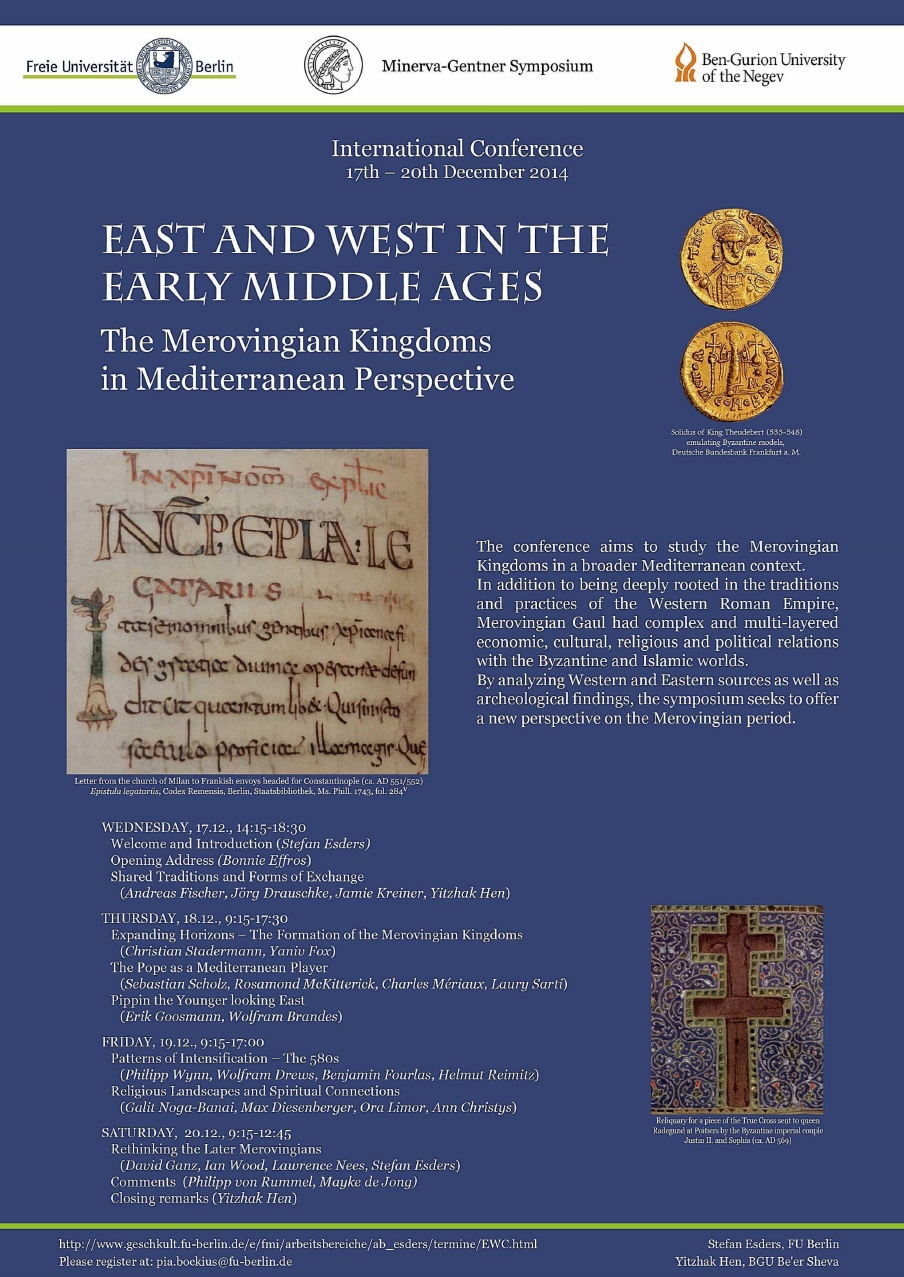
Colloque – East and West in the Early Middle Ages. The Merovingian Kingdoms in a Mediterranean Perspective

The conference aims to study the Merovingian Kingdoms in a broader Mediterranean context. In addition to being deeply rooted in the traditions and practices of the Western Roman Empire, Merovingian Gaul had complex and multi-layered economic, cultural, religious and political relations with the Byzantine and Islamic worlds. By analyzing Western and Eastern sources as well as archaeological findings, the symposium seeks to offer a new perspective on the Merovingian period.

1-5063962f35

Programme :

Wednesday, 17th December

14:15‒15.30: Opening Session
Stefan Esders (Berlin) – Welcome and introduction.
Bonnie Effros (Gainesville) – Merovingians and the Mediterranean – The enduring attraction of the Pirenne thesis

15:45‒18:30: Session I – Shared Traditions and Forms of Exchange

Andreas Fischer(Vienna) – Money for nothing – Franks, Byzantines and Lombards in the sixth and seventh century
Jörg Drauschke (Mainz) – Communication and trade between the Merovingians and the eastern Mediterranean – Archaeological perspectives

Jamie Kreiner(Athens/Ga.) – A generic Mediterranean – Hagiography in the early Middle Ages
Yitzhak Hen (Beer Sheva) – Defensor of Ligugé’s Liber scintillarum and the migration of knowledge

Thursday, 18th December

09:15‒10:30: Session II – Expanding Horizons: The Formation of the Merovingian Kingdoms

Christian Stadermann (Tübingen) – Passio sancti Vincentii Aginnensis – A different interpretation of the Franco-Visigothic war 507/508
Yaniv Fox (Ra’anana) – Anxiously looking east – Burgundian foreign policy on the eve of the reconquest

11:00‒15:45: Session III – The Pope as a Mediterranean Player

Sebastian Scholz (Zürich) – The papacy and the Frankish bishops in the 6th century
Rosamond McKitterick (Cambridge) – Perceptions of Rome and the papacy in late Merovingian Francia – The Cononian recension of the Liber pontificalis

12:15‒14:30 Lunch

Charles Mériaux (Lille) – From east to west – Constantinople, Rome and northern Gaul in the seventh century
Laury Sarti (Berlin) – Knowledge exchange and perception of the Eastern Empire in the late Merovingian west

16:15‒17:30: Session IV – Pippin the Younger looking East

Erik Goosman (Utrecht) – New dynasty, new frontiers? Pippin’s politics and the wider Mediterranean world
Wolfram Brandes (Frankfurt/M) – The Byzantine background to the so-called “Donation of Pepin”

Friday, 19th December

09:15‒12:15: Session V – Patterns of Intensification: The 580ies

Phillip Wynn (Beer Sheva) – Cultural transmission caught in the act – Gregory of Tours and the relics of St Sergius.
Wolfram Drews (Münster) – Hermenegild’s rebellion and conversion – Merovingian and Byzantine connections

Benjamin Fourlas (Mainz) – Early byzantine church silver offered for the eternal rest of Framarich and Karilos – Evidence of “the army of heroic men” raised by Tiberius II. Constantine?
Helmut Reimitz (Princeton) – Pax inter utramque gentem – The re-evaluation of Frankish identity in Merovingian encounters with the Empire during the last decades of the sixth century

12:15‒14:00 Lunch

14:00‒17:00: Session VI – Religious Landscapes and Spiritual Connections

Galit Noga-Banai (Jerusalem) – Relocation to the west – The relic of the True Cross in Poitiers
Maximilian Diesenberger (Vienna) – Martyrs and apostles from the Mediterranean in early medieval France

Ora Limor (Ra’anana) – Willibald in the holy places
Ann Christys (Leeds) – ‘Sons of Ishmael, turn back!’

Saturday, 20th December

09:15‒12:15: Session VII – Rethinking the late Merovingians

David Ganz (Notre Dame) – Getting to know the late Merovingians – What Bern 611 reveals
Ian Wood (Leeds) – Contact with the eastern Mediterranean in the late Merovingian period

Lawrence Nees(Newark) – ‘Merovingian’ illuminated manuscripts and their links with the eastern Mediterranean world
Stefan Esders (Berlin) – Unplugging the Merovingians from the Mediterranean – The case of Ebroin

12:15‒12:45: Closing words

Mayke De Jong (Utrecht) – Comment.
Philipp Von Rummel (Berlin) – Comment.

Yitzhak Hen (Beer Sheva) – Closing remarks.

Informations pratiques :
Place : Berlin
Date : 17.12.2014 – 20.12.2014
Host/Organizer : Yitzhak Hen, Department of General History, Ben-Gurion University of the Negev, Beer Sheva; Stefan Esders, Geschichte der Spätantike und des frühen Mittelalters, Friedrich-Meinecke-Institut, Freie Universität Berlin

Source de l’information : H-Soz-u-Kult

Publié dans Colloque | Laisser un commentaire

Publication – Les chapitres séculiers et leur culture : Vie canoniale, art et musique à Saint-Yrieix (VIe-XIIIe siècle)

Cet ouvrage réunit les Actes d’un colloque qui s’est tenu du 18 au 20 juin 2009 en trois sites différents : Limoges, Saint-Yrieix-la-Perche et Poitiers. Comme pour la rencontre concernant l’abbaye Saint-Martial de Limoges (PULIM, 2006)1, les médiévistes réunis ont examiné les différentes facettes de l’établissement installé au coeur de la ville de Saint-Yrieix dans une perspective pluridisciplinaire : le contexte historique, l’hagiographie, les clercs et leurs réseaux, le potentiel archéologique, les vestiges monumentaux, les manuscrits, les enluminures, la musique …

Les textes conservés offrent des aperçus exceptionnels sur le haut Moyen Âge, à commencer par le célèbre testament du fondateur (ici édité et traduit). Mais le statut canonial rend la communauté relativement difficile à cerner, d’autant que les sources médiévales considèrent souvent de haut ces religieux du siècle ou “séculiers”. Cette question est aujourd’hui en cours de renouvellement ; aussi l’étude monographique est-elle précédée par des enquêtes concernant plusieurs régions de l’Occident médiéval, de la Flandre à l’Espagne en passant par la Normandie et l’Empire.

In situ, le caractère monumental de la collégiale et le renom de la Bible de de Saint-Yrieix, riche de ses lettrines enluminées, ont suscité ou actualisé les questionnements des historiens de l’art. S’ajoute à ce kaléidoscope le manuscrit Latin 903 (BnF) ou Graduel de saint-Yrieix, bien connu des musicologues du monde entier, qui offre des compositions poétiques, liturgiques et musicales d’un grand intérêt pour la fin du XIe siècle.

Vanessa240Table des matières :

Avant-propos et remerciements

1 – Le monde des chanoines

Brigitte Meijns (Katholieke Universiteit Leuven) – Les chanoines séculiers : histoire et fonctions dans la société (IXe-XIIe siècle)
Véronique Gazeau (CRAHAM, Université de Caen) – En terre bénédictine, les établissements de chanoines de la Normandie médiévale : genèse et géographie des implantations, enjeux de pouvoir et lieux sacrés
Hubertus Seibert (Université de Munich) – Vivre en communauté ? Les chanoines dans l’Empire germanique (Xe-XIIe siècle)
Thierry Pécout (CERCOR, Université de Saint-Étienne) – Les collégiales dans l’espace du diocèse. Provinces ecclésiastiques d’Aix, Arles et Embrun (XIIe- XIVe siècle)
Catherine Saint-Martin (Conseil Général de l’Ariège, Bibliothèque départementale) – Le chapitre de Saint-Sernin de Toulouse
Eduardo Carrero Santamaria (Universitat Autonoma de Barcelona) – Modification de l’architecture ou de sa fonction. Les bâtiments des chanoines réguliers dans les cathédrales espagnoles après leur sécularisation

2 -Le chapitre de Saint-Yrieix : de la fondation à la ville

Philippe Depreux (Université de Hambourg) – Le testament d’Aredius
Catherine Faure (Université de Limoges) – Aredius (Yrieix) et ses amis. Réflexions sur les réseaux aristocratiques au VIe siècle
Edina Bozoky (CESCM, Université de Poitiers) – Les miracles de saint Yrieix
Anne Massoni (Université de Limoges) – Le chapitre de Saint-Yrieix : une dépendance martinienne en terre limousine
Jean-Pierre Thuillat – À propos du séjour de Henri II en pleine reconstruction de la collégiale de Saint-Yrieix
Jean-Loup Lemaître (École Pratique des Hautes Études, Paris) – Le testament de Bertrand Autier, chantre de Saint-Yrieix, oncle de Bernard Gui (1292)

3- Entre histoire et archéologie

Christian Rémy (CESCM, Université de Poitiers) – Des chanoines et des chevaliers : l’enclos castral de Saint-Yrieix
Romain Boisseau (SRA-DRAC Limousin) – Aux origines de Saint-Yrieix-la-Perche. Une approche archéologique du site
Patrice Conte (DRAC Limoges/CESCM, Université de Poitiers) avec la collaboration de Julien Denis (Bureau d’études Hadès, Toulouse / Bureau d’études Evéha, Limoges), Bernard Farago-Szekerès (INRAP Limoges, Poitiers et Toulouse), Christophe Maniquet (INRAP Limoges, Poitiers et Toulouse), Henri Molet (INRAP Limoges, Poitiers et Toulouse), Jacques Roger (DRAC Limoges/ Artéhis, Université de Dijon) – La ville antique et médiévale de Saint-Yrieix : apports récents de l’archéologie et nouvelles pistes de recherches
Luc Bourgeois (CRAHM, Université de Caen) – Beate Aradie, virginis, ou les origines de La Mothe-Saint-Héray (Deux- Sèvres)

4 – La collégiale de Saint-Yrieix

Claude Andrault-Schmitt (CESCM, Université de Poitiers) – Les ‘belles formes et la hardiesse de la structure’ de la collégiale : questions d’archéologie monumentale
Xavier Lhermite (Bureau d’études Eveha/CESCM, Université de Poitiers) – L’abside gothique de la collégiale de Saint-Yrieix
Vincent Debiais (CNRS/CESCM, Université de Poitiers) – Savoir-faire technique et pratique de l’écrit : les signes lapidaires de Saint- Yrieix
Marcello Angheben (CESCM, Université de Poitiers), Vincent DEBIAIS (CNRS/CESCM, Université de Poitiers) – La Maiestas Domini de la façade méridionale
Jean-François Boyer (Université de Limoges) – Reliquaires et orfèvrerie au Moustier de Saint-Yrieix

5 – Les manuscrits : enluminure, musique et poésie

Marianne Besseyre (Conservateur, BMC Lyon/CIHAM, UMR 5648), Eric Sparhubert (CRIHAM, Univ. de Limoges, CESCM, Univ. de Poitiers) – La Bible de Saint-Yrieix et le Peintre du Sacramentaire de Saint-Étienne de Limoges
Evelyne Proust (CESCM, Université de Poitiers) – La Bible de Saint-Yrieix et la sculpture romane en Limousin
Christelle Cazeaux-Kowalski (CESCM, Université de Poitiers) – Le graduel de Saint-Yrieix (Bibliothèque nationale de France, ms. latin 903)
Marie-Noël Colette (École Pratique des Hautes Études, Paris) – Les prosules et les proses du graduel de Saint-Yrieix, XIe siècle (Paris, BnF, latin 903)
Gunilla Iversen (Université de Stockholm) – Le répertoire de tropes du graduel de Saint-Yrieix (XIe siècle)

Conclusions

Cécile Treffort (CESCM, Université de Poitiers) – D’Attanum à Satrlt-Yrieix: petite histoire d’une communauté religieuse (presque) ordinaire

Informations pratiques :
Claude Andrault-Schmitt et Philippe Depreux, dir., Les chapitre séculiers et leur culture : Vie canoniale, art et musique à Saint-Yrieix (VIe-XIIIe siècle), Limoges : PULIM, octobre 2014, 580 p.

Source de l’information : Carnets du CESCM

Publié dans Publications | Laisser un commentaire

Colloque – Towards the Authority of Vesalius. Representations of the Human Body in Antiquity, the Middle Ages and the Renaissance

Towards the Authority of Vesalius. Representations of the Human Body in Antiquity, the Middle Ages and the Renaissance

image_preview3-4-5 December 2014
The Leuven Institute for Ireland in Europe
Leuven (Belgium)

Registration : here
Program : here

Source de l’information : Lectio

Publié dans Le réseau | Laisser un commentaire

Conférence – Gianluca Valenti, « Caccia e letteratura alla corte degli Este »

19 novembre 2014, 18h30
Université de Liège
Salle Wittert (Ulg – Bât. A1)

Gianluca Valenti, docteur en philologie romane formé à Rome, interrogera, grâce à l’étude d’un texte du quinzième siècle jusqu’aujourd’hui inconnu, le lien qui, à la cour des Este de Ferrare, unit littérature et chasse.

Vidéo de présentation : ici

Source de l’information : Transitions

Publié dans Colloque | Laisser un commentaire

Appel à contribution – Rewriting Arthurian Matter

The French originals were repeatedly rewritten in many ways, in a process of recreation that transformed them profoundly, altering their aesthetic and ideological dimensions while it expanded their reception. The prosification and the ciclification of the matter favoured themes and original forms that were disseminated throughout Europe. And this transfer often entailed a linguistic translation, which was the subject, many times also, of its own and long rewriting, as was the case in the Iberian Peninsula, where, in addition, it provided the model for the indigenous romance Amadis de Gaula. These different rewritings and their processing are, therefore, the themes of the colloquium.

Those wishing to present a paper are invited to send a proposal of approximately two hundred words to pgracia@ugr.es by December 1. The languages of the colloquium are the official ones of the Society (French, English and German), as well as the Hispano- Romance languages and Italian, in the case of works on the subject in both peninsulas.

Acceptance of proposals will be communicated by email and a few days after receipt. The message will contain information regarding registration, accomodation and travel, that will also appear in the website of the colloquium www.ugr.es/~pgracia, now in preparation. A provisional program will be published in December.

Registration fees are set at . 65 for participants who belong to any of the various branches of the International Arthurian Society and . 100 for others who register, but discounts will be granted in order to favour the participation of researchers from Latin American countries or from Eastern Europe.

February is a good month to visit Granada and enjoying the views of the snow-covered Sierra Nevada and where 30 km away it is possible to ski under the sun. The city has an airport, although, in many cases, it is more convenient to fly to Malaga, located an hour and a half away by road.

Paloma Gracia, secretary of the Hispanic branch of the International Arthurian Society

Source de l’information : The Medieval Academy blog

Publié dans Le réseau | Laisser un commentaire

Journée d’étude – Pour une histoire de l’espace au Moyen Âge : Méthodologies croisées

La recherche sur l’espace médiéval se développe aujourd’hui selon plusieurs axes complémentaires, en histoire comme en archéologie. Les sources textuelles en constituent le socle commun, dans leur diversité : documents d’archive, traités géographiques ou techniques ou encore descriptions médiévales de régions et de sites, récits de voyage. Dès lors, il semblera peut-être paradoxal de faire entrer les images, souvent réservées aux historiens de l’art, dans une journée d’étude d’histoire textuelle. Or, la réflexion historique sur l’espace médiéval, dans ses pratiques et ses concepts, ne peut faire l’impasse sur la question des représentations figurées. Est-ce que les images, prises au sens large, peuvent constituer une source, ou devenir un outil de travail, pour les historiens qui s’intéressent à l’espace médiéval ?

Il s’agit ici de confronter les points de vue et d’interroger le rapport des historiens de l’espace avec les sources textuelles et les sources iconographiques, et leur manière de construire un discours historique sur l’espace à partir de ces deux types de sources.

Deux méthodes opposées pourront ainsi être examinées : d’une part, l’analyse des représentations de l’espace au Moyen-Âge à partir de textes, mais aussi d’images médiévales (cartes, enluminures, fresques…), et le rapport entre elles ; d’autre part la construction d’images contemporaines (cartes, croquis, reconstitutions) à partir de sources textuelles médiévales, comme des documents d’archive ou des descriptions. Une troisième voie consiste à donner du sens à l’espace médiéval, c’est-à-dire à interpréter les formes d’occupation de l’espace en termes d’appropriation, de circulations, de sacralisation.

Programme :

Accueil : 9h30‐10h00

Introduction : 10h00‐10h20

1. La reconstitution de l’espace à partir de sources médiévales.
Président : Philippe Bernardi

10h20‐10h40 : Hélène Noizet et Boris Bove – De l’intérêt de cartographier les textes médiévaux : des représentations contemporaines pour comprendre les pratiques médiévales.
10h40‐11h00 : Keith Lilley – Navigating spaces? Geographical encounters and the multiple ‘mapping worlds’ of later medieval Bristol.
Discussion : 11h00‐11h20
Pause : 11h20‐11h40

2. Donner du sens à l’espace (histoire de l’art/histoire urbaine)
Président: Dominique Iogna‐Prat

11h40‐12h00 : Leonie Hicks – Retrouver la compréhension et la signification de l’espace médiéval à l’abbaye du Bec‐Hellouin en Normandie.
12h00‐12h20 : Elodie Lecuppre‐Desjardins – Représenter et penser le complexe territorial bourguignon à la fin du Moyen Âge : réalités médiévales et projections d’historiens.
Discussion : 12h20‐12h40
Repas : 12h40‐14h00

3. L’espace décrit par les sources médiévales : rapport texte/images.
Président : Patrick Gautier Dalché

14h00‐14h20 : Nathalie Bouloux – Construire un texte à partir d’une carte : quelques exemples italiens du XIVe siècle.
14h20‐ 14h40 : Christine Gadrat – L’espace adverse : descriptions de l’Orient au début du XIIIe siècle.
14h40‐ 15h00 : Emmanuelle Vagnon – Décrire et illustrer les ports de la Méditerranée.
Discussion : 15h00‐15h30
Conclusion de Patrick Boucheron

Informations pratiques :
Journée d’étude d’histoire textuelle du LAMOP
(Laboratoire de médiévistique occidentale de Paris)
CNRS‐LAMOP (Institut des Traditions Textuelles)
7 rue Guy Môquet, 94801, Villejuif
Jeudi 4 décembre 2014

Organisation : Emmanuelle Vagnon, Christopher Fletcher, Benoît Grévin, Aude Mairey
Contact : vagnon@vjf.cnrs.fr

Résumé des communications : ici

Source de l’information : LAMOP

Publié dans Colloque | Laisser un commentaire