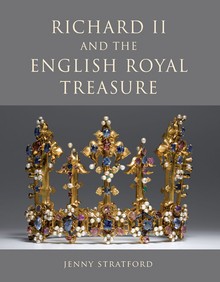
Publication – Jenny Stratford, « Richard II and the English Royal Treasure »

The remarkable treasure of gold and silver from England and France which Richard II had amassed by the end of his reign in 1399 is fully revealed for the first time in this richly illustrated book. The author explores the nature of the objects themselves, their provenance and later fate, and examines the crucial role the treasure played in diplomacy and in financing the Hundred Years War, especially at the time of Agincourt.

9781843833789This fresh analysis is based on the discovery in the National Archives at Kew of a roll over 28 metres long, compiled around the time of Richard’s deposition. English courtiers and Valois princes are named as the donors of many gifts. Concealed among the treasure are valuables Richard seized from the magnates he executed or exiled in 1397. Publication in full of this exceptional inventory leads to completely new perspectives on Richard II’s court and on its splendour in the last years of the fourteenth century.

Jenny Stratford began her career in the Department of Manuscripts, the British Library. Her books include The Bedford Inventories (1993). She is a Senior Research Fellow of the Institute of Historical Research, University of London.

Informations pratiques :
Jenny Stratford, Richard II and the English Royal Treasure, Woddbridge, Boydell and Brewer, 2013. 29,7 x 21 cm, 528 pages. ISBN : 9781843833789. Prix : £ 125.

Note :
À ce sujet, les historiens de la France et de l’Angleterre lors de la guerre de Cent ans tireront aussi un grand profit de la lecture de : Jenny Stratford, The Bedford Inventories, the worldly goods of John, duke of Bedford, regent of France, 1389-1435, London, Society of Antiquaries, 1993, 436 p. + LXVIII pl. h.-t.

Source de l’information : Boydell and Brewer

Publié dans Colloque | Laisser un commentaire

Offre d’emploi – Two Tenure-Track Positions, Ancient World/Medieval World (University of California, Santa Barbara, 1 July 2015)

Jobs:
1) Tenure-Track Position in the Architecture, Urbanism, and Visual Culture of the Ancient World
2) Tenure-Track Position in the Art and Architecture of the Medieval World
Department of History of Art & Architecture, University of California, Santa Barbara
Deadline: 18 October 2014

The Department of History of Art & Architecture, University of California, Santa Barbara, invites applications for two tenure-track Assistant Professor positions in Architecture, Urbanism and Visual Culture of the Ancient World, and Art and Architecture of the Medieval World beginning July 1, 2015. Candidates are expected to have a Ph.D. in the history of art and/or architecture or a related discipline, with demonstrated excellence in research and teaching to complement the department’s global strengths in art and architecture and its Architecture & Environment Emphasis. UC Santa Barbara encourages interdisciplinary studies and there will be opportunities for contributing to an Environmental Humanities initiative on campus, and for engaging with departments such as Classics, History, Medieval Studies, and the Ancient Borderlands Research Focus Group. The successful candidates will be expected to teach a wide variety of courses ranging from undergraduate surveys to advanced graduate seminars. The department is especially interested in candidates who can contribute to the diversity and excellence of the academic community through research, teaching and service.

uoc1) Assistant Professor: Architecture, Urbanism and Visual Culture of the Ancient World
We seek a colleague whose research focuses on the cross-cultural dynamics of the ancient world, including classical Greece and Rome and their far-flung territories, but also other regions and empires of the ancient Mediterranean. The ideal candidate will be theoretically informed, bringing critical perspectives to their teaching of ancient architecture and urbanism, with broader expertise in such areas as archeology, museology, visual culture, and/or digital media.

2) Assistant Professor: Art and Architecture of the Medieval World
We seek a colleague whose research makes new contributions to the understanding of cultural interchange in the medieval world. While the candidate’s research may focus on any medium and scale of analysis — painting, sculpture, illuminated manuscripts, architecture, and cities — we will expect the successful candidate to demonstrate a facility in exploring diverse media to engage larger issues related to social, political, and technological change in the medieval world.

To apply:
Please create an account and complete the online application at
https://recruit.ap.ucsb.edu.

The online application will require (1) a cover letter, (2) a statement of research and teaching interests, (3) a curriculum vitae with full contact information, (4) one or two publications or writing samples (5) three letters of recommendation submitted directly by referees through https://recruit.ap.ucsb.edu.

Please send queries about the position to search@arthistory.ucsb.edu. The subject line of the email must clearly state the position for which the candidate is applying. For full consideration, submit all application materials by October 18, 2014.

The University of California is an Equal Opportunity/Affirmative Action Employer. All qualified applicants will receive consideration for employment without regard to race, color, religion, sex, national origin, or any other characteristic protected by law including protected Veterans and individuals with disabilities.

Source de l’information : Medieval Art Research

Publié dans Offre d'emploi | Laisser un commentaire

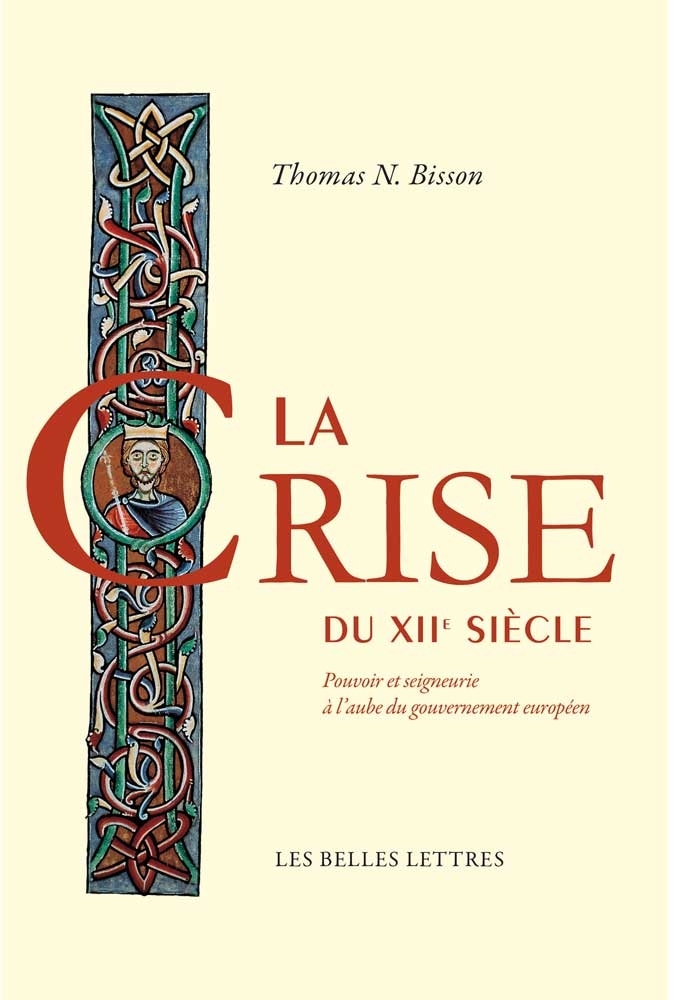
Publication – Thomas N. Bisson, « La Crise du XIIe siècle. Pouvoir et seigneurie à l’aube du gouvernement européen »

La civilisation médiévale parvint à maturité dans une époque marquée par des événements retentissants telles la Conquête normande et la première croisade. Le pouvoir tomba aux mains d’hommes gravitant autour des châteaux, qui exercèrent des seigneuries coercitives peu soucieuses de l’ordre public. Assoiffés de pouvoir, en quête de noblesse, empiétant sur les domaines cléricaux, exploitant les paysans, les chevaliers en nombre croissant finirent par apparaître comme une menace pour l’ordre social et pour la paix.

Dans La Crise du XIIe siècle, l’historien Thomas Bisson montre comment, dans une Europe sans gouvernement, les gens vivaient l’expérience du pouvoir et comment ils en souffraient. Repensant en profondeur une histoire familière, il rapporte les origines du gouvernement européen à une crise de la seigneurie et à sa résolution. Il explore les circonstances qui poussèrent les chevaliers, les nobles, les rois et les ecclésiastiques à insuffler des objectifs sociaux dans la seigneurie. La violence des puissants et les cris de protestation qu’elle provoqua contribuèrent ainsi à l’apparition de gouvernement dans les royaumes, les principautés et les villes.
Embrassant magistralement toute la chrétienté, La Crise du XIIe siècle est une histoire culturelle sans équivalent du pouvoir dans l’Europe médiévale.

Thomas N. Bisson est professeur émérite d’histoire médiévale à l’université de Harvard, spécialiste de l’histoire des institutions et du pouvoir en Catalogne et dans la France du Midi.

22510100945390LTable des matières :

Introduction

Partie I – L’âge de la seigneurie (875-1150)

Chapitre premier : L’ordre ancien
Chapitre 2 : La quête de la seigneurie et de la noblesse
Chapitre 3 : Les cultures de la seigneurie

Partie II – La domination seigneuriale (1050-1150) : l’expérience du pouvoir

Chapitre premier : La papauté
Chapitre 2 : Les royaumes de la Méditerranée occidentale
Chapitre 3 : Les terres impériales
Chapitre 4 : La France
Chapitre 5 : Les royaumes du Nord

Partie III – Les crises de pouvoir (1060-1150)

Chapitre premier : Une difficile maturité
Chapitre 2 : L’Église
Chapitre 3 : Des sociétés troublées
Chapitre 4 : Une époque de tyrannie ?

Partie IV – Résolution : intrusions du gouvernement (1150-1215)

Chapitre premier : Prospérité et crise de la grande seigneurie
Chapitre 2 : Des « ombres de paix »
Chapitre 3 : Justice et reddition de comptes
Chapitre 4 : Contrainte, compromis et office
Chapitre 5 : Travailler avec le pouvoir

Partie V – Célébration et persuasion (1160-1225)

Chapitre premier : Cultures du pouvoir
Chapitre 2 : Pacification
Chapitre 3 : Politisation du pouvoir
Chapitre 4 : Pouvoir des états et pouvoir d’État

Épilogue

Informations pratiques :
Thomas N. Bisson, La Crise du XIIe siècle. Pouvoir et seigneurie à l’aube du gouvernement européen, trad. fr. Béatrice Bonne, Paris, Les Belles Lettres, 2014 (Histoire), 650 p.,13 ill., 8 pl., 5 cartes.
Format 15 x 21,5 x 3,2 cm. ISBN : 978-2-251-38126-8. Prix : 35 euros.

Source de l’information : Les Belles Lettres

Publié dans Publications | Laisser un commentaire

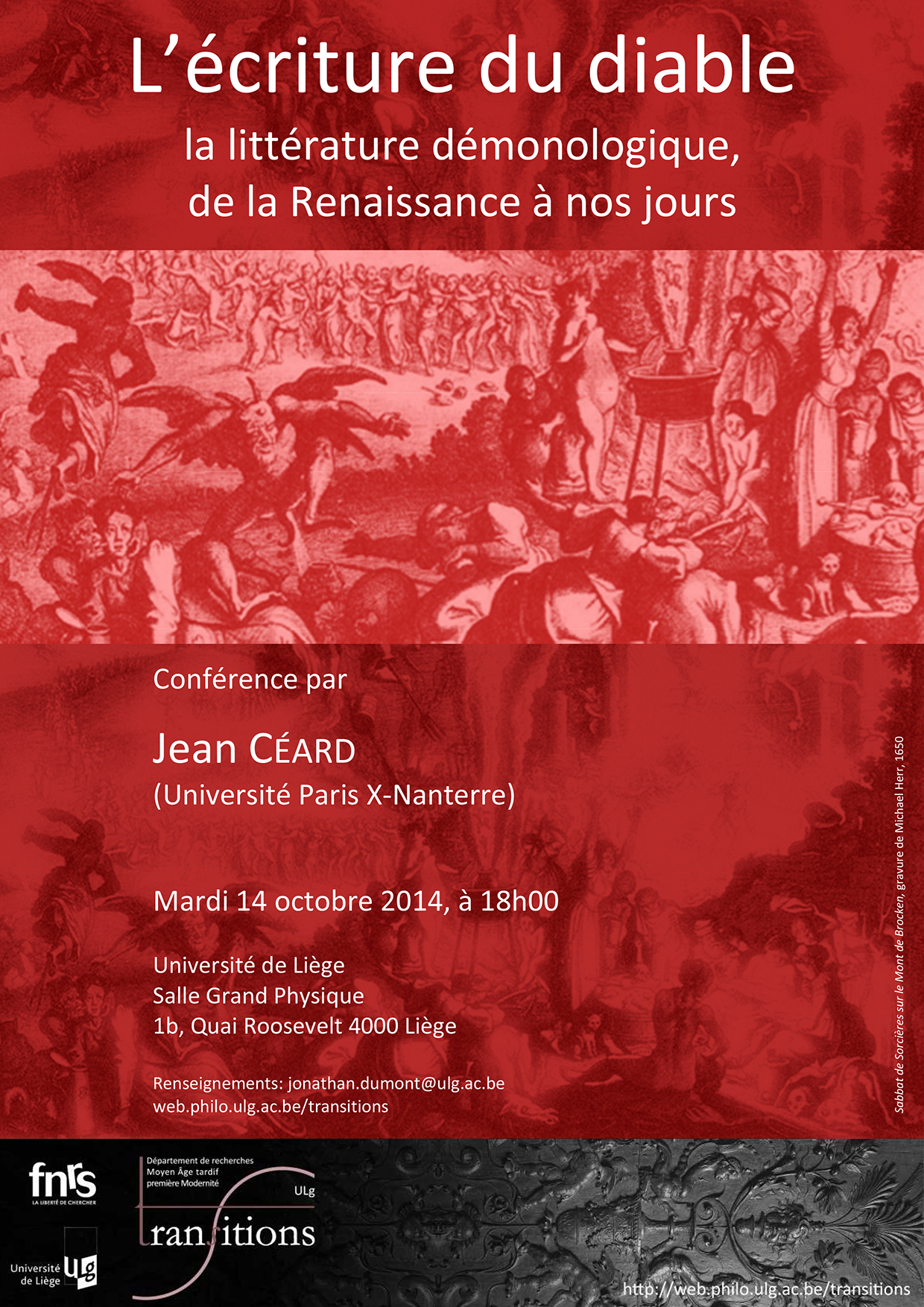
Conférence – Jean Ceard, « L’écriture du diable : la littérature démonologique, de la Renaissance à nos jours »

Le mardi 14 octobre 2014 à 18h00, dans le cadre du cycle annuel de conférences organisé par Transitions, Jean Ceard (Université de Paris X-Nanterre) présentera une communication intitulée L’écriture du diable : la littérature démonologique, de la Renaissance à nos jours.

Jean Céart octobre 2014Informations pratiques :
Université de Liège, Salle Grand Physique
1b, Quai Roosevelt
4000 Liège (Belgique)
http://www.transitions.ulg.ac.be
Renseignements : jonathan.dumont@ulg.ac.be

Publié dans Colloque | Laisser un commentaire

Appel à contribution – Concilium Lateranense IV – Commemorating the Octocentenary of the Fourth Lateran Council of 1215

Rome, 25-29 November 2015

Location : Italy

Call for Papers Date: 2014-11-01

In November 2015, we have a unique opportunity to re-evaluate the role of the Fourth Lateran Council in the reform of the universal Church. Taking an inter-disciplinary approach, we shall investigate how its decisions affected the intellectual, cultural, social and religious life of the medieval world. We particularly encourage individual papers from disciplines such as art history, theology, canon law, crusade studies, literature and from those who work on relations between Jews and Christians, which we hope will broaden current interpretations of the events of the Council, their subsequent importance and long-term impact. Alternatively, three-paper session proposals on a common theme will also be most welcome. Papers may be delivered in English, French, German, Italian or Spanish but must be limited to 30 minutes. Abstracts of no more than 200 words with the necessary contact details should be sent no later than 1 November 2014.

For questions: fourthlateranat800@gmail.com.

Website: http://LateranIV.com

————————————————–

On Monday 30 November 1215 in the Basilica of St John Lateran, Innocent III brought the first assembly of the whole Church since the Council of Chalcedon (451) to a rousing finale by summoning all the delegates to unite in faith and by issuing Ad Liberandum, an encyclical calling for a crusade to liberate the Holy Land. This Council, fourth in the Lateran series but the twelfth ecumenical gathering of the Church in the Western tradition, included the five patriarchs or their representatives, together with more than one thousand bishops, abbots and other dignitaries, both ecclesiastical and secular. At each of the three plenary sessions held on 11, 20 and 30 November respectively, Innocent preached a set-piece sermon whilst, behind the scenes, delegates debated such major issues as who was more worthy to lead the Empire and how to contain the Albigensian heresy.

The accounts of eyewitnesses reveal that Innocent’s consecration of Santa Maria in Trastevere and celebrations for the anniversary of the dedication of the Vatican Basilica served not only to emphasize the history, majesty and ritual of the Church but also offered a welcome respite from the intensive discussions in the Lateran Palace. The Fathers of the Council promulgated seventy decrees, covering topics as diverse as heresy, Jewish-Christian relations, pastoral care and Trinitarian theology as well as ecclesiastical governance. Monks and secular clergy were to be reformed, the nascent mendicant orders welcomed to the Church and diocesan bishops instructed to implement far-reaching conciliar decisions across Christendom.

Eight hundred years on, Lateran IV still stands as the high-water mark of the medieval papacy, its political and ecclesiastical decisions enduring down to the Council of Trent whilst modern historiography has deemed it the most significant papal assembly of the Later Middle Ages.

Contact :

Danica Summerlin
Email: fourthlateranat800@gmail.com
Visit the website at http://LateranIV.com

Source de l’information : H-Net.

Publié dans Le réseau | Laisser un commentaire

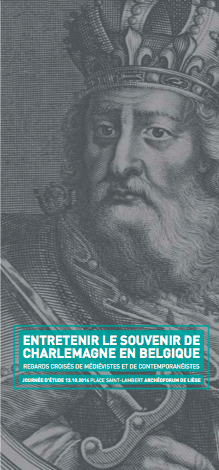
Colloque – Entretenir le souvenir de Charlemagne en Belgique. Regards croisés de médiévistes et de contemporanéistes

Douze siècles après sa mort, Charlemagne figure encore parmi les plus grands hommes de l’Histoire. Diverses villes et régions d’Europe se disputent son souvenir. Issu d’un lignage richement possessionné dans le bassin mosan, il a reçu l’honneur d’une notice dans la biographie nationale de Belgique après que le baron Kervyn de Lettenhove a osé proclamer sa nationalité belge le 15 mai 1862. Dès lors, et en dépit des objections parfois légitimes de certains intellectuels, le restaurateur franc de l’institution impériale en Occident a trouvé une place de choix dans les manuels scolaires, les arts plastiques et la culture populaire belge. Par ailleurs, malgré les siècles écoulés, son œuvre politique conquérante puis unificatrice n’a cessé de fasciner les puissants qui se sont employés à en entretenir le souvenir.

En écho à l’exposition organisée à l’Archéoforum (Liège) de mai à octobre 2014 sur le thème de Charlemagne dans les manuels scolaires, la journée d’étude du 13 octobre se propose d’évaluer l’impact du souvenir de Charlemagne sur le territoire belge. Conçue sur le mode du dialogue entre médiévistes et contemporanéistes, elle sera l’occasion d’une confrontation de ce que l’enseignement, la culture et le monde politique belges des XIXe, XXe et XXIe siècles ont incité à connaître et à retenir, d’une part, à ce que les avancées de la recherche scientifique en histoire carolingienne ont progressivement révélé, de l’autre.
Charlemagne - ArchéoforumProgramme :

9h : Accueil
9h15 : Introduction à la journée

9h30 : Conférence inaugurale : Michel Sot, Professeur émérite, Paris IV- Sorbonne – Au fondement du souvenir de Charlemagne : la Vita Karoli d’Eginhard
10h30 : Pause-café

1ère séance – Charlemagne dans La Littérature scolaire et grand public

11h00 : Catherine Lanneau, Chargée de cours, ULg – Charlemagne et la période carolingienne dans les ouvrages belges de vulgarisation historique
11h20 : Discussion avec les répondants médiévistes

11h30 : Marc Quaghebeur et Laurence Boudart, Directeur et Directrice Adjointe des Archives et du Musée de la Littérature – Un ancêtre pérenne pour dire une identité multiple
11h50 : Discussion avec les répondants médiévistes

12h00 : Michaël Antoine, Master en Histoire, ULg – Les représentations iconographiques de Charlemagne dans les manuels scolaires belges francophones. Introduction à l’exposition « Charlemagne à l’école »
12h20 : Visite libre de l’exposition et pause-repas

2e séance – Récupération politique de Charlemagne

14h00 : Alain Brose, Doctorant, ULB – Charlemagne dans la propagande national-socialiste
14h20 : Discussion avec les répondants médiévistes

14h30 : Christoph Brüll, Chercheur qualifié, FNRS/ULg – La Belgique et l’Europe au regard des discours de remise du Prix Charlemagne (1950-2014)
14h50 : Discussion avec les répondants médiévistes
15h00 : Pause-café

3e séance – Vestiges matériels

15h30 : Jean-Patrick Duchesne, Professeur ordinaire, ULg – « Sage comme une image ». L’iconographie carolingienne à Liège au XIXe siècle
15h50 : Discussion avec les répondants médiévistes

16h00 : Frédéric Chantinne et Philippe Mignot, Archéologues, SPW / service de l’archéologie DGO4 – La « période carolingienne » au travers des recherches archéologiques en Belgique, du XIXe siècle à nos jours
16h20 : Discussion avec les répondants médiévistes

16h30 : Table ronde conclusive : Le Charlemagne historique versus le Charlemagne du souvenir collectif belge. Confrontation des points de vue d’historiens médiévistes et contemporanéistes
Animation : Florence Close, Chargée de cours, ULg.
Avec la participation de :
– Jean-Patrick Duchesne, Professeur ordinaire, ULg – Jean-Louis Jadoulle, Chargé de cours, ULg
– Philippe Raxhon, Professeur ordinaire, ULg – Michel Sot, Professeur émérite, Paris IV-Sorbonne – Clemens Bayer, Chercheur indépendant, Bonn

17h30 : Clôture de la journée d’étude

18h00 : La mort de Roland, spectacle de marionnettes
liégeoises au Musée de la Vie Wallonne

Répondants médiévistes :
– Clemens Bayer, Chercheur indépendant, Bonn
– Alain Dierkens, Professeur ordinaire, ULB
– Jean-Louis Kupper, Professeur ordinaire émérite, ULg
– Julien Maquet, Directeur de l’Archéoforum / Institut
du Patrimoine Wallon

Informations pratiques :
13 octobre 2014

Archéoforum de Liège, place Saint-Lambert intention de participation souhaitée pour la journée d’étude, entrée libre
Inscription obligatoire à la séance de marionnettes liégeoises, places limitées
Informations et inscriptions avant le 6 octobre 2014 auprès de florence Close : fclose@ulg.ac.be

Source de l’information : Université de Liège

Publié dans Colloque | Laisser un commentaire

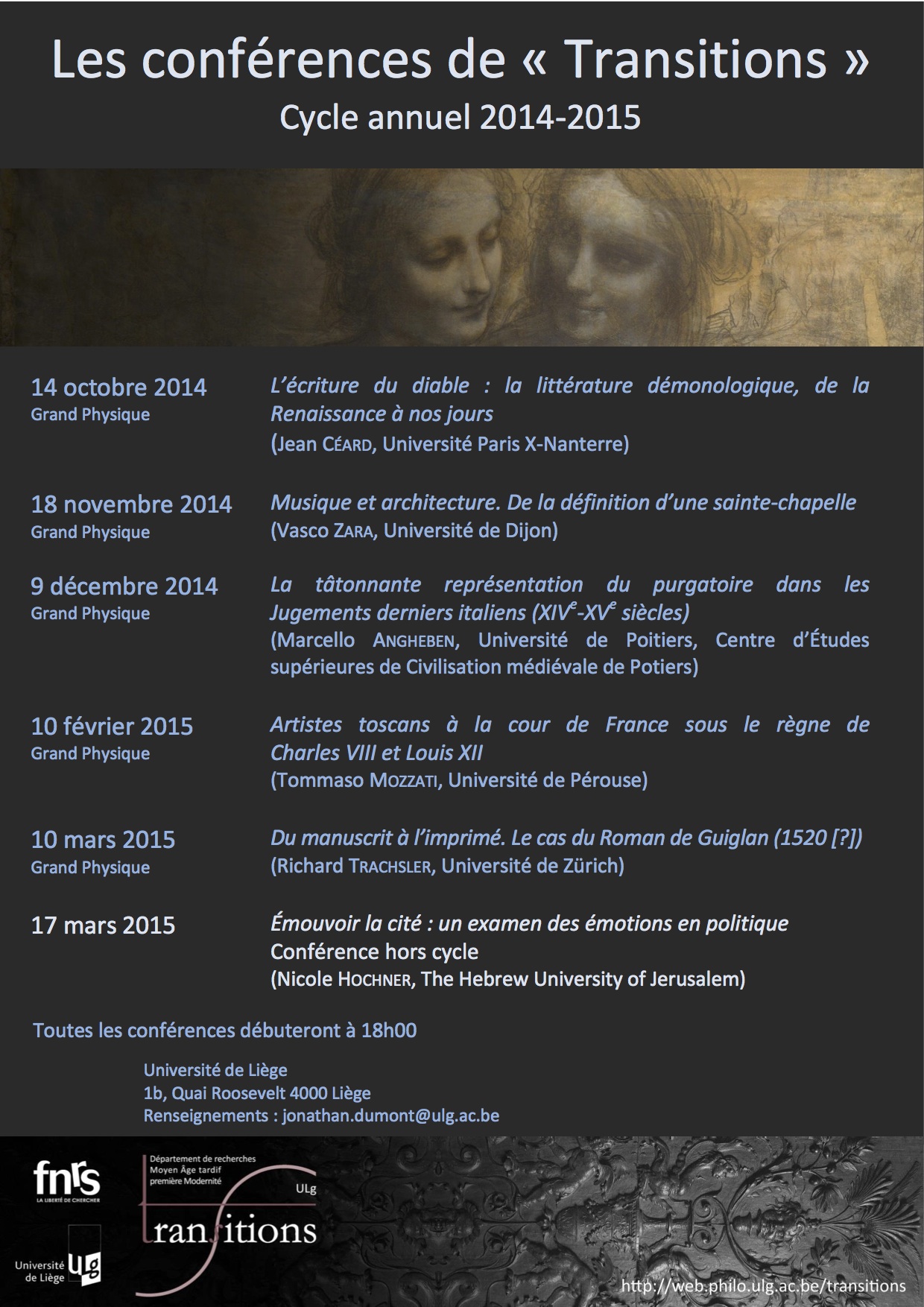
Cycle de conférences – Cycle de conférences du Département de recherches « Transitions. Département de recherches sur le Moyen Âge tardif et la première Modernité »

Programme du cycle de conférences 2014-2015 du Département de recherches « Transitions. Département de recherches sur le Moyen Âge tardif et la première Modernité » (Université de Liège) :

display.jsp14 octobre 2014 , 18 heures, Grand Physique
L’écriture du diable : la littérature démonologique, de la Renaissance à nos jours
Jean Ceard, Université Paris X-Nanterre

18 novembre 2014 , 18 heures, Grand Physique
Musique et architecture. De la définition d’une sainte-chapelle
Vasco Zara, Université de Dijon

9 décembre 2014 , 18 heures, Grand Physique
La tâtonnante représentation du purgatoire dans les Jugements derniers italiens. XIVe-XVe siècles
Marcello Angheben, Université de Poitiers, Centre d’études supérieures de civilisation médiévale de Poitiers

10 février 2015 , 18 heures, Grand Physique
Artistes toscans à la cour de France sous le règne de Charles VIII et Louis XII
Tommaso Mozzati, Université de Pérouse

10 mars 2015 , 18 heures, Grand Physique
Du manuscrit à l’imprimé. Le cas du Roman de Guiglan (1520[?])
Richard Trachsler, Université de Zürich

Informations pratiques :
Toutes les conférences débuteront à 18h00

Université de Liège
1 B, Quai Roosevelt
4000 Liège

Renseignements : Jonathan.Dumont@ulg.ac.be

Source de l’information : Transitions

Publié dans Colloque | Laisser un commentaire

Web – Musicologie médiévale

Le Réseau Musicologie Médiévale s’efforce de faire connaitre toutes les mises en lignes de manuscrits médiévaux musicaux. Ce réseau est ouvert à tous et spécialement aux musicologues et liturgistes. Accès : ici

Ce réseau scientifique regroupes déjà 1760 chercheurs et passionnés.
L’inscription au réseau est gratuite.

Le Réseau Musicologie Médiévale est en partenariat avec les sites :

http://gregofacsimil.free.fr/index.html
http://www.diamm.ac.uk/ (Oxford Faculty of Music)

Source de l’information : Musicologie médiévale

Publié dans Le réseau | Laisser un commentaire

Web – Nouveau portail dédié au département des manuscrits de la Bibliothèque nationale de France

Ce guide est destiné aux lecteurs et futurs lecteurs du département des Manuscrits. Il contient :

  • des présentations des différentes collections ainsi que des catalogues imprimés et en ligne,
  • des outils de travail utiles aux chercheurs travaillant sur des manuscrits,
  • des informations pratiques sur le fonctionnement de la salle de lecture, la consultation et la reproduction des manuscrits.

Destiné à des chercheurs de tous niveaux, ce guide concerne à la fois les collections de manuscrits médiévaux, contemporains et orientaux, tous consultables dans la salle de lecture du département des Manuscrits sur le site Richelieu de la BnF.

Accès : ici

Source de l’information : Bibliothèque nationale de France

Publié dans Le réseau | Laisser un commentaire

Appel à contribution – Negotiating Change in Urban Spaces from the Middle Ages to the Present

This interdisciplinary conference aims to explore the ways in which physical transformations of urban spaces have been negotiated and/or narrated over time. The politics of space continues to attract leading research, especially during moments of palpable transition such as the tearing down of city walls or the rebuilding of war-damaged districts. In these situations, struggles over municipal laws, codes, or regulations, or the changing aesthetics or rhythms of urban spaces illuminate a great deal about how the city has been imagined. They underscore the narratives that urban dwellers, professionals and government officials have told about the built environment and used to influence its transformation. In this sense, the imagined geography, image, role and importance of a city as conceived by a myriad ‘interested parties’ is as important as its physical reality. However, these rhetorically and visually defined cities never stop taking their legitimacy from the physical city.

This conference seeks to gather together academics from a number of disciplines interested in this relationship between material change and discourse. Some examples of the many ways in which this can be explored include investigations into the primacy of place in debates over urban change, be it structurally, politically, or socially understood. Likewise, investigations of mental geographies have enriched our understandings of clashes over urban development, through an increased sensitivity to how different forms of borders are created and policed. Other researchers have looked to explore questions of memory or heritage in material change. Indeed, this holds true for a whole range of political, social or cultural ideas. And of course, explorations of the relationship between the local and the global have raised fascinating questions of how urban identities were understood in space and changed across time.

We are seeking papers that consider the complexities of negotiating and/or narrating urban transformations according to any disciplinary approach. There are no restrictions on geographical region or time period but a reference to change according to one of the following themes:

  • Infrastructural change
  • Changes in housing and/or living standards
  • Changing regulations, including of the sounds, smells and rhythms of urban life
  • Local and/or global relationships in the city
  • Aesthetics or artistic depictions of the city
  • The development of heritage and sites of memory
  • Changing tensions between secular and religious spaces or relationships
  • Policing, surveillance and deviance

In order to ground the conference discussions in the realities of navigating change in the city, the conference will also include a number of architects and urban planners to help enrich the ways in which we talk about the city.

The conference will take place at Nuffield College, University of Oxford and will be consist of panels of short summary presentations based on pre-circulated papers of 5-6000 words. There will be no conference fee – coffee and meals including the evening meal are included. Limited funding to subsidize travel costs and accommodation is available, to those without a full wage or institutional support.

Paper proposals of up to 500 words and as well as an abridged curriculum vitae should be sent to S.R.Davies@swansea.ac.uk by 31 October 2014. The conference language will be English.

Please address all queries to: Sheona Davies, S.R.Davies@swansea.ac.uk

With the generous support of the KE Seed Fund, University of Oxford.

Source de l’information : H-Soz-u-Kult

Publié dans Appel à contributions | Laisser un commentaire