Appel à contribution – Jacques de Vitry. Reform, Mission, and Crusade in the Early 13th Century

Jacques de Vitry, the preacher who ‘moved the whole of France unlike anyone before or after him’, was a crucial actor in the reform movement of the early 13th century. As preacher, as bishop, and as cardinal, he contributed greatly to the Papacy’s reform and crusade agenda in the wake of the Fourth Lateran Council. Jacques’s Vita of Marie d’Oignies, his reports of his missions among the Levantine Christians and Muslims, his encyclopedic treatises on the Holy Land and the Western Church, as well as his monumental sermon collections all had a profound impact, both during his times and in the centuries to come.

These sessions aim to bring together scholars investigating Jacques’s life and works from different perspectives to discuss their most recent research. The publication of a volume of essays is anticipated. Paper proposals (title & 100 words abstract) are invited on any aspect of Jacques de Vitry’s life, network, and writings. Please send proposals to j.vandeburie@kent.ac.uk before 31 August 2014.

Source de l’information : Academia.edu

Publié dans Appel à contributions | Laisser un commentaire

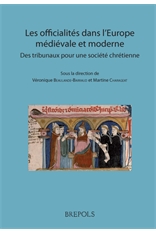
Publication – V. Beaulande-Barraud et M. Charageat (éd.), « Les officialités dans l’Europe médiévale et moderne. Des tribunaux pour une société chrétienne »

Les justices ecclésiastiques suscitent un intérêt historiographique renouvelé ces dernières années, tant comme juridictions temporelles spécifiques que dans les manifestations d’une justice compétente en matière « spirituelle ». C’est spécifiquement sur les « cours d’Église », les officialités, que s’est tenu ce colloque réunissant historiens et juristes, médiévistes et modernistes, pour un bilan en forme d’invitation à poursuivre les investigations.

dIS-9782503551494-1L’histoire des officialités a ainsi été éclairée dans sa diversité et dans son évolution, dans une perspective comparatiste. Leur compétence et la manière dont elles exercent leur juridiction, gracieuse, contentieuse, criminelle, a été mise en valeur, attestant de leur rôle quotidien auprès des populations. Enfin, l’étude de leur activité permet une approche de l’histoire des femmes et du couple qui, à son tour, met en valeur la richesse des sources des officialités, organes de « disciplinement des mœurs » encore en partie méconnus.

Table des matières : ici

Informations pratiques :
V. Beaulande-Barraud et M. Charageat (éd.), Les officialités dans l’Europe médiévale et moderne. Des tribunaux pour une société chrétienne, Turnhout, Brepols, 2014 (Ecclesia militans, 2). 340 p., 12 b/w ill., 6 b/w tables, 156 x 234 mm. ISBN: 978-2-503-55149-4. Prix : 75 euros.

Source de l’information : Brepols

Publié dans Publications | Laisser un commentaire

Appel à contribution – Renaissance Cardinals: Diplomats and Patrons in the Early-Modern World

Event Date: 13-14 March 2015
Event Location: Saint Mary’s University, Twickenham, London
Submission Deadline: 15 September 2014

Saint Mary’s University Twickenham is hosting an international conference on Renaissance cardinals as diplomats and patrons. The conference will mark the 500th anniversary of Thomas Wolsey’s being made a cardinal by Pope Leo X. As ‘Princes of the Church’, cardinals were almost invariably important politicians and international representatives of the Papacy, of princely, national, republican and civic regimes, and of their own families. The conference, organised by the School of Arts and Humanities, will take an innovative, interdisciplinary, approach to cardinals as ‘super-diplomats’, powerful political and cultural brokers, who played a vital role in the transfer and adaptation of ideas and artefacts within and beyond their primary sphere of Western Europe.

Proposals on any aspect of the role of cardinals as early-modern papal, princely, civic and dynastic representatives and patrons (rather than as ecclesiastics per se) will be considered. Papers from research students and early-career researchers are especially welcome.

Some suggested areas of enquiry and discussion include:

  • Ritual and protocol in diplomatic encounters between cardinals, secular diplomats, and rulers
  • The development, training and careers as diplomats of individual cardinals
  • The role of Church diplomats in the circulation of texts, literary ideas and artefacts
  • The representation of cardinals as diplomats in literary texts and art
  • Early modern legal and philosophical attitudes to churchmen/cardinals as diplomats
  • The artistic and architectural patronage of cardinals, as diplomats
  • The impact of the European Reformation in all its phases on the diplomatic practices and traditions of the Catholic Church
  • The part played by cardinals in Western Europe’s encounter with the world beyond.

Enquiries and Proposals for 20 minute papers or panels of 3-4 papers should be sent to Glenn.Richardson@smuc.ac.uk or Eugenia.Russell@smuc.ac.uk by 15 September 2014. Individual paper proposals should be no more than 300 words. Panel proposals should include abstracts of all papers (max 300 words) and a brief rationale (max 100 words) for the panel. All proposals should be accompanied by a short statement of affiliation and career. Delegates will be notified by 15 October 2014.

Source de l’information : Episcopus

Publié dans Appel à contributions | Laisser un commentaire

Offre d’emploi – Assistant Professor of Renaissance/Early Modern Visual Culture in the Mediterranean world (University of California at Berkeley)

Assistant Professor of Renaissance/Early Modern Visual Culture in the Mediterranean world (tenure track), The University of California at Berkeley
Deadline: 15 September 2014

The University of California at Berkeley announces the following job search:
Assistant Professor of Renaissance/Early Modern Visual Culture in the Mediterranean world (tenure-track). Appointment effective July 1, 2015; candidates must have Ph.D. dissertation or equivalent underway at time of application.

The Departments seek a specialist within the period (approx. 1300-1600) with strong interdisciplinary and/or comparative interests extending geographically beyond the boundaries of the Italian peninsula and the ability to contribute to the curricula and research profiles of both History of Art and Italian Studies. Areas of interest might include the relations between visual, verbal and material culture; travel studies; architectural history; cultural exchange between Europe and the East and/or Africa, or the New World.

Teaching at both undergraduate and graduate levels is expected, including the ability to teach in the Italian language where relevant. Ph.D. or equivalent must be completed by July 1, 2015.

The University of California is an Equal Opportunity/Affirmative Action Employer. All qualified applicants will receive consideration for employment without regard to race, color, religion, sex, national origin, disability, age or protected veteran status. For the complete University of California nondiscrimination and affirmative action policy see: http://policy.ucop.edu/doc/4000376/NondiscrimAffirmAct.

Deadline for application: 15 September 2014
For more information: https://aprecruit.berkeley.edu/apply/JPF00475 https://aprecruit.berkeley.edu/apply/JPF00475

Source de l’information : Medieval Art research

Publié dans Offre d'emploi | Laisser un commentaire

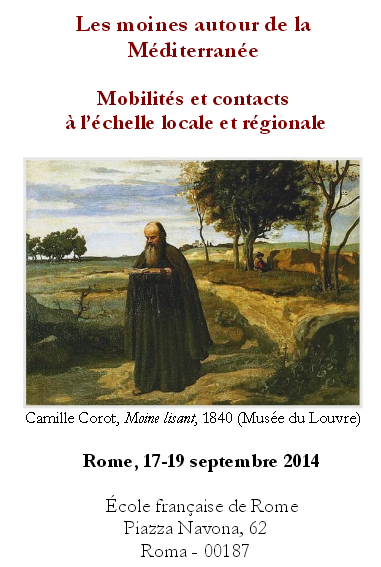
Colloque – Les moines autour de la Méditerranée. Mobilités et contacts à l’échelle locale et régionale

Rome, 17-19 septembre 2014
École française de Rome
Piazza Navona, 62
Roma – 00187

Le programme de recherche intitulé Les moines autour de la Méditerranée. Contacts, échanges, influences entre Orient et Occident, de l’Antiquité tardive au Moyen Âge (IFAO, EFR, EFA, Labex RESMED, UMR 8584 et 8167) se propose d’analyser la paradoxale mobilité du monde monastique, notamment méditerranéen, que des normes diverses paraissent contraindre à la stabilitas, mais qui connaît pourtant d’intenses et continus mouvements de circulation, d’échanges et d’influences sur un long Moyen-Âge (du IVe au XVe siècle). Ce programme pluriannuel (2012-2016), qui s’adresse aux historiens, historiens de l’art, philologues et archéologues travaillant sur le monachisme dans les différentes régions de la Méditerranée, tant en Orient qu’en Occident, se déclinera en plusieurs manifestations.

Moines autour de la Médit.Le premier colloque, intitulé Les moines autour de la Méditerranée. Mobilités et contacts à l’échelle locale et régionale, ambitionne d’étudier les moines en déplacement d’un monastère à un autre, les moines en voyage d’affaires ou en pèlerinage, de s’attacher aux exigences normatives à l’égard de ces déplacements, aux modalités pratiques des circulations, à l’organisation de l’accueil des moines voyageurs, aux échanges épistolaires entre les moines et les communautés. Il s’agit en particulier d’évaluer la nature des relations ainsi nouées, que celles-ci relèvent de la vie régulière, de la vie quotidienne, de la vie économique ou de la vie spirituelle.

Durée des communications : 25/30 minutes

Programme : ici

Comité scientifique :
Annick Peters-Custot
(Université de Nantes, C.R.H.I.A.)
Maria Mossakowska-Gaubert (IFAO)
Olivier Delouis (CNRS UMR 8167,
Orient et Méditerranée)

Contact :
École française de Rome
Stéphane Gioanni
Directeur des études médiévales
Grazia Perrino
Secrétariat des études médiévales
secrma@efrome.it

Source de l’information : École française de Rome

Publié dans Colloque | Laisser un commentaire

Appel à contribution – The Cross in Medieval Art

Recent art-historical research has brought new understandings of the central symbol of Christianity, the Cross, in different places, at different times, in different media, and with different theoretical and conceptual foci. The Cross, its representations and significations, and the appearance and materiality of those representations, features in many areas of current research, but not often as a central subject to be dealt with thematically and comparatively.

This session invites considerations of images depicting, representing or referring to the Cross in any media, and across the middle ages, from early to late. The aim of the session is to consider what can be gained at this particular moment in scholarship from a common concentration on the theme of the Cross. Therefore, proposers are invited especially to consider their subject matter in light of theoretical perspectives that have been prominent in recent art-historical scholarship, such as (but not limited to) affect, emotion, movement, medium and materiality.

Deadline for submissions: September 15th 2015. Please include paper proposals (consisting of an abstract of up to one page, and a completed Participant Information Form (http://www.wmich.edu/medieval/congress/submissions/index.html#Paper)

Contact Name: Dr Beth Williamson, University of Bristol
Contact and further information details: beth.williamson@bristol.ac.uk – See more at: http://www.aah.org.uk/students/news/1443#sthash.bqk28EPz.dpuf

Source de l’information : Association of Art Historians

Publié dans Appel à contributions | Laisser un commentaire

Web – CBMA. Chartes bourguignonnes du Moyen Age

Produits par centaines de milliers au Moyen Âge, les chartes sont probablement les sources les plus mobilisées par la tradition historiographique. Elles ont été souvent édités et font partie des premiers documents médiévaux à avoir été soumis à des traitements informatiques. S’insérant dans ce contexte, le projet des CBMA numérise, enregistre et exploite la prolifique documentation diplomatique bourguignonne, produite notamment par les abbayes de Cluny ou de Cîteaux.

Le programme conduit également une réflexion épistémologique sur les transformations dans la pratique de la recherche, induites par la numérisation massive de textes médiévaux et par l’usage du support électronique dans la reproduction des documents et manuscrits originaux. Des expériences nouvelles sont menées pour mieux connaître la société médiévale, pour la connaître autrement, en faisant toute la place aux études de sémantique structurelle, aux approches statistiques et spatiales, ainsi qu’aux implications cognitives de la littératie, en tant que technologie graphique et visuelle.

CBMA_petit_01Le projet de recherche des CBMA (Chartae Burgundiae Medii Aevi – Chartes de la Bourgogne du Moyen Âge) promeut et coordonne l’étude de la documentation diplomatique médiévale de la Bourgogne. Il met ses résultats à disposition via une plate-forme documentaire et une base de données d’actes diplomatiques librement accessibles sur Internet sous différents formats électroniques. Ce corpus de 15000 chartes bourguignonnes médiévales est interrogeable avec le logiciel Philologic () et constitue un terrain expérimental pour de nouvelles méthodes de recherche.

Ce programme a reçu depuis ses débuts en 2004 les soutiens de l’ACI, de l’ANR, de la Région Bourgogne et de Université de Bourgogne. Il est lié aux programmes ANR CHARCIS (Chartes cisterciennes du XIIe siècle, Programme Corpus 2013-2015), ANR OMNIA (Outils et Méthodes Numériques pour l’Interrogation et l’Analyse des textes médiolatins, Programme blanc 2008-2013), ANR ESPACHAR (Les espaces de la charte, Programme thématique ANR-CORPUS 2007-2011), ACI « Chartes et pouvoir au Moyen Âge » (2004-2007) et GDR Diplomatique (Groupement de recherches dédié à la diplomatique médiévale).

Il a été accueilli au sein du TGE Adonis et il est aujourd’hui hébergé par Huma-Num.

L’équipe CBMA est composée d’Eliana Magnani (responsable), Marie-José Gasse-Grandjean, Nicolas Perreaux et Coraline Rey, et bénéficie de l’appui d’un réseau de collaborateurs.

Contact et liens utiles.

Accès : ici

Publié dans Le réseau, Web | Laisser un commentaire

Web – La collection « Instrumenta » de l’Institut historique allemand disponible en ligne

Les volumes 1–20 de la collection Instrumenta de l’Institut historique allemand peuvent désormais être consultés en ligne sur la plateforme de publication perspectivia.net. Accès : ici.

Liste des titres disponibles :

Philippe Depreux: Prosopographie de l’entourage de Louis le Pieux (781–840), Sigmaringen (Thorbecke) 1997, (Instrumenta, 1), ISBN 3-7995-7265-1.

Andreas Wilkens: Archivführer Paris – 19. und 20. Jahrhundert. Zentrale Bestände zu Politik, Wirtschaft und Gesellschaft in Archiven und Bibliotheken, Sigmaringen (Thorbecke) 1997, (Instrumenta, 2), ISBN 3-7995-7266-X.

Henri Stein: Catalogue des Actes de Charles le Téméraire (1467–1477). Mit einem Anhang: Urkunden und Mandate Karls von Burgund, Grafen von Charolais (1433–1467). Bearb. von Sonja Dünnebeil, Sigmaringen (Thorbecke) 1999, (Instrumenta, 3), ISBN 3-7995-7267-8.

Regina M. Delacor: Attentate und Repressionen. Ausgewählte Dokumente zur zyklischen Eskalation des NS-Terrors im besetzten Frankreich 1941/42, Stuttgart (Thorbecke) 2000, (Instrumenta, 4), ISBN 3-7995-7268-6.

Wolfgang Hans Stein: Inventar von Quellen zur deutschen Geschichte in Pariser Archiven und Bibliotheken. Band 2: Archive im Bereich des Verteidigungsministeriums, Archive des Außen- und Finanzministeriums, Stadtpariser Archive und Bibliotheken, Koblenz (Verlag der Landesarchivverwaltung Rheinland-Pfalz) 2002, Veröffentlichungen der Landesarchivverwaltung Rheinland-Pfalz, Bd. 97 (Instrumenta, 5), ISBN 3-7995-7269-4.

Werner Paravicini: Invitations au mariage. Pratique sociale, abus de pouvoir, intérêt de l’État à la cour des ducs de Bourgogne 1399–1489. Documents introduits, édités et commentés par Werner Paravicini, Stuttgart (Thorbecke) 2001, (Instrumenta, 6), ISBN 3-7995-7270-8.

Stefan Martens (Hg.): Frankreich und Belgien unter deutscher Besatzung 1940–1944. Die Bestände des Bundesarchiv-Militärarchivs Freiburg. Bearb. von Sebastian Remus. Préface de Martine de Boisdeffre et de Hartmut Weber, Stuttgart (Thorbecke) 2007, (Instrumenta, 7), ISBN 3-7995-7271-6.

Brigitte Englisch: Zeiterfassung und Kalenderprogrammatik in der frühen Karolingerzeit. Das Kalendarium der Hs. Köln DB 83–2 und die Synode von Soissons 744, Stuttgart (Thorbecke) 2002, (Instrumenta, 8), ISBN 3-7995-7272-4.

Sonja Dünnebeil (Hg.): Die Protokollbücher des Ordens vom Goldenen Vlies. Band 1: Herzog Philipp der Gute 1430–1467. Mit den Aufzeichnungen des Wappenkönigs Toison d’or, Regesten und dem Text der Ordensstatuten. Unter Verwendung der Vorarbeiten von Wilko Ossoba. Vorwort Werner Paravicini, Stuttgart (Thorbecke) 2002, (Instrumenta, 9,1), ISBN 3-7995-7273-2.

Petra Ehm-Schnocks, Harm von Seggern (Hg.): »Recueil du Fay«. Die Briefsammlung des Claude de Neufchâtel zur Geschichte Karls des Kühnen 1474–1477 (1505). Unter Verwendung der Vorarbeiten von Thomas Sgryska. Vorwort Werner Paravicini, Ostfildern (Thorbecke) 2002, (Instrumenta, 10), ISBN 3-7995-7274-0.

Malte Prietzel (Hg.): Guillaume Fillastre d. J., Ausgewählte Werke. Mit einer Edition der Kreuzzugsbulle Pius’ II. »Ezechielis prophète«, Ostfildern (Thorbecke) 2003, (Instrumenta, 11), ISBN 978-3-7995-7911-7.

Sonja Dünnebeil (Hg.): Die Protokollbücher des Ordens vom Goldenen Vlies. Band 2: Das Ordensfest 1468 in Brügge unter Herzog Karl dem Kühnen. Mit einem Regestenverzeichnis. Unter Verwendung der Vorarbeiten von Wilko Ossoba. Vorwort Werner Paravicini, Ostfildern (Thorbecke) 2003, (Instrumenta, 12,2), ISBN 3-7995-7912-5.

Catherine Bébéar, Henri Dubois (Ed.): Le livre des délibérations de la Grande Saunerie de Salins (1466–1481). Transcription du Ms. 1 B 187 des Archives départementales du Doubs. Préface par Werner Paravicini, Ostfildern (Thorbecke) 2004, (Instrumenta, 13), ISBN 3-7995-7913-3.

Karl Ferdinand Werner: Enquêtes sur les premiers temps du principat français (IXe–Xe siècles)/Untersuchungen zur Frühzeit des französischen Fürstentums (9.–10. Jahrhundert). Traduit par Bruno Saint-Sorny, Avant-propos par Werner Paravicini, Préface par Olivier Guillot, Postface par Michel Parisse, Ostfildern (Thorbecke) 2004, (Instrumenta, 14), ISBN 3-7995-7914-1.

Holger Kruse, Werner Paravicini (Hg.): Die Hofordnungen der Herzöge von Burgund. Band 1: Herzog Philipp der Gute 1407–1467, Ostfildern (Thorbecke) 2005, (Instrumenta, 15,1), ISBN 3-7995-7915-X.

Pierre Cockshaw (Ed.): Prosopographie des secrétaires de la cour de Bourgogne (1384–1477). Envoi par Werner Paravicini, Ostfildern (Thorbecke) 2006, (Instrumenta, 16), ISBN 3-7995-7916-8.

Ulrich Pfeil: Vorgeschichte und Gründung des Deutschen Historischen Instituts Paris. Darstellung und Dokumentationi, Ostfildern (Thorbecke) 2007, (Instrumenta, 17), ISBN 978-3-7995-7917-9.

Monique Sommé (Ed.): La correspondance d’Isabelle de Portugal, duchesse de Bourgogne (1430–1471), Ostfildern (Thorbecke) 2009, (Instrumenta, 18), ISBN 3-7995-7918-6.

Sonja Dünnebeil (Hg.): Die Protokollbücher des Ordens vom Goldenen Vlies. Band 3: Das Ordensfest 1473 in Valenciennes unter Herzog Karl dem Kühnen. Mit einem Regestenverzeichnis. Unter Verwendung der Vorarbeiten von Wilko Ossoba, Ostfildern (Thorbecke) 2009, (Instrumenta 19,3), ISBN 978-3-7995-7919-3.

Sophie Glansdorff (Ed.): Comites in regno Hludouici regis constituti. Prosopographie des détenteurs d’offices séculiers en Francie orientale, de Louis le Germanique à Charles le Gros 826–887, Ostfildern (Thorbecke) 2011, (Instrumenta, 20), ISBN 3-7995-7920-9.

Source de l’information : IHA-DHIP

Publié dans Publications, Web | Laisser un commentaire

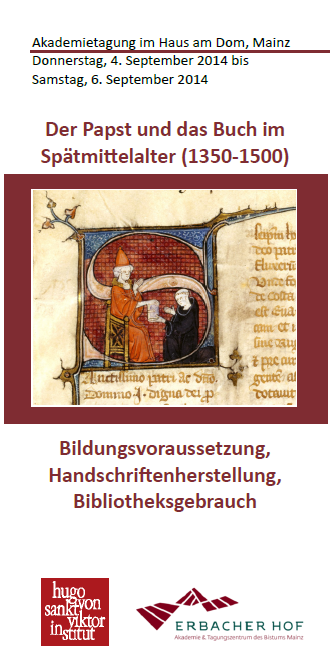
Colloque – Der Papst und das Buch im Spätmittelalter (1350-1500): Bildungsvoraussetzung, Handschriftenherstellung, Bibliotheksgebrauch

Akademietagung im Haus am Dom, Mainz
Donnerstag, 4. September 2014 bis
Samstag, 6. September 2014

Der Papst und das Buch im SpätmittelalterDie rapide Zunahme der Schriftlichkeit im aus-gehenden lateinischen Mittelalter stellt auch im Blick auf das Papsttum dieser Epoche einen zentralen Befund dar, der sich im Anwachsen des Bestandes der päpstlichen Bibliotheken und in der Entwicklung ihrer Ordnungen zeigt. Die Veranstaltung nimmt das Verhältnis von Papst und Buch für diesen Zeitraum unter die Lupe: Mit welchem Verhältnis zur Bildung traten die einzelnen Päpste ihr Amt an? Welche Hand-schriften ließen sie als Päpste abschreiben oder kaufen, was läßt sich sagen über die Hand-schriftenherstellung am päpstlichen Hof, die Illuminatoren, das Bildprogramm, Stil und Her-kunft? Und wie griffen die Päpste auf ihre Bü-cher zu – welche lasen sie, welche nicht, wie organisierten sie die Aufstellung, wie die Nut-zung? Welche Rolle spielten die Bibliothekare? Was weiß man über andere Benutzer dieser großen Bibliothek? Die Bibliothek ist ein, wenn auch nicht der einzige, Spiegel des geistigen Mikrokosmos ihres Besitzers. Auch das Papsttum dieser für diese Institution so schwie-rigen Zeit lässt sich mit Blick auf die Bibliothek besser verstehen.

Sie sind herzlich eingeladen!

Programm : ici

Erbacher Hof
Akademie des Bistums Mainz
Grebenstraße 24-26 · 55116 Mainz
Postfach 1808 · 55008 Mainz
Telefon: 06131/257-523, 550
Fax: 06131/257-525
ebh.akademie@bistum-mainz.de
http://www.ebh-mainz.de

Source de l’information : Bistum Mainz

Publié dans Colloque | Laisser un commentaire

Offre d’emploi – Doctoraatsbeurs Geschiedenis : Macht in een Metropolis. Stedelijke elitevorming in de demografische en commerciële bloeifase van Antwerpen (ca. 1450 – ca. 1550)

Aan het onderzoekscentrum HOST (Historisch Onderzoek naar Stedelijke Transformatie-processen) van het departement Geschiedenis van de Vrije Universiteit Brussel is een voltijdse doctoraatsbeurs (100%) te begeven voor het verrichten van onderzoek rond het thema « Macht in een Metropolis. Stedelijke elitevorming in de demografische en commerciële bloeifase van Antwerpen (ca. 1450 – ca. 1550) »

Situering van het onderzoek:

In de late vijftiende en vroege zestiende eeuw nam de stad Antwerpen de rol over van Brugge als draaischijf voor de handelseconomie van West-Europa. Antwerpen transformeerde daarbij van een middelgrote Brabantse stad tot de onbetwiste metropolis van de Bourgondisch-Habsburgse Nederlanden. In de naoorlogse historiografie is veel aandacht besteed aan de demografische en economische aspecten van de Antwerpse bloei, maar tot op heden is er weinig onderzoek gebeurd naar de politieke elite van de stad, en hoe die omging met de opportuniteiten en uitdagingen die gepaard gingen met het stedelijke expansieproces. Dit project is gericht op een sociale studie van de samenstelling en evolutie van de Antwerpse magistraat tussen ca. 1450 en ca. 1550, waarbij kwantitatieve en kwalitatieve invalshoeken worden gecombineerd. Bijzondere aandachtspunten van dit project zijn onder meer sociale mobiliteit, de interacties en overlappingen tussen de politieke en de commerciële elite van de stad, de huwelijksnetwerken en bezitsstructuren van de leidende politieke geslachten, evenals hun relaties met de Antwerpse ambachtswereld en met de adel van het Brabants-Vlaamse ommeland. De centrale doelstelling is een dieptestudie van de Antwerpse politieke elite die zich leent voor comparatieve analyse met enerzijds de elites van andere Europese “gateway cities” (middeleeuws Brugge, zeventiende-eeuws Amsterdam, achttiende-eeuws Londen enzovoorts) en anderzijds met de elites van de andere steden van de Bourgondisch-Habsburgse Nederlanden.

Dit onderzoeksproject is gefinancierd door het IUAP-project City and Society in the Low Countries (ca. 1200-ca. 1850) – Work package 3: Urban Community Building: Inclusion and Exclusion (Federaal Wetenschapsbeleid België) en de Vrije Universiteit Brussel.

Jouw opdracht:

  • Je bereidt onder begeleiding van promotor Frederik Buylaert (VUB) en een nader te bepalen co-promotor artikels, presentaties en een doctoraatsproefschrift voor in het domein Geschiedenis rond het thema van stedelijke elitevorming in vijftiende- en zestiende-eeuws Antwerpen
  • Je verricht je onderzoek in het kader van een gezamenlijk doctoraat van de Vrije Universiteit Brussel en een nader te bepalen andere Vlaamse universiteit.
  • Je neemt beperkte taken van onderwijs- en onderzoeksondersteuning op binnen het departement Geschiedenis en het Onderzoekscentrum Historisch Onderzoek naar Stedelijke Transformatieprocessen (HOST) aan de Vrije Universiteit Brussel

Functietype: Wetenschappelijk onderzoek

Type contract: Vaste baan

Plaats van tewerkstelling : Brussel

Wij zoeken:

  • Je bent in het bezit van een diploma Master in de Geschiedenis met uitstekende studieresultaten. Studenten die in september 2014 afstuderen, kunnen ook kandideren
  • Je leest vlot Nederlands, Frans en Engels
  • Je koestert een grote belangstelling voor sociale en politieke geschiedenis
  • Je beschikt over een sterk analytisch vermogen, je bent taalvaardig, nauwkeurig, gedisciplineerd en gedreven
  • Je bent zelfstandig ingesteld en je kan zowel individueel als in groep goed functioneren
  • Ervaring met middeleeuws of vroegmodern bronnenonderzoek strekt tot aanbeveling, maar is geen uitsluitingscriterium
  • Je bent leergierig en graag bereid tot bijscholing

Wij bieden:

  • Een voltijds doctoraatsbeurs voor een periode van vier jaar (jaarlijks verlengbaar) met indiensttreding tussen 1 oktober 2014 en 1 januari 2015
  • Een maandelijks beursbedrag van minstens € 1.850 euro
  • Volledige vergoeding voor werkverplaatsingen met het openbaar vervoer
  • Een dynamische en stimulerende onderzoeksomgeving

Inlichtingen:

Solliciteren?

Solliciteer voor 1 september 2014 met een e-mail aan Frederik.Buylaert@vub.ac.be, met de volgende pdf documenten in bijlage:

  • een sollicitatiebrief
  • een volledig curriculum vitae
  • een kopie van je diploma’s
  • een volledig overzicht van de individuele studieresultaten voor alle studiejaren
  • een pdf versie van je Masterthesis

Kandidaten worden rond 4 september 2014 per e-mail op de hoogte gebracht van de uitslag van de eerste selectieronde. De interviews in het kader van de tweede selectieronde zullen plaatsvinden op campus Etterbeek van de Vrije Universiteit Brussel in de week van 8 september 2014.

Meer informatie?

Raadpleeg de “Informatie voor toekomstige werknemers” en “Informatie voor toekomstige doctorandi” via de website van de Vrije Universiteit Brussel (www.vub.ac.be) voor meer informatie omtrent verloning, loopbaan en curriculum:
– http://www.vub.ac.be/infovoor/toekomstigewerknemers/
– http://www.vub.ac.be/phd/

Contacteer Frederik.Buylaert@vub.ac.be met eventuele inhoudelijke of andere praktische vragen rond deze vacature.

Source de l’information : VUB

Publié dans Offre d'emploi | Laisser un commentaire