Appel à contribution – L’art et la guerre. Les jeudis de l’art 2014-2015

Pour la quatrième année consécutive, les Jeudis de l’art, cycle de conférences en histoire de l’art gratuit et ouvert à tous, se dérouleront à l’Institut Catholique de Paris sur toute la durée de l’année universitaire 2014-2015 (entre octobre et avril). Dans le cadre des cursus de licence et de master de la Faculté des Lettres, ces rencontres régulières veulent apporter un complément aux enseignements généraux en abordant des sujets plus spécifiques, et créer un lieu d’échanges interdisciplinaires entre étudiants, enseignants et public extérieur. C’est aussi l’occasion pour les chercheurs de donner un aperçu de leurs travaux tout en initiant les étudiants à la recherche scientifique.

Pour l’année 2014-2015, le thème retenu pour les Jeudis de l’art est « L’art et la guerre ». Dans le cadre des commémorations du 70ème anniversaire du Débarquement de Normandie et du centenaire du début de la Première Guerre mondiale, nous souhaitons aborder la question des relations entre l’art, les artistes et la guerre. De la stèle de Narâm-Sîn, roi d’Akkad, et des reliefs illustrant la victoire de Ramsès II sur les Hittites à Qadesh jusqu’aux œuvres cinématographiques sur la Grande Guerre ou sur des conflits plus récents, en passant par les tableaux d’Antoine-Jean Gros glorifiant Napoléon Ier sur les champs de bataille, par le Guernica de Pablo Picasso ou encore par les photographies de Matthew Brady durant la Guerre de Sécession et plus tard celles de Robert Capa en Espagne, les artistes demeurent, depuis toujours, les principaux témoins des grands conflits, rendant avec force et lucidité ce qu’ils ont vu. Parfois muselés par le pouvoir et la censure, ou contraints de servir la propagande d’un chef triomphant, parfois résistants par leurs productions clandestines ou leur opposition ouverte, ils s’érigent en véritables acteurs de ces temps troublés, proposant aux autres leurs pensées singulières.

L’évolution des représentations de la guerre au fil des siècles, de l’Antiquité à nos jours, ainsi que l’attitude des artistes face aux conflits, ses horreurs et ses différents acteurs, sont les principales problématiques abordées au cours du cycle à venir. Six rencontres mensuelles auront lieu, de 18h30 à 20h, le deuxième jeudi de chaque mois de l’année universitaire (à savoir le 9 octobre 2014, 20 novembre 2014, 11 décembre 2014, 12 février 2015, 12 mars 2015 et 9 avril 2015). Elles permettront à deux ou trois intervenants de se retrouver autour d’une thématique commune que nous déterminerons en fonction des propositions de communication reçues. Le but est de créer une discussion entre les différents intervenants, mais aussi avec le public. D’ailleurs, pour lui permettre de participer plus facilement, nous mettons à sa disposition sur notre site internet http://www.jeudisdelart.com des éléments d’informations qui lui donneront certaines clés de compréhension, et par la suite d’approfondissement, pour aborder de tels sujets.

Conditions de soumission

Toutes propositions de communication, tant de chercheurs confirmés que de jeunes docteurs et doctorants, sont bienvenues. Étant donné le sujet abordé, historiens de l’art, archéologues, conservateurs, mais aussi architectes, artistes (peintres, cinéastes, etc.) ou encore restaurateurs sont les bienvenus dans la mesure où les présentations proposées sont issues de leurs spécialités de recherche et / ou de pratique. N’hésitez pas à nous proposer la communication d’un collègue ou d’une connaissance qui puisse mettre en relief les problématiques que vous aborderez.

Chaque intervention devra durer entre 15 et 20 minutes (en fonction du nombre de participants) et sera suivie d’une discussion avec les auditeurs et les autres acteurs de la séance. Les intervenants devront tenir compte du public, mêlant étudiants de licence et de master, enseignants-chercheurs et auditeurs libres, et adapter leur discours en conséquence.

Toute personne intéressée peut envoyer son projet de communication (CV + synopsis d’une page maximum), par voie électronique, aux adresses suivantes : cecile.coulangeon@orange.fr et pelabathie@yahoo.fr
avant le 31 juillet 2014.

Pour toute question supplémentaire, nous sommes à votre disposition ou vous donnons rendez-vous sur http://www.jeudisdelart.com.

Modalités d’évaluation

Les propositions de conférences seront examinées par les deux organisateurs du cycle de conférences :

  • Cécile Coulangeon (chargée d’enseignement en histoire de l’art médiéval, ICP).
  • Pierre-Emmanuel Perrier de la Bâthie (chargé d’enseignement en histoire de l’art contemporain, ICP).

Outre la qualité scientifique des propositions et des intervenants, nous nous attacherons également à sélectionner des interventions complémentaires au sein de chacune des six séances prévues, afin de créer une dynamique favorable aux échanges.

Source de l’information : Calenda
Publié dans Appel à contributions | Laisser un commentaire

Appel à contribution – Episcopus : Kalamazoo 2015 CFP

Event Date: 14-17 May 2015
Event Location: Western Michigan University (Kalamazoo, MI)
Submission Deadline: 15 September 2014

EPISCOPUS invites the submission of abstracts for its sponsored panels at the 2015 Congress in Kalamazoo, MI. Submitted abstracts should be accompanied by a Participant Information Form (available at http://wmich.edu/medieval/congress/submissions/index.html#Paper)

I. Bishops and their Towns (panel)

This session of the International Medieval Congress on Medieval Studies in 2015 will focus on bishops and secular clergy in their urban environments. Medieval bishops were very active in both their episcopal cities and the other towns in their dioceses. Bishops supported urban monasteries and leper houses, created (and disbanded) communes, built episcopal palaces, oversaw the development of parishes, and managed—with varying success—their cathedral canons. “Episcopus” welcomes paper proposals relating to the policies, activities, and relationships of secular clergy with urban communities, including, but not limited to: municipal governments and other secular authorities; other religious establishments; clerical interaction with and manipulation of urban space, including building campaigns; violence and communal aid, such as poor relief; ritual; and economic matters. Proposals are encouraged regarding all periods of the Middle Ages.

Please submit abstracts and participant forms to Kathy Salzer (kes30@psu.edu) by September 15, 2014.

II. Lateran IV and the English Secular Clergy, co-sponsored with the Pontifical Institute of Mediaeval Studies, Toronto, Ontario, (panel)

Lateran IV, while a famous landmark ecumenical council, could only be as effective as the bishops, archdeacons, and other clergy chose to make it within their jurisdictions. This session, commemorating the 800th anniversary of the Council, also observes the 80th anniversary of Gibbs and Lang’s Bishops and Reform and the 70th anniversary of Moorman’s Church Life in England in the Thirteenth Century by continuing the task of investigating how, and to what extent, papal pronouncements of theology and canon law were manifested in the life of the English church, particularly as represented by bishops and other secular clergy, after the Council. This session will be chaired by Joseph Goering (St. Michael’s College, University of Toronto).

Please submit abstracts and participant forms to William H. Campbell (whc7@pitt.edu), Andrew Reeves (andrew.reeves1@mga.edu) or Michael Burger (mburger1@aum.edu)

The complete CFP for ICMS 2015 is available at http://wmich.edu/medieval/files/call-for-papers-2015.pdf.

Source de l’information : Episcopus

Publié dans Appel à contributions | Laisser un commentaire

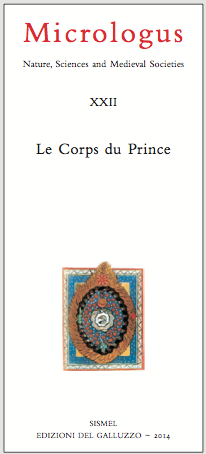
Publication – É. Bousmar, H. Cools, J. Dumont et A. Marchandisse (éd.), « Le corps du prince »

Le corps du prince, éd. É. Bousmar, H. Cools, J. Dumont, A. Marchandisse, Florence, SISMEL-Ed. del Galluzzo, 2014 (Micrologus. Nature, Sciences and Medieval Societies, 22) ; 1 vol., XVI-827 p., ill.

Corps du princeTable des matières :

Éric Bousmar, Hans Cools, Jonathan Dumont, Alain Marchandisse – Introduction

Jean Winand, Le corps du prince. La perception de l’Égypte ancienne
Agostino Paravicini Bagliani, «Le corps du pape», vingt ans après
Jean-Marie Moeglin, Corps de l’Empire et corps de l’Empereur (XI e- XVe siècle)
Malte Prietzel, Le corps des évêques. L’exemple de Wurtzbourg aux XVe et XVIe siècles
Elizabeth A. R. Brown, The French Royal Funeral Ceremony and the King’s Two Bodies. Ernst H. Kantorowicz, Ralph E. Giesey and the Construction of a Paradigm
Murielle Gaude-Ferragu, Le ‘double corps’ de la reine. L’Entrée d’I- sabeau de Bavière à Paris (22 août 1389)
Frédérique Lachaud, Corps du prince, corps de la res publica. Écri- ture métaphorique et construction politique dans le Policraticus de Jean de Salisbury
Chris Woolgar, Queens and Crowns: Philippa of Hainaut, Possessions and the Queen’s Chamber in Mid XIVth-Century England
Michael Penman, Head, Body and Heart. Legitimating Kingship and the Burial of Robert Bruce, Scotland’s ‘Leper King’, CA 1286-1329
Éric Bousmar, Hans Cools, Le corps du prince dans les anciens Pays-Bas, de l’État bourguignon à la Révolte (XIVe-XVIe siècles)
Bertrand Schnerb, Le corps armé du prince. Le duc de Bourgogne en guerre
Antheun Janse, Jacqueline of Bavaria and John of Brabant. The Princely Body as a Political Asset
Jelle Haemers, L’anniversaire Gantois de Marie, duchesse de Bourgo- gne (27 mars 1483). Autour de la participation des sujets urbains à un service commémoratif pour une princesse décédée
Minou Schraven, Contesting Supremacy. Funerals of the Spanish Monarchy in the Church of San Giacomo degli Spagnoli in Rome, 1497-1559
Thalia Brero, Éva Pibiri, Le corps du prince au sein des rituels funé- raires de la Maison de Savoie (XIVe-XVIe siècles)
Christine Shaw, The Person of the Doge of Genoa
Giovanni Ricci, Un corps sacré, un cadavre outragé. Deux princes
d’Este au XVIe siècle
Joana Barreto, Come soavemente dormisse: les funérailles des Aragon de Naples entre légitimation politique et exemplarité chrétienne
Francesca Sivo, Nani e giganti nel Mezzogiorno in età normanna
Miguel Ángel Ladero Quesada, Protéger le corps et façonner les gestes
du roi. Castille et Aragon (XIIIe-XVe siècle)
María Narbona Cárceles, Le corps d’une reine stérile. Marie de
Castille, reine d’Aragon (1416-1456)
Jean-Bernard de Vaivre, Alain Marchandisse, Laurent Vissière, L’agonie, la mort et les funérailles de Pierre d’Aubusson († 1503), grand maître de Rhodes et cardinal
Laurent Hablot, En chair et en signes. Le corps héraldique et emblé- matique du prince au cœur des rituels de cour
Annette Kehnel, Le corps fragile du prince. Dans les rites d’investiture médiévale
Gilles Lecuppre, Déficience du corps et exercice du pouvoir au XIVe siècle
Steven Thiry, How to Steal the King’s Body? Corporeal Identification of Princely Pretenders in the Renaissance
Hans-Joachim Schmidt, Le roi ne meurt pas. Transmissions des concepts politiques aux successeurs par des testaments politiques
Wim Blockmans, Beau, fort et fertile: l’idéal du corps princier

Index des noms de personne et de lieu, par Agostino Paravicini Bagliani
Index des manuscrits, par Agostino Paravicini Bagliani

Publié dans Publications | Laisser un commentaire

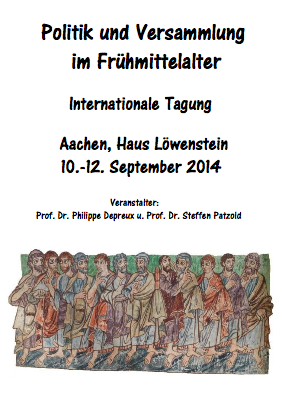
Colloque – Politik und Versammlung im Frühmittelalter

Internationale Tagung in Aachen, 10.-12. September 2014
Veranstalter: Prof. Dr. Philippe Depreux (Hamburg) und Prof. Dr. Steffen Patzold (Tübingen)

Politik und Versammlung im FrühmittelalterVersammlungen haben in vielerlei Hinsicht eine große Rolle im Frühmittelalter gespielt: Es gab nicht nur allgemeine Reichsversammlungen und Konzilien, sondern auch viele kleinere Gerichtsversammlungen bzw. lokale Synoden, die das Leben sowohl der Mitglieder der politischen Elite als auch das der einfachen Leute prägten. Die internationale Tagung „Politik und Versammlung im Frühmittelalter“ (Aachen, 10.-12. September 2014) möchte eine systematische Analyse dieses Phänomens auf unterschiedlichen Ebenen anbieten und somit auch einen Beitrag zur Bedeutung Karls und Aachens leisten, da an diesem Pfalzort viele Versammlungen stattfanden. Versammlungen haben mit Kommunikation zu tun, egal ob es dabei um den lokalen, den dem „Alltag“ zugehörenden Rat oder einen viel feierlicheren Anlass geht. Politische Versammlungen sollen in ihrer Vielfalt sowohl im zeitlichen als auch im regionalen Vergleich unter verschiedenen Gesichtspunkten (im kirchlichen, höfischen und lokalen Kontext) untersucht werden.

Programm der Tagung : ici

Informations pratiques :
Diese Tagung wird durch die Deutsche Forschungsgemeinschaft gefördert und genießt die freundliche Unterstützung der Stadt Aachen.

Anmeldung bis zum 4. 09. 2014 bei
Herrn Matthias Söhn
Universität Hamburg, Historisches Seminar
Von-Melle-Park 6, 20146 Hamburg
matthias.soehn@uni-hamburg.de
+49(0)40 / 42838-2582

Es wird keine Anmeldungsgebühr erhoben.

Source de l’information : Universität Hamburg

Publié dans Colloque | Laisser un commentaire

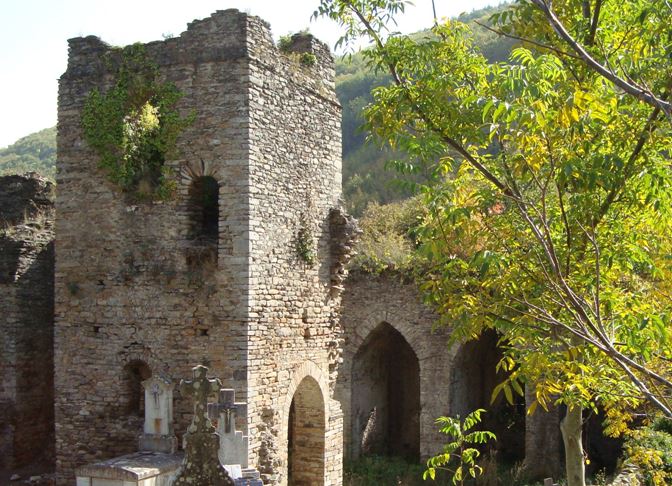
Colloque – Églises médiévales en Europe, à la croisée des regards. Sixième université d’été de Lastours

Université d’été organisée par l’Amicale laïque de Carcassonne sous la présidence de Caroline de Barrau, maître de conférences à l’Université de Perpignan-Viadomitia/CHRiSM.

31 juillet-2 août 2014

Conférences gratuites, mais inscription recommandée (places limitées)
Contact et inscriptions

Amicale Laïque de Carcassonne, 87 rue de Verdun 11000- Carcassonne 04 68 25 24 74 alcarcassonne@free.fr
Accueil des châteaux de Lastours : 04 68 77 56 02- chateaux.lastours@free.fr

saint_pierre_de_valsProgramme :

Jeudi 31 juillet (de 14h à 18h)

14h : Accueil par le maire de Lastours, Max Brail.
Introduction des journées par Caroline de Barrau et Marie-Elise Gardel (CHRiSM, UPVD)

14h15-15h : Caroline de Barrau (Maître de conférences en Histoire de l’Art, Univ. Perpignan-Via Domitia/CHRiSM) – Les églises gothiques du Midi de la France.
15h-15h45 : Marie-Elise Gardel (archéologue et historienne, CHRiSM / ERAAUB) – Les fouilles du prieuré du Saint-Sépulcre et de Saint-Foulc à Cazaban, Palaja (Aude).
15h45-16h :Pause

16h-16h45 : Nùria Molist (conservatrice, Musée d’Archéologie de Catalogne/ERAAUB) – Églises au sommet et églises cachées. Visibilité et territoire à l’époque médiévale à travers Sant Miquel d’Olèrdola et le Penedès (Catalogne).
16h45- 17h30 : Sylvie Sagnes (ethnologue, CNRS-EHESS) – Une église peut en cacher une autre… Rieux minervois dans l’Aude.
17h30-18h : Conclusion de la journée et questions

Vendredi 1er août (de 14h à 18h)

14h-14h45 : Dominique Allios (Maître de conférences en Histoire de l’Art et archéologue, Univ. Rennes 2) – Archéologies d’une église : l’église de Saint-Nectaire (Auvergne).
14h45-15h30 : Francesca Sogliani (Univ. Matera, Italie) – Archéologie des monastères grecs et latins dans l’Italie du sud: la région de la Basilicate au Moyen Age.
15h30-15h45 : Pause

15h45 -16h30 : Christiane Tarbouriech (architecte D.E.S.A., Carcassonne) – Restaurer une église : le point de vue de l’architecte.
16h30-17h15 : Francesca Sogliani, Dimitri Roubis (Univ. Matera) – Jure Vetere. Un projet d’archéologie monastique dans la Calabre du Moyen Age.
17h15- 18h : Barbara Delamarre (Docteur Univ. Rennes 2) – Croiser les regards et dévoiler le sens : la symbolique de l’espace dans les églises romanes de Bretagne.
18h-18h15 : Conclusion des journées et questions.

Samedi 2 août

Excursion “A la découverte des églises méconnues du Cabardès”, commentée par Marie-Elise Gardel

RV à Lastours, accueil des châteaux à 10h. Visite de Saint-Julien-et-Sainte-Basilisse de Villanière, Saint-Pierre-de-Vals (Miraval) et Saint-Sernin-de-Cubserviès.

Source de l’information : Calenda
Publié dans Colloque | Laisser un commentaire

Appel à contribution – Ad Vivum ?

Thursday 20 November and Friday 21 November 2014
The Courtauld Institute of Art, Somerset House, Strand, London WC2R 0RN

The term ad vivum and its cognates al vivo, au vif, nach dem Leben and naer het leven have been applied since the thirteenth century to depictions designated as from, to or after (the) life. This one and a half day event will explore the issues raised by this vocabulary in relation to visual materials produced and used in Europe before 1800, including portraiture, botanical, zoological, medical and topographical images, images of novel and newly discovered phenomena, and likenesses created through direct contact with the object being depicted, such as metal casts of animals.

It is has long been recognised that the designation ad vivum was not restricted to depictions made directly after the living model, and that its function was often to advertise the claim of an image to be a faithful likeness or a bearer of reliable information. Viewed as an assertion of accuracy or truth, ad vivum raises a number of fundamental questions about early modern epistemology – questions about the value and prestige of visual and/or physical contiguity between image and original, about the kinds of information which were thought important and dependably transmissible in material form, and about the roles of the artist in this transmission. The recent interest of historians of early modern art in how value and meaning are produced and reproduced by visual materials which do not conform to the definition of art as unique invention, and of historians of science and of art in the visualisation of knowledge, has placed the questions surrounding ad vivum at the centre of their common concerns.

This event will encourage conversation and interchange between different perspectives involving a wide range of participants working in different disciplines, from postgraduate students to established academics. It seeks to encourage dialogue and debate by devoting a portion of its time to sessions comprising short, 10-minute papers, which will allow a variety of ideas and areas of expertise to be drawn into the discussion.

Topics may include, but are not limited to:

  • The role of images, including book illustrations, described as ad vivum in early modern natural history, geography, cosmography, medicine and other investigative disciplines;
  • The meanings of ad vivum in relation to sacred images, portraiture, landscape depiction, animal imagery, and other types of subject matter involving a claim to life-likeness;
  • The connections between ad vivum and indexical images: death masks; life casts; the moulage; auto-prints made from natural phenomena;
  • The connections between concepts of ad vivum and graphic media: the print matrix; imitation and reproduction in print; drawings, diagrams which claim to be ad vivum;
  • The concept of ad vivum in cabinets of curiosities, sets and series, other groupings and collections;
  • The application of the phrase ad vivum and its cognates to specific images, and usages and discussions of the terminology in early modern texts;
  • The use of ad vivum in relation to images of the marvellous and the incredible, including monsters and other prodigies of nature.

We invite proposals for:

  • 20-minute papers
  • Short, 10-minute (maximum 1,000-word) papers which will address one example or theme, or make one argument persuasively.

Please send proposals of no more than 250 words by 15 August 2014 to joanna.woodall@courtauld.ac.uk and thomas.balfe@courtauld.ac.uk

Organised by Professor Joanna Woodall and Dr Thomas Balfe (The Courtauld Institute of Art).

Source de l’information : GEMS

Publié dans Appel à contributions | Laisser un commentaire

Offre d’emploi – Assistant Curator of Rare Books (University of North Carolina at Chapel Hill)

The University of North Carolina at Chapel Hill is pleased to post this professional position.

The minimum salary for librarian positions in the University Library is $45,000. Salary is commensurate with qualifications and experience.

Position : Assistant Curator of Rare Books (At Will Appointment)
Available : September 1, 2014

The University of North Carolina seeks an energetic and collegial individual with a strong academic background to further the curatorial work of the Rare Book Collection (RBC) (http://www.lib.unc.edu/rbc/) at the Louis Round Wilson Special Collections Library (http://www.lib.unc.edu/wilson/). Reporting to and working closely with the Curator of Rare Books, the Assistant Curator will contribute to maintaining a vibrant profile for the Rare Book Collection.

The Assistant Curator will participate in collection development, including the review of auction and dealer catalogs, sales offers, and potential gifts, as well as donor stewardship. The individual in this position will also work on programming and outreach initiatives, exhibitions, and publications, and manage social media and digitization projects. The Assistant Curator is expected to be active in scholarly and library professional organizations. The Assistant Curator may supervise students and will participate in reader services at the Rare Book Collection/North Carolina Collection Reading Room, with a regular weekly desk shift and occasional weekend desk service.

The Rare Book Collection has significant national and international literary and historical holdings, ranging from clay tablets, medieval manuscripts, and early printed books to recent fine printing. Collection strengths include English and Irish literature, incunabula and sixteenth-century printing, history of the book, French history and literature, the New World cronistas, Maya studies, Spanish, Portuguese, and Catalan drama, World War I and II graphic materials, and American popular culture.

In addition to the Rare Book Collection, the Louis Round Wilson Special Collections Library includes the North Carolina Collection, the Southern Folklife Collection, the Southern Historical Collection, and University Archives and Records Management Services.

Qualifications :
Required: ALA-accredited master’s degree in library or information science and/or an advanced degree in a humanities discipline supported by the holdings of the Rare Book Collection. Knowledge of descriptive bibliography and direct work experience with rare books for at least one year. Excellent oral and written communication skills. Proven attention to detail. Ability to work with a broad spectrum of individuals. Reading knowledge of Latin or at least one of the following modern European languages: French, German, or Spanish. Ability to understand bibliographic information in French, German, and Spanish. Active participation in appropriate professional organizations.

Preferred: Formal coursework in rare books. Additional foreign languages. Knowledge of the antiquarian book trade. Experience in planning and managing exhibitions, lectures, and other public programs. Advanced degree in a humanities discipline. Editorial and publishing experience and experience developing digital products that promote or facilitate the use of rare books and manuscripts and special collections.

The University and The Libraries
The University of North Carolina at Chapel Hill is the country’s oldest state university. UNC Chapel Hill has an enrollment of approximately 29,000 students, employs more than 3,500 members of the faculty, and offers 69 doctoral degrees as well as professional degrees in dentistry, medicine, pharmacy and law. The UNC Health Sciences Library is a recognized leader within the Association of Academic Health Science Libraries. University Library collections include over 6.5 million volumes. The Library is a member of the Association of Research Libraries and the Center for Research Libraries. Together with the libraries at Duke University, North Carolina Central University, and North Carolina State University, the members of the Triangle Research Libraries Network (TRLN) provide services and collections to their students, faculty, and staff in support of the education, research, and service missions of the universities.

The University Library invests proudly in its employees, strives to create a diverse environment of respect and collaboration, and encourages vision and innovation.

The Region
The Triangle region is one of the most desirable places to live and work in North America and offers its residents a wide array of recreational, cultural, and intellectual activities. The mountains or the seashore are less than half day’s drive from Chapel Hill.

The University of North Carolina is an equal opportunity employer and is strongly committed to the diversity of our faculty and staff.

Salary and Benefits
This is an At Will Appointment, contingent upon the availability of funding. Salary is commensurate with qualifications and experience. Standard state benefits of annual leave, sick leave, and State or optional retirement plan.

Deadline for Application
Review of applications will begin on July 21, 2014. Applications will be accepted until the position is filled, but preference will be given to applications received by the begin review date.

To Apply
Please visit http://unc.peopleadmin.com/postings/45698 and complete the online application. Please include a letter of application, a resume and the name, mailing address, email address, and telephone number of three professional references, one of whom must be a current supervisor. Additionally, please indicate in your cover letter where you first learned of this position.

Source de l’information : The Medieval Academy blog

Publié dans Offre d'emploi | Laisser un commentaire

Web – Ultra high resolution images of Jan van Eyck’s Virgin and Child in Australia

The Ince Hall Virgin and Child is a painting in the collection of the National Gallery of Victoria, Melbourne (inv. no. 1275/3). It was acquired from the Weld-Blundell Collection at Ince Hall, Ince Blundell, in Lancashire, England, in 1922. Below are provided links to download high-resolution images of the painting in direct, raking, and ultraviolet light, for study purposes. The images were made in 2013 using a Hassleblad MS200 camera and a Hasselblad 120 mm Macro lens, captured in 4 and 6 shot mode. The copyright of these images remains the property of the National Gallery of Victoria.

Click here to download an image of the Virgin and Child in direct light (464.2 Mb).

Click here to download an image of the Virgin and Child in raking light (113.8 Mb).

Click here to download an image of the Virgin and Child in ultraviolet light (116.3 Mb).

For a comprehensive discussion of the painting and its history, see: Hudson, H., Jan van Eyck: The Ince Hall Virgin and Child and the Scientific Examination of Early Netherlandish Painting, V.D.M. Verlag, Saarbrücken, 2009 (first edition 2008).

Source de l’information : Codart

Publié dans Web | Laisser un commentaire

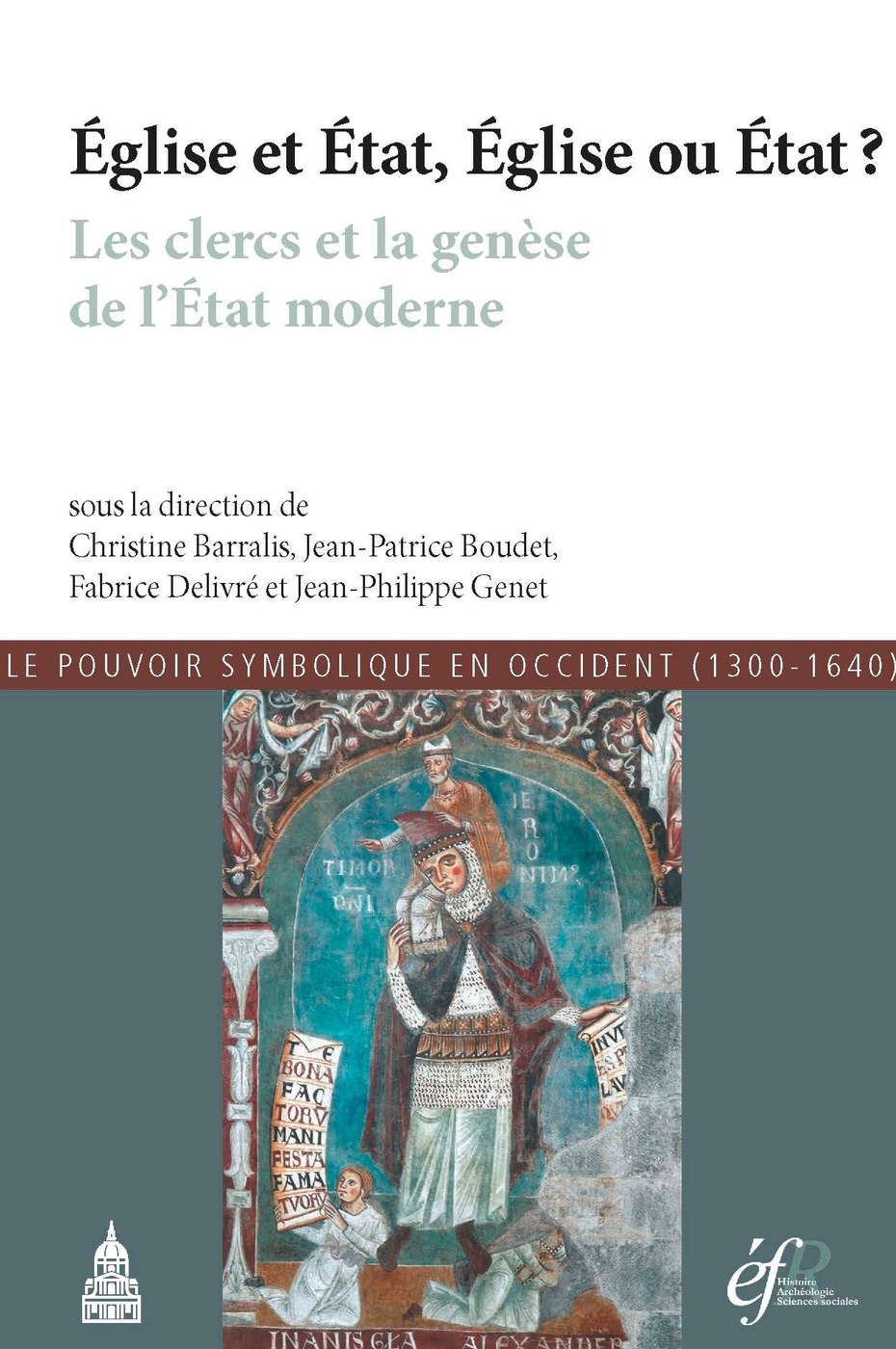
Publication – Christine Barralis, Jean-Patrice Boudet, Fabrice Delivré, Jean-Philippe Genet (éd.), « Église et État, Église ou État ? Les clercs et la genèse de l’État moderne »

Signs and States, programme financé par l’ERC (European Research Council), a pour but d’explorer la sémiologie de l’État du XIIIe siècle au milieu du XVIIe siècle. Textes, performances, images, liturgies, sons et musiques, architectures, structures spatiales, tout ce qui contribue à la communication des sociétés politiques, tout ce qu’exprime l’idéel des individus et leur imaginaire, est ici passé au crible dans trois séries de rencontres dont les actes ont été rassemblés dans une collection, Le pouvoir symbolique en Occident (1300-1640).

Ces volumes, adoptant une perspective pluridisciplinaire et comparative dans une visée de long terme, combinent études de cas, analyses conceptuelles et réflexions plus théoriques. Et les réponses à ce questionnaire, issu d’une réflexion sur une histoire culturelle poursuivie sur plus de cinq siècles, remettent en cause une histoire de l’Occident latin où l’on opposerait Église et État : la mutation culturelle engendrée par la réforme grégorienne qui, tout en assurant d’abord le triomphe de la papauté, a donné à l’État moderne les moyens d’assurer sa propre légitimité en créant les conditions d’une révolution du système de communication. Elle engendre un partage du pouvoir symbolique et des processus de légitimation avec l’État : la capacité de ce dernier à se légitimer par le consentement de la société politique en dehors de la contingence religieuse est une spécificité de l’Occident latin, clé de l’essor des États modernes européens.

28405100759600LTable des matières :

Christine Barralis, Jean-Patrice Boudet, Fabrice Delivré et Jean-Philippe Genet – Avant-propos

Jean-Philippe Genet – Introduction

Partie I : Le clerc dans l’appareil d’État

Virginia Davis – Clerics and the King’s Service in Late Medieval England

Françoise Lainé – Chanoines, officiaux et vicaires généraux entre l’Église et l’État. Le cas de Bordeaux

Charles Vulliez – Pierre de Mornay, évêque d’Orléans (1288-1296). Esquisse de régeste d’un épiscopat partagé entre le service de l’Église et celui de l’État

Bruno Galland – Le rôle de l’Église de Lyon au service du roi de France au XIVe siècle

Véronique Julerot – Les chanoines cathédraux au parlement de Paris. Entre service de l’État et intérêts personnels

Cédric Michon – Les prélats d’État dans la France et l’Angleterre de la Renaissance

Pascal Montaubin – Les chanoines à la fin du Moyen Âge étaient-ils au service de l’État ? En guise d’introduction pour une table ronde

Gergely Kiss – Les chanoines de la fin du Moyen Âge étaient-ils au service de l’État ? La Hongrie : bilan et perspectives

Anne Massoni – Les collégiales royales, ducales et comtales. Des institutions de fonctionnaires ?

Jean-Michel Matz – Formation universitaire et service de l’État dans les milieux canoniaux à la fin du Moyen Âge

Élisabeth Mornet – Quelques remarques sur la participation des chanoines nordiques au service de l’État

Vincent Tabbagh – Les chanoines de la fin du Moyen Âge étaient-ils au service de l’État ?

Hermínia Vasconcelos Vilar – Les clerici regis et le service du roi dans le Portugal des XIIIe et XIVe siècles

Partie II : Entre curie et cour

Armand Jamme – Rois de France et papes d’Avignon. Une relecture des relations entre deux pouvoirs dissemblables

Étienne Anheim – La Curie pontificale d’Avignon, une société de cour ?

Amandine Le Roux – Les collecteurs pontificaux, des curialistes non résidants

Daniel Le Blévec – Sede vacante. Administrer l’évêché à la mort de l’évêque. Viviers, juin 1382

María Narbona Cárceles – La Collégiale de Notre-Dame-la-Majeure de Saragosse et ses rapports avec Benoît XIII

Jacques Verger – Les clercs et la culture de l’enquête entre l’Église et l’État

Pierre Jugie – Les cardinaux avignonnais et la culture de l’enquête. Éléments de réflexion

Partie III : Assemblées et suffrages : du conseil au concile

Philippe Genequand – Des ombres aux chapeaux rouges. Pour une nouvelle histoire des cardinaux à la fin du Moyen Âge

Monique Maillard-Luypaert – Des assemblées capitulaires aux assemblées conciliaires. La contribution du chapitre cathédral de Cambrai à l’unité de l’Église d’Occident (1378-1417)

Sophie Vallery-Radot – Les Français au concile de Constance. Faire entendre sa voix

Émilie Rosenblieh – Délibérer par députations. L’expérience politique du concile de Bâle (1431-1449)

Christine Barralis – Les conciles provinciaux dans le Nord de la France au XVe siècle, à la croisée de la politique royale et de la réforme interne de l’Église

Partie IV : La culture des clercs

Jean-Patrice Boudet – Giovanni da Legnano et la genèse de son interprétation astrologique du Grand Schisme d’Occident

Jean-Baptiste Lebigue – Jean de Berry à l’heure de l’Union. Les Très Riches Heures et la réforme du calendrier à la fin du Grand Schisme

Paola Guerrini – Uso e riuso della profezia nel tardo Medioevo. Il caso dei Vaticinia de summis pontificibus

Michèle Fournié – Les suaires méridionaux du Christ, des reliques « clémentines » ? Éléments d’enquête

Olivier Marin – Fin des temps et sainteté moderne. La Narracio de Milicio par Matthias de Janov († 1394)

Clémence Revest – Aux origines d’une figure majeure de la papauté renaissante. La nomination de l’humaniste Gasparino Barzizza à l’office de secrétaire apostolique, le 13 août 1414

Nicole Lemaitre – Épilogue

Informations pratiques :
Christine Barralis, Jean-Patrice Boudet, Fabrice Delivré, Jean-Philippe Genet (éd.), Église et État, Église ou État ? Les clercs et la genèse de l’État moderne, Paris, Publications de la Sorbonne, 2014 (Histoire ancienne et médiévale). 16 x 24 x 2,3 cm, 650 gr. ISBN : 978-2-85944-786-1. Prix 28,00 €.

Source de l’information : Publications de la Sorbonne

Publié dans Publications | Laisser un commentaire

Appel à contribution – Hanseatic Identities

International and interdisciplinary conference “Hansische Identitäten – Hanseatic Identities” at Alfried Krupp Wissenschaftskolleg Greifswald, 04.03.-07.03. 2015

Organizer: Prof. Dr Gerhard Weilandt, Ernst-Moritz-Arndt-Universität Greifswald, Dr. Kerstin Petermann, Dr. Anja Rasche, Netzwerk Kunst und Kultur der Hansestädte sponsored by Stiftung Alfried Krupp Kolleg Greifswald

Deadline: 08.08.2014

Research concerning the Hanse has so far focused too little on questions of art and culture. In fact the Hanse is a good example for strong cultural interdependences in an economic area that over several centuries ranged from North Norway to Portugal, from London to Novgorod. Still popular today, the Hanse affects the present. The Hanse can be seen as a transnational network based on a network of merchants who at the same time functioned as delegates of cities. The interpretation of the Hanse as a cooperation of long distance merchants raises questions concerning a common awareness, a common culture. Can we even speak of a Hanseatic identity?

We welcome proposals for 30 minutes papers on the following topics:

  • History of science and research concerning the Hanse
  • Which role does the Hanse play in the history of individual regions and nations?
  • Traditions of the Hanse or Hanseatic cities: orientation, values and identities from the Middle Ages until today
  • Architecture in cities of the Hanse
  • Art regions in the area of the Hanse: guilds, mobility of artists, donators
  • Interdependences in the area of the Hanse

Moreover, we also encourage general project presentations and welcome proposals for 10 minutes papers.

The conference is part of the cooperation of „Netzwerk Kunst und Kultur der Hansestädte“ founded by Dr. Kerstin Petermann and Dr. Anja Rasche, and Prof. Dr. Gerhard Weilandt, chair of Art History at Ernst-Moritz-Arndt-Universität Greifswald. Further close partners are Prof. Dr. Cornelius Borck and Prof. Dr. Hans Wißkirchen (Zentrum für Kulturwissenschaftliche Forschung Lübeck – ZKFL) and Prof. Dr. Rolf Hammel-Kiesow (Forschungsstelle für die Geschichte der Hanse und des Ostseeraums am Archiv der Hansestadt Lübeck). The network consists at the moment of about 30 active members from eight countries who represent the disciplines art history, history, archeology, architecture, conservation and restoration.

The „Netzwerk Kunst und Kultur der Hansestädte“ links scholars and institutions from different countries and disciplines, whose field of interest lies in the research of art and culture of the cities and regions of the Hanse. It provides an internet gateway and organizes workshops, conferences and excursions for its members to meet personally. Due to the political situation in the 20th century research concerning the Hanse was mainly influenced by national perspectives. Our aim is to focus more on international interdependences, exchange and common issues in the area of the Hanse.

With the conference at Alfried Krupp Wissenschaftskolleg in Greifswald the network starts – after two workshops in Lübeck in 2013 and 2014 – to expand its activities including also scholars from a wider range of disciplines (such as cultural heritage preservation, philology and literature, musical history, book sciences). Equally important to us is the integration of institutions such as museums, archives and libraries.

Please send a short abstract (no more than 500 words) and a short CV via email by August 8, 2014 to kerstin.petermann@zkfl.uni-luebeck.de or anja.rasche@t-online.de

The conference languages are German and English. Publication of the articles is planned.
If you have any questions about the conference please contact us.

Source de l’information : ArtHist

Publié dans Appel à contributions | Laisser un commentaire