Offre d’emploi – Stellenausschreibung (EDV), E13 TV-L

Die Monumenta Germaniae Historica suchen für ihr Institut in München zum nächstmöglichen Zeitpunkt einen wissenschaftlichen Mitarbeiter/eine wissenschaftliche Mitarbeiterin mit ausgeprägten IT-Kenntnissen. Die Vergütung erfolgt nach E13 TV-L. Die Stelle ist auf zwei Jahre befristet.

Die Monumenta Germaniae Historica (MGH) sind eine außeruniversitäre Forschungseinrichtung für die Geschichte des Mittelalters mit einem Schwerpunkt auf der Edition lateinischer Quellen. Als selbstständige Körperschaft des öffentlichen Rechts stehen sie unter der Rechtsaufsicht des Bayerischen Staatsministeriums für Bildung und Kultus, Wissenschaft und Kunst. Das Institut der MGH ist zentral in München gelegen und befindet sich im Gebäude der Bayerischen Staatsbibliothek. Sämtliche Publikationen der MGH werden in einem digitalen Angebot (http://www.dmgh.de) bereitgestellt.

Die Hauptaufgabe der Stelleninhaberin/des Stelleninhabers wird in der Aufbereitung des Angebots der digitalen MGH für eine breite Nachnutzung der Editionstexte bestehen (Entwurf eines geeigneten TEI-XML-Schemas, Entwicklung von Skripten zur Konvertierung der dMGH-Rohdaten und Einrichtung eines Downloadservers mit komfortabler Nutzersteuerung).

Des weiteren soll auch (insbesondere im Zusammenhang mit den dMGH) an den elektronischen Angeboten der MGH und der Pflege der Webseiten mitgearbeitet werden.

Wir erwarten:

  • abgeschlossene Hochschulausbildung (Geschichtswissenschaft/Philologie oder Informatik/Computerlinguistik mit entsprechendem Interesse an Geisteswissenschaften)
  • gründliche Erfahrungen mit TEI-XML und gängigen XML-Technologien (Xpath, XSLT)
  • sehr gute Kenntnisse mindestens einer Skriptsprache (vorzugsweise Python)
  • Erfahrungen mit der Administration von Webservern (insbesondere in einer Windows-Umgebung)
  • Sicherheit im Umgang mit relationalen Datenbanken

Die MGH fördern aktiv die Gleichstellung von Frauen und Männern. Wegen der räumlichen Gegebenheiten ist die Stelle nur bedingt für Menschen mit Mobilitätseinschränkungen geeignet. Bewerbungen behinderter Menschen werden im Rahmen der Regelungen des SGB IX bei gleicher Eignung vorrangig berücksichtigt.

Ihre Bewerbung mit aussagekräftigen Bewerbungsunterlagen (Lebenslauf, Arbeitszeugnisse, einschlägige Qualifikationsnachweise) richten Sie bitte bis 31. Juli 2014 per E-Mail (zusammengefasst in einer PDF-Datei) an die Institutsdirektorin Prof. Dr. Martina Hartmann <Martina.Hartmann@mgh.de>.

Für Auskünfte steht Clemens Radl <clemens.radl@mgh.de> zur Vefügung.

Source de l’information : Monumenta Germaniae Historica

Publié dans Offre d'emploi | Laisser un commentaire

Appel à contribution – Espace perçu, espace vécu, espace rêvé. L’art d’appréhender l’espace

Au-delà d’une appréhension purement cartésienne, l’espace demeure une réalité sensible d’autant plus complexe qu’elle implique de nombreuses qualités du perçu caractéristiques de la psychologie humaine. L’approche géographique de l’espace est, de longue date, ouverte à des valeurs psychosociologiques intrinsèques, attentive à la manière dont l’espace est physiquement occupé, pratiquement vécu, cognitivement représenté, sensiblement perçu… L’espace est appréhendé en tant que territoire en lien avec les peuples qui l’habitent, eux-mêmes structurés en fonction de liens régissant l’ensemble de leurs rapports au monde, aux autres et aux objets. Mais l’espace ne se réduit pas à une question de spatialité, de société, de culture, de politique, une interrogation propre à la géographie culturelle. Conçu ou vécu, il est appréhendé par bien d’autres disciplines scientifiques.

Eu égard à l’essor des technologies numériques et des systèmes de géolocalisation par satellite, c’est notamment l’organisation et les structures relationnelles relatives à l’espace qui sont reconfigurées en même temps que les capacités perceptives et cognitives de l’homme sont augmentées – en témoignent notamment les élans cartographiques tels que Open Street Map, Google Maps, Mappy. L’espace, toujours objet pluridisciplinaire, se présente en tant qu’entité multiple ; quand espace physique et espace numérique sont constitutifs d’élans réflexifs variés qui tendent à redéfinir l’espace contemporain et aident à redéfinir les frontières entre le réel et l’imaginaire.

Faisant suite à la journée d’étude « Espace perçu, espace vécu, espace rêvé. L’art d’appréhender l’espace », organisée le 25 mars 2014 à l’Université de Valenciennes, les contributions attendues viseront à explorer quelques unes des perspectives évoquées plus haut, en faisant se confronter plusieurs disciplines. Ainsi l’objectif est-il de créer ici un panorama de ce que l’espace recèle de réflexions et théories, de la géographie à la psychologie en passant par l’architecture et les arts, afin de définir ensemble la manière dont la notion d’espace a et continue d’évoluer.

Ce dossier de la revue Hybrides proposera de rassembler des travaux de recherche pouvant s’appuyer sur des études de cas ou des bilans d’expériences pratiques autour des thématiques suivantes :

  • Espace, ville, territoire et représentation
  • Espace, composition, médium et média
  • Espace, peinture, arts plastiques et photographie
  • Espace, scène, cinéma et performance

Pour obtenir les consignes de présentation, les auteurs sont invités à s’adresser à Mei Menassel (menassel.mei@hotmail.fr) et Eulalie Pierquin (eulalie.pierquin@gmail.com).

Calendrier :
Soumission des articles complets : Septembre 2014
Retour des évaluations : Octobre 2014
Article révisé : Novembre 2014
Publication : Décembre 2014

Publié dans Appel à contributions | Laisser un commentaire

Offre d’emploi – Associate Professor of Byzantine Archaeology and Visual Culture

Job: Associate Professor of Byzantine Archaeology and Visual Culture
University of Oxford
Deadline: 12 noon (UK time) on Thursday 31 July 2014

The University of Oxford proposes to appoint an Associate Professor of Byzantine Archaeology and Visual Culture. The post is available from 1 January 2015 or as soon as possible thereafter. The appointee will be a member of the School of Archaeology, the Faculty of Classics and the Faculty of History, and will hold a Special Supernumerary Fellowship at University College. The deadline for applications is 12 noon (UK time) on Thursday 31 July 2014. Interviews will take place in Oxford on Monday 8 September 2014.

The successful candidate will be an outstanding researcher and teacher in Byzantine Archaeology and Visual Culture, broadly defined, with the ability to teach across a broad chronological range, with supervisory competence from ca. 300 – 1500. S/he will be able to teach a broad range of topics covering settlement and burial archaeology, art, images, monuments, architecture, and visual culture. The appointee will attract and teach graduate students in Late Antique and Byzantine Studies and Classical Archaeology and will supervise graduate student theses. S/he will be required to conduct research, give lectures, classes and tutorials, supervise, support and examine students at all levels, and play a part in the administrative work of the University and the College.

The University of Oxford uses the grade of associate professor for most of its senior academic appointments. Associate professors are eligible for consideration through regular recognition of distinction exercises for award of the title of full professor. This promotion in status, which brings an enhanced salary, is dependent on merit and does not normally occur until some years after reappointment to retirement. In exceptional cases, where the candidate has previously established an academic standing at an appropriate level of distinction, the title of full professor may be awarded at the time of appointment.

Further information about the University, the Divisions, the School of Archaeology, the Faculties of Classics and of History, University College, and the terms and conditions of the position, are provided in the ‘essential information for applicants’ below.

Candidates who wish to speak to someone informally about the process of the appointment or any other aspects of the post may contact the Head of the School of Archaeology, Professor Andrew Wilson (email: andrew.wilson@arch.ox.ac.uk), or the Senior Tutor of University College, Dr Anne Knowland (email: anne.knowland@univ.ox.ac.uk).
Queries about the application process should be addressed to Mr David Hyland, Head of Administration and Finance at the Faculty of History (email: administrator@history.ox.ac.uk).
All enquiries will be treated in strict confidence and form no part of the selection decision.

Duties of the post

The Associate Professor will be a member of both the University and the College community. S/he will be part of a lively and intellectually stimulating research community which performs to the highest international levels in research and publications and will have access to the excellent research facilities which Oxford offers. If a member of the Governing Body of University College, s/he will have a role to play as a trustee in the governance of the College. The College is also keen to ‘buy’ one hour of the appointee’s teaching stint.

The appointee will be required to perform the following University duties to the satisfaction of the Boards of the School of Archaeology, the Faculty of Classics and the Faculty of History:
a) to engage in advanced study and research;
b) to give, under the direction of the Boards, no fewer than thirty-six lectures or classes, in each academic year;
c) to co-operate in the administrative work of the Faculty in both term and vacation under the direction of the Boards;
d) to provide, under the direction of the Boards, up to 6 hours per week of tutorial teaching, or equivalent duties.

The main requirements of the post, within the above parameters, are as follows:

Research
1. to engage in advanced research within the field of Byzantine Archaeology and Visual Culture, broadly defined;
2. to disseminate research through publication in books and scholarly journals, participation in international conferences and seminars, and through other media;
3. to develop research projects and seek research funding.

Teaching and supervision
4. to supervise doctoral students, divided between Archaeology, Classics and History;
5. to supervise and teach graduate students on the MSt / MPhil courses in Late Antique and Byzantine Studies and the MSt / MPhil course in Classical Archaeology, through lectures, classes or tutorials as organised by the School and the Faculties;
6. to engage in undergraduate teaching, including supervision of undergraduate dissertations, and archaeology and art special subjects in the Final Honour Schools of Archaeology and Anthropology and of Classical Archaeology and Ancient History (The Late Roman Empire, AD 284-565; Byzantium, AD 500-1100). The appointee would also be able to offer Late Antique and Byzantine teaching for History and History of Art undergraduates.
7. to act as a College adviser to graduate students and provide occasional undergraduate teaching.

Examining
8. to take part in University examining as and when requested to do so;

Administration
9. to participate in the administration of the interdepartmental Late Antique and Byzantine Studies subject group both in term-time and in the vacation;
10. to co-operate in the administrative work of the School of Archaeology, the Faculty of Classics and the Faculty of History, including membership of committees or administrative offices, as and when requested by the Head of School / Chairs of the Faculty Boards; and
11. to participate in the governance of the College if elected to the Governing Body.

The appointee will be supported by a mentor, who will be available to give advice on all aspects of the position (other than those relating exclusively to the College). A separate assessor will also be assigned to the new postholder; the assessor is asked to prepare an interim report to the Boards mid-way through the initial period of office, and a final report upon completion of the period, when the postholder is considered for reappointment to the normal retiring age. These arrangements are intended to support the new postholder in meeting the objective of reappointment.

Person specification

Applications will be judged only against the criteria which are set out below. Applicants should make sure that their application shows very clearly how they believe that their skills and experience meet these criteria.

Oxford is committed to fairness, consistency and transparency in selection decisions. Chairs of selection committees will be aware of the principles of equality of opportunity and fair selection and there will be a member of each gender wherever possible.

The successful candidate will demonstrate the following:
1. hold a doctorate in a relevant field;
2. primary expertise in an area, period, or aspect of Byzantine Archaeology and Visual Culture, broadly defined;
3. a commitment to research of the highest calibre, including the capacity to publish in international journals and with major presses in the field of Byzantine Archaeology and Visual Culture;
4. the ability to teach effectively at undergraduate and graduate levels;
5. experience of supervising research students;
6. excellent command of language skills and significant fieldwork experience, specific to teaching and research in Byzantine Archaeology and Visual Culture;
7. ability and willingness to undertake administrative responsibilities;
8. good communication, interpersonal and organisational skills;
9. evidence of successful research grant applications or the potential to make successful applications.

Working at the University of Oxford

For further information about working at Oxford, please see: http://www.ox.ac.uk/about_the_university/jobs/academic/

How to apply

Applications must be submitted by 12 noon (UK time) on Thursday 31 July 2014. There is no application form. All applications must be made online. If you consider that you meet the selection criteria, click on the Apply Now button on the ‘Job Details’ page and follow the on-screen instructions to register as a user. You will be required to complete a number of screens with your application details. You are also required to upload:

1. A covering letter or statement explaining how you meet the selection criteria set out above. You must include your full contact details including an email address, full postal addresses, and a telephone number.
2. A full CV and publications list.
3. Names and contact details (email and postal addresses and telephone numbers) of three referees.

Your covering letter should explain your relevant experience which may have been gained in employment, education, or you may have taken time away from these activities in order to raise a family, care for a dependant, or travel for example. Your application will be judged solely on the basis of how you demonstrate that that you meet the selection criteria outlined above and we are happy to consider evidence of transferable skills or experience which you may have gained outside the context of paid employment or education.

You should supply each of your referees with a copy of these further particulars and ask them to write directly to board.admin@history.ox.ac.uk without further prompting by the same closing date. References may be sent by email only and need not be signed, provided they are sent from the referee’s official email address (and please ask the referee to quote the vacancy reference number 113848 in the subject line of their email). The selection committee wishes to take this opportunity to thank in advance those referees who write on behalf of applicants.

You should also send one article-length piece of your recent published or unpublished work as an email attachment to board.admin@history.ox.ac.uk without further prompting by the same closing date, again quoting the vacancy reference number 113848 in the subject line of their email. If you send a book or thesis chapter, please include the contents page so the selection committee can see where the submission fits into the larger work.

Should you experience any difficulties using the online application system, please email recruitment.support@admin.ox.ac.uk. To return to the online application at any stage, please click on the following link http://www.recruit.ox.ac.uk. Please note that you will be notified of the progress of your application by automatic e-mails from our e-recruitment system. Please check your spam/junk mail regularly to ensure that you receive all emails.

Interviews will be held in Oxford on Monday 8 September 2014. It is expected that all shortlisted candidates will be interviewed on the same day, and the interview process will include a presentation to the selection committee and students. All reasonable travel expenses will be reimbursed, and accommodation will be arranged if necessary.

Applications for this post will be considered by a selection committee containing representatives from the School of Archaeology, the Faculties of Classics and History, and University College. The selection committee is responsible for conducting all aspects of the recruitment and selection process; it does not, however, have the authority to make the final decision as to who should be appointed. The final decision will be made by the Humanities Divisional Board, the Social Sciences Divisional Board and the governing body of University College on the basis of a recommendation made by the selection committee. No offer of appointment will be valid, therefore, until and unless the recommendation has been approved by both the divisional boards and the governing body, and a formal contractual offer has been made.

Source de l’information : Medieval Art research

Publié dans Offre d'emploi | Laisser un commentaire

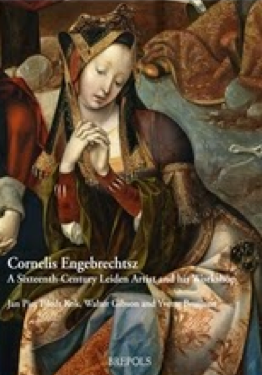
Publication – « Cornelis Engebrechtsz (c. 1460-1527). A Sixteenth-Century Leiden Artist and his Workshop »

Cornelis Engebrechtsz (c. 1460/62-1527) was the first major Leiden painter to whom works can be attributed with certainty. They include a Lamentation Triptych from c. 1508 and a Crucifixion Triptych that was probably executed a decade later, both of which were made for the Mariënpoel Convent near Leiden and are now in Museum De Lakenhal in Leiden. These monumental triptychs display the influence of the dynamic style and palette of the Antwerp Mannerists, including splendid gold brocades. On the basis of the documented works by Engebrechtsz, no more than a dozen paintings and some fragments can be attributed to him personally, but many more can be connected to his workshop, which specialized in devotional works. Engebrechtsz’s pupils included his three sons Pieter (c. 1490-1560/61), Cornelis (c. 1493-1546) and Lucas (c. 1495-before July 1552). Although they must have played an important role in the workshop, it has so far proved difficult to associate specific paintings with them.

Cornelis - BrepolsTaking Walter Gibson’s 1977 dissertation on Engebrechtsz and his workshop as its point of departure, the present volume also draws upon the subsequent technical investigation of many of the paintings. The spectacular underdrawings revealed with infrared reflectography has given better insight into the working methods of the artist and his workshop. Moreover, the study of the gold-brocaded velvets by Esther van Duijn clarifies his use of a variety of patterns, while Peter Klein’s dendrochronological examination of the panels helps determine a chronology of the oeuvre. All this makes it possible to characterize more clearly Engebrechtsz’s stylistic development, his workshop production and the different hands involved. The new findings are presented in different chapters, which are complemented by a complete catalogue of the paintings and drawings by Engebrechtsz and his workshop.

In addition, a complete survey of the monogrammed and/or dated drawings by Pieter Cornelisz, Engebrechtsz’s eldest son, is presented here for the first time, providing a firmer basis for the attribution of some paintings to him. Finally, the present volume is enhanced by documented biographies of Cornelis Engebrechtsz and his sons Pieter, Cornelis and Lucas. The known archival documents are complemented by an abundance of unpublished documents, richly enhancing our knowledge of the lives, careers and personalities of this family of artists.

Jan Piet Filedt Kok (1943) studied art history at the University of Amsterdam. His publications cover early Netherlandish and seventeenth-century Dutch paintings and drawings, as well as fifteenth to twentieth-century printmaking, collecting history and restoration issues.

Walter S. Gibson (1932) is Andrew W. Mellon Professor of the Humanities Emeritus at Case Western Reserve University in Cleveland. He has published extensively on the late medieval and early Renaissance art of the Low Countries.

Yvette Bruijnen (1967) received her doctorate at the Free University Amsterdam. Her articles and lectures are mainly on early Netherlandish and Dutch seventeenth-century painters.

Informations pratiques :
J. P. Filedt-Kok, W. Gibson, Cornelis Engebrechtsz (c. 1460-1527). A Sixteenth-Century Leiden Artist and his Workshop, Turnhout, Brepols, 2014. IV+316 p., 210 x 297 mm. ISBN: 978-2-503-54223-2. Prix : 135 euros.

Source de l’information : Brepols

Publié dans Publications | Laisser un commentaire

Appel à contribution – The afterlife of Cicero

The Warburg Institute, the Institute of Classical Studies and the Department of Greek and Latin at University College London will be hosting an international conference on the afterlife of Cicero in London on 7–8 May 2015, organised by Peter Mack, Gesine Manuwald, John North and Maria Wyke.

a3e22bc8d8

We invite 40-minute papers about the impact of Cicero’s writings and personality on intellectual and cultural history, on the visual arts, philosophy, politics, rhetoric and literature. Since so much of Cicero’s writings is extant, they cover a wide variety of genres and topics, and we are also able to get a glimpse of his personality from his letters, Cicero has had an enormous influence on western culture. By examining a diverse series of significant case studies, the conference aims to make a contribution to assessing Cicero’s impact more fully. Papers dealing with any period between late antiquity and 1900 will be especially welcome. Aspects of particular interest include Cicero’s role for early Christian writers, in the middle Ages, in the Ciceronian debate, for the American founding fathers and the French revolution, for the development of modern democracies and political rhetoric and in (early-)modern literature.

The conference will take place in the Warburg Institute; the proceedings will be jointly published by the two Institutes as Supplements to the Bulletin of the Institute of Classical Studies. We shall ask the authors for publishable versions of the papers three months after the conference.

If you have a suggestion for a paper that you would like us to consider, please submit a title, an abstract (of up to 300 words) and a brief CV (up to one page) by 11 July 2014 to Jane Ferguson, The Warburg Institute, Woburn Square, London WC1H 0AB or warburg(at)sas.ac.uk.

Source de l’information : The Warburg Institute

Publié dans Le réseau | Laisser un commentaire

Publication – Marjolaine Lemeillat (éd.), « Actes de Jean 1er, duc de Bretagne (1237-1286) »

Jean Ier (1237-1286), dit « Jean le Roux », est le duc dont le règne sur la Bretagne médiévale est le plus long. Fils de Pierre de Dreux et d’Alix de Thouars, il a laissé le souvenir d’un règne relativement calme. En vassal fidèle au roi de France, il s’abstient de tout conflit avec son seigneur, qu’il sert à l’occasion, tout en veillant à ce que cela ne constitue pas pour lui un fardeau. Cependant, l’autre facette du personnage est celle d’un duc redoutablement efficace dès lors qu’il s’agit d’imposer l’autorité ducale aux seigneurs bretons ou d’agrandir le domaine ducal aux dépens de ses vassaux, ainsi qu’Henri d’Avaugour, Hervé de Léon, Jeanne de la Roche-Derrien ou Alain de Lanvaux en ont fait l’expérience. Les armes ducales sont la ruse, la mauvaise foi, l’absence de tout scrupule, la chicane procédurale. Tous les moyens sont bons afin d’épuiser l’adversaire et de le réduire à merci.

Aucune étude ne porte spécifiquement sur ce personnage et aucun travail de recherches systématique de ses actes n’avait jamais été entrepris. Cet ouvrage, qui constitue la publication d’un mémoire universitaire de Master 2, comprend la transcription, l’édition et, pour ceux en latin, la traduction des actes émis par le duc Jean, ou le concernant de près. Le but est de mettre à disposition des chercheurs les outils nécessaires à la connaissance et à la compréhension du pouvoir ducal sous ce règne longtemps laissé de côté.

1401178160Table des matières :
Remerciements
Préface
Abréviations

Introduction
Un règne long et fructueux
Un vassal irréprochable
Un duc «retors»

Les actes
Les sources
Les originaux
Les sceaux
Remarques d’ordre diplomatique
Le contenu des actes
Les usages de la chancellerie de Bretagne sous Jean Ier

Les conventions éditoriales
Itinéraire
Les actes

Annexe
Glossaire
Sources et bibliographie
Index des noms de lieux et de personnes

Informations pratiques :
Marjolaine Lemeillat (éd.), Actes de Jean 1er, duc de Bretagne (1237-1286), Rennes, Presses Universitaires de Rennes, 2014 (Sources médiévales de l’histoire de Bretagne). 22 x 28 cm, 390 p. ISBN : 978-2-7535-3254-0. Prix : 21,00 €.

Source de l’information : Presses Universitaires de Rennes

Publié dans Publications | Laisser un commentaire

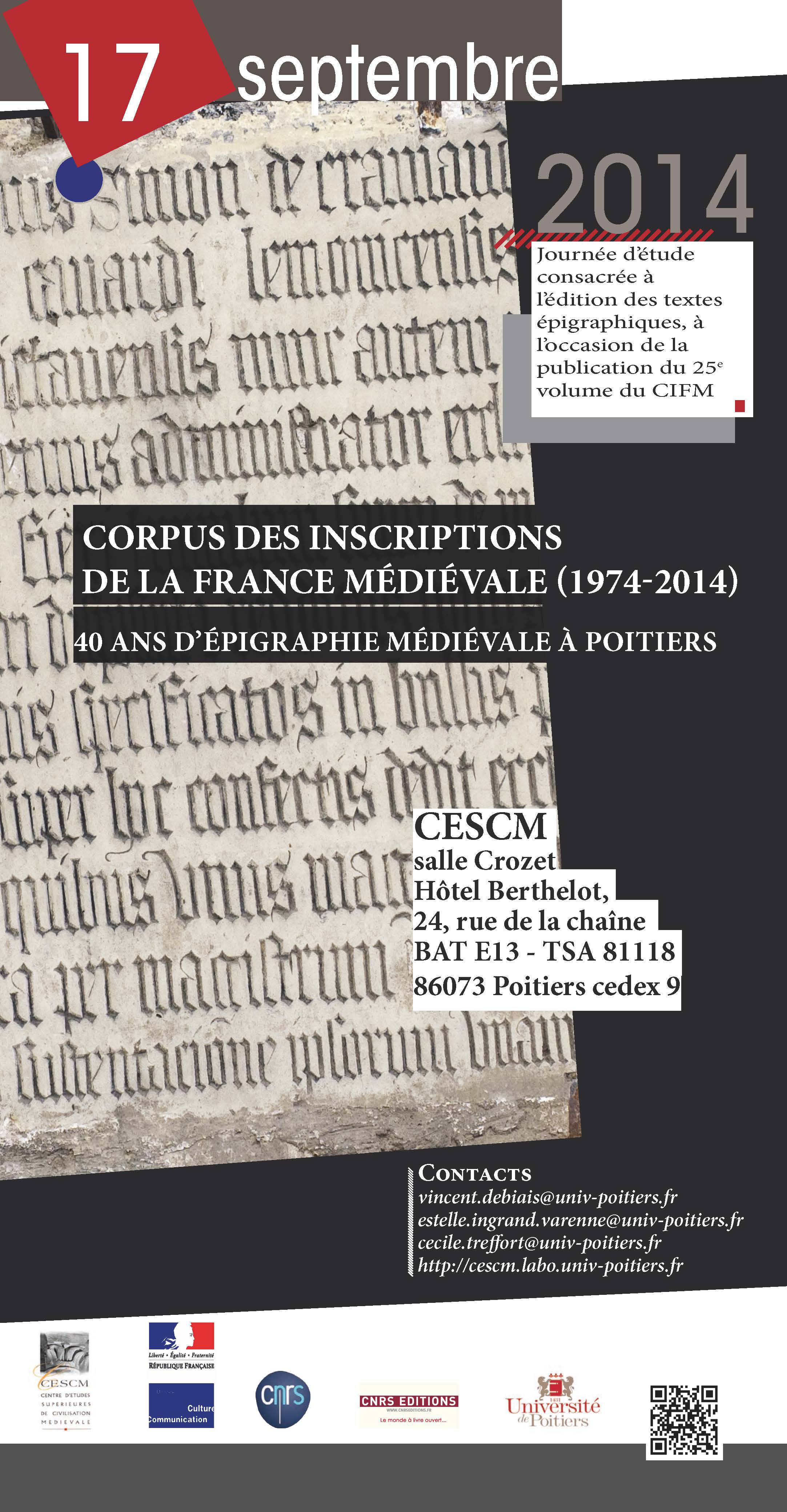
Journée d’étude – Corpus des inscriptions de la France médiévale (1974-2014) : 40 ans d’épigraphie médiévale à Poitiers

En présence des acteurs poitevins de l’édition des inscriptions et de chercheurs français et étrangers associés depuis plusieurs années ou pour l’occasion aux réflexions du Corpus des inscriptions de la France médiévale, cet anniversaire sera l’occasion d’un bilan de 40 ans de recherche en épigraphie du Moyen Âge, et de la publication de 25 volumes. Les communications proposeront à la fois un retour sur les évolutions qui ont animé la publication des textes épigraphiques du Moyen Âge (en lien avec l’évolution générale de la discipline d’un côté, de l’ecdotique de l’autre), et une ouverture vers de nouveaux horizons, technologiques (avec l’édition électronique des textes et la reconnaissance des caractères incisés), culturelles (épigraphie antique ou byzantine) ou encore professionnels (édition scientifique, muséographie). L’ampleur internationale de cette journée permettra de partager des expériences différentes et d’identifier éventuellement une singularité française, avec l’objectif d’améliorer encore les techniques de publication au moment où le Corpus des inscriptions de la France médiévale connaît de nouveaux défis éditoriaux (langues vernaculaires, inscriptions en minuscules, peinture sur chevalet ou tables…).

PROG_CESCMmai2014V3-1lightProgramme :

9h30 – Accueil

Présidence de séance de la matinée : Cécile Treffort (Directrice du CESCM-Université de Poitiers)

10h – Robert Favreau (directeur honoraire du CESCM et fondateur du CIFM) – Les débuts du CIFM
11h – Estelle Ingrand-Varenne (CNRS/CESCM) – Les perspectives du Corpus et les enjeux de l’édition électronique
11h45 – Carlo Tedeschi (Université de Chieti) et Elisa Pallottini (post-doctorante, Université La Sapienza Rome) – Le iscrizioni medievali d’Italia. Risultati, problemi, prospettive

Présidence de séance de l’après-midi : Estelle Ingrand-Varenne

14h30 – Andreas Rhoby (Académie de Vienne) – An envious gaze to the West. Byzantium’s contribution to medieval epigraphy
15h30 – Kristin Tanton (post-doctorante, Université de Californie Los Angeles) – Corpus of Inscribed Capitals in Romanesque France (ca. 1080—1160). Digital Research Possibilities
16h45 – Nicolas Tran (Université de Poitiers) – L’épigraphie latine d’époque romaine : un état des lieux des données en ligne

17h45 – Cécile Treffort – Conclusions

Informations pratiques :
Mercredi 17 septembre 2014
Journée d’étude consacrée à l’édition des textes épigraphiques, à l’occasion de la publication du 25e volume du CIFM

Lieu : Centre d’études supérieures de civilisation médiévale – Salle Crozet
Hôtel Berthelot
24 rue de la Chaîne
POITIERS

Contacts :
Estelle.ingrand.varenne@univ‐poitiers.fr
Vincent.debiais@univ‐poitiers.fr
Cecile.treffort@univ‐poitiers.fr

Source de l’information : Carnets du CESCM

Publié dans Colloque | Laisser un commentaire

Offre d’emploi – Assistant Keeper : Department of Manuscripts and Printed Books (University of Cambridge)

Assistant Keeper – Department of Manuscripts and Printed Books (Fixed Term)
University of Cambridge, The Fitzwilliam Museum
Deadline: 8 July 2014
Interview date: 21 July 2014

The Fitzwilliam Museum is the principal museum of the University of Cambridge. It houses internationally important collections organised in five curatorial departments and provides education and information services for a variety of audiences. All of its collections were designated in 1997 as being of outstanding national and international importance. With upwards of 160,000 illuminated manuscripts, rare books, manuscript and printed music, literary autographs and archives, the Department of Manuscripts and Printed Books is acknowledged as one of the finest and most significant museum collections of its kind in the world.

This three-year role offers an exciting opportunity for an inspirational pro-active professional to enhance the Museum’s standing within the fields of music or literary studies nationally and internationally. They will have academic expertise in at least one of the following disciplines: Musicology, Book History, History of Art, History or Literature, all European, including English, 15th- 20th century. Relevant experience with comparable collections in a curatorial, research or management capacity is also required. Excellent IT, organisational and communication skills are expected.

The successful candidate will act as the deputy to the Keeper, Manuscripts and Printed Books, in the overall care of the collections, the administration and management of the Department, and all curatorial and collections-related duties. The main responsibilities will include research, teaching publications; provision of information on and access to the collections; organisation of displays, specialist group visits and public talks; management or supervision of researchers, interns and volunteers; preparation of documents, funding applications and reports.

Further details on how to apply are to be found on the university website.

Source de l’information : Medieval Art Research

Publié dans Offre d'emploi | Laisser un commentaire

École d’été – The Age of van Eyck in Context Summer Course for the Study of the Arts in Flanders

The aim of the summer course is to bring to Flanders, annually, a select group of 18 national and international, highly qualified young researchers. They will be presented with an intensive 10-day program of lectures, discussions, and visits related to the specific course theme within Flemish art. This theme will vary annually and will focus each year on a different art-historical period.

Flemish primitivesThe aim is to provide the participants with a clear insight into the Flemish art collections from the period at hand, as well as into the available and most suited research methods, the state of the research and the research needs. We expect active participation from the participants, and therefore the discussion following each lecture will form an essential part of the program.

The first edition of the summer course titled The age of van Eyck in context will take place from June 21 through July 1 2015. Its content is coordinated by the Groeninge Museum and the Flemish Research Centre for the arts in the Burgundian Netherlands. The program will take place in Bruges, Ghent and Brussels. The language of the summer course will be English.

Participants have a master’s degree or are PhD-student. Participants are specialised in 15th century art form the Burgundian Netherlands.

Apply now through October 20 2014. Mail your CV and motivation to: summer.course@brugge.be

Find us on Facebook

The project has been submitted for subsidies. Therefore, the exact participation fee will be announced by July 15, 2014. We apologise for the inconvenience.

The Summer course for the study of the arts in Flanders is a joint initiative of the Flemish Art Collection, the Royal Museum of Fine Arts Antwerp, the Groeninge Museum Bruges, the University of Ghent, the Catholic University of Louvain, the Rubenianum and the Flemish Research Centre for the Arts in the Burgundian Netherlands.

Source de l’information : Flemish Primitives

Publié dans École d'été | Laisser un commentaire

Prix – Prix du mémoire de l’Institut du Patrimoine wallon (IPW)

Chaque année, plusieurs mémoires d’étudiants architectes, ingénieurs-architectes, architectes du paysage, historiens de l’art, archéologues ou étudiants du master complémentaire en conservation-restauration du patrimoine culturel immobilier sont consacrés à des sujets liés à la sauvegarde du patrimoine culturel immobilier. Toutes ces recherches constituent un véritable potentiel malheureusement souvent inexploité.

Pour sa 6e édition, ce prix sera à nouveau décerné, en 2015, par l’Institut du Patrimoine wallon.

ipw

Le prix du mémoire porte sur un mémoire relatif à la sauvegarde du patrimoine culturel immobilier en Wallonie ou à Bruxelles, qu’il s’agisse d’une étude préalable à la restauration d’un monument, d’une étude spécifique d’analyse préalable appliquée à un monument, d’une étude historique et/ou technique d’un monument, d’une typologie architecturale, d’une technique ancienne (telle que notamment le stuc, le décor peint, la dorure, le vitrail, la serrurerie…), d’une analyse des potentialités de réaffectation d’un monument, d’une étude monographique de l’œuvre d’un architecte, d’un paysagiste, d’un artiste ou d’un homme de métier…

Le prix, d’un montant de 1.500€, s’adresse aux titulaires d’un diplôme d’historien de l’art et archéologue, architecte, architecte du paysage, ingénieur-architecte ou du master complémentaire en conservation-restauration du patrimoine culturel immobilier.

Dans le cadre de sa mission de valorisation du patrimoine, l’IPW s’est laissé la possibilité de publier les mémoires récompensés, in extenso ou partiellement, dans l’une ou l’autre de ses collections. Ces publications, mais aussi les mémoires non récompensés, viendront – en accord avec leurs auteurs – également enrichir le Centre d’Information et de Documentation du Centre des métiers du patrimoine « la Paix-Dieu ».

En pratique : seuls les titulaires d’un diplôme délivré en 2013 et 2014 et dont les mémoires répondent aux critères précités sont concernés.

Pour tous renseignements complémentaires, contactez Céline Bulté (tél. 085/410.377 ou c.bulte@idpw.be).

Calendrier :

  • dépôt des dossiers de candidatures : avant le 31 octobre 2014
  • réunion du jury : 16 juin 2015
  • remise du prix : 2 octobre 2015

Formulaire de candidature : ici
Règlement : ici

Source de l’information : Institut du Patrimoine wallon

Publié dans Prix | Laisser un commentaire