
Universidad Rey Juan Carlos, Campus de Madrid – Quintana Organized by Project Thesauri Rituum : https://eventos.urjc.es/go/instrumentaaltaris
In the Middle Ages, Christian liturgy was far more than a sequence of prayers and ceremonies: it structured religious practice, shaped sacred space, and gave material form to the expression of faith. Objects, vestments, and books played a central role in this framework, endowed with a visual, tactile, and symbolic language that embodied the theology of the sacred. The International Conference Instrumenta altaris: Ritual Artefacts and Their Images for Medieval Liturgy seeks to refocus attention on the material dimension that, throughout the medieval centuries, rendered the invisible visible and preserved —often in fragmentary form— a tangible legacy of devotion.
For several decades, medieval art historiography has moved towards a reassessment of what was once pejoratively labelled as “minor arts”, no longer regarded as decorative appendices to the dominant monumental tradition, but as essential components for understanding the spaces, gestures, and imagery that shaped Christian liturgy. This shift owes much to the work of scholars such as Colum Hourihane, Eric Palazzo, Cécile Voyer, Klaus Gereon Beuckers, and Elisabeth Crouzet-Pavan, who have drawn attention to the luxurious, performative, and sensory dimensions of medieval liturgical art.
Organised by the research project Thesauri Rituum at Rey Juan Carlos University (Madrid), this conference focuses on three main categories of liturgical artefacts: ritual objects —sacred vessels, reliquaries, crosses, censers— whose craftsmanship reveals a theology of materials; sacred vestments, textiles that not only clothed liturgical ministers but transformed them into figures of transcendence endowed with graces bestowed through ordination; and liturgical books, often illuminated manuscripts, which contained not merely the order of prayer but a spiritual choreography of Christian time. These elements were not autonomous but interdependent, belonging to a practice in which art was not simply contemplated, but activated and handled within liturgical performance —something difficult to reconstruct solely from written sources.
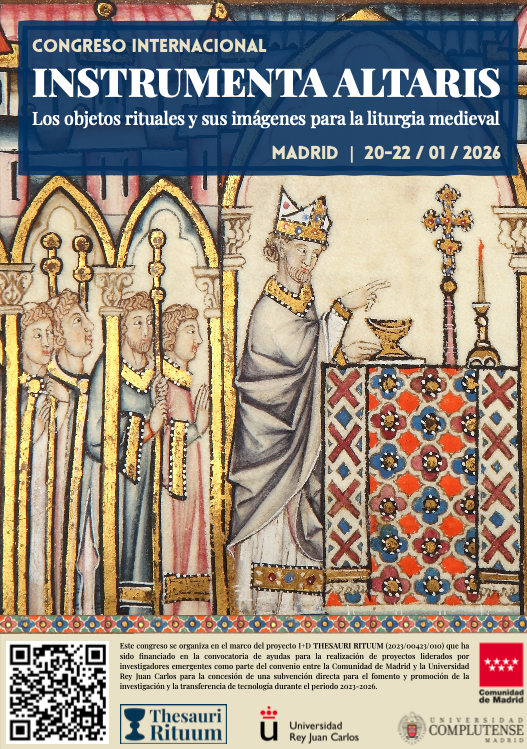
The International Conference Instrumenta altaris: Ritual Artefacts and Their Images for Medieval Liturgy is therefore also an invitation to reconsider the status of medieval art through the vitality of liturgical practice. It calls for a dialogue between form and function, between aesthetics and rituality, between the history of images and the presence of objects. This approach reflects a historiographical sensibility that no longer accepts the nineteenth-century hierarchy between the “major arts” and objects of worship, but instead pays renewed attention to those voices excluded from traditional academic classifications. For in the Middle Ages, the sacred was not confined to grandeur; it was equally revealed in the refinement of the minute and in the quiet eloquence of material signs that accompanied each rite, gesture, and ceremony.
Preferred Thematic Lines
The International Congress ‘Instrumenta altaris’: Ritual Objects and Their Images for Medieval Liturgy accepts proposals for on-site presentations in Spanish, English, Italian, or French that may be framed within the following lines:
1. Historiography and Theory of Medieval Sumptuary and Liturgical Arts
Proposals consisting of historiographical approaches to the study of sumptuary arts, with special attention to their revaluation within medieval art history. Also included will be studies addressing Christian liturgy as an aesthetic, performative, and spatial category, from interdisciplinary methodological perspectives (art history, theology, anthropology, musicology, philology, or cultural history, among others).
2. Materiality and Agency of Liturgical Objects
Presentations addressing questions centered on the matter, technique, use, and circulation of ritual objects: sacred vessels, ritual artifacts, vestments, and liturgical manuscripts. Both case studies and comparative approaches to ecclesiastical treasuries, relics, or sacred textiles will be considered, paying attention to their symbolic construction, cultic functionality, and artistic value.
3. Image of Objects and Objects in Images
Studies addressing the visual representation of liturgical objects in manuscripts, wall paintings, sculpture, or any figurative medium, as well as research on how these artifacts were visualized, interpreted, and re-signified in artistic productions from later periods, from the Early Modern era to the present.
4. Anthropology of Sacred ObjectsAnalyses focused on the social, symbolic, and ritual contexts of creation, use, and transformation of liturgical objects. Special consideration will be given to studies addressing processes such as copying, dismemberment, transfer, donation, inheritance, reuse, or re-signification of these pieces in scenarios different from those for which they were originally conceived.
5. Current Presence and Musealization of Medieval Liturgical Art
Presentations addressing the place and treatment of medieval liturgical objects in current museums, collections, and heritage institutions. Included are both innovative curatorial proposals and the ethical, hermeneutic, and pedagogical dilemmas posed by exhibiting decontextualized ritual artifacts, now detached from their original cultic function.
Abstract Submission for Evaluation
Researchers interested in participating with an on-site oral presentation (Madrid) at the International Congress ‘Instrumenta altaris’: Ritual Objects and Their Images for Medieval Liturgy should submit their presentation abstract through this digital application before October 1, 2025. Any queries will be addressed at the email proyecto.thesaurirituum@urjc.es.
Travel Grants for Master’s and Doctoral Students
To encourage young researchers’ participation, the congress organizing committee will award four grants to cover national or European travel expenses to the best presentation proposals submitted by master’s or doctoral students. These grants will only cover travel expenses to the congress city (Madrid), excluding accommodation, meals, or local transportation. They will be awarded based on criteria of academic quality, originality, and relevance among applicants.
Requirements to apply for the grant:
• Being enrolled in a master’s or doctoral program at the time of proposal submission.
• Explicitly indicate in the submission form the intention to apply for the travel grant.
• Traveling from within Spain or Europe.
Key Dates Summary
• Deadline for presentation proposal submissions: October 1, 2025
• Notification of acceptance: November 1, 2025
• Early registration deadline: November 15, 2025 *
• Congress dates: January 20-22, 2026
* At least one author per presentation must register for the congress under the appropriate category.
Only properly registered participants will receive congress certifications and documentation.





 L'Agenda des Médiévistes
Vous devez être connecté pour poster un commentaire.