Conférence – Alison Stones, « L’Estoire del saint Graal confectionnée pour Jean-Louis de Savoie et ses sources »

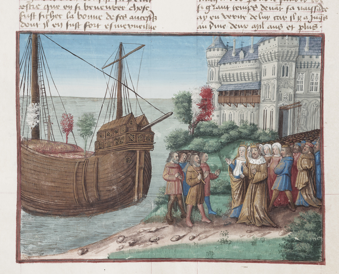
Le lundi 2 juin 2014, le Centre International de Codicologie organisera une conférence intitulée : L’Estoire del saint Graal confectionnée pour Jean-Louis de Savoie et ses sources. Cette conférence sera présentée par Alison Stones, Professeur émérite de l’Université de Pittsburgh, où elle a été professeur d’Histoire de l’Art et d’Architecture entre 1984 et 2012. Diplômée de l’Universiy of London, Alison Stones s’est spécialisée dans l’étude des enluminures des manuscrits médiévaux avec un intérêt particulier pour les illustrations des textes vernaculaires en français.
 
 
Illustration : Bruxelles, KBR, ms. 9246, f. 98v
Informations pratiques :
Lundi 2 juin 2014
à 13 h 30 
Bibliothèque Royale de Belgique – Koninklijke Bibliotheek van België
4, Bd de l’Empereur – 1000 Bruxelles – Salle du Conseil (niveau + 2)
Entrée libre
Publié dans Colloque | Laisser un commentaire

Offre d’emploi – 2 Ph.D. scholarships (Graduate School Scholarship Programme of the Deutscher Akademischer Austauschdienst – DAAD)

The Graduate School of the “Centre for the Study of Manuscript Cultures” (CSMC) / Integriertes Graduiertenkolleg im Sonderforschungsbereich 950 “Manuskriptkulturen in Asien, Afrika und Europa” at the University of Hamburg invites applications for 
 
2 Ph.D. scholarships (Graduate School Scholarship Programme of the Deutscher Akademischer Austauschdienst – DAAD) 
 
The scholarships which are directly awarded to Ph.D. students by DAAD (starting April 1st 2015) will include the following benefits and payments: 
  • scholarship aid granted by DAAD for a period of up to three years, or even of up to four years in case of Ph.D. students from developing or threshold countries (the grant will initially be awarded for one year; an extension of the grant period will depend on the progress of the thesis) 
  • scholarship amount of EUR 1,000 per month 
  • travel allowance depending on region 
  • combined health, accident and third-party liability insurance 
  • student and research allowance 
  • rent or family allowance, if applicable 
  • funding for a language course. 
 
The CSMC is a unique research centre for the historical and comparative study of manuscript cultures in Asia, Africa, and Europe building on decades of manuscript studies at the University of Hamburg. It was established with a generous grant from the German Research Association (DFG) in order to develop a comprehensive approach to manuscript cultures including disciplines such as philology, palaeography, codicology, art history, and material analysis. Ph.D. (Dr. phil.) theses must be written in English or German. 
 
Further information can be found on the Centre’s website: http://www.manuscript- cultures.uni-hamburg.de/index_e.html. We are looking for highly qualified and highly motivated Ph.D. students with an M.A. or equivalent degree in all disciplines studying manuscript cultures regardless of region. Applicants who have already stayed in Germany for more than fifteen month at the time of nomination for awards and applicants who have completed their last final exam more than six years before the application cannot be considered for DAAD scholarship. Applications must include: 
  • a research proposal compatible with the programme of the Centre’s objectives 
  • a full CV 
  • the DAAD-form “Application for Research Grants and Study Scholarships” (http://www.daad.de/medien/deutschland/stipendien/formulare/forschungsstipendium_en.pdf) 
  • letters of recommendation by two university professors from the applicant’s home 
  • university issued during the last two years using the relevant DAAD form (http://www.daad.de/imperia/md/content/de/foerderung/recommendation.pdf) or at least meet the criteria stated on the form. 
  • a cover letter which certifies that the applicant meets all necessary requirements for the scholarship programme and is aware of the scientific profile of the Graduate School of the “Centre for the Study of Manuscript Cultures” 
  • copies of the school leaving certificate allowing university entrance in the applicant’s home country 
  • copies of all university certificates concerning any annual examinations of the degree or graduation certificate including the final marks and an explanation of the grading system 
  • proof of English language skills and/or German language skills 
  • proof of successfully completed internships , if applicable 
  • a list of publications, if applicable 
  • if you have planned a field study, you need to make a reference to that at the time of the application
 
Applications with all documents in one pdf-file must be sent by email to the Director of the Graduate School no later than June 30th 2014: Univ.-Prof. Dr. Oliver Huck eMail: stipendium.geisteswiss@uni-hamburg.de.
 
Source de l’information : Universität Hamburg
Publié dans Offre d'emploi | Laisser un commentaire

Appel à contribution – Coping with Copia: Epistemological Excess in Early Modern Art and Science

Call for papers for a conference in Montreal, May 14-16, 2015
 
We are living in an era of unprecedented information overload. This is one of the most common clichés defining the early 21st century, both in academic circles and in general public imagery. And, as clichés often do, this one encapsulates some elements of truth. The Internet era is indeed, quantitatively at least, the scene of the most formidable multiplication of readily available information of any kind humanity has ever experienced. A considerable portion of this information comes in visual form: we have more and more images and diagrams of all kinds of things at our disposal, and we often wish – this is perhaps a broader anthropological phenomenon – to give visual figure to information that is not quintessentially meant to address the eyes.
 
The “unprecedented” nature of our contemporary overload may be less clear than we tend to think, however. Some periods in the past were confronted with a similar cultural situation, considering both the objective growth in available information and the subjective impression of living in an era of unprecedented epistemological saturation. An emblematic moment of this kind was the sixteenth and seventeenth century in Europe, the two centuries that led up to, and witnessed, the now often contested “Scientific Revolution”, a period characterised also by geographical expansion and aesthetic subversion. Then, as now, optimism about the prospects of knowledge was inextricably mingled with fears of having “too much to know,” to borrow the title of Ann Blair’s seminal monograph – and of the impossibility of selecting, organizing, and finally making sense of the ever increasing amount of information facing our early modern predecessors. Then, as now, artists and scholars were at the forefront of the struggle to digest and discipline knowledge – or, conversely, to denounce its overabundance and express our human failure to meaningfully organize what we know. Then, as now, they also unwittingly contributed to the very copia that they so frequently bemoaned.
 
Indeed, epistemic abundance is a constant challenge to those people whose function in society is to represent different facets of reality. Arguably the two most prominent professions regularly producing visual representations of the world – be they all-embracing or specific, systematic or seemingly random – are those of scientists and visual artists. In their professional universes, more often than not completely
separate from one another, practitioners of science and of art try – and have tried in the past – to give form and order to the epistemological saturation around them. Or they strive, on the contrary, to represent precisely the irrepresentability of a multifaceted and seemingly inexhaustible reality. At the same time, we should not conceive of artists and scientists as purely reactive vis-à-vis the multiplication
of available knowledge but, rather, consider their role also in bringing it about in the first place.
 
The different strategies conceived for the visual representation (or denunciation) of information overload, as well as the sometimes unintentional creation of even more information along the way, will lie at the heart of the conference that Montreal will host in 2015, welcoming historians, art historians, historians of science and of ideas and scholars of related disciplines. While proposed papers for the conference should address the early modern period, sessions will be accompanied by respondents from the field of contemporary science and art, who will comment on the relevance of the historical example to our own time.
 
In the artistic field, the aesthetic and epistemological strategies of contemporary artists and of painters and sculptors of the late Renaissance, Mannerism and the early Baroque indeed offer fertile ground for comparison, contrasting and mutual illumination. If one can convincingly tell the story of sixteenth- and seventeenth-century art as a series of attempts at visually representing knowledge and at repressing the unbearable complexity of such an enterprise—a narrative that this conference offers to verify and elaborate upon – one can arguably claim that art around 2000 is concerned by a surprisingly similar predicament and that, conversely, modernity in art has its roots in a relatively distant past.
 
As for science and its own visual policies, the proliferation of images in contemporary cognitive science, amongst other fields, and the high expectations often attached to them, are reminiscent of a similar upsurge of the use of images in sixteenth- and seventeenth-century natural history, and the simultaneous rise of diagrammatical forms of representing and ordering knowledge. Visual strategies were used both to visualise epistemic objects and thus generate knowledge about them and to order and parse this knowledge. The concerns with “Big Data” in contemporary science also arguably have a precedent in the attempts of early modern scholars to gather and parse the huge amounts of information on all sorts of “natural particulars” (Grafton & Siraisi) that they gathered and shared through their correspondence networks.
 
We invite proposals from the history of science, the history of art, and adjacent disciplines. Please send abstracts of no more than 300 words (including the title), for papers in English or in French, to Fabian
Kraemer (Fabian.Kraemer@lmu.de) and Itay Sapir (sapir.itay@uqam.ca) by May 31, 2014.
Source de l’information : Medieval Art Research
Publié dans Appel à contributions | Laisser un commentaire

Appel à contribution – Les institutions de mobilisation populaire / Institutions of Popular Mobilisation

Workshop – Institutions of Popular Mobilisation
Ghent
5th December 2014
 
Project « Politisations ordinaires »/« Common Politisations »
Labex SMS, University of Toulouse, University of Ghent, University of Leuven, University of Sevilla
 
Coordinated by Jan Dumolyn (Ghent), Jelle Haemers (Leuven), Rafael Oliva Herrer (Sevilla) et Claire Judde de Larivière (Toulouse)
 
Keynote Speakers : Marc Boone (Ghent), Marcel van der Linden (Amsterdam) 
 
In the middle ages and the early modern period, the common people were part of various institutions that regulated collective life. Some of these were structured formally and had statutes, for instance guilds, confraternities and church-fabric committees. Workers as well as urban elites belonged to these groups, which means they involved people from different social groups in their practices. These institutions regulated the organisation of labour, organised collective devotion, financed and took care of church buildings. Men and women were active in these institutions and they regularly assembled to decide for instance about rules and regulations regarding labour time, the duration of contracts, the age of apprenticeship, or the nature and quality of production.
 
In order to come to agreements, the members negotiated and discussed, imposed their views on others, followed or resisted the leaders’ ideas and proposed alternatives. These spaces and moments of collective life provided occasions for the commoners to elaborate upon and discuss the frameworks and rules of their communities and to come to a shared understanding, whether tacit or explicitly formulated on codes of action and of reflecting on the common good. This implied integrating the rules of negotiation in a habitus of collective deliberation, of learning how to convene, how to behave, how to vote and how to discuss.
 
The objective of this workshop is to identify how these institutions functioned and how they provided the common people with a political culture necessary to build up a critical public discourse and a set of resources for popular mobilisation. Whether the elites ignored this capacity or took it into account, in the end these discourses created a practice of power by themselves.
 
We are seeking papers from across the disciplines, and especially in late medieval and early modern history, which explore the role and functions of ordinary people in these institutions, the way they worked, their organisation, their composition ; the forms of action of their members, their means of action, the topics of discussion and debate, their political resources and tools of actions ; the places of gathering ; and the sources which can help study them.
 
Please send a brief abstract (max. 250 words) and a brief narrative CV (max. 150 words) to Jan Dumolyn (jan.dumolyn@ugent.be) and Claire Judde de Lariviere (judde@univ-tlse2.fr) by 15 May 2014.
 
Source de l’information : Vlaamse Werkgroep Mediëvistiek
Publié dans Appel à contributions | Laisser un commentaire

Colloque – Network for the Study of Caroline Minuscule. Inaugural Colloquium

Network for the Study of Caroline Minuscule
Inaugural Colloquium
23 May 2014, 9 am – 6 pm, Milstein Seminar Room, Cambridge University Library, UK
Programme :
 
8:30–9: Registration
 
9–10:30: The beginning
 
Rosamond McKitterick – Welcome
David Ganz – Preconditions of Caroline Minuscule: Two Decades Later.
Birgit Ebersperger – On the third volume of Bischoff’s Katalog der festländischen Handschriften des neunten Jahrhunderts.
10:30–11:00: Morning tea
 
11:00–12:30: Individuals and the development of scriptoria
 
Susan Rankin – Primus inter pares: Notker of St Gall.
Daniela Mairhofer – The Gozbald Minuscule: Definition, Problems, and Samples.
Mary Garrison – Alcuin and Caroline Minuscule: Hypotheses and Speculations.
12:30–1:30: Scribal practices
 
Mariken Teeuwen – The Practice of Annotating Manuscripts in the Carolingian Period.
Daniel DiCenso – How Many Scribes does it Take to Make a Mass Chant Book?: Reflections on the Peculiar Scribal Practices in Brussels, Bibliothèque Royale, MS 10127–44.
1:30–2:30: Lunch
 
2:30–4:30: Caroline minuscule in Italy
 
Andrea Puglia – Out of the Book: The Caroline Minuscule Utilized for Private and Solemn Acts in West Tuscany Between the Ninth and Twelfth Centuries.
Laura Pani – On the Study of North Italian Carolingian Manuscripts: Problems and Methods.
Lila Yawn – Toward a Regional Map of Bischoff’s ‘Reformed’ Caroline Minuscule Scripts in Eleventh-Century Italy.
Giuliana Capriolo – Inedited excerpta in Caroline Minuscule From the Area of Salerno.
4:30–5:00: Afternoon tea
 
5:00–6:30: The end
 
Erik Kwakkel – The End: Caroline Minuscule in the Eleventh Century.
Anna Dorofeeva and Zachary Guiliano – Litterae carolinae prospectus-survey and summary.
 
If you wish to attend the colloquium, please download and fill out our registration form. 
 
In the meantime, become part of the network of scholars interested in joint study of Caroline minuscule by joining our mailing list and Facebook group, where our future events and projects will be advertised.
 
Publié dans Colloque | Laisser un commentaire

Offre d’emploi – Editorial assistant for Speculum

Qualifications 
Applicants must have strong computer and editorial skills, together with a background in any area of the humanities with a particular specialty in Medieval Studies, and must be available to start work late spring 2014 in Cambridge, MA. Strict attention to detail and excellent communication skills are particularly important. Reading ability in French, German, Spanish, Latin and/or Italian is also highly desirable.
 
Job description
This internship will provide experience with the book review process of Speculum, the major North American journal in the field of Medieval Studies. Duties include: sorting books; mailing books to reviewers; compiling information in a database from print books and online resources; transmitting information to the book review editors; receiving, organizing, and proofreading reviews for publication; and using an Excel-based management system (or other appropriate software).
 
This is a two-stage part-time paid internship. During the summer the intern will sort and mail the review books while training under the current senior intern (12 hours per week). Starting in the fall, the intern will assume the duties of the senior intern, including overseeing a new hire, managing the database of reviews, working with the Book Review Editors, and coordinating and proofreading the reviews (up to 28 hours per week at a higher rate).
 
Submit cover letter, together with resume and up-to-date contact information for two referees to Sarah Spence, Editor, Speculum, sspence@themedievalacademy.org. Applications completed by May 23 will be given full consideration.
 
For more information about Speculum, click here.
 
Source de l’information : Medieval Academy Blog
Publié dans Offre d'emploi | Laisser un commentaire

Journée d’étude – Bouvines 1214-2014, un lieu de mémoire

La Commission historique du Nord, la Société historique du pays de Pévèle et les Archives départementales du Nord organisent, les samedi 17 et dimanche 18 mai 2014, une manifestation ouverte à tous et intitulée Bouvines 1214-2014, un lieu de mémoire.
Cette manifestation fera intervenir des spécialistes français et étrangers (allemand, américain, belge…) de la célèbre bataille.
Il s’agira de mettre l’événement en perspective et d’analyser son impact jusqu’à nos jours tant en France qu’en Europe.
Programme :
9h00 : Accueil du public
9h30 : Ouverture de la journée
10h00 : Dominique Barthélemy (Université de Paris-Sorbonne) – Une bataille, une société.
La bataille de Bouvines a été tenue pour une victoire nationale. Mais dans un système social fortement dominé par l’aristocratie chevaleresque, l’esprit proprement national ne paraît tenir que peu de place. Une esquisse d’une sociologie de la guerre autour de l’an 1214.
10h40 : John W. Baldwin (Université Johns Hopkins, Baltimore) – Bouvines à l’échelle européenne.
Comment Bouvines assura la suprématie de Capétiens tout au long du XIIIe siècle : consolidation des réformes administratives initiées depuis 1190, renforcement de l’idéologie royale, conséquences pour les affaires intérieures de l’Angleterre et de l’Allemagne…
11h20 : Els De Paermentier (Université de Gand) – Une autorité bridée. Les conséquences de Bouvines pour le gouvernement politique de Jeanne de Constantinople en Flandre sous la Couronne (1212-1244).
Suite à la défaite de la coalition dont faisait partie son époux à Bouvines, Jeanne de Constantinople, comtesse de Flandre et de Hainaut, âgée de quatorze ans, a vu disparaître et arrêter la plupart des conseillers et fidèles. Elle se vit forcée d’explorer de nouvelles pistes pour garder et consolider son autorité vis-à-vis de ses sujets en l’absence de son époux.
14h30 : Isabelle Guyot-Bachy (Université de Lorraine) – Du bon usage de Bouvines dans la construction d’une histoire du royaume au Moyen Âge et jusqu’à la Révolution française.
La communication se propose de parcourir et d’approfondir les pistes ouvertes par Georges Duby dans Le Dimanche de Bouvines (1973) d’une histoire du « souvenir de Bouvines, de sa déformation progressive par le jeu, rarement innocent, de la mémoire et de l’oubli ».
15h10 : Marie-Madeleine Castellani (Université Charles de Gaulle – Lille 3) – Échos de l’histoire contemporaine dans la littérature du XIIIe siècle.
On retrouve dans la littérature du XIIIe siècle l’écho des évènements historiques de ce temps retenus dans les chroniques et les annales. La chanson de geste comme le roman français définissent leur conception du pouvoir et d’une société dont, sans en ignorer les failles, ils proposent des modèles qui rejoignent les écrits des théoriciens du pouvoir royal et de la féodalité.
15h50 : Malte Prietzel (Université de Humboldt, Berlin) – L’Allemagne et Bouvines.
Le Dimanche de Bouvines fut de première importance pour l’Allemagne de l’époque. Pourquoi la bataille ne devient-elle pas un lieu de mémoire allemand ? Quels thèmes dominèrent jadis et dominent aujourd’hui l’image que l’on se fait outre-rhin de l’histoire allemande du XIIIe siècle ?
Informations pratiques :
Bouvines 1214-2014, un lieu de mémoire
17-18 mai 2014
Le samedi 17 mai aux Archives départementales du Nord, 22 rue Saint-Bernard à Lille,
Le dimanche 18 mai à l’institut de Genech (amphi Félix Dehau) le matin
Le dimanche 18 mai après-midi en l’église de Bouvines.
Tarif : Gratuit – Renseignements :historique.pevele@wanadoo.fr
Programme au format PDF : ici
Source de l’information : Bouvines 2014
Publié dans Colloque | Laisser un commentaire

Colloque – Humanisten und Reformatoren – Brüder im Geiste? 8. Internationaler Reuchlin-Kongress

Das gleichermaßen enge wie spannungsreiche Verhältnis von Humanismus und Reformation lässt sich in keiner Region so gut beobachten wie am Oberrhein. Über die Konzile von Konstanz und Basel hatte sich von hier im 15. Jahrhundert der italienische und griechische Humanismus nach Mitteldeutschland, West- und Nordeuropa ausgebreitet; Luthers Anstöße zur Reformation von Kirche und Gesellschaft stießen im deutschen Südwesten früh auf einen fruchtbaren Boden, der von Humanisten wie Johannes Reuchlin und Erasmus von Rotterdam bereitet worden war.
Der 8. internationale Reuchlin-Kongress, der im Mai 2014 namhafte Theologen, Historiker und Philologen aus Deutschland, der Schweiz, Österreich, England und den USA in Reuchlins Geburtsstadt Pforzheim zusammenführt, geht den Wechselwirkungen zwischen Humanismus und Reformation mittels aktueller Forschungsansätze und auf der Grundlage vielfach erst in jüngster Zeit erschlossener Quellen nach.
Auf diese Weise werden die geistigen und religiösen « Milieus » fassbar, in denen italienische Autoren wie Petrarca, Pico della Mirandola oder der mitunter als « Apostel des Humanismus in Deutschland » apostrophierte Enea Silvio Piccolomini rezipiert wurden. An Reuchlins Lehrer Johannes Argyropulos, dem Buchdrucker Aldo Manuzio und dem Gräzisten und Mediziner Andreas Vesalius werden Transfer und Transformation der antiken griechischen Literatur und Kultur beleuchtet, in deren Horizont auch Luthers Übersetzung des Neuen Testaments aus dem Urtext erfolgte. Vor dem hellen Hintergrund des emphatischen Bildungsoptimismus der Humanisten gewinnen die zum Teil heterogenen religiösen Triebkräfte der Epoche an Kontur, wie sich besonders an dem christlichen Kabbalisten Reuchlin zeigen lässt, der von Herder nicht ganz zu Unrecht als « Morgenstern der Reformation » bezeichnet worden ist, obwohl er sich Luther nicht angeschlossen hat.
Mit ihren Schlaglichtern auf einige der ganz großen oder wenigstens exemplarischen Gestalten des Renaissance-Humanismus und ihre reformationszeitliche Rezeption leistet die Pforzheimer Tagung einen wichtigen Beitrag zum bevorstehenden Reformationsjubiläum, das mit dem Wittenberger Thesenanschlag Luthers nur sehr vordergründig zusammenfällt. Die Wurzeln der Reformation reichen tiefer und weiter, bis in den deutschen Südwesten, in Städte wie Basel, Straßburg oder Pforzheim.
Programme :
Donnerstag, 22. Mai 2014
19h00 : Eröffnung (Congress Centrum Pforzheim, Mittlerer Saal, Am Waisenhausplatz 1-3, 75172 Pforzheim)
Begrüßung: Roger Heidt, Erster Bürgermeister der Stadt Pforzheim
Grußwort: Dr. Matthias Dall’Asta, Wissenschaftlicher Leiter des Kongresses
Vortrag: Prof. Dr. theol. Thomas Kaufmann (Göttingen) – Humanismus und religiöse Erregung im Zeichen der Reformation
Anschließend Empfang im Foyer
Freitag, 23. Mai 2014
09h00 : Dr. phil. Matthias Dall’Asta (Heidelberg) – Einführung
09h15 : Prof. Dr. phil. Carmen Cardelle de Hartmann (Zürich) – Petrarca-Lektüre im 15. Jahrhundert. Der Dialog „Secretum“ und seine Leser
10h00 : Dr. phil. Stefan Bauer (London) – Enea Silvio Piccolomini als Geschichtsschreiber
11h45 : Kaffeepause
11h15 : Prof. Dr. theol. Ulrich Bubenheimer (Heidelberg / Reutlingen) – Die vorreformatorische Rezeption des italienischen Humanismus in Erfurt und Wittenberg
12h00 : Mittagspause, Gelegenheit zum Besuch des Museum Johannes Reuchlin
14h00 : PD Dr. phil. Christian Gastgeber (Wien) – Von Johannes Argyropulos bis Antonios Eparchos: Kulturtransfer oder Der griechische Blick auf Deutschland im 15. und 16. Jahrhundert
14h45 : Dr. theol. Christian Herrmann (Stuttgart) – Griechische Aldinen in Deutschland als Beispiel humanistischer Publikationspolitik
15h30 : Kaffeepause
16h00 : Prof. Dr. med. Dr. phil. Klaus Bergdolt (Köln) – Der ‘Luther der Medizin’? Betrachtungen zu Andreas Vesalius
18h00 : Gemeinsames Abendessen
20h00 : Derniere von Peter Wortsmans Schauspiel « Wo man Bücher verbrennt … » (« Burning Words ») im Kulturhaus Osterfeld
Samstag, 24. Mai 2014
09h00 : Dr. phil. Matthias Dall’Asta (Heidelberg) – Nikolaus Gerbel aus Pforzheim (1485–1560): Philologie im Dienst von Humanismus und Reformation
09h45 : Dr. theol. Franz Posset (Beaver Dam, USA) – Vom Sumpf und den Bächen zurück zu den Quellen. Beobachtungen zu Caspar Amman, Johann Reuchlin und Martin Luther
10h30 : Kaffeepause
11h00 : Prof. Dr. theol. Anselm Schubert (Erlangen) – Die Wittenberger Reformation und die christliche Kabbala (1518–1524)
11h45-12h30 : Schlussdiskussion
Alle Vorträge sind öffentlich. Sie sind herzlich eingeladen.
Informations pratiques :
Veranstalter : Stadt Pforzheim
Datum, Ort : 22.05.2014-24.05.2014, Pforzheim, Reuchlinhaus Pforzheim, Großer Vortragssaal, Jahnstr. 42, 75173 Pforzheim (23.-24.05.2014); Abendvortrag (22.05.2014): Congress Centrum Pforzheim, Mittlerer Saal, Am Waisenhausplatz 1-3, 75172 Pforzheim
Kontakt : Kulturamt der Stadt Pforzheim, Marktplatz 1, 75175 Pforzheim, Tel: 07231/39-2113, kult@stadt-pforzheim.de
Source : H-Soz-U-Kult
Publié dans Colloque | Laisser un commentaire

Publication – Frédéric Tixier, « La monstrance eucharistique (XIIIe-XVIe siècle) »

En menant une réflexion sur l’ensemble du territoire de la Chrétienté occidentale, cet ouvrage aborde – sous plusieurs angles d’approche – l’émergence, le développement et la place de l’ostensoir dans la société médiévale et du début de la Renaissance. Malgré un rôle incontournable au bas Moyen Âge, la monstrance eucharistique n’avait jusqu’à présent jamais fait l’objet d’une étude de synthèse.
Avec une préface de Jean-Pierre Caillet.
Avec le soutien de l’université Paris Ouest-Nanterre-La Défense et de l’université de Nantes.
Table des matières : ici
Après avoir collaboré au projet Carnotensia : manuscrits sinistrés de la bibliothèque de Chartres à l’Institut de recherche et d’histoire des textes (CNRS-Paris), Frédéric Tixierest actuellement maître de conférences en histoire de l’art du Moyen Âge à l’université de Lorraine (Nancy, CRULH, EA 3945). En parallèle, il enseigne à l’École du Louvre. Ses recherches portent sur le domaine des arts somptuaires du Moyen Âge et du début de la Renaissance, le décor des manuscrits romans et l’histoire des collections d’art médiéval aux XIXe et XXe siècles.
Informations pratiques :
Frédéric Tixier, La monstrance eucharistique (XIIIe-XVIe siècle), Rennes, Presses Universitaires de Rennes, 2014 (Art et Société). 17,5 x 25 cm, 368 p. Couleurs et N&B. ISBN : 978-2-7535-2720-1. Prix : 22,00 €
Source de l’information : Presses Universitaires de Rennes
Publié dans Publications | Laisser un commentaire

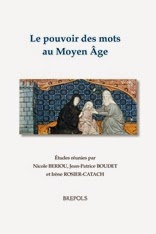
Publication – N. Bériou, J.-P. Boudet, I. Rosier-Catach (éd.), « Le pouvoir des mots au Moyen Âge »

L’idée d’un pouvoir ou d’une efficacité des paroles émerge de la lecture de sources fort différentes au Moyen Âge, qu’il s’agisse de textes doctrinaux ou d’ouvrages à vocation pratique. Ce livre se veut une confrontation la plus large possible, sur ce thème, dans une perspective d’histoire intellectuelle et anthropologique. En effet, dans les différents cas, relevant de différents domaines, de nombreuses questions transversales se posaient, au sujet des éléments qui étaient décrits comme déterminant l’efficacité de la parole (les paroles elles-mêmes, le rituel, les protagonistes). Cette efficacité faisait-elle l’objet d’un discours normatif ? Donnait-elle lieu à un discours réflexif, de la part des philosophes ou des théologiens ? L’engagement du locuteur, sa croyance, son intention, étaient-elles, comme le consentement ou la collaboration de l’auditeur, des facteurs déterminants ? Existait-il dans les paroles un pouvoir intrinsèque, ou n’étaient-elles que le vecteur d’un pouvoir venu d’ailleurs, surnaturel notamment ? Des matériaux et analyses présentés surgissent des questions qui pourront intéresser la philosophie du langage comme l’histoire ou l’anthropologie.
Les contributeurs :
Eléonore Andrieu, Enrico Artifoni, François Boespflug, Hélène Bouchardeau, Jean-Patrice Boudet, Alain Boureau, Carla Casagrande, Laurent Cesalli, Florence Chave-Mahir, Béatrice Delaurenti, Jean-Pierre Descamps, Lucie Doležalová, Giacomo Gambale, Benoit Grévin, Gábor Kiss Farkas, Gábor Klaniczay, Corinne Leveleux-Teixeira, Costantino Marmo, Franco Morenzoni, Sylvain Piron, Alessandra Pozzo, Aurélien Robert, Irène Rosier-Catach, Silvana Vecchio, Julien VéronèseTable of Contents
Table des matières :
Introduction
Irène Rosier-Catach – Le pouvoir des mots au Moyen Âge : diversité des pratiques et des analyses
Jean-Patrice Boudet, Julien Véronèse – La Somme de la magie sacrée, du maître Bérenger Ganell
Arts du langage, littérature et images
Laurent Cesalli – Faut-il prendre les mots au mot? Quelques réflexions logico-sémantiques sur le pouvoir des mots
Costantino Marmo – De virtute sermonis/verborum. L’autonomie du texte dans le traitement des expressions figurées ou multiples
Éléonore Andrieu – Quand les rhinocéros prennent la parole: le gab et la question de la parole efficace dans Le Voyage de Charlemagne à Jérusalem et à Constantinople
Benoit Grévin – L’étymologie en action? Questions sur la pratique des annominationes de noms propres dans la rhétorique politique du XIIIe siècle
Lucie Doležalová et Gábor Kiss Farkas – Le pouvoir des mots dans l’art de la mémoire à la fin du Moyen Âge
François Boespflug – Illustrer, faire aimer, faire rêver. Pouvoirs des mots et pouvoirs des images à la lumière des représentations de Dieu-Trinité dans l’art
Deux discours normatifs : droit et théologie morale
Corinne Leveleux-Teixeira – Prêter serment au Moyen Âge. La virtus verborum au risque du droit
Alain Boureau – Le vœu, une parole à l’efficacité disputée
Discours public, prédication et prophétie
Enrico Artifoni – La politique est «in fatti» et «in detti». L’éloquence politique et les intellectuels dans les cités communales au XIIIe siècle
Carla Casagrande – Sermo potens. Rhétorique, grâce et passions dans la prédication médiévale
Franco Morenzoni – Signes, mots et images dans la prédication de Guillaume d’Auvergne
Sylvain Piron – La parole prophétique
Alessandra Pozzo – Un langage inspiré « efficace ». La xénolalie dans les récits hagiographiques du Moyen Âge
Discours bénéfiques, discours maléfiques
Florence Chave-Mahir – L’exorcisme des possédés, une parole efficace d’après quelques œuvres doctrinales des VIe-XIIIe siècles
Gábor Klaniczay – L’efficacité des mots dans les miracles, les visions, les incantations et les maléfices
Silvana Vecchio – Légitimité et efficacité de la malédiction dans la réflexion théologique médiévale
Giacomo Gambale – ‘Par langue les livre a martire…’ . La potestas nocendi de la parole
Magie, médecine, théories et pratiques
Jean-Patrice Boudet, Jean-Pierre Descamps – Pouvoir des mots et brevets magiques
Julien Véronèse – La parole efficace dans la magie rituelle médiévale (XIIe-XVe siècle)
Béatrice Delaurenti – La nature à l’horizon. Virtus verborum, causalité et naturalisme
Aurélien Robert – Le pouvoir des incantations selon les médecins du Moyen Âge (XIIIe-XVe siècle)
Hélène Bouchardeau – La disposition: un autre point de vue sur l’efficacité de la parole
Conclusions
Irène Rosier-Catach – Regards croisés sur le pouvoir des mots au Moyen Âge
Informations pratiques :
N. Bériou, J.-P. Boudet, I. Rosier-Catach (éd.), Le pouvoir des mots au Moyen Âge, Turnhout, Brepols, 2014. 601 p., 15 b/w ill. + 16 colour ill., 156 x 234 mm. ISBN: 978-2-503-55141-8. Prix : 95 euros.
Source de l’information : Brepols
Publié dans Publications | Laisser un commentaire