Appel à contribution – The Church and doubt

Event date: 22-24 July 2014
Event location: University of Sheffield, UK
Submission deadline: 15 April 2014

Men and women have always expressed doubts about ideas and individual doctrines, but the means and the implications of doing so depend on historical circumstance. Having a crisis of faith in the post-Enlightenment nineteenth century, with its concept of ‘honest doubt’, had different socio-political consequences to a crisis of doubt in, say, the fourth or fourteenth centuries or the present era. These differences persist both at the level of our sources and in the nature or content of doubt, which has been deeply affected by changes in science and technology. Any history of a Church also needs to explore the changing means by which men and women in power have sought to maintain credibility while also dealing with incomplete information. Doubt, then, is clearly central to the history of Christianity.

Proposals are invited for twenty-minute papers tackling any aspect of this theme.

Ecclesiastical History Society
c/o dr Tim Grass
Email: tgrass.work@gmail.com

For complete details and a proposal form to accompany your proposal, see the website at http://www.history.ac.uk/ehsoc

Source de l’information : Episcopus
Publié dans Appel à contributions | Laisser un commentaire

Colloque – Medieval anchorites in their communities

The International Anchoritic Society, in conjunction with MEMO at Swansea University, is pleased to announce its 5th International Anchoritic Conference.

Medieval anchorites in their communities

Much of the work undertaken in the field of medieval anchoritism, particularly within an English context, has concentrated on the vocation’s role within the history of Christian spirituality, its function as a locus of (gendered) sacred space and its extensive ideological cultural work. Indeed, in the hundred years since Rotha Mary Clay’s foundational 1914 study of English anchoritism, The Hermits and Anchorites of England (1914), only sporadic attention has been given to the English anchorite as part of a community – whether social, intellectual, spiritual or religious – and as part of a widespread ‘virtual’ community of other anchorites and religious or ‘semi-religious’ figures spread across England and beyond. This conference, therefore, will examine the figure of the ‘communal anchorite’ and the central role often played by her/him within local and (inter)national political contexts, and within the arenas of church ideology, critique and reform. 

Programme : 

Tuesday, April 22

11.0-1.00 : Coffee and Registration
1.0-2.00 : Lunch

2.0-2.10 : Welcome and Introduction – Liz Herbert McAvoy (Swansea University)
2.10-4.00 : Postgraduate Workshop – Working with Anchoritic Manuscripts : Bella Millett (University of Southampton) and Eddie Jones (University of Exeter)
4.0-4.30: Tea/Coffee

4.30-6.00: Session 1: Some Postgraduate Positions on Anchoritic Texts
Chair: Liz Herbert McAvoy

Joseph Leake (University of Connecicut) – The Vernacularity of the leoue sustren: Language and Audience in Ancrene Wisse.
Krista A. Murchison (University of Ottawa) – The Role of Confession in the Transmission of the Ancrene Wisse.
Sophie A. Sawicka-Sykes (University of East Anglia) – Celestial Conscription: Writing the Anchorite into the Heavenly Ranks.

6.00 : Wine reception and Book-Launch: E. A. Jones, Speculum Inclusorum/Myrour of Recluses: A Parallel-Text Edition (Liverpool: Liverpool University Press, 2013). Event generously sponsored by the University of Wales Press/University of Liverpool Press
7.00 : Dinner

8.15-9.15 (Gregynog Bar): Dramatic performance: An Audience with Shurl, written and performed by Sue Bevan
Wednesday, April 23

8.0: Breakfast 

9.00-10.30: Session 2: Inventing Textual Communities
Chair: Michelle Sauer (University of North Dakota)

Catherine Innes-Parker (Prince Edward Island) – Anchoritic Textual Communities and the Wooing Group Prayers.
Ayoush Lazikani (University of Oxford) – Emotional Communities in On Lofsong of ure Louerde.
Dorothy Kim (Vassar College) – Ancrene Wisse and the Egerton Hours
10.30-11.00: Tea/Coffee

11.00-1.00: Session 3A: Community and Reform
Chair: Juliana Dresvina (King’s College, London)

Clare Dowding (King’s College, London) – ‘Item receyvyd of ye Anker’: the Relationship between a Parish and its Anchorites as seen through the Churchwarden’s Accounts.
James Plumtree (Central European University) – ‘Tempting the People, as Jeroboam did Israel’: The Curious Incident of the False Hermit in Fisherton Anger at Mass.
Justin Byron Davies (University of Surrey) – ‘Holy church shalle be shaked in sorrow and anguish and tribulation in this worlde as men shaketh a cloth in the wind’: Reformist Currents in Julian of Norwich’s Revelation of Divine Love. 
11.00-1.00: Session 3B: Friendships and Beliefs
Chair: Christiania Whitehead (University of Warwick)

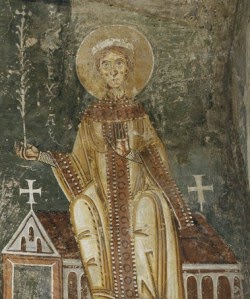
Kathryn Maude (King’s College, London) – ‘She fled from the uproar of the world’: The Contested Recluse Status of Eve of Wilton.
Michelle M. Sauer (University of North Dakota) – ‘Each one of you has al that she needs from one friend’: Ideas of Friendship in Anchoritic Literature.
Cate Gunn (Independent scholar) – The Anchoress of Colne Priory: A Case Study.
1.0-2.30: Lunch

2.30-4.00: Session 4A: Anchorites: the Psychological and the Material
Chair: Dorothy Kim (Vassar College)

Juliana Dresvina (King’s College, London) – A Case for a Psycho-history of Medieval Solitaries.
Julia Bourke (University of Cambridge) – Anchoresses, Emotion and Religious Practice: A Neurohistorical Approach.
Godelinde Perk (Umeå University) – Was Julian’s Nightmare a Māre? Julian of Norwich and Folk Belief.
2.30-4.00: Session 4B: Rhetoric and Devotion
Chair: Denis Renevey (University of Lausanne)

Fumiko Yoshikawa (Hiroshima Shudo University) – Julian of Norwich and Medieval Rhetorical Arts of Preaching
Margaret Healy-Varley (Providence College) – Wounds shall be worships: Anselm in Julian of Norwich’s Revelation of Love.
Diana Denissen (University of Lausanne) – ‘I gave it to you entirely, nailed and stretched out on my cross, in this holy order’: Anchoritic Rhetoric in A Talkyng of the Love of God. 
4.0-4.30: Tea/Coffee

4.30-6.00: Keynote Lecture – Chair: Liz Herbert McAvoy (Swansea University)

Eddie Jones (University of Exeter) – ‘O sely ankir’.

6.00 Cash bar
7.00 Dinner

Thursday, April 24

8.0 : Breakfast

9.00-10.30: Session 6: Visionary and Social Communities
Chair: Catherine Innes-Parker (University of Prince Edward Island)

Naoë Kukita Yoshikawa (Shizuoka University) – Mechtild of Hackeborn and her Community in Later Medieval England.
Clarck Drieshen (University of Leeds) – English Recluses and Communal Interactions: the Translation of Late Medieval Revelatory Devotional Literature into Social Reality. 
10.30-11.00: Tea/Coffee

11.00-12.45: Keynote Lectures – Chair: Eddie Jones (University of Exeter)

Diane Watt (University of Surrey) – Eve of Wilton in her Communities
Tom Licence (University of East Anglia) – Anchorites as Occult Practitioners in the Eleventh and Twelfth Centuries
12.45-1.00: Concluding remarks
Informations pratiques :
The 5th International Anchoritic Society Conference 
Gregynog Hall, Newtown, Powys, Wales 
April 22-24, 2014 

All those interested in attending this workshop should indicate attendance on the registration form, available on the conference website.

Source de l’information : Swansea University
Publié dans Colloque | Laisser un commentaire

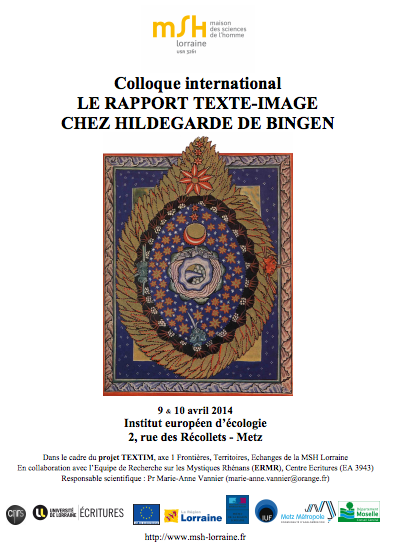
Colloque – Le rapport texte-image chez Hildegarde de Bingen

9 et 10 avril 2014

Institut européen d’écologie
2, rue des Récollets – Metz

Dans le cadre du projet TEXTIM, axe 1 Frontières, Territoires, Echanges de la MSH Lorraine
En collaboration avec l’Equipe de Recherche sur les Mystiques Rhénans (ERMR), Centre Ecritures (EA 3943)

Responsable scientifique : Pr Marie-Anne Vannier (marie-anne.vannier[at]orange.fr)

Programme :

Mercredi 9 avril 2014

Matin
Sous la présidence du Professeur Jacques Walter

9h00 : Ouverture par Jacques Walter, Directeur adjoint de la MSH Lorraine.

9h30 : Marie-Anne Vannier (Université de Lorraine, ERMR, MSH Lorraine, Membre de l’IUF) – Rapport texte-image dans le Scivias et le Livre des oeuvres divines d’Hildegarde de Bingen
10h00 : Harald Schwaetzer (Université d’Alanus, Kueser Akademie) – La place d’Hildegarde de Bingen dans l’iconographie du XIIe siècle
10h30 : Pause
11h00 : Yannick Beuvelet (Obernai) – La Sixième Vision de la première partie du Scivias et l’Hortus deliciarum d’Herrade de Landsberg
11h30 : Danielle Keller (Association Hildegarde) – Les règles d’Or selon Hildegarde

Après-midi
Sous la Présidence du Professeur Roland Recht, Président de l’Institut de France

15h00 : Jean-Claude Lagarrigue (ERMR) – L’apport du Commentaire de la Sagesse d’Eckhart
15h30 : Klaus Reinhardt (Université de Trèves, Directeur émérite du Cusanus Institut) – L’apport du Codex 63 de la Bibliothèque de Nicolas de Cues à Bernkastel-Kues à la connaissance du Scivias d’Hildegarde de Bingen
16h00 : Jean Devriendt (ERMR) – L’homme microcosme chez Hildegarde de Bingen et Eckhart
16h30 : Pause
17h00 : Jean-Marie Pelt (Université de Lorraine, Institut européen d’écologie) – L’actualité d’Hildegarde de Bingen

Réception par la Ville de Metz
Repas hildegardien à l’Association Carrefour – 6, rue Marchand à Metz
Renseignements et inscriptions : daniellekeller57[at]free.fr


Jeudi 10 avril 2014

Matin
Sous la Présidence du Professeur Frédérique Lachaud, Université de Lorraine

9h30 : Hans-Walter Stork (Staatsbibliothek Hamburg) – Le “Rupertsberger Riesencodex” (Wiesbaden, Lb Hs. 2). Remarques sur la codicologie et la reliure
10h00 : Monique Gruber (ERMR) – L’iconographie d’Hildegarde de Bingen et celle d’Henri Suso. Convergences et différences
10h30 : Pause
11h00 : Klaus Riga – L’apport des textes d’Hildegarde de Bingen pour l’alimentation
11h30 : Marie-Reine Demollière (Scola Metensis, Centre d’Etudes Grégoriennes de Metz) – Symphonia harmoniae caelestium revelationum : Hildegarde, poète et chantre

Après-midi
Sous la Présidence du Professeur Jean-Marie Pelt

15h00 : Martin Trouve (Médecin, Quimper) – L’apport du Livre des mérites de la vie
15h30 : Emmanuel Bohler (Metz) – L’Ordo virtutum et la musique d’Hildegarde de Bingen
16h00 : Matthieu Malonga (Association Hildegarde) – La boîte à outils hildegardienne
Conclusions
17h00 : Concert hildegardien à la Cathédrale par Norbert Petry (Organiste de la Cathédrale. Orgue Renaissance du Triforium), Marie­-Reine Demollière et Annick Hoerner (Scola Metensis)
Source de l’information : Compitum
Publié dans Colloque | Laisser un commentaire

Journée d’étude – La conoscenza dello ps. Dionigi in Occidente fino all’età carolingia

9 aprile 2014

Società Internazionale per lo Studio del Medioevo Latino – SISMEL
Via Montebello 7, Firenze

Programme : 

10.30-10.45 : Agostino Paravicini Bagliani – Introduzione

10.45-11.15 : Ernesto Sergio Mainoldi – The Ps.-Dionysius from Constantinople to Rome. Earliest Evidences of a Planned Wide-Spreading of the Corpus Dionysiacum in the West
11.15-11.45 : Alexandros Alexakis – The Ps.-Dionysius between Rome and Constantinople in the period of Iconoclasm
11.45-12.45 : Discussione
13.00-14.30 : Pranzo

14.30-15.00 : Francesca Dell’Acqua – À rebours: from Ambrosius Autpertus to the Ps.-Dionysius?
15.00-15.30 : Réka Forrai – The Papacy and the Corpus Dionysiacum in the Ninth Century
15.30-16.30 : Discussione

16.30-17.00 : Francesco Santi – Conclusioni

Source de l’information : SISMEL
Publié dans Colloque | Laisser un commentaire

Publication – Sergio Boffa, "Les manuels de combat.’Fechtbücher’ et ‘Ringbücher’"

Les manuels de combat, qu’ils concernent les différentes formes d’escrime (Fechtbücher) ou de lutte (Ringbücher), sont une source historique exceptionnelle. Ils nous permettent d’appréhender la réalité du combat individuel et présentent l’éventail des techniques martiales à disposition du guerrier. Ces documents commencent à être exploités de manière systématique par les chercheurs. Il est donc important de souligner l’importance historique de ces textes, d’en analyser le contenu, de dévoiler les champs de la recherche qui peuvent bénéficier de leur exploitation et de présenter les difficultés qui guettent l’historien qui désirent s’attaquer au manuels de combat.

Sergio Boffa, licencié en histoire médiévale de l’Université Libre de Bruxelles et docteur en histoire de l’Université de Cambridge (U.K.), est actuellement Conservateur au Musée communal d’archéologie, d’art et d’histoire de Nivelles. L’auteur est, d’une part, spécialiste de l’histoire militaire de l’Antiquité et du Moyen Âge et, d’autre part, de l’histoire du duché de Brabant.

Informations pratiques :
Sergio Boffa, Les manuels de combat.’Fechtbücher’ et ‘Ringbücher’, Turnhout, Brepols, 2014 (Typologie des sources du Moyen Âge occidental, 87). 93 p., 10 colour ill., 156 x 234 mm. ISBN: 978-2-503-54938-5. Prix : 25,00 euros.
Source de l’information : Brepols
Publié dans Publications | Laisser un commentaire

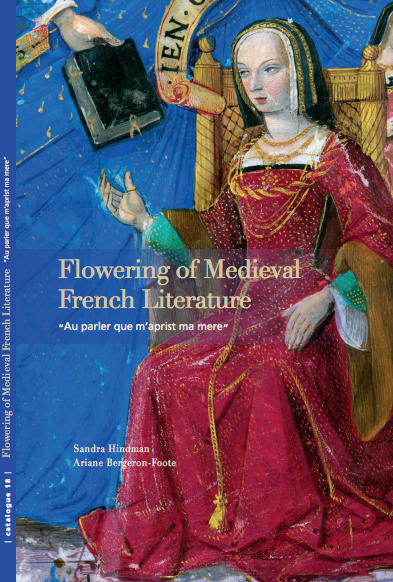
Exposition – Flowering of Medieval French Literature : "Au parler que m’aprist ma mere"

This project previews an exhibition in New York and Paris, a scientific catalogue, and an international colloquium that all focus on a group of sixteen manuscripts all written in the French language between c. 1300 and c. 1550. Mostly illuminated, the manuscripts are widely diverse. They are written in verse and in prose. Some are translations from the Latin, others new compositions entirely in French. They treat a wide variety of subjects ranging from literature and science, to philosophy and theology, and to history and government. There are some unique texts that exist only in the manuscripts included here. A significant number of the volumes boast royal provenance. There are signed and dated works by newly identified scribes, as well as works by famous calligraphers. Some of the manuscripts still have their original bindings. So rare on the art market are illuminated manuscripts in the French language of this period that this project would not be possible without the purchase of a substantial group of mostly unpublished manuscripts from the Collection of Joost R. Ritman (born 1941), the Amsterdam businessman and founder of the Bibliotheca Philosophica Hermetica. 

The subtitle appropriates a quote from Jean de Meun, who with Guillaume de Lorris wrote the Roman de la Rose, the very bedrock of medieval French literature. In c. 1325, Jean describes writing in French as “speaking as I learned from my mother” (parler que m’aprist ma mere) or we might say now “speaking in my mother tongue.” Although the earliest records of written French date from the ninth century, by the thirteenth century French had become widespread as a written language, even if for writers like Dante, Latin was still considered the sovereign of the vernacular (“sovrano del volgare,” Convivo 1:7)

Many factors influenced the shift from Latin to the “mother tongue.” The change from an agrarian economy based on the land to a commercial economy in the towns and cities imposed a need for the middle classes to understand each other in written as well as oral forms. The centralization of French government and the rise of a nation state with the reign of King Philip Augustus (reigned 1180-1223) dictated a need for a language through which the court and the nobles could wield power far and wide (medieval French written and spoken in Paris became known as the “langue du roi” often contrasted with the “mother tongue” which was usually a dialect). And, not least of all, women played a major role the rise and evolution of medieval French as women readers, writers, and collectors. By the fifteenth century, vernacular language was well established as the language of literature, historical record, and personal expression.

The technology of the press provided greater access to the mother tongue and contributed to its standardization. Statistics of publications in French are indeed astonishing. Whereas in 1501 only 10% of books published in Paris were in French, by 1575, 55% of all books published in Paris were in French. The triumph of the French vernacular was also promoted by the Renaissance King Francis I, who in 1539, deemed French the official language of his kingdom. Then, in 1635, Cardinal Richelieu founded the Académie française whose mission was “to codify the French language, to give it rules, to make it pure and comprehensible to everyone.” And, the rest, so they say, is history. The medieval and Renaissance manuscripts discussed here endure as vibrant reminders of the historical legacy of modern-day France and the French language.

The scholarly catalogue that accompanies the exhibition will include of detailed descriptions with comparative material, a preface, an introduction, and an extensive bibliography, and will be published in full color. A one-day international colloquium will take place in Paris.

Exhibition catalogue : here

Informations pratiques :
EXHIBITION IN NEW YORK:

23 East 73rd Street, 7th Floor
New York, NY 10021
tel +1 212 717 7273

newyork@lesenluminures.com

April 2 to 26, 2014

Opening Hours: Mondays to Saturdays, 10 AM to 6 PM 

EXHIBITION OPENING AND RECEPTION: 
Wednesday, April 2nd, 6 to 8 PM

EXHIBITION IN PARIS:
1, rue Jean-Jacques Rousseau
75001 Paris

tel +33 1 42 60 15 58

May 13 to 20, 2014

Opening Hours: Monday to Friday, 11 AM to 7 PM

COLLOQUIUM:
INHA, salle Vasari
2, rue Vivienne
75002 PARIS
Saturday, May 17, 2014, from 9:30 AM to 6 PM

Source de l’information : Les enluminures
Publié dans Exposition | Laisser un commentaire

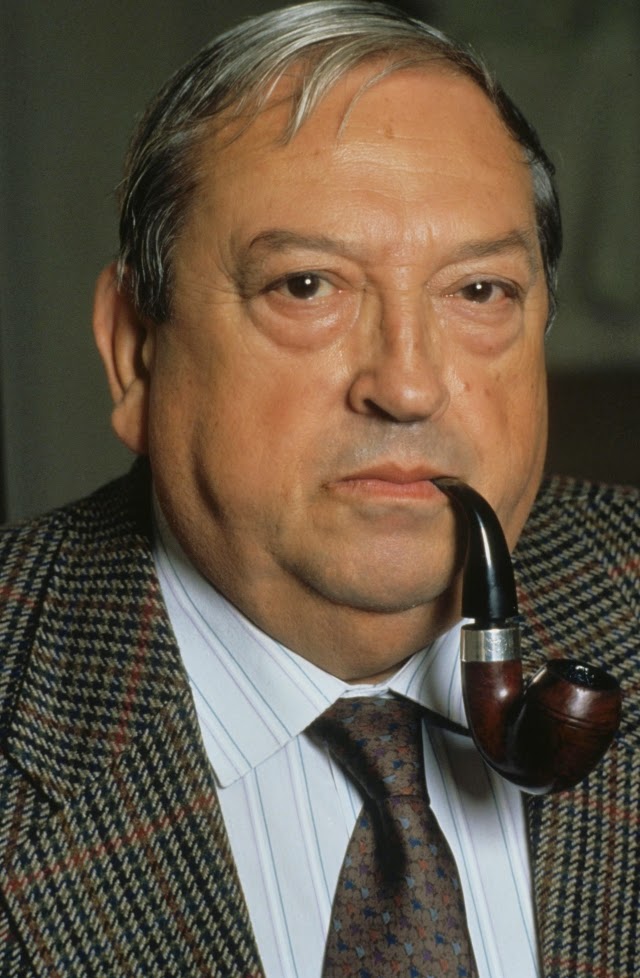
Audio – France Culture rend hommage à Jacques Le Goff

« L’Histoire ne peut être objective, c’est une activité presque involontaire de rationalisation » 

L’historien médiéviste français, co-producteur de l’émission « Les Lundis de l’histoire » depuis 1968, est mort ce mardi 1er avril à Paris. Il était âgé de 90 ans. Co-directeur de la revue « Annales, Histoire et Sciences sociales« , son travail a été de nombreuses fois récompensé. Grand Prix national d’Histoire en 1987, médaille d’or du CNRS en 1991, il fut promu au grade de Commandeur de l’ordre des Arts et des Lettres en 1997.

Né le 1er janvier 1924, ce normalien brillant, agrégé d’histoire en 1950, (quatrième ex-aequo avec Alain Touraine), se rend compte qu’il ne veut pas enseigner et préfère la recherche collective.

Pour continuer sa formation, il étudie à Oxford pendant un an, mais ne s’y plait pas. Suite à cela, il travaille un an au CNRS, mais là encore l’univers ne lui convient pas. En 1962, il devient maître-assistant à la VI° section de l’École pratique des hautes études (devenue en 1975 l’Ecole des hautes études en sciences sociales) et découvre la liberté de recherche et la possibilité d’échanger avec de nombreux intellectuels. En 1972, il succède à Fernand Braudel.
Ses travaux sur l’Occident médiéval font figure de référence pour les historiens et ses ouvrages ont été lus par des générations d’étudiants.

Dans la tradition des grands historiens français, ce médiéviste n’hésitait pourtant pas à quitter sa période de prédilection pour aborder l’actualité.

Aurélie Filipetti, ministre de la Culture, lui rend ainsi hommage : « L’apport de Jacques Le Goff aux progrès de la science historique et à l’enrichissement du débat d’idées est inestimable. Il nous reste le legs précieux d’une œuvre riche, d’une rigueur exemplaire, et qui nourrira pendant longtemps encore le débat historique, culturel et intellectuel. »

France Culture consacre à Jacques Le Goff plusieurs heures d’antenne à partir de ce mardi 1er avril : 

Nuit du vendredi 4 au samedi 5 avril, 1h30-6h : Nuit spéciale « Les Lundis de l’histoire par Jacques Le Goff » par Philippe Garbit 
  • « Comment on écrit l’histoire de Paul Veyne » (1971) : entretien de Jacques Le Goff avec Paul Veyne, Pierre-Vidal Naquet, Emmanuel Le Roy Ladurie
  • « La guerre au Moyen-Age de Philippe Contamine » (1980): entretien de Jacques Le Goff avec Philippe Contamine
  • « Histoire quantitative, histoire sérielle » (1978) : entretien de Jacques Le Goff avec Pierre Chaunu, Philippe Ariès, Jean Meyer, Emmanuel Le Roy Ladurie 

Du lundi 7 au vendredi 11 avril, 20h – 20h30 : « A voix nue » « Jacques Le Goff », rediffusion de la série d’entretiens réalisée par Emmanuel Laurentin en 2004
Via France Culture Plus, l’EHESS propose deux entretiens vidéo de Jacques Le Goff autour de son oeuvre et de sa conception de l’histoire

Source de l’information : France Culture
Publié dans Audio, News | Laisser un commentaire

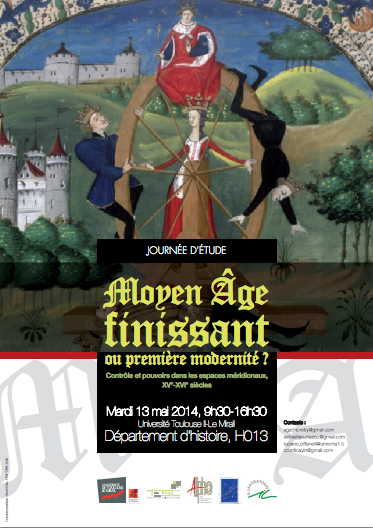
Journée d’étude – Moyen Âge finissant ou première modernité ?

Moyen-Âge finissant ou première modernité ?
13 mai 2014
Université Toulouse II-Le Mirail
Département d’histoire, salle H013
Contact :
Agathe Roby
agathe.roby@gmail.com

Programme :

9h30 : Avant-propos
9h45 : Introduction de la journée par Philippe Hamon, professeur en histoire moderne, Université de Rennes II, CERHIO

Discutante : Claire Judde. Maître de conférences en histoire médiévale, Framespa, UTM

10h30 : Agathe Roby, Doctorante en histoire médiévale, Framespa, UTM – Du mal nécessaire à la condamnation : le contrôle de la prostitution par les autorités urbaines en Midi toulousain XVe – XVIe siècles
11h : Discussion
11h15 : Pause

11h30 : Fabien Coletti. Doctorant en littérature italienne, Il Laboratorio, UTM – Au-delà du Castelletto : la dispersion de la prostitution dans la Venise du XVIe siècle
12h : discussion
12h30 : Repas

Discutant : Daniel Baloup. Maître de conférences en histoire médiévale, Framespa, UTM

14h : Luciano Piffanelli. Doctorant en histoire médiévale, Université de Rome La Sapienza – Gérer le pouvoir en Italie au Quattrocento : les transformations dans les pratiques diplomatiques 
14h30 : Discussion
14h45 : Pause

15h : Sébastien Mazou. Doctorant en histoire médiévale, Framespa, UTM – Le problème du contrôle des combattants dans la péninsule italienne du XVe siècle : l’exemple des provéditeurs vénitiens
15h30 : Discussion

15h45 : Conclusion de la journée par Sophie Cassagnes-Brouquet. Professeure, Framespa, UTM ; Bernard Doumerc. Professeur, Framespa, UTM.

Source de l’information : Université de Toulouse-Le Mirail
Publié dans Colloque | Laisser un commentaire

Colloque – Romanesque Art: Patrons and Processes

7-9 April 2014, Museu Nacional d’Art de Catalunya, Barcelona
Following earlier conferences on Romanesque and the Past (London, 2010), and Romanesque and the Mediterranean (Palermo, 2012), the British Archaeological Association is collaborating with the Museu Nacional d’Art de Catalunya and the Research project Magistri Cataloniae to stage the third in a biennial series of international conferences concerned with Romanesque art and architecture. This conference, Romanesque: Patrons and Processes, is concerned with patronage – and agency – in their broadest senses during the Romanesque period. Thus, in addition to more traditional prosopographical approaches, and examinations of individual patrons, there will be papers on various forms of institutional patronage. The conference will also address the processes involved in commissioning buildings or works of art – the mechanics of design – authorship – intermediaries and agents – and the extent to which patrons are designers. Are there limits to patronal influence?
Speakers include: Claude Andrault-Schmitt (Centre d’Etudes supérieures de Civilisation Médiévale CNRS/Université de Poitiers), Maria Bonet (Universitat Rovira i Virgili, Tarragona), Eduardo Carrero (Universitat Autònoma de Barcelona), Manuel Castiñeiras (Universitat Autònoma de Barcelona – Magistri Cataloniae), Hugh Doherty (Jesus College, Oxford), Eric Fernie (Courtauld Institute of Art), Alexandra Gajewski and Stephanie Seeberg

The conference will open at 9:30 on Monday, 7 April with lectures at the Museu Nacional d’Art de Catalunya (Parc de Montjuïc, 08038 Barcelona). Teas, coffees and lunch will be provided on all three days, in addition to dinners on two evenings and a drinks reception on the third. The conference will also include a late afternoon visit to the Romanesque collections at Museu Nacional, and a visit to the complex of early medieval and Romanesque churches at Terrassa. More information will be provided on the website.
Source de l’information : Medieval Art Research
Publié dans Colloque | Laisser un commentaire

Publication – P. Bougard et B. Delmaire (éd.), Le cartulaire et les chartes de l’abbaye de femmes d’Avesnes-lès-Bapaume (1128-1337)

En 1975, Pierre Bougard, archiviste du département du Pas-de-Calais, découvrit dans les archives privées du château de Tramecourt (France, département du Pas-de-Calais) un cartulaire inconnu de l’abbaye de femmes d’Avesnes, fondée vers 1128 par Clémence, comtesse douairière de Flandre. Il en commença l’édition qui a été terminée par Bernard Delmaire, professeur émérite d’histoire médiévale à l’université de Lille III.

Cette découverte est d’autant plus précieuse que les archives de l’abbaye ont entièrement disparu. Pour cette raison, on a ajouté à l’édition des 153 actes du cartulaire celle d’une trentaine d’actes retrouvés en divers dépôts d’archives et bibliothèques.

L’édition des documents, aux 4/5 inédits, est précédée d’une introduction codicologique sur le cartulaire, et historique sur le sort obscur et mouvementé de cette abbaye bénédictine qui accueillait trente moniales, qui fut détruite en 1553, lors des guerres entre Charles Quint et les rois de France, et transférée près d’Arras. Elle est complétée par cinq annexes, dont une liste refaite des abbesses jusqu’en 1789 et l’édition des restes de l’obituaire.

Les documents édités touchent à l’histoire mal connue du monachisme féminin en Flandre, puis en Artois, à l’histoire rurale, à l’histoire seigneuriale et féodale de l’Artois et de la Picardie, et à l’histoire des villes de Bapaume et d’Arras.

Table des matières :
Avant-propos
Sources et bibliographie
Sources manuscrites
Sources éditées et regestes
Instruments de travail: dictionnaires, inventaires, répertoires, etc.
travaux historiques

Introduction
Le manuscrit de Tramecourt (Histoire du manuscrit; Description; Histoire de la composition: essai de synthèse)
Pourquoi le cartulaire fut-il composé ?
Contenu du cartulaire
Actes inconnus du cartulaire
Les débuts de l’abbaye d’après le cartulaire
La destinée mouvementée de l’abbaye d’Avesnes

Edition des actes

Annexes
Table initiale du cartulaire
Liste des actes du cartulaire (dans l’ordre du manuscrit)
Liste chronolgique des actes édités (dans l’ordre de l’édition)
Liste des abbesses d’Avesnes
Extraits de l’obituaire dressés par dom Le Pez en 1697-1715

Index onomastique des actes
Tables
Informations pratiques :
P. Bougard et B. Delmaire (éd.), Le cartulaire et les chartes de l’abbaye de femmes d’Avesnes-lès-Bapaume (1128-1337), Turnhout, Brepols, 2014 (Atelier de recherche sur les textes médiévaux – ARTEM, 19). 326 p., 1 b/w ill., 10 b/w tables, 156 x 234 mm. ISBN: 978-2-503-55129-6. Prix : 75,00 euros.

Source de l’information : Brepols
Publié dans Publications | Laisser un commentaire