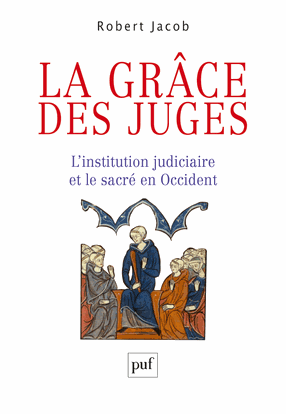
Publication – Robert Jacob, "La grâce des juges. L’institution judiciaire et le sacré en Occident"

Comment comprendre le halo de sacralité qui entoure aujourd’hui encore la pratique de la justice ? Comment s’explique le fossé qui sépare la conception de la fonction de juger en Occident et dans d’autres cultures, comme celle de la Chine ? Quelle est l’origine de l’écart qui s’est creusé entre les justices de common law et celles de l’Europe continentale, jusque dans la construction de la vérité judiciaire ? 

À ces questions, ce livre cherche des réponses dans l’histoire des articulations entre justices humaines et justice divine au sein même de la pratique des procès. En Occident, elles sont passées par deux phases. La première fut d’instrumentalisation. La christianisation des ordalies permettait de solliciter directement de Dieu le jugement des causes. La seconde fut d’imitation. À partir du Moyen Âge central, les hommes allaient assumer seuls la charge du jugement. Mais jamais ils ne perdirent de vue l’exigence de perfection que leur imposait la référence à l’idéal d’une justice absolue.

L’ouvrage entreprend de dénouer les fils de cette histoire, en même temps qu’il l’éclaire du dehors en l’inscrivant dans une ample anthropologie comparative des rituels judiciaires.
Juriste et médiéviste, Robert Jacob est Directeur de Recherche du CNRS, rattaché au Laboratoire de médiévistique occidentale de Paris. Il est également Professeur d’histoire du droit aux universités de Liège et Saint-Louis de Bruxelles.

Table des matières : 


Ouverture

I – Les ordalies : anthropologie et histoire
II – La promesse du jugement de Dieu
III – Des royaumes de justice
IV – L’acte de juger dans l’histoire des mots
V – Le serment des juges ou l’invention de la conscience judiciaire
VI – Le pape, l’enquête et la vérité
VII – La formation de la déontologie judiciaire
VIII – Juger sous le Ciel. Allers et retours d’Occident en Chine
IX – La grâce des juges

Perspective
Index nominum
Notice bibliographique – abréviations

Informations pratiques :
Robert Jacob, La grâce des juges. L’institution judiciaire et le sacré en Occident, Paris, PUF, 2014. 520 pages. ISBN : 978-2-13-063058-6. Prix : 25.00 €.

Source de l’information : Presses universitaires de France – PUF
Publié dans Publications | Laisser un commentaire

Appel à contribution – Der Papst, die römische Kurie und die Welt. Hilfsmittel zu ihrer (rechts-)historischen Erforschung. Studientage am MPI für Europäische Rechtsgeschichte

Veranstalter: Max-Planck-Institut für europäische Rechtsgeschichte, Frankfurt am Main
Datum, Ort: 16.06.2014-18.06.2014, Frankfurt am Main, Hansaallee 41, D-60323 Frankfurt am Main
Deadline: 21.04.2014
Wie in den vergangenen Jahren lädt das Max-Planck-Institut für europäische Rechtsgeschichte Doktorandinnen und Doktoranden sowie junge Wissenschaftlerinnen und Wissenschaftler zu den „Studientagen 2014“ ein. In diesem Jahr werden wir folgenden thematischen Schwerpunkt setzen: „Der Papst, die römische Kurie und die Welt. Hilfsmittel zu ihrer (rechts-)historischen Erforschung“. Die Studientage werden vom 16. bis 18. Juni 2014 in Frankfurt a. M. stattfinden.

Ziel der Studientage ist es, den Teilnehmern Grundkenntnisse zur Durchführung eigener Forschungen in römischen Archiven – sowohl der Dikasterien der Kurie als auch anderer kirchlicher Institutionen – zu vermitteln. Darüber hinaus sollen sie mit Grundlagen der Quellenkritik für eine fachgerechte Interpretation und Kontextualisierung der Dokumente mittels der aktuellen Forschungsliteratur vertraut werden.

Es sind drei Sektionen vorgesehen: 1. Vererbung: die alten kurialen Dikasterien; 2. Modernität: Reform und Reformen der Kurie; 3. Auf dem Weg zur Zeitgeschichte: die neuen Formen der Beziehungen mit der Welt. Besondere Aufmerksamkeit wird der Methodologie der Archivforschung gewidmet sein, und zwar unter besonderer Berücksichtigung der (rechts-)historischen Thematiken, der Vermittlung von Hilfsmittel und spezifischen essentiellen Kompetenzen, die für die Arbeit im Archiv zweckmäßig sind.

Das Seminar wird von Olivier Poncet (École nationale des chartes, Paris) und Benedetta Albani (MPI für europäische Rechtsgeschichte) organisiert. Die Kurse werden von Wissenschaftlerinnen und Wissenschaftlern sowie Archivarinnen und Archivaren verschiedener Disziplinen durchgeführt, die ihre langjährige Erfahrung in der Erforschung römischer Archive und Bibliotheken weitergeben: Paolo Aranha (Marie Curie-Gerda Henkel Stiftung/LMU München), Orazio Condorelli (Università di Catania), Cecilia Cristellon (Goethe Universität, Frankfurt/M.), Irene Fosi (Università di Chieti-Pescara), Thomas Frenz (Universität Passau), Silvano Giordano (Pontificia Università Gregoriana, Roma), Armand Jamme (CNRS, Lyon), Wolfgang Müller (Fordham University, New York), Giovanni Pizzorusso (Università di Chieti-Pescara), Roberto Regoli (Pontificia Università Gregoriana, Roma), Benjamin Weber (Université de Toulouse 2 Le Mirail), Hervé Yannou (Verwalter des Schlosses de Maisons- Laffitte, ehemaliger Pressekorrespondent in Rom).

Außerdem finden Gesprächsrunden statt, in denen sowohl methodologische Probleme als auch Fragen zu den jeweiligen Forschungsvorhaben der Teilnehmer diskutiert werden können. Unterrichtssprachen sind Englisch, Deutsch und Italienisch; es wird stets eine englische Zusammenfassung zur Verfügung gestellt.

Bewerbungen sind bis zum 21. April 2014 an Frau Nicole Pasakarnis (sekduve@rg.mpg.de) zu richten. Sie müssen neben dem ausgefüllten Anmeldeformular eine kurze Beschreibung der Forschungsaktivitäten (max. 1000 Zeichen, ohne Leerzeichen) und einen aktuellen Lebenslauf (max. 3 Seiten) enthalten. Die Entscheidung über die Auswahl der Kandidaten wird bis zum 30. April 2014 mitgeteilt werden. Das Programm wird bald verfügbar sein unter: www.rg.mpg.de/de/qualifikation/trainingsprogramm/studientage.cfm.

Das Max-Planck-Institut wird die Kosten für die Unterkunft übernehmen, die Reisekosten sind von den Teilnehmern selbst zu tragen. In Ausnahmefällen können auch die Reisekosten übernommen werden.

Englischsprachige Zusammenfassung: 

As in previous years, the Max-Planck-Institut für europäische Rechtsgeschichte invites doctoral students and young researchers to participate in the seminar “Studientage”. This year the focus will be on “The Pope, the Roman Curia and the World. Research tools for History and History of Law”. The seminar will take place in Frankfurt am Main from 16th to 18th June 2014.

Three work sessions will be held: 1. Heritage: The roman dicasteries of long duration; 2. Modernity: Reformation and reforms of the roman curia; 3. Towards the contemporary era: New forms of communication with the world. The seminar will also focus on the methodology of archival investigation, with special attention to historical and legal-historical issues, and the description of specific competences and tools that are essential for the purposes of archival work.

The seminar is organised by Olivier Poncet (École nationale des chartes, Paris) and Benedetta Albani (MPI für europäische Rechtsgeschichte). The lessons will be held by researchers and archivists specialised in several disciplines and with long experience in the Roman archive and library research.

Applications must be submitted to Mrs. Nicole Pasakarnis (sekduve@rg.mpg.de) by 21th April 2014 and include, together with the application form duly completed, a short description of the candidates’ research activity (max. 1000 characters, spaces excluded) and an updated CV (max. 3 pages). The selected candidates will be notified by 30th April 2014. The complete programme will be soon available at: www.rg.mpg.de/de/qualifikation/trainingsprogramm/studientage.cfm .

Kontakt: 
Nicole Pasakarnis
Max-Planck-Institut für europäische Rechtsgeschichte 
Hansaallee 41 
D-60323 Frankfurt am Main 
+49-69-78978-165 
+49-69-78978-169 
sekduve@rg.mpg.de

Source de l’information : H-Soz-u-Kult
Publié dans Appel à contributions | Laisser un commentaire

Web – Corpus Scriptorum Ecclesiasticotum Latinorum (CSEL), a Monastic Manuscript Project

A list of all texts appearing on the first 55 volumes of the Corpus Scriptorum Ecclesiasticorum Latinorum (Vienna) with hyperlinks each text on the Internet Archive. This page is part of the the Monastic Manuscript Project (CSEL)

The Monastic Manuscript Project is a database of descriptions of manuscripts that contain texts relevant for the study of early medieval monasticism, especially monastic rules, ascetic treatises, vitae patrum-texts and texts related to monastic reforms. It provides lists of manuscripts for each of these texts, which are linked to manuscript descriptions. The purpose is to offer a tool for reconstructing not only the manuscript dissemination of early medieval monastic texts but also to give access to the specific contexts in which a text appears.

The database supports current edition projects and draws attention to understudied texts and the transmission of fragments, excerpts and florilegia. It is designed to facilitate the work of students and scholars who are interested in the history and reception of texts and who want to work with manuscripts rather than rely on modern editions.

Most pages provide links to a number of web resources, such as manuscript catalogues, online texts and translations, digitized manuscripts and repertoria. Manuscript descriptions are usually based on published manuscript catalogues and secondary literature. It hopes to replace these often incomplete and inaccurate descriptions with new ones that are based on hands on studies of the manuscripts themselves.

The Monastic Manuscript Project is conceptualized as a ‘Wiki’ project. Every student or scholar who works on monastic manuscripts is invited to contribute new manuscript descriptions, to fill in gaps and to submit additions and corrections to existing pages. Eventually the project will become a forum for collaborative work and the presentation of new research.

The database currently can be searched for authors, texts, manuscripts, incipits, genres, and provenances. Other inquiries, about scripts or on CLA numbers, for example, can be carried out with the site search function (below).

Contact : For questions, additions, corrections and contributions to our database, please send an email to Albrecht Diem at adiem@maxwell.syr.edu

Source de l’information : CESCM
Publié dans Banque de données, Web | Laisser un commentaire

Colloque – Moving Body Parts: Their Transcendence of Time and Space in Pre-Modern Europe

Internationales Begegnungszentrum der Wissenschaft, 
Seminarraum,
Amalienstraße 38,
80539 München,

April 11 – 12, 2014
Organizers :
Urte Krass (Institut für Kunstgeschichte der LMU München)

Romedio Schmitz-Esser (Historisches Seminar der LMU München)
Münchner Forschungszentrum Fundamente der Moderne

According to Jean-Claude Schmitt, « the dead have no existence other than that which the living imagine for them » – and sometimes, the living not only force them to exist in their memory but also to persist materially. By keeping the mortal remains above the earth, by dividing them, manipulating them and moving them to different places, the deceased are assigned a very active role within the world of the living. The title of this workshop includes, however, also a second « species » of migrating bodily fragments, namely body parts that are imagined to be moving by themselves. This workshop asks for the reasons why body parts were moved, in which way this happened, how they were visualized, and what the nature, both visual and material, of their transport media was. It asks for the benefits of body parts transcending space and time, and which body parts could be imagined to be moving.
Program
Friday, April 11
1.15-2 pm : Romedio Schmitz-Esser and Urte Krass (LMU Munich) – Introduction
2-2.30 pm : Kristin Marek (Staatliche Hochschule für Gestaltung, Karlsruhe) – Body Parts in / as Pictures
2.30-3pm : Discussion
Coffee break
3.45-4.30pm : Immo Warntjes (Queen’s University, Belfast, UK) – Moving Hearts and the Rise of Individualism in the 13th Century
Estella Weiss-Krejci (Austrian Academy of Sciences, Vienna) – Heart Burials in Medieval and Early Modern Europe
4.30-5pm : Discussion
Coffee break
5.30-6.15pm : Kay Peter Jankrift (TU Munich, Germany) – Dead Leg Walking. A Miraculous Transplantation and its Medico-Ethical Dimension
Sergius Kodera (New Design University, St. Pölten, Austria) – Giovan Battista Della Porta’s Shady Hands and Feet of Executed Criminals
6.15-6.45pm : Discussion
Break
19.30 : Public Lecture: Ann Marie Rasmussen (Duke University, USA) – Wandering Genitalia


Saturday, April 12

9.15-10am : Hester Schadee (LMU Munich, Germany)– Reviving the Corpse of Quintilian: Humanist Texts and the Language of Relics
Noria Litaker (University of Pennsylvania, USA) – Migrating Martyrs: The Visual Presentation of Whole-Body Roman Catacomb Saints in Counter-Reformation Bavaria
10-10.30am : Discussion
Coffee break
11-11.45am : Masza Sitek (Jagiellonian University Kraków, Poland) –  The Triple Movement of St Adalbert’s Head Masza Sitek (Jagiellonian University Kraków, Poland)
Henrike Haug (TU Berlin, Germany) – Moving the Saints Through Texts
11.45-12.15 : Discussion
Source de l’information : ArtHist.net
Publié dans Colloque | Laisser un commentaire

Colloque – Early Modern soundscapes

The Difficulty of that language is not to bee conceived, and the reasons thereof are especially two: 

First, because it hath no affinitie with any other that ever I heard.

Secondly, because it consisteth not so much of words and Letters, as of tunes and uncouth sounds, that no letters can expresse.

For you have few words, but they signifie divers and severall things, and they are distinguished onely by their tunes that are as it were sung in the utterance of them, yet many words there are consisteth of tunes onely, so as if they like they will utter their mindes by tunes without wordes

Francis Godwin, The Man in the Moone (1638)


Early modern culture was awash with sounds. From psalm singing to tavern songs to the reading of the riot act or town criers announcing noteworthy news, we are presented with an image of oral culture forming the basis of perpetual interaction between individuals and their communities. 

Music, in particular, forms a backdrop to the soundscape, negotiating abstract sounds and speech. This two-day symposium will interrogate ways of conceiving the early modern soundscape.
Programme : here

Informations pratiques :
Bangor University
24th-25th April 2014

The organisers are Dr Rachel Willie (r.willie@bangor.ac.uk) and Marta Napodano (elued0@bangor.ac.uk)

School of English
Bangor University, Bangor, LL57 2DG, UK
Phone: +44 (0)1248 351151

Registered Charity: No. 1141565
Copyright © 2001–2014

Source de l’information : Bangor University
Publié dans Colloque | Laisser un commentaire

Offre d’emploi – Postdoc position Economic and Social History (Utrecht University)

At Utrecht University, at the department of History and Art History, the Section Economic and Social History, within the research team of prof.dr. Bas van Bavel, there is also a vacancy for a Postdoc position. As a Postdoc you will work within the ERC-funded project “Coordinating for life. Success and failure of Western European societies in coping with rural hazards and disasters, 1300-1800”, which aims to explain why some societies are successful in preventing the effects of major hazards and buffering threats, or in recovering quickly, while others prove highly vulnerable. 

Deadline for applications: 14 April 2014.

Functie
As a postdoc you will work within the ERC-funded project “Coordinating for life. Success and failure of Western European societies in coping with rural hazards and disasters, 1300-1800”, which aims to explain why some societies are successful in preventing the effects of major hazards and buffering threats, or in recovering quickly, while others prove highly vulnerable. A main element in the project is a comparative analysis, using selected Northwestern European regions as test areas. The project is funded by the European Research Council, by way of an Advanced Grant awarded to project-coordinator Prof. Bas van Bavel. Within the project, 1 postdoc position will be available: The postdoc (starting preferably 1 September 2014, or earlier) will work on fine tuning the case selection for the comparative tests, start analysing the cases and make the first step in building the project’s databases (Work Package 1: “Strengthening the foundations”) and subsequently on the role of systems of allocation and redistribution in the mitigation of crop failure and famine, in the period 1500-1800 (Work Package 3: “Getting access to food”). You will be based at Utrecht University, and be part of the research team led by prof. Bas van Bavel and will as such also be part of the department History and Art History, Section Economic and Social History, led by prof. Bas van Bavel and prof. Jan Luiten van Zanden.
Profiel
A succesful candidate should preferably have:
  • a PhD in social and/or economic history or a manuscript submitted to the PhD committee;
  • experience with both qualitative and quantitative research and methods for comparative research;
  • strong interest for relevant theory;
  • capacity to work both as a creative and independent researcher and as part of a team;
  • capacity or at least willingness to collaborate across the academic disciplines;
  • experience in publishing at high academic standards;
  • ability to work in an international, interdisciplinary team.
 
Aanbod
We offer a postdoc-positions of 0.8 fte beginning 1 September 2014, or earlier). The positions may be augmented with a 0.2 fte teaching assignment at BA and/or MA-level, when available. Initially, there is a one year contract. After a positive evaluation this contract can be extended with three more years (a total of three to five years maximum). Salary ranges between € 3.037,- and € 3.831,- gross per month on a fulltime basis depending on experience and qualifications. Utrecht University offers a pension scheme, a holiday allowance of 8% per year, an end-of-year bonus of 8.3% and flexible employment conditions. Conditions are based on the Collective Employment Agreement of the Dutch Universities. More information: terms of employment


Over de organisatie
Utrecht University is one of Europe’s leading research universities, recognised internationally for its high quality and innovative approach to both research and teaching. Founded in 1636, the University has always focused strongly on research. Owing to its solid grounding in discipline-based scholarship, Utrecht University is at the forefront of developments in interdisciplinary knowledge. The University participates in various thematic multidisciplinary collaborations that conduct excellent research. With its prominence in teaching and research, Utrecht University works towards finding solutions of the highest possible impact and significance to the major challenges facing the 21st century.

The Faculty of Humanities has around 7,000 students and 900 staff members. With its research and education in these fields, the Faculty aims to contribute to a better understanding of the Netherlands and Europe in a rapidly changing social and cultural context. The enthusiastic and motivated colleagues and the excellent facilities in the historic town centre of Utrecht, where the Faculty is located, provide a stimulating professional atmosphere.


Aanvullende informatie
Are you interested? For more information about the project please contact the project leader prof.dr. Bas van Bavel, email: b.j.p.vanbavel@uu.nl. For practical information and questions please contact Linda Westerink, email: a.h.westerink@uu.nl Applicants can also consult the Utrecht University website


Solliciteren
Applicants should send a cover letter and a curriculum vitae, certified copies of relevant diplomas, one recent academic publication, the contact details of two referees (names, affiliations and phone numbers or email addresses; preferably, reference letters are included) and a 600-word research design proposal, in which the applicant presents his/her ideas about the relevant project. Included in this proposal in an indication of the specific position and Work Package you are applying for. Please note that applications without this 600-word research design proposal will not be included in the subsequent selection procedure! Please refer to the position you are applying for and use the application button below to apply.
Source de l’information : jobs.ac.uk
Publié dans Offre d'emploi | Laisser un commentaire

Offres d’emploi – Hulme University Fund and John Fell OUP Research Fund Postdoctoral Fellowship in the Humanities

University of Oxford – Humanities Division and Brasenose College
Grade 7: £29,837 p.a.

The University of Oxford’s Humanities Division, in association with Brasenose College, is offering a Postdoctoral Fellowship from 1 October 2014 on a full-time fixed-term contract for 3 years.

The fellowship is designed to support a promising academic who has completed her or his doctorate and is developing a new academic project. During the tenure of the post, the fellow will develop experience in research, teaching and organising academic initiatives. The fellowship is hosted by the Oxford Research Centre in the Humanities (TORCH), which stimulates and supports research activity that transcends disciplinary and institutional boundaries. For more details see http://www.torch.ox.ac.uk.

The successful applicant will pursue a research project in one of the following three areas: Orientophilia, Medieval Studies, or Race and Resistance Across Borders. Further details on research networks in these areas in TORCH are available in the job description.

The Hulme Postdoctoral Fellow will be a member of the Senior Common Room at Brasenose College for the full duration of the fellowship and expected to contribute to the intellectual life of both the college and their faculty. Applicants will have completed a doctorate by the date of taking up the fellowship and be at an early stage of an academic career with a commitment to their own professional development and progression to an academic post.

Applications must be submitted online.

The closing date for applications is 12.00 noon on 11 April 2014. You will be required to upload a supporting statement, a CV, and other documents as detailed in the job description.

Source de l’information : Medieval Art Research
Publié dans Offre d'emploi | Laisser un commentaire

Appel à contribution – 29th Conference on Medievalism : Medievalisms on the Move

Date limite : 15 avril 2014
One of the great epistemological strengths of medievalism studies has been its openness to the many variants of cultural reception, including multiple linguistic, ideological, geographical, and disciplinary perspectives. For this year’s conference at the Georgia Institute of Technology, we specifically invite sessions and individual papers that will investigate the manifold transformations that happen when recreations, reinventions, and redefinitions of the “medieval” move from one cultural space and time to another.
The conference (« Medievalisms on the Move ») will feature two plenary speakers. Sylvie Kandé’s research on the migration of medievalisms from Europe and Africa to the Americas, and Kathleen Verduin’s investigation of the North American Dante reception present excellent examples of the kind of work we invite. We also imagine contributions that would show how medievalisms move between different discourses, genres, technological modes, historical periods, geographies, religions, art forms, social levels, research paradigms, etc. In addition to these contributions to the general theme of the conference, we invite any and all papers on the reception of medieval culture in postmedieval times.
Inquiries, one page proposals for entire sessions (deadline: April 15, 2014), and one page proposals for individual papers (deadline: June 1, 2014) should be sent to the conference organizers at medievalisms@lmc.gatech.edu . The conference will be held from October 24-25, 2014, in Atlanta, GA at the Georgia Institute of Technology.
Appel à contribution : Fabula.org
Publié dans Appel à contributions | Laisser un commentaire

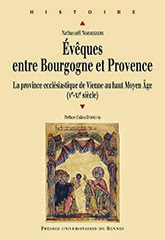
Publication – Nathanaël Nimmegeers, "Évêques entre Bourgogne et Provence. La province ecclésiastique de Vienne au haut Moyen Âge (Ve-XIe siècle)"

Au cours du haut Moyen Âge, le rayonnement de Vienne s’exerce bien au-delà de la moyenne vallée du Rhône. Capitale de la province administrative de Viennoise puis d’une province ecclésiastique qui porte son nom, la ville occupe une position stratégique au contact de la Bourgogne et de la Provence. Forts de cette situation exceptionnelle, ses métropolitains puis ses archevêques déploient leur influence des portes de Lyon au sud de Valence et du Vivarais aux crêtes alpines. Parmi eux se détachent de grandes figures : Mamert l’inventeur des Rogations, Avit le conseiller des rois burgondes ou encore Adon, auteur de la seule chronique épiscopale carolingienne connue au sud de la Loire.

De génération en génération, ces prélats travaillent à la promotion de leur siège et luttent pied à pied contre les ambitions de leurs homologues de Lyon et d’Arles. Ils administrent les affaires ecclésiastiques avec l’appui des souverains et refusent toute concurrence monastique ou aristocratique, ce qui leur permet de contrôler la vie régulière, la gestion des reliques et les institutions religieuses. Leur implication dans l’histoire de l’Occident accentue sans cesse une macrocéphalie provinciale qui laisse peu de place à leurs suffragants, même si les recompositions territoriales des Xe et XIe siècles confèrent une certaine autonomie aux évêques de Genève.

Nathanaël Nimmegeers, agrégé d’histoire et docteur en histoire médiévale, a obtenu le Prix de thèse 2011 de l’université Jean Moulin-Lyon 3. Il est actuellement chercheur à l’École des hautes études hispaniques et ibériques (Casa de Velázquez, Madrid).

Table des matières : ici
Informations pratiques :
Nathanaël Nimmegeers, Évêques entre Bourgogne et Provence. La province ecclésiastique de Vienne au haut Moyen Âge (Ve-XIe siècle), Rennes, Presses Universitaires de Rennes, 2014 (Histoire). 16,5 x 24 cm, 404 p. ISBN : 978-2-7535-2884-0. Prix : 24,00 €.

Source de l’information : Presses Universitaires de Rennes
Publié dans Publications | Laisser un commentaire

Web – Französisches Etymologisches Wörterbuch de Walther Von Wartburg

Le dictionnaire étymologique et historique du galloroman (français et dialectes d’oïl, francoprovençal, occitan, gascon) Französisches Etymologisches Wörterbuch (FEW).
En vertu d’une convention passée entre le Fonds National Suisse et le CNRS, le Centre du Französisches Etymologisches Wörterbuch (FEW) a été transféré en 1993 de Bâle à Nancy, à l’INaLF (devenu depuis l’ATILF). Sa tâche consiste à poursuivre dans ce cadre l’édition du dictionnaire étymologique du galloroman fondé et rédigé, pour sa plus grande part, par le Suisse Walther Von Wartburg (1888–1971).
La traduction du titre de l’ouvrage : Dictionnaire étymologique français et son sous-titre : Une représentation du trésor lexical galloroman (= Eine darstellung des galloromanischen sprachschatzes) déterminent la perspective et l’objet que lui avait assignés Warttburg. Le FEW vise à fournir le tableau le plus complet possible du lexique galloroman dans une perspective génétique. Véritable Thesaurus galloromanicus, le FEW s’efforce de rassembler toutes les données accumulées par la lexicographie du français, du francoprovençal, de l’occitan et du gascon, de leurs parlers dialectaux, de leurs argots et de leurs technolectes, tant dans leurs états passés que modernes. Ces données, après analyse des évolutions phonétiques, morphologiques et sémantiques qui les ont marquées, sont classées, avec les références précises aux sources, dans des articles qui décrivent et expliquent le développement depuis l’étymon jusqu’aux aboutissements contemporains dans toutes ses ramifications morphologiques et sémantiques.
Accès : ici
Source de l’information : ATILF
Publié dans Web | Laisser un commentaire