Appel à contribution – Bucema Varia 18.1

Le Bucema 18.1 publié en ligne sur la plateforme Revues.org est en préparation et vous invite à soumettre, dès maintenant et avant le 28 février 2014, votre contribution pour ses différentes rubriques en vue de la publication du numéro varia n° 18.1, à paraître en juin 2014. Pour exemple, le numéro 17.1 est consultable à cette adresse.

Fidèle à son principe de diffusion de la recherche en train de se faire et librement accessible, le Bucema continue à mettre l’accent sur l’interdisciplinarité ‐sciences humaines et sociales, sciences de la nature et mathématiques‐, comme le meilleur moyen d’inventer une nouvelle médiévistique. Il est particulièrement intéressé par les contributions proposant des nouvelles méthodes, faisant état d’expériences dans le domaine des humanités numériques (digital humanities) et des nouvelles technologies, s’interrogeant sur les implications épistémologiques et conceptuelles des recherches sur le Moyen Âge. Il accueille aussi des études et des synthèses de fond dans les domaines de l’archéologie, de l’histoire et de l’histoire de l’art, tout en se faisant l’écho de l’actualité de la recherche la plus récente.

Tourné vers la communauté scientifique internationale, le Bucema accepte des contributions dans les langues suivantes : allemand, anglais, espagnol, français, italien, portugais.

Le contenu de votre contribution est soumis à un comité de lecture avant publication.

Les différentes rubriques :
  • Recherche active : articles et études de fond inédits ;
  • Entretien: échanges avec un(e) spécialiste sur son expérience dans son domaine de recherches ;
  • Note de lecture : essai bibliographique thématique, autour d’un ou plusieurs ouvrages ;
  • Point de vue : sur une expérience concrète d’exercice, avec des implications dans le champ de la recherche ;
  • Découvertes : archéologique, archivistique, textuelle, iconographique, artistique, etc., importante ;
  • Chantiers: communications brèves mais problématisées, faisant état des avancées scientifiques des recherches nouvelles ou en cours (fouilles archéologiques, recherches archivistiques, iconographiques, lexicales, etc.) ;
  • Chroniques : synthèses fouillées des rencontres scientifiques ;
  • Dissertatio : résumés de thèses, de dissertations et de mémoires ;
  • À venir : annonces de nouveaux programmes de recherches, des rencontres à venir.


Les contributions doivent être envoyées en format électronique au secrétariat de rédaction : bucema.contact@gmail.com

Elles doivent suivre les normes rédactionnelles consultables à :http://cem.revues.org/index522.html
Modalités de soumission des articles
Les articles seront soumis au comité de rédaction et envoyés au secrétariat de rédaction de la revue, sous forme électronique (fichier attaché format .doc, .docx), à l’adresse suivante :

dès maintenant et avant le 28 février 2014.

Les articles doivent être inédits et ne pas être soumis simultanément à une autre publication.
Tout auteur qui envoie un article au Bucema‐Bulletin du Centre d’études médiévales d’Auxerre, si cet article est accepté, reconnaît au CEM le droit de le publier sous forme électronique sur le site Revues.org.
Le comité de rédaction :
Pierre Bonnerue (CEM)
Claude Coupry (CNRS)
Noëlle Deflou-Leca (Univ. Grenoble)
Marie-José Gasse-Grandjean (CNRS)
Dominique Iogna-Prat (CNRS -EHESS)
Eliana Magnani(CNRS)
Daniel Russo (Univ. Bourgogne)
Christian Sapin (CNRS-CEM)

Source de l’information : Calenda
Publié dans Appel à contributions | Laisser un commentaire

Journée d’étude – Kloster und Identität

Interdisziplinäres Kolloquium organisiert von der Fachkommission Geschichte Kloster Muri

24. Januar 2014
Universität Luzern, SOC Hörsaal 3.B47,
Frohburgstrasse 3, 6003 Luzern (Schweiz)

Innere und an sie herangetragene Krisenmomente sowie gesellschaftliche Herausforderungen gehören seit ihrer Entstehung zum Alltag monastischer Lebensformen. In ihrer äussersten Ausprägung konnten diese mit der Auflösung von Klöstern enden, in moderateren Formen einen Paradigmenwechsel in Bezug auf ihre innere Ordnung oder den weltlichen Bedingungen ihrer Existenz bedeuten. Immer jedoch waren Individuen als Einzelne und im Kollektiv mit einer Veränderung oder Neuordnung der Verhältnisse konfrontiert und in Bezug auf ihre Identität als Mitglieder einer klösterlichen Gemeinschaft und in ihrer Identifikation mit der monastischen Lebensform herausgefordert. Die interdisziplinäre Kolloquiumsreihe zu Klosterforschung widmet sich mit der nächsten Veranstaltung dem Thema monastische Identitäten. Dabei werden Biografien und Lebensverläufe von Individuen aber auch Identitätsbilder ganzer Klostergemeinschaften in den Blick genommen. Entwicklungen und Veränderungen der Selbst- und Fremdbilder verschiedener Epochen werden in Bezug zu gesellschaftlichen, politischen und wirtschaftlichen Ereignissen jeweiliger Lebenszeiten und -orten gesetzt. Der Bedeutung und dem Bedeutungswandel von Identitäten und Identitätsbildern wird dabei ebenso Rechnung getragen wie der teilweisen Diskrepanz zwischen Innen- und Aussenperspektive auf monastische Wesenseinheiten.

Die von der Fachkommission Geschichte Kloster Muri organisierte Kolloquiumsreihe startete 2013 dank Unterstützung des Graduate Campus Zürich mit einer Tagung zum Thema Kloster und Herrschaft an der Universität Zürich. Das diesjährige Kolloquium findet an der Universität Luzern statt und wird von der Stiftung Geschichte Kloster Muri getragen. Ziel ist es, den interdisziplinären und interuniversitären Austausch von Nachwuchsforschenden und Expertinnen und Experten zu fördern. Der gewählte Rahmen ist ideal, um Fragestellungen und Probleme von Qualifikationsschriften Fächer- und Epochengrenzen übergreifend zu diskutieren.

Das Programm:

Teil I : Varianten Biografischer Zugänge

9h00 : Kaffee und Gipfeli

09h30-9h45 : Prof. Dr. Markus Ries (Theologe/Kirchenhistoriker, UNILU) – Einführung
Moderation : Prof. Dr. Markus Ries

09h45-10h30* : Dr. Esther Vorburger-Bossart, lic. phil. Regula Schär (Kirchenhistorikerinnen, UNILU) – Biografische Einzelzugänge, Kollektive Identität: Religiöse Frauengemeinschaften der Ostschweiz im 20. Jahrhundert

10h30-11h15* : Dr. des. Myriam Rutschmann Unternährer (Erziehungswissenschaftlerin, UZH) – Biografische Geschlechter(re)konstruktionen katholischer Kongregationsschwestern
Moderation :   Prof. Dr. Martina Stercken (Historikerin/Mediävistin, UZH)

11h30-12h15* : lic. phil. Sybille Knecht (Historike-rin/Mediävistin, UZH) – Ausharren oder austreten? Lebenswege von Nonnen nach der Klosteraufhebung am Beispiel der Städte Zürich, Bern und Basel

12h15-12h45** : Vorstellungsrunde

Teil II : Innen-und Aussenperspektive

13h45-14h15 : Prof. Dr. Carola Jäggi, (Kunsthistorikerin, UZH) – Keynote Speech

14h15-15h00* :    Mag. M.A. Sebastian Mickisch (Kunsthistoriker, Technische Universität Dresden) – Innen und Aussen: Konstruktion und Symbolik von Grenz- und Schwellenräumen im mittelalterlichen Kloster
Moderation : Prof. Dr. Carlo Moos (Historiker/Neuzeit, UZH)

15h15-16h00* : lic. phil. Nina Caprez (Historikerin/Neuzeit, UNIFR) – Krisenzeit im Kloster Muri: Die Herausforderungen nach 1918 aus Innen- und Aus-senperspektive

16h00-16h45* : lic. phil. Annina Sandmeier-Walt (Historikerin/Neuzeit, UZH) – Die Aufhebung des Klosters Muri: Wandel von Wahrnehmung und Erinnerung

* 25 Minuten Präsentation gefolgt von 20 Minuten Diskussion
** nicht mehr als 5 Minuten pro Projekt

Publié dans Colloque | Laisser un commentaire

Appel à contribution – Trust and Happiness in the History of Political Thought

Trust and Happiness in the History of Political Thought: Third International Conference of the European Society for the History of Political Thought
Central European University, Budapest
17-19 September, 2014

In political and public discourse, as well as in political science and theory, debates concerning trust, fidelity, happiness, well-being, social contract and capital, and the connections between them, have intensified over the past two decades. The Society invites proposals that bring the perspectives and methods of the history of political thought to bear on these concepts and connections in ancient, medieval, and modern European contexts. Prospective participants are also encouraged to reflect on the wider implications of their empirical topic for the state of the art and the overall relevance of the field. 

Keynotes: 
Steven Johnstone (Arizona) – trust and citizenship in ancient Greece 
Ralf-Peter Fuchs (München) – trust as a concept of religious plurality during the Thirty Years War 
John Dunn (Cambridge) – toleration, trust and the travails of living together globally 

Send proposals (individual papers: max. 200 words; full panels: max. 600 words) with a short CV to trustandhappiness@ceu.hu by 15 January, 2014. 

László Kontler 
Central European University 
9 Nádor u. 
H-1051 Budapest 
Tel. 0036 1 3273000/2514

Source de l’information : H-Net
Publié dans Appel à contributions | Laisser un commentaire

École d’été – Geographical, Ethnic, Social and Cultural Frontiers in Late Antiquity

The Summer Intensive Course – Luminosus Limes: Geographical, Ethnic, Social and Cultural Frontiers in Late Antiquity to be held at Central European University, in Budapest, July 7-12, 2014 is calling for participants.

The “Bright Frontier” summer course explores the dynamic transformation of classical frontiers between the second and the sixth century from a multidisciplinary perspective: archaeology, medieval studies, social and cultural history, art, theology, and literature. Offering a groundbreaking approach to the field of border studies including social, gender, ethnic and religious categories with the participation of outstanding scholars in the field, this course will provide students with a solid knowledge of up-to-date international scholarship on frontiers: a strong theoretical background as well as hands-on acquaintance with physical borders and material artifacts excavated along the Danube River (the ripa Pannonica) as well as in the late antique cemetery of Pécs in Hungary.

The “Bright Frontier” summer course explores the dynamic transformation of classical frontiers between the second and the sixth century from a multidisciplinary perspective: archaeology, medieval studies, social and cultural history, art, theology, and literature. Offering a groundbreaking approach to the field of border studies including social, gender, ethnic and religious categories with the participation of outstanding scholars in the field, this course will provide students with a solid knowledge of up-to-date international scholarship on frontiers: a strong theoretical background as well as hands-on acquaintance with physical borders and material artifacts excavated along the Danube River (the ripa Pannonica) as well as in the late antique cemetery of Pécs in Hungary.

For more information, see: http://www.summer.ceu.hu/limes-2014

Source de l’information : The Medieval Academy blog
Publié dans École d'été, Colloque, Stage | Laisser un commentaire

Bourse – « Research in Paris ». Chercheurs étrangers à Paris (2014-2015)

La Mairie de Paris a lancé, le lundi 16 décembre 2013, l’édition 2014 du dispositif d’accueil des chercheurs étrangers dans les laboratoires publics parisiens « Research in Paris ».

Critères d’éligibilité
Le programme d’accueil s’adresse uniquement aux chercheurs étrangers titulaires d’un doctorat (PhD) et affiliés à une structure de recherche dans leur pays, où ils doivent impérativement résider et travailler. Une priorité est accordée aux chercheurs étrangers juniors, titulaires d’un doctorat depuis moins de cinq ans, dans la mesure où plus de 2/3 des aides leurs sont réservées.

Ne sont pas éligibles
– les candidats de nationalité française
– les candidats étrangers résidant déjà en France ou travaillant déjà en France ou ayant déjà été lauréat les années précédentes

Durée du séjour
– chercheurs juniors : minimum 6 mois et maximum 12 mois
– chercheurs seniors : de 2 à 6 mois

La date d’arrivée du chercheur doit être comprise entre le 1er septembre 2014 et le 28 février 2015.

Indemnités de séjour et frais de voyage
– chercheurs juniors: 2500€ nets mensuels
– chercheurs seniors : 3000€ nets mensuels

Les frais de voyage aller/retour entre le pays d’origine et la France sont pris en charge sur la base d’un forfait en fonction de l’origine géographique et au vu des justificatifs des frais engagés. L’assurance médicale du chercheur est également prise en charge par le programme.

Deadlines
Les candidats pourront candidater jusqu’au jeudi 13 février 2014 à midi (heure française).


Source de l’information : blog de l’ApAhAu
Publié dans Bourse | Laisser un commentaire

Offres d’emploi – Two postdoctoral fellowships (The Max Planck Institute for the History of Science, Berlin)

The Max Planck Institute for the History of Science, Berlin (the Max Planck Research Group Art and Knowledge in Pre-Modern Europe; Director: Prof. Dr. Sven Dupré) announces :


two postdoctoral fellowships for up to two years 

starting date between July 1 and October 1, 2014. Outstanding scholars are invited to apply. 

Candidates should hold a doctorate in the history of science and technology or a related field (art history, conservation science, technical art history, history of medicine) at the time of application and show evidence of scholarly promise in the form of publications and other achievements. Tenure of a prior postdoctoral fellowship will be to the candidate’s advantage. 

Particularly welcome are research projects on ‘Early Modern Art Technologies and Materials’:

However, research projects addressing the full scope of Max Planck Research Group dealing with the history of knowledge and art up to the eighteenth century (with a preference for the period between 1350 and 1750) will be considered. Research projects may concern any geographical area within Europe, and any of the visual and decorative arts. For short descriptions of the project, see http://www.mpiwg-berlin.mpg.de/en/research/projects/MRGdupre. 

Postdoctoral fellows are expected to take part in the scientific life of the Institute, to advance their own research project, and to actively contribute to the project of the Max Planck Research Group Art and Knowledge in Pre- Modern Europe. 

The Max Planck Institute for the History of Science is an international and interdisciplinary research institute (http://www.mpiwg-berlin.mpg.de/en/index.html). The colloquium language is English; it is expected that candidates will be able to present their own work and discuss that of others fluently in that language. Fellowships are endowed with a monthly stipend between 2.100 € and 2.500 € (fellows from abroad) or between 1.468 € and 1.621 € (fellows from Germany, who may alternatively opt for a contract TVöD E13 in the German system). 

Candidates of all nationalities are encouraged to apply; applications from women are especially welcome. The Max Planck Society is committed to promoting handicapped individuals and encourages them to apply. 

Only electronic submissions will be accepted. Candidates are requested to submit a cover letter, curriculum vitae including publication list, research prospectus (maximum 750 words), and at least one sample of writing (i.e. article or book chapter) to: 

Please arrange to have two referees send signed scanned letters of recommendation to: 

or originals by snail mail to: Max-Planck-Institut für Wissenschaftsgeschichte Max Planck Research Group Dupré Boltzmannstr. 22
14195 Berlin
Germany 

Deadline for submission: 15 February 2014 // Interviews will take place on 26 March 2014. 

For questions concerning the Max Planck Research Group on Art and Knowledge in Pre-Modern Europe, please see http://www.mpiwg-berlin.mpg.de/en/research/projects/MRGdupre or contact Sven Dupré (officedupre@mpiwg- berlin.mpg.de). For questions relating to the online application procedure please contact (officedupre@mpiwg- berlin.mpg.de). For administrative questions concerning the position or the Institute, please contact Claudia Paaß (paass@mpiwg-berlin.mpg.de), Head of Administration, or Jochen Schneider (jsr@mpiwg-berlin.mpg.de), Research Coordinator.
Publié dans Offre d'emploi | Laisser un commentaire

Appel à contribution – Creating Nothing New. Perspectives on the Faithful Copy 1300-1900

Hannover, Schloss Herrenhausen
26. – 28.06.2014

Deadline-CFP: 20 janv. 2014

Up until a few years ago art history showed little interest in the phenomenon of copies: « Versions » of « art works » that were closely related in terms of form and content were mostly dealt with in footnotes and could be found in the storage rooms of museums or as second-rate exhibits. However, the last years have seen a « renaissance of the copy ». Inspired by media theory and the transformation theories of social and cultural history the copy phenomenon has been pulled from the shadows and partially illuminated, using labels such as citation, variation, transfer medium and multiple.
Yet interestingly, the primary focus still seems to lie on the characteristics that make a copy different from the alleged « original » and thus « new ». But this emphasis on innovative and individual achievements in the process of repetition, as well as on claims of originality and authorship, means that the object of study is still being measured against something it is not inherently meant to be. The conscious approximation of a painted, drawn, printed or sculpted prototype (be it in a different or in the same medium) is thus rarely targeted. Only the realization that artistic freedom and creative autonomy are not sufficient as criteria for the aesthetic and art historical evaluation of faithful copies can lead to an appreciation of their very own qualities.
Therefore the conference aims to focus impartially on the constitutive characteristics of the faithful copy, such as similarity, exactitude and dependence. These shall be liberated from their possible negative connotations and instead analyzed as measures of quality. In addition, their discussion should provoke a fresh sight on faithful copies and help to develop ideas for their future presentation and treatment in the museum context as well as in academic research.
Possible topics may include:
  • historical concepts of truthfulness and similarity, for example in art theory 
  • the faithful copy in museum practice and conservation 
  • the function of faithful copies in the process of artistic creation and apprenticeship 
  • faithful copies functioning as substitutes 
  • faithful copies for purposes of propaganda and ostentatious reference 
  • the reception of faithful images from a psychological perspective 
  • the faithful copy as a gender-related concept 
  • the faithful copy in relation to copyright issues 
  • the faithful copy in media theory 
  • faithful copies of cult images in cultural anthropology 
We welcome short proposals (up to 1800 characters) for 25 minute presentations from (junior) researchers to copyconference@gmail.com until January 20th 2014.

Antonia Putzger, M.A. (TU Berlin)
Marion Heisterberg, M.A. (U Bonn)
Dr. Susanne Müller-Bechtel (TU Dresden)
This conference is funded by VolkswagenStiftung.

Source: H-Arthist
Publié dans Appel à contributions | Laisser un commentaire

Séminaire – Commerce & Urban Rivalry in the Low Countries, 1250 – 1650

On 28 January 2014, the University of Antwerp hosts the workshop Commerce and Urban Rivalry in the Low Countries, 1250-1650. This workshop aims to bring together a varied selection of scholarly specialists to reflect on the topic of Oscar Gelderblom’s recent book ‘Cities of Commerce’. It wishes to single out the possible directions for future research in this field of historical enquiry. 
Time: Tuesday 28 January 2014, 13.00 – 18.30 hours. 
Place: W. Elsschotzaal, Hof van Liere, University of Antwerp. 
Programme :
Programme : here
After a welcome by Henk De Smaele (Head of the History Department of the University of Antwerp) and an introduction to ‘Cities of Commerce’ by Peter Stabel (Professor of Medieval History, University of Antwerp), the following speakers are lined up: 
  • Oscar Gelderblom, Associate Professor of Economic History (Utrecht University);
  • Thomas Max Safley, Professor of Early Modern European History (University of Pennsylvania);
  • Leo Lucassen, Professor of Social History (Leiden University);
  • Bart Lambert, Post-doctoral researcher (University of York) & Jan Dumolyn, Professor of Medieval History (Ghent University);
  • Guillaume Daudin, Professor in Economics (Université Paris-Dauphine);
  • Bruno Blondé, Professor of Early Modern History (University of Antwerp);
Finally, a plenary session – followed by drinks – will be moderated by Hilde Greefs, Professor of Modern History (University of Antwerp). 
A full programme of the workshop Commerce and Urban Rivalry in the Low Countries, 1250-1650 can be found here.
Information :
Organisers: 
Jeroen Puttevils (UA) 
Wouter Ryckbosch (UA & VUB) 
Jessica Dijkman (UU) 
Peter Stabel (UA). 
This workshop is realised with the financial support of: 
IAP 7/26 programme ‘City and Society in the Low Countries.’ 
Participation is free, but registration is required: wouter.ryckbosch@uantwerpen.be.
Source de l’information : Universiteit Leiden
Publié dans Séminaire | Laisser un commentaire

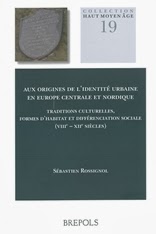
Publication – Sébastien Rossignol, "Aux origines de l’identité urbaine en Europe centrale et nordique. Traditions culturelles, formes d’habitat et différenciation sociale (VIIIe-XIIe siècles)"

Cette publication étudie les conceptions d’un habitat à caractère urbain dans les territoires de l’Europe centrale et nordique situés à l’extérieur des anciennes provinces romaines avant la période de transformations sociales et démographiques du Moyen Âge central.

Y a-t-il eu un habitat à caractère urbain dans les territoires de l’Europe centrale et nordique situés à l’extérieur des anciennes provinces romaines avant la période de transformations sociales et démographiques du Moyen Âge central? Bien que cette question ait préoccupé de nombreuses générations de chercheurs, les réponses proposées sont restées ambiguës. Cette étude reprend le dossier en abordant le problème du point de vue des auteurs médiévaux: avait-on, lors des siècles précédant les transformations accompagnant la fondation de villes nouvelles aux XIIe et XIIIe siècles, une conception d’un habitat urbain? Avait-on conscience d’une particularité, d’une qualité, d’une identité urbaine? Les recherches archéologiques des dernières décennies invitent à une reconsidération de l’habitat et du mode de vie des populations du haut Moyen Âge. Seule, cependant, une approche interdisciplinaire permet d’illustrer pourquoi le processus d’urbanisation, en tant que phénomène culturel, était le résultat d’interactions constantes entre traditions culturelles, formes d’habitat et différenciation sociale.

Informations pratiques :
Sébastien Rossignol, Aux origines de l’identité urbaine en Europe centrale et nordique. Traditions culturelles, formes d’habitat et différenciation sociale (VIIIe – XIIe siècles), Turnhout, Brepols, 2013 (Haut Moyen Âge, 19). Approx. 402 p., 23 b/w ill., 156 x 234 mm. ISBN: 978-2-503-54781-7. Prix : 75,00 euros.
Publié dans Publications | Laisser un commentaire

Appel à contribution – 3rd International Postgraduate Conference on Medieval Archaeology

The Department of Medieval and Post-Medieval Archaeology, Leopold-Franzens-University Innsbruck, together with the Urban Archaeology Hall in collaboration with the Seminar of Pre- and Protohistoric Archaeology of the Georg-August-University Göttingen cordially invite to the third Postgraduate Conference on Medieval Archaeology (PCMA) in Austria.

This meeting will be held from March 28-30, 2014 in Hasegg Castle in the historic town Hall in Tirol. 
The PCMA symposium offers an excellent opportunity for postgraduate students and young scholars from Eastern and Western Europe, who are currently carrying out research in this discipline, to present their work, exchange ideas and meet people who work in the same field.

We welcome all papers regarding archaeological, historical and anthropological topics, or rather material culture and art history related to Medieval or Early Modern Archaeology. The aim of this congress is to build new bridges between young archaeologists in East and West in our smaller becoming field of research and to encourage more common projects, also outside of university facilities.
Please send your paper proposal with title, an abstract (as PDF or Word-doc) of no more than 300 words and the name and address of the author (or authors), to Mittelalterarchaeologie@uibk.ac.at no later than January 15th, 2014.

Students in their introductory study period and graduate students are welcome to attend the conference without presenting a paper (registration deadline also January 15th). 

The papers can be presented in English or German. Speakers presenting their paper in German are asked to hand in an abstract in English and to provide their PowerPoint presentations either with English or bilingual captures. Presentations should not be longer than 20 minutes, as they will be followed by a discussion. 
Besides the presentation of their own work progress in the form of short presentations, a workshop-based forum with debate and also an intensive program with evening lectures, excursions in the neighbourhood, a city tour and dining with plenty of time for discussions are on the program. 
There will be no registration fee. The incurring costs during the excursions (admission fees to museums) and any transfers by public transport are to be paid by the participants themselves. The organizers are happy to help finding affordable accommodation and car sharing. To order the optional lunch and dinner a separate circular will be sent. 
We would especially like to encourage students and doctoral candidates from Eastern Europe to participate.

For recommended hotels in Hall in Tirol and the Youth-Hostel in Innsbruck see: Hotels in Hall in Tirol

For further inquiries please contact:
Mag. Beatrix Nutz
FB Mittelalterarchäologie
Universität Innsbruck
Langer Weg 11
A-6020 Innsbruck

Christoph Kühne M.A.
Sem. für Ur- und Frühgeschichte
Universität Göttingen
Nikolausberger Weg 15
D-37073 Göttingen

Birthe Lehnberg M.A.
Sem. für Ur- und Frühgeschichte
Universität Göttingen
Nikolausberger Weg 15
D-37073 Göttingen

Source de l’information : Universität Innsbruck
Publié dans Appel à contributions | Laisser un commentaire