Appel à contribution – Autour de la notion d’art impérial. Sessions Art-Hist International Medieval Congress Leeds 2014

The Art-Hist project will organize in July 2014 two sessions during the next International Medieval Congress in Leeds (UK). The platform ART-HIST is designed as a structure of « virtual symposium » in which an original paper is proposed as support of discussions and exchanges between the members of a community of researchers invited to exchange on artistic creation from Antiquity to Modern times. A moderator assures the flow of exchanges between the participants to the virtual symposium, leads the debate and writes the synthesis of discussions. As a conclusion, the diptych article-synthesis is published on-line and becomes accessible to Internet users.
The theme of the next IMC is “Empire”; that’s why the Art-Hist project would like to explore topics dealing with “Imperial images and shapes: historical and historiographical approaches” and try to answer some questions: Does an imperial art exist during Carolingian or Ottonian Empire? How can it be defined? What can recall or evoke, in medieval works of art, the idea or concept of Empire? How does this principle of evocation work in artistic creation? How did emperors use these forms or images to build their own power and history?
Submission guidelines
Proposals (title and abstract) have to be sent
before August, 25th
to Estelle Ingrand-Varenne (estelle.ingrand.varenne@univ-poitiers.fr)
and Vincent Debiais (vincent.debiais@univ-poitiers.fr).
Papers can be published after the IMC in the framework on the Art-Hist platform (http://art-hist.edel.univ-poitiers.fr).
Papers will be evaluated by Art-hist project’s members.
Source de l’information : Calenda
Publié dans Appel à contributions | Laisser un commentaire

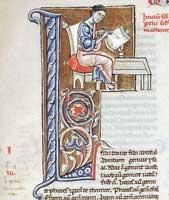
Documentaire – Hildegard of Bingen: Authorship and Stylometry

HD documentary, first shown 18 July 2013 @ Digital Humanities 2013 (#dh2013) — in Lincoln, Nebraska, USA (dh2013.unl.edu/abstracts/ab-126.html).
The documentary (here) based on the scientific article: Kestemont, M.; Moens, S. & Deploige, J., Collaborative Authorship in the Twelfth Century. A Stylometric Study of Hildegard of Bingen and Guibert of Gembloux. Under review for publication with: LLC. The Journal of Digital Scholarship in the Humanities, Oxford University Press.
The documentary was first shown on 18 July at the Digital Humanities 2013 Conference in Lincoln, Nebraska, USA, replacing the author’s original contribution: ‘Stylometry and the Complex Authorship in Hildegard of Bingen’s Oeuvre’.
Editing & Camera: Jo Bruyninckx
Sound: Johan Limbourg
Visual FX: Sander Van Dijck
Still Photography: Bram Tack
Images of the manuscript Dendermonde, Abbey of Saint Peter & Saint Paul, Ms. Cod. 9 have been digitized by the Alamire Foundation Digital Lab; Courtesy of Dendermonde, Abbey of Saint Peter & Saint Paul.
We value your feedback: please send all correspondence to mike (dot] kestemont (at] ua (dot] ac (dot] be
Source de l’information : Vimeo
Publié dans Documentaire | Laisser un commentaire

Journée d’étude – Historical documents, digital approaches

Historical documents, digital approaches.
Mark-up, analysis and representation of Medieval texts. Theory and practice
Ghent University, 5-7 september 2013

Three-day seminar-workshop on the use of Humanities computing methods in Historical Studies organized by the Ghent Center for Digital Humanities, the Departments of History and of Languages and Cultures, and the Ghent Center for Slavic and East European Studies, in cooperation with the Flemish Medieval Studies Workgroup and the Henri Pirenne Institute of Medieval Studies.

While e-Humanities conferences abound, reporting on specific tools and special methodological and technical issues, this seminar-workshop seeks to reach digital novices as well as a more advanced audience by wedding the opposite extremes of the spectrum, viz. practice at its most basic and theory at its most general and abstract level

Programme : here

Source de l’information : Vlaamse Werkgroep Medievistiek
Publié dans Séminaire | Laisser un commentaire

Offre d’emploi – The forging of a Pre-Modern Urban Elite. Political Networks and Social Change in Sixteenth-Century Ghent, VUB, PhD

At the Vrije Universiteit Brussel there is a vacancy for a Four-Year PhD Fellowship (Full-Time)


Project description : the forging of a pre-modern urban elite. Political networks and social change in sixteenth-century Ghent
This project is dedicated to elite formation in the city of Ghent, one of the largest cities of the Habsburg Low Countries. It aspires to understand how urban elites were shaped and reshaped in light of a wide range of far-reaching transformations within urban society, from socio-economic trends over the dawning of religious dissent to the shifting balance of power between the Ghent community and princely government. Taking the political elite of Ghent as a point of departure, this research project is concerned with questions concerning the definition and organization of elite families, processes of social mobility between elites and the milieu of the Ghent craft guilds, the socio-economic basis of the urban power elite and the interactions and overlaps between that power elite and those of the surrounding countryside, neighboring towns and the Habsburg state. This project will contribute to the international debates on pre-modern urban elites by the application of qualitative and quantitative approaches within a comparative framework in which the case study of Ghent is measured against research for other late medieval and early modern cities.

The PhD fellow is expected to publish and disseminate research results to an academic audience and to complete a PhD within four years.

This PhD-project is funded by the Interuniversity Attraction Poles (IAP) of Belgian Science Policy Office and is part of the project City and Society in the Low Countries (ca. 1200-ca. 1850) – Work package 3: Urban Community Building: Inclusion and Exclusion. Prof. dr. Frederik Buylaert (VUB) will act as supervisor; prof. dr. Anne-Laure Van Bruaene (Ghent University) as co-supervisor.

Candidate profile
  • Master’s degree in History or other relevant Master’s degree with demonstrable interest in historical research (students who will graduate in September 2013 can apply). Research experience related to the project’s subject matter is a plus.
  • Good knowledge of Dutch, French, and English
  • Good writing and presentation skills
  • An enthusiastic and dynamic team player
  • Willing to travel abroad for research, conferences, meetings etc.

Offer
  • A 4-year contract (via yearly renewals) as a full-time scientific staff member of the Vrije Universiteit Brussel (scholarship starting from around 1800 euros net./month)
  • Contact with national and international research groups
  • A friendly, dynamic environment for research
  • Opportunity to follow an individualized PhD program at the VUB Doctoral School of Human Sciences, including language courses
  • Start of project: between 1 October 2013 and 1 January 2014

How to apply
To apply, please send a letter of motivation together with a recent CV, transcript of grades and pdf version of your Master’s thesis to Frederik.Buylaert@vub.ac.be before August 15th. Selected candidates will be invited for an interview in late August, and notified about the results before September 15th.

For further details, please contact Frederik.Buylaert@vub.ac.be

Source de l’information : Vlaamse Werkgroep Medievistiek
Publié dans Offre d'emploi | Laisser un commentaire

Appel à contribution – White, Empty, Silent in Medieval Artistic Creation. Art-Hist sessions in Kalamazoo 2014

In Spring 2014, Art-Hist will organize two sessions at Kalamazoo International Congress on Medieval Studies (8-11 May). Art-Hist sessions this year will deal with « White, Empty, Silent in Medieval Artistic Creation ». The committee offered us two sessions: « I. Paleographical Aspects »; « II. From Sonorous White to Visual White: Silence and Its Representation ». We are expecting proposals dealing with representation of silence in Medieval art and graphic practices. The deadline for the paper proposal is September 15th. 
Argument
White, Empty, Silent in Medieval Artistic Creation.
Session I: “Paleographical Aspects”.
Session II: “From Sonorous White to Visual White: Silence and Its Representation”.
The platform ART-HIST is designed as a structure of « virtual symposium » in which an original paper is proposed as support of discussions and exchanges between the members of a community of researchers invited to exchange on artistic creation from Antiquity to Modern times. A moderator assures the flow of exchanges between the participants to the virtual symposium, leads the debate and writes the synthesis of discussions. As a conclusion, the diptych article-synthesis is published on-line and becomes accessible to Internet users.
New questions regarding the ability of inscribed, engraved, sculpted or painted signs to depict absence or emptiness. This topic can be explored in even the more anachronistic connotations through three terms: whiteness, emptiness, and silence. This broad theme of research encompasses both the intellectual conception of blankness and its use in the material and artistic culture. 
By ascribing blankness a real value, this call for papers do not intend to understand the terms “whiteness, emptiness, and silence” within the strict sense of their opposition (black, fullness, and the voice), as if blankness were simply a null presence, whether auditory, visual, or gestural. Instead, it returns the material status to blankness that the concept held in the Middle Ages when it was understood as a substance with numerous tangible qualities and a complex, symbolic background. 
Blankness, as it is envisioned here, is above all a malleable material, invoked in order to represent things that are unrepresentable by the traditional semiotic methods of artistic creation, of literary and theological exegesis, or of material culture. The topic proposed by the Art-Hist collective will endeavor to find traces of the use and the characterization of this elusive material.
Submission guidelines
Proposals (title and abstract) have to be sent
before September, 10th
to Estelle Ingrand-Varenne (estelle.ingrand.varenne@univ-poitiers.fr)
Papers can be published after the IMC in the framework on the Art-Hist platform
Please use the PDF form to send your proposal or send an email to this blog editor (http://www.wmich.edu/medieval/congress/submissions/index.html#Paper).
Papers will be evaluated by Art-hist project’s members.
Les propositions seront évaluées par les membres du projet Art-hist ; conformément aux objectifs de la plateforme, les textes seront évalués pour leur capacité a créer le débat intellectuel et a favoriser l’échange entre enseignants, chercheurs et étudiants.
Lieu : Kalamazoo, États-Unis
Date : mardi 10 septembre 2013
Sites de référence : Art-Hist online review ; Art-Hist blog
Source de l’information : Calenda
Publié dans Appel à contributions | Laisser un commentaire

Stage – Stage d’initiation au manuscrit médiéval et au livre humaniste (domaines latin et roman)

L’IRHT organise un stage annuel d’initiation au manuscrit médiéval et au livre humaniste, destiné aux étudiants de Master I et II et thèse en lettres, en philosophie, en histoire (notamment de l’enluminure). Le prochain stage aura lieu du lundi 7 au vendredi 11 octobre 2013 à Paris.

Pour donner une perspective d’ensemble sur le travail et la recherche sur les manuscrits, différents thèmes sont abordés aux cours d’exposés magistraux et de séances en petits groupes : présentation de manuscrits et introduction à la codicologie, histoire de l’écriture, mise en page et décoration, transmission des textes, rapport texte/image, héraldique, histoire des bibliothèques, passage du manuscrit à l’imprimé, exercice d’édition de textes. Le stage est aussi l’occasion de découvrir l’IRHT et la documentation qu’il met au service des chercheurs.

Thèmes abordés : introduction à la codicologie, histoire de l’écriture, mise en page du manuscrit, rapport texte/image, transmission des textes, notions de reliure et d’héraldique.

Nous tenons à préciser que les séances ne comprennent ni apprentissage de la paléographie, ni exercice de lecture, ni histoire de l’art.

Le livret-guide du stage a pour objet de fournir les éléments essentiels pour s’initier à l’approche du manuscrit et de sa description, tels qu’ils ont été élaborés au fil du temps dans un laboratoire de recherche par des équipes spécialisées. Il est révisé chaque année et distribué sous format papier le premier jour du stage.

Nous vous signalons par ailleurs que les sections grecque et arabe de l’IRHT organisent deux autres stages spécifiques à leurs manuscrits.

Organisateur(s) IRHT: 
Bourlet Caroline
Flamand Jean-Marie
Kogel Judith
Liaigre Stéphane
Picque Nathalie
Informations pratiques :
Du 7 au 11 octobre 2013
Centre Félix Grat (IRHT) – Paris
Inscription nécessaire : inscription_2013.pdf
Livre de présentation : livret-presentation_stage2013.pdf
Source de l’information : IRHT
Publié dans Stage | Laisser un commentaire

Workshop – Scribbling Through History. Comparative studies of graffiti from Ancient Egypt onwards

Scribbling Through History is a three-day workshop devoted to the relationships between graffiti, individual expression and social interactions, from ancient times until the present day. The conference will take place at The Ertegun House, University of Oxford, between 23-25 September 2013.
Although many primary studies of such inscriptions have been carried out, this explanatory workshop will for the first time address historical graffiti in a holistic manner as a specific cultural practice and as an anthropological object that illuminates these key aspects of human experience. By fostering cross-regional, diachronic and integrative approaches, the workshop will develop new frameworks and agenda for this research.
Participants :
Roger Bagnall (Ancient History, New York University) – Solemnity and Play: the Mentality of the Smyrna Graffiti’
Paul Bertrand (Medieval History, Université de Louvain) – Graffiti and ordinary writing in the Middle Ages
Alain Delattre (Coptic, Greek, Papyrology, Université Libre de Bruxelles) – Local cults, pilgrimages and religious life. Christian inscriptions in the Theban Mountain
Glen Dudbridge (Chinese literature and culture, Oxford University) – Verses on walls in medieval China’
Elizabeth Frood (Egyptology, Oxford University) – Temple Graffiti in Ancient Egypt and Karnak.
Susanna Gebhardt (Early Modern England, Université de Genève) – Early Modern Wall-Writing
Omur Harmansah (Western Asian Archaeology, Brown University) – Miraculous Image and The Living Rock: Event and Deep Time at Anatolian Rock Reliefs’
Frédéric Imbert (Epigraphie arabe et islamique, Université d’Aix en Provence) – Islamic graffiti in Arabia during the two first centuries of Islam’
Cornelia Kleinitz (African Archaeology) – Writing and image making practices in the Meroitic world: contextualizing the graffiti of Musawwarat es Sufra, Sudan
Michael MacDonald (Ancient Arabia, Syria and Jordan, Oxford University) – The Nabataean and Ancient North Arabian graffiti: their use, function and distribution
Hana Navratilova (Egyptology, Metropolitan Museum of Arts) – Visitors graffiti in Ancient Egypt and the Memphite necropoleis
Elisabeth Olton (Maya history, University of New Mexico) – A Witness to History: Classic Maya Graffiti from Tikal, Guatemala
Richard Salomon (Ancient India, University of Washington) – Pilgrims, sailors and calligraphers: graffiti in the Indian world and beyond’. NB: R. Salomon will also (and separately) present his reflexion about pioneers’ graffiti in North America.
Karen Stern (Jews history in the Graeco-Roman world, Brooklyn College) – Methods to their madness? Deciphering mortuary graffiti of ancient Jews and their Levantine neighbours
Pierre Tallet (Egyptology, Université de Paris-Sorbonne) – Desert inscriptions in Ancient Egypt: the example of Sinai
Chairs and Discussants:
Prof. John Baines (Egyptology)
Dr. Jennifer Baird (Roman Archaeology)
Dr. Fredrik Hagen (Egyptology)
Dr. Christian Jacob (Anthropology)
Dr. Bryan Ward-Perkins (Late Roman History)

Scribbling through History will take place between 23-25 September 2013, at Ertegun House, 37A St Giles, Oxford, OX1 3LD [map]. The registration fee for attendees is £50, with coffee, lunch, and afternoon tea are provided for all participants. To register your interest and apply for a place, please address graffitioxford@gmail.com before 15 September 2013.
Support for the conference has been kindly provided by The John Fell OUP Research Fund, the Budge Fund (University College), the Faculty of Oriental Studies, the Ertegun House, and the Centre National de la Recherche Scientifique (UMR 8167 – Orient & Méditerranée/Mondes Pharaoniques).
To apply for a place, please address graffitioxford@gmail.com.


For further information please address the organiser, Chloé Ragazzoli (chloe.ragazzoli@orinst.ox.ac.uk), or the conference secretary, Charles Draper (charles.draper@queens.ox.ac.uk).
Publié dans Colloque | Laisser un commentaire

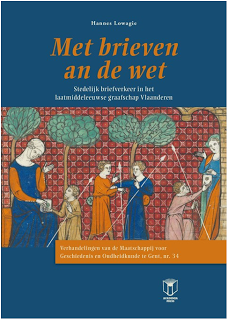
Publication – Hannes Lowagie, "Met brieven an de wet. Stedelijk briefverkeer in het laatmiddeleeuwse graafschap Vlaanderen"

In dit boek onderzoekt Hannes Lowagie de stedelijke communicatie in het vijftiende-eeuwse Vlaanderen. Voor het eerst wordt de correspondentie van steden zoals Gent en Brugge aan een diepgaand onderzoek onderworpen. Vernieuwend is dat de auteur het briefverkeer verklaart vanuit de sociaaleconomische positie van een stad en de interne politieke machtsverhoudingen. Het schrijven en sturen van brieven versterkte de machtspositie van een stad en stelde haar in staat het omliggende platteland te domineren. Aan wie schreven de Vlaamse steden en wat wilden ze hiermee bereiken? De auteur legt hierbij een verband tussen vormelijke aspecten zoals het zegel en de opmaak van de brief enerzijds en de relatie tussen zender en ontvanger anderzijds. Het briefverkeer wordt bovendien gekaderd in de multimediale context van een middeleeuwse samenleving. Dit werk steunt op een gedetailleerde studie van stadsrekeningen en op een corpus van 219 brieven, verzameld na intensief archiefonderzoek in België, Frankrijk en Engeland. Bijgevolg vormt dit boek een belangrijke en onmisbare studie van de politieke verhoudingen in het laatmiddeleeuwse Vlaanderen.

Hannes Lowagie (°1985) is mediëvist, geïnteresseerd in sociale geschiedenis, stadsgeschiedenis en politieke communicatie. Dit boek is gebaseerd op zijn proefschrift waarmee hij in januari 2012 een doctoraat in de geschiedenis behaalde aan de Universiteit Gent. In andere publicaties onderzocht hij de omgang met zelfmoord in de late middeleeuwen.
Informations pratiques :

Hannes Lowagie, Met brieven an de wet. Stedelijk briefverkeer in het laatmiddeleeuwse graafschap Vlaanderen, Gand, 2012 (Verhandelingen van de Maatschappij voor Geschiedenis en Oudheidkunde te Gent, nr. 34). Academia Press, 273 p.

Publié dans Publications | Laisser un commentaire

École d’été – Les économies de la pauvreté. Deuxième École d’été d’histoire économique

Deuxième École d’été d’histoire économique 
30-31 août et 1er septembre 2013 
Hyères 

Les économies de la pauvreté
Organisateurs : Katia Beguin (EHESS), Simona Cerutti (EHESS), Laurent Feller (Université Paris 1 Panthéon-Sorbonne/IUF), Julie Claustre (Université Paris 1 Panthéon-Sorbonne), Emmanuel Huertas (Université Toulouse 2-Le Mirail/CNRS). 

Programme provisoire :

Vendredi 30 août 

8h30 : Accueil des participants 

9h00 : Session 1 :  Laurent Feller (Université de Paris 1) et Katia Béguin (EHESS) – Les économies de la pauvreté : présentation et historiographie
10h00 : discussion 
10h30 : pause-café 

11h00 – 12h00 : Session 2 : Agnès Gramain (Université de Paris 1) et Giacomo Todeschini (Université de Trieste)  – Qu’est-ce qu’un pauvre ?
12h00: discussion 
12h30 – 14h00 : repas 

14h00 : Session 3 – La vulnérabilité
coordination Massimo Vallerani (Université de Turin)

Emmanuel Bain (Université de Nice) – L’exégèse, une source pour l’histoire économique du Moyen Âge
Diane Chamboduc (Université Paris 4) – Une histoire économique des milieux populaires lucquois à la fin du XIVe siècle
Christophe Speroni (Université d’Orléans) – Reconstituer les réseaux sociaux des pauvres au XVIIIe siècle
Mouna Ben Messaoud (Université deTunis) – Handicap et handicapés physiques à Paris au XVIIIe siècle

15h00 : discussion 
15h30 : Fin des travaux de la journée 


Samedi 31 août 

9h00 : Session 4 – Bonnes et mauvaises pauvretés

Eléonore Andrieu (Université Bordeaux 3) – Les représentations de la pauvreté dans les textes de langue d’oïl 
Bernard Gazier (Université Paris 1) – L’employabilité. Emploi, travail et pauvreté : le concept d’employabilité et ses usages. 
10h00 : discussion 
10h30 : pause-café 

11h00 : Session 5– Assistance et charité 
coordination Simona Cerutti (EHESS)

Marina Garbellotti (Université de Vérone) et Julie Claustre (Université Paris 1) – Grâce royale et action charitable
12h00 : discussion 
12h30 – 14h00 : repas 

14h00 : Session 6 – Assistance et charité (suite)

Sandra de la Torre (Université de Saragosse) – Les mathématiques du salut : les élites entrepreneuriales de Saragosse et la gestion de la charité (1380-1430) 
Aurore-Diane Simon (Université de Bourgogne) – Implantations, activités et relations des établissements d’assistance en Bourgogne à la fin du Moyen Age
Irène Strobbe (Université Paris 4 – Université de Gent) – Pouvoir et assistance à Lille à la fin du Moyen Age
Christelle de Monserrate (Université d’Evora) – Investir dans le développement humain : les dépenses de la Casa Pia de Lisbonne à la fin du XVIIIe siècle. Perspectives d’études
Fernando Franulic (EHESS) – Economie et stratification sociale au sein d’une institution hospitalière : le cas de l’hôpital Saint-Jean-de-Dieu (Chili, entre XVIIIe et XIXe siècle)

15h30 : discussion 
15h30 : Fin des travaux de la journée 


Dimanche 1er septembre 

9h00 : Session 7 – Pauvretés et hiérarchies sociales
coordination Emmanuel Huertas (Université Toulouse 2/CNRS) 

Lucie Malbos (Université Paris 1) – Changement social et changement économique dans, Framing the Early Middle Ages. Europe and the Mediterranean, 400-800 de Chris Wickham (Oxford, 2005)
James Norrie (Université d’Oxford) – The charters of the pieve Church Santo Stefano Vimercate in the diocese of Milan in the eleventh and early twelfth centuries
Philippe Lefeuvre (Université Paris 1) – Quelles lumières offrent les fonds des abbayes vallombrosiennes du contado florentin sur l’évolution des sociétés rurales aux XIIe et XIIIe siècles ? 
Thibault Cardon (EHESS) – La monnaie des pauvres (Moyen Age – Epoque moderne) 
Romain Grancher (Université de Rouen) – L’« armement à la part ». Salariat, association économique et pauvreté dans le monde de la pêche (Dieppe, XVIIIe siècle) 
Djanabou Bakary (Université de Maroua) – Marchés, marchandises et marchands dans les abords sud du lac Tchad (XIXe-XXe s.)

10h30 : discussion 
11h00 : pause-café 
11h30 : Table ronde conclusive

12h30 – 14h00 : repas 
Source de l’information : LAMOP
Publié dans École d'été | Laisser un commentaire

Offre d’emploi – Poste d’assistant à temps partiel (50 %) en histoire (Bruxelles)

Le Conseil d’administration de l’Université Saint-Louis – Bruxelles déclare ouverte la vacance, pour les années académiques 2013-2014 et 2014-2015, d’un poste d’assistant en histoire à mi-temps (50 %), éventuellement fractionnable.

Qualifications requises :
Les candidats à ce poste doivent être titulaires, au minimum, d’un diplôme de 2°cycle en histoire (licence, maîtrise, master 120) ou d’un diplôme équivalent obtenu avec mention. En outre, une spécialisation en histoire du Moyen-Âge et des Temps Modernes est recommandée.

Activités pédagogiques : 
Le candidat retenu assurera principalement des tâches d’encadrement (séminaires et travaux pratiques) dans le domaine de l’histoire au niveau des baccalauréats des Facultés de droit et de philosophie, lettres et sciences humaines.
Activités scientifiques :
Le candidat retenu s’intégrera dans les équipes de recherche en histoire de l’Université Saint-Louis et développera dans ce cadre une activité de recherche doctorale.
Les dossiers de candidature, comprenant une lettre de motivation et un curriculum vitae, seront adressés par courrier postal au Recteur de l’Université, M. le Prof. Jean-Paul Lambert. Une copie sera également adressée par mail au Doyen de la Faculté de Philosophie, Lettres et Sciences humaines, M. le Prof. Laurent Van Eynde (vaneynde@fusl.ac.be) et au Doyen de la Faculté de droit, M. le Prof. Pierre Jadoul (jadoul@fusl.ac.be).

Date-limite de remise des dossiers : 9 août 2013.
Publié dans Offre d'emploi | Laisser un commentaire