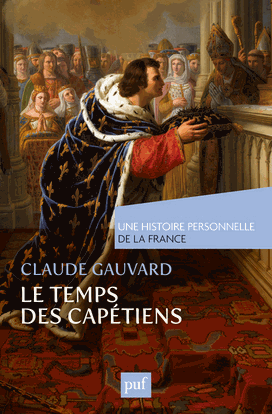
Publication – Claude Gauvard, "Le temps des Capétiens (Xe-XIVe siècle)"

Rien ne semblait destiner la dynastie capétienne à une si grande longévité, qui la maintient à la tête du royaume de 987 à 1328. La royauté, d’abord élective, devient héréditaire et le roi est peu à peu reconnu dans tout le royaume.

Les personnalités de ces monarques sont mal connues, mais ils se sont imposés par le succès de leurs conquêtes, par la gestion d’un domaine royal à la pointe du progrès économique et intellectuel, et par l’ancrage religieux de leurs actions. Rois sacrés et guérisseurs, soutenus par le réseau des évêchés et des monastères, ils se sentent responsables devant Dieu du salut de leur peuple. Gouverner leur royaume consiste donc à le purifier, qu’il s’agisse de saint Louis, canonisé en 1297, ou de Philippe le Bel et ses successeurs, grands constructeurs de l’État naissant.
Loin des idées reçues, ce livre donne la parole aux sources et présente les dernières avancées de la recherche en histoire médiévale pour dessiner l’originalité du temps des Capétiens qui, de rois des Francs, sont devenus rois de France.
Claude Gauvard est professeur émérite d’histoire du Moyen Âge à l’université Paris 1 Panthéon-Sorbonne et membre honoraire de l’Institut universitaire de France. Spécialiste de la société politique au Moyen Âge, elle consacre notamment son œuvre à l’histoire de la criminalité et de la justice.
Table des matières :
Première partie – Les premiers Capétiens (987-1108)
Chapitre I – Les principautés territoriales
1. Origines des principautés
2. Fonctionnement des principautés
3. Les châteaux se multiplient
Chapitre II – Naissance d’une dynastie
1. Le sang royal
2. Le sacre et les pouvoirs thaumaturgiques
3. Les rois d’un royaume ?
Chapitre III – L’Église fonde l’unité
1. L’Église, source de sacré
2. L’expansion de l’ordre de Cluny
3. L’Église, premier seigneur du royaume
Deuxième partie – La France du XIIe siècle
Chapitre I – Une expansion à son zénith
1. Nouvelles techniques, défrichements et villages neufs
2. Le monde des villes
3. Une nouvelle façon de penser
Chapitre II – Une société hiérarchisée
1. L’encadrement ecclésiastique et seigneurial
2. Les liens de seigneur à seigneur
3. La vie de château et l’idéal chevaleresque
Chapitre III – Des rois à la conquête de leur royaume
1. Louis VI face aux sires et aux princes
2. Louis VII face aux Plantagenêts
3. Le roi est la tête du royaume
Troisième partie – Des rois reconnus dans leur royaume (1180-1270)
Chapitre I – Philippe Auguste impose le pouvoir royal
1. Portrait de Philippe Auguste
2. Les conquêtes de Philippe Auguste
3. La résistance du Midi : hérésies cathares et croisade des Albigeois
Chapitre II – Le règne de saint Louis (1226-1270)
1. Un personnage d’exception
2. Le croisé
3. Le politique
Quatrième partie– L’État royal sous les derniers Capétiens (1270-1328)
Chapitre I – Les transformations des institutions
1. L’hôtel du roi
2. De nouvelles institutions
3. De nouvelles façons de gouverner
Chapitre II – Un pouvoir royal renforcé
1. Le droit et les légistes
2. La lutte contre la papauté : Philippe le Bel et Boniface VIII
3. L’affaire des Templiers
Chapitre III – Problèmes et résistances de la monarchie
1. Les difficultés économiques
2. Les révoltes
Conlusion
Cartes
Index
Bibliographie
Informations pratiques :
Claude Gauvard, Le temps des Capétiens (Xe-XIVe siècle), Paris, 2013 (Une histoire personnelle de la France). 200 pages. ISBN : 978-2-13-060825-7. Prix : 14.00 €
Audio :
Présentation de l’ouvrage lors de l’émission La Fabrique de l’Histoire sur France Culture. 
Disponible en podcast : ici
Publié dans Audio, Publications | Laisser un commentaire

Appel à contributions – Un/making Mistakes in Medieval Media (Kalamazoo, 2014)

Organizers: Barbara M. Eggert (Humboldt University, Berlin) and Christine Schott (Erskine College, South Carolina)

Errare humanum est – and just as today, errors and mistakes occurred in every field of medieval culture, concerning the sacred and the secular sphere alike.

During the Holy Mass, priests lost focus, words were omitted from liturgical texts, wine got spilled on sacred garments – and there were texts, of course, telling you how to deal with these failings, how to unmake these mistakes. In the legal context, mistakes of law or fact could have a vital influence on the sentence – therefore, following the Roman Law, errors and mistakes were categorized, classed, and addressed in legal texts. While scholars of medieval arts usually focus on the craftsmanship of the artifacts, errors and mistakes of a different nature are to be found in any genre; some of them, like flaws in pottery, obviously happened accidentally; others, like portraits of figures with two left hands, belong to the category of deliberate mistakes.

As a follow-up of the questions raised in the session Un/making Mistakes in Medieval Manuscripts (Kalamazoo 2013), the purpose of this session is to examine errors and mistakes and the « corrections » thereof from different angles: On the one hand, the sessio_nFocuses on theory by analyzing how medieval scholars of different fields defined error and mistake and the consequences these phenomena could have. What mistakes mattered, and in what context – and (how) could they be corrected? On the other hand, the session is dedicated to the material aspects of error, that is the exploration of mistakes in medieval artifacts. It invites paper proposals from both scholars of text as well as scholars of images of any genre (manuscripts, textiles, stained glass windows, etc.) that explore the nature of errors, mistakes, and obscurities in medieval media as well as the “corrections” thereof to gain insight into the contemporary assumptions about what a particular medium should look like.

The session welcomes papers from all disciplines.

Please send your abstract, along with a short CV and the paper proposal form (which you can download here) to Barbara M. Eggert and Christine Schott by September 1, 2013.

Source : Manchester Medieval Society
Publié dans Appel à contributions | Laisser un commentaire

Web – The Medieval Electronic Scholarly Alliance (MESA)

About MESA
The Medieval Electronic Scholarly Alliance (MESA) is a federated international community of scholars, projects, institutions, and organizations engaged in digital scholarship within the field of medieval studies. MESA seeks
  • to provide a community for those engaged in digital medieval studies and
  • to meet emerging needs of this community, including making recommendations on technological and scholarly standards for electronic scholarship, the aggregation of data, and the ability to discover and repurpose this data.
MESA has adopted tools and infrastructure utilized by our sister organizations, NINES and 18thConnect. Specifically, MESA operates on the Collex platform, which has been developed and updated by grants from the Andrew W. Mellon Foundation. As a result, when searching MESA, researchers may benefit from an extensive index of resources, including material from NINES and 18thConnect.
Using the Collex interface, MESA aggregates the best scholarly resources in medieval studies and make them fully searchable and interoperable. This interface also provides a collection and authoring space in which researchers can create and publish their own work.

How to use MESA
Scholars and researchers at any level of academics are welcome to create their own free account to participate in the MESA community.
To get started exploring our index of digital projects, try the following:

  • use the tabs above to search digital collections and scholarly projects 
  • browse the MESA tag cloud
  • participate in Discussions about each project or collection featured in MESA
  • read essays, or Exhibits, written by members of the MESA community


Source de l’information : MESA
    Publié dans Web | Laisser un commentaire

    Appel à contribution – Historical discourses on languages and power

    Historical Discourses on Language and Power


    We are pleased to announce that the next Historical Sociolinguistics Network (HiSoN) conference will take place on 6-8 February 2014 at the University of Sheffield. Bordering the picturesque Peak District, Sheffield is easily reached via Manchester International Airport as well as London airports.

    Description:
    This conference aims to zone in on the interface between history and linguistics, with a sharp focus on historical discourses on language and power. Power plays a central role in shaping social interactions and various forms of group membership. It enables the construction of insiders and outsiders in relation to ethnicity, social class, gender, religion and so on. From a historical perspective, in what ways has language been central to constructing, challenging and reconfiguring boundaries? Additionally, in what ways do contemporary discourses on language and power draw on historical events to justify or contest social practices? Contributions are welcome but not limited to the fields of sociolinguistics, historical linguistics, social history and cultural anthropology.
    The deadline for abstracts of 250-300 words (bibliography included) is 31 August 2013. Abstracts and queries about the conference should to be sent to the conference email address: hisonsheffield@gmail.com. Notification of acceptance will be sent by 31 October 2013.
    We look forward to seeing you in February 2014.
    The Sheffield HiSoN conference organizers are Susan Fitzmaurice (School of English), Kristine Horner (SLC, Germanic Studies), Catharina Peersman (SLC, French Studies) and Mark Faulkner (School of English).
    Source de l’information : Sheffield University
    Publié dans Appel à contributions | Laisser un commentaire

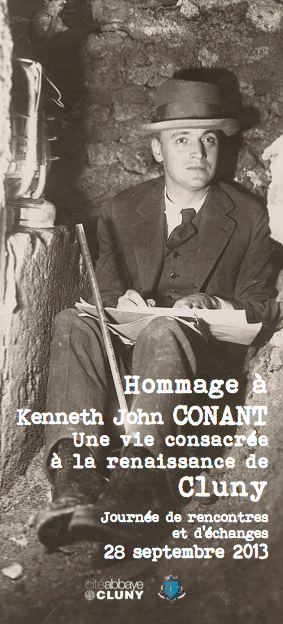
    Colloque – Hommage à Kenneth John Conant. Une vie consacrée à la renaissance de Cluny

    Kenneth John Conant (1894 – 1984) a consacré son activité d’archéologue à la redécouverte du site de Cluny. Il a laissé pour les chercheurs qui lui succèderont des milliers de documents (dessins, croquis, photos, etc..) conservés depuis quarante ans au musée Ochier (musée d’Art et d’Archéologie) où ils sont consultables.

    En reconnaissance de ce geste généreux, de cette certitude que le travail d’un homme ne s’achève pas avec sa vie mais qu’il appartient aux nouvelles générations de le poursuivre, le nouveau centre de recherche de Cluny est baptisé « espace Kenneth John Conant ».

    L’inauguration de cet espace est l’occasion de célébrer la mémoire de ce passionné qui a tant apporté à Cluny. Sous la présidence de Neil Stratford, une journée de rencontres est organisée pour évoquer l’homme, son oeuvre, et la postérité de sa recherche.
    Programme :

    09h30 : Accueil des participants salle Justice de Paix par Jean Luc Delpeuch, Maire de Cluny, et Neil Stratford, membre de l’Institut

    Modération : Brigitte Maurice-Chabard, Conservateur en chef du Patrimoine, Directrice du musée Rollin

    10h00 : Peter Fergusson, Professeur émérite d’Art, Wellesley College – Kenneth Conant as interpreter of Cluny
    10h45 : Janet Marquardt, Professeur distingué d’Histoire de l’Art, Directrice du Centre des sciences humaines, Eastern Illinois University – Lettres d’Europe, la correspondance de Conant pendant la première guerre mondiale
    11h30 : Neil Stratford – Cluny et Kenneth Conant : quarante ans après ses dernières publications
    12h30 : Déjeuner

    14h30 : Jean-Denis Salvèque, Président du Centre d’Etudes Clunisiennes – Poursuivre la recherche : le Centre d’Etudes Clunisiennes garant de l’après Connant à Cluny
    15h30 : Christian Sapin, Directeur de recherche CNRS, et Walter Berry du Centre d’Eudes Médiévales – Méthodologie de Conant à Cluny et exemple de relec- ture archéologique du site
    16h30 : Conclusion de la journée par Neil Stratford

    18h00 : Inauguration de l’espace Conant
    20h30 : Soirée en hommage à Conant au Théâtre municipal

    Informations pratiques :
    28 septembre 2013
    Les conférences se dérouleront en salle Justice de Paix (face à l’Hôtel de Bourgogne)

    Renseignements :
    Tel : (33)3 85 59 89 99 Mail : musee@cluny.fr

    Pour se rendre à Cluny :
    – depuis Paris ou Lyon : autoroute A6, sortie « Mâcon Sud »
    – depuis la gare TGV Mâcon-Loché : lignes de bus régulières, location de voitures, taxis

    Hébergement à Cluny :
    Gîtes, hôtels et chambres d’hôtes Renseignements et réservations à l’Office de Tourisme de Cluny et du Clunisois : Tel : (33)3 85 59 05 34 
    Mail : contact@cluny-tourisme.com

    Bulletin d’inscription : ici
    Publié dans Colloque | Laisser un commentaire

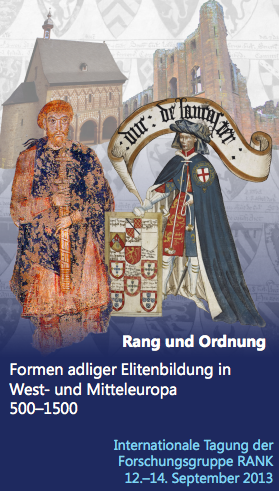
    Colloque – Rang und Ordnung. Formen adliger Elitenbildung in West- und Mitteleuropa. 500-1500

    Internationale Tagung: Rang und Ordnung. Formen adliger Elitenbildung in West- und Mitteleuropa. 500-1500 
    vom 12.09-14.09.2013
    Die Tagung, die den Abschluß der durch den ERC gefördeten Forschungsgruppe RANK markiert, nimmt die Ausbildung aristokratischer Eliten in England, Frankreich und dem Reich zwischen 500 und 1500 und die damit verbundene Ausformung politisch-sozialer Ordnungen in den Blick. In der dezidiert interdisziplinären Ausrichtung möchte die Tagung Historiker, Kunsthistoriker, Archäologen, Ethnologen und Musikwissenschaftler anhand einer gemeinsamen Fragestellung ins Gespräch bringen.
    Im Zentrum stehen folgende Fragenkomplexe:
    1. Welche Faktoren waren rangbildend? Veränderte sich ihre Konfiguration im Lauf der Zeit und wenn ja, wie? Welche regionalen Varianten gab es?
    2. Eng damit verknüpft sind Fragen nach der Kommunikation von Rang: Wie wurden Rangansprüche, -vorstellungen und -ordnungen kommuniziert und eingeübt?
    Programme :
    Donnerstag, 12.09.2013
    10.00 Uhr. : Führung durch die Ausstellung „Tod und Gedächtnis. Die Grablegen der Wittelsbacher in Heidelberg“ im Kurpfälzischen Museum der Stadt Heidelberg 
    12.15 Uhr. : Registrierung und Mittagessen 
    13.20 Uhr. : Stefan Maul (Dekan der Philosophischen Fakultät, Heidelberg) – Begrüßung
    13.30 Uhr.  : Jörg Peltzer (Heidelberg) – Einführung
    Sektion 1. Sektionsleiter: Stefan Weinfurter (Heidelberg) 
    13.50 Uhr. : Guido Sprenger (Heidelberg) – The rank of people and the rank of things: Perspectives from ethnology
    14.20 Uhr. : Diskussion 
    14.40 Uhr : Verena Epp (Marburg) – Frühmittelalterliche Grabinschriften als „Statussymbole“
    15.10 Uhr. : Philippe Depreux (Limoges) – Rangfaktoren und Rangkommunikation im karolingischen Reich
    Kommentar: Klaus Oschema (Heidelberg)
    16.10 Uhr. Pause
    Ausstellungsbesuch in Mannheim, Abfahrt 16.30 

    18.00 Uhr. : Führung durch die Ausstellung „Die Wittelsbacher am Rhein“ 
    20.00 Uhr. : Rückfahrt nach Heidelberg (Bahn) 
    20.45 Uhr. : Gemeinsames Abendessen
    Freitag, 13.09.2013
    Sektion 2, Sektionsleiter: Claudia Zey, Zürich 
    9.00 Uhr. : Jürgen Dendorfer (Freiburg) – Herzöge, Markgrafen, Grafen – Der Rang der principes im ostfränkisch-deutschen Reich (10.- 12. Jahrhundert)
    10.00 Uhr. : David Crouch (Hull) – Athelings, duces and comites in England’s changing society, 1000–1200
    Kommentar: Hugh Doherty (Oxford) – Stefan Burkhardt (Heidelberg)
    10.40 Uhr. : Pause
    Sektion 3, Sektionsleiter: Jean Dunbabin (Oxford)
    11.10 Uhr. : Nicholas Vincent (Norwich) – The making and breaking of counts in France, c. 1050–c. 1200
    11.40 Uhr. : Jean-Marie Moeglin (Paris) – Die Frage des Rangs in der französischen Gesellschaft des Spätmittelalters (14.–15. Jhdt.)
    Kommentar: Frédérique Lachaud (Metz) 
    12.40 Uhr. : Mittagessen
    Sektion 4, Sektionsleiter: Karl-Heinz Spieß (Greifswald)
    14.15 Uhr. : Andrea Stieldorf (Bamberg) – Hochadeliges Selbstverständnis in bildlichen Darstellungen bis 1200
    14.45 Uhr. : Thorsten Huthwelker (Karlsruhe) – Die Darstellung fürstlichen Rangs in Wappenrollen des späten Mittelalters
    15.15 Uhr. : Pause 
    15.45 Uhr. : Laurent Hablot (Poitiers) – Ordonner et inclure : formes et fonctions du partage des devises princières dans les cours européennes de la fin du Moyen Age
    Kommentar: Markus Späth (Gießen)
    Tagungsessen (Haus Buhl) 
    18.00 Uhr. : Empfang 
    18.30 Uhr. : Burgundischer Tanz, Silke Leopold, Heidelberg 
    20.00 Uhr. : Abendessen
    Samstag, 14.09.2013
    Sektion 5, Sektionsleiter: Heinz Krieg (Freiburg) 
    9.00 Uhr. : Annie Renoux (Le Mans) – Les élites et leurs lieux de pouvoir : les signes distinctifs (espace français, VIIe–Xe siècle)
    9.30 Uhr. : Oliver Creighton (Exeter) – Transforming Saxo-Norman landscapes: Wallingford, Oxfordshire and the archaeology of power, c. 800–1200 AD
    Kommentar: Matthias Untermann (Heidelberg)
    10.30 Uhr. : Pause
    Sektion 6, Sektionsleiter: Martin Kintzinger (Münster)
    11.00 Uhr. : Maximilian Wemhöner (Heidelberg) – Fürstliches Bauen im England des 14. Jahrhunderts
    11.30 Uhr. : Géraldine Victoir (Montpellier) – Les châteaux de Louis II de Bourbon : résidence et prestige
    Kommentar: Lindy Grant (Reading)
    12.30 Uhr. : Jörg Peltzer (Heidelberg) – Verabschiedung
    13.00 Uhr. : Tagungsende
    Informations pratiques :
    Veranstalter: Jörg Peltzer, Forschungsgruppe RANK, FPI, Ruprecht-Karls-Universität Heidelberg
    Datum, Ort: 12.09.2013-14.09.2013, Heidelberg, Internationales Wissenschaftsforum Heidelberg (IWH), Hauptstr. 242, 69117 Heidelberg
    Deadline: 05.09.2013
    Kontakt: 
    Carolin Schreiber
    Historisches Seminar der Ruprecht-Karls-Universität Heidelberg 
    Grabengasse 3-5, 69117 Heidelberg 
    06221/54-2931
    carolin.schreiber@zegk.uni-heidelberg.de
    Programme au format PDF : ici
    Source de l’information : Universität Heidelberg
    Publié dans Colloque | Laisser un commentaire

    Offre d’emploi – Research Associate – John Rylands Research Institute

    Closing date :01/09/2013
    Reference :
    HUM-03162
    Faculty / Organisational unit :
    Humanities
    School / Directorate :
    School of Arts, Languages and Cultures
    Division :
    John Rylands Research Institute
    Salary :
     £29,541 to £36,298 per annum according to relevant experience
    Employment type :
    Fixed Term
    Duration:
    1 September 2013 for one year with a possibility of renewal dependent on budget availability
    Hours per week :
    Full time
    Location :
    Oxford Road, Manchester
    We are seeking to appoint an ambitious and outstanding postdoctoral researcher to work in the newly founded John Rylands Research Institute. You will carry out research on the Special Collections in the University of Manchester Library. Your specialization can be in any area connected with the Special Collections, but preference may be given to research on our Persian Manuscripts; Incunables; or Art and Visual Culture collection.

    You should have, or be working towards, a PhD or equivalent in a field relevant to our Special Collections, and have gained significant experience in this field. You should be capable of working under your own initiative and interacting closely with scholars with a range of complimentary expertise, so excellent communication and organisational skills are also required. Previous grant writing experience is also desirable.

    Informal enquiries

    Informal inquiries may be made to Professor Peter E Pormann. Email: peter.pormann@manchester.ac.uk
    The University of Manchester values a diverse workforce and welcomes applications from all sections of the community.
    More informations here
    Publié dans Offre d'emploi | Laisser un commentaire

    Journée d’étude – Les langues de l’Angleterre médiévale : au-delà du bilinguisme

    Vendredi 13 septembre 2013
    Hôtel Fumé – Amphi Bourdieu, 8 rue René Descartes à Poitiers
    Organisé par : Jean-Pascal Pouzet, Maître de conférences en langue et littérature anglaises du Moyen Âge (Université de Limoges-CESCM) et Alban Gautier, Maître de conférences en histoire du Moyen Âge (Université du Littoral Côte d’Opale-HLLI).
    La multiplicité des langues, parlées et écrites, est un trait important de l’Angleterre médiévale. La production écrite, littéraire ou documentaire au sens large, y est souvent marquée par la coexistence de plusieurs langues. L’atelier, qui donnera lieu à publication dans la revue Médiévales, a pour but d’étudier des situations précises de coexistence linguistique, en portant l’attention sur des cas où au moins trois langues sont impliquées dans un jeu de contiguïtés, de transferts ou d’interférences.
    Informations complémentaires et programme : ici
    Publié dans Colloque | Laisser un commentaire

    Appel à contribution – Art-Hist. Researches on Artistic Creation from Antiquity to Modern Times

    The Art-Hist platform permanently receives for publication unpublished papers on artistic creation from Antiquity to Modern Times, with very wide geographical contours: East, West, Mediterranean, Scandinavia, Slavic world. Papers could consider actors (craftsmen, artists, theorists, critical), productions (monument in all its forms, from artifacts to buildings and performances), the function or absence of social, political, religious function of works of art, the conditions of its production, life, survival and exhibition, the philosophical concepts at stake in the making of art.
    The platform retains a very broad definition of artistic creation and considers both the monumental as moveable arts, permanent creations as the short-lived compositions. Contributions are expected on sculpture, architecture, painting, drawing and graphic arts, dance, theatre, music, literature. Studies can be monographic, thematic or conceptual, dedicated to a work of art, artist, concept, culture, place, etc.
    About the Art-Hist project : here
    Contacts : 
    Vincent DEBIAIS / Estelle INGRAND-VARENNE
    CESCM
    24, rue de la Chaine – BP 603
    86034 POITIERS Cedex – France
    Tél : (33) (0)5 49 45 45 57
    Fax : (33) (0)5 49 45 45 70
    Vincent.Debiais@univ-poitiers.fr
    Estelle.Ingrand.Varenne@univ-poitiers.fr
    Source de l’information : Art-Hist
    Publié dans Appel à contributions | Laisser un commentaire

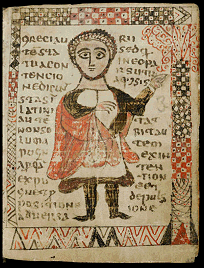
    Colloque – Le scriptorium. XVIIIe Colloque international de paléographie latine

    Le XVIIIe Colloque international de paléographie latine se tiendra à Saint-Gall (Suisse), du 11 au 14 septembre 2013.
    Il aura pour thème « Le scriptorium ».
    Organisation:
    • Rudolf Gamper, Vadianische Sammlung St. Gallen
    • Andreas Nievergelt, Universität Zürich
    • Ernst Tremp, Stiftsbibliothek St. Gallen
    • Birgit Ebersperger, Bayerische Akademie München
    • Beat von Scarpatetti, Binningen
    Programme : 

    Mercredi 11 septembre
    1. La problématique des scriptoria
    D. Muzerelle (Paris) – A la (re)découverte des scriptoria : l’exemple du Catalogue des manuscrits datés français.
    D. Ganz (Notre Dame, In.) – Can a scriptorium always be identified by its products?
    2. Le développement historique des scriptoria
    P. Fioretti (Bari) – Prima dello scriptorium. Esperienze di produzione manoscritta comunitaria in età tardoantica.
    D. Tronca (Verona) – Lo scriptorum della cattedrale di Verona attraverso l’analisi dei manoscritti delle opere di sant’Agostino.
    L. Reynhout (Bruxelles) – Scriptores de scriptoriis : mentions de « scriptoria » dans les colophons latins, les mots et les réalités.
    3. Problèmes stylistiques.
    M. Gurrado (Paris) – L’homogénéité graphique du scriptorium de Saint-Pierre de Jumièges au XIe siècle.
    A. M. J. Irving (Yale Univ.) – Uniformity and Variability in Cassinese Gospel Books. A Case Study in Scriptorium Production Engineering and its Description.
    M. Bernasconi Reusser (Fribourg) – Handschriften und Inschriften aus dem Kloster Allerheiligen in Schaffhausen (CH)
    A. Ommundsen (Bergen) – Seeing scriptoria in scraps: Norwegian manuscript fragments and their historical context.
    4. La production documentaire des scriptoria.
    P. Erhart (St. Gallen) – Zwischen Kanzlei und Scriptorium: Urkunden- und Handschriftenproduktion im Kloster St.Gallen in der Zeit von Abt Grimald 841-872.
    M. Marchiaro (Pistoia) – La produzione documentaria e libraria nella canonica di San Zeno di Pistoia (sec. XI-XII).
    I. Ceccherini & T. De Robertis (Firenze) – Scriptoria e cancellerie nella Firenze del XIII e XIV secolo.
    Jeudi 12 septembre
    5. Tour d’Europe des scriptoria (I)

    M. R. B. Morujao (Coimbra) – Le scriptorium de la cathédrale de Coimbra au Moyen Âge.
    M. Wagendorfer (Wien) – Welche Skriptorien? Zu Stand und Perspektiven der Skriptorien-Forschung in Österreich.
    G. M. Gunnlaugsson (Reykjavik) – The Helgafell Scriptorium (Iceland, 14th cent.).
    (Pause)
    6. Tour d’Europe des scriptoria (II)
    J. Sedivy (Bratislava) – Gab es im spätmittelalterlichen Pressburg ein Skriptorium?
    W/ Mrozowicz (Wroclaw) – Das Schreiben im Kloster als Weise der Bereicherung der Klosterbibliothek (am Beispiel der Sammlungen der regulierten Augustiner-Chorherren zu Zagan/Sagan)
    H. Patkova (Praha) – Between Middle Ages and modern era. Some remarks on the writing and scriptoria in the reformed Franciscan monasteries in Bohemia in the end of 15th and beginning of 16th centuries.
    Vendredi 13 septembre
    7. Scriptoria et vie intellectuelle
    C. Denoël & F. Cinato (Paris) – Y a-t-il eu un scriptorium à Auxerre au temps d’Heiric ?
    T. J. H. McCarthy – The foundation and development of a Bamberg scriptorium: Frutolf of Michelsberg and his early twelfth-century legacy.
    G. Murano (Firenze) – Uno scriptorium di corte: Carlo d’Angiò e magister Faragius.
    8. Scriptoria et vie religieuse
    T. Webber (Cambridge) – Script, book production and the practice of the Rule at Christ Church, Canterbury in the mid twelfth century.
    E. Giraud (Cambridge) – The Dominican Scriptorium at St Jacques, and its production of liturgical exemplars.
    X. Hermand (Namur) – Entre le scriptorium et la cella : production communautaire et copie individuelle dans les monastères de l’ordre des Croisiers au XVe siècle.
    9. Les méthodes de travail dans les scriptoria
    C. Egger (Wien)  – Die Suche nach dem archimedischen Punkt. Methodische Probleme der Erforschung von Scriptorien und Buchproduktion im 12. Jahrhundert am Beispiel von Admont und Klosterneuburg.
    R. G. Babcock (Chapel Hill, N.C.) & A. Derolez (Ghent) – The Gembloux scriptorium in the Eleventh century.
    D. Stutzmann (Paris) – Un couteau dans la main gauche ? Organisation du scriptorium et correction des textes d’après le feuillet de corrections du ms. Paris, Bibl. nat. de france, Arsenal, ms. 302.
    10. Productions spécifiques
    F. Newton (Duke Univ.) – Proving the Existence of a Scriptorium: The Case of the Early South Italian Liturgical Rolls (Saec. X ex.) and the (Hitherto Unidentified) Scriptorium at Benevento from which They Came.
    L. Yawn (Roma) – Occasional Workshops and Clustered Production of Eleventh-Century Italian Giant Bibles and Patristic Manuscripts.
    11. Recherches en cours (présentations sommaires)
    P. Stokes (London) – The DigiPal Project for Late Anglo-Saxon Script.
    A. Puglia (Arezzo) – Scrivere nelle cattedrali della Toscana occidentale. Pisa, Lucca e Volterra nei secoli X-XII.
    E. Niblaeus (Erlangen) – The Production of Liturgical Books for the Twelfth-Century Parish Church – Where and How?
    Hors programme
    E. Tremp (St. Gallen) – Bedeutung und Organisation des Scriptoriums im frühmittelalterlichen Kloster St. Gallen – das Zeugnis der Geschichtsschreibung.
    Informations pratiques :
    Saint-Gall (Suisse),
    du 11 au 14 septembre 2013.
    Les sessions se tiendront dans les locaux de l’ancienne abbaye. Saint-Gall est facilement accessible par train, depuis l’aéroport international de Zurich (départs toutes les heures environ).
    Mardi 10 septembre
    Arrivée.
    Enregistrement à partir de 17:00 h
    18:30 : Apéritif de bienvenue.
    Mercredi 11 septembre
    9:00 h : Ouverture du colloque
    9:30 – 12:15 h : Programme scientifique (sessions 1 et 2)
    14:00 – 17:30 h : Programme scientifique (sessions 3 et 4)
    En soirée : séance publique en commémoration des Scriptoria Helvetica Medii Aevi d’Albert Bruckner.
    Jeudi 12 septembre
    9:00 12:15 h : Programme scientifique (sessions 5 et 6)
    14:00 – 17:30 h : Session et Assemblée générale d’APICES
    En soirée : concert d’orgue à la cathédrale.
    Vendredi 13 septembre
    9:00 12:15 h : Programme scientifique (sessions 7 et 8)
    14:00 – 17:30 h : Programme scientifique (sessions 9–11)
    En soirée : Dîner de clôture
    Samedi 14 septembre
    Excursion à Schaffhouse via le lac de Constance
    Source de l’information : paleographia.org
    Publié dans Colloque | Laisser un commentaire