Publication – Liz Fischer, « Network Analysis for Book Historians. Digital Labour and Data Visualization Techniques »

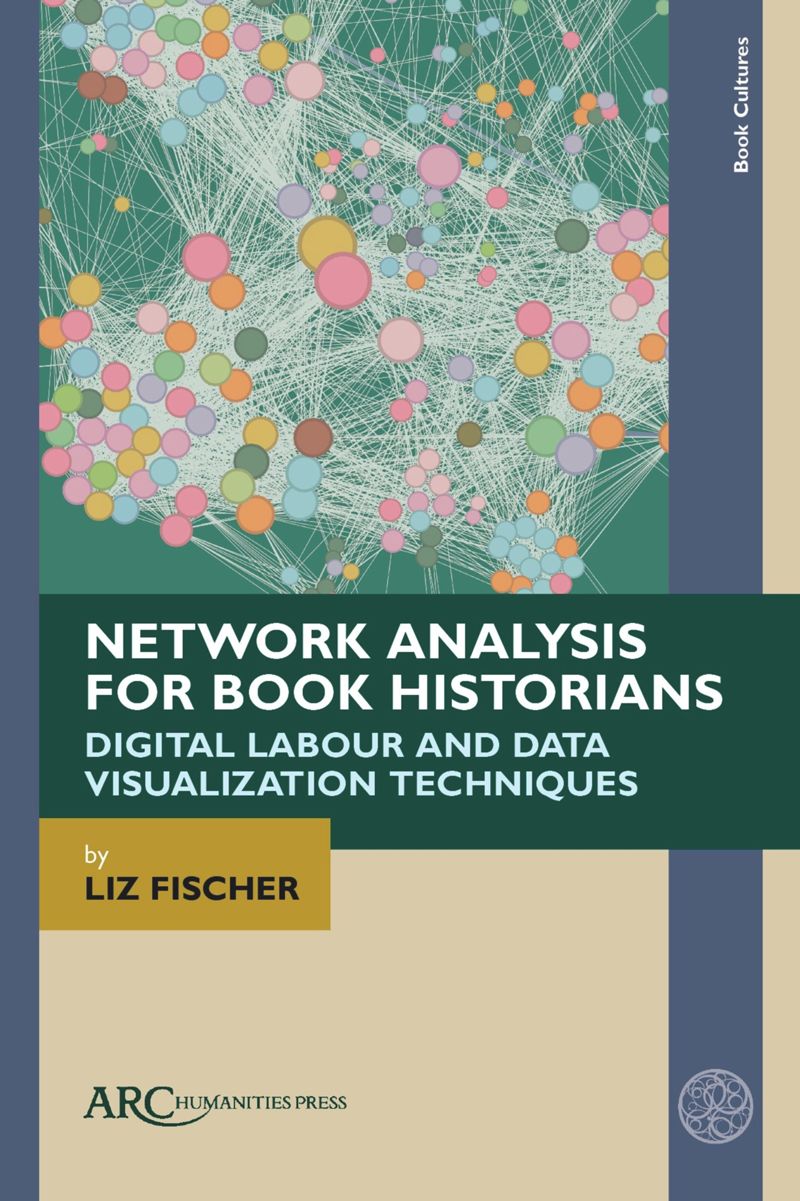
Researchers and archivists have spent decades digitizing and cataloguing, but what does the future hold for book history? This book explores the potential of network analysis as a method for medieval and early modern book history. Presented through case studies of the Cotton Library, the Digital Index of Middle English Verse, and the Pforzheimer Collection, this book offers a blueprint for drawing on extant scholarly resources to visualize relationships between people, text, and books. Such visualizations serve as a new form of reference work with the potential to offer new, broad insights into the history of book collecting, compilation, and use. This volume gives a realistic look at the decision-making involved in digital humanities work, and emphasizes the value of so-called « mechanical » labour in scholarship.

Liz Fischer is an independent scholar whose research interests include medieval book history, digital humanities, antiquarianism, and craftsmanship.
List of Illustrations

Part One

Read Me

Where Are We Now? Or, Networked Humanities

How to Network

Part Two

Case Study 1. The Digital Index of Middle English Verse

Case Study 2. The Cotton Library

Case Study 3. The Pforzheimer Collection Where to Next?

Glossary

Bibliography

Index

Liz Fischer, Network Analysis for Book Historians. Digital Labour and Data Visualization Techniques, Leeds, ARC Humanities Press, 2025 ; 1 vol., 157 p. (Book Cultures). ISBN : 9781802702682. Prix : GBP 104,00.

Source : ARC Humanities Press

Publié dans Publications | Commentaires fermés sur Publication – Liz Fischer, « Network Analysis for Book Historians. Digital Labour and Data Visualization Techniques »

Publication – Florin Curta, Sébastien Rossignol, « Medieval East Central and Eastern Europe »

An excellent teaching resource and a first-of-its-kind textbook in English, Medieval East Central and Eastern Europe by Florin Curta and Sébastien Rossignol focuses on medieval history in East Central, Southeastern, and Eastern Europe.

From Bohemia to Rus’ and from the White Sea to the Balkans, Medieval East Central and Eastern Europe by Florin Curta and Sébastien Rossignol covers the medieval history of a large area. This groundbreaking textbook is an important introduction for students and an essential tool for instructors of courses on the Middle Ages and the entire eastern half of Europe.

With elements of medieval archaeology, Medieval East Central and Eastern Europe includes dynastic characters, political legacies, and a list of suggested readings for anyone interested in learning more about the history of these regions. Written in an accessible style that appeals to a general reader, this textbook explicates the diversity of historical experiences available in these parts of Europe during the Middle Ages – from the influence of Byzantine traditions in the Balkans to the integration of Western cultures and the impact of the Eurasian steppe lands. This text highlights the distinct social and cultural characteristics that shaped these societies, including the persistence of nomadic groups, the limited reach of feudalism, and the enduring presence of pagan, Jewish, and Muslim communities.

Structured with chronological overviews and thematic chapters, Medieval East Central and Eastern Europe is an invaluable resource on underrepresented regions for specialists and non-specialists alike.

Florin Curta is a professor in the Department of History at the University of Florida.

Sébastien Rossignol is an associate professor in the Department of History at Memorial University of Newfoundland.

Table des matières : ici

Informations pratiques :

Florin Curta, Sébastien Rossignol, Medieval East Central and Eastern Europe, Toronto, University of Toronto Press, 2025 ; 1 vol., 509 p. ISBN : 978-1-48756-625-8. Prix : USD 125,00.

Source : University of Toronto Press

Publié dans Publications | Commentaires fermés sur Publication – Florin Curta, Sébastien Rossignol, « Medieval East Central and Eastern Europe »

Publication – Rebecca Menmuir, « Medieval Responses to Ovid’s Exile »

The Augustan poet Ovid exerted significant influence over the Middle Ages, and his exile captured the later medieval imagination. Medieval Responses to Ovid’s Exile examines a variety of creative scholastic and literary responses to Ovid’s exile across medieval culture. It ranges across the medieval schoolroom, where new forms shape Ovidian exile anew, literary pilgrimages, medieval fantasies of dismemberment and visits to Ovid’s tomb. These responses capture Ovid’s metamorphosis into a poet for the Christian age, while elsewhere medieval poets such as John Gower and Geoffrey Chaucer demonstrate how to inhabit an Ovidian exilic voice. Medieval audiences fundamentally understood the foundations laid by the exilic Ovid, and so from antiquity and from exile Ovid shaped his own reception. The extent, enthusiasm and engagement of medieval responses to Ovid’s exile are to such a degree that they must be considered when we read Ovid’s exilic works, or indeed any of his poetry.

  • Develops and extends current theories of reception, moving away from a linear idea of influence and towards a theory of reception as a dialogue
  • Challenges the idea of a ‘fractured’ Ovid, showing that in the Middle Ages the mythographer, lover and exilic Ovids were not disconnected but informed each other
  • Transcribes, translates, and interprets new material from medieval manuscripts

REBECCA MENMUIR is a Darby Fellow in English Literature at Lincoln College, Oxford, having previously held a British Academy Postdoctoral Fellowship at Queen Mary University of London. She has published widely on medieval classical reception, forgeries and the medieval schoolroom. She is also the editor of Authenticity in Medieval and Early Modern Literature (forthcoming).

Table des matières :

  • Introduction
  • Part I. Responding to Exile:
  • 1. Ovid’s response
  • 2. Forming responses
  • 3. Resurrecting Ovid
  • Part II. Becoming the Exile:
  • 4. Becoming the exile
  • 5. John Gower’s Visio Anglie
  • 6. Geoffrey Chaucer’s exilic voice
  • Epilogue: Forging exile.

Informations pratiques :

Rebecca Menmuir, Medieval Responses to Ovid’s Exile, Cambridge, Cambridge University Press, 2025 ; 1 vol., 262 p. (Classics after Antiquity). ISBN : 978-1-00955-392-6. Prix : GBP 90,00.

Source : Cambridge University Press

Publié dans Publications | Commentaires fermés sur Publication – Rebecca Menmuir, « Medieval Responses to Ovid’s Exile »

Colloque – Les qualités de la terre dans l’Europe médiévale et moderne. 46es Journées internationales d’Histoire

Le colloque de Flaran se déroule cette année au Pavillon de l’Écomusée de Marquèze, à Sabres
(département des Landes)

Pour tous renseignements concernant le déroulement de ces Journées ou l’inscription
contact@journeesflaran.org

16-17 octobre 2025

Programme : ici

Comité d’organisation :
Frédéric BOUTOULLE (Université Bordeaux Montaigne)
Alain CHAMPAGNE (Université de Pau et des Pays de l’Adour)
Emmanuelle CHARPENTIER (Université Toulouse – Jean Jaurès)
Guilhem FERRAND (Université Toulouse – Jean Jaurès)
Philippe MEYZIE (Université Bordeaux Montaigne)
Sylvain OLIVIER (Nîmes université)

Source : Journées internationales de Flaran

Publié dans Colloque | Commentaires fermés sur Colloque – Les qualités de la terre dans l’Europe médiévale et moderne. 46es Journées internationales d’Histoire

Bourse – Call for Applications for a Travel Grant for Research into the History of the Early Printed Book

The Museum Plantin-Moretus and the Hendrik Conscience Heritage Library are launching a call for applications for a travel grant for research into the history of the early printed book (15th-18th century) in Antwerp, with the gracious support of the Thierry and Frédéric Nottebohm Grant of the Nottebohm Family Foundation. The fellowship is intended to promote research on the history of the early printed book (15th-18th century) in Antwerp. It allows scholars to travel to Antwerp to conduct research on the collections of both institutions.

The grant provides a maximum of 2000 euros for researchers living in Europe and a maximum of 3000 euros for researchers outside Europe. The grant can only be used for transportation and accommodation. More information can be found on the webpage: https://consciencebibliotheek.be/en/fellowship-programme-2025. If you have further questions, do not hesitate to reach out to Zanna and/or myself.

Please send your applications to steven.vanimpe@antwerpen.be and zanna.vanloon@antwerpen.be before October 1st, 2025. 

Publié dans Bourse | Commentaires fermés sur Bourse – Call for Applications for a Travel Grant for Research into the History of the Early Printed Book

Journée d’étude – Dévotion et émotions. Pérennité et évolution des pratiques dévotionnelles entre le Xe et le XVe siècle

Journée d’études du laboratoire CESCM – UMR 7302, organisée par Marcello Angheben.

9 octobre 2025

En présentiel à Poitiers : 8 rue René Descartes, salle 203

En visioconférence Lien de connexion : https://univ-poitiers.webex.com/meet/marcello.angheben

Entrée libre, dans la limite des places disponibles

Inscription préalable souhaitée : marcello.angheben@univ-poitiers.fr

Session du matin

9h / Marcello ANGHEBEN (Université de Poitiers, CESCM) : Accueil et introduction : la piété affective dans les manuscrits anglo-saxons et les prémisses des usages dévotionnels des derniers siècles du Moyen Âge

9h40 / Cécile VOYER (Université de Poitiers, CESCM) : Réflexions sur la douleur, l’exemple du Christ du tympan de Conques (1100)

10h30 / Pause café

10h50 / Steve MORRISON (Université de Poitiers, CESCM) : Piété laïque : le témoignage de deux textes anglais de la fin du XIVe et du XVe siècle : The Pore Caitif et The Book of Margery Kempe

11h40 / Sarah BORGES (EHESS) : Exercices spirituels, exercices d’images ? Le rosaire du MS Egerton 1821 de la British Library.

12h30 / Déjeuner

Session de l’après-midi

14h / Fuensanta MURCIA NICOLÁS (Universidad de Oviedo) : Les émotions dans le miracle de Théophile : un guide textuel et visuel pour la dévotion privée

14h50 / Benoît VAN DEN BOSSCHE (Université de Liège) : Gérer les émotions par la prière : le psautier de Lambert le Bègue conservé à l’Université de Liège (dernier quart du XIIIe siècle)

15h40 / Pause

16h / Marion LOISEAU : Mémoire et affects dans les livres d’heures féminins en Bretagne

16h50 / Marcello Angheben : Conclusions

Source : Carnets du CESCM

Publié dans Colloque | Commentaires fermés sur Journée d’étude – Dévotion et émotions. Pérennité et évolution des pratiques dévotionnelles entre le Xe et le XVe siècle

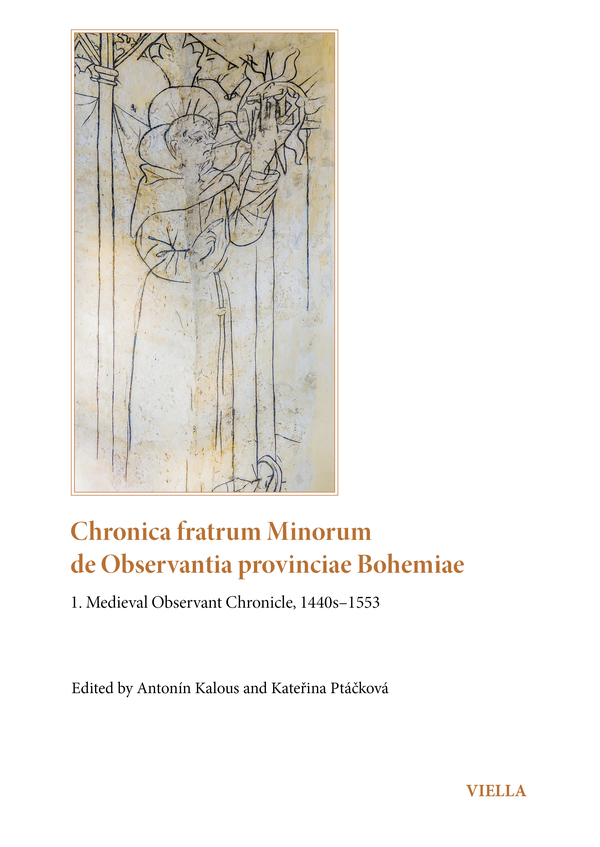
Publication – « Chronica fratrum Minorum de Observantia provinciae Bohemiae », t. 1, « Medieval Observant Chronicle, 1440s–1553 », éd. Antonín Kalous, Kateřina Ptáčková

The Chronica fratrum Minorum de Observantia provinciae Bohemiae secularibus non communicanda is the second Bohemian Observant Franciscan chronicle published in this series. The initial section, spanning the years 1440–1553, provides a comprehensive overview of the history of the Franciscan Observant Order during this period. It is an invaluable narrative source for the Bohemian province, and furthermore a critical source for the history of the Cismontane family of the Observant friars. The text has not been edited thus far and consequently evaded the attention of historians; the Chronica constitutes a fundamental addition to the known narrative sources. In this respect the present text serves to complement the other crucial Franciscan Observant chronicles by John of Komorowo and Nicholas Glassberger. This newly accessible chronicle enhances the source pool of the self-presentation through history-writing of mendicant Orders in general.

  • Preface
  • Introduction
  • Chronica fratrum Minorum de Observantia provinciae Bohemiae secularibus non communicanda
  • Appendix
  • Bibliography
  • Index of names
  • Index of places

Informations pratiques :

Chronica fratrum Minorum de Observantia provinciae Bohemiae, t. 1, Medieval Observant Chronicle, 1440s–1553, éd. Antonín Kalous, Kateřina Ptáčková, Rome, Viella, 2025 ; 1 vol., 360 p. (Franciscans and Europe: history, identity, memory, 2). ISBN : 979-1-25469-975-1. Prix : € 45,00.

Source : Viella

Publié dans Publications | Commentaires fermés sur Publication – « Chronica fratrum Minorum de Observantia provinciae Bohemiae », t. 1, « Medieval Observant Chronicle, 1440s–1553 », éd. Antonín Kalous, Kateřina Ptáčková

Publication – Arnaud de Villeneuve, « Lettre sur l’imposture de la magie nigromantique, Arnaud de Villeneuve. Magie et rationalité chez un penseur du XIIIe siècle », trad. Olivier Rimbault

Vers 1280, Arnaud de Villeneuve publie une courte démonstration à la fois philosophique, théologique et médicale de l’illusion de ces lettrés musulmans, juifs et chrétiens qui prétendaient pouvoir, selon les instructions de manuels de magie alors en vogue, commander aux démons pour obtenir d’eux la réalisation des vœux les plus divers – ce que l’on appelait la nigromancie. Cette édition bilingue est la première en français d’un document représentatif aussi bien du rationalisme aristotélicien que de la médecine galénique qui accompagnèrent le développement de l’enseignement scolastique. Olivier Rimbault commente Arnaud de Villeneuve en historien, en philosophe et en anthropologue. Il montre en effet ce que la rationalité des Modernes doit à cette longue période paradoxale et méconnue qu’est le Moyen Âge, et de cette synthèse tire des parallèles avec la nôtre, mettant en évidence l’irrationnel à l’œuvre dans nos propres croyances les plus « scientifiques » et réhabilitant en conclusion une forme de « magie philosophique » qui pourrait répondre aux défis du XXIe siècle.

Olivier Rimbault est agrégé de lettres classiques, docteur en philologie latine, capésien de philosophie, spécialiste de l’imaginaire.

Introduction générale
Remarques préliminaires. 
Quelques mots sur la vie et l’œuvre d’Arnaud de Villeneuve. 
Arnaud de Villeneuve, astrologue, magicien, alchimiste ? 
La bibliothèque personnelle d’Arnaud de Villeneuve. 
Le thème de l’Epistola de reprobacione : la magie nigromantique. 
Études déjà faites sur l’Epistola de reprobacione nigromantice ficcionis
Résumé de l’Epistola de reprobacione nigromantice ficcionis. 
Plan de notre édition française et de ses commentaires.

Texte latin et traduction française

Commentaire linéaire

Synthèse historique
Les sources de la lettre. 
Un contexte culturel favorable à l’irrationalité : foi chrétienne et croyances païennes. 
La médecine antique et médiévale : une école de rationalité. 
Un contexte social et intellectuel favorable à la rationalité : l’université médiévale. 
Un cadre intellectuel favorable à la rationalité : la théologie monothéiste. 
La lettre d’Arnaud de Villeneuve dans l’histoire de la démonologie. 
La lettre de Vilanova dans l’histoire des rapports entre rationnel et irrationnel.

Conclusion générale
Sur la lettre et son auteur.
Sur l’époque d’Arnaud de Villeneuve. 
Délimiter plutôt que définir le rationnel et l’irrationnel (the scope of rationality). 
Prolongements anthropologiques. 
Perspectives philosophiques.

Annéxes

Arnaud de Villeneuve, Lettre sur l’imposture de la magie nigromantique, Arnaud de Villeneuve. Magie et rationalité chez un penseur du XIIIe siècle, trad. Olivier Rimbault, Turnhout, Brepols, 2025 ; 1 vol., 322 p. (Témoins de Notre Histoire, 24). ISBN : 978-2-503-61323-9. Prix : € 109,00.

Source : Brepols

Publié dans Publications | Commentaires fermés sur Publication – Arnaud de Villeneuve, « Lettre sur l’imposture de la magie nigromantique, Arnaud de Villeneuve. Magie et rationalité chez un penseur du XIIIe siècle », trad. Olivier Rimbault

Publication – Michelle P. Brown, « Illumino. A History of Medieval Britain in Twelve Illuminated Manuscripts »

Illuminoexplores the history of medieval Britain through the biographies of twelve remarkable illuminated manuscripts and of their creators and owners. The manuscripts each serve as portals into these lives and as springboards into the era of their production. For illuminated manuscripts are among the most intricate and fascinating forms of evidence for the Middle Ages, blending the fruits of human intellect – the arts, the sciences, politics, philosophy and faith – with the materiality of their production. By undertaking the detective work needed to determine the nature of each project and the underlying human-interest stories, this book reveals their manifold social, economic and cultural contexts and charts the exchange of ideas, techniques and materials over time and space. Featuring more than a hundred beautiful illustrations, this is a unique and accessible introduction to Britain’s history, art history and book history across a thousand years.

Michelle P. Brown, Illumino. A History of Medieval Britain in Twelve Illuminated Manuscripts, Londres, Reaktion Books, 2025 ; 1 vol., 320 p. ISBN : 9781836390374. Prix : € 25,00.

Source : Reaktion Books

Publié dans Publications | Commentaires fermés sur Publication – Michelle P. Brown, « Illumino. A History of Medieval Britain in Twelve Illuminated Manuscripts »

Publication (en ligne) – « Bulletin du Centre d’Études médiévales d’Auxerre – BUCEMA » 29.1 (2025)

Le Bucema, Bulletin du Centre d’études médiévales d’Auxerre, est une revue scientifique à comité de lecture consacrée aux études sur le Moyen Âge.

Fidèle au principe de diffusion de la recherche en train de se faire et librement accessible, le Bucema met l’accent sur l’interdisciplinarité -sciences humaines et sociales, sciences de la nature et mathématiques. Il cherche à publier des contributions proposant des nouvelles méthodes, faisant état d’expériences dans le domaine des humanités numériques et des nouvelles technologies, s’interrogeant sur les implications épistémologiques et conceptuelles des recherches sur le Moyen Âge. Il accueille aussi des études et des synthèses de fond dans les domaines de l’archéologie, de l’histoire et de l’histoire de l’art, tout en se faisant l’écho de l’actualité de la recherche la plus récente.

En plus d’articles inédits, il publie des entretiens, des essais bibliographiques, des points de vue, des notices sur des découvertes importantes, des communications sur des chantiers en cours (archéologiques, historiques, archivistiques, iconographiques…), des synthèses des dernières rencontres scientifiques, des résumés de thèses et de dissertations, ainsi que l’annonce de nouveaux programmes de recherche et de rencontres à venir.

Le Bucema fait paraître également des numéros hors série et deux collections relatives à des programmes de recherche :  « CBMA  – Chartae Burgundiae Medii Aevi » et « Histoire de l’art et Anthropologie ».

Tourné vers la communauté scientifique internationale, le Bucema accepte des contributions dans différentes langues : allemand, anglais, espagnol, français, italien, portugais.

Source : BUCEMA

Publié dans Publications | Commentaires fermés sur Publication (en ligne) – « Bulletin du Centre d’Études médiévales d’Auxerre – BUCEMA » 29.1 (2025)