Publication – Pablo de Felipe, « Flattening the Medieval Earth. Seeking the Early Modern Origins of the Idea of an Historical Conflict between Science and Christianity »

Flattening the Medieval Earth explores the origin of the ‘flat error’, i.e. the false accusation that ancient and medieval Christians believed in a flat Earth, and what this implies in terms of a conflict between science and Christianity. Engaging with scientific and religious debates, this book includes a reception study of two key figures of the 4th century AD, Lactantius and Augustine. This study demonstrates that the mistaken ‘dark’ image of medieval scholars as flat-earthers started very early, c. 1600, as an internal Christian debate in the context of new geographical and astronomical views. The author draws on extensive research including many primary and secondary sources from different countries and languages not previously put into conversation. Combining history of science, church history, science and religion, history of navigation, and historiography, this book gives the most updated explanation of the origin of the flat error, finding paradoxes and unexpected answers along the way to understand the past and to reflect on some current approaches in science and religion.

Pablo de Felipe is a researcher and lecturer, with a focus on the relations between science and Christianity, at the Protestant Faculty of Theology SEUT in Madrid (Spain). In the same city he also lectures at the Xavier Zubiri Foundation and is part of the advisory board of the Science, Technology and Religion Chair at the Comillas Pontifical University. He holds a PhD in Molecular Biology from the Universidad Autónoma de Madrid and a PhD in Religion and Theology from the University of Bristol (UK). He works as Head of Service (Virology) at the Spanish Agency of Medicines and Medical Devices (AEMPS) in Madrid.

Table des matières :

Introduction: Columbus and the flat Earth;
1. Searching for the origins and causes of an error;
2. From the Greek discovery of the spherical Earth to the Medieval debate of the antipodes;
3. Revival and criticism of early Christians’s geographical views in the Early Renaissance (14th and 15th centuries);
4. Old texts and the geographical challenge of the voyages (1434-1522);
5. The early Copernicans and the flat-earthers (1541-1616);
General Conclusions: From the invention of the flat error to the idea of an historical conflict between science and Christianity.

Informations pratiques :

Pablo de Felipe, Flattening the Medieval Earth. Seeking the Early Modern Origins of the Idea of an Historical Conflict between Science and Christianity, Lodnres, Routledge, 2025 ; 1 vol., 280 p. (Routledge Science and Religion Series). ISBN : 978-1-03289-306-8. Prix : GBP 145,00.

Source : Routledge

Publié dans Publications | Commentaires fermés sur Publication – Pablo de Felipe, « Flattening the Medieval Earth. Seeking the Early Modern Origins of the Idea of an Historical Conflict between Science and Christianity »

Colloque – Mémoire de pierre, pierre de mémoire. Comprendre, conserver et transmettre les monuments funéraires

Programme : ici

Pour sa septième journée d’étude, le CIPAR a décidé de valoriser un patrimoine très présent dans nos églises et pourtant trop souvent oublié : le patrimoine funéraire en pierre. Discret et bien souvent méconnu, il est pourtant porteur de sens, raconte l’histoire locale, et permet d’étudier l’histoire et l’évolution de la sculpture à travers ses différents courants artistiques.

Intitulée Mémoire de pierre, pierre de mémoire. Comprendre, conserver et transmettre les monuments funéraires, cette journée aura lieu le 10 octobre 2025 à l’Arsenal (Namur) et tentera de répondre à plusieurs questions : Pourquoi enterre-t-on nos défunts ? Quelles bases théologiques expliquent cette pratique ? Depuis quand et pourquoi n’enterre-t ’on plus dans les églises ? Et aujourd’hui, que peut nous apprendre ce patrimoine ? Comment l’appréhender et envisager les problématiques qu’il pose, qu’elles soient d’ordre législatif ou même éthique ? Comment entretenir et conserver ces éléments de pierre ? Que mettre en place pour les valoriser ?

Cette journée s’adresse aux gestionnaires des églises paroissiales, aux administrations diocésaines, aux administrations communales mais aussi aux passionnés du patrimoine.

Comme pour les précédentes éditions, la première partie de cette journée sera consacrée aux aspects théologiques, historiques et artistique de ce patrimoine. Nous aborderons aussi ces monuments à travers leurs différentes typologies, leur évolution, et les aspects législatifs qui les concernent.

La seconde partie de la journée portera sur les enjeux de leur conservation. La pierre, souvent considérée comme un élément résistant dans le temps et insensible à son environnement, peut au contraire – qu’elle se trouve à l’intérieur ou à l’extérieur d’un édifice – se détériorer à cause des conditions climatiques mais aussi de l’usure, à l’utilisation de mauvais produits d’entretien, à des actes de vandalisme, … Il est important de bien identifier ces risques de natures diverses afin de s’en prémunir ou de réagir de manière adaptée en cas d’altérations.

Des exemples concrets de restauration et de valorisation de monuments funéraires en Wallonie seront également mis en lumière à travers des témoignages.

10 octobre 2025
Arsenal de Namur

Inscription avant le 29 septembre 2025 : info@cipar.be
PAF : 60 € (étudiants : 30 €)
À verser sur le compte du CIPAR BE60 5230 8094 6070 avec la mention « Journée d’étude :  funéraire».
Le paiement valide l’inscription. Une attestation sera délivrée.
Programme et infos pratiques : cipar.be/journees-detude-cipar/

Publié dans Le réseau | Commentaires fermés sur Colloque – Mémoire de pierre, pierre de mémoire. Comprendre, conserver et transmettre les monuments funéraires

Publication – « Gates to Paradise. Metal doors of the 11th–12th century », éd. Marianne Mödlinger, Judith Utz, Martin Fera, Heike Schlie

The bronze doors that survive to this day are the only complex of monumental bronzes from the European Middle Ages that has survived intact. Most of them date from the 11th and 12th centuries and are located in Italy. The doors were crafted from a variety of copper alloys using the lost wax process. They could be cast as a single unit or individual metal fittings could be attached to a wooden support. Some doors feature inlays of various materials, which allowed for the coloured depiction of different biblical scenes or saints. We can now answer questions about the manufacture, the choice of materials and the significance of the materials of all the doors on-site thanks to a complete high-resolution photographic documentation, 3D models and comprehensive material analyses. This book presents the latest research on these extraordinary objects, showcasing new findings and insights.

  • First volume in English on the largest complex of medieval monumental bronze doors in Europe
  • Presentation of interdisciplinary research on medieval doors

Informations pratiques :

Gates to Paradise. Metal doors of the 11th–12th century, éd. Marianne Mödlinger, Judith Utz, Martin Fera, Heike Schlie, Ratisbonne, Schnell und Steiner, 2025 ; 1 vol., 208 p. (formate – Forschungen zur Materiellen Kultur, 4). ISBN : 978-3-79543-987-3. Prix : € 45,00.

Source : Schnell und Steiner

Publié dans Publications | Commentaires fermés sur Publication – « Gates to Paradise. Metal doors of the 11th–12th century », éd. Marianne Mödlinger, Judith Utz, Martin Fera, Heike Schlie

Publication – « LOCUS 2 – Le lieu, le sacré, l’espace social au Moyen Âge / LOCUS – Places, sacred and social space in the Middle Ages », éd. Hélène Noizet, Emmanuelle Vagnon

LOCUS 2 – Le lieu, le sacré, l’espace social au Moyen Âge / LOCUS – Places, sacred and social space in the Middle Ages, éd. Hélène Noizet, Emmanuelle Vagnon, Cahiers de recherches médiévales et humanistes – Journal of Medieval and Humanistic Studies, t. 49, 2025.ISBN : 978-2-406-18802-5. Prix : € 65,00.

Hélène Noizet, Emmanuelle Vagnon
Avant-propos. Locus – Le lieu, le sacré, l’espace social au Moyen Âge / Foreword. Locus–Places, Sacred and Social Space in the Middle Ages, p. 15.

LE LOCUS : DÉFINITION THÉORIQUE ET APPROCHES GÉO-HISTORIQUES

Didier Méhu
L’église comme « lieu », l’église comme « espace ». Réflexions à partir de travaux récents en langue française / The church as “place”, the church as “space”. Reflections based on recent works in French, p. 27.

Tristan Martine
Entre polylocalité et multipolarisation. Conception et utilisation des lieux et de l’espace par l’aristocratie lotharingienne (IXe-XIe siècle) / Between polylocality and multipolarization.
Conception and usage of sites and space by the Lotharingian aristocracy (9th-11th century)
, p. 45.

Valérie Theis
La place du lieu dans la géographie administrative de la papauté jusqu’au début du XIIIe siècle / The question of location in the administrative geography of the papacy up to the early 13th century, p. 63.

LE LIEU ET LE SACRÉ : L’APPROCHE ICONOGRAPHIQUE

Mathieu Beaud
La mise en image de l’offrande (XIe-XIIe siècles). Schéma iconographique de la spiritualisation des lieux, des biens et des personnes / The image of the ritual offering (11th-12th centuries). Iconographic schema of the spiritualization of places, material things and persons, p. 87.

Angélique Ferrand
Les duodecim caeli signa et les figures de l’Ecclesia au coeur du lieu ecclésial (XIe-XIIe siècles) / The duodecim caeli signa and the figures of the Ecclesia at the heart of the ecclesial place (11th-12th centuries), p. 111.

LIEUX DE VIE : PRATIQUES SPATIALES

Carole Puig
L’apport de l’aire d’ensilage du village de Taxo-d’Avall (VIIe-XIe siècle) (Pyrénées-Orientales) à notre perception de l’espace médiéval / The contribution of the silage area of the village of Taxo-d’Avall (7th-11th century) (Pyrénées-Orientales) to our perception of medieval space, p. 129.

Caroline Bourlet, Léa Hermenault
Les lieux de l’activité économique à Paris au XIVe siècle, logiques productives et géographiques / Places of economic activity in fourteenth century Paris, production and geographical logics, p. 149.

Ingrid Houssaye-Michienzi, Claire Soussen
Convertir un espace, du « locus Iudeorum » à un « locus conversorum » ? La transformation des quartiers juifs de la couronne d’Aragon après les persécutions de 1391 / Converting a space, from “Locus Iudeorum” to “Locus conversorum”? The transformation of Jewish quarters in the Crown of Aragon after the persecutions of 1391, p. 169.

Source : LAMOP

Publié dans Publications | Commentaires fermés sur Publication – « LOCUS 2 – Le lieu, le sacré, l’espace social au Moyen Âge / LOCUS – Places, sacred and social space in the Middle Ages », éd. Hélène Noizet, Emmanuelle Vagnon

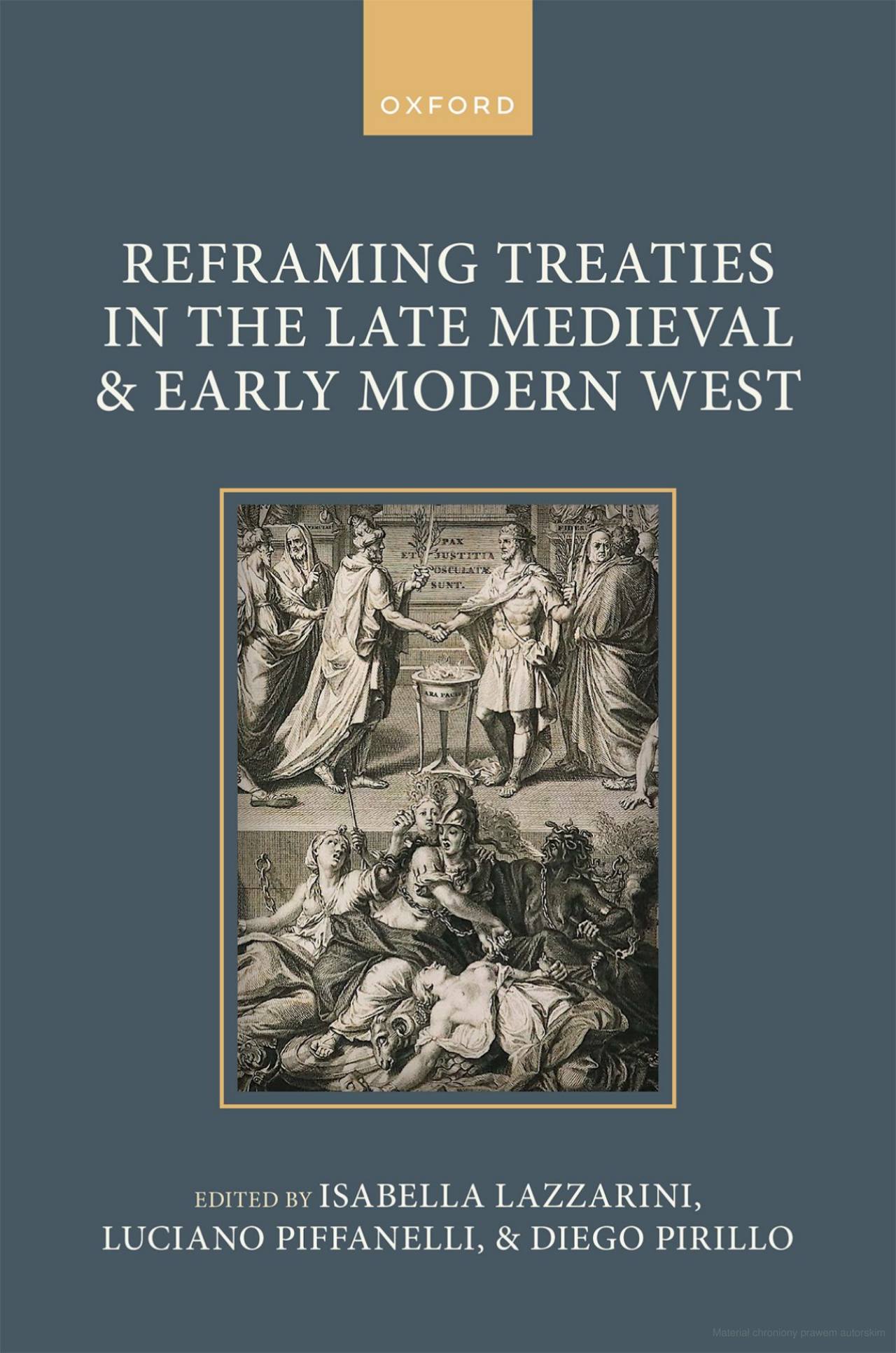
Publication – « Reframing Treaties in the Late Medieval and Early Modern West », éd. Isabella Lazzarini, Luciano Piffanelli, Diego Pirillo

The history of peacemaking has traditionally been reduced to isolated case studies and seen as the prelude to the presumed ‘universal’ and ‘modern’ international order. Countering this one-dimensional and Eurocentric narrative, this multi-authored volume reconceptualizes peace treaties as a range of successful and failed agreements, settlements, truces, leagues, and other forms of conflict resolution, thus recovering their multilayered history throughout the medieval and early modern period. Rather than a series of ‘great’ treaties, peacemaking is reframed as a flexible phenomenon; a ‘political grammar’, whose complexity is reflected in its variety of forms and sources. Drawing on both diplomatic history and international relations studies, this volume traces the central role that peacemaking has played in the political history of the Western World.

Isabella Lazzarini is Full Professor of Medieval History at the Department of Historical Studies at the University of Turin and a member of the board of the PhD in ‘Historical and Archaeological Sciences’, of the DISCI department of the University of Bologna. Her research interests focus on the political, social, and cultural history of late medieval Italy and the Mediterranean, with an emphasis on Renaissance diplomacy, the growth of different political languages in documentary sources, and gender studies. She is currently working at the EOS project DiplomatiCon: a Connected History of Medieval Mediterranean Diplomacy. The Mamluk Sultanate, Italy, and the Crown of Aragon (14th-15th centuries) (Liège, Antwerpen, Barcelona, Torino/Bologna, 2022-2027).

Luciano Piffanelli is Associate Professor of Early Modern History and Archival Science at the University of Upper Alsace and member of the board of the PhD in ‘European History and Cultures’ at the University of Rome ‘Sapienza’. Spanning from the 15th to the 18th century, his research deals with European politics, cultures, and societies, focusing on diplomatic practices, archival strategies, and intersections between politics, philosophy, and science. He is member of the editorial boards of the journal Legatio and of the book series In margine: Exploring Pre-modern Paratexts, and he has recently been awarded a PIR grant for his project Faire la paix. Édition et textualité des collections diplomatiques de l’époque moderne (XVIIe-XVIIIe s.).

Diego Pirillo is Professor of Italian Studies at the University of California, Berkeley, where is also affiliated with the History Department. His work focuses on early modern Italy, Europe, and the Atlantic world, with a strong interest in intellectual history, the history of books and reading, refugee studies, colonialism, the history of news and information.

The Political Grammar of Agreements in the Late Medieval and Early Modern West: An Introduction, Isabella Lazzarini, Luciano Piffanelli, and Diego Pirillo
Prologue: Sources and Text Tradition
1:Diplomatic Sources on Peacemaking in the Late Medieval and Early Modern West (14th-16th Centuries): Letters-Acts-Treaties, Néstor Vigil Montes
2:At the Roots of the History of Diplomacy: Writing, Preserving, and Publishing a Peace Treaty (1454/5-1735), Isabella Lazzarini
Peacekeeping: Political and Confessional Pacts
3:Keeping the Peace and Defending Christendom: The Shaping of the Holy Roman Empire as a Treaty-Based Multilateral Order (14th-16th Centuries), Duncan Hardy
4:Peace and Territory in the Burgundian and Habsburg Low Countries: The Post-Revolt Settlements of 1421-1427 and 1576-1577, Bram De Ridder
5:Giving the Heretics a Stand: The ‘Compacts’ and ‘Concordats’ of Jihlava (Basel) in the Long Struggle for a Peace Agreement between the Roman Church and Bohemian Hussites (1436), Klára Hübner
6:Peacemaking as a Written Work in Progress: Texts and Players (Italy, 15th-16th Centuries), Francesco Senatore
7:Dealing with a Discordant Hydra: Members of the Swiss Confederation in a Constant Struggle for Good Neighbourly Relations, Heinrich Speich
8:Peacemaking in the Context of Religious Violence: The Edict of Nantes and the Fragility of Conflict Resolution, Brian Sandberg
Peacemaking: Foreign Relations and Religious Treaties
9:From Tlemcen to Pisa: Negotiating the Peace in 1358, Mohamed Ouerfelli
10:A Century of Failure? Making Peace in the Hundred Years War, David Green
11:Negotiating for Peace and Trade with the Mamluks: From Truce to Decree, Frédéric Bauden
12:Invisible Treaties: The Governors of Algiers and the Strategic Use of Peace Negotiations during the 16th-Century Ottoman-Habsburg Mediterranean Struggle, Francesco Caprioli
13:On the Diplomatistic Nature of the Treaties of Cateau-Cambrésis (1559): Rule or Exception?, Roseline Claerr
14:On the Failure of Treaties: Bristol 1575, John Watkins
Intersections: Law, Literature, Ethics, Philosophy, and Peacemaking
15:Negotiation, Peacemaking, and Treaties: An Early Medieval Perspective, Jenny Benham
16:Peacemaking in Late Medieval Ius Commune, Dante Fedele
17:Signed, Sealed, Delivered: Ratification, Delay, and the Time of Tragedy, Timothy Hampton
18:The Bridge of Peace: Religious Peace, Oblivion, and the Sovereign’s Clemency, Michaela Valente
19:Peace and Treaties in the Political Thought of Francis Bacon, Samuel Garrett Zeitlin
20:’The Resurrection of a Body Whose Limbs Were Extremely Dispersed’: Reframing Peace and Peace Treaties in Leibniz’s Work (17th-18th Centuries), Luciano Piffanelli
21:Negotiating on the Frontier: Indian Treaties and the Republic of Letters, Diego Pirillo
Epilogue: Afterlives
22:Remembering Westphalia: Rights Talk in Times of ‘Domestic Jurisdiction’, 1648 and 1948, Jane O. Newman

Informations pratiques :

Reframing Treaties in the Late Medieval and Early Modern West, éd. Isabella Lazzarini, Luciano Piffanelli, Diego Pirillo, Oxford, Oxford University Press, 2025 ; 1 vol., 512 p. ISBN : 978-0-19895-847-5. Prix : GBP 119,00.

Source : Oxford University Press

Publié dans Publications | Commentaires fermés sur Publication – « Reframing Treaties in the Late Medieval and Early Modern West », éd. Isabella Lazzarini, Luciano Piffanelli, Diego Pirillo

Appel à contribution – Multidisciplinary Approaches to the Study of Medieval Roofing Systems from Europe to the Christian East

One of the most important structural elements in the formulation of the architectural language of sacred space in the Middle Ages was the creation of varied roofing systems (wooden roofs, stone vaults, domes). It is the roofs that decisively conditioned the internal spatiality and assumed a primary importance also in formulating the external form of the churches, because the entire construction is based on the shape that the roof will have.

Roofing systems, therefore, have an enormous potential for the study of sacred spaces: if these structures are studied with an interdisciplinary approach they can be compared, contextualised and better understood.

The aim of this session is to delve deeper into some case studies from Europe to the Christian East in a multidisciplinary perspective, integrating seamlessly elements of the history of architecture and restorations, archaeometry, archaeology, and art history. Although these methods are native to different disciplines, they constitute indispensable and complementary approaches for a holistic analysis of medieval roofing systems.

Potential topics include, but need not be limited to, the following:

  • The structure of roofing systems and the construction phases of individual buildings
  • Analysis of groups of buildings: contextualization and regional or international comparison of building ensembles
  • Dating and structural analysis of timber roof frameworks
  • Stereotomy and construction techniques of vaulted stone structures
  • Nineteenth- and twentieth-century restoration campaigns

This session forms part of the activities of the CaMeRoofs (Cataloguing Medieval Roofs) project, coordinated by the University of Cyprus and funded by the European Commission under the Marie Sklodowska-Curie Actions.

If you are interested in participating, please send an abstract of max. 200 words, 2-4 relevant index terms (https://www.imc.leeds.ac.uk/imc-index-terms/), a short bio with full affiliation details (department, institution, email address) to: passuello.angelo@ucy.ac.cy.

Source : Medieval Art Research

Publié dans Appel à contributions | Commentaires fermés sur Appel à contribution – Multidisciplinary Approaches to the Study of Medieval Roofing Systems from Europe to the Christian East

Exposition – Martin Schongauer Superstar. La métamorphose de la gravure (1450-1510)

Aujourd’hui figure relativement méconnue du grand public, Martin Schongauer (vers 1440/45-1491) fut en son temps une « superstar ». Organisée dans le cadre du Wittert Project, cette exposition lève le voile sur ce graveur visionnaire dont le Musée Wittert abrite une centaine de pièces.

Graveur virtuose et conteur captivant, Schongauer dit en noir et blanc aussi bien l’amour d’une mère que la hargne des démons, la résilience des saints que les merveilles de la nature. Mais il fut aussi un entrepreneur féroce qui misa sur un objet multiple – systématiquement marqué de ses initiales, pour mieux diffuser ses images.

Ces œuvres connurent alors un succès sans précédent et rayonnèrent de l’Italie aux Pays-Bas, de l’Espagne à la Bohème, où elles séduisirent les artistes les plus célèbres, tels Michel-Ange ou Jérôme Bosch. Mais c’est surtout en donnant à l’estampe ses lettres de noblesse, que Schongauer ouvrit la voie à une nouvelle génération de graveurs illustres : Albrecht Dürer, Lucas Cranach ou encore Lucas de Leyde.

De cet artiste précurseur, le Musée Wittert conserve l’un des fonds les plus importants au monde. En présentant une partie de son œuvre, et en la faisant dialoguer avec celles de ses héritiers, l’exposition invite à redécouvrir l’univers de celui qu’on surnommait le « Beau Martin » en raison de son art.

Commissariat scientifique : Aude Briau, doctorante en histoire de l’art (EPHE-PSL, Paris / Ruprechts-Karl Universität Heidelberg / INHA, Paris) et chercheuse attachée au Wittert Project.

Du 24 mai au 26 septembre 2025

Musée Wittert
Place du 20-Août, 7
4000 Liège

Du lundi au samedi de 10h à 16h. Fermeture les 29/05, 09/06, 21/07 et 15/08.

Source : Musée Wittert

Publié dans Exposition | Commentaires fermés sur Exposition – Martin Schongauer Superstar. La métamorphose de la gravure (1450-1510)

Publication – Elina Gertsman, Vincent Debiais, « L’hypothèse abstraite. Écart, excès d’image au Moyen Âge »

Pictorial abstraction in the Middle Ages: an innovative reflection that offers a powerful cross-disciplinary approach to medieval art, under a completely rethought concept of abstraction in close contact with finely analyzed images.

Elina Gertsman is Distinguished University Professor, Andrew W. Mellon Professor in the Humanities, and Professor of Medieval Art at Case Western Reserve University. She writes on a wide variety of subjects, from image theory to polyfunctionality of objects.

Vincent Debiais is Director of Research at the CNRS and a member of the Centre de recherches historiques (EHESS-CNRS, Paris). He has published on writing, silence and text/image relations in medieval art.

Elina Gertsman, Vincent Debiais, L’hypothèse abstraite. Écart, excès d’image au Moyen Âge, Dijon, Les Presses du Réel, 2025 ; 1 vol., 360 p. ISBN : 978-2-37896-614-0. Prix : € 30,00.

Source : Les Presses du Réel

Publié dans Publications | Commentaires fermés sur Publication – Elina Gertsman, Vincent Debiais, « L’hypothèse abstraite. Écart, excès d’image au Moyen Âge »

Colloque – Päpste und Paramente von Julius II. bis Benedikt XVI.

Vom 26. bis 29. November 2025 kommen Expertinnen und Experten verschiedenster Fächer und Forschungsrichtungen zu einer internationalen Tagung im Römischen Institut der Görres-Gesellschaft am Campo Santo Teutonico zusammen, um päpstliche „Textilien, Texte und Kontexte aus sechs Jahrhunderten“ zu beleuchten, von Julius II. (1503-1513) bis Benedikt XVI. (2005-2013). Neben Kirchenhistorikerinnen und -historikern wie dem Hauptveranstalter Prof. DDr. Jörg Bölling (Univ. Hildesheim) referieren Kunsthistoriker/innen, Restauratorinnen und Textilkundler/innen, Historiker/innen, Literatur- und Liturgiewissenschaftler/innen, Modetheoretikerinnen und Computer-Linguisten sowie praktizierende Geistliche.

Purpurrot die päpstliche Mozzetta, und die Pallien werden den Metropoliten wieder vom Papst persönlich angelegt: Mit Leo XIV. stehen erneut Paramente und textile Stilfragen im Fokus der Weltöffentlichkeit. Die „New York Times“ listet ihn bereits unter den stilvollsten Personen des Jahres („The Most Stylish People of 2025“). Passend dazu zeigt schon die deutsche Mai-Ausgabe der „Vogue“ (internationales Magazin für „Mode, Trends, Beauty und People“) als „Coverstar“ Nadja Auermann, die dann im zentralen Titel-Interview von ihrem Konversionserlebnis durch die Schönheit altehrwürdiger Liturgie und von ihrer folgenden katholischen Taufe berichtet.

Diese neuesten Entwicklungen werfen Fragen zu den historischen Grundlagen der heutigen Paramente und außerliturgischen Gewänder auf. Hierfür kommen im Römischen Institut der Görres-Gesellschaft am Campo Santo Teutonico vom 26. bis 29. November 2025 Expertinnen und Experten verschiedenster Fächer und Forschungsrichtungen zusammen: Kirchen- und Kunstgeschichte, Restauration und Textilkunde, Geschichts-, Literatur- und Liturgiewissenschaft, Modetheorie und Computer-Linguistik.

Die öffentliche Abendveranstaltung am Samstag, dem 29. November 2005, um 18.00 Uhr ist als „Round Table“ gestaltet – mit dem Thema: „Hülle und Fülle. Textilien Christi, der Päpste und der Kirche“. Diskutieren werden die Literaturwissenschaftlerin und Modetheoretikerin Prof. Dr. Barbara Vinken (München), die Textilhistorikerin und langjährige Inhaberin der Berner Abegg-Stiftungs-Professur „Geschichte der textilen Künste“ Prof. Dr. Birgitt Borkopp-Restle und der im Kloster Maria Laach beheimatete Ökumeniker und Liturgiewissenschaftler Pater Dr. Augustinus Sander. Die Moderation übernimmt Dr. Benjamin Leven von der Zeitschrift COMMUNIO.

18.00 Uhr Führung durch den Campo Santo Teutonico
20.00 Uhr Gemeinsames Abendessen der Referenten

9.15 Uhr Stefan Heid (Rom) / Jörg Bölling (Hildesheim)
Begrüßung und Einführung in die Themenstellung

I. RENAISSANCE ALS STILPRINZIP UND REFORMPROJEKT
(Moderation: Arne Karsten)

9.45 Uhr Jörg Bölling (Hildesheim)
Die 24 Paramente der Papstliturgie. Texte und Textilien zwischen kirchlicher Tradition und Antikenrezeption im Rom der Renaissance (1503-1521)

10.30 Uhr Anrea Schloemer (Herzogenrath)
Ein Papst und eine Krone. Vom Drachen Julius’ II. zum Pfau Leos X.

11.15 Uhr Kaffeepause

11.45 Uhr Alessandra Rodolfo (Rom)
Simbolo di potere papale ed imperiale nella coronazione di Carlo V (1530). Il baldacchino di Clemente VII (1523-1534)

12.30 Uhr Mittagspause

15.30 Uhr Christian Hecht (Weimar)
Renaissance statt Gegenreformation. Formen und Funktionen der frühneuzeitlichen Papstparamente

II. PARAMENTE UND AUSSERLITURGISCHE GEWÄNDER DER FRÜHEN NEUZEIT
(Moderation: Birgitt Borkopp-Restle)

16.15 Uhr Simone Andreoni (Rom)
The creation, the relevance and the primacy of the 17th-century vestments of Santa Maria in Campo Santo Teutonico

17.00 Uhr Kaffeepause

17.30 Uhr Francesca Paola Massara (Palermo) / Maria Stragapede (Florenz)
Studi, ricerche e prospettive. Restauro, iconologia e digitalizzazione dei paramenti di Benedetto XIII Orsini (1724-1730)

09.15 Uhr Philipp Zitzlsperger (Innsbruck)
Zwischen Bild und Lebenswirklichkeit. Die außerlitgurgischen Gewänder kirchlicher Eliten und ihre Darstellungen

10.00 Uhr André Jesinghaus (Wien)
Kult und Karikatur. Filippo Bonanni (1638-1725) und Pier Leone Ghezzi (1674-1755)

10.45 Uhr Kaffeepause

III. PARAMENTE UND KLEIDUNG IM LANGEN 19. UND IM VERLÄNGERTEN 20. JAHRHUNDERT
(Moderation: Barbara Vinken)

11.15 Uhr Helena Iwasinski (Hildesheim), unter Mitarbeit von Gesa Heilmann (Hannover)
Päpstliche Paramente in protestantischer Perspektive. Römische Reminiszenzen der deutsch-dänischen Schriftstellerin Friederike Brun (1765-1835)

12.00 Uhr Arne Karsten (Wuppertal)
Restauration und Risorgimento. Kleidung und Stoffe in Lampedusas Roman « Il Gattopardo »

12.45 Uhr Mittagspause

15.45 Uhr Johan Ickx (Rom)
Schützende Stoffe. Der Einsatz Papst Pius’ XII. für Verfolgte des Nazi-Regimes

16.30 Uhr Sven Leo Conrad (Bettbrunn)
Priesterliche Paramente. Genese, Form und Funktion im Lichte der Liturgie Papst Benedikts XVI.

17.15 Uhr Kaffeepause

17.45 Uhr Ulrich Heid (Hildesheim) / Jörg Bölling (Hildesheim)
Die 24 Paramente der Papstliturgie in der Computerlinguistik. Prolegomena zu einem Hildesheimer Internet-Lexikon Lateinisch-liturgischer Fachbegriffe (HILF)

09.30 bis 13.00 Uhr Führung zu den Paramentenbeständen des 16./17. Jahrhunderts in den Vatikanischen Museen (Alessandra Rodolfo) und in Santa Maria Maggiore (Andreas Raub)

18.00 Uhr Öffentliche Abendveranstaltung:

ROUND TABLE: « Hülle und Fülle. Textilien Christi, der Päpste und der Kirche »
(Moderation: Benjamin Leven, Zeitschrift COMMUNIO)

mit
Barbara Vinken (München), Literaturwissenschaftlerin und Modetheoretikerin
Birgitt Borkopp-Restle (Bern), Textilhistorikerin
Augustinus Sander OSB (Maria Laach/ Rom), Ökumeniker und Liturgiewissenschaftler

Datum: 26.11.2025
Ort: Campo Santo Teutonico

Veranstalter : Prof. Dr. Dr. Jörg Bölling, Professur für Kirchengeschichte, Institut für Katholische Theologie, Universität Hildesheim in Kooperation mit Msgr. Prof. Dr. Stefan Heid (Römisches Institut der Görres-Gesellschaft, Campo Santo Teutonico, Città del Vaticano).

Source : Römisches Institut der Görres-Gesellschaft

Publié dans Colloque | Commentaires fermés sur Colloque – Päpste und Paramente von Julius II. bis Benedikt XVI.

Appel à contribution – La réception de la Grèce ancienne en Europe par le dialogue entre textes et images dans et hors du livre (XIVe-XVIe siècle) / The reception of ancient Greece in Europe through the dialogue between texts et images inside and outside the book (14th-16th century)

Colloque international – ERC AGRELITA
Les 18 & 19 juin 2026 à l’Université de Caen Normandie

Appel à communications

(Please find an English version of this call below)

Le projet ERC AGRELITA organise à l’université de Caen Normandie, les 18 et 19 juin 2025, un colloque international intitulé « La réception de la Grèce ancienne en Europe par la dialogue entre textes et images dans et hors du livre (XIVe-XVIe siècle) ».

Ce colloque propose d’explorer la réception littéraire, artistique et culturelle de la Grèce ancienne au prisme des relations entre les textes et les images en Europe, du XIVe au XVIe siècle. Comment associe-t-on les différentes formes du visuel et du textuel dans ce contexte ? Comment l’alliance entre le texte et l’image a-t-elle été intégrée dans les processus de la réception de la Grèce ancienne au sens large du terme défini par Lorna Hardwick, c’est-à-dire à la fois la réception de ses savoirs et de ses textes, et l’élaboration de représentations de la Grèce ancienne ? Qu’apporte la collaboration de la création littéraire et de la création visuelle aux différentes formes de la réception de la Grèce ancienne ? Quels aspects de l’Antiquité grecque, réelle ou imaginée, sont particulièrement mis en valeur grâce au dialogue entre les textes et les images dans les œuvres littéraires, historiques et philosophiques ?

Le colloque portera sur le dialogue entre les textes écrits en Europe du XIVe au XVIe siècle (éditions, traductions et commentaires d’œuvres grecques antiques, mais aussi nouveaux textes littéraires, historiques, philosophiques, didactiques) et les images. Deux axes seront envisagés.

Le premier axe – textes et images dans le livre – concerne le dialogue entre textes et images à l’intérieur du livre manuscrit et imprimé, du point de vue de sa matérialité et de ses contenus. Il s’agira d’étudier les différents liens établis entre textes et images, les rôles donnés à l’image dans les multiples formes de réception de la Grèce ancienne et l’évolution de cette collaboration des représentations textuelles et visuelles XIVe au XVIe siècle. On s’intéressera aux différentes formes d’illustrations et de décorations qu’offrent les manuscrits et les imprimés (peintures, gravures, dessins, décorations marginales, frontispices, inscriptions…).

Le deuxième axe – textes et images hors du livre – porte sur la création d’images qui s’inscrivent en dehors du livre, mais qui prennent leur origine dans un ou des livres, et qui illustrent, développent ou retravaillent une tradition textuelle sur la Grèce ancienne et en contiennent une trace textuelle, un signe textuel (légende, inscription, poème sous l’image, phylactère, représentation d’un livre dans l’image ou l’objet visuel…). Ce corpus inclut diverses catégories d’œuvres appartenant aux arts visuels (dessins, gravures, emblèmes, peintures, sculptures, architectures…), aux arts décoratifs (ameublement, orfèvrerie, vitrail, tapisserie, objets précieux…), aux arts scéniques (cérémonies, théâtre, danse, opéra…) ou aux arts appliqués (mode, objets du quotidien…).

Ces deux axes nous engagent à réfléchir sur l’importance de l’intermédialité dans la réception de la Grèce ancienne, autrement dit sur les transferts de formes et de sens entre différents media qui contribuent à cette réception. Par ailleurs, l’approche intermédiale n’est pas née ex nihilo mais se fonde sur un héritage des théoriciens de l’Antiquité grecque, comme le souligne Jürgen E. Müller, qui a développé ce concept dans les années 19801.

L’affirmation de liens étroits, voire d’une parenté entre les différents arts, est en effet très ancienne, puisqu’Aristote évoquait déjà, dans la Poétique, les similitudes entre le travail du poète et celui du peintre : « le poète est un auteur de représentations, tout comme le peintre ou tout autre faiseur d’images »2. La célèbre formule du poète Horace, ut pictura poesis3, se situe au cœur de la théorie des arts à la Renaissance, justifiant l’idée que le travail des peintres n’est pas moins noble que celui des écrivains. Si le dialogue des arts est fortement affirmé et valorisé à partir du XVIe siècle, il n’est cependant pas absent aux siècles précédents, bien que ce soit sous une forme moins théorisée.

La perspective de l’intermédialité permet ainsi d’aborder les processus de création et les transferts de forme et de sens entre texte et image au sein d’un vaste champ d’étude interdisciplinaire. Sans exclure d’autres approches, les propositions mettront en lumière des aspects encore peu explorés concernant la polyvalence des artistes, la circulation de modèles et les stratégies de représentation de la Grèce antique au sein de la transmission depuis les livres vers d’autres œuvres visuelles.

Dans l’espace du livre, notre premier axe, quels types de dialogue se nouent entre le texte et l’image, et dans quelles formes de livres illustrés? Quels rôles jouent le texte par rapport à l’image qui l’illustre, et inversement, l’image muette par rapport au texte parlant ? L’image illustre le texte, elle complexifie une histoire ou, au contraire, simplifie le récit ; l’image interprète le texte, elle allégorise ou personnifie un concept, elle modifie parfois aussi sa signification, elle peut mettre en présence (« re-présenter ») ce qui n’est pas dit ; elle déploie une fonction d’ornement là où on ne l’attend pas nécessairement (dans la marge, par exemple), s’autonomisant peu à peu par rapport au texte.

D’autres questionnements sont soulevés par le deuxième axe : comment des images liées à la Grèce ancienne s’incarnent-elles en dehors de l’espace du livre, tout en s’inspirant de traditions textuelles sur la Grèce antique ? Comment révèlent-elles cet héritage par la présence dans l’image de textes courts ou de signes textuels ? et comment interpréter ces formes différentes de liens entre le texte et l’image, et ces dispositifs de mise en abyme ? Comment les artistes s’en emparent-ils dans leurs représentations de la Grèce ancienne ?

Les diverses modalités d’émergence et d’ordonnance de l’image vis-à-vis d’un texte ne s’excluent pas les unes des autres, et d’autres restent sans nul doute encore à étudier dans le champ des études sur la réception de la Grèce ancienne.

Modalités de soumission

Les propositions de communication, en français ou en anglais (titre et résumé de 200-300 mots), sont à adresser, accompagnées d’un bref CV, au plus tard le 15 décembre 2025 aux adresses suivantes :

Après examen des propositions, l’acceptation sera notifiée vers le 15 janvier 2026.

Les frais de déplacement et d’hébergement seront pris en charge selon les modalités de l’Université de Caen Normandie.

Les actes du colloque seront publiés dans la collection « Recherches sur les Réceptions de l’Antiquité » de Brepols (https://www.brepols.net/series/RRA). Les articles proposés devront être inédits.

Organisation

  • Catherine Gaullier-Bougassas, Professeure des universités en langue et littérature médiévales françaises, ERC Agrelita (Principal Investigator), CRAHAM (UMR 6273), Université de Caen Normandie
  • Julie Labregère, Post-doctorante ERC Agrelita, CRAHAM (UMR 6273), Université de Caen Normandie
  • Giulia Parma, Post-doctorante ERC Agrelita, CRAHAM (UMR 6273), Université de Caen Normandie
  • Lorène Bellanger, Project Manager ERC Agrelita, CRAHAM (UMR 6273), Université de Caen Normandie

Appel à communication colloque textes et images

International conference – ERC AGRELITA

The reception of ancient Greece in Europe through the dialogue between texts et images inside and outside the book (14th-16th century)

June 18-19, 2026 at the University of Caen Normandie

Call for papers

This conference aims to explore the literary, artistic, and cultural reception of ancient Greece through the prism of the relationships between texts and images in Europe from the 14th to the 16th century. How are the different visual and textual forms associated in this context? How was the alliance between text and image integrated into the processes of reception of ancient Greece, in the broad sense defined by Lorna Hardwick i.e., both the reception of its knowledge and texts, and the development of representations of ancient Greece? What does the collaboration between literary and visual creation bring to the various forms of reception of ancient Greece? What aspects of Greek antiquity, real or imagined, are particularly highlighted through the dialogue between texts and images in literary, historical, and philosophical works?

The conference will take place at the University of Caen Normandie on June 18–19, 2026. It will focus on the dialogue between texts written in Europe from the 14th to the 16th century (editions, translations, and commentaries on ancient Greek works, as well as new literary, historical, philosophical, and didactic texts) and images. Two main themes will be considered.

The first theme—texts and images in the book—concerns the dialogue between texts and images within manuscripts and printed books, from the perspective of their materiality and content. We will study the different links established between texts and images, the roles assigned to images in the multiple forms of reception of ancient Greece, and the evolution of this collaboration between textual and visual representations from the 14th to the 16th century. Attention will be given to the different forms of illustration and decoration found in manuscripts and printed works (paintings, engravings, drawings, marginal decorations, frontispieces, inscriptions, etc.).

The second theme—texts and images outside the book—focuses on the creation of images that exist outside the book but originate in one or more books, and that illustrate, develop, or rework a textual tradition about ancient Greece, containing a textual trace or sign (caption, inscription, poem beneath the image, speech scroll, representation of a book within the image or visual object, etc.). This corpus includes various categories of works belonging to visual arts (drawings, engravings, emblems, paintings, sculptures, architecture, etc.), decorative arts (furniture, goldsmithing, stained glass, tapestry, precious objects, etc.), performing arts (ceremonies, theater, dance, opera, etc.), or applied arts (fashion, everyday objects, etc.).

These two themes invite reflection on the importance of intermediality in the reception of ancient Greece, in other words on the transfers of form and meaning between different media that contribute to this reception. Furthermore, the intermedial approach is not born ex nihilo but is founded on a legacy from the theorists of ancient Greek, as Jürgen E. Müller has pointed out, developing this concept in the 1980s1 .

The assertion of close links, even kinship, between the different arts is indeed ancient, as Aristotle already noted, in his Poetics, the similarities between the work of the poet and that of the painter: “the poet is a maker of representations, just like the painter or any other maker of images.”2 Horace’s famous formula, ut pictura poesis3, lies at the heart of Renaissance art theory, justifying the idea that the work of painters is no less noble than that of writers. While the dialogue between the arts was strongly affirmed and valued from the 16th century onward, it was not absent in previous centuries, albeit in a less theorized form.

The intermedial perspective thus allows us to address the processes of creation and the transfers of form and meaning between text and image within a vast interdisciplinary field of study. Without excluding other approaches, proposals will highlight aspects still little explored concerning the versatility of artists, the circulation of models, and the strategies of representation of ancient Greece in the transmission from books to other visual works.

Within the space of the book, our first theme, what types of dialogue are established between text and image, and in what forms of illustrated books? What roles does the text play in relation to the image that illustrates it, and conversely, the silent image to the speaking text? The image illustrates the text, complicates a story, or, on the contrary, selects and simplifies the narrative; the image interprets the text, allegorizes or personifies a concept, sometimes alters its meaning, and can make present (“re-present”) what is not said; it deploys an ornamental function where it is not necessarily expected (in the margin, for example), gradually gaining autonomy from the text.

Other questions are raised by the second theme : how do images related to ancient Greece take shape outside the space of the book, while drawing on textual traditions about ancient Greece ? How do they reveal this heritage through the presence of short texts or textual signs on the image? and how to interpret these different forms of links between text and image, and these devices of mise en abyme? How do artists use them in their representations of ancient Greece?

The various ways in which images emerge and are arranged in relation to texts do not exclude each other, and others undoubtedly remain to be studied in the field of reception studies of ancient Greece.

Submission guidelines

Proposals for papers, in French or English (title and abstract of 200–300 words), should be submitted along with a brief CV by December 15, 2025 to the following addresses:

After review, notification of acceptance will be sent by January 15, 2026.

Travel and accommodation expenses will be covered according to the regulations of the University of Caen Normandie.

The conference proceedings will be published in Brepols’ series “Recherches sur les Réceptions de l’Antiquité” (https://www.brepols.net/series/RRA). Submitted articles must be original and previously unpublished.

Organization

  • Catherine Gaullier-Bougassas, Professor of Medieval French Language and Literature, ERC Agrelita (Principal Investigator), CRAHAM (UMR 6273), Université de Caen Normandie
  • Julie Labregère, Postdoctoral Researcher, ERC Agrelita, CRAHAM (UMR 6273), Université de Caen Normandie
  • Giulia Parma, Postdoctoral Researcher, ERC Agrelita, CRAHAM (UMR 6273), Université de Caen Normandie
  • Lorène Bellanger, Project Manager, ERC Agrelita, CRAHAM (UMR 6273), Université de Caen Normandie

Source : Agrelita

Publié dans Appel à contributions | Commentaires fermés sur Appel à contribution – La réception de la Grèce ancienne en Europe par le dialogue entre textes et images dans et hors du livre (XIVe-XVIe siècle) / The reception of ancient Greece in Europe through the dialogue between texts et images inside and outside the book (14th-16th century)