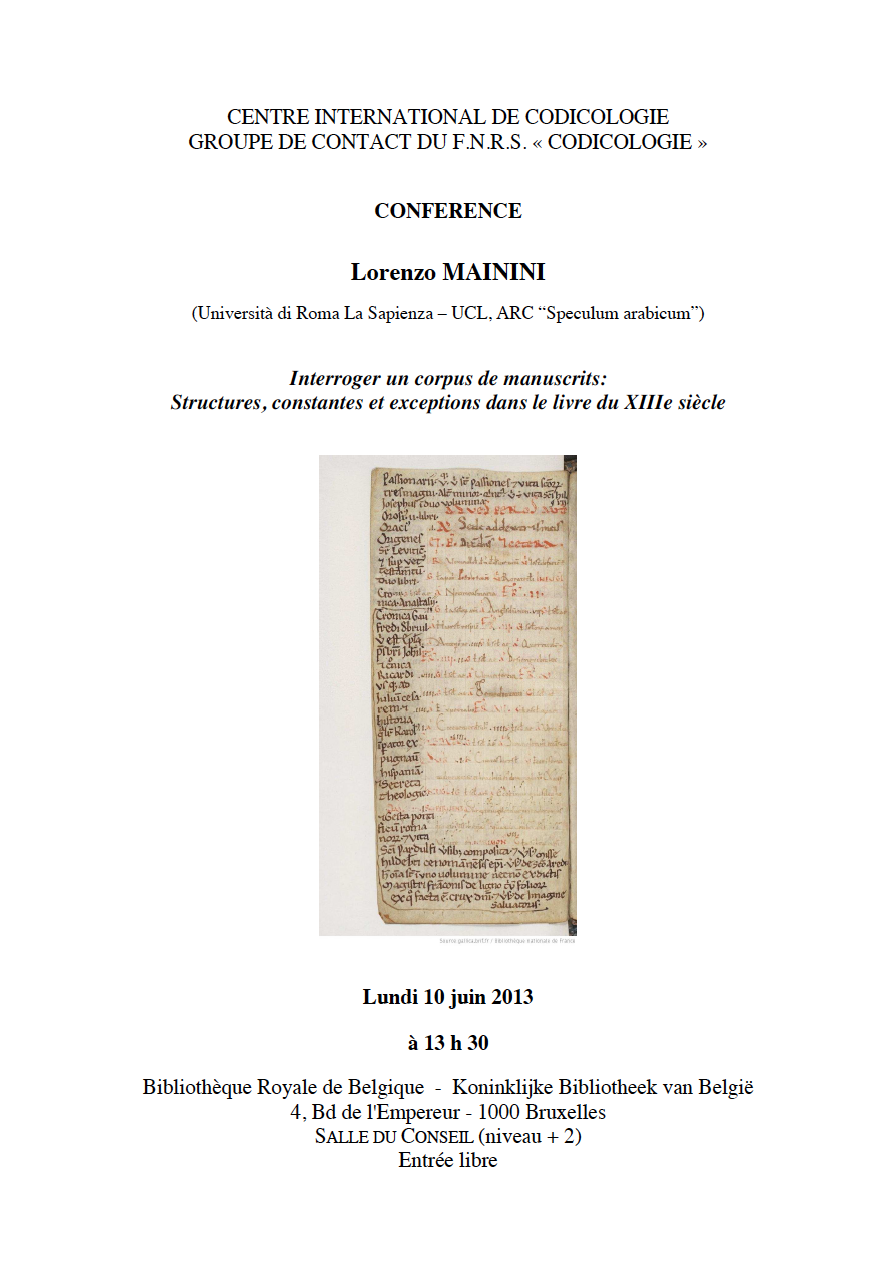
Conférence – Lorenzo Mainini, Interroger un corpus de manuscrits: Structures, constantes et exceptions dans le livre du XIIIe siècle

Centre international de codicologie
Groupe de ocntact FNRS « Codicologie »

Bruxelles
Bibliothèque Royale de Belgique, salle du conseil (niveau + 2)
10 juin 2013, à 13h30
par
Lorenzo Mainini
Université catholique de Louvain (ARC “Speculum arabicum”)
Università di Roma La Sapienza
Histoire des idées, histoire des textes et histoire du livre se mêlent l’une à l’autre dans la matérialité des manuscrits. Choix anthologiques, structures rédactionnelles récurrentes, gloses, mise en page révèlent, chacun avec son langage, le statut des contenus culturels qu’ils organisent. Au XIIIe siècle, en particulier, l’histoire des manuscrits subit les conséquences du développement de nouvelles formes culturelles : essor des universités et des ordres mendiants, pleine émergence des cultures romanes, crise du modèle monastique. Chacun de ces phénomènes entraîne un renouveau du savoir et par conséquent une nouvelle idée du livre lui-même. Universités et ordres mendiants, en outre, produisent une certaine « formalisation » du savoir et de ses outils, le manuscrit avant tout. Ces données nous ont permis d’imaginer une enquête sur les « formes-livre » diffusées au XIIIe siècle à partir, tout d’abord, d’un vaste recensement quantitatif des manuscrits copiés au cours du XIIIe siècle, prioritairement en France et en Italie (à partir d’un corpus d’à peu près 2000 mss.). 

Publié dans Colloque | Laisser un commentaire

Journée d’étude – Actuele vraagstukken in de religieuze en kerkelijke historiografie van de volle middeleeuwen

Actuele vraagstukken in de religieuze en kerkelijke historiografie van de volle middeleeuwen
Conventus. Problems of religious communal life in the High Middle Ages
Third annual round table
Programme :
10h30 : Verwelkoming en voorstelling van de deelnemers door Brigitte Meijns (KULeuven) en Steven Vanderputten (UGent)
11h00 Keynote lezing door Dr. David Defries (Kansas State University) – “Historiography in the Mind’s Eye: Lotharingian Monastic Reform in Tenth-Century Flanders”, gevolgd door discussie
12h00-13h30 Lunch
13h30-14h30 : Eerste paneldiscussie: Kloosters (chairs Georges Declercq en Alexis Wilkin)
Bijdragen door: Helena Vanommeslaeghe, Koen Vanheule, Jérôme Verdoodt
14h30-15h00 : Break
15h30-16h30 : Tweede paneldiscussie: Bisschoppen (chairs Brigitte Meijns en Tjamke Snijders)
Bijdragen door: Jelle Lisson, Sam Janssens, Pieter Byttebier, Ortwin Huysmans
16h30-17h00 : Samenvattende opmerkingen door Steven Vanderputten, gevolgd door discussie
Informations pratiques :
4/6/2013, 10u30-17u00
KULeuven
Decanenkamer van de Faculteit Letteren
Blijde Inkomstraat 21
3000 Leuven
Registratie: jelle.lisson@kuleuven.be

Source de l’information : Vlaamse Werkgroep Mediëvistiek
Publié dans Colloque | Laisser un commentaire

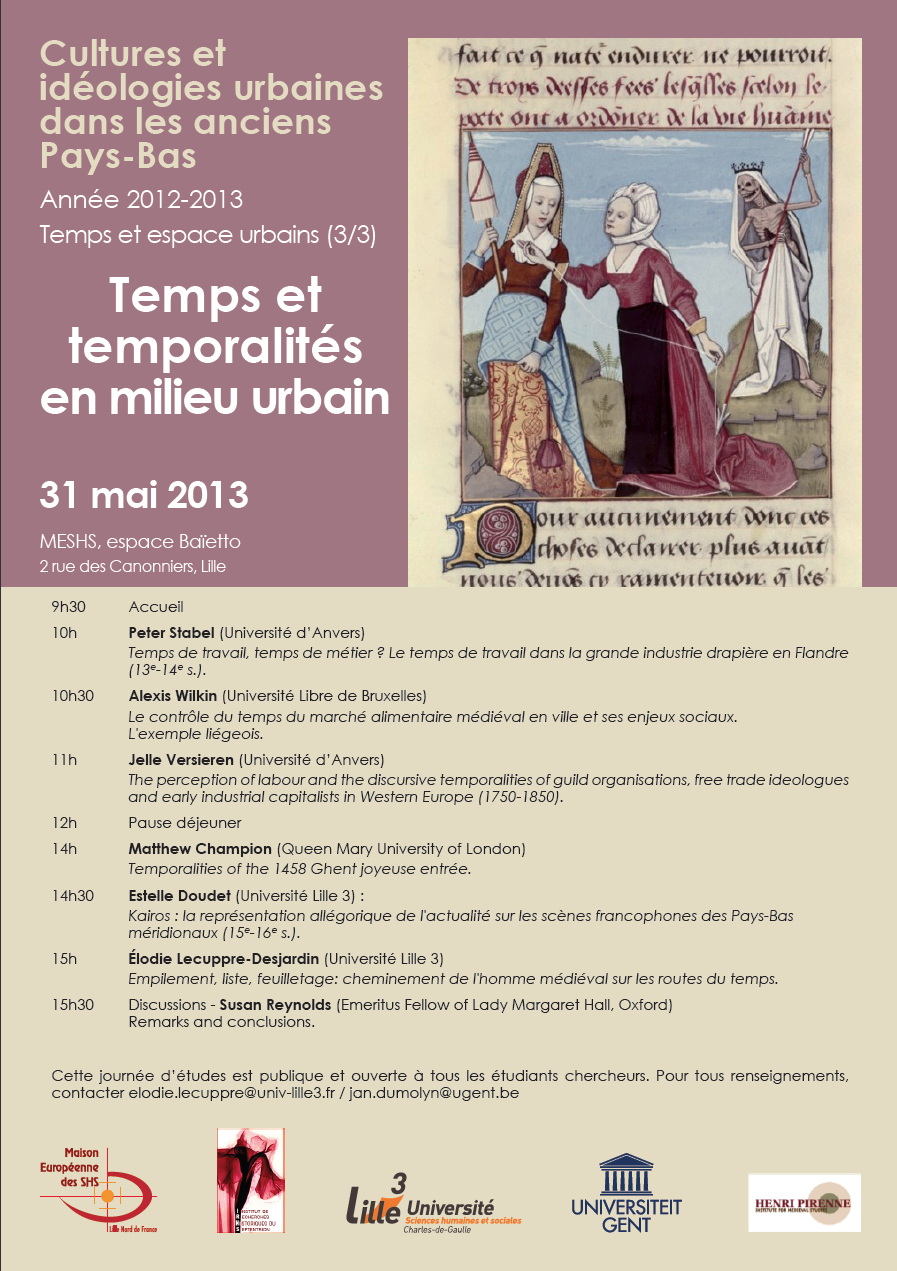
Journée d’étude – Cultures et idéologies urbaines dans les anciens Pays-Bas – Temps et temporalités en milieu urbain

Temps et espace urbains (3/3)
31 mai 2013 
MESHS, espace Baïetto
2 rue des Canonniers, Lille


9h30 Accueil 

10h Peter Stabel (Université d’Anvers) 
Temps de travail, temps de métier ? Le temps de travail dans la grande industrie drapière en Flandre 
(13e-14e s.).

10h30 Alexis Wilkin (Université Libre de Bruxelles) 
Le contrôle du temps du marché alimentaire médiéval en ville et ses enjeux sociaux. 
L’exemple liégeois.

11h Jelle Versieren (Université d’Anvers) 
The perception of labour and the discursive temporalities of guild organisations, free trade ideologues 
and early industrial capitalists in Western Europe (1750-1850).

12h Pause déjeuner

14h Matthew Champion (Queen Mary University of London) 
Temporalities of the 1458 Ghent joyeuse entrée.

14h30 Estelle Doudet (Université Lille 3) : 
Kairos : la représentation allégorique de l’actualité sur les scènes francophones des Pays-Bas 
méridionaux (15e-16e s.).

15h Élodie Lecuppre-Desjardin (Université Lille 3) 
Empilement, liste, feuilletage: cheminement de l’homme médiéval sur les routes du temps. 

15h30 Discussions – Susan Reynolds (Emeritus Fellow of Lady Margaret Hall, Oxford) 
Remarks and conclusions. 

Cette journée d’études est publique et ouverte à tous les étudiants chercheurs. Pour tous renseignements, contacter elodie.lecuppre (at) univ-lille3.fr / jan.dumolyn (at) ugent.be

Publié dans Colloque | Laisser un commentaire

Appel à contribution – Ecclesia et Violentia. Violence against the Church and Violence within the Church in the Middle Ages

The presented conference is devoted to the phenomenon of violence in relation to the medieval Church, as well as within the structures of that institution. The aim of this conference is to gain a clearer understanding of hostile and violent acts against the religious institutions and clergy alike, forceful contestation of property rights of the Church, etc. This conference seeks to explore also the interpersonal violence between clergymen or aggressive competition between local churches, moreover, the role of violence in maintaining discipline within the communities of the regular and secular clergy, as well as many aspects of these phenomena, including the religious, legal or ideological interpretation of these issues. The given issues seem to be neglected, especially on the ground of the Central European historiographies. Hence the organizers hope that the new discussion will help to create new fields of research and will shed some light on the given topics, and thus enrich our understanding of the role of the Church in medieval European society.
Organizers :
Dr hab. Jacek Maciejewski, prof. nadzw. (jmac@ukw.edu.pl)
Mgr Radosław Kotecki (Radoslaw_Kotecki@op.pl)
Conference programme committee :
Dr hab. Jacek Maciejewski, prof. nadzw. – przewodniczący / chairman
Dr hab. Dariusz Dąbrowski, prof. nadzw.
Dr hab. Tomasz Nowakowski, prof. nadzw.
Mgr Radosław Kotecki – sekretarz / secretary
Please send abstracts of no more than 200 words for papers, in English or Polish, for presentations approximately twenty minutes in length to:
The application deadline for conference registration is officially postponed to June 1. Decisions will be made in June 2013 and the final program published on September 1, 2013. Conference fee: 250 PLN (ca 80$ or 60€).
Localisation:
PRRZYSTAŃ HOTEL BYDGOSZCZ
2 Tamka Street
Bydgoszcz 85-162
Phone: +48 52 5895-601
Source de l’information : Episcopus
Publié dans Appel à contributions | Laisser un commentaire

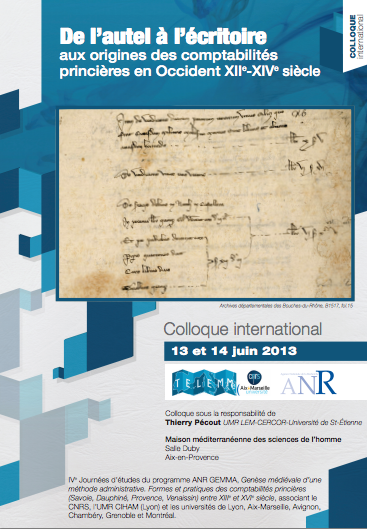
Colloque – De l’autel à l’écritoire : aux origines des comptabilités princières en Occident (XIIe-XIVe siècle)

Jeudi 13 et vendredi 14 juin 2013
Maison méditerranéenne des sciences de l’Homme, Salle Georges Duby – 5, rue du Château de l’Horloge 
Aix-en-Provence, France (13090) 

La mise en place des comptabilités princières, dans le courant du XIIIe siècle, nécessite deux types de réflexion. La première porte sur le personnel mobilisé par le prince, son origine, sa formation et sa culture familiale et professionnelle. La seconde interroge les méthodes de mise à l’écrit, de conservation et de consultation utilisées par les institutions chargées de la comptabilité princière, tout particulièrement les Chambres des comptes. 
Pour ces deux aspects, la réflexion s’est surtout développée en termes d’influences et s’est ainsi portée sur la question de l’apport des milieux urbains, marchands et des institutions communales, ainsi que sur la place du notariat et des hommes de loi. Par exemple, dans le cas de la principauté angevine de Provence, a été noté l’apport probable d’un personnel provenant de la péninsule Italienne, des communes du Piémont, de Lombardie et de Ligurie, de Toscane, en particulier à l’occasion de la venue des podestats et de leur suite lors des mutations des gouvernements communaux. La comptabilité princière entretient vraisemblablement d’étroites relations avec ces milieux et les comptabilités urbaines, mais selon des modalités et une chronologie qui restent à éclaircir, à partir d’une étude précise du vocabulaire institutionnel et de la structure des écrits comptables. En outre, si le recours à un personnel étranger par les gouvernements princiers a donné lieu à de distinctes enquêtes prosopographiques, il reste à mettre en relation leurs compétences avec l’élaboration des méthodes de comptabilité. La circulation de ce personnel qualifié mérite aussi une recherche précise dépassant l’échelle d’une seule principauté territoriale. 

Un autre domaine nous paraît en revanche encore en friche, malgré les perspectives ouvertes par des travaux portant plutôt sur le Moyen Âge finissant. Il s’agit de l’importance de la matrice ecclésiastique dans ce processus d’élaboration, qui tempère ou plutôt complète les pistes laïques décrites ci-dessus. L’enquête devra d’abord porter sur la présence de la comptabilité et sa nécessité au sein de structures ecclésiales et de communautés religieuses pour lesquelles le calcul et le comput sont constitutifs de leur formation intellectuelle. Au sein de milieux ecclésiastiques provenant eux mêmes de milieux urbains, comme les chapitres cathédraux, la mise en place dans le courant du xiiie siècle d’outils comptables améliorant la gestion de la mémoire et de la commémoration des défunts, tels les livres des anniversaires, nécrologes et obituaires, mérite une attention spéciale. Ensuite, le développement d’une fiscalité pontificale, avec les décimes, annates et services, a imposé aux évêques et aux chapitres cathédraux, qui en sont les relais locaux, la mise en place d’une comptabilité bénéficiale et d’une rationalisation de sa gestion qu’il s’agira d’examiner de près. Quelle a été leur conséquence sur l’émergence de compétences spécifiques au sein de ce milieu clérical ? La place des clercs séculiers dans les premières institutions comptables princières, et d’un personnel de notaires et de scribes issu de leur entourage, et en retour la présence de nombreux collaborateurs du prince au sein de ce milieu, doit nourrir enfin une enquête d’histoire sociale de l’institution comptable. Elle ouvrira sans doute de nouvelles perspectives non seulement au regard de l’élaboration des outils comptables, mais aussi du lien qu’ils peuvent entretenir avec certaines de leurs origines. Les enjeux idéologiques sont ici prégnants, quand pareille comptabilité a d’abord été mise en œuvre comme un auxiliaire de l’économie du salut. 
Programme  :

Jeudi 13 juin 2013 

8h30 : Accueil et ouverture du colloque 
Brigitte Marin (directrice de la MMSH et représentante du Président de l’Université d’Aix- Marseille) ; Laure Verdon (directrice adjointe de l’UMR TELEMME) ; Armand Jamme (CNRS)  – Allocutions d’ouverture 
Thierry Pécout (UMR LEM-CERCOR-Université de St-Étienne) – Introduction générale 
9h30-13h – Rationalités et institutions : des hommes aux modèles 
Président – Armand Jamme (UMR CIHAM, CNRS) 
Clément Lenoble (UMR CIHAM, Université de Pékin) – Formation et diffusion de rationalités comptables et religieuses dans l’Europe médiévale (Ve-XVIe siècle) 
Jacques Chiffoleau (EHESS) – Administrer une cure : les officiers de la Chambre apostolique et la gestion paroissiale au XIVe siècle dans le diocèse d’Avignon : l’exemple de Pont-de Sorgue 
Thierry Pécout (UMR LEM-CERCOR, Université de Saint-Étienne) – Aux origines d’une culture administrative : le clergé des cathédrales et la genèse d’une comptabilité princière en Provence à la fin du XIIIe siècle 
Jean-Baptiste Santamaria (Université de Lille 3) – Les ecclésiastiques et la comptabilité des princes : Bourgogne, Pays-Bas méridionaux, XIVe-XVe siècles 
Discussion 

14h30-17h30 – Experts et expertise 
Président – Jacques Chiffoleau (EHESS)


Nicholas Vincent (Université d’East Anglia) – Les pratiques anglaises, traditions et influences : 1130-1280 
Paul Bertrand (Université de Louvain) – Comptabilités artésiennes : pratiques ordinaires et extraordinaires. Les paysages documentaires de Thierry d’Hireçon et de Mahaut d’Artois 
Damien Carraz (UMR CIHAM, Université de Clermont-Ferrand II) et Karl Borchardt (Deutsches Institut für Erforschung des Mittelalters, Monumenta Germaniæ Historica, Munich) – Les pratiques comptables de l’ordre de l’Hôpital en Provence. Le cas de la commanderie de Manosque (années 1260-1320) 
Michel Fol (UMR CIHAM) – Des comptabilités ecclésiales. Comment on tient les registres de comptes dans les institutions canoniales et hospitalières en Savoie à la fin du Moyen Âge 
Discussion 


Vendredi 14 juin 2013 

9h30-12h30 – Circulations et synergies 
Président – Laurent Feller (UMR LAMOP, Université de Paris I et Institut universitaire de France)
Anne Lemonde (UMR CRHIPA, Université de Grenoble II) – Notaires et marchands dans le premier banc des comptes delphinal, 1307-1318 
Jean-Luc Bonnaud (Groupe de recherche sur les pouvoirs et les sociétés de l’Occident médiéval et moderne, Université de Moncton) – Officiers royaux angevins, milieux marchands et économie urbaine (Provence, XIVe-XVe siècle)
Mark Mersiowsky (Université d’Innsbruck) – Entre Brabant et Italie : influences des marchands italiens dans les comptes de l’empereur Henri VII 
Jordi Morelló (Baget Centro de Investigación en Humanidades del Consejo Superior de Investigaciones Científicas, Barcelone) – Sur la révision de la comptabilité bénéficiale dans la Couronne d’Aragon au XVe siècle (ou l’établissement d’une nouvelle assiette fiscale) 
Discussion 

14h30-17h – Les registres du prince 
Président – Noël Coulet (UMR TELEMME, Université d’Aix-Marseille)
Gaël Chenard (Archives départementales des Hautes-Alpes) – La comptabilité capétienne au XIIIe siècle 
Stephan Köhler (Université de Vienne) – La comptabilité dans le comté de Provence – L`administration princière à l’avènement de Charles d`Anjou 
Paolo Buffo (Université de Turin) – Gérer la diversité : les comptables des Savoie-Achaïe face aux comptabilités urbaines et ecclésiastiques 
Discussion et pause 

Jean-Paul Boyer (UMR TELEMME, Université d’Aix-Marseille) – Conclusions

Source de l’information : UMR Telemme
Publié dans Colloque | Laisser un commentaire

Journée d’étude – Construire le Moyen Âge : autour du travail de Chris Wickham

Les Journées du LAMOP
Lundi 27 mai 2013, 9h-18h
Sorbonne, salle Marc Bloch
Programme : 
9h00 : Accueil des participants
9h15 : Laurent Feller – Présentation
10h00 : Chris Wickham – Archéologie d’une pratique historique
Discussion
13h00 : Déjeuner (salle Perroy)
14 h 30 : Les recherches doctorales au LAMOP au prisme des travaux de Chris Wickham
Section 1 – Écritures pragmatiques : Harmony Dewez et Claire de Cazanove
Section 2 – Espace et pouvoir : Lucie Malbos et Solal Abeles 
Section 3 – Hiérarchies et distinction : Mélanie Dubois-Morestin et Philippe Lefeuvre
Section 4 – Normes et pratiques judiciaires : Maud Ternon et Xavier Pindard
Source de l’information : LAMOP
Publié dans Colloque | Laisser un commentaire

Offre d’emploi – Kress Interpretive Fellowship : European Painting before 1900

The Philadelphia Museum of Art seeks candidates for a one year fellowship in interpretation, beginning September 2013 and ending August 2014. This Kress Interpretive Fellow, supported by a grant from the Samuel H. Kress Foundation, will work collaboratively with Museum curators, educators, and conservators to create new interpretive strategies for selected works from the Museum’s collection of northern European painting from the 15th to the 17th centuries. The Fellow will have access to relevant collections and to the Museum’s library, and will partake of all professional privileges extended to Museum staff.

 Reporting jointly to the Associate Curator of European Painting & Sculpture before 1900 and the Senior Curator of Education, the Fellow will be engaged in both art historical and audience research; planning and production of interpretive content; design and implementation of interpretive strategies; and formative and summative evaluation activities. She/he will collaborate with and link together colleagues within the Department of European Painting before 1900; the Department of Conservation; and the Division of Education.

During the monthly Fellows Colloquia at the Museum, the Fellow will report on aspects of the project to fellows working in other areas of the Museum. He /she may be involved in program planning and volunteer training and may be asked to present lectures, gallery talks, and tours regarding core collections holdings.
Qualified candidates will have 1+ years of experience in an art museum setting, master’s level education in Art History, and familiarity with Museum Interpretation and/or Education. Candidates must possess a demonstrated knowledge of the history of European Art from the 15th to through 17th centuries; an ability to work collaboratively across the institution; excellent writing and communication skills, and an enthusiasm for introducing art to a broad audience, diverse in experience and learning styles. The ability to think innovatively, manage time, and prioritize work on multiple projects are necessary. Some research travel is expected.
To apply, create a single document that contains a cover letter, a resume, a writing sample and/or sample/example of a museum interpretive project, and a list of professional references. 

Application Instructions :

  • Apply via Museum’s website: www.philamuseum.org/jobs 
  • Create a single document that contains all the application material listed above to be uploaded with your application. 
  • Candidates without a social security number should decline the background check section. This does not impact the status of your application.
Application deadline : June 15, 2013
Source de l’information : Codart
Publié dans Offre d'emploi | Laisser un commentaire

Appel à contribution – Neue Methoden der spätmittelalterlichen Wirtschaftsgeschichte

Veranstalter: Arbeitskreis für spätmittelalterliche Wirtschaftsgeschichte
Datum, Ort: 15.11.2013-16.11.2013, Frankfurt am Main
Deadline: 30.06.2013

Wirtschaftshistoriker sitzen häufig zwischen allen Stühlen. Die beiden Disziplinen, in denen sie sich verorten können, folgen ganz unterschiedlichen Annahmen und Zielsetzungen: Die Wirtschaftswissenschaften interessieren sich für Gleichgewichtszustände und überzeitliche, abstrakte Erklärungsmodelle, die Geschichtswissenschaft beschäftigt sich mit historischem Wandel und wechselnden Rahmenbedingungen menschlichen Handelns. Wirtschaftliche Aktivitäten gab es in jeder Epoche der Menschheitsgeschichte, die Theorien der Wirtschaftswissenschaft wurden hingegen vor dem Hintergrund moderner Wirtschaftsformen entwickelt. Die Erforschung vormodernen Wirtschaftens steht folglich stets vor besonderen methodischen Herausforderungen.

Wirtschaftshistoriker, die sich mit dem Mittelalter beschäftigen, bedienen sich deshalb ganz unterschiedlicher Herangehensweisen, um ökonomische Phänomene der Vergangenheit zu erklären und zu analysieren. Zum ersten werden quantitative Methoden aus den Wirtschaftswissenschaften für frühere Zeiten nutzbar zu machen versucht. Hierzu zählen etwa statistische Auswertungen oder Netzwerkanalysen. Auch institutions- oder unternehmensgeschichtliche Studien lassen sich für mittelalterliche Zeiten durchführen.

Zum zweiten können wirtschaftliche Phänomene mit den Herangehensweisen der Sozialwissenschaften erfasst werden. Dabei spielen ebenfalls quantitative Verfahren eine Rolle. Darüber hinaus werden systemtheoretische, kommunikationswissenschaftliche und wirtschaftssoziologische Methoden herangezogen. 

Zum dritten öffnet sich gerade in jüngerer Zeit auch die historische Kulturwissenschaft für wirtschaftliche Themen. Entsprechend den hierbei angelegten „umfassenden, integrierenden und transdisziplinären Fragestellungen“ (Oexle, 2011) erscheint ein problemorientierter und komparatistisch angelegter Zugriff zur Wirtschaftsgeschichte vielversprechend. Im Mittelpunkt steht hier die Verknüpfung von Problemstellungen, wie dem wirtschaftlichem Handeln mit der Wissensschöpfung oder der Institutionalisierung mit den Inszenierungsformen ökonomischen Wissens.

Auf einer Tagung in Frankfurt am Main möchten wir Vertreter aller drei Herangehensweisen zusammenbringen. Wir möchten diskutieren, mit welchen Methoden wirtschaftshistorische Forscher heute Themen aus dem mittelalterlichen wirtschaftlichen Sektor bearbeiten. Es geht uns also nicht darum, bloße Überschneidungen zwischen Wirtschafts-, Sozial- und Kulturwissenschaft festzustellen. Die Konferenz richtet sich an Doktoranden und Postdoktoranden, die zu einem Thema aus der Wirtschaft des Spätmittelalters (ca. 1350-1600) arbeiten und ihre methodische Ausrichtung vorstellen und diskutieren möchten.

Interessenten bitten wir, bis zum 30. Juni 2013 einen Abstract (500 Wörter) und einen kurzen Lebenslauf zu senden an: arbeitskreis@wirtschaftsgeschichte.org

Julia Bruch (Universität Köln) 
Ulla Kypta (Universität Frankfurt am Main) 
Tanja Skambraks (Universität Mannheim) 
Kontakt: 
Ulla Kypta
Universität Frankfurt am Main, Historisches Seminar, Grüneburgplatz 1, 60323 Frankfurt am Main
ulla.kypta@gmail.com
Source de l’information : H-Soz-u-Kult
Publié dans Appel à contributions | Laisser un commentaire

Offre d’emploi – Scholarships, School of Celtic Studies, DIAS

The School of Celtic Studies is able to offer two additional scholarships this year.
A CV, including an outline of the research which the applicant proposes to undertake, should be sent to: Ms Eibhlín Ní Dhonncha, School Administrator, School of Celtic Studies, Dublin Institute for Advanced Studies, 10 Burlington Road, Dublin 4, IRELAND.

or by e-mail to eibhlin@celt.dias.ie.


To be returned not later than 30 June 2013.

The applicant should also ensure that references from at least two referees are sent to the School Administrator by the above date. The date at which the applicant wishes the Scholarship to commence and proposed length of tenure should be indicated. The usual commencement date is the 1st of October and the normal tenure is three years. Applications are particularly welcome from candidates who have completed, or are close to completing, their PhD. The stipend is €25,000 for candidates with a PhD.

The School of Celtic Studies is an eligible organization for the IRCHSS funding schemes.


Further details: http://www.dias.ie
Source de l’information : FMRSI
Publié dans Offre d'emploi | Laisser un commentaire

Colloque – The Production and Reading of Music Sources

The Production and Reading of Music Sources
London, June 6 – 08, 2013

International Conference hosted by the Warburg Institute and the British
Library, 6-8 June 2013

Organised by Thomas Schmidt (University of Manchester) and Hanna Vorholt (University of York)

Funded by the Arts and Humanities Research Council ‘Production and Reading of Music Sources, 1480-1530′ project

Speakers include: Jane Alden (Wesleyan), Stanley Boorman (New York), Vincenzo Borghetti (Verona), Stratton Bull (Leuven), Helen Deeming (Royal Holloway), Pawel Ganczarczyk (Warsaw), Mara Hofmann (Warburg), Oliver Huck (Hamburg), Christian Leitmeir (Bangor), Andrea Lindmayr-Brandl (Salzburg), Emanuele Lugli (York), Grantley McDonald (Salzburg), Elizabeth Morrison (Getty Museum), Sanna Raninen (Manchester), Ian Rumbold (Manchester), Martina Šárovková (Prague), Katelijne Schiltz (Munich), Thomas Schmidt (Manchester), Tim Shephard (Sheffield), Dagmar Thoss (Vienna), Paul Vetch (King’s College London).

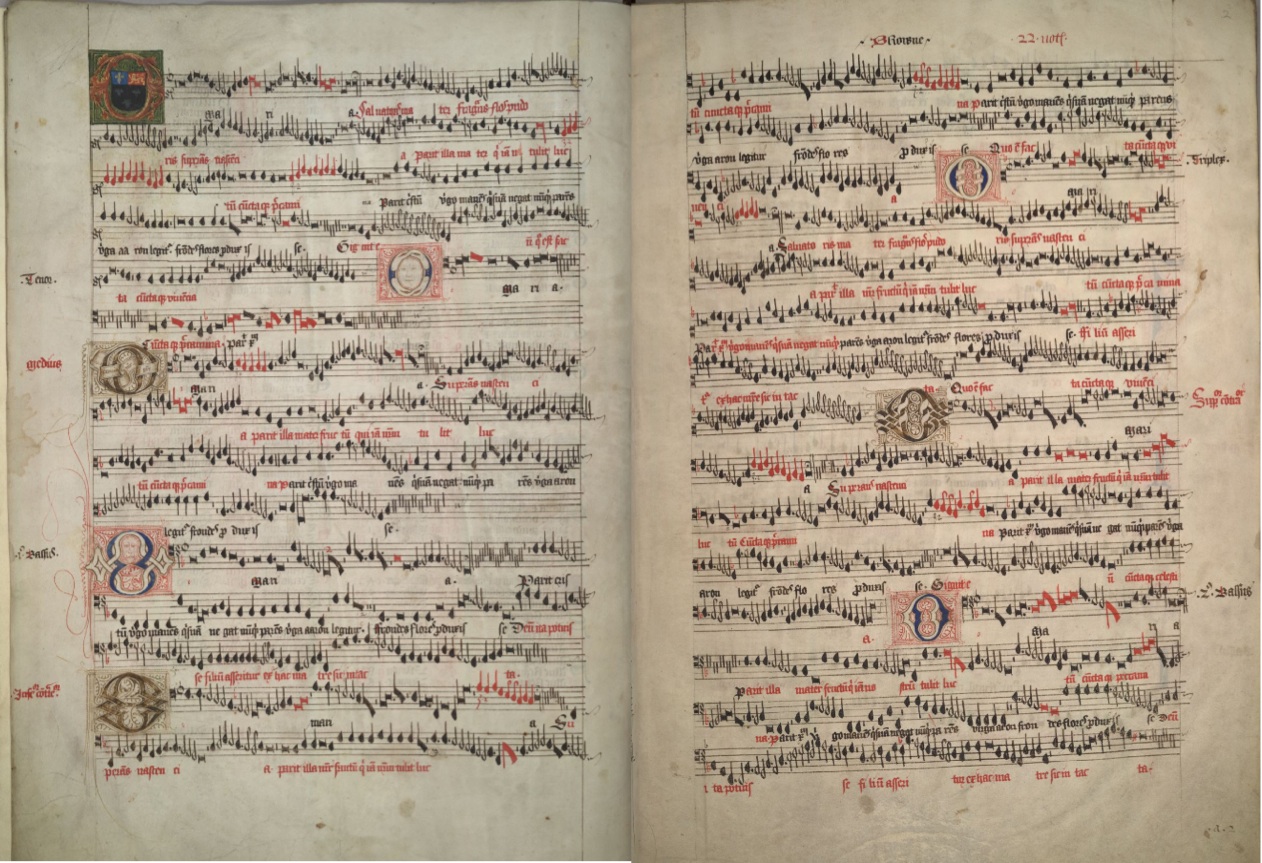
The mise-en-page of medieval and early modern music sources has become an increasing focus of scholarly enquiry in recent years. In their combination of verbal text, musical notation, images and other graphic devices, they are amongst the most complex books of their time, and much about the relationship between their visual appearance, their function and their use (in performance or otherwise) is still insufficiently understood. This conference – organised in the context of an AHRC-funded project in which a team of musicologists, art historians and codicologists examines the mise-en-page of sources containing polyphonic music from 1480-1530 (www.proms.ac.uk) – brings together a wide selection of scholars engaged in the analysis of the layout of manuscripts and printed books, and will explore in an interdisciplinary perspective overarching questions that are relevant to music sources in the broadest sense. The spectrum of papers ranges from the thirteenth to the sixteenth centuries, from simple workaday collections to elaborate presentation codices, from panel paintings to chantbooks and music theory prints.

A full schedule of the conference, and information on how to register, can be found at

Further information on the conference can be obtained by e-mailing :
thomas.schmidt@manchester.ac.uk

Programme :

Thursday 6 June
British Library, Centre for Conservation

14h00 : Welcome – Thomas Schmidt, Nicolas Bell

Session 1 – Chair : Peter Gumbert (Leiden)

14h10 : Tim Shephard (Sheffield) – Seeing and Singing: Interpreting Visual Decoration in Music Manuscripts of ca 1500
14h45 : Thomas Schmidt (Manchester) – The Notation of Polyphonic Music: Visual and Spatial Aspects
15h20 : Jane Alden (Wesleyan) – Nested Polyphonies: Stratification and Organicism in 15th-Century
Chansonniers
16h00 : coffee
Session 2 – Chair : Nicolas Bell (British Library)

16h30 : Oliver Huck (Hamburg) – The Layout of the Early Motets
17h05 : Helen Deeming (Royal Holloway) – Isolated Jottings? The Compilation, Preparation and Use of Song Sources from Thirteenth-Century Britain
Friday 7 June
Warburg Institute

10h10 : Welcome – Hanna Vorholt

Session 3 – Chair : Hanna Vorholt (York)

10h20 : Emanuele Lugli (York) – Music in the Sky. On the Washington Coronation of the Virgin
10h55 : Katelijne Schiltz (Munich) – Subtilitas—Brevitas— Tentatio: Reading Musical Riddles
11h30 : Coffee

Session 4 – Chair : Mara Hofmann (Warburg)

11h55 : Martina Šárovcová (Prague) – Limbus Patrum. Correlations Between Visual and Textual Elements in Sources of Rorate Chants in Bohemia
12h30 : Christian Leitmeir (Bangor) – Design or Disaster? A Concert of Images, Words and Music in the Penitential Psalm Codices (Munich Ms. A)
13h05 : Lunch
Session 5 – Chair : John Lowden (Courtauld)

14h20 : Dagmar Thoss (Vienna) – On the Miniatures and Initials of the Vienna Alamire Codices
14h55 : Elizabeth Morrison (Getty) – Music Meant to Impress: A Consideration of the Design of Some Late Flemish Alamire Manuscripts
15h30 : Coffee

Session 6 – Chair: Charles Burnett (Warburg)

16h00 : Mara Hofmann (Warburg) – Nipped Noses and Locked Lips: Grotesque Initials in the Alamire Manuscripts
16h35 : Vincenzo Borghetti (Verona) – The Listening Gaze: Alamire’s Presentations Manuscripts and the Courtly Reader
17h10 : Stratton Bull (Alamire Foundation, Leuven) – The Cappella Pratensis – PRoMS Collaboration
18h00 : Wine Reception (Warburg)


Saturday 8 June
Warburg Institute

Session 7 – Chair: Christian Leitmeir (Bangor)

10h15 : Ian Rumbold (Manchester) – Alternative Mises-en-Page in Informal Sources: The Case of Heinrich Isaac’s Missa Wohlauf gesell
10h50 : Pawel Ganczarczyk (Warsaw) – From Manuscript to Print: Transformations of Musical Sources in the First Half of the Sixteenth Century
11h25 : Coffee
Session 8 – Chair: Ian Rumbold (Manchester)

11h50 : Andrea Lindmayr-Brandl /Grantley McDonald (Salzburg) – The Early Days of Music Printing in German-Speaking Lands: Ode Settings and Hymn Books
12h25 : Sanna Raninen (Manchester) – Xylography in Polyphonic Music Printing
13h00 Lunch
Session 9 – Chair: Helen Deeming (Royal Holloway)

14h00 : Stanley Boorman (New York) – Interpretations of the Notation in Early Printed Treatises
14h35 : Paul Vetch (King’s College London) – PRoMS at a Glance: The Visual Representation of Complex Musicological and Codicological Data (with presentation of the online resource)
15h35 : Coffee and close

Source de l’information : ArtHist
Publié dans Colloque | Laisser un commentaire