Appel à contributions – Symposium XIX for the Study of Underdrawing and Technology in Painting : Technical Studies of paintings: problems of attribution (15th-17th century)

Bruges, 11-13 September 2014
Dear Madam, Sir, Colleague,
In preparation of the XIXth symposium for the Study of Underdrawing and Technology in Painting to be held at Bruges, 11-13 September 2014, UCL (Louvain-la-Neuve), the Laboratoire d’étude des œuvres d’art par les méthodes scientifiques (Musée de Louvain-la-Neuve) and Musea Brugge, in conjunction with the Royal Institute for Cultural Heritage (Brussels), its Centre for the Study of the Flemish Primitives, and Illuminare (Centre for the Study of Medieval Art, KULeuven), invite you to submit an abstract on the theme:
Technical Studies of paintings: problems of attribution (15th-17th century)
Attribution is a central question in art history. Since the introduction of new examination techniques such as radiography, infrared photography and reflectography, traditional art history has undergone major changes. Technical investigation can provide information that contributes to the attribution of works of art to artists or workshops. However, it often also reveals complex working methods that the art historian has to take into account. New scientific imagery on works of art can often force the reconsideration – if not reversal – of accepted attributions. This symposium will focus on the various ways in which technical studies can provide answers to the often complex issue of attribution and will discuss the challenges that art historians face in proposing conclusive theories.
The papers should be of interest to curators, art historians, conservators and scientists working mainly on painting in the Low Countries from the 15th to the 17th century. The authors of selected abstracts will present their papers at this international conference in Bruges. In addition to the paper presentations, there will be a special session dedicated to presentation of five-minute summaries of new technical projects held in different institutions.
We would be very grateful if you would send us a preliminary title and abstract (maximum 500 words) as soon as possible and at the latest by 15 September 2013. A short notification on new technical projects should also be sent in order to plan the special session. The conference language will be English. We hope that you will support our efforts by notifying your colleagues and students about the colloquium.
With best regards,
Anne Dubois                                                             Till-Holger Borchert                       
UCL                                                                         Groeningemuseum/Musea Brugge
Christina Ceulemans                                                 Jan Van der Stock
KIK/IRPA                                                                KULeuven
Proposals for papers should be sent by e-mail to: Anne Dubois (Université catholique de Louvain, Département d’histoire de l’art), anne.dubois (at) uclouvain.be by 15 September 2013. Postprints of the colloquium will be published.

Source de l’information : Anne Dubois

Publié dans Appel à contributions | Laisser un commentaire

Offre d’emploi – Institut royal du Patrimoine artistique (IRPA) – HRM S1316 (Centre d’Étude des Primitifs flamands)

SERVICE PUBLIC FEDERAL DE PROGRAMMATION POLITIQUE SCIENTIFIQUE.
Institut royal du Patrimoine artistique (IRPA)
Vacance d’un emploi (M/ F) de premier assistant (classe SW2 de la carrière scientifique) – Vacance numéro HRM S1316 (Centre d’Étude des Primitifs flamands).
1. POSITIONNEMENT DE LA FONCTION AU SEIN DE L’ETABLISSEMENT.
Il s’agit d’un emploi d’agent scientifique statutaire à prestations complètes.
Titre et classe de la carrière scientifique : premier assistant (SW2).
Groupe d’activités de la carrière scientifique dont l’emploi fait partie : groupe d’activités 2 « service public scientifique ».
L’emploi sera exercé au sein de la direction opérationnelle « Documentation » de l’Institut royal du Patrimoine artistique (IRPA, Parc du Cinquantenaire 1, 1000 Bruxelles), dans la cellule « Centre d’Étude des Primitifs flamands ».
2.  REGIME LINGUISTIQUE.
Cet emploi est accessible aux candidat(e)s pouvant être affecté(e)s au rôle linguistique néerlandais, en vertu des règles fixées par les lois sur l’emploi des langues dans l’administration.
3. CONTEXTE DE LA FONCTION.
L’Institut royal du Patrimoine artistique (IRPA) est un établissement scientifique fédéral belge. Il fait partie du Service public fédéral de Programmation Politique scientifique (SPP).
L’IRPA est chargé de documenter (réalisation d’un inventaire photographique), d’étudier (expertises et analyses scientifiques) et de conserver/restaurer le patrimoine culturel et artistique de notre pays, et ce dans une large perspective de développement durable.
Dans une optique d’interdisciplinarité, il effectue des études de pointe sur les techniques et matériaux utilisés dans les œuvres d’art, ainsi que sur les produits et méthodes de conservation-restauration. Il valorise et diffuse la documentation et les données scientifiques, photographiques et techniques, ainsi que le savoir-faire exceptionnel présent dans ce domaine. En tant qu’établissement scientifique fédéral, l’IRPA a également vocation de recherche et de service au public.
L’IRPA réunit historiens de l’art, photographes, chimistes, physiciens et conservateurs- restaurateurs pour une approche interdisciplinaire des œuvres d’art.
La Documentation compte également une unité de recherche spécialisée : le « Centre d’Étude des Primitifs flamands » (dénommé dans la suite de ce texte « le Centre »), qui prend en charge l’étude d’histoire de l’art et l’inventaire des œuvres dans ce domaine.
4. CONTENU DE LA FONCTION.
4.1. Objectifs de la fonction au regard des missions de l’établissement.
Gérer une équipe de recherche spécialisée afin de pouvoir garantir le travail du « Centre » au sein de l’Institut; Gérer l’inventaire du « Centre » et le rendre accessible aux spécialistes et au grand public afin de promouvoir la recherche ;
Mener et coordonner des recherches en histoire de l’art dans le vaste domaine des Primitifs flamands en Belgique et dans les collections étrangères ;
Publier les résultats de ces recherches et les diffuser nationalement et internationalement afin de faire connaître l’IRPA, aussi bien dans le cercle des professionnels qu’auprès du grand public.
4.2. Domaines de résultats.
Enrichissement et amélioration de l’inventaire actuel du « Centre » ; Optimaliser la documentation scientifique et la rendre facile d’accès dans le cadre des activités du département ;
Mise en œuvre et coordination de l’étude des Primitifs flamands en Belgique et à l’étranger ; Travail de rédaction en vue des prochaines publications du « Centre » ; Organisation du service et de l’accueil des visiteurs ;
Rédaction de contributions scientifiques qui concourent à la diffusion des connaissances ; Rédaction de textes à visée scientifique (conférences, articles, posters pour des colloques…) ainsi que de textes à visée didactique (site Internet, affiches didactiques…) ;
Participation active aux colloques, congrès et expositions touchant au vaste domaine des Primitifs flamands.
5. PROFIL DE COMPETENCES.
5.1. Diplômes et formations requises.
Le/la candidate doit être en possession d’un diplôme universitaire de docteur en histoire de l’art. Il/elle doit pouvoir justifier d’une activité scientifique d’au moins 4 ans dans le domaine de la recherche.
Une expérience professionnelle dans un contexte international est un atout.
5.2. Compétences techniques (connaissances, spécialisations, expériences, …) que les candidats (m/f) devons avoir pour être retenu (critères d’admission).
Disposer d’une expérience professionnelle d’au moins 4 ans dans le domaine de l’étude des Primitifs flamands ; cette expérience sera attestée par des dossiers d’étude et de traitement, des publications, des attestations de stages et par le fait d’avoir donné des conférences et d’avoir assisté à des journées de formation ;
Disposer d’une expérience dans un centre de documentation.
5.3 Compétences génériques (compétences comportementales, aptitudes, …) qui seront évaluées après le stage.
Faire preuve de fiabilité dans l’exercice de leurs tâches ; Pouvoir motiver leurs collaborateurs et prendre en charge la gestion et l’organisation du « Centre » ;
Être capable d’engager le dialogue avec les spécialistes du domaine et les chercheurs des autres directions opérationnelles de l’IRPA entre autres, à savoir les « Laboratoires » et la « Conservation-restauration », et de synthétiser et de diffuser les connaissances en collaboration avec la direction opérationnelle « Valorisation-communication » ; Traiter de manière efficace et serviable les demandes internes et externes ;
Faire montre d’un bon esprit d’équipe.
6. CONDITIONS DE TRAVAIL.
6.1. Rémunération – carrière.
Le candidat/ la candidate choisi(e) sera engagé(e) comme premier assistant(e) en période d’essai avec l’échelle de traitement correspondante, donc l’échelle SW21. (une expérience professionnelle d’au moins de 4 ans est exigé)
Rémunération minimum (montants bruts, à l’index actuel, allocations réglementaires non comprises): dans l’échelle SW21 (pour une ancienneté de 4 ans): 55200,29 € brut par an (4600,02 € par mois).
La période d’essai a une durée normale de 1 an.
6.2. Autres avantages.
La gratuité des transports en commun pour le trajet domicile- travail et possibilité d’obtention d’une indemnité bicyclette ;
Un lieu de travail (Parc du Cinquantenaire) facilement accessible en transports en commun ;
Un environnement de travail vert et agréable ; Un régime de jours de congé favorable ;
Des horaires flexibles ;
La possibilité de souscrire à une assurance hospitalisation collective avantageuse ;
De nombreuses possibilités de formation.
7. CONDITIONS DE PARTICIPATION ET D’ADMISSIBILITE.
7.1 Le candidat/la candidate choisi€ doit remplir, à la date de l’entrée en service, les conditions suivantes :
être Belge ou citoyen d’un Etat faisant partie de l’Espace économique européen ou de la Confédération suisse;
jouir des droits civils et politiques;
avoir satisfait aux lois sur la milice;
être d’une conduite répondant aux exigences de la fonction sollicitée.
7.2. Au plus tard le dernier jour du délai fixé pour l’introduction des candidatures, les conditions suivantes doivent être remplies:
posséder les diplôme requis (voir le point 5.1 ci-dessus);
posséder les compétences techniques requises (voir le point 5.2.1 ci-dessus) et en faire preuve.
posséder les compétences génériques requises (voir le point 5.3 ci-dessus) et en faire preuve durant la période de stage ;
7.3. Dans les deux cas ci-après, la participation à la procédure de sélection n’est possible que sous les réserves suivantes.
7.3.1. Le diplôme requis a été obtenu dans un autre pays que la Belgique / dans un pays membre de l’Espace économique européen ou en Suisse
Dans ce cas, le président du jury de l’IRPA examinera préalablement si le diplôme présenté par le/ la candidat(e) est admissible en application des dispositions des directives 89/48/CEE ou 92/51/CEE du Conseil des Communautéseuropéennes.
C’est pourquoi le candidat/ la candidate concerné(e) doit ajouter à sa candidature, en plus d’une copie du diplôme présenté, les renseignements et les documents requis suivants en vue de l’examen précité :
– une traduction en néerlandais du diplôme si celui-ci n’a pas été établi en français, néerlandais, allemand ou anglais ;
– une attestation par laquelle l’institution d’enseignement qui a décerné le diplôme fournit les renseignements suivants (pour autant que ceux-ci ne figurent pas dans le diplôme en question) : le nombre d’années d’études à accomplir normalement en vue de l’obtention du diplôme ; la rédaction d’un mémoire était-elle requise pour l’obtention du diplôme ? 3. les connaissances et qualifications acquises et sur la base desquelles ledit diplôme a été décerne
– une traduction en néerlandais de cette attestation si celle-ci n’a pas été établie en français, néerlandais, allemand ou anglais ;
– une reconnaissance du diplôme par la Communauté flamande.
7.3.2. Le diplôme requis a été obtenu dans une autre langue que le français ou le néerlandais.
En principe, conformément aux lois sur l’utilisation des langues dans l’administration, c’est la langue dans laquelle ont été suivies les études qui ont mené à l’obtention du diplôme qui détermine le rôle linguistique auquel le candidat/la candidate doit être affecté(e).
Quand un diplôme de docteur est requis (ou quand le candidat présente un tel diplôme dans son dossier de candidature), diplôme ayant été obtenu à l’issue de la défense publique d’une thèse de doctorat, le rôle linguistique est déterminé par la langue dans laquelle ont été suivies les études qui ont mené à l’obtention du diplôme universitaire qui a donné accès au doctorat.
Dans le cas où les études ont été suivies dans une autre langue que le néerlandais, le candidat/la candidate doit avoir obtenu le certificat de connaissances linguistiques délivré par le SELOR (Bureau de Sélection de l’Administration fédérale – l’ancien Secrétariat permanent de Recrutement – boulevard Bisschoffsheim 15, 1000 Bruxelles; tél. : +32 – (0)2-788 66 31; e-mail : linguistique@selor.be), attestant que le/la candidat(e) a réussi l’examen linguistique se substituant au diplôme exigé en vue de la détermination du régime linguistique. Ce certificat doit être délivré après une épreuve sur la maîtrise de la langue néerlandaise attendue des porteurs d’un des diplômes visés ci-dessus sous le point 5.1.
8. RENSEIGNEMENTS COMPLEMENTAIRES.

Vous pouvez obtenir plus d’informations sur le contenu de cette fonction auprès de Madame Christina Ceulemans directeur general a.i. directeur@kikirpa.be , T. +32 2 739 67 45, IRPA Parc du Cinquantenaire 1, 1000 Bruxelles
9. PROCEDURE DE SELECTION.

Parmi les candidatures recevables, le jury de l’IRPA détermine les candidat(e)s qu’il estime être les plus aptes pour exercer la fonction à pourvoir (5 candidat(e)s au maximum peuvent ainsi être sélectionné(e)s).
S’il l’estime nécessaire, le jury peut inviter les candidat(e)s à présenter toute épreuve complémentaire qu’il détermine en vue d’apprécier leurs aptitudes à exercer la fonction à pourvoir.
Les candidat(e)s, ainsi retenu(e)s, sont ensuite invité(e)s à comparaître devant le jury pour une audition en vue de la fixation du classement des candidats.
Ce classement ne deviendra définitif qu’après avoir été notifié aux candidat(e)s concerné(e)s et qu’ils/elles aient eu la possibilité de porter plainte par rapport au classement, ainsi que de demander d’être entendu(e)s par le jury.
10. PROCEDURE D’INTRODUCTION DES CANDIDATURES.
10.1. Les candidatures doivent être introduites dans les 30 jours calendrier qui suivent la publication de cette vacance d’emploi au Moniteur belge, donc au plus tard le 12/06/2013.
Elles doivent être introduites par lettre recommandée adressée au Service d’encadrement Personnel & Organisation du Service public fédéral de Programmation (SPP) Politique scientifique, Avenue Louise 231, 1050 Bruxelles.
10.2. Le candidat/ la candidate doit indiquer explicitement dans sa candidature:
l’emploi postulé;
l’adresse à laquelle il/ elle acceptera la lettre recommandée l’informant de sa place dans le classement des candidat(e)s; chaque modification de cette adresse doit être communiquée sans retard.
10.3. Documents à joindre à la candidature:
un curriculum vitae complet et sincère;
si le candidat/ la candidate a déjà effectué des activités scientifiques: des attestations justifiant celles-ci (attestations délivrées par les employeurs, autorités ayant octroyé des bourses, …); pour être informé(e) des renseignements à fournir : voir la note relative à l’octroi de l’ancienneté scientifique sur le site web du SPP Politique scientifique (http://www.belspo.be, rubrique « Offres d’emploi » – Institut royal du patrimoine artistique – il est également possible d’obtenir une copie de cette note auprès du Service d’encadrement P&O du SPP Politique scientifique (tél. : 02 238 34 19 ou 02 238 35 68);
une copie du/des diplôme(s) exigé(s) ; • une liste des travaux scientifiques éventuellement publiés; • les renseignements et pièces visés ci-dessus sous le point 7.3.1, si le/les diplôme(s) requis, obtenu(s) par le candidat/la candidate, a/ont été décerné(s) par un établissement d’enseignement autre qu’un établissement belge; • le certificat de connaissances linguistiques évoqué sous le point 7.3.2, si ce certificat est nécessaire ou si le/la candidat(e) souhaite que son affectation à un rôle linguistique se fasse sur la base de ce certificat.
10.4. Il ne sera pas tenu compte des candidatures introduites sans respecter la procédure d’introduction ci-dessus.

Publié dans Offre d'emploi | Laisser un commentaire

Offre d’emploi – Academic Position in Computer Science for Digital Humanities

Academic Position in Computer Science for Digital Humanities
Occupation : Full-time
Place : Leuven (Belgium)
Apply before : June 30, 2013

KU Leuven invites applications for a full-time tenured academic position in Computer Science for Digital Humanities at the Department of Computer Science. We are looking for a dynamic and motivated individual (m/f) with an excellent research record in related areas.

Duties :

Research :
We are looking for a candidate with expertise in applications of computer science in digital humanities. A successful candidate will already have obtained excellent research results in the area of applying computer science techniques in research applications in the digital humanities. For the applied computer science techniques, examples could be data mining, or archiving or disclosure of information from large e-archives, or human-computer interaction, or visualisation techniques, or e-learning. Concerning the applications domains, examples could be the Arts, or the Social or Instructional Sciences. Research experience with the application of multiple techniques from computer Science and/or with multiple application domains in the Humanities or Behavioral Sciences are considered are a strong added value of the application.

Teaching :
The selected applicant will take on teaching responsibilities in various study programs, in particular for courses on basic computer science techniques for students in the humanities. Apart from this, the applicant will also be asked to teach an advanced course on applications, related to his/her research, in digital humanities. Possibly, the accepted applicant can be asked to teach courses in the Master/Bachelor Computer Science and/or the Master/Bachelor in (Applied) Informatics.

Together with an existing team, the successful applicant will further develop courses related to digital humanities. The applicant needs to engage in setting up an interdisciplinary cooperation, both in teaching and in research, on digital humanities.


Requirements :

Interested candidates should hold a Ph.D. or doctoral degree in computer science or informatics.
or
candidates should be holder of a Ph.D. in digital humanities or in the humanities, with a topic which is very closely related to computer science, informatics or the informatics-technical aspects of digital humanities. In the latter case, an additional degree in a related subject – especially in computer science or informatics – has significant added value.

Qualified candidates are expected to have an excellent research record and very good teaching and training skills, in order to contribute to the research output of the Department of Computer Science and to the quality of its educational programs. The high quality of the candidate’s research should be evidenced by publications in international peer-reviewed journals and conferences. International research experience is highly appreciated. 

An important criterion in the selection will be whether the candidate can link his/her research to one of the research units in the Department of Computer Science.

If you do not speak Dutch, you will be expected to learn the language within three years of your appointment. The required proficiency level will depend on the duties assigned to you. Dutch language courses are offered at KU Leuven.

Proficiency in the English language is also required.


Offer :

The full-time position can be offered in one of the academic levels (full professor, professor, associate professor, assistant professor), depending on the qualifications of the candidate.


Interested?

For more information please contact Prof. dr. ir. Ronald Cools, tel.: +3216327562, mail: ronald.cools@cs.kuleuven.be.

For problems with online applying, please contact Mrs. Katoe Buyle, tel.: +3216328324, mail: katoe.buyle@kuleuven.be.
You can apply for this job no later than June 30, 2013 via the 

Source de l’information : KULeuven
Publié dans Offre d'emploi | Laisser un commentaire

Journée d’étude – Barbes, moustaches et toisons de l’Antiquité à nos jours : jalons pour une histoire du poil

Mercredi 5 juin 2013 de 10h à 19h, à Arras, L’Être Lieu, Cité Scolaire Gambetta-Carnot, 21 boulevard Carnot

Le sujet du poil pourrait apparaître superflu ou anecdotique voire même être matière à plaisanteries plus ou moins graveleuses. Considéré d’un point de vue historique rigoureux, il se révèle toutefois comme une vraie source de réflexions des plus diverses. Au-delà des modes ou des caprices personnels, le poil a toujours signifié, constitué, un marqueur visuel et symbolique pour dire le genre, la rectitude morale, le raffinement esthétique ou la puissance érotique. La journée d’étude du 5 juin 2013 de 10 heures à 19 heures intitulée« Barbes, moustaches et toisons : jalons pour une histoire du poil » proposera quelques perspectives dans ce nouveau champ de ce qu’il conviendra peut-être de baptiser un jour la « nanohistoire ».

Les chercheurs participant à cette journée d’étude à la confluence de l’histoire, de l’histoire de l’art, de la philosophie, de la littérature et de l’anthropologie sont issus de diverses universités françaises ou étrangères (université d’Aix-Marseille, d’Ottawa, de Paris-IV…), de Classes Préparatoires aux Grandes Écoles (Lycée Gambetta d’Arras) et de musées français (musée Sainte Croix de Poitiers, musée des Beaux Arts d’Arras).

Organisée par Jean-Christophe Abramovici, professeur en littérature et histoire des idées du XVIIIe siècle à l’Université de Valenciennes, et par Mathieu Mercier, chercheur en histoire du XVIe siècle au centre Roland Mousnier de l’université Paris IV-Sorbonne et chargé de cours d’histoire moderne à l’université de Valenciennes, cette journée d’étude s’ouvre à tous les publics, étudiants, enseignants, érudits ou simples curieux. Les communications feront l’objet de l’édition d’un livre d’actes dans le courant de l’année 2014.

Programme :
  • Présentation par Jean-Christophe ABRAMOVICI
  • Élise GILLON (CPGE, lycée Gambetta, Arras) : Augustin, l’éternité a(u) poil.
  • Florent POUVREAU (Université de Grenoble II) : « Défaire le poil » : Tonsure, tonte et rasage dans les manuscrits enluminés du Moyen Âge.
  • Mathieu MERCIER (Université de Valenciennes) : Comment la barbe vient aux hommes : du poil courtisan féminisé sous Henri III au triomphe du poil belliqueux sous Henri IV.
  • Audrey GILLES-CHIKAOUI (Université d’Aix-Marseille-Université d’Ottawa) : Marc Papillon de Lasphrise ou les ambiguïtés du poil.
  • Jean-Christophe ABRAMOVICI (Université de Valenciennes) : Le poil et le médecin.
  • Daniel CLAUZIER (Musée Sainte Croix, Poitiers) : Deux glabres pour un Barbu : La mort de Hyacinthepar Jean Broc (1801).
  • Vincent VIVÈS (Université de Valenciennes) : Quand le cil bas et lourd… : poil et hétérologie.
  • Anne ESNAULT (Musée des Beaux Arts, Arras) : Regard sur le poil et ses représentations dans l’histoire de l’art.
Publié dans Colloque | Laisser un commentaire

Offres d’emploi – "Speculum Arabicum" Pre-doctoral and post-doctoral fellowships in comparative medieval encyclopaedism

As part of our current research project in the field of comparative medieval encyclopaedism, we are pleased to announce the availability of 2 fellowships (1 doctoral and 1 post-doctoral) to highly qualified scholars.

Promoters: Godefroid de Callataÿ, Baudouin Van den Abeele, Mattia Cavagna, Françoise Van Haeperen.
The research project :

« Speculum Arabicum: Objectifying the contribution of the Arab-Muslim world to the history of sciences and ideas: the sources and resources of medieval encyclopaedism » (http://www.uclouvain.be/419390.html) is a project which seeks to explore medieval encyclopaedism in the East and the West in order to provide unbiased information and quantifiable benchmarks that can help us better understand the extent of what Europe owes to the scholars of Islam. The comparative study of encyclopaedias in Islam, Byzantium, the Latin and the Romance-speaking West has been at the core of our investigations ever since our group ‘Cyclopes’ was founded in 2003. The current project will run until at least 2017. In addition to five topics of inquiry that have been specifically defined for PhD students and post-doctoral fellows (3 of them already appointed), the project includes, among other activities, a yearly seminar and the participation in at least one international conference on issues at the heart of the present investigation.

In attachment to the present message (Topic Suda ; Topic Wonders), please find a detailed presentation of the two topics for which the present announcement is made, namely: 

1. Between the East and the West: the sources and scopes of the Byzantine Suda (10th C.) (PhD; supervisor: F. Van Haeperen)

What about ?
The work of a single compiler or of a team, the Suda (10th C.) forms the most elaborate encyclopaedic dictionary of the Byzantine period, with more than 30,000 entries. Relying for the most part on a collection of ancient and Byzantine sources, it provides an excellent tool to appraise which forms of knowledge were held to be of interest in the Byzantine East, saturated as it was with classical culture and apparently much less receptive to the Arab-Muslim world, although it was in permanent contact with it.

Why ?
Studies devoted to the Suda are mainly focused on issues such as the identity of its author(s) and its literary genre – lexicon of rare words or genuine encyclopaedia – or else on just a few entries relating to a specific topic or source. As a result of its impressive and discouraging size, the Suda has rarely been the subject of comprehensive studies. The digitization of the work, its translation into English (in progress) and the creation of a search engine will now allow more rapid and easier access, which will greatly facilitate large-scale investigations. One of these is, undoubtedly, the systematic search and analysis of the sources and issues covered by the Suda.

How ?
The work will start with the compilation of a database that lists, for each relevant entry in the Suda, the sources (Greek, Roman, Byzantine, Jewish, Christian, Islamic, and the like) explicitly or supposedly used, as well as the fields covered by them (definition of rare words, history, topography, biographies, institutions, philosophy, theology, natural sciences, and so on).

For which objective ?
The objective will be to assess, in a scientific way, the importance of the different sources of the work, and, consequently, to better evaluate the importance of the cultural areas from which these sources come. To what extent can we observe cultural transfers from the past to the present and from other areas of power and knowledge to the Byzantine East? Conversely, what are the omissions in this process – the composition of the Suda is slightly later than Ibn al-Nadīm’s Fihrist, which seems to have been completely overlooked – and how are we to interpret these omissions? In fine, the study should also enable us to clarify how neighbouring cultures – Persian, Jewish, Arab – were perceived.

By whom ?
This investigation is appropriate for a 45-month doctorate. It requires a deep familiarity with Greek philology and history of the Byzantine World


2. A comparison of the Oriental and Occidental traditions with respect to the Wonders of the Word (Post-doc; supervisor: G. de Callataÿ)

What about ?
Popularized by a canonical list of seven masterpieces, the traditions about the Wonders of the Ancient World have been the subject of a multitude of studies and a wide variety of hypotheses over the centuries. In addition to the relatively well-known (if not always well-interpreted) literary and iconographical sources from Antiquity, the Wonders of the World topos also contains a broad variety of medieval texts, in Latin or vernacular languages but also in Arabic, and these texts are often crucial. Moreover, Arabic literature provides of its own a wide collection of texts about other human accomplishments of the past that have been similarly regarded as masterpieces. Descriptions have circulated, from the 9th C. onwards, among travelers, historians and litterateurs (al-Jāḥiẓ, al-Masūdī, Ibn al-Faqīh) to be taken up later, with sometimes considerable deformation, by the great encyclopaedists of the 13th and 14th C. (al-Maqrīzī, al-Qalqashandī, al-Nuwayrī, al-Waṭwāṭ, al-‛Umarī). Among other groupings, a list of four ‘Wonders of the World’ (‛ajā’ib al-‛ālam), could even be regarded as the Oriental equivalent to the Seven Wonders of the Occidental tradition.

Why ?
With the exception of one now-dated article restricted to the Latin area, medieval evidence about the Wonders of the World, although crucial at times, has not received the attention it deserves. In particular – and notwithstanding a brief overall inquiry made more than 20 years ago – no synthesis of any kind has been attempted so far about Arab traditions in the same field, let alone a work in which these traditions would be compared with those having circulated in the Latin and Byzantine worlds. A comparative, cross-cultural study would not only fill important gaps in our information about the subject, but would also contribute to the study of cultures by questioning the way each identifies itself with its own ‘roots’.

How ?
As opposed to the study of traditions available in Greek or Latin, which have been already investigated several times, an inventory of Arabic sources will be the first requisite of this inquiry. It need not be exhaustive – exhaustiveness in this field is neither a realistic nor a desirable objective, as a very large number of reports of the Wonders are mere repetitions of former statements – but should focus on those reports that are either innovative or especially relevant in the transmission process of tradition. Subsequently, this inventory will be compared to those already available for Latin and Greek sources.

For which objective ?
It is the purpose of such a study to give us a panoramic view of the issue. The objectives are three: 1) to complete and refine the scientific information that we have about great artefacts of the past; 2) to help us better understand the ways of transmission of the traditions about them, and more specifically the role played by encyclopaedias in this transmission; 3) to identify habits, trends, folklore, mental representations and images that could be viewed as culturally representative in a field which by nature mixes sciences, techniques, arts, folklore and popular literatures.

By whom ?
The panoramic scope of this project requires the skills of a post-doctoral researcher with an excellent command of classical Arabic and a thorough familiarity with the medieval Arabic literature. A further background in the Classics would be welcome.
The fellowships
  • The fellowship for doctoral research (« Suda ») is for a 45-month tenure, to start in October 2013.
  • The net monthly allowance for PhD students amounts to c. 1,500-1,700 euros. 
  • The fellowship for post-doctoral research (« Wonders ») is for a 24-month tenure, to start in October 2013.
  • The net monthly allowance for post-doc fellows amounts to 2,000-2,300 euros. 
Applicants for these fellowships should not have stayed or worked in Belgium for more than 24 months during the three years that precede the appointment.

They should not have obtained their PhDs more than 6 years prior to this appointment. 

The deadline for applications is 15 June 2013.

As full-time employments, it is implied that the recipients will reside in Belgium during the entire tenure of the respective fellowships (both doctoral and post-doctoral).


Application guidelines

Applications should be made electronically at the following address: godefroid.decallatay@uclouvain.be  

They should include:
  • An up-to-date CV, including a full list of publications (no published or ready-to-be-published material should be sent).
  • The name and address, with email address, of 2 (for the doctoral fellowship) or 3 (for the post-doctoral fellowship) scholars of international reputation that we may address to obtain a reference.

A letter of motivation (in English or French, maximum 5 pages in all) in relation with one of the above-defined topics of inquiry, containing the following elements:
  1. an outline of the proposed research, expounding as clearly as possible the plan, method and aim of the research project;
  2. an exposition of the reasons why the applicant believes he/she has the appropriate qualifications for conducting this particular research and for completing it in due time;
  3. the applicant’s view on how he/she conceives of his/her own interaction with the other fields of inquiry and with the project as a whole. 

Applications not related to the above-defined topics will not be considered.


Schedule :

Receipt of each fully completed application will be acknowledged as soon as possible. Final decision and notification of results are expected for 15 July 2013.

ARC: speculum Arabicum http://www.uclouvain.be/419390.html

Institut INCAL
Collège Erasme
Faculté de Philosophie, Arts et Lettres
Place Blaise Pascal, 1, B-1348 Louvain-la-Neuve, Belgium

Godefroid de Callataÿ (FIAL/INCAL)
Baudouin Van den Abeele (FIAL/INCAL)
Mattia Cavagna (FIAL/INCAL)
Françoise Van Haeperen (FIAL/ INCAL)

Source de l’information : Calenda
Publié dans Offre d'emploi | Laisser un commentaire

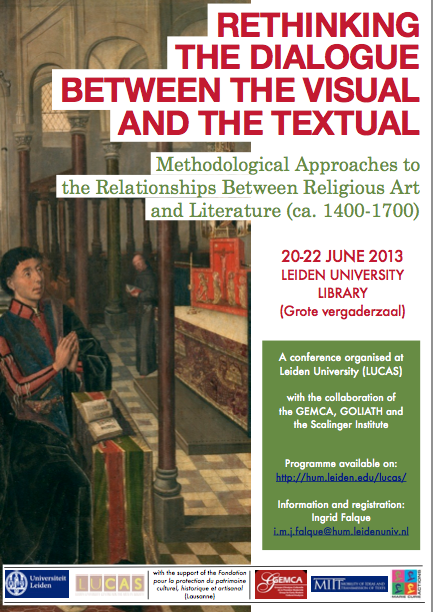
Conference – Rethinking the Dialogue between the Visual and the Textual. Methodological Approaches to the Relationships Between Religious Art and Literature (ca. 1400-1700).

Rethinking the Dialogue between the Visual and the Textual. 
Methodological Approaches to the Relationships Between Religious Art and Literature (ca. 1400-1700) 

A conference at LUCAS (Leiden University Centre for the Arts in Society) 
organised by Ingrid Falque and Geert Warnar 
20-22 June 2013 
In collaboration with 
GOLIATH, GEMCA (Université Catholique de Louvain, Louvain-La-Neuve) and the Scaliger Institute (Universiteit Leiden) 
And with the support of the “Fondation pour la protection du patrimoine culturel, historique et artisanal” (Lausanne)

Presentation :
In recent decades, the interactions between religious art(s) and literature(s) – and more generally between text(s) and image(s) – in the Late Middle Ages and Early Modern Period have been an important area of study for many scholars working in the field of the humanities. More particularly, the study of the interconnectedness of texts and images and of the contact zones between visual arts and literature constitute an emerging field that is particularly stimulating for both art historians and historians of literature. Growing awareness that texts and images functioned in the same community of discourse and were destined for the same audiences means that art historians frequently turn to texts to enlighten the functions and meaning of works of art. Similarly, historians of literature are increasingly bringing images in their analysis of literary works. Many scholars also consider texts and images together – as equivalent sources – in order to study cultural phenomena, concepts and notions.

These scholarly interests in the relations between art and literature generate a range of general methodological and theoretical questions: how can a text be used to understand an image? How can an image help to discern the meaning of a text? How do we interpret texts and images together in order to understand the religious culture of these periods? How do we consider them in relation to each other, without underestimating the specificities of each medium? What are the purposes and aims of the combined study of these sources?

During this conference, we would like to focus on the methodological approaches to the relationships between religious art(s) and literature(s) of the Late Middle Ages and the Early Modern Period, with special emphasis on the mystical traditions of these periods. The conference aims to explore not only the many forms of interactions between religious texts and images in this period, but also the methodological and theoretical issues they imply in order to sketch an overview of the different approaches used by scholars while studying texts and images together. Among others, the following forms of dialogue between the visual and the textual will be at the centre of this enquiry: the influence of spiritual authors on pictorial practices; the visual and textual discourses on images in mysticism; the impact of works of art on religious literary production; the complex text/image relationships in illuminated manuscripts, in printed books or in emblems books; the links between visual and biblical exegesis, the connections between painters and rhetoricians, etc. On a more general level, speakers will discuss how religious texts and images can work together in order to produce meaning, the capacity of a text not only to signify but also to represent, and the ability of a work of art (or an image) not only to depict but also to produce sense.

The invited speakers will address methodological issues while presenting case studies in order to reflect on the richness of seeing and reading in late Medieval and Early Modern literature and art, as well as the diverse ways in which scholars put the visual and the textual into dialogue with each other.

In collaboration with GOLIATH, GEMCA (Université Catholique de Louvain, Louvain-La-Neuve)
and the Scaliger Institute (Universiteit Leiden).

And with the support of the “Fondation pour la protection du patrimoine culturel, historique et artisanal” (Lausanne).


Programme :

Thursday 20 June

13h30-13h40 : Welcome by Kitty Zijlmans, director of LUCAS

Moderator : Wim van Anrooij (Universiteit Leiden, LUCAS)

13h40-14h10 : Ingrid Falque (Universiteit Leiden, Lucas) –  Introduction
14h10-14h55 : Agnès Guiderdoni (Université Catholique de Louvain, GEMCA) – Locutiones figuratae: Neither Text Nor Image. Figurability of Mystical Experience in the Early Modern Period
Coffee break

15h15-16h00 : Paul Smith (Universiteit Leiden, LUCAS) – Rereading Dürer’s Representations of The Fall of Man
16h30-17h30 : Keynote Lecture (open to the public): Walter Melion (Emory University, Atlanta) – Devota anima sese oblectari in dies poterit: The Tropes of Pasting, Printing, and Engraving in Martin Boschman’s Paradisus precum selectarum of 1610

Friday 21 June

Moderator : Geert Warnar (Universiteit Leiden, LUCAS)

9h15-10h00 : Sanne De Vries (Universiteit Leiden, LUCAS) – All Roads Lead to Rome. The Mass of St. Gregory and its Prayers
10h00-10h45 : Kees Schepers (Universiteit Antwerpen) – The Draughtsman’s Library. Gielis vander Hecken, his Books and his Labyrinthi
Coffee break

11h15-12h00 : Aline Smeesters (Université Catholique de Louvain, GEMCA) – The Text/Image Relationship in Herman Hugo’s Pia Desideria (1624)
12h00-12h45 : Ralph Dekoninck (Université Catholique de Louvain, GEMCA) – « To Give Spirit to the Mute Figure ». The Enlivening Word and the Animated Image in the Early-Modern Spiritual Literature
12h45-14h15 : Lunch

14h15-15h00 : Stijn Bussels (Universiteit Leiden, LUCAS) & Bram Van Oostveld (Universiteit van Amsterdam) – Vondel’s Brethren: Defending the Performance of the Word of God
15h00-15h45 : Bart Ramakers (Rijksuniversiteit Groningen) – Looking Through, Seeing Clearly. Imagination, Meditation and Cognition in Cornelis Everaert’s play of Mary Compared to the Light
Coffee break

16h15-17h00 : Jürgen Pieters (Universiteit van Gent, GOLIATH) – title to be announced


Saturday 22 June

Moderator : Ingrid Falque (Universiteit Leiden, LUCAS)

10h00-10h45 : Elliott Wise (Emory University, Atlanta) – “Hidden Sons of God”: Baptism and Transfiguration in Rogier van der Weyden’s St. John Triptych
10h45-11h30 : Reindert Falkenburg (NYU Abu Dhabi) – Speculation as a Solid Mode of Interpretation: ‘Reading’ Hieronymus Bosch’s Garden of Earthly Delights
Coffee break

12h00-12h45 : Geert Warnar (Universiteit Leiden, LUCAS) – Elckerlijc and Provoost
12h45-13h15 : Concluding remarks
Informations pratiques :
Date: 20-22 June 2013
Venue: Leiden University, University Library (Grote vergaderzaal), Witte Singel, 26-27, Leiden
Information and Registration: Ingrid Falque (i.m.j.falque@hum.leidenuniv.nl)

Publié dans Colloque | Laisser un commentaire

Publication – Xavier Hermand, Jean-François Nieus et Étienne Renard (dir.), "Décrire, inventorier, enregistrer entre Seine et Rhin au Moyen Âge. Formes, fonctions et usages des écrits de gestion"

Des polyptyques carolingiens aux listes bénéficiales et autres inventaires spécialisés de la fin du Moyen Âge, nombreux sont les « écrits de gestion » conçus à l’époque médiévale dans l’intention première de recenser, décrire et (ré)organiser les réalités les plus diverses – personnes, droits, revenus et biens matériels, transactions de tous ordres… Néanmoins, contrairement aux sources diplomatiques et comptables, servies par une solide tradition historiographique qui en valorise de longue date les spécificités, beaucoup de ces « écrits de gestion » restent peu étudiés en tant que genres spécifiques et moins encore comme productions intellectuelles, révélatrices entre autres des aspirations de leurs concepteurs et des enjeux du recours à l’écriture.

C’est à la mise en perspective de ces catégories d’écrits, au premier chef les documents à caractère « énumératif » (listes, inventaires, registres, etc.), qu’était dédié le colloque international organisé aux facultés universitaires de Namur les 8 et 9 mai 2008. Le cadre géographique a été délibérément restreint à l’aire comprise entre Seine et Rhin : plutôt délaissée dans les travaux récents sur l’écrit pragmatique médiéval, en raison sans doute d’une réputation de « retard » sur d’autres espaces, elle constitue pourtant un foyer important de créativité documentaire, en particulier dans le champ de l’écrit de gestion. Rassemblées dans ce volume, les contributions nées de cette rencontre sont axées sur un type ou un groupe de documents dont il s’agira tout à la fois d’affiner la typologie, de comprendre la logique interne et les fonctionnalités propres, de définir le statut et le rôle au sein de la culture écrite de leur époque.

Table des matières :

Xavier Hermand, Jean-François Nieus et Étienne Renard – Avant-propos
Étienne Renard – Administrer des biens, contrôler des hommes, gérer des revenus par l’écrit au cours du premier Moyen Âge
Georges Declercq – Qu’est-ce qu’un Liber traditionum ? À propos d’un genre mal défini
Jean-Pierre Devroey – Au-delà des polyptyques. Sédimentation, copie et renouvellement des documents de gestion seigneuriaux entre Seine et Rhin (IXe-XIIIe siècle)
Steven Vanderputten – Réforme, gestion de l’écrit et écrits de gestion en milieu monastique au début du XIIe siècle
John W. Baldwin – Les premiers registres capétiens, de Philippe Auguste à Louis IX
Jean-François Nieus – Formes et fonctions des documents de gestion féodaux du XIIe au XIVe siècle
Paul Bertrand – Jeux d’écriture : censiers, comptabilités, quittances… (France du Nord, XIIIe-XIVe siècle)
Ghislain Brunel – Listes de terres, listes de tenanciers, listes de revenus. La gestion et la mémoire entre Seine et Oise (XIIe-XIVe siècle)
Nicolas Ruffini-Ronzani – Administrer sa familia au bas Moyen Âge. Pratiques de l’écrit et dépendance en Hainaut (XIIIe-XIVe siècle)
Emmanuel Bodart – Enjeux des écrits de gestion en milieu urbain. Les livres de cens et rentes du Grand Hôpital de Namur entre 1312 et 1521
Bernard Delmaire – Pouillés, taxationes et comptes de décime
Jacques Pycke – Du Rotulus privilegiorum de 1299 au Repertorium cartarum et munimentorum de 1422-1533. Les inventaires du Trésor des chartes de la cathédrale de Tournai, du XIIIe au XVIe siècle
Xavier Hermand – Comment les communautés religieuses géraient-elles leur bibliothèque (Pays-Bas méridionaux, XIVe-XVe siècle) ?
Jean-Philippe Genêt – Entre mémoire, droit et culture : les écrits de gestion
Résumés
Index des noms de personnes et de lieux
Crédits photographiques
Informations pratiques :
Xavier Hermand, Jean-François Nieus et Étienne Renard (dir.), Décrire, inventorier, enregistrer entre Seine et Rhin au Moyen Âge. Formes, fonctions et usages des écrits de gestion, Paris, 2012  (Mémoires  et documents de l’École des chartes, 92). 430 pages, ISBN 978-2-35723-026-2. Prix : 32 €.
Publié dans Publications | Laisser un commentaire

Colloque – Art, Knowledge and Commerce. Print publishers and the professionalization of printmaking in Europe 1500-1600

This colloquium is organized on the occasion of the exhibition Hieronymus Cock – The Renaissance in Print by Illuminare – Centre for the Study of Medieval Art (University of Leuven), Fondation Custodia – Collection Frits Lugt (Paris) and the Royal Library of Belgium (Brussels). 
In 1550, Hieronymus Cock, a young painter and publisher from Antwerp published a monumental engraving after the School of Athens, the renowned fresco by Raphael in the Vatican. Not only was this a milestone in the dissemination of the Italian High Renaissance outside of Italy, it also marked the success of a relatively new form of organizing the production and distribution of prints. 
In response to the ever growing and rapidly internationalizing demand for printed images several European cities saw the emergence of publishing houses of various sizes throughout the 16th century. 
Publishers would coordinate and finance the production of prints, from the preparatory drawings in the artist’s workshop, to the printing of the woodblock or copper plate at a specialized print shop. A business-minded publisher, coordinating the outsourcing and delegating of work thus became the prevailing standard. This naturally influenced the quality of the prints. Due to the fact that each craftsman involved in the process could dedicate himself entirely to his own specialty, the level of professionalism increased considerably. 
In addition, publishers had an extensive network of agents at their disposal to spread their product internationally. Quite regularly print publishers took the initiative to have specific prints, or print series designed, and they trusted the work to artists and engravers whose work was expected to be commercially successful. Often print publishers had the most decisive impact on what prints would come on the market and how they would look. 
It will come as no surprise then, that publishers were at the forefront of the development of graphic art at the time. Nevertheless, the actual study of these publishing houses, their organization and their production is a fairly recent phenomenon. Within the Romantic concept of the ‘PeintreGraveur’ that exerted such a profound influence on collectors in the 19th and 20th century, the publisher – primarily a commercial actor – played no significant part. 
In the past decades, much new research in this matter has been done. This has led to the wide acceptance of the idea that publishers were key figures in the artistic and commercial aspects of the society they lived in. This colloquium aims to focus on current research concerning print publishers in Early Modern Europe. Special attention is given to commercial and organizational aspects of printing and publishing, the interaction with artists, engravers, printers and publishers, and the artistic and commercial self-development of publishers. 
Programme :
5 June 2013 | M – Museum of Leuven 
Leopold Van der Kelenstraat 28, 3000 Leuven 
14h00 :Welcome by Joris Van Grieken followed by a scholarly visit to the exhibition Hieronymus Cock – The Renaissance in Print 
6 June 2013 | Royal Library of Belgium, Brussels 
Boulevard de l’Empereur 2, 1000 Brussels 
9h30 :Registration with coffee 
10h00 : Opening lecture by Ger Luijten 
11h00 : Joris Van Grieken – No address mentioned. Hieronymus Cock’s ‘generic prints’ 
11h30 : Ed Wouk – Granvelle and Cock: new light on the aims of the Quatre Vents press 
12h00 : Petra Maclot – The Four Winds: The House of the Antwerp Print Publisher Hieronymus Cock
12h30 : Virginie D’Haene – Hieronymus’ Adumbrationes after Matthijs Cock: landscapes ‘in the new Italian or antique way’?
13h00 : Lunch break
14h00 : Huigen Leeflang – The Fischerman and the Cook. Hieronymus Cock, Claes Jansz. Visscher II and their Brand Names 
14h30 : Peter Fuhring – Joannes Galle as an editor of Cock: supply and demand for sixteenth century prints in mid seventeenth century Antwerp 
15h00 : Jan Van der Stock – The Antwerp Print Publisher Merten Peeters van Ghelle (Martinus Petri): in the Shadow of Aux Quatre Vents 
15h30 : Coffee break
16h00 : Pieter Martens – City Views and Siege Maps: New Light on Hieronymus Cock’s Chorographic Prints 
16h30 : Robrecht Janssen – ‘Go on living through this painting, living through my verses’. Dominicus Lampsonius, Jan van Scorel & Anthonis Mor
Source de l’information : KULeuven
Publié dans Colloque | Laisser un commentaire

Web – Un séminaire de recherche (UCL) sur l’Inquisition médiévale. Au travers du « Livre des Sentences » de Bernard Gui.

Le carnet de recherches« NEO», sur la plate-forme« Hypothèses », a pour objectif scientifique de donner un ancrage plus fort dans la communauté scientifique et universitaire aux jeunes historiens en devenir de l’Université de Louvain (UCL) à Louvain-la-Neuve. Destiné aux médiévistes, il a vocation à accueillir les étudiants et leurs travaux au fil des années universitaires, sous la direction d’un médiéviste professionnel. Les premiers à pouvoir mettre en valeur les résultats de leurs recherches sont les étudiants du séminaire d’Histoire du moyen âge (Bac13, équivalent licence3) dirigé par le Professeur Paul Bertrand. Ils se sont penchés, durant l’année académique 2012-2013, sur la délicate question des hérésies au tournant des XIIIe et XIVe siècles, autour du Livre des sentences de l’inquisiteur Bernard Gui.


L’objectif du séminaire : comprendre l’institution médiévale de l’Inquisition, son fonctionnement, son organisation, ses outils juridiques, ses relations avec les autorités temporelles ; mais aussi saisir ce qu’est l’ «hérésie » selon Bernard Gui : qui sont les hérétiques, comment vivent-ils, quelles sont leurs croyances… Il est pratiquement impossible d’analyser l’ «hérésie » –ou plutôt les hérésies– comme elle se présente, puisqu’elle n’a laissé aucune trace documentaire. Ces mouvements déviants ou dissidents ne peuvent donc être saisis qu’au travers de la vision qu’en ont donnée les inquisiteurs ou, plus largement, le monde ecclésiastique catholique. Soit, ici, au travers du « Livre des Sentences ». C’est donc une construction intellectuelle que nous livre Bernard Gui, qui tente de comprendre le monde des hérétiques en le systématisant avec ses propres outils, pour mieux le combattre. Les étudiants néo-louvanistes ont donc été confrontés à un grand défi critique : l’étude des mouvements hérétiques de la fin du XIIIe-début du XIVe s., au moment où ils sont en train de disparaître, au travers des sources laissées par leurs opposants

Le défi était d’autant plus grand que l’historiographie actuelle, autour de cette question de l’inquisition, est complexe, déchirée entre différentes écoles, entre les tenants de l’existence d’une église cathare « structurée » et ceux qui sont attachés à la réalité historique de mouvements hérétiques diffus, non-structurés et difficilement saisissables dans les sources. Les étudiants durent trouver leur chemin critique dans cette forêt.

Durant les prochaines semaines, les étudiants qui ont participé à ce séminaire publieront, jour après jour, les « bonnes feuilles » de leur travail. Chacun a rédigé une note de blog en dégageant de sa recherche les données qui lui semblaient les plus innovantes et assume la paternité des travaux ici publiés. Le lecteur, que nous espérons fidèle, suivra donc, trois fois par semaine (les lundi, mercredi et vendredi), cette publication en feuilleton. La qualité de ces travaux, qui font montre d’une vraie maturité scientifique, témoigne de l’importance de former à la recherche très tôt les étudiants apprentis historiens.
Publié dans Enseignement, Web | Laisser un commentaire

Colloque – Disgust. Histoire, langage, politique et esthétique d’une émotion plurielle

Disgust 
History, Language, Politics and Aesthetics of a Complex Emotion
Histoire, Langage, Politique et Esthétique d’une Emotion Plurielle 

Colloque international et interdisciplinaire 
Centre Interdisciplinaire de Poétique Appliquée (CIPA) Groupe de contact FNRS «Cultures sensibles» 
22-24 mai 2013 Université de Liège Salle des Professeurs Place du 20-Août, bât. A1
Programme :

Mercredi 22 mai
18h00 : M. Ferrières (Université d’Avignon) – Cuisines ouvertes au temps de Lancelot de Casteau, maître cuisinier de la Renaissance

Bibliothèque des Chiroux, Espace Rencontres (8, Place des Carmes). La conférence sera suivie d’un apéritif et d’une dégustation. 


Jeudi 23 mai

8h30 : Accueil des participants 

9h00 : Allocutions de J. Winand (Doyen de la Faculté de Philosophie et Lettres, ULg) et de B. Demoulin (ULg/Pro- vince de Liège, Culture) 
9h15 : M. Delville (ULg), A. Norris (ISTI) et V. von Hoffmann (FNRS/ULg) – Introduction 

9h30 : Keynote : W. Menninghaus (Max-Planck-Institute for Empirical Aesthetics) – The Enjoyment of Negative Feelings in the Arts 
10h30 : Pause 

Session 1
Apports théoriques et langages du dégoût / Languages and theories of disgust Présidence
Chair : I. Meuret (ULB) 

10h45 : A. Delli Pizzi (FNRS/ULg) – Le dégoût de l’autre dans la Grèce antique : analyse sémantique des termes aedia et bdeluria et implications sociologiques 
11h05 : A. Tolstoy (Oxford University) – “I’d like to Taste the Inside of Your Mouth”: The Mouth as Metonym of Disgust in Vladimir Nabokov’s Fiction 
11h25 : A. Lussier (Université du Québec à Montréal) – La morsure du dégoût et le sens de l’esthétique freudienne (d’Emmy von N. à l’Homme aux rats)
11h45 : D. O’Shiel (KUL) – Kolnai’s Disgust as Violation of Value 
12h05 : O. El Mansouri (Université Paris VIII) – Aux limites du plaisir tragique : dégoût et horreur dans la théorie de la tragédie française (XVIIe-XVIIIe siècles) 
12h25 : Discussion 
13h00 : Déjeuner 

14h00 : Keynote : M. Ferrières (Université d’Avignon) – De (de)gustibus non disputandum est : peut-on disputer des degoûts ? 

Session 2
Histoire et cultures sensibles du dégoût / History, culture and the senses of disgust 
Présidence/Chair : L. Strivay (ULg) 

15h00 : C. Chalumeau (Université de Versailles) – Une littérature où « les genz sont en merde jusques au cou ». Thèmes et enjeux du dégoût dans deux textes profanes du Moyen Âge 
15h20 : V. Vandenberg (FNRS/ULB) – Dégoût et désespoir : réflexions sur la représentation de la faim et des transgressions alimentaires au Moyen Âge 
15h40 : I. Meuret (ULB) – Dégoût alimentaire : de la sainte inédie à l’anorexie mentale 
15h40-16h00 : Pause 

16h00 : A. Marculescu (Harvard University) – The Psychopathology of the Possessed in French Mystery Plays 
16h20 : C. Naji (ENSAM) – Dégoûts et voyages
16h40-17h15 : Discussion 
18h30 : Dîner à l’Aquilone (25, Blvd Saucy) 

20h00 : Conférence-performance : M. Delville (ULg), A. Norris (ISTI) et M. Melia – Sound and Disgust/Le son et le dégoût
Vendredi 24 mai

8h30 : Accueil des participants

9h00 : Keynote : C. Forth (University of Kansas) – Fat and disgust, or the problem of “life in the wrong place” 
10h00 : Pause 

Session 3
Esthétique ou érotique du dégoût / Aesthetics or erotics of disgust 
Présidence/Chair : C. Havelange (FNRS/ULg) 

10h15 : M. Olivero (Université Sorbonne Nouvelle – Paris III) – Entre sadisme et sublimation. La mise en forme cinématographique du dégoût 
10h35 : S. Louet (Université de Provence) – Le goût du dégoût dans le film américain d’horreur ou gore 
10h55 : V. Glansdorff (ULB) – Taxidermie : la mort dans l’art
11h15 : L. Doublet (Université Paris X Nanterre) – Le rôle du dégoût dans l’érotisme de Georges Bataille
11h35 : F. Tilkin (ULg) – Gros goûts et dégoût dans l’Histoire de ma vie de Casanova
11h55-12h30 : Discussion
12h30 : Déjeuner

13h30 : Keynote : W. Miller (University of Michigan) – Do I disgust you? (or, rather, you me?) mes frères, mes sœurs, mes semblables? 

Session 4
Politique et éthique du dégoût / Politics and ethics of disgust 
Présidence/Chair : A. Norris (ISTI) 

14h30 : F. Saenen (ISLV/ULg) – Albert Caraco, entre nausée et gnose 
14h50 : S. Al-Matary (Université Lyon 2/Collège de France) – Le culte de la charogne. Autopsie de l’œuvre barrésienne 
15h10 : G. Tanase (Université de Toronto/ATER, Université de Nantes) – Corps de dégoût et aspect corporel du texte parodique chez Baude Fastoul 
15h10-15h30 : Pause

15h30 : D. M. Munch-Hansen (University of Copenhagen) – Disgust as a stop sign 
15h50 : A. Boisseuil (CMPEA/CATTP) – Psychopathologie du dégout de l’ordinaire chez l’adolescent
15h50-16h30 : Discussion 

16h30 : M. Delville (ULg), A. Norris (ISTI), V. von Hoffmann (FNRS/ULg) – Conclusions
Comité organisateur :
M. Delville (ULg) A. Norris (ISTI) V. von Hoffmann (FNRS/ULg) 

Comité scientifique :
J. Baetens (KUL)
F. Bellarsi (ULB)
V. Bragard (UCL)
D. Caplan (Ohio Wesleyan University)
A. Cazé (Paris VII) 
M. Delville (ULg)
O. de Maret (VUB/FOST)
A. Geyzen (VUB/FOST)
C. Havelange (FNRS/ULg)
R. Ingelbien (KUL)
M. Jacobs (FARO/VUB)
S. McCaffery (SUNY Buffalo)
P. Nicholls (New York University)
I. Meuret (ULB)
I. Parmentier (FUNDP)
A. Norris (ISTI)
M. Perloff (Stanford University)
P. Scholliers (VUB/FOST)
V. von Hoffmann (FNRS/ULg)
M. Watthee-Delmotte (FNRS/UCL)
Publié dans Colloque | Laisser un commentaire