-
Avec le soutien du FNRS, du CRHiDI (UCLouvain – Saint-Louis, Bruxelles), d'INCAL (UCLouvain), de PraME (UNamur), de sociAMM (ULB) et de Transitions (ULiège)
-

-

-

-

-

-

- Activités du RMBLF Appel à contributions Appel à projet Audio Bande dessinée Banque de données Bourse Colloque Documentaire Débat et historiographie Enquête Enseignement Excursion Exposition Le réseau Les journées Musique Mécénat Médias News Nécrologie Offre d'emploi Podcast Prix Publications Réseau de recherche Stage Séminaire Web École d'été
- Follow L'Agenda des Médiévistes on WordPress.com
-
Publication – Steven Vanderputten, "Monastic Reform as Process. Realities and Representations in Medieval Flanders, 900-1100"
The history of monastic institutions in the Middle Ages may at first appear remarkably uniform and predictable. Medieval commentators and modern scholars have observed how monasteries of the tenth to early twelfth centuries experienced long periods of stasis alternating with bursts of rapid development known as reforms. Charismatic leaders by sheer force of will, and by assiduously recruiting the support of the ecclesiastical and lay elites, pushed monasticism forward toward reform, remediating the inevitable decline of discipline and government in these institutions. A lack of concrete information on what happened at individual monasteries is not regarded as a significant problem, as long as there is the possibility to reconstruct the reformers’ ‘‘program.’’ While this general picture makes for a compelling narrative, it doesn’t necessarily hold up when one looks closely at the history of specific institutions.
In Monastic Reform as Process, Steven Vanderputten puts the history of monastic reform to the test by examining the evidence from seven monasteries in Flanders, one of the wealthiest principalities of northwestern Europe, between 900 and 1100. He finds that the reform of a monastery should be studied not as an « exogenous shock » but as an intentional blending of reformist ideals with existing structures and traditions. He also shows that reformist government was cumulative in nature, and many of the individual achievements and initiatives of reformist abbots were only possible because they built upon previous achievements. Rather than looking at reforms as “flashpoint events,” we need to view them as processes worthy of study in their own right. Deeply researched and carefully argued, Monastic Reform as Process will be essential reading for scholars working on the history of monasteries more broadly as well as those studying the phenomenon of reform throughout history.
Table des matières :
Introduction
1. Corporate Memories of Reform
2. The « Failed » Reforms of the Tenth Century
3. The “Dark Age” of Flemish Monasticism
4. Introducing the New Monasticism
5. Processes of Reformist Government
6. Shaping Reformed Identities
7. The “Waning” of Reformed Monasticism
Conclusion
Appendix A : Overview of the Leadership of Benedictine Monasteries in Flanders Reformed in the Tenth and Early Eleventh Centuries between c. 900 and c. 1120
Appendix B : Booklist of the Abbey of Marchiennes, c. 1025–1050
Bibliography
Index
Informations pratiques :
Steven Vanderputten, Monastic Reform as Process. Realities and Representations in Medieval Flanders, 900-1100, Ithaca, Cornell University Press, 2013. 12 ill., 2 maps. Prix : 55 $.
Source de l’information : Cornell University Press
Publié dans Publications
Laisser un commentaire
Conférence – Anatole Pierre Fuksas, "Divisio operis et paratexte dans la tradition manuscrite du roman médiéval"
Le jeudi 18 avril à 18h30, Anatole Pierre Fuksas (Università di Cassino) présentera une communication intitulée « Divisio operis » et paratexte dans la tradition manuscrite du roman médiéval.
Informations pratiques :
La conférence aura lieu à 18h30 à la Salle du Conseil FIAL de l’Université catholique de Louvain.
Contact : mattia.cavagna@uclouvain.be
Publié dans Colloque
Laisser un commentaire
Offres d’emploi – "The changing face of medieval Dutch literature in the early period of print (1477c. 1540)" (Universiteit Antwerpen & Universiteit Utrecht)
Ci-dessous, vous trouverez l’annonce de deux postes vacants pour le projet de recherche (collaboration FWO-Vlaanderen/NWO) The changing face of medieval Dutch literature in the early period of print (1477-ca 1540)
Université d’Anvers (0,8 fte) et Université d’Utrecht (1,0 fte)
Durée du projet: 3 ans, entrée en fonction: le 1er septembre 2013
Universiteit Antwerpen
Bij het Instituut voor de Studie van de Letterkunde in de Nederlanden (ISLN) van de Faculteit Letteren en Wijsbegeerte van de Universiteit Antwerpen is volgende functie (m/v) vacant
Postdoctoraal onderzoeker (80 %) in het domein van de Middelnederlandse letterkunde voor het onderzoeksproject (samenwerking FWO-NWO) De gedaanteverandering van de Middelnederlandse verhalende literatuur in de eerste decennia van de boekdrukkunst
Uw opdracht :
- U publiceert een zevental artikelen in peer reviewed tijdschriften over het onderzoeksthema;
- U organiseert een internationaal congres en draagt bij aan de publicatie van de proceedings;
- U werkt nauw samen met de Utrechtse postdoc die op hetzelfde project is aangesteld;
- U draagt bij aan BA- en MA-colleges over Middelnederlandse verhalende literatuur in de eerste decennia van de boekdrukkunst ;Een complete beschrijving van het project is te vinden op de website van het ISLN: http://www.ua.ac.be/main.aspx?c=*ISLN&n=11963
Uw profiel :
- U bezit een diploma van doctor in de taal- en/of letterkunde, middeleeuwse studies, geschiedenis of een andere relevante studie of u promoveert vóór 1 november 2013;
- U hebt een goede kennis van de Middelnederlandse verhalende letterkunde, die blijkt uit publicaties op dit gebied;
- U bent in staat teksten te lezen in het Middelfrans; kennis van het Middelhoogduits, het Middelnederduits en het Middelengels strekt tot aanbeveling;
- Uw onderzoekskwaliteiten sluiten aan bij de beleidslijnen van de universiteit (http://www.ua.ac.be/onderzoek)
- U legt in uw onderwijs de juiste accenten die passen binnen de UA-visie op onderwijs (http://www.ua.ac.be/onderwijs)
- U bent kwaliteitsgericht, integer, creatief en samenwerkingsgericht.
Wij bieden :
- Een aanstelling van 80 % voor een periode van drie jaar, begindatum 1 september 2013; evaluatie na één jaar;
- Een brutomaandwedde die ligt tussen € 3177,05 en € 3264,82;
- Een dynamische en stimulerende onderzoeksomgeving.
Dit smaakt naar meer?
- U kunt solliciteren door per e-mail of per post een brief met motivatie en volledig curriculum vitae te sturen naar prof. dr. Frank Willaert, frank.willaert@ua.ac.be
- Instituut voor de Studie van de Letterkunde in de Nederlanden, Universiteit Antwerpen, Prinsstraat 13, kamer D.120, B–2000 Antwerpen, en dat tot uiterlijk 15 mei 2013; in verband met een eventueel gesprek wordt u verzocht 17 en 18 juni vrij te houden.V
- oor inhoudelijke vragen over de functie kunt u contact opnemen met prof. dr. Frank Willaert, frank.willaert@ua.ac.be tel. +32 3 265 42 56.
De Universiteit Antwerpen werkt mee aan een open, democratische en multiculturele samenleving. Wij voeren een gelijkekansenbeleid.
Universiteit Utrecht
Postdoctoraal onderzoeker (1,0 fte) voor het onderzoeksproject (samenwerking FWO-NWO) ‘De gedaanteverandering van de Middelnederlandse verhalende literatuur in de eerste decennia van de boekdrukkunst’
Functie :
Project
Dit project bestudeert 35 boeken die gedrukt werden in de vroege periode van de boekdrukkunst (1477-ca 1540). Hoewel deze uitgaven met verhalende Middelnederlandse teksten slechts een gering deel van het totale aantal drukken in de eerste decennia van het gedrukte boek vormen, is hun belang voor de geschiedenis van de Nederlandse literatuur in de Lage Landen groot. Zij vormen de cruciale schakel tussen de middeleeuwse verhalen die in handschriften bewaard gebleven zijn en de vroegmoderne verhalen die gedrukt werden na het midden van de zestiende eeuw. De ontwikkeling van handschrift naar druk heeft het karakter van deze teksten diepgaand beïnvloed. Het project zal de innovatieve elementen, de heterogeniteit en de Europese context van het gehele corpus bestuderen. De aandachtsgebieden zijn: de kenmerken van het corpus, de beweegredenen voor de tekstuele veranderingen die in de verhalen aanwijsbaar zijn, en de strategieën om de tekstuitgaven toegankelijk en aantrekkelijk te maken. Het project zal nieuwe inzichten opleveren met betrekking tot een weinig onderzocht tekstcorpus dat van grote cultuur-historische betekenis is.
- U publiceert een zevental artikelen in peer reviewed tijdschriften over het onderzoeksthema;
- U organiseert een internationaal congres en draagt bij aan de publicatie van de proceedings;
- U werkt nauw samen met de Antwerpse postdoc die op hetzelfde project is aangesteld;
- U draagt bij aan BA- en MA-colleges over Middelnederlandse literatuur;
Een complete beschrijving van het project is te vinden via de website van het OGC.
Profiel :
- U bezit een diploma van doctor in de taal- en/of letterkunde, middeleeuwse studies, geschiedenis of een andere relevante studie of u promoveert vóór 1 november 2013;
- U hebt een goede kennis van de Middelnederlandse verhalende letterkunde, die blijkt uit publicaties op dit gebied;
- Kennis van het Oudfrans, Middelhoogduits, het Middelnederduits en het Middelengels strekt tot aanbeveling;
- U bent kwaliteitsgericht, integer, creatief en samenwerkingsgericht.
Aanbod :
We bieden een full-time aanstelling per 1 september 2013 voor de duur van 12 maanden met, na evaluatie, de mogelijkheid tot verlenging van maximaal nog eens 24 maanden (drie jaar totaal). Uw bruto salaris bedraagt minimaal € 3.037,- en maximaal € 4.462,-(volgens de CAO Nederlandse Universiteiten) bij een volledige aanstelling.
Daarnaast biedt de Universiteit Utrecht aantrekkelijke secundaire arbeidsvoorwaarden, zoals 8% vakantiegeld en 8,3% eindejaarsuitkering. Verder bieden wij goede pensioenvoorzieningen, gedeeltelijk doorbetaald ouderschapsverlof en flexibele arbeidsvoorwaarden. Meer informatie: arbeidsvoorwaarden.
Over de organisatie :
De Universiteit Utrecht, gesticht in 1636, is een van de grootste en meest vooraanstaande universiteiten van Europa. De faculteit Geesteswetenschappen biedt met bijna 7.000 studenten en bijna 900 medewerkers een stimulerende en dynamische werkomgeving. Onze onderwijs- en onderzoeksprogramma’s richten zich op taal, cultuur, geschiedenis, kunsten, literatuur, media, filosofie en theologie, van de Oudheid tot heden. Tot de speerpunten behoren interdisciplinaire en internationale samenwerking, uitmuntende kwaliteit van onderzoek en onderwijs, en het gebruik van nieuwe media. Het onderzoek is ondergebracht in drie instituten:
- Utrecht Institute of Linguistics OTS (UiL OTS)
- Onderzoekinstituut voor Geschiedenis en Cultuur (OGC)
- Onderzoekinstituut voor Filosofie en Religiewetenschap (OFR)
De Utrecht University Graduate School of Humanities waarborgt de hoogwaardige kwaliteit van het onderwijs voor onderzoeksmasterstudenten en promovendi. Bovendien biedt de Universiteit Utrecht aantrekkelijke arbeidsvoorwaarden.
Aanvullende informatie :
Voor inhoudelijke vragen over de functie kunt u contact opnemen met dr. Bart Besamusca (a.a.m.besamusca@uu.nl).
Solliciteren :
U kunt uw sollicitatie, voorzien van motivatiebrief, CV en publicatielijst, indienen via onderstaande knop. In verband met een eventueel gesprek wordt u verzocht 17 en 18 juni 2013 vrij te houden.
Reageren uiterlijk : 15 mei 2013
Publié dans Offre d'emploi
Laisser un commentaire
Conférence – Emmanuel Rousseau et Michel Pastoureau, "L’armorial Le Breton (MM 684L/AE 25, n° 6)"
L’armorial Le Breton (MM 684L/AE 25, n° 6)
Conférence par Emmanuel Rousseau, directeur des fonds, Archives nationales, et Michel Pastoureau, directeur d’études, École pratique des hautes études.
Acquis par les Archives nationales en décembre 2003, l’armorial Le Breton est l’un des plus anciens armoriaux français conservés. Ce recueil d’armoiries a été composé à la fin du XIIIe siècle, au milieu du règne de Philippe le Bel, par un héraut anonyme. Il a fait ensuite successivement partie des bibliothèques d’Hector de Flavy et d’Anne Malet de Graville, avant d’entrer dans celle d’Hector Le Breton, sieur de la Doinneterie, héraut Montjoie et roi d’armes de France, qui l’a fait relier à ses noms et armes et lui a laissé son nom. Les érudits Pereisc et André du Chesne le citent dans leur travaux. À la fin du XIXe siècle, le manuscrit a été acquis par le comte Chandon de Briaille, d’où son autre nom d’armorial Montjoie-Chandon.
Constitué de trois grandes parties, le manuscrit s’ouvre par un armorial imaginaire, celui des fils de Priam, puis la partie principale rassemble les 579 blasons de chevaliers français de la fin du XIIIe siècle, et il s’achève par une partie réalisée aux XVe et XVIe siècles. Il est constitué de 74 pages de parchemin peint à la gouache. L’armorial devait se présenter sous la forme de cahiers pendant la période médiévale.
Les armoriaux sont les livres propres de l’héraldique et se développent dans la seconde moitié du XIIIe siècle. Tout d’abord manuels pratiques destinés à identifier les protagonistes de combats ou de tournois, ils rassemblent ensuite les armoiries d’une région, d’un royaume entier, voire de toute la chrétienté. Les armoriaux peuvent être figurés, comme c’est le cas ici, ou bien simplement « blasonnés ». L’utilité de tels recueils pour identifier des armoiries n’est plus à démontrer. Ce précieux document a été édité par les Archives nationales en 2004 sous la forme d’un fac-similé.
La conférence a lieu le 16 avril, à 18h15, à l’Institut national du patrimoine – Auditorium de la Galerie Colbert – 2 rue Vivienne, 75002 Paris.
Cette conférence est organisée par l’Institut national du patrimoine et les Archives nationales.
En partenariat avec Connaissance des arts
Source de l’information : Institut national du Patrimoine
Publié dans Colloque
Laisser un commentaire
Colloque – The Gruuthuse Manuscript. Literature, Music and Devotion Around 1400
The Gruuthuse Manuscript. Literature, Music and Devotion Around 1400
International Conference, Bruges, 25-27 April 2013
Organized by Musea Brugge, the Royal Library – National Library of the Netherlands, and Radboud University
Nijmegen
In the context of the exhibition ‘Love and Devotion: the Gruuthuse Manuscript’, 22 March – 23 June 2013, Bruges, Gruuthuse Museum, in collaboration with the Royal Library – National Library of the Netherlands and Radboud University Nijmegen.
Theme :
The Gruuthuse manuscript was compiled in Bruges around 1395-1408. It is a highlight in Middle Dutch literature and an important source of information on late medieval urban culture in the Netherlands. Besides prayers and poems, the manuscript contains the oldest known collection of songs with musical notation in the Low Countries: songs of courtly and uncourtly love, songs of fellowship and sacred songs.
The Gruuthuse manuscript is the starting point and the main theme of the exhibition at the Gruuthuse Museum. After a brief introduction about the manuscript and the city of Bruges c. 1400, the exhibition goes on to examine a number of themes broached by the manuscript: music, love, ‘const’, fellowship and devotion. The conference will take up these themes as the starting point for an international and multidisciplinary approach to (urban) culture in Northwest Europe in the early fifteenth century. New insights in the field of history, art history, literature and musicology will be explained and developed during this conference.
Programme :
Thursday, 25 April 2013
16h30-18h00 : Registration of participants at the Town Hall, Burg 12, 8000 Bruges
18h00-19h00 : Reception at the Town Hall
19h00-20h00 : Lecture by Herman Pleij – The triumph of literary self-awareness among an urban elite (in Dutch)
20h00 : Dinner at the Crown Plaza Hotel, Burg 10, 8000 Bruges
Friday, 26 April 2013
08h30-9h00 : Registration and reception with coffee, Concertgebouw, ’t Zand 34, 8000 Bruges
9h00-10h00 : Wim Blockmans – Dutch literature in multilingual Bruges (in Dutch)
10h00-10h30 : Break
10h30-11h00 : Herman Brinkman – Nicht vor waeldoen ende vroilic sijn! Early users of the Gruuthuse manuscript (in Dutch)
11h00-11h30 : Ad Leerintveld and Henk Porck – A closer look at the Gruuthuse coat of arms. Spectrometric analyses (in Dutch)
11h30-12h00 : Anne Korteweg – The acquisition of the Gruuthuse manuscript: facts and fictions (in Dutch)
12h00-12h30 : Panel discussion chaired by Johan Thielemans
12h30-14h00 : Lunch
14h00-14h30 : Cyriel Stroo – Aspects of (the) art (of painting) in Bruges around 1400. Const si doch const met consten loonen (in Dutch)
14h30-16h00 : Parallel session A – Chaired by Ad Leerintveld
Sonia Tortajada Hernando – The conservation of the two Tydeman’s angels from the Prado Museum (in English)
Saskia Van Bergen – Goris de liberaris heeft meer bouken dan alle die vander stede… Book production in Bruges in the early 15th century (in Dutch)
Hugo van der Velden – The concept of ‘const’ in the Gruuthuse manuscript (in Dutch)
Parallel session B – Chaired by Johan Oosterman
Jan Dumolyn – Corporative ideology in the Gruuthuse manuscript (in Dutch)
Jan de Klerk – Goed voorgaan doet goed volgen. Views on good government in Dat kaetspel ghemoralizeert in relation to the Gruuthuse manuscript and the political and legal developments in Flanders between 1380 and 1440 (in Dutch)
Hendrik Callewier – The curate of Oedelem: the secular clergy and the Gruuthuse manuscript (in Dutch)
16h00-16h30 : Break
16h30-17h00 : Jos Koldeweij – The Gruuthuse manuscript in pictures
17h15-19h30 : Visit to the exhibition Love and Devotion. The Gruuthuse Manuscript, Gruuthuse Museum, Dijver 17, 8000 Bruges
18h00-19h30 : Sandwich meal, Vriendenzaal Musea Brugge, Dijver 12, 8000 Bruges
20h00 : Concert featuring Club Mediéval, Concertgebouw, ’t Zand 34, 8000 Bruges
Saturday, 27 April 2013
08h30-09h00 : Reception with coffee, Concertgebouw, ’t Zand 34, 8000 Bruges
09h00-09h20 : Johan Oosterman – Not that I am worth anything as a poet. The first person in the Gruuthuse poems (in Dutch)
09h20-09h40 : Noël Geirnaert – From (informal?) company to rhetoric guild: the continuity between poets of the ‘Gruuthuse manuscript’ and the rhetoricians of the Holy Spirit (in Dutch)
09h40-10h00 : Karl Kuegle – Musical eroticism in the Gruuthuse’ songs (in English)
10h00-10h45 : Break
10h45-11h05 : Joris Reynaert – The many formats of an ethical discourse. Artistic projection(s) in the ‘allegorical poems’ (in Dutch)
11h05-11h30 : Frank Willaert – Poetical connections. Gruuthuse’s lyrical poetry in Flemish and international perspective (in Dutch)
11h30-12h00 : Panel discussion chaired by Wim Blockmans
12h00 : Lunch
13h30-15h30 : Parallel session A – Chaired by Frank Willaert
Ita Hijmans – The polyphonic potential of Gruuthuse melodies from a Central European perspective: an experimental musicological exploration (in English)
Pieter Mannaerts – Modality in the Gruuthuse songs (in English)
Hélène Haug and Steven Marien – Different ways of performing the Gruuthuse repertoire (in Dutch and French)
Stefan Rosmer – The sacred songs of the Gruuthuse manuscript and the works of the ‘Monk of Salzburg’. Similarities and differences (in English)
Parallel session B – Chaired by Herman Brinkman
Thom Mertens – The sermon of Brother Jan Lyoen (in Dutch)
Janet van der Meulen – Gruuthuse between Bruges and Paris: on poets, devotion and the debate of the Roman de la Rose (in Dutch)
Dieuwke van der Poel – Uncourtly, mad, erotic? The literary and historical context of certain Gruuthuse songs (in Dutch)
15h30-16h00 : Break
16h00-16h45 : Frits Van Oostrom – The polyphony of Gruuthuse (in Dutch)
16h45 : Closing reception
Informations pratiques :
Please register by sending the attached registration form by 12 April 2013 to:
Bruggemuseum / congres, Dijver 12, B- 8000 Brugge
bruggemuseum@brugge.be
fax +32 (0)50 44 87 37
Admission :
110 euros non-speakers
75 euros speakers
75 euros students
60 euros conference dinner
Bank account number: see registration form
All conference locations are in the centre of Bruges.
You can book a hotel at http://www.meetinginbrugge.be/en/scientifique-symposium-gruuthusemuseum-gruuthusehandschrift
The concert on 26 April is free of charge for all conference participants. On 27 April, conference participants who so wish may attend the concert featuring Psallentes and Camerata Trajectina (8.00pm, Concertgebouw) and can order tickets at a 15% discount.
Source de l’information : Liefde & Devotie
Publié dans Colloque
Laisser un commentaire
Conférence – Jonathan Dumont, "Organisation du royaume, définition de la nation et hiérarchies sociales. Une histoire de la pensée politique à la cour de France au début du XVIe siècle"
Le mardi 16 avril, à 18h00, dans le cadre du cycle annuel de conférences organisé par Transitions, Jonathan Dumont (F.R.S.-FNRS – Université de Liège) présentera une communication intitulée Organisation du royaume, définition de la nation et hiérarchies sociales. Une histoire de la pensée politique à la cour de France au début du XVIe siècle
Informations pratiques :
Université de Liège, Salle Grand Physique
1b, Quai Roosevelt
4000 Liège (Belgique)
Renseignements : jonathan.dumont@ulg.ac.be
Publié dans Colloque
Laisser un commentaire
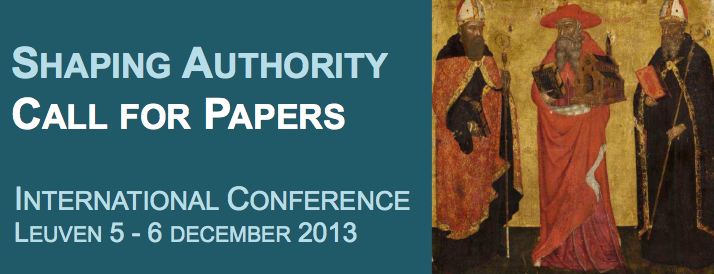
Appel à contribution – Shaping authority
Shaping authority. How did a person become an authority in Antiquity, the Middle Ages and the Renaissance?
International conference
Leuven, 5-6 december 2013
The cultural and religious history from Antiquity through the Renaissance maybe read through the lens of the rise and demise of auctoritates. Throughout this long period of about two millennia, many historical persons have been considered as exceptionally authoritative. Obviously, this authority derived from their personal achievements. But one does not become an authority on one’s own. In many cases, the way an authority’s achievements were received and disseminated by their contemporaries and later generations, was the determining factor in the construction of their authority. We will focus on the latter aspect: what are the mechanisms and strategies by which participants in intellectual life at large have shaped the authority of historical persons? On what basis, why and how were some persons singled out above their peers as exceptional auctoritates and by which processes did this continue (or discontinue) over time? What imposed geographical or other limits on the development and expansion of a person’s auctoritas? Which circumstances led to the disintegrationof the authority of persons previously considered to be authoritative?
We invite interdisciplinary and innovative scholarly case studies that document these processes. They may focus on one (group of) source(s) to analyse its contribution to shaping the authority of a historical person or they may take a longue durée perspective on the rise (and demise) of a person’s auctoritas.
Thematic clusters one can think of may include (1) Biography, historiography and hagiography as grounds for authority; (2) The role played by manuscript transmission and production; (3) The contribution of non-textual sources; (4) Biblical characters as authorities. Papers are invited from fields as diverse as philosophy,classical studies, Oriental and Byzantine studies, history, theology and religion, art history, manuscript studies and hagiography.
The papers selected for presentation at the conference will preferably be case studies which contain the following elements in some combination: (1) Presentation and analysis of the sources and their context; (2) Analysis of the strategies for the “making of authority”; (3) Description of the long term success (or failure) of these enterprises.
Papers may be given in English, French of German and should be twenty minutes long. To submit a proposal, please send an abstract of your paper and a brief curriculum vitae (max one pag. each) by e-mail to marleen.reynders@ghum.kuleuven.be before 20 April 2013. The publication of selected papers is planned in a volume to be included in the peer-reviewed LECTIO Series (Brepols Publishers).
The keynote lecture will be delivered by Prof. John Van Engen (Notre Dame Indiana USA) Detailed information about the conference on http://ghum.kuleuven.be/lectio.
Scientific comitee :
Pieter De Leemans
Sylvain Delcomminette
Russell Friedman
Peter Gemeinhardt
Michèle Goyens
Johan Leemans
Brigitte Meijns
Jan Papy
Gert Partoens
Stefan Schorn
Steven Vanderputten
Peter Van Deun
Gerd Van Riel
Organizing comitee :
Johan Leemans
Brigitte Meijns
Gerd Van Riel
Shari Boodts
Marleen Reynders
Keynote lecture :
Prof. John Van Engen
(Notre Dame Indiana USA)
Registration :
Registration is required before 29 November 2013
Contact :
marleen.reynders@ghum.kuleuven.be
Source de l’information : Lectio
Publié dans Appel à contributions
Laisser un commentaire
Publication – Die Konzilien der karolingischen Teilreiche, 875–911
Die Konzilien der karolingischen Teilreiche 875–911
Herausgegeben von Wilfried Hartmann, Isolde Schröder und Gerhard Schmitz
(Concilia 5)
XXX und 736 S. 4°. 2012
ISBN 978-3-7752-5356-7 Ln. 175,00 euros.
Mit diesem Band ist der karolingische Teil des Editionsprojekts Concilia im Rahmen der Monumenta Germaniae Historica nach etwas mehr als 100 Jahren abgeschlossen. An seiner Ausarbeitung beteiligten sich neben Wilfried Hartmann auch Isolde Schröder, die 15 Synoden aus dem Westfrankenreich bearbeitet, und Gerhard Schmitz, der die Editionen der umfangreichen Akten von Fismes 881 und von Trosly 909 vorgelegt hat. Der Band enthält die Zeugnisse von über 60 Synoden aus der Zeit zwischen 875 und 911, darunter sind einige, die wegen des Umfangs ihrer Akten oder wegen der bedeutenden Rezeption ihrer Kanones für die Geschichte des Kirchenrechts von großer Bedeutung sind, so die Konzilien von Troyes 878, von Fismes 881, von Tribur 895 und von Trosly 909. Aber auch eine Reihe von weiteren Synoden hinterließen wichtige Aktenstücke wie Synodalprotokolle oder Kanones, so z.B. Ponthion 876, Ravenna 877, Mainz 888 oder Ravenna 898. Der Anhang behandelt Texte solcher Synoden, die entweder zeitlich nicht genau einzuordnen sind oder deren Charakter als Synoden nicht klar erkennbar ist. Die ausführlichen Register sind wie in den Bänden 3 und 4 der Concilia-Reihe gestaltet; das umfangreiche Wortregister verzichtet darauf, alle Belege für ein bestimmtes Wort zu verzeichnen; es soll vor allem den Inhalt des Bandes erschließen.
Publié dans Publications
Laisser un commentaire
Colloque – Présences septentrionales en Lombardie au temps des Sforza (1450-1535)
Inscrit dans le Projet Sinergia du FNS Constructing Identity: Visual, Spatial and Literary Cultures in Lombardy (14th-16th century) des Universités de Genève, Lausanne et Zurich et de l’EPFL de Lausanne, ce colloque est consacré à la présence d’œuvres et de personnalités septentrionales (musiciens, orfèvres, graveurs, peintres, etc.) en Lombardie entre le milieu du XVe et le début du XVIe siècle. Il s’attachera particulièrement à comprendre le rôle joué par la cour des Sforza.

Programme :
Vendredi 12 avril 2013
Uni Bastions, salle B101
14h00 : Accueil et introduction
Président de séance: Frédéric Elsig
14h30 : Edoardo Rossetti (Milan) et Carlo Cairati (Milan) – Luoghi di diffusione della cultura oltremontana nella Milano sforzesca
15h15 : Marco Rossati (Scuola Normale Superiore di Pisa) – Sculture “oltremontane” nella Lombardia sforzesca: presenze, scambi, importazioni
15h45 : Discussion et pause
16h30 : Paola Venturelli (Museo Gonzaga di Mantova) – Presenze orafe « del Nord » a Milano e Mantova tra la seconda metà del XV secolo e gli inizi del successivo
17h00 : Laura Aldovini (Università Cattolica del Sacro Cuore di Milano) et Corinna Tania Gallori (Milan) – Dal Nord a Milano: stampe e stampatori tra Quattro e Cinquecento
17h45 : Discussion
Samedi 13 avril 2013
Uni Bastions, salle B101
8h30 : Accueil et introduction
Président de séance: Mauro Natale
9h00 : Stefania Buganza (Università Cattolica di Milano) – Milano e il Nord Europa nel Quattrocento: il contributo dei maestri vetrai e il caso di Hans Witz
9h30 : Christine Seidel (Freie Universität de Berlin) – Livres d’heures lombards à la fin du XVe siècle: à propos de quelques modèles septentrionaux »
10h00 : Discussion et pause
10h45 : Nello Forti Grazzini (Milan) – Le opere del Maestro della candela spenta, un cartonista di arazzi brussellesi dell’inizio del XVI secolo finora trascurato
11h15 : Edoardo Villata (Milan) – Grünewald in Lombardia?
11h45 : Marco Bizzarini (Università degli studi di Padova) – Presenze di musici oltremontani a Milano tra Quattro e Cinquecento
12h15 : Discussion et conclusions
Informations pratiques :
Université de Genève, Uni Bastions, salle B101 (1er étage) – 5 rue De-Candolle
Genève, Confédération Suisse
Vendredi 12 avril 2013- Samedi 13 avril 2013
Publié dans Colloque
Laisser un commentaire
Publication – Digital Medievalist. The Journal of the Digital Medievalist Community (8, 2012)
Digital Medievalist
The Journal of the Digital Medievalist Community
ISSN: 1715-0736
Table des matières :
Philippe Chevallier – Consultation of Manuscripts Online: a qualitative study of three potential user categories
Juan Garcés – Kodikologie und Paläographie im digitalen Zeitalter 2 / Codicology and Palaeography in the Digital Age 2, eds. Franz Fischer, Christiane Fritze, and Georg Vogeler, in collaboration with Berhard Assmann, Malte Rehbein, and Patrick Sahle, Schriften des Instituts für Dokumentologie und Editorik 3, Norderstedt: Books on Demand, 2010. (ISBN 978-3-8423-5032-8, €58 at bookstores, €35 from IDE directly; electronic version [pdf] free at http://kups.ub.uni-koeln.de/4337/)
Grant Leyton Simpson – Kiernan, Kevin. 2011. Electronic Beowulf 3.0. London: British Library. DVD-ROM. ISBN #9780712351010. $45/£25.
Accès : Digital Medievalist
Publié dans Publications, Web
Laisser un commentaire


Vous devez être connecté pour poster un commentaire.