Appel à contribution – Patrons and Processes

The Museu Nacional d’Art de Catalunya (MNAC) and the British Archaeological Association (BAA) will hold the third of the biennial series of International Romanesque conferences in Barcelona on 7-9 April, 2014. The theme is Patrons and Processes, and the aim is to examine patronage – and agency – in their broadest senses during the Romanesque period. Thus, in addition to more traditional prosopographical approaches to patronage and papers on individual patrons (both clerical and lay), papers dealing with institutional patronage will be welcomed. Does institutional patronage differ from individual patronage, and was it understood by contemporaries as being different? The conference will also address the people and processes involved in commissioning buildings or works of art – the mechanics of design – authorship – intermediaries and agents – and the extent to which patrons are designers. Are there limits to patronal influence? Changes in the patterns of patronage are fundamental to understanding the procedures involved in the development of a work of art, and it is hoped the conference will also consider how long-running commissions cope with changes of patron.

This might include decisions to move site, changes of plan, simplification, failure or abandonment, in addition to changes of use. Proposals for papers of up to 30 minutes in length should be sent to the conference convenors, Manuel Castineiras and Jordi Camps (baa2014bcn@mnac.cat) by 31 March, 2013. Decisions on acceptance will be made by 30 April, 2013. Papers should be given in English.
The Conference will be held in the Museum of Catalan Art in Barcelona from 7-9 April, 2014 with the opportunity to stay on for two days of visits to medieval buildings in and around Barcelona from 10-11 April.
Source de l’information : ici
Publié dans Appel à contributions | Laisser un commentaire

École d’été – The Nijmegen Spring School in eHumanities

The Nijmegen Spring School in eHumanities 
3 – 5 April 2013
Due to the very big interest in the Spring School all places are booked and a waiting list system is in place.
This intensive three-day workshop will equip both junior and senior scholars with the ability and skills to “go digital”. The goal of this workshop is to offer its participants the skills to understand the potential of selected tools in Digital Humanities (DH), to consider their application within the realms of their own field and, eventually, to be able to start their own eHumanities projects. The workshop will consist of three modules: Programming in Python, Statistics in R and Network Analysis with Gephi. These modules will be designed to build upon each other, thereby putting newly acquired skills to practical use immediately. We also want to ensure a productive exchange between participants as well as the instructors and, as such, the development of long-lasting networks. In keeping with ALLC’s principal interests, the workshop has a firm emphasis on the computational analysis of textual data, be they literary or linguistic.
To ensure the broad coverage of relevant techniques for the workshop, we have selected three generic research tools which are currently widely applied within the eHumanities.
The programming language Python is widely used within many scientific domains nowadays and the language is readily accessible to scholars from the Humanities. Python is an excellent choice for dealing with (linguistic as well as literary) textual data, which is so typical of the Humanities. Workshop participants will be thoroughly introduced to the language and be taught to program basic algorithmic procedures. Because of the workshop’s emphasis on textual data, special attention will be paid to linguistic applications of Python, e.g. Pattern. Finally, participants will be familiarized with key skills in independent troubleshooting.
Deplored by many DH scholars, most humanities curricula today fail to offer a decent training in statistics. At the same time, a majority of DH applications make use of quantitative tools in one way or the other. We seek to provide our participants with hands-on experience with a common statistical tool, R, with a specific emphasis on the practical implementation of statistics and potential pitfalls. The statistical software package R is widely used in the scientific processing and visualisation of textual data.
Network visualizations can be counted among the most prominent and influential forms of data visualization today. However, the processes of data modelling, its visualization and the interpretation of the results often remain a “black box”. The module on Gephi will introduce the key steps in the systematization of relational data, its collection from non-standardized records such as historical sources or works of fiction, the potential and perils of network visualizations and computation and finally the identification of relevant patterns and their significance for the overall research question.
The workshop seeks to provide as much practical skills and knowledge in as little time as possible. Each module will have the same basic structure: After an introduction to the respective method and the targets for the day, the participants will solve pre-defined tasks. The workshop embraces the concept of trial and error and learning based on one’s own accomplishments rather than passive information reception. Previous experience in either programming, statistics or data visualization is not required.
Source de l’information et inscription : Radboud University Nijmegen
Publié dans École d'été | Laisser un commentaire

Workshop – Medieval Texts and Manuscripts in the World of Linked Data

Workshop COST ACTION IS 1005 Medieval Europe

Catholic University of Louvain, Louvain-la-Neuve
Faculté de Philosophie, arts et lettres
Collège Erasme, Place Blaise Pascal 1, Salle du Conseil
April 4-6, 2013


Les médiévistes –et parmi eux, les spécialistes des textes et des manuscrits– ont toujours des acteurs essentiels du Digital Turn scientifique dans lequel les sciences humaines et sociales sont engagées. Depuis les premiers travaux de constitution de corpus à l’édition électronique en TEI, en passant par l’établissement de bases de données structurées, la recherche sur les sources manuscrites médiévales s’est profondément transformée. Le temps est probablement venu de structurer le paysage numérique des études sur les textes et manuscrits médiévaux en Europe. C’est avec cet objectif qu’est né le projet COST IS 1005 Medieval Europe (http://www.cost.eu/domains_actions/isch/Actions/IS1005et http://www.medioevoeuropeo.org/). Cet atelier constitue, dans les travaux de ce groupe, un jalon essentiel.

En effet, le projet COST IS 1005 favorise la mise en relation -l’interopérabilité- des corpus numériques européens concernés. Un des objectifs concrets est la mise en place de préconisations techniques et méthodologiques, la conception de procédures d’interconnexion des données pour préparer des espaces de consultation et d’interrogation communs. Ces procédures, dûment documentées, constitueront le cœur d’un projet européen qui est en préparation et qui sera la continuation naturelle de Medieval Europe.

Les bases de ces procédures de mise en relation des données restent à mettre en place : pour ce faire, dans la ligne des projets « open and linked data » déjà montés et menés à bien (Europeana Regia, Centre Pompidou Virtuel, SemanticPedia…) ou en cours (IRHT, SISMEL, Biblissima…), les ressources du « linked data » et du web de données seront mises en œuvre. Au cours de cette réunion, des spécialistes de ces dernières technologies rencontreront une série de partenaires du projet COST IS 1005, autour de leurs données et de leurs préoccupations. Cette rencontre vise à clarifier les situations documentaires, expliciter les problèmes et surtout choisir ensemble préconisations, procédures et techniques pour mieux jeter les bases du futur projet européen.

April 4

15h-15h45
Introduction
A. Paravicini (SISMEL) : What are the objectives  of COST Action IS 1005 ? What are we waiting from this Workshop ?
P. Bertrand (UCLouvain), Preliminary remarks to the Workshop.
Medieval texts and manuscripts : data and structures
16h – C. Macé (KuLeuven), Digitization of manuscripts and texts : what is there and what would be needed – an overview from a non-technical perspective.
16h30 – E. Degl’Innocenti (SISMEL-Fundazione E. Franceschini), The SISMEL databases : data and structure.
17h – C. Masset  (IRHT-CNRS, Orléans), The IRHT databases : data and structure.
17h30 – B. Van den Abeele (UCLouvain-FNRS), Scriptorium: data and structure.
April 5
9h30 – J. Edmond (Trinity College, Dublin), Building the CENDARI Pipeline: Strategic Questions from Archive to Article.
10h – J. Deploige  (UGhent) : Narrative Sources and Diplomata Belgica : data and structure.
Linked data, Web of Data : knowledge and techniques
11h – S. Gradmann (KULeuven), Europeana : a pioneering project.
11h45 – R. Wenz (Conservateur des bibliothèques, archiviste-paléographe, responsable du projet data.bnf.fr à la Bibliothèque nationale de France), Web of Data in BnF : linking catalogues in data.bnf.fr.
14h15 – [N, from DDH, King’s College], Linked data and Web of data in DDH.
15h – J Cojan (INRIA, Wimmics, post-doctorant), DBpedia, une base de donnée pivot pour le Web Sémantique.
16h – R. Letricot (IRHT-CNRS, Orléans), On the way to Linked Data : the IRHTLab project.
 16h45 – N. Bulatovic (Max Planck Digital Library, Max Planck Society, Munich), Data in- data out: from files, databases and searches to networked resources.
April 6
10-12h – Round table led by C.I. Ore (Associate Professor, linguistics and Nordic Studies, University of Oslo) : How to prepare a European project around linking medieval texts and manuscripts?
Conclusions : N. Bériou (IRHT-CNRS, Paris)
Contact : Paul Bertrand, UCL, FIAL – Place Blaise Pascal 1 bte L3.03.21, B-1348 Louvain-la-Neuve, Belgium – paul [dot] bertrand [at] uclouvain [dot] be – programme sur NEO : http://neo.hypotheses.org/163


Publié dans Colloque, Séminaire, Web | Laisser un commentaire

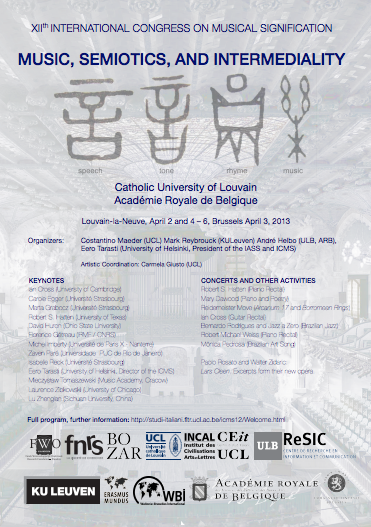
Colloque – XIIth Congress on Musical Signification: "Music, Semiotics and Intermediality"

Programme provisoire : ici
The International Congress on Musical Signification (ICMS) is a biennial conference on recent developments and future trends in Musical Semiotics. It is one of the major platforms of the Project of Musical Signification, which was launched in Paris in 1984, and which has been directed since 27 years by Eero Tarasti at the University of Helsinki.
The 11th ICMS in Krakow (Poland) was a resounding success. The 12th International Congress will be organized in Belgium from april 2 – 6, 2013 at Louvain-la-Neuve and Brussels. It will be organized jointly by the Center for Italian Studies (Université Catholique de Louvain) (UCL), the University of Leuven (KU Leuven) and the Université Libre de Bruxelles (ULB) under the auspices of the International Association for Semiotic Studies (IASS), with the University of Helsinki and the International Semiotics Institute (ISI) as co-organizers and Professors Costantino Maeder (UCL), Mark Reybrouck (KU Leuven), André Helbo (ULB, ARB) and Eero Tarasti (Director of the Musical Signification Project, University of Helsinki) as Directors. 
Music plays a decisive role in intermedial phenomena as opera, theater, television, advertising, interactive websites, and so on. Even experiencing a sonata or a Lieder Cycle in a concert is intermedial (the performance, the context of the performance, the shared experience of the audience, etc.). In this conference, we will deal with the complex and enigmatic interaction of music, language, acting, performance and surrounding events as well as with the immediate, comprehensive, all encompassing, sometimes selective response by the audience to these very complex intermedial events. 
Semiotics offers important instruments when dealing with these phenomena. This conference will focus on how and why music is composed and experienced within an intermedial framework. Our aim is to foster a better and comprehensive understanding of how music works semiotically.
Let us exemplify the ideas developed above: a competent poet writes a libretto. But, his libretto is not only a literary outline: it contains a projection of possible musical scores and dramatic performances. He distributes his plot on different segments (recitative/versi sciolti, tempo d’attacco, cantabile, tempo di mezzo, cabaletta, all differentiated metrically) according to his estimation of what music is able to express, but as well according to what a spectator will be able to experience immediately. A composer reads and interprets this libretto. His composition offers a new reading of the libretto, according to his own intentions and experiences, and own view about literature. In doing so, he also imagines what his audience will be able to experience. The resulting score can differ sensibly from the poet’s “virtual” scores and dramatic performances. A director, finally, will easily offer a mise en scène that rewrites the composer’s and the poet’s outlines and suggestions. His product makes also a statement about what music is in his eyes. 
A spectator of film, opera, or advertisement, experiences music as a part of an organic whole, even without consciously listening to the score. Therefore, we cannot separate music from text, acting, drama, image, etc. In this sense, intermediality does not study theater, opera, or a music album as a mere aggregate of separate media. Many single components of an intermedial object are connected and interwoven, and imply and mirror the other constituents.
The main focus of this conference, within this intermedial framework, will be on the following topics:
  • Music in an intermedial context (opera, musical, theater, television, advertising, internet, video games, pop album, etc.).
  • Tension between traditional musicology with emphasis on structural approach to music (music as structure, score analysis) and sense-making by the listener (music as heard or music as experience) from a semiotic point of view.
  • The working of music within such a context as autonomous constituent (syntactics, semantics, etc.).
  • Link with central topics of the “International Project on Musical Signification”: musical sense-making, narrativity, and reception.
  • Role of semiotic point of view: moving from syntactics over semantics (self-reflective or extramusical) to pragmatics (effect on listener).
  • Encompassing actual and emerging topics of music research such as music and emotion, music as experience, music and the body, musical universals, music and evolution.
  • Interdisciplinary and transdisciplinary approaches: bringing together traditional musicology, musical semiotics, cognitive sciences, and neurobiology.

Organizers :
Prof. Dr. Costantino Maeder (Université catholique de Louvain)
Prof. Dr. Mark Reybrouck (KU Leuven)
Prof. Dr. André Helbo (Université libre de Bruxelles, Académie Royale de Belgique)
Prof. Dr. Eero Tarasti (Director of the Musical Signification Project, University of Helsinki)
Staff :
Prof. Dr. Christophe Georis (UCL) 
Prof. Dr. Carmela Giusto (UCL)
Nathalie Coisman (UCL)
Sonia Henrot (UCL)
Aline Geuze (UCL)
Emmanuelle Fantoni (UCL)
President of ISI, PMS and AISS :
Eero Tarasti
Scientific :
Costantino Maeder (UCL)
Mark Reybrouck (KUL)
André Helbo (ULB, ARB)
Ian Cross (University of Cambridge)
Eero Tarasti (Director of the Musical Signification Project, University of Helsinki)
Robert S. Hatten (University of Texas)
Dario Martinelli (University of Helsinki)
Bernard Vecchione (Université d’Aix en Provence)
Christine Esclapez (Université d’Aix en Provence)
Jean-Marie Jacono (Université d’Aix en Provence)
Márta Grabócz (Université de Strasbourg)
Gino Stefani (Università degli studi di Bologna)
Mieczysław Tomaszewski (Music Academy, Cracow)
Constantin Floros (Universität Hamburg)
Vladimir Petrov (State Institute for Art Studies, Moscow)
Dmitriy Shumilin (Russian Institute for Art History, St.Petersburg)
Konstantin Zenkin (Tchaikovsky Conservatory, Moscow)
Websites
Publié dans Colloque | Laisser un commentaire

Appel à contribution – (Ré)éditer les classiques (Moyen Âge-XXIe siècle)

Appel à contribution pour l’ouvrage collectif à paraître chez Orizons

dans la série « Culture des médias »
dirigée par Anne Réach-Ngô (Université de Haute-Alsace, ILLE)

(Ré)éditer les classiques (Moyen-Âge ‒ XXIe siècle)

Remise des propositions et acceptation des articles : fin mars 2013

Remise des articles : fin octobre 2013

En s’intéressant aux ouvrages que l’on peut qualifier de « classiques » et aux pratiques de publication qui leur sont propres, cet ouvrage collectif voudrait susciter une réflexion sur l’influence de l’édition et de la librairie sur la patrimonialisation des œuvres et leur intégration à l’institution littéraire. De fait, l’intervention éditoriale, lors de la mise en livre et de la diffusion des textes, contribue à informer le lecteur sur la nature des ouvrages qui lui sont soumis. De surcroît, les procédés éditoriaux contribuent au succès de certaines œuvres et notamment à leur « classicisation », que l’on pourrait définir comme la reconnaissance de la participation d’une œuvre à l’histoire littéraire et son intégration à un Panthéon érigé par les institutions, les circuits marchands, la doxa, etc. Procédant à la consécration de certains textes érigés en référence ou d’auteurs reconnus comme des autorités, l’édition et la libraire participent par des moyens qui leur sont propres à la détermination de la valeur de l’œuvre. C’est à ces divers moyens de promotion de la littérature – présentation matérielle du livre, stratégies de vente de l’œuvre, marketisation de l’auteur ̶ que l’on s’intéressa ici en explorant les trois champs de réflexion suivants :

1. Ériger une œuvre en « classique » : les procédés éditoriaux de la consécration

On s’intéressera aux moyens par lesquels l’acte de publication et les stratégies de vente contribuent à consacrer certaines œuvres et à en les présenter au public comme des « classiques » : étude des critères qui concourent à la sélection des œuvres, procédés d’intitulation du texte et de construction de l’image d’auteur, discours péritextuels et épitextuels visant à faire la promotion de l’œuvre, procédés de présentation matérielle de l’ouvrage (choix du format, qualité de l’ouvrage, appartenance à telle collection, publication en œuvre intégrale ou en extraits, etc…). Seront particulièrement appréciées les contributions examinant un corpus d’un point de vue synchronique ou diachronique, visant à mettre en valeur l’émergence, au sein d’un contexte éditorial précis, d’œuvres formatées pour accéder au statut de « classique ».

2. Le devenir des classiques : les procédés de réactualisation éditoriale
Il s’agira également de se demander comment une œuvre qui accède à la consécration et se voit ainsi canonisée est dans le même temps reformulée, récrite, actualisée suivant l’horizon d’attente de ses nouveaux lecteurs. En somme, dans quelle mesure le procédé de classicisation, qui vise à diffuser une même œuvre, estimée justement pour sa singularité, auprès de publics différents, ne va-t-il pas de pair avec une adaptabilité inhérente de l’œuvre, qu’il conviendra d’évaluer ?
On étudiera notamment les stratégies éditoriales qui visent à perpétuer le succès des œuvres élues : révisions textuelles, modernisation orthographique, traductions, intégration à des anthologies, à des manuels scolaires, élaboration de produits dérivés… On s’intéressera également aux différentes stratégies marchandes qui visent à toucher des publics préalablement ciblés : spécialistes, public « éclairé », grand public, public scolaire… On envisagera aussi le rôle, dans la canonisation des classiques, des institutions (école, université, Académie…) et de la presse qui accompagnent la réception du public.
3. La classicisation anticipée des textes : du classique au best-seller
On examinera enfin les pratiques de classicisation éditoriale qui relèvent, de la part de l’édition et de la librairie, de l’art d’anticiper sur l’accession d’un ouvrage au statut de « classique ». Dans cette perspective, le classique n’est plus un livre qui fait consensus ; c’est le consensus qui fait le classique, au point que la canonisation de l’œuvre intervienne parfois avant même la publication du texte. C’est dès lors le statut de classique prêté a priori à l’œuvre qui assure son succès éditorial et contribue, par la suite, à en faire un best-seller. En somme, l’étiquette de « classique » devient un argument de vente en tant que tel, avant même que l’ouvrage n’ait été lu !
On s’intéressera au processus même de la classicisation éditoriale et aux procédés de marketingqui permettent à l’éditeur de positionner l’ouvrage contemporain qu’il publie comme un classique, dès ou avant même sa parution. On pourra alors s’interroger sur les adaptations qu’une telle conception du produit « classique » impose aux stratégies auctoriales (construction d’une image d’auteur, stratégies de communication, etc.). On pourra encore réfléchir à la portée d’une classicisation publicitaire des œuvres par le biais de l’illustration, de la couverture, des jeux de collection et de tout le protocole commercial qui vise à assurer la diffusion et la vente du classique devenu après-coup best-seller.
Les propositions de contribution sont à envoyer, accompagnées d’un titre et d’un résumé, des coordonnées postales et institutionnelles de leur auteur ainsi que d’une brève présentation biobibliographique.
Les articles acceptés seront à rendre pour le 31 octobre 2013 au plus tard et ne dépasseront pas les 40 000 caractères, espaces compris.
Source de l’information : Fabula.org
Publié dans Appel à contributions | Laisser un commentaire

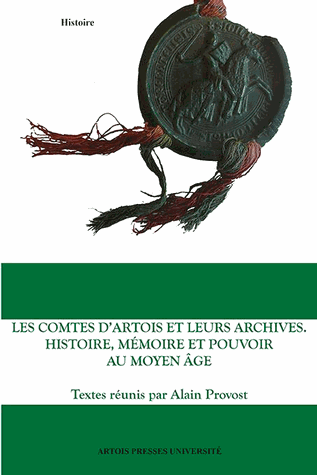
Publication – Alain Provost (éd.), "Les comtes d’Artois et leurs archives. Histoire, mémoire et pouvoir au Moyen Âge"

Conservé aux Archives Départementales du Pas-de-Calais, le Trésor des chartes des comtes d’Artois (XIIIe-XIVe siècles) rassemble plusieurs dizaines de milliers de documents dont la très grande richesse est parfois méconnue. Les études ici réunies s’attachent à la constitution et à la conservation de ce fonds, à l’histoire de la production documentaire (cartulaires, enquêtes, comptabilités), et plus généralement à l’histoire des comtes et du comté d’Artois (société politique, gouvernement et administration du comté, pratiques judiciaires, pratiques de dévotion, mémoire généalogique). L’ouvrage s’inscrit dans le renouvellement actuel de l’histoire des pratiques de l’écrit. Par la diversité des thèmes et des approches, il dresse un état des connaissances relatives aux archives des comtes d’Artois, et, au-delà, dessine des perspectives de recherche. Il attirera l’attention de la communauté scientifique sur un fonds documentaire exceptionnel et apportera au public cultivé une contribution importante à la connaissance de l’Artois au Moyen Âge et, plus largement, du royaume de France sous les règnes des derniers Capétiens.

Informations pratiques :
Alain Provost (éd.), Les comtes d’Artois et leurs archives. Histoire, mémoire et pouvoir au Moyen Âge, Arras, Artois Presses Université, 2013. Nb de pages : 172 p. ISBN : 978-2-84832-165-3. Prix : 18,00 euros.
Publié dans Publications | Laisser un commentaire

Appel à contribution – European Courts in a Globalized World 1400-1700

European Courts in a Globalized World 1400-1700 (Lisbon, 7-8 Nov 13)
Lisbon, November 7 – 08, 2013
Deadline-CFP: 25 mars 2013
The call for papers for the PALATIUM conference « European Courts in a Globalized World 1400-1700 » in Lisbon (Portugal), 7-8 November 2013, is now available. Abstracts are invited by 25 March 2013. Young scholars who want to participate in this event are encouraged to apply for a travel grant.
In the Early Modern age, Europe’s contact with the external, non-European world changed dramatically in scope. Change was brought about by Europe’s own expansion beyond its frontiers into Africa, Asia and America. The growth of the Ottoman Empire also put pressure on Europe’s eastern frontiers while at the same time providing opportunities for political and economic alliances to be forged and for cultural and artistic exchange to take place. European courts were central agents in this process and changed subsequently. In contact with previously unknown political realities, European courts were provided with terms of comparison, some as splendid as the Mughal or Chinese imperial courts, some as exotic as the Maya and Aztec empires. New works of art, from African ivories to Japanese folding-screens, from Chinese porcelain to pre-Columbian artifacts, were introduced into the European markets, changing patrons’ tastes, acquisition patterns and dynastic gift practices. Worldwide networks of commercial agents were set up, diplomatic missions were sent and received bearing gifts and information, new collections were assembled, and new architectural spaces to display them were devised. Exotic objects and themes which mirror Europe’s worldwide possessions and a patron’s command of the new knowledge of the world became a mandatory part of courtly artistic discourse through their introduction in palace decoration, including gardens where menageries where set up, and in court ceremonies and festivities.
This colloquium is designed to reflect upon the effects of these changes on court life and the spaces in which it took place. It will allow for various European imperial experiences to be brought together and compared, thus setting up the ground for these to be understood in a coherent, all-encompassing narrative, rather than in a nationally-fragmented set of disparate studies.
Papers will be organized around the following four topics:
  • The Empire in Court Ceremonies
  • Architectural Spaces to Display the Empire
  • Non-European Objects in Palace Decoration
  • European Courts Outside of Europe
For more information see:
Publié dans Appel à contributions | Laisser un commentaire

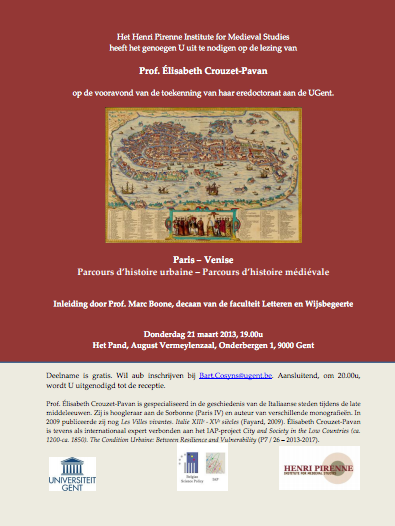
Conférence – Prof. Élisabeth Crouzet-Pavan, "Paris – Venise. Parcours d’histoire urbaine – Parcours d’histoire médiévale"

Het Henri Pirenne Institute for Medieval Studies heeft het genoegen U uit te nodigen op de lezing van

Prof. Élisabeth Crouzet-Pavan
op de vooravond van de toekenning van haar eredoctoraat aan de UGent.

Paris – Venise
Parcours d’histoire urbaine – Parcours d’histoire médiévale

Inleiding door Prof. Marc Boone, decaan van de faculteit Letteren en Wijsbegeerte
Donderdag 21 maart 2013, 19.00u
Het Pand, August Vermeylenzaal, Onderbergen 1, 9000 Gent
Deelname is gratis. Wil aub inschrijven bij Bart.Cosyns@ugent.be. Aansluitend, om 20.00u, wordt U uitgenodigd tot de receptie. 
Prof. Élisabeth Crouzet-Pavan is gespecialiseerd in de geschiedenis van de Italiaanse steden tijdens de late middeleeuwen. Zij is hoogleraar aan de Sorbonne (Paris IV) en auteur van verschillende monografieën. In 2009 publiceerde zij nog Les Villes vivantes. Italie XIIIe-XVe siècles (Fayard, 2009). Élisabeth Crouzet-Pavan is tevens als internationaal expert verbonden aan het IAP-project City and Society in the Low Countries (ca 1200-ca 1850). The Condition Urbaine: Between Resilience and Vulnerability (P7 / 26 – 2013-2017).

Publié dans Colloque | Laisser un commentaire

Appel à contribution – Early Modern Print Culture in Central Europe

Call for Papers – Early Modern Print Culture in Central Europe
Seminar of the Academia Europaea and the University of Wrocław – 16-18 September 2013

The Academia Europaea Knowledge Hub Wrocław and the University of Wrocław invite young scholars (PhD candidates and postdocs), to take part in the Seminar “Early Modern Print Culture in Central Europe” to be held in Wrocław (Poland) on 16 – 18 September 2013. 
Context and rationale 
International research has little to say about the development of early modern print culture in Central Europe. Poland for instance is mentioned just once in the latest edition of Elisabeth Eisenstein’s classic study The Printing Revolution in Early Modern Europe (2005), and other parts of Central Europe are not mentioned at all. Nevertheless, the first printing press in Central Europe was established in 1473 in Cracow (Poland) and in the next decades presses were put into operation particularly in university towns. Although at the beginning these presses produced books in Latin, texts in vernacular languages appeared from the early sixteenth century onward as a result of the Protestant Reformation. Although there is a rich historiography on this topic in various countries in the region, research literature is unfortunately not easily accessible to an international public because of language barriers. The seminar is aimed at bringing together scholars in the field of print culture to discuss the latest developments in their discipline against the background recent international research on print culture. Keynote lectures by senior scholars will be combined with presentations by younger scholars. The outcome of the seminar will be a collection of papers, but also forging contacts to set up new collaborative research projects. 
Possible topics :
  • international knowledge networks in the early modern period in Central Europe
  • printers, booksellers, publishers
  • readers and reading
  • libraries
  • scholarly publishing
  • book production in vernacular languages
  • censorship
  • privileges before copyright
  • book illustration
  • periodicals in the early modern period
  • religious matters in print
  • mapmaking
  • geography of the book
Application: 
Submit a 300-word abstract, a curriculum vitae, a letter of recommendation from a senior scholar, and a completed registration form via email by April 15, 2013. All applicants will be notified about the selection of participants before May 1, 2013. 
Second requierement:
Only those, who are selected to participate will be asked to submit a 3,000-5,000 word description or excerpt (i.e. chapter, article, etc.) for circulation to the workshop participants by 31 July 2013. These papers will be made available online. All workshop participants are asked to read these submissions prior to the workshop. The paper should be an unpublished one. Presenters who do not meet the submission deadline, will not be able to attend the workshop. 
Seminar language will be English. 
Financial arrangements : 
The organisers will provide accommodation, reimburse travel expenses to certain maximum*, conference fee, insurance and the costs of publication of refereed conference papers for participants. 
Organising committee : 
Pieter Emmer (Leiden Univerity; Academia Europaea)
Aleksandra Nowak (Academia Europaea Knowledge Hub Wrocław)
Stefan Kiedroń (Wrocław University; organiser)
Siegfried Huigen (Wrocław University)
Irena Barbara Kalla (Wrocław University)
All correspondence, including submission of proposals and final papers, must be addressed to:
Dr Aleksandra Nowak (nowak@acadeuro.wroclaw.pl)
Academia Europaea Knowledge Hub Wrocław
Rynek 13, 50-101 Wrocław
tel/fax +48 71 770 20 26
mobile +48 506 388 101
Source de l’information : Academy of Europe
Publié dans Appel à contributions | Laisser un commentaire

Colloque – Orderic Vitalis: New Perspectives on the Historian and his World

Orderic Vitalis: New Perspectives on the Historian and his World
St. John’s College, Durham University, 9-11 April 2013
Organising Committee:
Dr Giles E. M. Gasper (Durham University)
g.e.m.gasper@durham.ac.uk
Charlie Rozier (Durham University)
c.c.rozier@durham.ac.uk
Durham University Department of History
43 North Bailey
Durham, DH1 3EX
Daniel Roach (University of Exeter)
dr229@ex.ac.uk
Exeter University Department of History
Amory Building
Rennes Drive
Exeter, EX4 4RJ
Programme :
Tuesday 9 April
10h00 : Arrivals, registration and check-in.
11h30-12h00 : Prof. Christopher Holdsworth – Welcome Lecture: ‘Marjorie Chibnall: an Appreciation’
12h00-13h00 : Lunch
13h00-14h30 : Session 1 – Manuscripts of Saint-Évroul
Erik Kwakkel – Orderic’s Hand and the development of Anglo-Norman gothic
Jenny Weston – Following the Master’s Lead: A New Orderic Vitalis Manuscript in Perspective
Charlie Rozier – The study of History at Saint-Évroul and the place of the Historia Ecclesiastica within this
15h00-16h30 : Session 2 – Monastic and Ecclesiastical Life
Thomas Roche – Reading Orderic Vitalis with Charters in Mind
Véronique Gazeau – Orderic Vitalis and the Cults of Saints
Giles E. M. Gasper – Orderic Vitalis and Historical Theology
17h30-19h00 : Keynote Lecture: Prof. Elisabeth van Houts (Cambridge University) – Orderic Vitalis: the Man and the Historian
19h30 : Drinks Reception – Tunstall Gallery, Durham Castle.
20h00 : Conference Dinner – Senate Suite, Durham Castle.
Wednesday 10 April
9h00-10h30 : Session 3 – Monks, Patrons and the Wider World
Kate Hammond – Orderic Vitalis and family, politics and conflict
Dan Roach – In the interests of the church of Ouche’: St. Evroul and Southern Italy in the Historia ecclesiastica
Bill Aird – The judgement of God…waits till the day when you must render account of your stewardship: Orderic’s secular rulers, and representations of personality and power in the Historia Ecclesiastica
11h00-12h30 Session 4 – Issues of Theology and Doctrine
Kathleen Thompson – Orderic and the Tironensians
Elisabeth Mégier – Jesus Christ, a protagonist of AngloNorman history? History and theology in Orderic Vitalis Historia Ecclesiastica
Daniel Gerrard – Orderic’s Demons
12h30-13h30 : Lunch
13h30-15h00 : Session 5 – Outlawry, Death and Violence
Rick Barton – Orderic Vitalis and Violence
Estelle Ingrand-Varenne and Vincent Debiais – Between Historia and poesis: Funerary Inscriptions in the Historia Ecclesiastica
Melissa Sartore – To outlaw, to exile, and to imprison: social, political, and legal practices according to Orderic Vitalis
15h30-17h00 : Session 6 – Orderic’s Places
Peter Frankopan – Orderic and Byzantium
Benjamin Pohl – Mentality and Memory in the Works of Orderic Vitalis
Chris Lewis – Orderic’s England
18h00 : Wine reception followed by dinner in St John’s College  – Dining Hall (from 19:00), with cash bar available for the rest of the evening.
Thursday 11 April
09h00-10h30 : Session 7 – Military Men
Emily Winkler – The Invasion Narratives of Orderic and his Contemporaries
Fanny Madeline – Orderic Vitalis and the Arts of War
Joanna Huntington – Gender in Orderic Vitalis
11h00-12h30 : Session 8 – Literary Approaches
Tom O’Donnell – Meanders, Loops, and Dead Ends: Form and Interpretation in Orderic Vitalis
Mark Faulkner – Orderic Vitalis and (the) English
Emily Albu – Spiritual joy and worldly woe: The tone of the Historia Ecclesiastica
12h30-13h30 : Lunch

13h30-15h00 : Session 9 – Memory and Legacy
Sigbjørn Olsen Sønnesyn – The Moral of the Story: Monastic Edification in Orderic’s Historia ecclesiastica
Xavier Storelli – Temporality, Death and Other World in Orderic’s Historia Ecclesiastica
James Clark – Orderic’s Reception in the Later Middle Ages
15h00 : Daniel Roach and Charlie Rozier – Closing Remarks and Future Directions
15h30 : Departures
Source de l’information : Unicaen
Publié dans Colloque | Laisser un commentaire