-
Avec le soutien du FNRS, du CRHiDI (UCLouvain – Saint-Louis, Bruxelles), d'INCAL (UCLouvain), de PraME (UNamur), de sociAMM (ULB) et de Transitions (ULiège)
-

-

-

-

-

-

- Activités du RMBLF Appel à contributions Appel à projet Audio Bande dessinée Banque de données Bourse Colloque Documentaire Débat et historiographie Enquête Enseignement Excursion Exposition Le réseau Les journées Musique Mécénat Médias News Nécrologie Offre d'emploi Podcast Prix Publications Réseau de recherche Stage Séminaire Web École d'été
- Follow L'Agenda des Médiévistes on WordPress.com
-
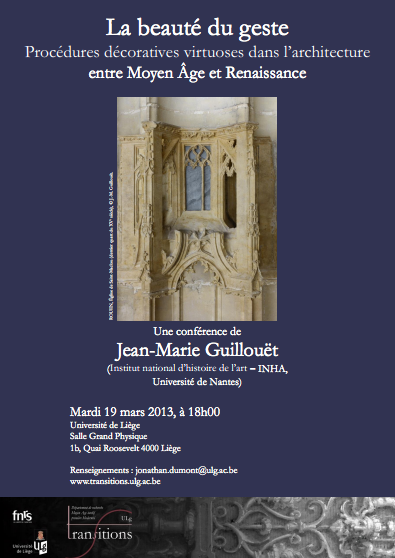
Conférence – Jean-Marie Guillouët, "La beauté du geste. Procédures décoratives virtuoses dans l’architecture entre Moyen Âge et Renaissance"
Le mardi 19 mars 2013 à 18h00, dans le cadre du cycle annuel de conférences organisé par Transitions, Jean-Marie Guillouët (Institut national d’histoire de l’art – INHA, Université de Nantes) présentera une communication intitulée La beauté du geste. Procédures décoratives virtuoses dans l’architecture entre Moyen Âge et Renaissance.
Informations pratiques :
Université de Liège, Salle Grand Physique
1b, Quai Roosevelt
4000 Liège (Belgique)
Publié dans Colloque
Laisser un commentaire
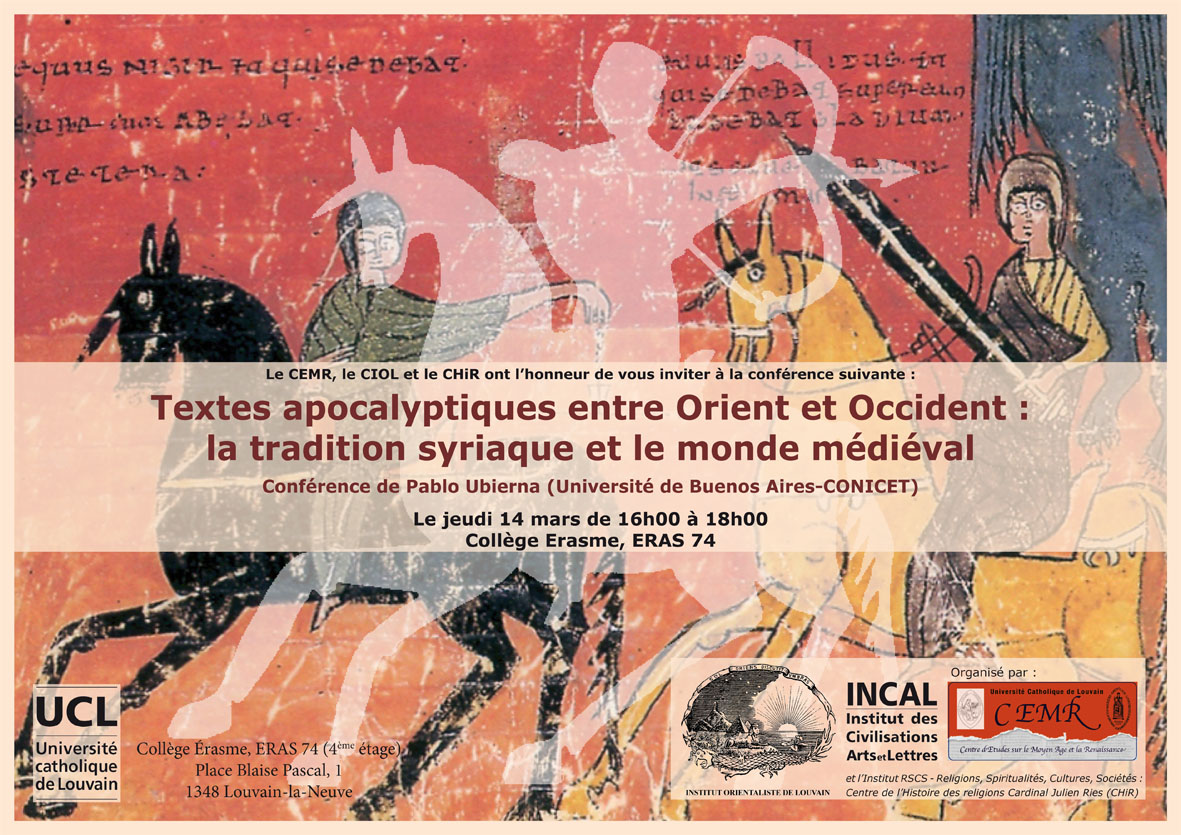
Conférence – Textes apocalyptiques entre Orient et Occident : la tradition syriaque et le monde médiéval
Le CEMR, le CIOL et le CHiR (Université catholique de Louvain) ont l’honneur de vous inviter à la conférence suivante :
Textes apocalyptiques entre Orient et Occident : la tradition syriaque et le monde médiéval
Conférence de Pablo Ubierna (Université de Buenos Aires-CONICET)
Informations pratiques :
Louvain-la-Neuve, Université Catholique de Louvain
Collège Erasme, ERAS 74
Jeudi 14 mars de 16h00 à 18h00
Source de l’information : Université Catholique de Louvain
Publié dans Colloque
Laisser un commentaire
Appel à contribution – L’écriture de l’histoire au Moyen Âge (XIe -XVe siècle), entre contraintes génériques et contraintes documentaires
Ce colloque, qui se tiendra les 21 et 22 novembre 2013 à l’Université de Versailles Saint-Quentin-en-Yvelines, a été conçu comme l’aboutissement de trois journées d’études organisées le 5 mai 2009, le 27 mai 2010 et le 30 mai 2011 dans le cadre de l’axe « historiographie et philologie » du laboratoire ESR. Elles ont rassemblé littéraires et historiens autour de la question suivante : comment l’écriture de l’histoire organise-t-elle son matériau, entre les contraintes liées au genre littéraire qu’impose le travail d’écriture ou de réécriture et la nécessité de recourir aux documents,indispensables à la dimension référentielle du discours ?
Entre narration et documents
La question se pose avec une particulière acuité pour l’historiographie médiévale parce que la notion de sources, qui suppose l’utilisation de documents d’archives employés comme preuves, avec mise à distance, ne commence à être mise en œuvre qu’au début du XVIIe siècle et ne s’impose guère qu’au XVIIIe siècle. En revanche les modèles génériques (l’hagiographie, l’épopée) sont bien présents depuis l’antiquité et très utilisés dans l’écriture de l’histoire. Au Moyen Age l’apport documentaire est donc la plupart du temps soit étroitement intégré à la narration, qui construit le sens historique en recourant à des modèles sous forme de remploi ou d’assimilation de récits plus anciens empruntés à des textes antérieurs, soit exposé à l’état brut dans des écrits où la narrativité n’est présente que de manière minimale ou fragmentaire.
Les communications présentées au cours des journées d’études et les débats auxquels elles ont donné lieu ont ainsi bien montré les difficultés suscitées par la prise en compte simultanée des deux contraintes, documentaire et narrativo-générique. On n’en a pas moins vu émerger quelques pistes fécondes autour de dossiers significatifs. Ainsi au tournant des XIe et XIIe siècles les cartulaires-chroniques du Mont Cassin, tout en utilisant des récits comme des documents d’archives, s’efforcent déjà d’organiser dans l’espace du folio et du recueil manuscrits les rapports entre narration et documentation pour raconter le mieux possible l’histoire du monastère, tandis que la « Chronique romane de Montpellier » offre l’exemple intéressant d’un discours narratif émergeant peu à peu, du XIIIe au XIVe siècle, de notations annalistiques très brèves fonctionnant au départ comme de simples marqueurs mémoriels. Les Grandes Chroniques de France élaborées à Saint-Denis montrent pour leur part comment un choix soigneux a été fait par les collecteurs des textes-sources latins antérieurs sur la base de choix génériques qui sont aussi des choix idéologiques, en relation avec l’image du roi (plus cléricale qu’épique) qui cherche à s’imposer aux XIIe et XIIIe siècles sous l’influence de la réforme grégorienne. Cette reprise orientée de narrations latines antérieures utilisées comme documents se retrouve dans l’historiographie anglonormande avec la mise à distance du genre hagiographique par Wace et sa laïcisation par Benoît, au service d’un autre modèle royal, celui des souverains Plantagenêt.
Qu’apporte la narration, et qu’est-ce qu’un document ?
L’enjeu est donc maintenant de préciser et d’approfondir ces pistes, voire d’en ouvrir d’autres qui leur sont apparentées et qui sont apparues au cours des discussions. Ainsi la reprise de récits antérieurs comme support documentaire montre bien que la notion de document est complexe : elle ne dépend pas tant de l’intention de ceux qui fabriquent un texte que de ceux qui l’interprètent et choisissent de l’utiliser, souvent en l’adaptant à leur propre projet. La réception contemporaine et contrastée de textes comme l’Estoire de la guerre sainte attribuée à Ambroise, à mi-chemin entre document historique et texte poétique, en témoigne éloquemment. Il faudrait donc revenir sur cette notion en cherchant à analyser sa présence et son fonctionnement dans le détail des écrits médiévaux qui, à un titre ou à un autre, se réclament d’une démarche historiographique.
L’utilisation qui est faite de l’espace du manuscrit pourrait être prise en compte, ainsi que les moyens mis maintenant à notre disposition par l’outil informatique pour faire apparaître clairement ces stratégies. D’autre part l’importance généralement accordée à la narration et aux traditions génériques qui l’informent invite à s’interroger sur le ou les pouvoir(s) de la mise en récit. Lorsqu’au beau milieu d’un traité théorique sur la musique on voit apparaître dès la fin du XIIe siècle quelques développements narratifs sur des musiciens précis, ou lorsque des chansonniers font précéder la transcription de poèmes des troubadours d’une compilation raisonnée de leurs vidas, une démarche historiographique de type biographique est en cours et elle semble avoir pour but d’« autoriser » les protagonistes des récits ainsi constitués. Nous avons là les débuts de l’histoire littéraire ou de l’histoire de la musique. On pourrait donc s’interroger sur la fonction héroïsante (ou autorisante) de la narration historique, jugée d’autant plus convaincante qu’elle s’appuie sur des récits présentés comme des documents (du factuel, donc), mais qui découle peut-être des modèles génériques les plus souvent utilisés dans l’écriture historiographique (hagiographie ou épopée).
Nos questions tournent en définitive autour de trois notions clefs : remploi, référence et autorité. Remploi, car il s’agit d’étudier les modalités de la présence des documents, ou d’une réalité documentaire, dans le récit. Référence, car cette insertion vient dans certains cas au moins renforcer la fonction référentielle du langage. Autorité enfin, car cet usage d’hypotextes autorise le scripteur. Réfléchir sur ces trois notions pourra être l’occasion de revenir sur l’assertion de Bernard Guenée selon laquelle « au Moyen Age, l’utilisation des documents d’archives […] avait été contenue dans de telles limites que […] les grands ouvrages ambitieux devaient s’appuyer bien moins sur les chartes que sur les livres », et aussi de rediscuter sa fameuse phrase relative à l’autorité : « Les historiens du Moyen Âge ne critiquaient pas des témoignages, ils pesaient des témoins. »
Comité scientifique :
- Etienne Anheim (Histoire médiévale, UVSQ / ESR)
- Pierre Chastang (Histoire médiévale, UVSQ / ESR)
- Catherine Croizy-Naquet (Littérature médiévale, Université de Paris 3)
- Laurent Feller (Histoire médiévale, Université de Paris 1)
- Francine Mora (Littérature médiévale, UVSQ / ESR)
- Michel Zink (Littérature médiévale, Collège de France)
Pour répondre à cet appel à communications
Vous pouvez adresser vos propositions de communications jusqu’au 31 mars 2013 à Francine Mora (Francine.Mora@poetiques.uvsq.fr), Etienne Anheim (valetien@gmail.com) et Pierre Chastang (chastangpierre@gmail.com) en précisant votre nom, votre affiliation, le titre proposé pour votre communication, ainsi qu’un résumé d’une demi-page environ.
Source de l’information : Université Versailles-Saint-Quentin-en-Yvelines
Publié dans Appel à contributions
Laisser un commentaire
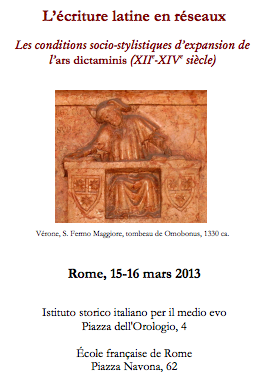
Colloque – L’écriture latine en réseaux. Les conditions socio-stylistiques d’expansion de l’ars dictaminis (XIIe-XIVe siècle)
Réécrire l’histoire des styles latins médiévaux à la lumière de l’histoire sociale permet de féconder réciproquement des approches historique et philologique encore souvent séparées. La réflexion sur l’importance des réseaux de tous ordres (professionnels, familiaux, régionaux…) dans la diffusion de styles d’écriture latins a été abordée depuis longtemps par les historiens de l’humanisme italien et européen. À des époques où la documentation est plus parcellaire, et les conditions de l’enquête plus drastiques, beaucoup reste à faire pour reconstituer les « conditions socio-stylistiques » d’expansion de pratiques d’écriture spécifiques.
Les pratiques rhétoriques latines valorisées aux XIIe, XIIIe et XIVe siècles sous le nom d’ars dictaminis, à partir de l’Italie, offrent un terrain d’enquête idéal pour explorer les possibilités de reconstitution de réseaux « socio-stylistiques » en pleine époque médiévale. Secteur d’études en plein renouvellement, à la croisée de la diplomatique, de l’histoire du notariat et de l’histoire littéraire, concernant l’écriture des chancelleries, du pouvoir, du droit, mais aussi les moyen d’expression et d’affirmation personnelle, l’ars dictaminis peut-il être appréhendé sous l’angle des réseaux ? Avec quelle méthodologie, quelles perspectives et quelles limites ? L’atelier, premier d’une série couvrant l’ensemble du Moyen Âge, propose d’explorer, à travers une réflexion commune, les questions qui se posent dans la reconstitution des différentes phases de développement du dictamen communal nord-italien, comme du dictamen « sicilien », en Italie et vers l’Europe.
Programme :
Vendredi 15 mars 2013
Istituto Storico Italiano per il Medioevo
10h00 : Massimo Miglio (ISIME), Stéphane Gioanni (EFR) – Accueil
Problèmes généraux
Fulvio Delle Donne (Università della Basilicata/ISIME), Benoît Grévin (CNRSLAMOP) – Introduction générale du cycle
Anne-Marie Turcan-Verkerk (EPHE) – La reconstitution des premières phases du dictamen (fin XIe-années 1160) : le point sur la question
Benoît Grévin (CNRS-LAMOP), Fulvio Delle Donne (Università della Basilicata/ISIME) – La reconstitution des réseaux de dictatores des XIIIe-XIVe siècles : avancées et problèmes méthodologiques
Florian Hartmann (Universität Bonn) – Présentation et discussion du projet Dictamen
15h00
École française de Rome
Les réseaux d’expansion du dictamen dans le nord de l’Italie aux XIIe-XIIIe siècles
Anne-Marie Turcan-Verkerk (EPHE), Florian Hartmann (Universität Bonn), Elisabetta Bartoli (Università di Siena Arezzo) – Un manuscrit et son contexte, le ms. 45 Accademia dei Filopatridi, Savignano sul Rubicone : présentation-lectures/débat
Marino Zabbia (Università di Torino) – L’articolazione tra la mutazione del ceto notarile e la diffusione delle prassi retoriche : il punto di vista dello storico
Carole Mabboux-Sutton (Université de Savoie) – Référence ‘cicéronienne’ et dictamen (débat)
« Est-il trop tôt pour faire une synthèse sur le dictamen ? ». Autour du livre de Ronald Witt, The two Latin Cultures and the Foundation of Renaissance Humanism in Medieval Italy, Cambridge, 2012 – Débat en présence de Claudio Felisi (ENS-EPHE), Paolo Garbini (Sapienza Università di Roma), Clémence Revest (EFR), Francesco Stella (Università di SienaArezzo), Vito Sivo (Università di Foggia)
Samedi 16 mars, 9h30
École française de Rome
Les réseaux de diffusion du dictamen dans le Mezzogiorno aux XIIIe-XIVe siècles
Dario Internullo (Università di Roma Tre) – Prassi dell’ars dictaminis e cultura notarile nella Roma del Trecento. Questioni e piste
Séance de travail autour du manuscrit « Fitalia » de Palerme
Pietro Colletta (Università di Enna « Kore ») – Il manoscritto Fitalia e la sua inserzione nella tradizione notarile e storiografica siciliana del Trecento
Fulvio Delle Donne (Università della Basilicata/ISIME) – Il manoscritto Fitalia e l’ars dictaminis di età sveva: problemi di tradizione
Benoît Grévin (CNRS-LAMOP) – Il manoscritto Fitalia nel quadro della cultura “aragonese” : le reti di diffusione del dictamen tra Italia e Aragona (secc. XIII-XIV)
Informations pratiques :
Rome, 15-16 mars 2013
Istituto storico italiano per il Medio Evo
Piazza dell’Orologio, 4
École française de Rome
Piazza Navona, 62
Organisation scientifique :
Fulvio Delle Donne (Università della Basilicata/ISIME) ; Monique Goullet (CNRS-LAMOP) ; Benoît Grévin (CNRS-LAMOP) ; Clémence Revest (École française de Rome)
Contacts :
École française de Rome
Stéphane Gioanni
Directeur des études médiévales
Grazia Perrino
Secrétariat des études médiévales
secrma@efrome.it
Source de l’information : École française de Rome
Publié dans Colloque
Laisser un commentaire
Appel à contribution – Urban Communities in Europe, 1300-1650: New Social and Economic Perspectives
Call for Papers for a Session on ‘Urban Communities in Europe, 1300-1650: New Social and Economic Perspectives’ at the European Social Science History Conference (ESSHC)
Vienna, 23-26 April 2014
Title: Urban Communities in Europe, 1300-1650: New Social and Economic Perspectives
Deadline: 15 April 2013
Organisers: Justin Colson (University of Exeter) and Arie van Steensel (Utrecht University)
Communities in medieval and early modern urban societies, as in modern cities, were never static entities, but were created through a continuous process of everyday human interaction. Over the past decades, scholars have offered new insights into the collective civic and cultural identities of towns across Europe, through ritualised political celebrations and religious processions. The unity of the idealised urban community was, however, undermined by the multiple, often overlapping and competing, sub-communities within the walls of each town. Urban communities were constituted of numerous solidarities between town-dwellers who, for example, shared the same occupation, ethnicity, religion, neighbourhood or political objectives, rather than ties of kinship or fealty. Thus, the formation of urban communities was as much a process of inclusion as of exclusion; solidarity and conflict were two sides of the same coin.
Seeking to capture the dynamic process of community formation, this session takes a critical approach to current conceptions of urban communities in late-medieval and early modern Europe as an ideal, unified corporation, body or civil society. It asks how social groups within towns were constructed and reconstructed, and how they reflected a sense of social cohesion and identity. What kind of social institutions emerged from the interaction amongst members of differing groups and solidarities, and, in turn, how did these institutions come to structure these interactions? How were social and spatial boundaries between social groups created and sustained within the urban community? Above all, the session aims to tease out the social and economic factors that patterned the formation of urban (sub-)communities by comparing developments in different towns.
Therefore, this call invites contributions that develop new perspectives on the formation of urban communities in the late-medieval and early modern Europe. One the one hand, papers with a more theoretical focus are welcomed, combining political-cultural with socio-economic approaches to the notions of community and solidarity. On the other, papers may examine specific case studies, for example, on the role of citizenship, occupational clustering, poor relief and parochial or neighbourhood life in shaping social boundaries and solidarities. Together, the papers should shed new light on the socio-economic conditions, the formal and informal institutions and the strategies of town dwellers that explain the similarities and differences in the organisation and functioning of urban communities in pre-modern Europe.
Information: Please send abstracts of around 500 words for papers to the organisers, Arie van Steensel (a.vansteensel@uu.nl) and Justin Colson (j.r.colson@exeter.ac.uk). Deadline for paper abstracts is 15 April 2013. Candidates will be informed about the selection of papers by 1 May 2013, after which the session will be submitted to the ESSHC organisers.
If the session is accepted, participants are expected to circulate their full papers before the start of the conference. The organisers are planning an edited volume of the papers contributed to this session, which will be published afterwards.
About ESSHC: See the conference website: esshc.socialhistory.org/esshc-vienna-2014
Publié dans Appel à contributions
Laisser un commentaire
Appel à contribution – Digital Diplomatics 2013
Digital Diplomatics 2013
Paris, Archives Nationales de France, 14-16 November 2013
Diplomatics has changed fundamentally in the last few decades due to dramatic developments in information technology. While consolidating itself as an autonomous science with its own centuries-old theory, methodology, analytical processes and tools, focused on research on medieval and early modern legal documents, it has also grown into an interdisciplinary field, expanding its area of inquiry to all kinds of textual traditions, documentary forms and creation processes through the use of sophisticated digital tools. “We shape our tools, and then our tools shape us”– said Marshal McLuhan. This is especially true with regard to diplomatics. The easy reproduction and publication of charters makes large fonds accessible to historical research and gives the opportunity to reconstruct dispersed fonds. Text analysis tools allow researchers to dig deeply into the data in the documents, extracting information on the distribution of phrases or legal concepts, and creating resources for statistical and network analysis of content. The possibility of developing data models beyond the material restrictions of a printed book inspires rethinking the traditional ways of editing charters. The access to huge image collections fosters historical research on the semiotics of documents as visual signs. At the same time, the comparison between documents on traditional media and those born digital has shown that classic diplomatic knowledge can be used to address issues related to documents created, managed and preserved in the digital environment.
Many of the advantages of conducting any kind of documentary research in the digital environment were clear to diplomatists when they began creating online portals of archival material, doing digital editions of medieval documents, analysing linguistically charter corpora or applying to them visual analysis or visualization technologies. Additional opportunities they identified were the ability to make automatic or semiautomatic annotation to the content of documents, and the application of diplomatics concepts for the identification of digital records and the assessment and protection of their authenticity in a variety of information systems. However, a scholarly reflection on how these new directions taken by diplomatics affect its nature as a field of study concerned with a systematic critical analysis of documents has just begun.
Following the two conferences on Digital Diplomatics that took place in 2007 in Munich and 2011 in Naples, this conference has the goal to further the scholarly reflection on the way in which diplomatics has developed as a result of both the opportunities offered by digital tools to study historical documents and the challenges presented by born digital documents and by the need to understand their structure and of the complex digital environments in which they reside.
We invite proposals for papers addressing the manifestations and effects of what appears to be a paradigm shift from a classic humanistic science to a cyberscience (Nentwich).
Examples of issues that could be considered are:
- Changes in scholarly editing of documents when using digital methods
- Diplomatics as a hard science, a social science or a humanisties discipline
- Measuring versus understanding as the main method of diplomatics of the documents (e.g. automatic author identification versus ‘Diktatvergleich’)
- The focus of diplomatics: a single documents or aggregations (corpora, files, series, fonds)?
- Digitized charters as images, texts, or meaning?
- Can the whole meaning of a charter be represented digitally?
- Comparing creation of trusted documents in the traditional and the digital environment
- Signatures and seals in the traditional and the digital environment: are they comparable?
- Are digital forensics and its tools related to diplomatics? How?
- Diplomatic tools for analyzing digital and non-digital documents
- Teaching diplomatics in the digital environment (both in traditional classroom and through eLearning)
- Using diplomatics to build a virtual archives
Each submitted proposal will be peer reviewed by at least three members of the Program Committee to ensure that the program provides significant, timely, and authoritative information.
Proposals can be submitted for individual papers (for a 20 minutes oral presentation followed by a 5 minutes discussion), for a traditional session including three papers (1 hour of presentation time and 15 minutes of discussion time), or for a panel of speakers (1 hour and 15 minutes total).
Proposals should include:
- a 500-word abstract that clearly identifies the working title and the content of each paper.
- a 50-word biographical sketch of each author
- mailing address, phone, and email for the primary author
Proposals can be submitted via the conference website at http://www.cei.lmu.de/digdipl13/organisation/proposals or sent to digdipl13@lrz.uni-muenchen.de.
The deadline for proposal submission is March 15, 2013.
You find all the organisational details of the conference at http://www.cei.lmu.de/digdipl13/organisation/
Source de l’information : http://www.cei.lmu.de/digdipl13/
Publié dans Appel à contributions
Laisser un commentaire
Publication – Hélène Sirantoine, "Imperator Hispaniae Les idéologies impériales dans le royaume de León (IXe-XIIe siècles)"
L’histoire impériale de l’Espagne a commencé bien avant le règne de Charles Quint. Elle trouve ses origines dans le petit royaume astur-léonais du Xe au XIe siècle, dont quelques rois furent désignés imperatores. Elle connaît son développement le plus étonnant au cours de la période qui va du règne d’Alphonse VI de Castille-León (1065-1109) à celui de son petit-fils Alphonse VII (1126-1157). Ces deux souverains n’hésitèrent pas à s’autoproclamer « empereurs des Espagnes » et à revendiquer une souveraineté qui, dans cette période de Reconquête, s’étendait idéalement sur toute la péninsule Ibérique.
Ce livre retrace l’histoire de ce phénomène singulier que l’historiographie espagnole du milieu du XXe siècle avait érigé en mythe identitaire hispanique. Par un regard dépassionné sur les sources, il s’attache à dégager les procédés de légitimation monarchique dont témoigne l’usage du concept d’empire dans le León médiéval.
Table des matières :
En quête de l’imperator léonais (IXe siècle -1065)
I. – Aux origines de l’empire hispanique médiéval
II. – De l’imperium au regnum-imperium asturo-léonais
III. – Changement dynastique et fusion des héritages asturien et navarrais
Premiers essais. Alphonse VI, Urraca et Alphonse Ier le Batailleur, imperatores Hispaniae (1065-1126)
IV. – Prémices de la prétention impériale
V. – Alphonse VI et la tentation d’un empire néogothique
VI. – L’époque d’Urraca et d’Alphonse Ier d’Aragon : un interrègne impérial ?
Vie et mort de l’empire d’Alphonse VII (1126-1230)
VII. – Vers la (re)constitution d’un empire hispanique (1126-1135)
VIII. – Le système impérial alphonsin (1135-1157)
IX. – Souvenir et mémoire de l’empire hispanique dans l’« Espagne des cinq royaumes » (1157-1230)
Conclusion : Idéologie et mémoire
Informations pratiques :
Hélène Sirantoine, Imperator Hispaniae. Les idéologies impériales dans le royaume de León (IXe-XIIe siècles), Madrid, 2013 (Bibliothèque de la Casa de Velázquez, 58). 508 pp., 17 x 24 cm. 59,00 €. ISBN : 9788496820852.
Publié dans Publications
Laisser un commentaire
Conférence – François Bougard, "Du catalogue aux manuscrits : l’inventaire de la bibliothèque cistercienne de Vauluisant"
Le jeudi 7 mars 2013 à 16h00, dans le cadre du cycle annuel de séminaires-conférences organisé par le centre de recherche « Pratiques médiévales de l’écrit » (Université de Namur), François Bougard (Université de Paris-Ouest-Nanterre-La Défense) présentera une communication intitulée Du catalogue aux manuscrits : l’inventaire de la bibliothèque cistercienne de Vauluisant.
Informations pratiques :
Les séances se tiendront de 16h00 à 18h00 au Séminaire Histoire de la Faculté de Philosophie et Lettres des FUNDP. Adresse : 61, rue de Bruxelles, B – 5000 Namur. Entrée libre. Contact : xhermand@fundp.ac.be ou jfnieus@fundp.ac.be.
Source de l’information : Université de Namur
Publié dans Colloque
Laisser un commentaire
École d’été – London Palaeography Summer School
The London Palaeography Summer School is a series of intensive courses in Palaeography and Diplomatic. Courses range from a half to two days duration and are given by experts in their respective fields from a wide range of institutions. Subject areas include Latin palaeography, English, German and Greek palaeography, history of scripts, illuminated manuscripts, vernacular editing and liturgical and devotional manuscripts.
The Summer School is hosted by the Centre for Manuscript and Print Studies with the co-operation of the British Library, the Calligraphy and Lettering Arts Society, the Institute of Historical Research, Senate House Library, the Warburg Institute, University College, King’s College London and the Victoria and Albert Museum.
Programme : here
Publié dans École d'été
Laisser un commentaire
Colloque – Grants of Arms and Patents of Nobility as Expressions of a European Cultural Transfer?
Even though recent research on the late medieval European aristocracy has increasingly been stressing regional and national differences of the constitution of nobility and the perception of what made and kept people “noble”, most scholars agree that this period was a vital phase of social mobility from “non-nobility” to “nobility” which resulted in a synchronous differentiation within the aristocratic elites all over Europe. Investigation has focussed so far on the social implications of integration and segregation or the symbolic capital of social advancement. This international interdisciplinary colloquium organised by the universities of Opava and Brno together with the Institute for Medieval Research of the Austrian Academy of Sciences aims to add the neglected point of view of diplomatics: which conclusions about the constitution of the “aristocracy”, its self-fashioning and its role within the politics of the European monarchs are offered by patents of nobility or acts of promotion to higher ranks of nobility? For the first time the concise cooperation of historian and art historians shall push the interdisciplinary approach towards grants of arms which, due to their illuminated coats of arms, may be considered as an important diplomatic innovation of the 14th and 15th centuries. A central question is how far – considering the profound differences between the European aristocratic elites – the progressive output of patents of nobility and grants of arms issued by European monarchs may be interpreted as a result of a European cultural transfer.
Programme :
Wednesday, 13th March
18h30-18h45 : Grußworte und Eröffnung/Opening and Introduction to the workshop
18h45-19h45 : Andreas Zajic (Österreichische Akademie der Wissenschaften, Institut für Mittelalterforschung, Wien) – Ein Vergleich von Äpfeln und Birnen? Europäische Adels- und Wappenbriefe und Standeserhöhungsurkunden des Mittelalters. Versuch einer Einleitung/Comparing apples and oranges? Grants of arms, patents of nobility and promotion to higher ranks of nobility in medieval Europe. An Introductory Essay.
Thursday 14th March
Sektion I: Wappenbriefe und Standeserhöhungsurkunden im exemplarischen europäischen Vergleich/Session 1: Grants of arms and patents of nobility in a European exemplary comparison
9h00-9h40 : Ghislain Brunel (Archives Nationales, Paris) – Wappenbriefe und Nobilitierungsurkunden in Frankreich/Grants of arms and patents of nobility in France
9h40-10h20 : Daniela Dvořáková (Slovenská akadémia vied, Historický ústav, Bratislava) – Adels- und Wappenbriefe als Quelle für die Erforschung der sozialen Mobilität im spätmittelalterlichen Ungarn/Patents of nobility and grants of arms as sources for studies into social mobility in late medieval Hungary
10h20-10h40 : Kaffeepause/Coffee break
Sektion II: Wappenbriefe, Standeserhöhungsurkunden und die soziale Mobilität im Spätmittelalter/Session 2: Grants of arms, patents of nobility and the social mobility in the late Middle Ages
10h40-11h20 : Gustav Pfeifer (Südtiroler Landesarchiv, Bozen) – Wappenbriefe als Wegmarken sozialen Aufstiegs? Zwei Tiroler Beispiele aus dem 15. und 16. Jahrhundert/Grants of arms as milestones of social climbing? Two examples from Tyrol from the 15th and 16th centuries
11h20-12h00 : Robert Novotný (Akademie věd České republiky, Centrum medievistických studií, Praha) – Diplome – Rituale – Fiktionen. Verschiedene Wege in den Herrenstand in Böhmen und Mähren im späten Mittelalter/Diplomas – rituals – fiction. Different paths into the estates of lords in Bohemia and Moravia in the late Middle Ages
12h00-12h40 : Marek Starý (Vysoká škola finanční a správní, Katedra práva a veřejné správy, Praha) – Promotion and admission to the estates in the kingdom of Bohemia in the 16th century as manifestation of the duality of powers/Aufstieg und Eintritt in die Stände im Königreich Böhmen im 16. Jahrhundert als Ausdruck eines Dualismus der Macht
12h40-14h30 : Mittagspause/Lunch
Sektion III: Europäische Wappenbriefe aus dem Blickwinkel der Kunstgeschichte/European grants of arms from the point of view of art history
14h30-15h10 : Martin Roland (Österreichische Akademie der Wissenschaften, Institut für Mittelalterforschung, Wien) – Wappen – Kunst. Zur kunsthistorischen Relevanz von mittelalterlichen Wappenbriefen/Coats of arms and art. On the relevance of grants of arms from the point of view of art history
15h10-15h50 : Zsombor Jékely (Iparművészeti Múzeum, Budapest) – Grants of arms for Hungarian nobles at the court of King Sigismund/Wappenbriefe für ungarische Adelige am Hof König Sigismunds
15h50-16h30 : Milada Studničková (Akademie věd České republiky, Ústav dějin umění, Praha) – Die mittelalterlichen Wappenbriefe in den Böhmischen Ländern und ihre Beziehung zur Buchmalerei/Medieval grants of arms from the Bohemian lands and their relation to illuminated manuscripts
16h30-16h50 : Kaffeepause/Coffee break
Sektion IV : Kommunale Wappenbriefe. Ein Sonderfall?/Session 4: Municipal grants of arms – a special case?
16h50-17h30 : Karel Müller (Zemský archiv Opava) – Die Frühphase der kommunalen Wappenbriefe in den Böhmischen Ländern (bis ins Zeitalter der Jagiellonen)/The early stage of municipal grants of arms in the Bohemian lands
17h30-18h10 : Anna Jagošová (Österreichische Akademie der Wissenschaften, Institut für Mittelalterforschung, Wien) – Die Wappenbriefe der ungarischen Städte im Spätmittelalter/Grants of arms for Hungarian towns in the late Middle Ages
Freitag 15. März/Friday 15th March
Sektion V: Nobilitierung und Wappenverleihung durch die römisch-deutschen Könige und Kaiser von den Anfängen bis zu Maximilian I./Session 5: Ennoblement and the granting of arms by the kings and emperors of the Romans up until Maximilian I.
9h00-9h40 : Wolfram Ziegler (Österreichische Akademie der Wissenschaften, Institut für Mittelalterforschung, Wien) – Standeserhöhungen unter den Staufern/Promotion to higher ranks of nobility during the Staufer period
9h40-10h20 : Tomáš Krejčík (Ostravská univerzita, Katedra historie, Ostrava) – Die Anfänge der Wappenbriefe und Nobilitierungsurkunden im Kontext der feierlichen Privilegien/The beginnings of grants of arms and patents of nobility in the context of solemn privileges
10h20-10h40 Kaffeepause/Coffee break
10h40-11h20 : Petr Elbel (Masarykova univerzita, Historický ústav, Brno – Österreichische Akademie der Wissenschaften, Institut für Mittelalterforschung, Wien) – Die Empfänger der Wappenbriefe und Standeserhöhungsurkunden Kaiser Sigismunds aus dem Reich und Böhmen/The recipients of grants of arms and patents of nobility issued by king and emperor Sigismund in the Holy Roman Empire and Bohemia
11h20-12h00 : Přemysl Bar (Masarykova univerzita, Historický ústav, Brno) – Die gescheiterte Erhebung des Großfürsten Witold von Litauen zum König durch König Sigismund/The failed promotion of Grand Duke Witold to king of Lithuania prepared by king Sigismund
12h00-14h00 : Mittagspause/Lunch
14h00-14h40 : Jörg Schwarz (Ludwig-Maximilians-Universität, Historisches Seminar, München) – Wappenbriefe und Standeserhöhungsurkunden Friedrichs III./Grants of arms and patents of nobility issued by emperor Frederick III
14h40-15h20 : Daniel Luger (Universität Wien, Institut für Geschichte und Institut für Österreichische Geschichtsforschung) – Die Romreise Kaiser Friedrichs III. im Jahr 1469: Diplomatische und paläographische Bemerkungen/Emperor Frederick III and his journey to Rome in 1469: diplomatic and paleographic remarks
15h20-16h00 : Manfred Hollegger (Österreichische Akademie der Wissenschaften, Institut für Mittelalterforschung, Wien/Graz) – „Zu Belohnung und Anreiz gehorsamer Dienstbarkeit“. Wappenbriefe und Standeserhöhungsurkunden Maximilians I. als sozio-politische Steuerungselemente/„Zu Belohnung und Anreiz gehorsamer Dienstbarkeit“. Grants of arms and patents of nobility issued by emperor Maximilian I as elements of socio-political guidance
16h00-16h20 : Kaffeepause/Coffee break
Sektion VI: Adels- und Wappenbriefe als Phänomen von Longue Durée? Ausblicke in die (frühe) Neuzeit/Session 6: Grants of arms and patents of nobility as a phenomenon of “longue durée“? Glimpses into the early modern period
16h20-17h00 : Anne-Katrin Kunde (Université du Luxembourg, Laboratoire d’Histoire) – Frühneuzeitliche kaiserliche Konfirmationen mittelalterlicher Wappenbriefe und Standeserhöhungsurkunden/Early modern imperial confirmations of medieval grants of arms and patents of nobility
17h00-17h40 : Jiří Brňovják (Ostravská univerzita, Katedra historie, Ostrava) – Wappenbriefe als spezifische Quellengattung für Standeserhöhungen in den Böhmischen Ländern in der (Frühen) Neuzeit: Fortführung einer alten Tradition?/Keeping up an old tradition? Grants of arms as specific sources for promotion to higher ranks of nobility in the Bohemian lands during the (early) modern period
17h40-18h00 : Andreas Zajic – Zusammenfassung/Summary and Conclusions
Informations pratiques :
Veranstalter: Robert Antonín (Schlesische Universität Opava [Troppau], Institut für Geschichtsforschung/Petr Elbel und Andreas Zajic (Österreichische Akademie der Wissenschaften Wien, Institut für Mittelalterforschung)
Datum, Ort: 13.03.2013-15.03.2013, Ostrava (Troppau), Ostrava, Gemeindehaus, Ostrožná 46
Source de l’information : H-Soz-u-Kult
Publié dans Colloque
Laisser un commentaire


Vous devez être connecté pour poster un commentaire.