Séminaire – Histoire des bibliothèques anciennes (2012-2013)

La section de Codicologie, histoire des bibliothèques et héraldique de l’IRHT organise un séminaire-atelier consacré aux recherches en cours sur les bibliothèques du haut Moyen Âge à la fin du XVIIIe siècle, lieu de rencontre des partenaires du projet BiblIFraM (Les bibliothèques, matrices et représentations des identités de la France médiévale) financé par l’ANR.

Programme :
 

26 octobre 2012
Monique Peyrafort, Anne-Marie Turcan (avec une intervention d’Emmanuelle Kuhry)
Quelle histoire des bibliothèques médiévales de France aujourd’hui ? (du répertoire de sources à l’édition électronique des inventaires)

16 novembre 2012
Stéphane Lecouteux
L’importance des réseaux de confraternité pour l’histoire des bibliothèques anciennes : réflexions autour de l’abbaye de la Trinité de Fécamp (XIe-XIIIe siècles)

11 janvier 2013
Iolanda Ventura
La médecine à l’abbaye Ter Doest

22 mars 2013
Francesco Siri
« Le prince des Doctes Hardi a le moindre liure choisi » : la bibliothèque de Claude Hardy († 1678), avocat et mathématicien

7 juin 2013
Gilbert Fournier
Un catalogue inédit de la bibliothèque du collège de Sorbonne (milieu du XVIe siècle)

Informations pratiques :
Lieu (IRHT) Centre Félix-Grat :
40, Avenue d’Iéna
75116 Paris
 

Tel : 01.44.43.90.70
Fax : 01.47.23.89.39

Organisateur(s) IRHT :
Donatella Nebbiai-Della Guarda
Publié dans Colloque | Laisser un commentaire

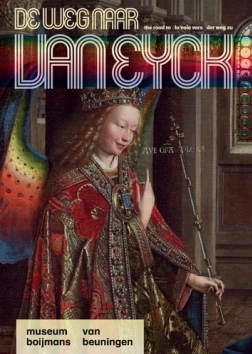
Exposition – The Road to Van Eyck

In the autumn of 2012, the extremely valuable and fragile works of one of Europe’s most brilliant painters, Jan van Eyck (Maaseik? c.1390 – Bruges 1441), have came to Rotterdam from all over Europe and the United States. Museum Boijmans Van Beuningen is showing the paintings of this artist, long considered the father of oil painting along side other masterpieces from other artist of this period.

In 2008 Museum Boijmans Van Beuningen organised the successful exhibition ‘Early Hollanders. Paintings from the Late Middle Ages’. The successor to this exhibition goes one step further back in history and ends with Jan van Eyck (c.1390-1441). The exhibition is an art-historical voyage of discovery and will present the only images we have of Holland in the early Middle Ages. Practically all the paintings that still exist from this period will be assembled in Rotterdam. This is the first time that all these paintings have been brought together. And because of their fragile condition, it will also be most likely the last time.

Paintings
The core of the exhibition will comprise panel paintings, complemented by a small by high-quality selection of sculptures, metalwork, illuminated manuscripts and drawings. The highlight of the exhibition will be a small group of paintings by Van Eyck and artists from his circle, including the restored ‘The Three Marys at the Tomb’. This is the first and – due to the fragility of the works – probably the last time that an exhibition on this subject will be held.

Funding
Museum Boijmans Van Beuningen would like to thank the following foundations, companies and private individuals, whose enthusiastic and generous support has made ‘The Road to Van Eyck’ exhibition possible: the Turing Foundation, Robeco, BankGiro Loterij, Cultural Heritage Agency of the Netherlands, SNS REAAL Fonds, VSBfonds, Prins Bernhard Cultuurfonds (thanks, in part, to the Breeman Talle Fonds), Aon Artscope, Unilever, Nedspice, Ploum Lodder Princen, Shell, Blockbusterfonds and Thalys. A campaign has been launched on the initiative of private individuals to support this exhibition, to which you are also welcome to contribute. For further information about the ‘Van Eyck Circle’, please visit www.boijmans.nl/dekring.

Catalogue
For this exhibition a catalogue was made. The Road to van Eyck exhibition catalogue presents more than 90 masterpieces of Netherlandish, French and German art from around 1400. The richly illustrated catalogue sheds light on what and who inspired the renowned painter Jan van Eyck (c. 1390 – 1441). You can order the catalogue here.

Please note: a surcharge of € 4,00 applies on the exhibition ‘The Road to Van Eyck’
Publié dans Exposition | Laisser un commentaire

Appel à contribution – Iconology Old and New. Transregional Conference on the Move Croatia and Hungary

Iconology Old and New (Transregional CONF, Croatia/Hungary, 23-31 May 13)

Rijeka/ Budapest /Szeged

23-31 May 20122013

Deadline-CFP: 1 déc. 2012

The Center for Iconographic Studies, Faculty of Humanities, University of Rijeka
The School of History and Pasts Inc. of Central European University, Budapest
The Cultural Iconology and Semiography Research Group, University of Szeged

Organizers: Marina Vicelja (Rijeka), Attila Kiss (Szeged) and 
György E. Szönyi (Szeged and Budapest)
in association with:
Barbara Baert (Leuven) 
Nadia al-Baghdadi (Budapest)
Colum Hourihane (Princeton)

Part One: May 23-24 (Thursday-Friday) – University of RIJEKA 

Seventh International Conference of Iconographic Studies – Iconology at the Crossroads 
Invited keynote speakers: Xavier Barral i Altet (Venice), Hans Belting (Karlsruhe), Ann Michel Holly (Williamstown USA), Colum Hourihane (Princeton), Bianca Kühnel (Jerusalem), Alexei Lidow (Moscow)
Part Two: May 28-29 (Monday-Wednesday) – CEU, BUDAPEST
Current Theoretical Interfaces: Iconicity, Semiotics, Historicity 
Invited keynote speakers: Massimo Leone (Torino), WJT Mitchell (Chicago), Jolán Orbán (Pécs / Budapest), Roland Posner (Berlin)
Part Three: May 29-31 (Wednesday evening-Friday) – University of SZEGED
European Iconology East & West 5: Cultural Imageries of Body and Soul – Intermedial Representations of the Corporeal, the Psychic and the Spiritual 
Invited keynote speakers: Barbara Baert (Leuven), Ivan Gerat (Bratislava), Marina Warner (Essex / Abu Dhabi), Rowland Wymer (Cambridge)
Each part is independent, applicants can join them separately or in combination.
Send your application 1/ indicating your name and affiliation; 2/ with an abstract of max. 150 words to MARINA VICELJA for the Rijeka part and to GYÖRGY E. SZÖNYI for the Budapest and Szeged programs.
First application deadline is 1 December 2012, however early contacts are most encouraged.
Continuously updated information will be available on the conference website:
Publié dans Appel à contributions | Laisser un commentaire

Publication – Intermediate institutions in the county of Flanders in the Late Middle Ages and the Early Modern Era

éd. Georges Martyn, René Vermeir et Chantal Vancoppenolle
Bruxelles, Archives générales du royaume et archives de l’Etat dans les provinces, 2012, 178 p.
(Studia, 135)
This volume contains the proceedings of a conference held at University of Ghent in November 2010, during which nine scholars presented their recent (mostly doctoral) research on the composition, the competences and the functioning of the intermediate institutions in the County of Flanders, i.e. institutions situated between the local (towns, villages and seigniories) and the supra-regional or central level of the Burgundian-Habsburg composite state, like it was getting settled at the end of the fifteenth and beginning of the sixteenth centuries. The conference was organised by the Institute of Legal History of the Ghent Law Faculty (Georges Martyn) in collaboration with the Institute of Early Modern History of the Ghent Arts Faculty (René Vermeir) and the Ghent Department of the Belgian State Archives (Chantal Vancoppenolle). Contributions by Frederik Buylaert and Jonas Braekevelt, Sarah Castelain, Sylvie De Smet, Laurie Fréger, Simon Groenveld, Laurent Inghelbrecht, Klaas Van Gelder and An Verscuren.
Karel Velle
Opening address by the national archivist
René Vermeir
Introduction
Simon Groenveld
Dutch or Flemish ? The old and the new in the government of States Flanders (ca. 1572-1700)
Sylvie De Smet
A matter of give and take. The Chief College of the Castellany Land van Waas and the state building process in the Southern Netherlands in the sixteenth and seventeenth centuries
Laurent Inghelbrecht
The general assembly of the liberty of Bruges (1505-1770)
Frederik Buylaert et Jonas Braekevelt
Rural political elites and social networks in late medieval Flanders : the Castellany of Furnes
Klaas Van Gelder
The Estates of Flanders manning the barricades for territorial integrity : the protest against the Barrier Treaty of 1715
An Verscuren
The interactions between the Council of Flanders and the Great Council of Malines in the eighteenth century
Laurie Gréger
The bailliage et siege présidialof Ypres. A French intermediate institution in Flemish Flanders (1693-1713)
Sarah Castelain
The University of Douai. From judicial independence to assimilation with royal justice (1562-1749)
Publié dans Publications | Laisser un commentaire

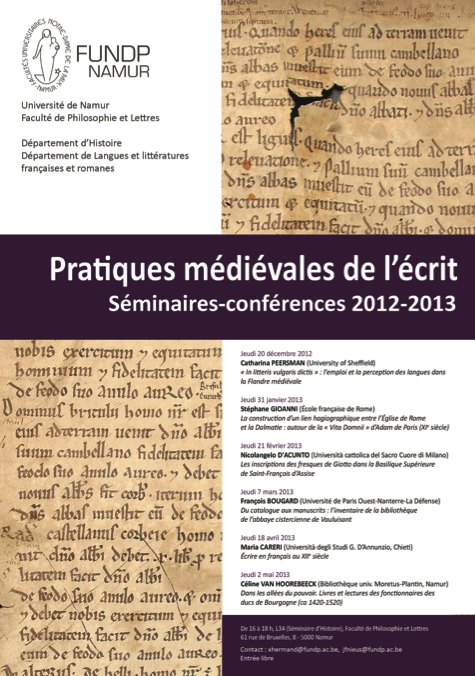
Conférences – Pratiques médiévales de l’écrit. Séminaires-conférences 2012-2013

Créé en 2011, le Centre de recherche « Pratiques médiévales de l’écrit » réunit les médiévistes de l’Université de Namur (enseignants, chercheurs, doctorants et post-doctorants) qui s’intéressent à la problématique multiforme de l’écrit au Moyen Âge, ainsi qu’une vingtaine de membres associés belges et étrangers. Son objectif principal est de promouvoir les collaborations à tous niveaux dans ce secteur de la médiévistique occidentale actuellement en plein essor, grâce à des initiatives de coordination et de décloisonnement de la recherche, qui passent notamment par l’organisation de colloques, de conférences et d’ateliers de recherche interdisciplinaires.


Programme :
Jeudi 20 décembre 2012
Catharina Peersman (University of Sheffield)
« In litteris vulgaris dictis » : l’emploi et la perception des langues dans la Flandre médiévale

Jeudi 31 janvier 2013
Stéphanne Gioanni (École française de Rome)
La construction d’un lien hagiographique entre l’Église de Rome et la Dalmatie : autour de la « Vita Domnii » d’Adam de Paris (XIe siècle)

Jeudi  21 février 2013
Nicolangelo D’Acunto (Università cattolica del Sacro Cuore di Milano)
Les inscriptions des fresques de Giotto dans la Basilique Supérieure de Saint-François d’Assise

Jeudi 7 mars 2013
François Bougard (Université de Paris-Ouest-Nanterre-La Défense)
Du catalogue aux manuscrits : l’inventaire de la bibliothèque cistercienne de Vauluisant

Jeudi 18 avril 2013
Maria Careri (Università degli Studi G. D’Annunzio, Chieti)
Écrire en français au XIIe siècle

Jeudi 2 mai 2013
Céline Van Hoorebeeck (Bibliothèque universitaire Moretus-Plantin, Namur)
Dans les allées du pouvoir. Livres et lectures des fonctionnaires des ducs de Bourgogne (ca 1420-1520)

Informations pratiques :
Les séances se tiendront de 16h00 à 18h00 au Séminaire Histoire de la Faculté de Philosophie et Lettres des FUNDP. Adresse : 61, rue de Bruxelles, B – 5000 Namur. Contact : xhermand@fundp.ac.be ou jfnieus@fundp.ac.be. Entrée libre.
Publié dans Colloque | Laisser un commentaire

Offre d’emploi – Postdoctoral Fellowship, The Max Planck Institute (Berlin)

The Max Planck Institute for the History of Science in Berlin, Department II (Prof. Lorraine Daston), announces one Postdoctoral fellowship for two years with possibility of renewal for a third year, starting date 01 September 2013.

The fellow will join the MPG Minerva Research Group “Reading and Writing Nature in Early Modern Europe” lead by Dr. Elaine Leong. The group is part of Department II at the Max Planck Institute for the History of Science, and is connected to the project “The Sciences of the Archive.” Further details concerning the project may be found at : 

They particularly welcome applicants whose research contributes to the working group project ‘Testing Drugs and Trying Cures in Early Modern Europe’ :

Other possible topics include:
  • Cultures (material, social and intellectual) of selecting, collecting, preserving, classifying, and transmitting knowledge and, in particular, notebooks and paper technologies
  • Histories of reading (e.g. investigations of reading practices and histories of book collections and libraries)
  • Histories of book production including publishing and print, scribal publication and translation practices.

The Max Planck Institute for the History of Science is an international and interdisciplinary research institute (http://www.mpiwg-berlin.mpg.de/en/index.html). The colloquium language is English; it is expected that candidates will be able to present their own work and discuss that of others fluently in that language. Candidates should hold a doctorate in the history of science, history of medicine or related field at the time the fellowship begins.

Outstanding junior scholars are invited to apply. Fellowships are endowed with a monthly stipend between 2.100 € and 2.500 € (fellows from abroad) or between 1.468 € and 1.621 € (fellows from Germany). Candidates of all nationalities are welcomed to apply; applications from women are especially welcomed. The Max Planck Society is committed to promoting more handicapped individuals and encourages them to apply.

Applications should be submitted in English. Candidates are requested to send a curriculum vitae, publication list, research prospectus (maximum 750 words), a sample text, and two letters of recommendation no later than January 15, 2013.

to:
Max Planck Institute for the History of Science
Administration, PD-II-Minerva
Boltzmannstraße 22
D-14195 Berlin, Germany

Electronic submission is also possible: rheld@mpiwg-berlin.mpg.de. For questions concerning the research project and Department II, please contact Dr. Elaine Leong (eleong@mpiwg-berlin.mpg.de); for administrative questions concerning the position and the Institute, please contact Claudia Paaß (mailto: paass@mpiwg-berlin.mpg.de), Head of Administration, or Jochen Schneider (jsr@mpiwg-berlin.mpg.de), Research Coordinator.
Publié dans Offre d'emploi | Laisser un commentaire

Appel à contribution – Arthur, la mer et la guerre

Un colloque européen se tiendra du jeudi 22 au samedi 24 mai 2014 à Boulogne-sur-Mer. Le colloque s’articulera autour des trois grands blocs thématiques et chronologiques détaillés ci-dessous. Il permettra de confronter les travaux d’archéologues, d’historiens, de philologues, d’historiens de l’art, de spécialistes de littérature anglaise et française, médiévale autant que contemporaine, ainsi que de spécialistes du cinéma ou de la bande dessinée. Cet appel à communications se veut large et sans exclusive : n’hésitez pas à le diffuser le plus largement, y compris à l’étranger. Le français et l’anglais seront les langues de travail du colloque. 


La mer et la guerre à « l’Âge d’Arthur » (300-700)

Dans un premier temps, historiens et archéologues seront sollicités pour faire le point sur la guerre sur mer, l’organisation des défenses côtières et l’articulation stratégique terre-mer dans l’Antiquité tardive et le très haut Moyen Âge, à la fois dans l’île de Bretagne et dans les régions côtières avoisinantes. Quel type de marine et de défenses côtières auraient pu être celles d’un chef de guerre ou d’un roi breton dans la période s’étendant de l’usurpation de Carausius jusqu’à la fin des migrations anglo-saxonnes ?

C’est en effet au cœur de cette période qu’Arthur pourrait avoir vécu. Même si les textes les plus anciens (Historia Brittonum, Annales Cambriae) ne font jamais mention d’une activité maritime du héros, son activité est placée par ces auteurs dans le cadre d’un conflit entre des populations insulaires, les Bretons, et des populations d’envahisseurs venus de la mer, les Saxons. Le cas de Riothamus, le roi breton combattant sur le continent mentionné à la fois par Sidoine Apollinaire et par Jordanès, et que Geoffrey Ashe a (sans doute à tort) identifié à Arthur, pourra ainsi être réexaminé. On pourra aussi se pencher sur les figures de Magnus Maximus et de Constantin III, retenues par certaines versions de la légende arthurienne, chez Geoffroy de Monmouth ou en milieu gallois.

Parmi les thèmes abordés, on pourra aussi retenir l’organisation du Litus Saxonicum, les ports de la région (dont bien entendu Boulogne) avant l’émergence de Quentovic au VIIe siècle, les ravages des pirates francs et saxons sur les côtes bretonnes et gauloises avant et après le retrait des légions romaines de Bretagne, l’engagement de mercenaires ou fédérés saxons, et de manière générale les migrations à but guerrier autour de l’île de Bretagne.


La mer et la guerre dans la littérature arthurienne médiévale (1000-1500)

Dans les premiers textes en langue brittonique (dès les environs de l’an 1000), Arthur ne semble que modérément lié à la mer : il la traverse néanmoins pour se rendre en armes dans l’Autre Monde, il est lié à l’île d’Avalon, et il pourrait être intéressant de proposer à des celtisants d’explorer ces questions.

Mais à partir de l’œuvre de Geoffroy de Monmouth (1136), un épisode majeur de la geste arthurienne consiste en sa campagne contre le roi romain Lucius, campagne qui nécessite des allers-retours de part et d’autre de la Manche, surtout après la rébellion de son neveu Mordred. La campagne contre Lucius et la trahison de Mordred sont une constante du récit de la fin d’Arthur depuis Geoffroy jusqu’à Malory en passant par le cycle de la Vulgate. Ainsi, dans la Mort le roi Artu, c’est à Douvres, au retour de la campagne continentale, que meurt Gauvain. Comment se déroulent ces campagnes que l’on pourrait a priori dire « amphibies », puisqu’elles combinent forces terrestres et navales ? Le roi Arthur a-t-il une marine ? Comment s’en sert-il ? La dimension maritime de ces campagnes est-elle seulement abordée par les textes ? Se bat-on sur mer, ou fait-on le siège de places portuaires ?

Les îles et les territoires ultra-marins sont très présents dans la matière de Bretagne. Comment les chevaliers traversent-ils la mer ? Est-ce en armes et pour faire la guerre ? Comment ces traversées sont-elles représentées dans les miniatures des manuscrits arthuriens du Moyen Âge ?

Dans une perspective plus historique, on pourra aussi se pencher sur les rapports entre légende arthurienne et stratégie militaire et navale. Au temps des croisades et des passages outre-Mer, comment la matière arthurienne est-elle utilisée par les gouvernants ? On sait ainsi que Richard Cœur de Lion céda au roi Tancrède de Sicile l’épée Excalibur en échange de navires pour sa croisade : cet épisode et d’autres semblables pourront être étudiés.

On s’interrogera aussi sur l’existence d’une temporalité dans le traitement maritime de la guerre arthurienne et sur son devenir dans les réécritures des XIVe-XVIe siècles, en français comme dans d’autres langues : certains textes tardifs comme Isaïe le Triste ouPerceforest présentent en effet des épisodes de guerre sur mer, voire de bataille navale. La guerre sur ou via la mer est-elle plus présente dans ces récits contemporains des traversées guerrières d’Édouard III ou d’Henri V ?


La mer et la guerre dans la production arthurienne contemporaine (XIXe-XXIe siècle)
Le roman historique anglophone de la fin du XXe siècle s’était approprié le travail des historiens et surtout des archéologues médiévistes (Leslie Alcock, John Morris) pour recréer l’image d’un Arthur « guerrier des Âges obscurs », se voulant en général fidèle à la réalité « historique » elle-même construite par ces savants des années 1950-1980. Dans cette production littéraire, la mer et la guerre sur mer occupent parfois une place importante, et nous nous pencherons sur ce sujet ; mais qu’en est-il d’œuvres plus récentes ?

Il serait aussi intéressant d’aborder la place de la mer dans la littérature contemporaine présentant une inspiration arthurienne directe ou indirecte (heroic fantasy, littérature pour enfants, etc.), mais aussi dans le cinéma, dans l’opéra, et dans de nombreux autres modes d’expression artistique, en particulier ceux qui tiennent à la culture populaire (bande dessinée, illustration), ayant puisé à la matière arthurienne. Le phénomène du re-enactment pourra aussi être abordé.


Organisateurs du colloque :

Alban GAUTIER (Histoire médiévale, ULCO) ; Marc ROLLAND (Littérature anglaise, ULCO) ; Michelle SZKILNIK (Littérature française, Paris III)


Pour répondre à cet appel à communications :

Vous pouvez adresser vos propositions de communications jusqu’au 31 janvier 2013 à Alban Gautier (alban.gautier@univ-littoral.fr), en précisant votre nom, votre affiliation, le titre proposé pour votre communication, ainsi qu’un résumé d’une demi-page environ.
Publié dans Appel à contributions | Laisser un commentaire

Colloque – "Héritages". Cinquièmes Universités d’Hiver de Saint-Mihiel

« Héritages ». Cinquièmes Universités d’Hiver de Saint-Mihiel
Saint-Mihiel (France), Abbaye bénédictine
7-10 novembre 2012

Programme :

Mercredi 7 novembre – Après-midi, à partir de 14 heures

Démonstration de calligraphie

Exposition « Ex-libris et marques de propriété »,
à la bibliothèque bénédictine


Jeudi 8 novembre – Matin, de 10 heures à 12 heures

Géographie, Histoire ancienne et médiévale

Harmand Dominique (CERPA) – Les héritages morphologiques en Meuse
Corbiau Marie-Hélène (Facultés universitaires Notre-Dame de la Paix à Namur) et Yante Jean-Marie (Université catholique de Louvain) – Héritage romain et créations médiévales ; à propos d’itinéraires routiers lorrains et luxembourgeois
Blanchard Jean-Christophe (Centre de Médiévistique Jean Schneider) – Nicolas de Heu et la notion d’héritage au miroir de son recueil généalogique
Bouyer Mathias (CRULH) – La succession du duc de Bar Robert Ier : de la simplicité aux difficultés imprévisibles
Muller Vianney (HISCANT-MA ; UL) – De l’individu au lignage : héritages et transmissions dans la maison de Neufchâtel-Bourgogne (XIIIe-XVIe siècle)

Après-midi, de 14 heures à 17 heures
Histoire de l’Art

Bouchot Juliette (Lille 3) – Le mécénat artistique sous les ducs de Bar et de Lorraine : étude sur les sculptures conservées
Klein Benoît (UL), Vitoriano Garcia, Laurent Pflughaupt – Les écritures de la Renaissance et leurs héritages
Franz Thierry – Héritages et décors mobiliers : une approche de l’histoire du goût sous Léopold et François III de Lorraine (1698-1737)
Lebasch Sarah (Université Lille 3, laboratoire IRHIS, CNRS UMR 8529) – Garde-robe héritée, garde-robe transformée. Échanges et transmission à la cour de Lorraine

Visite guidée de la bibliothèque bénédictine


Vendredi 9 novembre – Matin, de 9 heures à 12 heures

Héritages des périodes anciennes et modernes

Bérenger Agnès (CRULH) – L’héritage de l’Egypte pharaonique et lagide dans l’administration romaine en Egypte sous le Haut-Empire (Ier siècle av. J.-C.-IIIe siècle ap. J.-C.)
Simiz Stefano (CRULH) – Réactualiser un héritage religieux : Verdun cité de Marie d’après le manuscrit du chanoine Baleycourt (BM Verdun)
Maes Bruno (CRULH) – Les livres de pèlerinage du XVIIe siècle, médiateurs de la spiritualité du concile de Trente ?
Jalabert Laurent (CRULH) – L’empreinte militaire en Lorraine: l’exemple de Saint-Mihiel
Léonard Julien (CRULH) – L’héritage huguenot à Metz aux XVIIIe et XIXe siècles.
Voisin Amélie (Université Lyon 2) – François-Etienne de Lorraine (1708-1765): un héritier ambigu, un héritage méconnu ? 

Après-midi, de 14 heures à 17 heures
Héritages contemporains

Martischang François-Xavier (CRULH) – La discorde en héritage. Le discours sur la crise de l’autorité de l’Etat dans la France du XIXe siècle
Logie Etienne (CRULH) – Les héritages de Darwin : de la théorie de l’évolution aux premières sciences humaines.
Streiff Karine (CRULH) – De la veille de la Grande Guerre à la fin de la Reconstruction, les Héritages des Communautés Rurales Meusiennes : transmissions, permanences et adaptations.
Roth François (CRULH) – Les héritages de l’annexion allemande en Moselle de 1918 à nos jours 


Samedi 10 novembre – Matin, de 9 heures à 12 heures

Héritages contemporains (suite)

El Gammal Jean (CRULH) – Héritages politiques et territoires électoraux en Lorraine de 1945 à nos jours
Audigier François (CRULH) – Un exemple d’héritage politique et de ses limites : que reste-t-il des années de militantisme dans une organisation de jeunesse ? L’exemple des cadets gaullistes de l’UJP dans les années 1980, 1990 et 2000
Metzger Chantal (CRULH) – Les héritages de la RDA dans les nouveaux landers
Schopfel Ann-Sophie (CRULH) – L’héritage du conflit sino-japonais en Asie du Sud-est
Andriot Cédric (CRULH) – La tentative de récupération de l’héritage de Pierre Fourier par deux congrégations au XIXe siècle (clercs de Notre Sauveur et chanoines de Latran)
Publié dans Colloque | Laisser un commentaire

Offre d’emploi – Call for PhD Research Fellow at the University of Leuven (KU Leuven – Belgium)

Call for PhD Research Fellow at the University of Leuven (KU Leuven – Belgium), Department of Art History/ Illuminare – Centre for the Study of Medieval Art
Thursday, 18 October 2012

For the period 1 February 2013 – 31 January 2014
In relation to the project: In Search of Utopia, 1516-2016
Funding will be provided by the Veronique Vandekerchove Chair of the City of Leuven (KU Leuven)

With the following project outline:
Between 5 October 2016 and 15 January 2017 a major international loan exhibition is planned at M – Museum Leuven (Belgium) entitled In Search of Utopia, 1516. The exhibition is organized by the KUnST Leuven Foundation, M – Museum Leuven, and Illuminare – Centre for the Study of Medieval Art (University of Leuven). The curator of the exhibition and promoter of the research project is Prof. dr. Jan Van der Stock of the University of Leuven.

In 2016 it will be 500 years since Thomas More published his Utopia in Leuven with printer-publisher Dirk Martens. This anniversary is the occasion for the City of Leuven and the Leuven University to organize a prestigious exhibition which will illustrate several aspects of the exploration of ‘the world around 1516’.

Although the project starts with a tangible historical fact in Leuven – the first edition of the Utopia (1516) – the ‘search for Utopia’ is viewed from a broader perspective. Not only is the intellectual and cultural context in which the publication was created examined, but also the West’s particular fascination with distant, alien worlds. The image of the Earthly Paradise and a diversity of ideal dream worlds such as the Golden Age, the hortus conclusus, the Garden of Delights, the Land of Cockaigne and the representation of the New World are discussed in detail. The early 16th century’s artistic and playful search for the ideal human form and the perfectibility of man rounds off the quest. Was the dream ever within reach?

Chronologically, the exhibition spans the period from the end of the Middle Ages to approximately the middle of the sixteenth century. The horizons are Western Europe and the Western European world views. Illuminare – Centre for the Study of Medieval Art (KU Leuven) seeks a scholar to prepare a PhD on Northern Renaissance art from the first half of the 16th century in relation to the In Search of Utopia, 1516-2016 project.

The scholarship is destined for those with a university degree (MA) in Art History (Middle Ages – Early Modernity) whose areas of interest lie in research into Northern Renaissance art, the history of the Utopia, Thomas More, the history of the 16th century, exoticism, the ideal city, utopia-dystopia, …

The candidate will reside periodically in Leuven, Belgium. The In Search of Utopia, 1516-2016 project is supported by the Veronique Vandekerchove Chair of the City of Leuven (KU Leuven).

Funding will be provided by the Chair for the first year of the PhD project. During this year the candidate will have the opportunity to outline the project in order to apply for other grants.

All candidates are requested to send in the standard application documents (Curriculum Vitae, copies of degree certificates, a list of publications, two letters of reference from university/college lecturers) as well as a brief outline of their research project (max. 3 pages, plus timetable and bibliography) by 1 December 2012 to (e-mail is sufficient):

Prof. dr. Jan Van der Stock
Illuminare – Centre for the Study of Medieval Art (KU Leuven)
Faculty of Arts Room 04.11
Blijde Inkomststraat 21 – box 3313
B-3000 Leuven
Phone: +32 (0)16 32 48 70
For further information on the project: 
Publié dans Offre d'emploi | Laisser un commentaire

Conférence – Région Antiochienne : sites archéologiques chrétiens

Mercredi 14 novembre 2012, à 17 h
Louvain-la-Neuve, Place du Cardinal Mercier, UCL, Auditoire SOCR 25 
Conférence donnée par le Prof. A. Badwi, directeur de l’institut d’Art Sacré de l’Université Saint-Esprit de Kaslik (Liban) : Région Antiochienne : sites archéologiques chrétiens

Organisée par le Centre d’études orientales – Institut Orientaliste de Louvain (CIOL) et l’A.S.B.L « Les Amis du Proche-Orient »

Publié dans Colloque | Laisser un commentaire