Prix Jacques Lavalleye-Coppens

Le Prix Jacques Lavalleye-Coppens est destiné à récompenser l’auteur ou les auteurs belges ou étrangers du meilleur travail (imprimé ou manuscrit) consacré à une ou à des questions relatives à l’archéologie ou à l’histoire de l’art des anciens Pays-Bas méridionaux et des anciennes principautés ecclésiastiques de Liège et de Stavelot. 

Le Prix est doté d’un montant à déterminer (3.000 euros en 2008). La date limite de dépôt des candidatures est fixée au 30/06/2012. Veuillez trouver ci-jointe une présentation succincte de l’annonce. Pour davantage de renseignements, nous vous invitons à visiter le site web de l’organisme et à le contacter si nécessaire.
Publié dans Prix | Laisser un commentaire

Offre d’emploi – Academic Assistant : Digitisation of the Corpus of Italian Medals in British Collections

One year, Fixed-term, 0.5FTE

Description of Post  
The Warburg Institute has received a Grant from the Kress Foundation to digitise and make available online the Corpus of Italian Medals in British Collections, a collection of c. 4000 black and white photographs assembled in the 1970s.  The corpus spans from the 15th to the 18th century and is divided in two sets: Italian Medals and Papal Medals. We are now seeking to appoint an Academic Assistant to work half time on this project for one year. 
The Main Duties of the post will be entering digitised images into the on-line Warburg Institute Iconographic Database and providing metadata for these images. Part of the data is already available in the folders of the corpus and will have to be checked and consolidated against more recent catalogues. 
The Academic Assistant should hold at least an MA in Art History.  A sound knowledge of art history, particularly the iconography of European art, will be required as well as a knowledge of Italian and some Latin. Familiarity with medals, emblems and portraiture will be an advantage. High level IT skills are also essential. 
The Academic Assistant will be based at the Institute and work under the direction of Dr François Quiviger and in close collaboration with the team of staff currently working on the digitisation of the Institute’s Photographic Collection. It is essential that the person appointed is able to act independently as well as work effectively as part of a team.
Conditions of Appointment
 
This is a one year fixed-term, part- time appointment (17.5 hours per week) to commence as soon as possible. The appointment will be made to Level 06 (Administration, Management and Professional), point 24 of the University of London pay scale. The current salary is £13,692.50 per annum, a pro rata calculation of £27,385 per annum (including £2,134 London Weighting). Deductions from salary for National Insurance contributions will be made at the statutory contracted-out rate. Salary is payable in arrears no later than the last day of each month by bank transfer. 
The person appointed will be entered automatically as a member of the Universities Superannuation Scheme (USS) and will be required to make such contributions as are determined from time to time under the rules of this Scheme. If, once full information on the Scheme has been received, the person decides to withdraw from the Scheme, the decision must be confirmed in writing. 
The appointment will be full-time. The person appointed will work for 17.5 hours per week during Institute opening hours according to a rota to be determined. The Institute’s opening hours are 10 a.m. to 6 p.m. on Mondays, Wednesdays and Fridays; 10 a.m. to 8 p.m. on Tuesdays and Thursdays during term-time or 10 a.m. to 6 p.m. during vacations. The Institute is open from 10 a.m. to 4 p.m. on Saturdays; you will be required to work from 10a.m. to 1p.m. on one Saturday in four. No other paid work may be undertaken without permission of the Director. 
The appointment is terminable by three months notice in writing on either side. The appointment will be probationary for a period of three months. 
The leave entitlement for a full year is six weeks (30 working days) in addition to public holidays and Institute closures. For this one year 0.5FTE appointment the leave entitlement will therefore amount to 15 days in addition to public holidays and Institute closures. The Institute is normally closed for one week at Easter. Holiday periods are to be approved in advance by Dr Quiviger. 
The appointment will be subject to the Terms and Conditions for Administrative, Management and Professional Staff of the University of London. 
Sick leave will be in accordance with the scheme in force for staff within the University. Full details are available from the Institute Manager. 
Disciplinary matters will be dealt with by the Director in the first instance in accordance with the scheme in force for staff within the University. 
Employees have the right to belong to a Trade Union, to take part in its activities and to seek and hold office. The appropriate Trade Union is the Association of University Teachers.
The University is an Equal Opportunities employer.
Method of application
There is no application form. Applications should be made by letter addressed to Miss C E Charlton, Institute Manager, The Warburg Institute, Woburn Square, London WC1H 0AB and should include an up-to-date curriculum vitae with the names and address of two referees. 
Applicants are also asked to download an Equal Opportunities form from the Institute’s website, which they should complete and send in along with their application. Click here to download the form (rtf 40 kb)
 
The closing date for receipt of applications is Friday 25 May.  Interviews will be held in early June.
 
Any further enquiries should be addressed to Dr Quiviger (Francois.Quiviger@sas.ac.uk) 
Publié dans Offre d'emploi | Laisser un commentaire

Appel à contribution – Images of the power in the italian middle ages

Incontri, Rivista Europea di Studi Italiani
Thematic Issue 2013/2

In 2013, Incontri’s editorial board aims to publish a thematic issue about the Italian Middle Ages (from circa 500 to circa 1500).
In this issue, attention will be given to the various forms of power on stage of the Italian peninsula in the Middle Ages – a time when kings, emperors and popes vied for control over parts of the territory, while scattered, autonomous city-states emerged.
These political leaders appealed to a wide range of cultural instruments in order to legitimize their power and to flourish. To assist their agendas, chronicles were filled with heroic deeds and political theories that supported the hegemonies were spun. Artists were employed to visually support the legitimacy of claims on a particular area, or to represent an illustrious, noble lineage. Important buildings were erected to manifest and indicate centers of power. These public places offered platforms for politically motivated parades and other rituals and spectacles.
Power was not exclusively exercized in a purely masculine domain. The Italian Middle Ages offered a rich array of distinguished women of power. Moreover, the right to power rarely remained uncontested. Indeed, medieval literature is littered with acrimonious, sometimes cleverly veiled, criticism of the leaders of the moment.
In conclusion, the theme proposed by Incontri, highlighting the relationship between medieval politics and culture, offers ample space for a wide range of contributions from different departure points, such as (art) historical, literary and archaeological perspectives. Additionally, the editorial board also welcomes contributions such as reflections on the use of medieval images, symbolism or rhetoric in modern Italian political agendas (e.g. Fascism or Lega Nord).
The editors invite interested authors to submit a concise proposal in Dutch, Italian or English (maximum 250 words) to David Napolitano (dphn2@cam.ac.uk) by June 1, 2012. Selected authors are requested to adhere to the editorial guidelines, to be found on: www.rivista-incontri.nl.
Publié dans Appel à contributions | Laisser un commentaire

Séminaire – Perception and Performance of Social Identity in the Nascent Urban Societies of the High Middle Ages

This informal workshop, centered around research in progress, is organised as part of the activities of a VLAC fellowship cluster at the Flemish Academic Centre for Science and the Arts (Feb.-June 2012) and as an introductory meeting of a new FWO-project (Ghent University, 2012-15) on the same topic.
Programme :
13.30h: Introduction / Inleiding
13.40h: Jeff Rider (Wesleyan University, CT) – Who Lived in Bruges in 1127-28?
14.30h: Jan Dumolyn (Ghent University) – Was There a Commune in the Bruges of Galbert?
15.20h: Jeroen Deploige (Ghent University) – A Ship on Wheels in St Trond, 1135. Wage Labour, Heresy and the Performance of Social Identity in the Long Twelfth Century
16.10h: Walter Simons (Dartmouth College, NH) – Slander! Naming Beguines in the Southern Low Countries, 1200-1250
17.00h: Drink

Informations pratiques :
 Brussel, Thursday 10 May 2012

Venue: Paleis der Academiën – Stevinzaal
Hertogstraat 1
1000 Brussel

How to get there? See: http://www.kvab.be/contact.aspx

If you would like to participate in the workshop, please register your attendance by contacting Jeroen Deploige (jeroen.deploige@ugent.be) in order to the receive the preparatory reading materials (excerpts of sources, draft chapter etc.).

Publié dans Le réseau | Laisser un commentaire

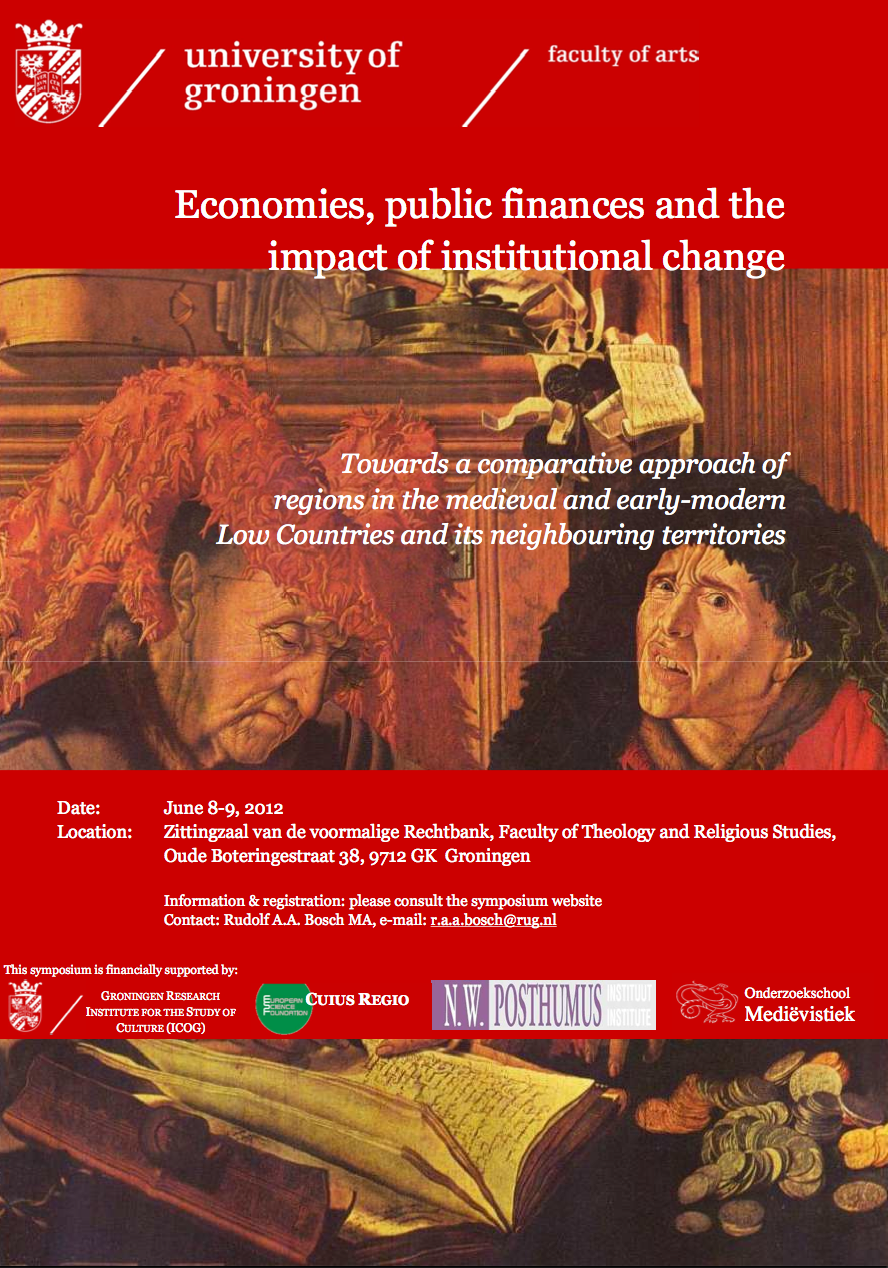
Colloque – Economies, public finances and the impact of institutional change


Towards a comparative approach of regions in the medieval and early-modern Low Countries and its neighbouring territories

Rijksuniversiteit Groningen, 8-9 juni 2012

The recent publication of Bas van Bavel’s book Manors and markets, which provides an overview and a new interpretational framework of the social and economic history of the medieval Low Countries, has already evoked quite some debate. One of the main issues in this debate is whether differences in the socio-institutional arrangements (institutions like markets, property structures and socio-political power relations to name but a few) within pre-modern society can solely (or primarily) account for the divergent paths of economic development and the momentum of relative socio-economic growth and decline or stagnation which different regions within the Low Countries have witnessed during the late middle ages and early-modern period. Some scholars argue that Van Bavel has marginalized some of the more « traditional » explanatory factors, such as geography, demography, urbanization, technological development, capital accumulation, commercialization and trade networks and politico-economic systems as main factors or « prime movers » for economic developments in the Low Countries. In order to get to grips with these problems new research into the regional differences in both institutional and macro-economic developments should be conducted on a comparative basis, in which both central and more peripheral regions are studied equally, thus creating a much wider array of case studies which in turn can provide a much more diverse and articulated overview of regional differences (as well as similarities) within the Low Countries and its neighbouring territories.
Although the regional approach of the socio-economic history of the Low Countries now seems widely accepted among historians, so far a more comparative approach of regions has never really had a platform on which scholars can present their findings and integrate them into an ever growing body of knowledge on regional divergence of both institutions and socio-economic structures. By organizing this symposium we want to stimulate this development and create a podium on which research into economic development, socio-political structures and institutions from different regions within (or on the fringes of) the Low Countries can be presented and discussed in-depth, and to create useful comparisons between these case-studies, both chronologically, geographically as well as thematically.
The main theme of this symposium is the way and the degree to which differences in economic systems and their relative development and the impact of institutional change affected the political economy and fiscal systems of regions, or vice versa. One main problem which has to be tackled is the non-convergence of economic regions, socio-political networks, political borders and even fiscal systems. And in line with this problem: what to think about the question whether a set of variables is supra-regional, interregional, regional, local or even a mix of these? Furthermore, the almost exclusive focus of research on Flanders, Brabant and Holland brings with it a possible neglect of less dominant economic regions in the Eastern Low Countries and adjacent German territories. The question is whether the generalizing effects of the application of a « Flandro-Hollandocentric model » of economic, financial and institutional development as pars pro toto for the whole Low Countries deepens or actually threatens our understanding of the regional divergence in the interaction between economic and institutional developments? 
Programme : ici
June 8, 2012
11:00 – 11:30 
Reception 
11:30 – 11:40 
Prof. Dr. Catrien Santing – Introduction
11:40 – 12:00 
Dr. Marjolein’t Hart (University of Amsterdam) – Status questionis on state formation processes in the late Middle Ages and early modern period 
12:00 – 12:20 
Prof. Dr. Peter Hoppenbrouwers (Leiden University) – Socio-economic development in the medieval Low Countries: a comparative overview of long-term developments 
12:30 – 13:30 
Lunch 
13:30 – 18:00 
Session 1: Economy and social structures (chair: prof. dr. Dick E.H. de Boer) 
13:30 – 14:15 
Prof. Dr. Peter Stabel & Prof. Dr. Tim Soens (University of Antwerp) – Town in the countryside: Textile and agriculture around Ypres and Hondschoote in the late Middle ages and the 16th century 
14:15 – 15:00 
Dr. Job Weststrate (University of Groningen) – The institutional structures of river trade in the Lower Rhine region in the sixteenth and seventeenth centuries 
15:00 – 15:30 
Tea-break 
15:30 – 16:15 
Dr. Jord Hanus (University of Antwerp) – Living standards and real inequality in diverging economies: Brabant and Holland between 1500 and 1900 
16:15 – 17:00 
Drs. Bert Thissen (Stadtarchiv Kleve) – Regional dynamics of the urban brewing industries in Cleves and Guelders in the late Middle Ages and early-modern period
17:00 – 17:30 
General discussion session 1 
June 9, 2012
09:00 – 12:30 
Session 2: Socio-political structures (chair: prof. dr. Raingard Esser) 
09:00 – 09:45 
Prof. Dr. Marc Boone (Ghent University) – The introduction of the French model of Rekenkamers in the Burgundian Low Countries 
09:45 – 10:30 
Dr. Kees Verkerk (Amsterdam) – Social dichotomy in towns and its implications for the management of towns and principalities 
10:30 – 11:00 
Coffee-break 
11:00 – 11:45 
Prof. Dr. Jelle Haemers (Katholieke Universiteit Leuven) – A financial revolution in Flanders? Fiscal innovation, urban resilience and public debt in the 1480s
11:45 – 12:15 
General discussion session 2 
12:30 – 13:30 
Lunch 

13:30 – 17:30 
Session 3: Political economy & financial systems (chair: dr. Remi van Schaïk) 
13:30 – 14:15 
Dr. Jaco Zuijderduijn (Utrecht University/Geldmuseum Utrecht) – Medieval practice? The community responsibility system and foreign public debt in the Northern Low Countries 
14:15 – 15:00 
Rudolf Bosch MA (Groningen University) – Path-dependency or path-persistency? Urban finances, fiscal systems and urban public debt in the Eastern Netherlands and the Lower Rhine area (14th-16th centuries). 
15:00 – 15:30 
Tea-break 
15:30 – 16:15 
Dr. David Kusman (Université Libre de Bruxelles) & Dr. Jean-Luc Demeulemeester (Solvay Business School, Université Libre de Bruxelles) – New evidence on the circulation of financial instruments in the late-medieval Low Countries: from Lombard letters of obligation to transferable life-annuities (Brabant, Guelders, Flanders and Hainaut, ca. 1260-1355) 
16:15 – 16:45 
General discussion session 3 
16:45 – 17:15 
Prof. Dr. Wim Blockmans – Concluding remarks
17:15 – 18:30 
Drinks & departure 
N.B.: During the symposium, the majority of the presentations will be in Dutch. Discussions can be in either Dutch or English. 
Informations pratiques :
The symposium is meant to place the current debate on the interaction between economies, institutions and public finances in the late-medieval and early-modern Low Countries in a wider, regional comparative framework. 
Available places for this symposium are limited; registration via the online registration form on the symposium website
Organization: Rudolf A.A. Bosch MA & dr. Remi van Schaïk (University of Groningen) 
This symposium is financially supported by: Groningen Research Institute for the Study of Culture (ICOG), ESF-project ‘Cuius Regio’, the N.W. Posthumus Institute and the Onderzoekschool Mediëvistiek. 
Prior to the symposium, on Thursday afternoon, 7 June 2012 the Onderzoekschool Mediëvistiek organizes a Masterclass for Research Master and PhD students led by dr. Jord Hanus (University of Antwerp, Centre for Urban History), entitled ‘Regional comparisons of the interaction between economic and institutional developments’. For more information see the symposium website or contact the Onderzoekschool Mediëvistiek.


Publié dans Colloque | Laisser un commentaire

Appel à contributions – SMA PG Colloquium

The SMA Colloquium provides a platform for postgraduates and early career professionals to share their research

This year’s event will be held at Cardiff University, on the 8-9th November 2012. Over the two days there will be a wide-range of paper sessions, a poster session and a wine reception.

Call for Papers


The first call for papers is now open for the Society of Medieval Archaeology Student Colloquium, to be held at Cardiff University, 8-9th November 2012. The event aims to provide a platform for postgraduates and early career professionals to present and discuss their current research.

Papers from across the medieval period (5th-16th centuries AD) and from all geographical areas are welcomed. Papers from subjects other than archaeology, but which have a broader medieval significance, will also be considered. Abstracts for posters are also encouraged.

Abstracts should be written concisely in English (no more than 150 words) and submitted using the attached form. Please note that papers will be 20 minutes in length with a 10 minute discussion for each session.

Presentations will be restricted to postgraduates and early career professionals but we welcome posters from all medievalists.

Completed abstract forms should be sent to medieval.archaeology@googlemail.com. The deadline for all presentation and poster abstracts is Friday 7th September.

Please see the attached poster for more details, or email
medieval.archaeology@googlemail.com

NB: This conference will be held in English.

Registration

Details to follow shortly.

Getting there & Accommodation
Cardiff has an array of quality (and cheap!) accommodation, including hotels, hostels, guest houses and caravan parks, available within walking distance of the Humanities Building where the Colloquium will be hosted.

Cardiff is easily accessible from anywhere in the UK or overseas. It is served by several train stations and there is a national coach station located in the centre of the city. Cardiff has its own international airport and the city is in close proximity to Bristol International Airport. Birmingham, Manchester, Heathrow and Gatwick airports are easily accessible to Cardiff by train or coach. Cardiff is located in close proximity to several ferry ports and if you intend to travel by car it is easily reached on the national motorway system.

Information on how to get to Cardiff University can be found here. The Colloquium will be held in the School of History, Archaeology and Religion in the Humanities Building which is labelled on this map.

If you are intending on staying in Cardiff on the night of 9th November please note that there is an autumn international rugby match scheduled for Saturday 10th. On a match day Cardiff is a really exciting place to be with an exhilarating and friendly atmosphere however the city centre can become extremely busy with demand for accommodation and public transport significantly increasing. Therefore, if you intend to stay on the weekend, it is advisable to book your accommodation and plan your travel in advance.

Programme
The programme will be released in September.

Further info?
For any further enquiries contact the SMA Colloquium team at medieval.archaeology@googlemail.com
Publié dans Appel à contributions | Laisser un commentaire

Publication – Patrick Hoffsummer, "Les charpentes du XIe au XIXe siècle"

Voici une suite aux Charpentes de la France du Nord et de Belgique de 2002. Elle reprend la méthodologie visant à comprendre l’évolution des charpentes de toiture du XIe au XIXe siècle à travers une typo-chronologie basée sur une chronologie solide, notamment grâce à la dendrochronologie. L’aire visitée est un vaste « Grand Ouest », de la Normandie à l’Aquitaine, en passant par la Bretagne, les Pays de Loire et la région Centre. Le territoire est largement couvert – essentiellement grâce à la documentation de la Médiathèque de l’architecture et du patrimoine et en s’aidant de collaborations extérieures – mais de façon inégale car il fallait tenir compte d’impératifs pragmatiques et dresser un état de la question. Outre l’évolution des techniques, le lecteur découvrira différents aspects de l’art de la charpente en France, avec ses spécificités régionales. Plusieurs spécialistes apportent leurs lumières qu’ils soient historien de l’art, architecte, archéologue, ethnologue, ingénieur ou dendrochronologue.


Informations pratiques :
Patrick Hoffsummer, Les charpentes du XIe au XIXe siècle. Typologie et évolution, analyse de la documentation de la Médiathèque de l’architecture et du patrimoine, Turnhout, Brepols, 2012 (Architectura Medii Aevi, 5). XXVIII + 385 p., 338 b/w ill., 220 x 280 mm. ISBN: 978-2-503-54078-8. Prix : 70, 00 Euros.
Publié dans Publications | Laisser un commentaire

Offre d’emploi – Financements doctoraux en histoire (site de Limoges)

Divers financements doctoraux (contrat doctoral ou bourse régionale) d’une durée de trois ans sont ouverts au concours à l’Université de Limoges pour effectuer une thèse dans le domaine des sciences de l’homme et de la société à compter de la rentrée de l’année universitaire 2012-2013. Un (ou plusieurs) projet(s) est (sont) susceptible(s) d’être attribué(s) pour réaliser une thèse d’Histoire au sein du CRIHAM.

Le laboratoire CRIHAM (EA 4270) propose aux étudiants titulaires d’un master ou en deuxième année de master d’histoire, ayant un projet de doctorat en histoire, histoire de l’art ou musicologie de le rejoindre. 

Les recherches proposées doivent s’inscrire dans les travaux menés actuellement par les chercheurs du laboratoire. Ses thématiques privilégiées actuellement concernent :
  • l’étude du patrimoine matériel et immatériel (époque moderne ou contemporaine) ;
  • les pratiques et politiques culturelles (époque moderne ou contemporaine) ;
  • l’histoire des pouvoirs et de la norme (époque médiévale ou moderne) ;
  • les sociétés et la justice (époque moderne ou contemporaine);


Histoire des pouvoirs et de la norme (époques médiévale et moderne). 

Direction possible à l’Université de Limoges : Sylvio De Franceschi, Philippe Depreux, Jacques Péricard.

L’histoire des idées politiques, des pratiques de gouvernement et de négociation, et des mécanismes décisionnels est au cœur des recherches développées, plus particulièrement pour les périodes médiévale et moderne, au sein de l’axe « Pouvoirs ». Un programme ANR et un cycle de manifestations scientifiques ont été dédiés à ces questions à Limoges dans les dernières années. Parmi les sujets susceptibles d’être étudiés dans ce cadre, on peut mentionner : le rôle des intermédiaires dans la gestion des conflits, l’histoire politique et/ou sociale du haut Moyen Âge ; l’histoire des pratiques de la négociation à l’époque moderne et l’histoire des idées politiques à l’époque moderne. Dans une perspective d’histoire du droit, une étude des pratiques judiciaires et de la gestion des conflits durant le Moyen Âge est également possible. Dans le domaine de la norme, on peut citer : l’étude de la résistance à la justice et du contournement du droit ; les phénomènes d’acculturation juridique (construction juridique et réalités sociales) ; l’étude de la fluctuation et de la diffusion de la norme au haut Moyen Âge ; des recherches sur les capitulaires carolingiens (tradition manuscrite & analyses thématiques) ; l’histoire de la théologie catholique à l’époque moderne. Des recherches sur l’histoire du positivisme et de l’antipositivisme dans l’historiographie contemporaine ou sur la diplomatique royale comparée (du VIe au XIIe siècle) seraient également les bienvenues.

Informations pratiques : 
Les propositions pluridisciplinaires et les comparaisons internationales seront particulièrement appréciées. 

Il sera demandé aux allocataires ou boursiers de s’intégrer pleinement au sein du laboratoire, en participant activement aux actions scientifiques du laboratoire.
Conditions de candidature

Les candidats à un financement doctoral à l’Université de Limoges doivent impérativement avoir soutenu leur mémoire de Master 2 le 5 juillet 2012 au plus tard. 

Les auditions des candidats présélectionnés auront lieu les 9 et 10 juillet 2012. 

Les candidatures sont à adresser à Philippe Depreux, directeur-adjoint du CRIHAM, responsable du site de Limoges (philippe.depreux@unilim.fr), avec copie au directeur de recherche concerné avant le mercredi 23 mai 2012. 

Elles comportent :
  • une lettre de motivation ;
  • un curriculum vitae ;
  • un projet de recherche (entre 10.000 et 15.000 signes) ;
  • la copie d’une pièce d’identité.
Les candidats présélectionnés seront alors invités à déposer leur candidature auprès du collège doctoral de l’Université de Limoges avant le 13 juin 2012 (http://www.unilim.fr/Ecoles-Doctorales-thematiques,11?lang=fr).

Divers types de financements (tous d’une durée de trois ans) sont ouverts au concours :
  • Bourse de la Région Limousin (1300 € nets en 1ère et 2ème année, bourse transformée en 3ème année en allocation d’un montant brut de 1684,92 €) ;
  • Contrat doctoral : 1684,92 € brut ;
  • Contrat doctoral avec charge d’enseignement (64 h/an) : 2024,70 € brut.
Publié dans Offre d'emploi | Laisser un commentaire

Séminaire – Les catégories de l’histoire littéraire, artistique et culturelle des XVe-XVIIIe siècles en Europe

10 mai 2012 (Louvain-la-Neuve)
Séminaire doctoral, parcours « Études européennes »
Organisateurs
Ralph Dekoninck (UCL), Agnès Guiderdoni (UCL), Elsa Kammerer (Lille 3), et Charles-Olivier Stiker-Metral (Lille 3)

Laboratoires associés
Université catholique de Louvain (GEMCA)
& Université Charles de Gaulle Lille 3 (ALITHILA et CECILLE).


Problématique

De quels outils disposons-nous pour penser et organiser les productions culturelles, littéraires et artistiques du passé ? Que désignons-nous exactement lorsque nous parlons de « renaissance », d’« humanisme », de « baroque », de « classique », d’« époque moderne » ? Nous nous proposons de réfléchir à l’élaboration et l’usage de catégories qui servent à la fois à périodiser et à organiser les œuvres : du découpage chronologique en âge, période, siècle ou génération, on passe fréquemment à l’idée d’esthétique (le mouvement, l’école, voire la doctrine). Pourtant, loin de relever de la logique de la production, la plupart des catégories utilisées pour l’époque moderne (et il s’agit là encore d’une catégorie) relèvent d’une logique de la réception. Si elles permettent le plus souvent d’unifier la production d’un même moment historique et de penser la succession des œuvres en établissant une relation entre les périodes artistiques et le contexte historique, elles sont fréquemment associées à une détermination de la valeur des œuvres. Il s’agira donc d’interroger les présupposés et le rôle des discours critiques. Où, quand et comment ces catégories critiques naissent-elles ? Y a-t-il entre elles complémentarité ou concurrence, dans le système qu’elles sont fréquemment appelées à former ? Au-delà de leur identification comme artefacts, quelle est la valeur heuristique de ces catégories ? comment mesurer la fécondité de leurs effets dans les différents pays européens ? Que dire de leur éventuelle application transhistorique et parfois même de leur transformation en concepts ?

Il sera particulièrement fructueux de confronter entre eux les usages nationaux de ces catégories, mais également leur usage dans les différentes disciplines (littérature, histoire, histoire de l’art, musicologie, philosophie). Il semble en effet que dans chacun de ces cas, elles ne disposent ni des mêmes frontières, ni des mêmes définitions. La réunion de chercheurs venant d’horizons disciplinaires et linguistiques différents sera l’occasion de revenir sur ces catégories que nous rencontrons, que nous élaborons ou que nous contestons.

Sans prétendre être exhaustifs, notre séminaire, porté par un quatuor transfrontalier (UCL, GEMCA / Lille 3, ALITHILA) propose de réfléchir au premier chef sur les catégories suivantes : Renaissance/Humanisme, Réforme/Réformation/Contre-Réforme, Baroque/Néobaroque, Classicisme/Siglo d’Oro/Gouden Eeuw/Klassizismus, Époque moderne/Early Modern/Frühe Neuzeit. Le séminaire repose sur l’intervention de chercheurs confirmés spécialistes des XVe-XVIIIe siècles et sur la participation active des doctorants. 

Programme et informations : ici
 
Publié dans Colloque | Laisser un commentaire

Conférence – Sigebert de Gembloux and the unicorn

par Robert Babcock (University of North Carolina) 
Mercredi 9 mai 2012 à 18h30
Salle du Conseil FIAL (Collège Erasme)
Place Blaise Pascal, 1
1348 Louvain-la-neuve
Organisé par le Centre d’études sur le Moyen Âge et la Renaissance de l’Université de Louvain


Longtemps conservateur des manuscrits et des livres anciens à la Beinecke Rare Books and Manuscript Library de l’université de Yale à New Haven, Robert Babcock est à présent professeur à l’université de Caroline du Nord à Chapel Hill. Il a développé des recherches fondamentales sur les milieux monastiques de nos régions, publiant entre  autres sur les écoles de Liège aux XIe et XIIe s., et il travaille pour  le moment sur le scriptorium de Gembloux. Dans ce cadre, il nous  remettra en mémoire la personnalité du grand historien Sigebert de Gembloux en prenant quelques voies moins fréquentées, suivant la trace  de la licorne des bestiaires. C’est tout un pan de l’activité littéraire  à la jonction des XIe et XIIe siècles qu’il nous fera ainsi découvrir.
Publié dans Colloque | Laisser un commentaire