-
Avec le soutien du FNRS, du CRHiDI (UCLouvain – Saint-Louis, Bruxelles), d'INCAL (UCLouvain), de PraME (UNamur), de sociAMM (ULB) et de Transitions (ULiège)
-

-

-

-

-

-

- Activités du RMBLF Appel à contributions Appel à projet Audio Bande dessinée Banque de données Bourse Colloque Documentaire Débat et historiographie Enquête Enseignement Excursion Exposition Le réseau Les journées Musique Mécénat Médias News Nécrologie Offre d'emploi Podcast Prix Publications Réseau de recherche Stage Séminaire Web École d'été
- Follow L'Agenda des Médiévistes on WordPress.com
-
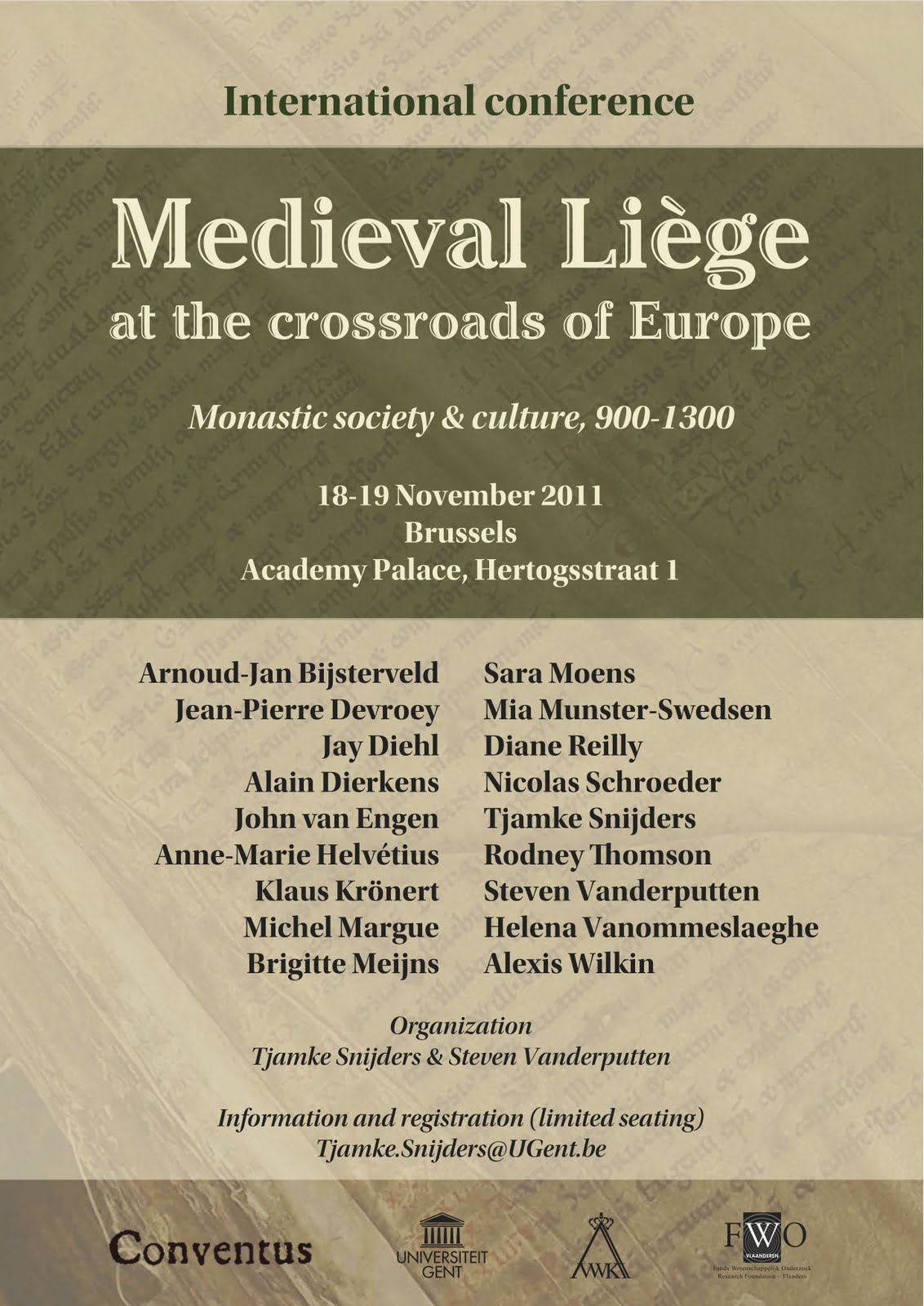
Colloque – Medieval Liège at the Crossroads of Europe : Monastic Society and Culture, 900-1300
During the high Middle Ages, the bishopric of Liège found itself at a cultural crossroads between the German Empire and the French lordships. As such, it has been described as an interesting ‘point de rencontre et pénétration de deux grandes civilisations.” The same idea continues to echo in contemporary parlance : ‘Gaul considers us its most distant inhabitants, Germany as nearby citizens. In fact we are neither, but both at the same time.’ Medieval monastic communities in Liège were key sites of this interpenetration, actively participating in the cultural developments, social networks, and political structures of both regions.
This conference will address the problem of monastic identity and its formation in a region that was geographically wedged between two complex and competing socio-political powers. It will investigate how monastic communities negotiated the uncertainties of this situation, while also capitalizing on the opportunities it presented. These questions will be organized around three thematic strands. The first strand, Textual Transmission, will examine the circulation of texts and manuscripts between Liège and its surrounding territories. A second strand on Social Regulation will be devoted to novel forms of control and coercive power exercised by and upon monastic communities in the bishopric of Liège. A final strand will focus on Corporate Individuation and explore how monasteries fashioned their own social and cultural identities in response to the often contentious developments in Liège.
Vendredi 18 novembre 2011
10h30 : Inscriptions
10h55 : Ouverture du colloque
11h00 : Steven Vanderputten (UGent) – Introduction
Textual transmission between Liège and Reims – Présidence : Anne-Marie Helvétius
11h30 : Tjamke Snijders (UGent) – Saintly Presence in Manuscripts from Liège and Flanders: From Isolation to Exchange
12h00 : Diane Reilly (Indiana University) – Reims, Liège and Institutional Reform in the Central Middle Ages: The Manuscript Evidence
12h30 : Lunch
14h00 – Keynote I : Rodney Thomson (University of Tasmania) – The Library of the Abbey of St Laurence, Liège, in the Twelfth Century: A Reflection of Two Cultures
Textual transmission between Liège and Cologne – Présidence : Steven Vanderputten
15h00 : Jay Diehl (Long Island University) – Libraries and Masters at St Laurence: Re-thinking Monastic Schools and Rupert of Deutz’ Early Career
15h30 : Klaus Krönert (Université Charles-de-Gaulle/Lille-III) : Between Identity, History and Rivalry: Hagiographic Legends in Trier, Cologne and Liège
16h00 : Pause
Textual transmission in and around Gembloux – Présidence : Jay Diehl
16h15 : Mia Munster-Swedsen (Københavns Universitet) – Law and Theology in Sigebert of Gembloux’ Letter of the Liégeois against pope Pascal
16h45 : Sara Moens (UGent) – An Inquisitive Monk at the Crossroads between the Rhineland and Tours: Transmission of Ideas, Texts, and Fame within the Network of Guibert of Gembloux (1124/25 –1124)
18h30 : Repas
Samedi 19 novembre 2011
9h30 – Keynote II : John Van Engen (Notre-Dame University) – Recluses, Beguines, New Nuns? On the Religious Women of Liège in the Early Thirteenth Century
Social regulation and social development – Présidence : Jean-Pierre Devroey
10h30 : Arnoud-Jan Bijsterveld (Katholieke Universiteit Brabant) – Five Countries, Three Languages: How Challenging can the Monastic History of the Medieval Diocese of Liège Be?
11h00 : Alain Dierkens (Université Libre de Bruxelles) – Problèmes autour de Rathier de Vérone, évêque de Liège
11h30 : Pause
Social regulation : abbots, agency and lordship – Présidence : Tjamke Snijders
11h45 : Helena Vanommeslaeghe (UGent) – Wandering Abbots: Abbatial Agency and Stabilitas Loci in Eleventh-Century Liège
12h15 : Nicolas Schroeder (Université Libre de Bruxelles) – Imperial Abbacy meets French Lordship: Stavelot-Malmedy and the county of Luxembourg under Thibaut of Bar and Ermesinde (1197-1247)
12h45 : Lunch
Institutional development: the case of Saint-Hubert – Présidence : Steven Vanderputten
14h00 : Brigitte Meijns (Katholieke Universiteit Leuven) – The Spread of the Ideas of the Eleventh-Century Church Reform in the Diocese of Liège and the Abbey of Saint-Hubert
14h30 : Michel Margue (Université de Luxembourg) – Le Cantatorium de Saint-Hubert
15h00 : Alexis Wilkin (Université Libre de Bruxelles) – Conclusions
Informations pratiques : organisé par Steven Vanderputten et Tjamke Snijders dans le cadre du réseau de recherche « Conventus – Problems of communal life in the High Middle Ages », le colloque se tiendra les 18 et 19 novembre 2011 à la Royal Flemish Academy of Belgium for Science and the Arts (KVAB), Academy Palace – Hertogsstraat 1, 1000 Brussels (Belgium). Contact et inscription : tjamke.snijders@ugent.be
Publié dans Colloque
Laisser un commentaire
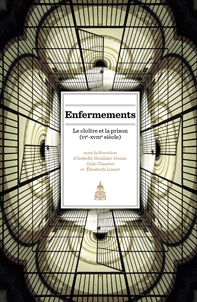
Publication – Enfermements. Le cloître et la prison (VIe-XVIIIe siècle)
Dès le Moyen Âge, le claustrum et le carcer, le cloître et la prison, ont été associés. Exaltant l’ascèse monastique, Bernard de Clairvaux, pour ne citer que lui, comparait déjà le monastère à une prison ouverte, où seule la crainte de Dieu retenait les moines. Aujourd’hui, les liens entre cloître et prison sont encore perceptibles dans le site exceptionnel de Clairvaux, ancienne abbaye cistercienne fondée au XIIe siècle et transformée en centre pénitentiaire au XIXe siècle.
Dans les années 1960-1970, penseurs des institutions répressives et historiens du monachisme ont âprement polémiqué sur l’analogie entre cloître et prison. Afin de dépasser les apories de ces controverses et de renouer les fils du dialogue interrompu entre historiens du cloître et historiens de la prison, cet ouvrage propose une histoire commune des deux enfermements. Il explore les conceptions et les valeurs associées à l’enfermement, les particularités de la vie en milieu clos, la sociologie des groupes exposés à l’enfermement, dans l’ensemble de l’Europe, de l’Espagne à la Saxe et de l’Angleterre à l’Italie, entre le VIe et le XVIIIe siècle. Faisant appel aux meilleurs spécialistes internationaux de ces questions, il privilégie les vues synthétiques plutôt que les études de cas. Il dessine enfin les renouvellements historiographiques intervenus depuis quatre décennies dans les domaines de l’histoire du droit, de l’histoire sociale et de l’histoire religieuse.
Table des matières :
Jean-François Leroux – Avant-propos
Isabelle Heullant-Donat, Julie Claustre, Élisabeth Lusse – Introduction
Conceptions et valeurs de l’enfermement
Julia Hillner – L’enfermement monastique au VIe siècle
Megan Cassidy-Welch – Incarcération du corps et libération de l’esprit : un motif hagiographique
Elsa Marmursztej – Issues obligatoires. Clôture et incarcération dans la pensée scolastique des XIIIe-XIVe siècles
Julie Claustre – Les prisonniers « desconfortés ». Les littératures de la prison au bas Moyen Âge
Elizabeth Makowski – L’enfermement des moniales au Moyen Âge. Débats autour de l’application de la décrétale Periculoso
Daniel-Odon Hurel – La prison et la charité. Les enjeux contradictoires de l’enfermement pour faute grave dans l’ordre de Saint-Benoît à l’époque moderne
Vivre en milieu clos
Gregoria Cavero Domíngue – L’hôtellerie et sa projection sur la clôture monastique. La tradition médiévale hispanique
Élisabeth Lusset – Entre les murs. L’enfermement punitif des religieux criminels au sein du cloître (XIIe-XVe siècles)
Romain Telliez – Geôles, fosses, cachots… Lieux carcéraux et conditions matérielles de l’emprisonnement en France à la fin du Moyen Âge
Louis de Carbonnières – Prison ouverte, prison fermée. Les règles procédurales de la détention préventive sous les premiers Valois devant la chambre criminelle du parlement de Paris
Camille Dégez – Les conditions de vie en prison à l’époque moderne. L’exemple de la Conciergerie
Falk Bretschneider – Enfermements : circulation et croisement des pratiques dans l’espace germanique
à l’époque moderne
Objectifs et usages sociaux des enfermement
Sylvie Joye – Les monastères féminins du haut Moyen Âge : rempart ou prison ?
Anna Benvenuti – Cellanae et reclusae dans l’Italie médiévale. Modèles sociaux et comportements religieux
Marie-Élisabeth Henneau – Les débats relatifs à la clôture des moniales aux XVIIe et XVIIIe siècles. Discours croisés entre deux mondes
Marie-Claude Dinet-Lecomte – Les faux-semblants et les avatars de l’enfermement à l’époque moderne
Véronique Beaulande-Barrau – « Au pain de douleur et à l’eau de tristesse ». Prison pénale, prison pénitentielle dans les sentences d’officialité à la fin du Moyen Âge
James B. Given – Dans l’ombre de la prison. La prison de l’Inquisition dans la société languedocienne
Guy Geltner – La prison urbaine. Pratiques civiques, discours religieux et enjeu social
Claude Gauvard – Conclusions
Informations pratiques : Isabelle Heullant-Donat, Julie Claustre et Élisabeth Lusset (dir.), Enfermements. Le cloître et la prison (VIe-XVIIIe siècle), Paris, Publications de la Sorbonne, 2011. 376 pages, 16 x 24 cm. 35 Euros. ISBN : 978-2-85944-673-4
Publié dans Publications
Laisser un commentaire
Journée d’étude – Digital resources for Paleography
Journée d’étude organisée par le centre de recherche ‘Digital Resource and Database of Palaeography, Manuscripts and Diplomatic’ (DigiPal) du Department of Digital Humanities, King’s College London. La journée d’étude aura lieu le 5 septembre 2011, au King’s College de Londres, de 9h30 à 17h30. Inscriptions souhaitées avant le 22 août 2011. Contact : digipal@kcl.ac.uk
Programme de la journée :
Elaine Treharne – A Site for Sore Eyes: Digital, Visual and Haptic Manuscript Studies
Peter Stokes – DigiPal in Theory
Stewart Brookes – DigiPal in Practice
Wim Van Mierlo – How to Work with Modern Manuscripts in a Digital Environment — Some Desiderata
Franck Le Bourgeois – Overview of Image Analysis Technologies
Erik Kwakkel – The Digital Eye of the Paleographer: Using Databases to Identify Scribes and Date their Handwriting
John McEwan and Elizabeth New – The Seals in Medieval Wales Project: Towards a New Standard in Digital Sigillography
Els De Paermentier – Diplomata Belgica: Towards a More Creative and Comparative Palaeographical Research on Medieval Charters
James Brusuelas and John Wallin – The Papyrologist in the Shell
Ben Outhwaite and Huw Jones – Navigating Cambridge’s Digital Library: the Cairo Genizah and Beyond
Publié dans Colloque
Laisser un commentaire
Appel à contribution – Episcopus. Society for the Study of Episcopal Power and Culture in the Middle Ages
Appels à contribution lancés par le groupe de recherche Episcopus en vue du prochain International Congress on Medieval Studies de Kalamazoo (Michigan), qui se tiendra du 10 au 13 mai 2012. Les propositions de communication sont à remettre pour le 15 septembre 2011, soit à Maureen Miller (mcmiller@berkeley.edu pour le premier appel), soit à John Ott (ott@pdx.edu pour les deux autres).
Les propositions doivent inclure un titre et un résumé de la communication (environ 300 mots) et un curriculum vitae d’une page au maximum. Il est également nécessaire de compléter le formulaire « Participant Information » disponible à l’adresse suivante : http://www.wmich.edu/medieval/Assets/doc/PIF2012.doc
Les trois thèmes proposés sont :
I. Men of the Cloth: Vestments and the Performance of Episcopal Power (co-sponsored with DISTAFF, Discussion, Interpretation, and Study of Textile Arts, Fabrics, and Fashion)
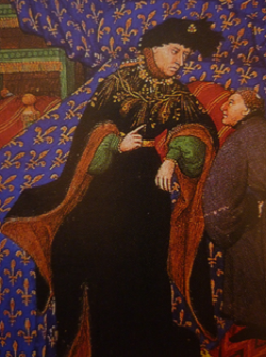
What can liturgical attire tell us about the changing nature of the episcopal office in the Middle Ages? Artistic representations of bishops depict their vestments, often in remarkable detail, and many textual sources — liturgical ordines, letters, chronicles, wills — describe uses of these garments. This proposed session, co-sponsored with DISTAFF, invites investigations of representations and practices of episcopal vestiture, readings of individual images or garments, or analyses of narratives or events in which the bishop’s vestments figure.
II. Re-thinking Reform: Bishops, Issues, Texts (co-sponsored with ICMAC, Iuris Canonici Medii Aevi Consociatio)
Research on reform in the eleventh and twelfth centuries has, for some time now, expressed dissatisfaction with our standard narratives (Fliche, Tellenbach) of this period in ecclesiastical history. But new, broad interpretations have not yet emerged. This proposed session, which has been linked to and is being co-sponsored with two, related sessions under the aegis of ICMAC (International Society of Medieval Canon Law) invites papers taking a fresh look at a leading clerical figure, issue, or source. What aspects of reform are not captured by the traditional narratives? How crucial is the episcopate and secular clergy to existing and proposed narratives of church reform? And, more importantly, what kind of narrative about reform does a renewed focus on individuals, groups, or documents suggest?
III. Monks against Bishops? Reconsidering Episcopal-Monastic Relationships
On the heels of a 2011 Episcopus session devoted to monks who became bishops in the course of their careers, this panel will examine a long-standing debate about the roles and relationships between regular and secular clergy within a universal church. In particular, it aims to take as its point of departure the arguments of earlier scholars, who frequently saw episcopal and monastic interests as inherently controversial or at cross-purposes. This panel will question the usefulness of this dichotomy and seek alternative visions for understanding the structural relationships of monks (including abbots) and prelates across historical periods and contexts.
Publié dans Appel à contributions
Laisser un commentaire
Colloque – Au-delà des miroirs : la littérature politique dans la France de Charles VI et de Charles VII
Organisé par Frédérique Lachaud (Université Paul-Verlaine-Metz) et Lydwine Scordia (Université de Rouen), le colloque « Au-delà des miroirs : la littérature politique dans la France de Charles ViI et de Charles VII » se tiendra les 15 et 16 septembre à l’Université Paul-Verlaine de Metz.
Programme du colloque :
Jeudi 15 septembre 2011 – Session 1 : Formes et enjeux du texte politique
14h00 : Accueil
14h30 : Frédérique Lachaud (Université Paul Verlaine Metz) et Lydwine Scordia (Université de Rouen) – Introduction
15h00 : Jean-Claude Muhlethaler (Université de Lausanne) – Tristesses de l’engagement : l’affectivité dans le discours politique à la fin du Moyen Âge
15h30 : Philippe Contamine (Institut de France) : Le Quadrilogue invectif d’Alain Chartier (1422) : oeuvre littéraire ou écrit de circonstance ?
16h00 : Discussion et pause
16h45 : Jean-Patrice Boudet (Université d’Orléans) : L’Avis à Yolande d’Aragon. Edition d’un miroir au prince du temps de Charles VII
17h15 : Discussion
20h00 : Repas
Vendredi 16 septembre 2011 – Session 2 : À la croisée des genres
9h : Denis Lorée (Université de Rennes II) – Qu’apprend-on aux rois ? L’exemple de la physiognomonie dans le Secret des secrets
9h30 : Kathleen Daly (Oxford) – « Par ung miroir en oscurté ? ». L’histoire comme conseil politique dans les ouvrages de Noël de Fribois, Mathieu Thomassin et leurs contemporain
10h00 : Discussion et pause
10h45 : Franck Collard (Université Paris-Ouest) – Morigéner ou galvaniser ? Les miroirs aux princes à l’époque de Charles VII
11h15 : Discussion
11h30 : Mireille Chazan (Université Paul Verlaine Metz) – Conclusions
12h00 : Table ronde
13h00 : Clôture du colloque
Informations pratiques : le colloque se tiendra les 15 et 16 septembre 2011 à l’Université Paul-Verlaine de Metz, Salle du Conseil (D206) – UFR Sciences Humaines et Arts. Contact : frederique.lachaud@univ-metz.fr
Publié dans Colloque
Laisser un commentaire
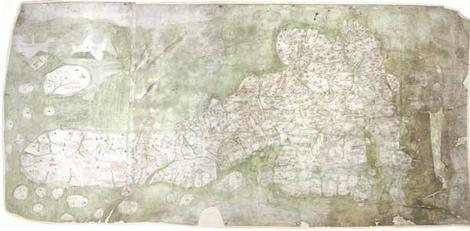
Site Internet – Earliest medieval map of Britain put online !
A fifteen-month research project of the earliest surviving geographically recognizable map of Great Britain, known as the Gough Map, provides some revealing insights into one of the most enigmatic cartographic pieces from the Bodleian collections. The findings are recorded on a newly-launched website : http://www.goughmap.org/
The fifteen-month AHRC-funded project used an innovative approach that explores the map’s ‘linguistic geographies’, that is the writing used on the map by the scribes who created it, with the aim of offering a re-interpretation of the Gough Map’s origins, provenance, purpose and creation of which so little is known. Although the identity of the map-maker is unknown, it is now possible to reveal that the text on the Gough Map is the work of at least two scribes: the original 14th-century scribe and a 15th-century reviser.
One of the key investigations based on historical reference and the handwriting on the map was to date the map more accurately. The project has discovered that the map was made closer to 1375, rather than in 1360 as was previously thought.
There are visible differences between recorded details in Scotland and England. For example: the text written by the original scribe is best preserved in Scotland and the area north of Hadrian’s Wall, whereas the text written by the reviser is found in south-eastern and central England. The buildings in Scotland do not have windows and doors, whereas in the revised part of the map, essentially everywhere south of Hadrian’s Wall, most buildings have both windows and doors.
Throughout, towns are shown in some detail, the lettering for London and York coloured gold, while other principal medieval settlements such as Bristol, Chester, Gloucester, Lincoln, Norwich, Salisbury and Winchester are lavishly illustrated.
One of key outcomes of Linguistic Geographies is to make available online a searchable version of the Gough Map based upon a digital image of the map. The website features a zoomable, pan-able digital version of the Gough Map – this map is fully searchable and browse-able by place name (current and medieval), and also by geographical features. Once clicking on a chosen location, information regarding that location’s geographical appearance, etymology, appearance on earlier maps, and much, much more is revealed;
The website also includes a series of scholarly essays discussing the map; latest news about the project and a blog, among others.
Nick Millea, Bodleian Map Librarian, said: ‘The project team was keen to ensure that our research findings reach the widest possible audiences, not least because maps are enduringly popular objects and always capture the imagination; medieval maps especially. To this end one of the main project outcomes is this web-resource through which the Gough Map is made more widely accessible. We hope this will help others to develop other lines of enquiry on medieval maps and mapmaking, whether in academic or non-academic sectors, as well as provide greater levels of access to the Gough Map, enhancing its world-wide significance in the history of cartography.’
This is an outcome of the collaborative project involving Queen’s University Belfast, King’s College London, and the Bodleian Libraries.
Publié dans Web
Laisser un commentaire
Stage – Initiation au manuscrit médiéval et au livre humaniste (domaines latin et roman)
L’IRHT organise un stage annuel d’initiation au manuscrit médiéval et au livre humaniste, destiné aux étudiants de Master I et II (à l’exception des Masters professionnels) et thèse en lettres, en philosophie, en histoire (notamment en histoire de l’enluminure). Le prochain stage aura lieu du lundi 10 au vendredi 14 octobre 2011 à Paris.
Pour donner une perspective d’ensemble sur le travail et la recherche sur les manuscrits, différents thèmes sont abordés aux cours d’exposés magistraux et de séances en petits groupes : présentation de manuscrits et introduction à la codicologie, histoire de l’écriture, mise en page et décoration, transmission des textes, rapport texte/image, héraldique, histoire des bibliothèques, passage du manuscrit à l’imprimé, exercice d’édition de textes. Le stage est aussi l’occasion de découvrir l’IRHT et la documentation qu’il met au service des chercheurs. Thèmes abordés : introduction à la codicologie, histoire de l’écriture, mise en page du manuscrit, rapport texte/image, transmission des textes, notions de reliure et d’héraldique.
Informations pratiques : les inscriptions au stage doivent être rendues avant le 1er septembre 2011. Le formulaire est disponible à l’adresse suivante : http://www.irht.cnrs.fr/formation/stage_inscription.htm. Organisation (IRHT) : Caroline Bourlet, Jean-Marie Flamand, Stéphane Liaigre, Nathalie Picque. Les organisateurs tiennent à préciser que les séances ne comprennent ni apprentissage de la paléographie, ni exercice de lecture, ni histoire de l’art.
Un livret-guide du stage est disponible en ligne en pages WEB standard et au format PDF. Il a pour objet de fournir les éléments essentiels pour s’initier à l’approche du manuscrit et de sa description, tels qu’ils ont été élaborés au fil du temps dans un laboratoire de recherche par des équipes spécialisées de l’IRHT. Il est accessible à l’adresse suivante : http://aedilis.irht.cnrs.fr/stage
Publié dans Stage
Laisser un commentaire
Publication – Chancelleries princières et scriptoria dans les anciens Pays-Bas (Xe-XVe siècles)
Informations pratiques :
Thérèse de Hemptinne et Jean-Marie Duvosquel (eds.), Chancelleries princières et scriptoria dans les anciens Pays-Bas, Xe-XVe siècles/Vorstelijke kanselarijen en scriptoria in de Lage Landen 10de-15de eeuw, dans Bulletin de la Commission royale d’histoire, t. 176/2, 2010.
Table des matières :
Walter Prevenier – Sense and usefulness of diplomatic research in the 21st century. The merits of the Royal Historical Commission
Du scriptorium à la chancellerie
Jens Schneider – Monastères et scriptoria en Lotharingie (IXe-Xe siècles)
Georges Declercq – Van privaatoorkonde tot vorstelijke oorkonde. De oorkonden van de eerste graven van Vlaanderen, inzonderheid voor de Sint-Pietersabdij te Gent (10de-11de eeuw)
Steven Vanderputten – Collectieve identiteit, sociaal gedrag en monastieke memoria in het liber traditionum van de priorij van Saint-Georges te Hesdin (1094 – circa 1185)
Chancelleries épiscopales et chapitres cathédraux
Jean-Louis Kupper – La « chancellerie » des évêques de Liège (Xe-XIIe siècles)
Nathalie Barré – Chancellerie épiscopale, chancellerie canoniale : unicité ou pluralité des institutions à Cambrai au XIIe siècle ?
Benoît-Michel Tock – L’élaboration des chartes épiscopales à Thérouanne au XIe siècle
J. W. J. Burgers – De bisschop, de heren en de stad. Het oorkondewezen in Utrecht , circa 1250 – circa 1320
Chancelleries princières et seigneuriales
Michel Margue – Actes princiers et naissance des principautés territoriales : chartes et pouvoirs laïques dans les espaces mosan et mosellan (fin Xe-début XIIe siècles)
Alain Dierkens et David Guilardian – Actes princiers et naissance des principautés territoriales : du duché de Basse-Lotharingie au duché de Brabant (XIe-XIIIe siècles)
Els De Paermentier – La chancellerie comtale en Flandre et en Hainaut sous Baudouin VI/IX (1195-1206) et pendant la régence de Philippe Ier de Namur (1206-1212)
Jean-François Nieus – Des seigneurs sans chancellerie ? Pratiques de l’écrit documentaire chez les comtes et les barons du nord de la France aux XIIe-XIIIe siècles
Personnel et gestion
Valeria Van Camp – Trois clercs de chancellerie hennuyers au service des comtes de Hainaut, Hollande et Zélande (1299-1345) : au centre d’une réforme administrative ?
Jinna Smit – Meten is weten ? De toepassing van het Groningen Intelligent Writer Identification System (GIWIS) op hollandse kanselarijoorkonden, 1299-1345
Eef Dijkhof – Bewaren of weggooien ; afschrijven of verplaatsen. Het papieren cartularium van de graven van Holland en Zeeland en de politieke en ambtelijke zorg voor het grafelijke archief in 1299
Alexis Wilkin – Enquête sur l’impact de l’incendie de 1185 sur les archives de la cathédrale Saint-Lambert de Liège et sur la rédaction d’un premier cartulaire
Jean-Charles Bédague – Archives, archivage et archivistique à la collégiale de Saint-Omer à la fin du XVe siècle à la lumière d’un inventaire de 1480
Conclusion
Thérèse de Hemptinne – New trends in research on scriptoria and chanceries in the Low Countries : results and perspectives
Publié dans Publications
Laisser un commentaire
Appel à contribution – Kings and Queens : Politics, Power, Patronage and Personalities in Medieval and Early Modern Monarchy
The institution of Monarchy was absolutely central to the political developments and events of the medieval and Early Modern world. This conference aims to celebrate monarchy in all of its various aspects, from examining the institution itself to assessing the impact of particular monarchs in their own realms and beyond. Historic Corsham Court, located just outside of Bath, is a beautiful and appropriate setting for this conference, with its origins as a summer palace for the Kings of Wessex. We welcome papers and/or panels on any theme which connects to monarchs or monarchy in any way including (but not limited to):
– Kingship/queenship/rulership
– The relationship between monarchs and consorts
– The relationship between monarchs and their subjects
– The involvement of monarchs in politics, religion and war
– The patronage and representation of monarchs
– The monarch and their court
We encourage a multi-disciplinary approach including papers which draw on gender studies, art, military, political and/or cultural history. Graduate students and early career researchers are particularly invited to submit a proposal. We hope to produce a published volume of the papers generated by the conference.
Informations pratiques : les propositions de communication (250 mots environ) ou de session (ensemble de trois communications) doivent être envoyées avant le 31 octobre 2011 à l’adresse suivante : monarchyconference@gmail.com. Contact : Elena Woodacre – Bath Spa University, Newton Park Campus.
Publié dans Appel à contributions
Laisser un commentaire
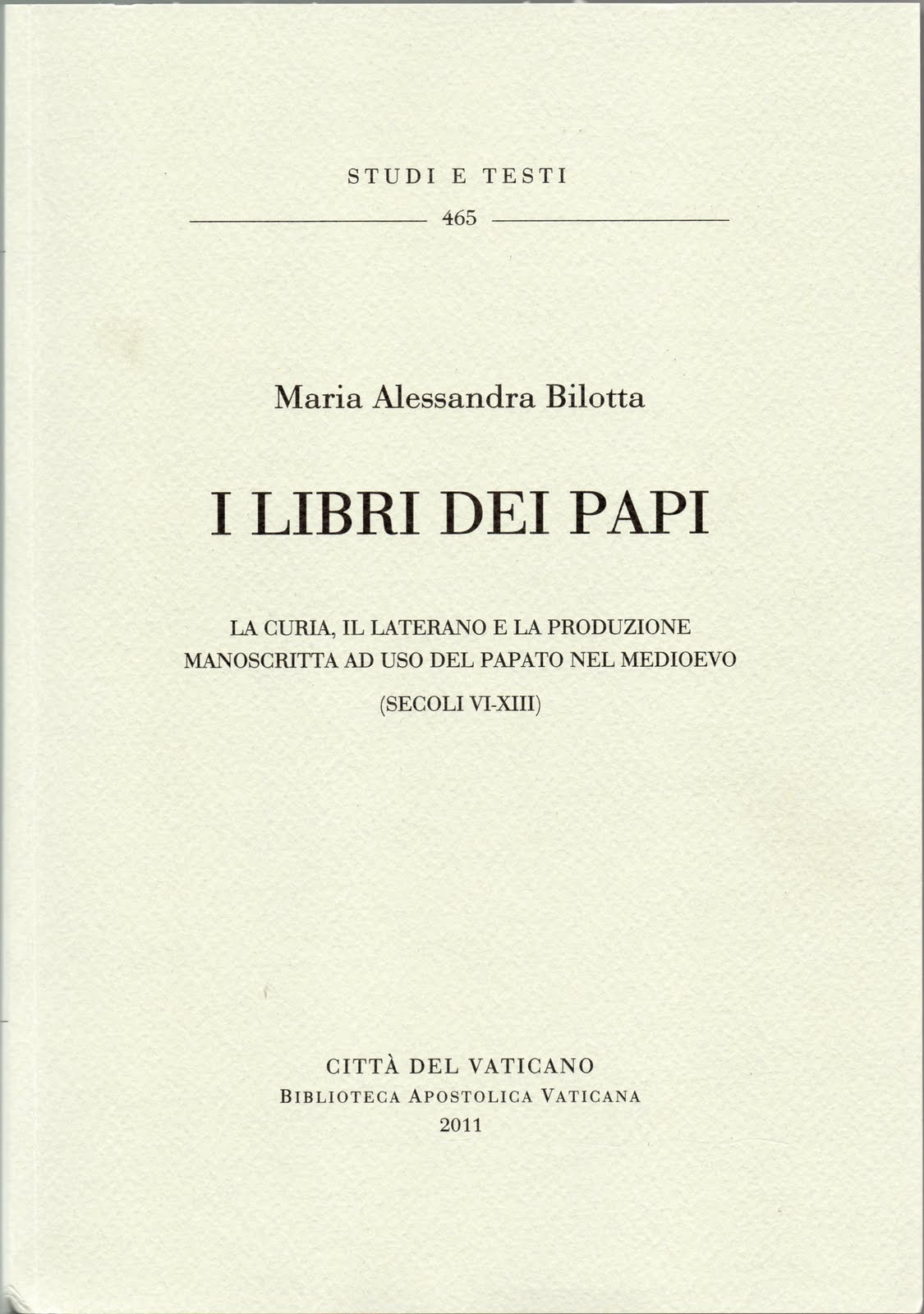
Publication – M. A. Bilotta, "I libri dei papi. La Curia, il Laterano e la produzione manoscritta ad uso del Papato nel Medioevo (secoli VI-XIII)"
Informations pratiques :
Prefazione di S. Em. Card. Raffaele Farina … p. XI
Presentazione di Agostino Paravicini Bagliani … p. XIII
Introduzione di Mario D’Onforio … p. XIX
Ringraziamenti … p. XXIII
Premessa … p. XXVII
1. La Biblioteca nell’antica residenza pontificia del Laterano dal primo insediamento dei pontefici a Bonifacio VIII (1294-1303) : ipotesi di localizzazione e vicende storiche del patrimonio librario pontificio … p. 1
- 1.1 La Biblioteca del Laterano dalla fondazione della Basilica Salvatoris all’affermazione del Laterano come residenza del papa … p. 4
- 1.2 La Biblioteca papale in Laterano tra X e XII secolo … p. 25
- 1.3 La raccolta libraria papale e la mobilità della Curia nel secolo XIII e all’inizio del XIV… p. 29
2. I primi manoscritti, dalla fondazione della basilica Salvatoris all’affermazione del Laterano come residenza del papa … p. 43
- 2.1 Troyes, Médiathèque de l’Agglomération Troyenne, ms 504 … p. 43
- 2.2 Città del Vaticano, Biblioteca Apostolica Vaticana, Vat. lat. 10696, Vat. lat. 14586 … p. 52
- 2.3 Monaco di Baviera, Bayerische Staatsbibliothek, Clm 14008 … p. 55
- 2.4 Città del Vaticano, Biblioteca Apostolica Vaticana, Vat. lat. 4965 … p. 64
3. Codici, riforma canonicale e canonici di San Frediano in Laterano tra XI e XII secolo … p. 71
- 3.1 Città del Vaticano, Biblioteca Apostolica Vaticana, Ottob. lat. 38 … p. 71
- 3.2 Città del Vaticano, Biblioteca Apostolica Vaticana, Vat. lat. 5319 … p. 80
- 3.3 Firenze, Biblioteca Riccardiana, Riec. 299 … p. 87
- 3.4 Firenze, Biblioteca Riccardiana, Riec. 300 … p. 96
- 3.5 Roma, Archivio Capitolare Lateranense, A. 80 … p. 99
- 3.6 Firenze Biblioteca Medicea Laurenziana, San Marco 356 … p. 102
- 3.7 Roma, Archivio di Stato, ex-Santissimo Salvatore 997 … p. 106
- 3.8 Città del Vaticano, Biblioteca Apostolica Vaticana, Vat. lat. 1192 … p. 109
- 3.9 Città del Vaticano, Biblioteca Apostolica Vaticana, Vat. lat. 4406 … p. 116
4. I libri liturgici secundum consuetudinem et usum romanae Curiae : il Duecento … p. 119
- 4.1 Città del Vaticano, Biblioteca Apostolica Vaticana, Vat. lat. 12989 … p. 122
- 4.2 Madrid, Biblioteca Nacional de Espaiia, lat. 730 … p. 127
- 4.3 Città del Vaticano, Biblioteca Apostolica Vaticana, Ottob. lat. 356 … p. 130
- 4.4 Avignone, Bibliothèque municipale, ms 100 … p. 144
- 4.5 New York, Pierpont Morgan Library, M. 976 / Philadelphia, Morgan Free Library Lewis EM 008.12 … p. 147
- 4.6 Città del Vaticano, Biblioteca Apostolica Vaticana, Vat. lat. 1155 … p. 149
- 4.7 Parigi, Bibliothèque nationale de France, ms lat. 960 … p. 156
- 4.8 Città del Vaticano, Biblioteca Apostolica Vaticana, Vat. lat. 4747 … p. 163
- 4.9 Avignone, Bibliothèque municipale, ms 203 … p. 167
- 4.10 Lione, Bibliothèque municipale, lat. 5132 … p. 170
- 4.11 Roma, Biblioteca dell’Accademia Nazionale dei Lincei e Corsiniana, 55.K.3 … p. 173
Conclusioni … p. 177
Publié dans Publications
Laisser un commentaire


Vous devez être connecté pour poster un commentaire.