Lo sviluppo delle scritture amministrative, in ambito ecclesiastico e successivamente laico, è il segno quanto lo strumento della razionalizzazione gestionale della proprietà fondiaria e immobiliare nell’economia medievale. Lo studio analitico del primo inventario-censuario dei beni del capitolo di S. Pietro in Vaticano conservato e l’edizione della lista degli edifici ad uso abitativo pertinenti alla basilica a metà Trecento mettono in luce le condizioni materiali, economiche e sociali dell’alloggio a Roma mentre l’anno giubilare fornisce l’occasione di innovazioni fondamentali nelle modalità gestionali della proprietà immobiliare.
Penetrando nella fabbrica del documento e, idealmente, nella mente dell’autore allo scrittoio, il libro svela come l’elenco delle case, dietro la sua aridità apparente, diventi lo specchio delle trasformazioni che mutarono le città tardomedievali e che fecero dell’alloggio cittadino un settore basilare dell’economia urbana.
Etienne Hubert è stato chargé de recherches al Centre national de la recherche scientifique (Lione) e directeur d’études all’École des hautes études en sciences sociales (Parigi). Tra i suoi libri ricordiamo: Espace urbain et habitat à Rome du Xe siècle à la fin du XIIIe siècle (Roma 1990), L’incastellamento en Italie centrale (Roma 2002). Per Viella ha curato i volumi Roma nei secoli XIII e XIV. Cinque saggi (1993) e La necessità del segreto (2018, con Roberta Mucciarelli e Jacques Chiffoleau).
Informations pratiques :
Etienne Hubert, Anatomia di un documento. Scrivere le case di S. Pietro in Vaticano a metà Trecento, Rome, Viella, 2024 ; 1 vol., 300 p. (I libri di Viella, 510). ISBN : 979-1-25469-486-2. Prix : € 29,00.
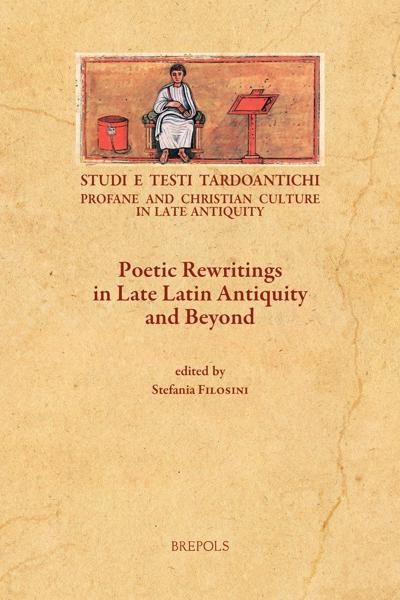
‘Rewriting’ as the reworking of narrative material based on conscious strategies of composition plays a significant role in much of the Latin poetry of Late Antiquity. This book, resulting from the conference Riscritture poetichenell’Occidente latino tra tarda antichità e medioevo, which was held on 9-11 May 2022 at the Department of Human Sciences (DSU) of the University of L’Aquila, looks at the range of practices and purposes that inform this procedure, with particular regard to the processes of transcodification enacted – in different historical and cultural contexts – by the recasting of authoritative prose texts into a classicising poetic idiom. The contributions present a multifaceted approach to rewriting, cover a variety of authors, genres, and texts, and cast a glance also at medieval Latin literature. In short, the essays in this collection, by reflecting on the interpretative contribution of the critical category of ‘rewriting’, not only add further tesserae to the mosaic of literary studies on Late Latinity, they also invite to grasp the difference between secular and Christian rewritings.
Stefania Filosini is Assistant Professor of Latin Language and Literature at the University of L’Aquila. Her research focuses on late Latin poetry, with contributions on various authors and literary genres (Claudianus, Paulinus of Nola, Prudentius, Sedulius, Sidonius Apollinaris, Ennodius, Dracontius, Venantius Fortunatus). She is also the author of a commentary on Paulinus Nolanus, poems 10 and 11 (Roma, 2008), and of an edition with commentary on Sidonius’ epithalamium for Ruricius and Iberia (Turnhout, 2014).
Table des matières :
Introduction (Stefania Filosini)
Late Latin Antiquity: Secular Rewritings
Poetic Rewriting of Hylas: Dracontius, Romul. 2 (Salvatore Costanza) La réécriture d’Ausone par Luxorius : enjeux et poétique (Florence Garambois-Vasquez) Forms of Martial’s Reception in the Aenigmata Symposii (Marco Onorato)
Late Latin Antiquity: Christian Rewritings
1. The Biblical Poetry Poetic Rewritings between Literature and Doctrine: Prudentius, Cathemerinon 5 (Fabio Gasti) La réécriture à visée argumentative de la Bible. Le cas des médaillons bibliques du poème d’Orientius et du Carmen adversus Marcionitas (Ps.-Tert.) (Lucie Martin) Rewriting the Miracles: The Healing of the Man Blind from Birth in Sedulius (carm. pasch. IV. 251-270) (Stefania Filosini) The Parable of the Rich Man and Lazarus in Avitus of Vienne, carm. III. 220-310 (Franca Ela Consolino) Réécriture des discours des Actes des Apôtres chez Arator. Technique de la réécriture et visée pragmatique du texte (Bruno Bureau)
2. A Case Study on Biblical Poetry: The Heptateuchos Poem The Heptateuch Poet as a Battalist: Strategies of Epicisation in Battles Scenes and Military Speeches (Donato De Gianni) Per grandia tempora: Time and Temporal References in the Poem of the Heptateuchos (Francesco Lubian) Structure of the Narrative Sequences and Intratextual Links in the Heptateuchos Poem (Luciana Furbetta) Costruzione di una formularità epica interna nel poema dell’Heptateuchos. Studio di casi dell’Exodus: la teofania sul monte Horeb (Michele Cutino)
3. The Hagiographic Poetry La réécriture poétique de la Vie de saint Martin par Paulin de Périgueux au miroir des genres littéraires (Sylvie Labarre) Réflexions sur un exemple de réécriture poétique : Paulin de Périgueux, Vie de saint Martin, V. 398-487 (Vincent Zarini) Poetic Rewriting with an Audience: Venantius Fortunatus’ Life of St Martin and the Ladies of the Abbey Sainte-Croix in Poitiers (Lorenzo Livorsi)
Beyond Late Antiquity
Un siriaco tardo antico in riscrittura carolingia. L’attualizzazione dell’armonia evangelica di Taziano nel Heliand anticosassone (Wolfgang Haubrichs) Riscrivere i vangeli in volgare: il Liber evangeliorum e la tentazione di Cristo (Chiara Staiti) Isidore and the Wisdom of Gildas in the Vita Merlini (Francesco Marzella)
Index The Authors
Informations pratiques :
Poetic Rewritings in Late Latin Antiquity and Beyond, éd. Stefania Filosini, Turnhout, Brepols, 2024 ; 1 vol., 520 p. (Studi e testi tardoantichi, 23). ISBN : 978-2-503-61024-5. Prix : € 110,00.
Lancement du Groupe de recherche sur l’écrit délibératif dans l’espace francophone Décembre 2024
Longtemps restés dans l’angle mort des recherches historiques, les registres de délibérations ont récemment fait l’objet d’un important travail de reconsidération. Tantôt en marge des études sur les écrits urbains médiévaux et modernes ou sur les écritures grises, tantôt objet d’une recherche collective[1] l’écrit délibératif est aujourd’hui un outil à part entière des historiens pour penser les activités politiques et administratives à l’échelle d’une institution. Plus qu’un simple réservoir de données historiques, ces documents constituent des fenêtres pour penser le gouvernement, à savoir la culture d’un corps politique avec ses acteurs, ses processus décisionnels et les intérêts collectifs qu’il administre au quotidien. À ces enjeux politiques s’ajoute celui de l’écrit. Conservé sous forme de registres ou de liasses, l’écrit délibératif suit un modèle scriptural précis qui vise à coucher sur le papier les interactions verbales prononcées durant la réunion ou l’assemblée. Tout comme l’unanimité des délibérants, la dimension orale des procès-verbaux est le résultat d’artifices narratifs mobilisés par les scribes. Loin d’être neutre, la mise par écrit des délibérations se situe ainsi au carrefour entre un modèle délibératif et un certain récit du politique tel que souhaite le conserver l’institution. Cette tension autour de l’objet registre — à la fois relevé de conclusions, instrument du politique et support de mémoire — nous incite à en poursuivre l’étude dans une perspective collective et diachronique.
Fondé en 2024 par Rudi Beaulant (Université de Franche-Comté), Rémi Demoen (CESR de Tours) et Cléo Rager (Institut catholique de Paris), le Groupe de recherche sur l’écrit délibératif dans l’espace francophone vise à offrir de nouvelles contributions autour des registres de délibérations d’Ancien Régime en langue française. Pensé comme une passerelle entre les centres archivistiques (communaux, municipaux et départementaux) et la recherche universitaire, mais aussi entre les mondes médiévaux et modernes, le groupe a vocation à valoriser les patrimoines délibératifs, souvent au cœur de programmes de numérisation, et à enrichir les champs d’études actuels entre historiographie, techniques documentaires et histoire des pratiques politiques. Pour se faire, deux temps d’échanges ont été retenus. D’une part, des rencontres (présentiel/distanciel) dans le cadre d’un séminaire trimestriel dont la thématique serait introduite par un conférencier, puis discutée et complétée par le reste du groupe. D’autre part, un rendez-vous annuel sous la forme d’une journée d’étude accueillie dans un centre archivistique ou universitaire et qui, nous l’espérons, fera l’objet de publications. À terme, la vocation du groupe de recherche est de :
– Promouvoir une réflexion au long cours sur les évolutions des formes, des rôles, des usages et de l’archivistique des registres de délibérations grâce au dialogue entre médiévistes et modernistes.
– Poser les premiers jalons d’une vaste étude comparative entre registres d’institutions laïques et ecclésiastiques dans l’espace francophone.
– Construire un réseau et un lieu d’échanges pour les chercheurs et historiens confrontés à l’écrit délibératif.
– Renforcer les liens de collaboration entre la recherche universitaire et les institutions patrimoniales qui conservent et valorisent ces archives par leurs entreprises de numérisation et d’édition.
Soucieux de correspondre aux intérêts des chercheurs, le projet est à ce stade ouvert aux suggestions. C’est pourquoi, nous donnons rendez-vous à toute personne intéressée le 11 décembre 2024 à 14h, en présentiel à l’IRHT, Campus Condorcet, salle 2001, bâtiment de recherche nord ou en distanciel (le lien sera transmis un peu avant), afin de faire connaissance et de définir ensemble les axes de recherche pour les années 2025-2026. En l’état, le calendrier du groupe est le suivant :
Mars 2025 – Séminaire – La fabrique du registre de délibérations : construction et évolution d’un objet archivistique.
– Parution de l’appel à contribution pour la journée d’étude de Décembre 2025.
Juin 2025 – Séminaire – Le modèle délibératif dans l’espace francophone : influences, usages, altérations.
Décembre 2025 – Journée d’étude – Le scribe a-t-il son mot à dire ? Libertés et contraintes des mains face au modèle délibératif (sujet provisoire).
Si vous souhaitez rejoindre le groupe de recherche, participer aux événements, proposer une conférence pour l’un des séminaires à venir ou assister à la première réunion du 11 décembre 2024 (présentiel ou distanciel), merci de nous écrire à l’adresse : recherche.deliberations@gmail.com.
[1] comme le projet REGIDEL porté par François Otchakovsky-Laurens et Laure Verdon sur les registres de délibérations municipaux de l’espace méditerranéen : https://regidel.hypotheses.org ou plus récemment le projet collectif e-NDP sur les registres de délibérations capitulaires de Notre-Dame de Paris : https://endp.chartes.psl.eu
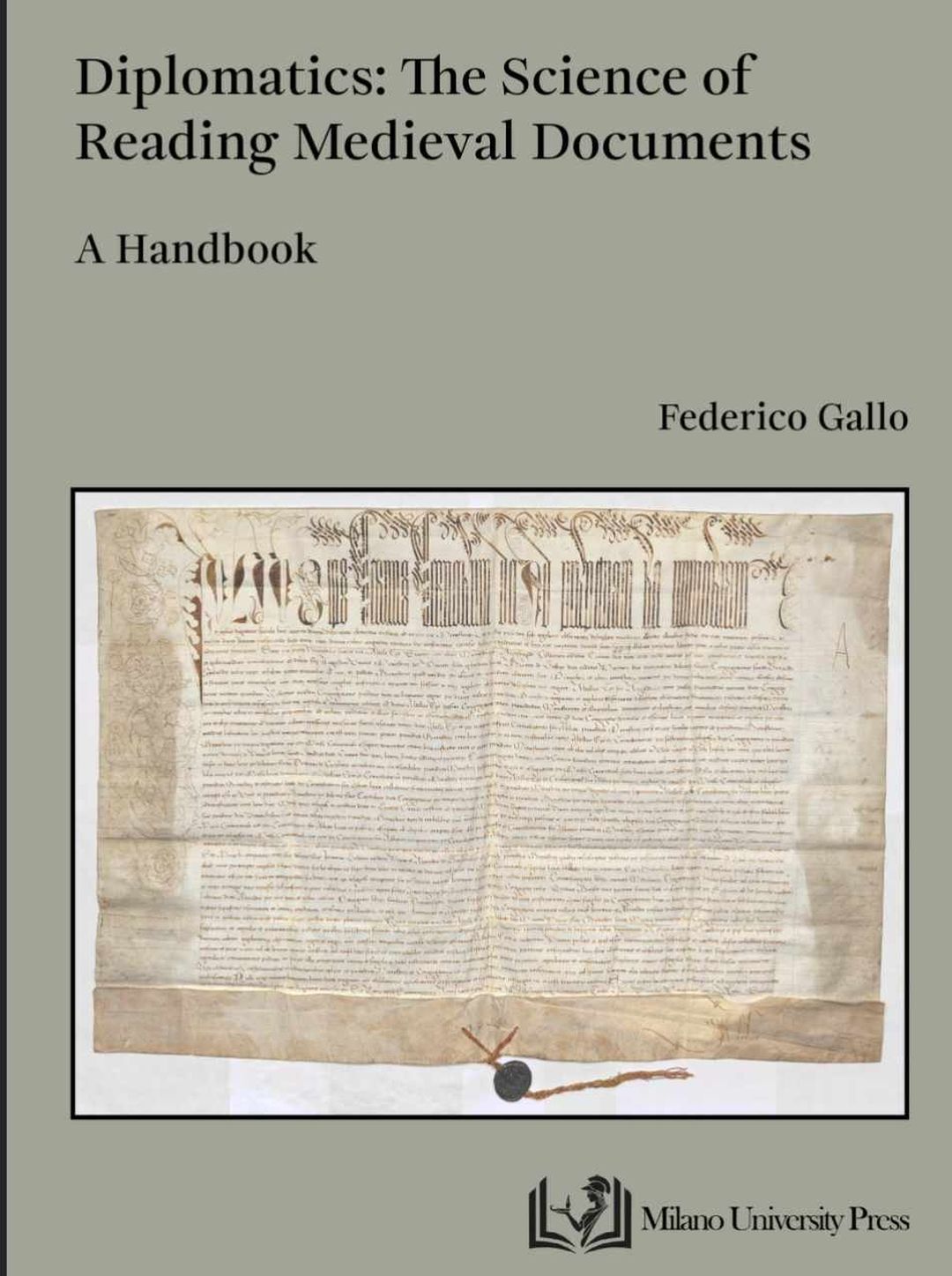
La Diplomatica è la scienza che studia i documenti, in modo particolare quelli di epoca medioevale. La parola ‘Diplomatica’ non ha nulla a che vedere con la diplomazia: il termine deriva da ‘diploma’, ossia un testo scritto certificato, dal valore giuridico. Gli oggetti di studio della disciplina sono i documenti pubblici e privati, le loro caratteristiche esterne ed interne, il linguaggio, la cronologia, la produzione, la trasmissione, la registrazione, l’edizione. Questo manuale colma un vuoto notevole negli studi di Diplomatica perché fornisce finalmente al pubblico di lingua inglese la possibilità di conoscere l’affascinante universo della documentazione medievale.
(Milano, 1973) è Dottore Ordinario della Biblioteca Ambrosiana, dove dirige la Biblioteca e gli Studi Greci e Latini. È laureato in lettere classiche, dottore di ricerca in Lettere (PhD), diplomato presso l’Archivio Segreto Vaticano come Paleografo e Archivista e in Paleografia Greca. Insegna Paleografia latina all’Archivio di Stato di Milano, Diplomatica all’Archivio di Stato di Perugia, Codicologia all’Università degli Studi di Milano. È stato Consigliere e Segretario dell’Associazione dei Bibliotecari Ecclesiastici Italiani (ABEI). La sua bibliografia riguarda soprattutto il patrimonio manoscritto della Biblioteca Ambrosiana.
Informations pratiques :
Federico Gallo, Diplomatics: The Science of Reading Medieval Documents. A Handbook, Milan, Milano University Press, 2024 ; 1 vol., 98 p. ISBN : 979-12-5510-174-1. Prix : € 24,00.
Games with a medieval setting are commercially lucrative and reach a truly massive audience. Moreover, they can engage their players in a manner that is not only different, but in certain aspects, more profound than traditional literary or cinematic forms of medievalism. However, although it is important to understand the versions of the Middle Ages presented by these games, how players engage with these medievalist worlds, and why particular representational trends emerge in this most modern medium, there has hitherto been little scholarship devoted to them.
This book explores the distinct nature of medievalism in digital games across a range of themes, from the portrayal of grotesque yet romantic conflict to conflicting depictions of the Church and religion. It likewise considers the distinctions between medievalist games and those of other periods, underlining their emphasis on fantasy, roleplay and hardcore elements, and their consequences for depictions of morality, race, gender and sexuality. Ultimately the book argues that while medievalist games are thoroughly influenced by medievalist and ludic tropes, they are nonetheless representative of a distinct new form of medievalism. It engages with the vast literature surrounding historical game studies, game design, and medievalism, and considers hundreds of games from across genres, from Assassin’s Creed and Baldur’s Gate to Crusader Kings and The Witcher series. In doing so, it provides a vital illustration of the state of the field and a cornerstone for future research and teaching.
ROBERT HOUGHTON is Senior Lecturer in Medieval History at the University of Winchester, UK.
Table des matières :
Introduction: The Middle Ages in Computer Games
Mechanical and Social Pressures
Medievalist Genres
Combat and Warfare
Science, Technology and the Dark Ages
Rule and Rulership
The Church and Organised Religion
Morality
Race and Nationality
Gender and Sexuality Conclusion: A Different Medievalism, Different Games Bibliography Filmography Ludography
Informations pratiques :
Robert Houghton, The Middle Ages in Computer Games. Ludic Approaches to the Medieval and Medievalism, Woodbridge, D.S. BRewer, 2024 ; 1 vol., 372 p. (Medievalism, 28). ISBN : 9781843847298. Prix : GBP 95,00.
Calculating Ethics in the Fourteenth Century addresses a moment in the history of ethics, when discoveries in natural philosophy blurred the boundary between the possible and the impossible, and made the impossible a preferred territory in discussions on practical reason. The volume studies the onset and expansion of a new movement in constructing ethics, as the methods, arguments, and cases adopted from logic and natural philosophy came to be extensively applied at Oxford and swiftly disseminated among other Oxonians eventually making their way outside Oxford. It shows how the Oxford Calculators triggered a unique and durable transformation in ethics.
Contributors are Pascale Bermon, Valeria Buffon, Michael W. Dunne, Marek Gensler, Simon Kemp, Edit A. Lukács, Monika Michałowska, and Andrea Nannini.
Edit Anna Lukács, Ph.D. (2008), is Academy Scientist at the Institute for Medieval Research of the Austrian Academy of Sciences. Her most recent book is titled Immovable Truth. Divine Knowledge and the Bible at the University of Vienna (1384-1419) (Brill, 2024).
Monika Michałowska, Ph.D. (2007), is Professor at the Medical University of Łódź. Her research focuses on late medieval ethics and theology. She has critically edited Richard Kilvington’s Quaestiones super libros Ethicorum and Quaestiones super libros Sententiarum (Brill, 2016, 2021, 2023).
Calculating Ethics in the Fourteenth Century, éd. Edit Anna Lukács, Monika Michałowska, Boston–Leyde, Brill, 2024 ; 1 vol., X–241 p. (Investigating Medieval Philosophy, 22). ISBN : 978-90-04-69648-8. Prix : € 140,00.
As the Roman Empire in the west crumbled over the course of the fifth century, new polities, ruled by ‘barbarian’ elites, arose in Gaul, Hispania, Italy, and Africa. This political order occurred in tandem with growing fissures within Christianity, as the faithful divided over two doctrines, Nicene and Homoian, that were a legacy of the fourth-century controversy over the nature of the Trinity. In this book, Marta Szada offers a new perspective on early medieval Christianity by exploring how interplays between religious diversity and politics shaped post-Roman Europe. Interrogating the ecclesiastical competition between Nicene and Homoian factions, she provides a nuanced interpretation of religious dissent and the actions of Christians in successor kingdoms as they manifested themselves in politics and social practices. Szada’s study reveals the variety of approaches that can be applied to understanding the conflict and coexistence between Nicenes and Homoians, showing how religious divisions shaped early medieval Christian culture.
Marta Szada is Assistant Professor at the Department of Classical Studies at Nicolaus Copernicus University in Toruń. Her research in the fields of late antique church history has been published in Journal of Early Christian Studies, Zeitschrift für Antikes Christentum, and Revue des Études Augustiniennes et Patristiques.
Table des matières :
Introduction
Religious controversy and conversion in Vandal Africa
Building the Christian kingdom: Nicene-Homoian competition in Vandal Africa
The Vandal Wars and conversion in East Roman Africa
Nicene-Homoian conversion in Ostrogothic Italy
Nicene-Homoian conversions in Lombard Italy
The religious controversies in Gaul and Hispania
Family life and conversion in Gaul, Hispania, and Italy
Converting the kings: Bishops, saints and royal conversions
Converting the kingdom: politics and conversion in Gaul and Hispania Conclusion.
Informations pratiques :
Marta Szada, Conversion and the Contest of Creeds in Early Medieval Christianity, Cambridge, Cambridge University Press, 2024 ; 1 vol., 376 p. ISBN : 9781009426442. Prix : GBP 105,00.
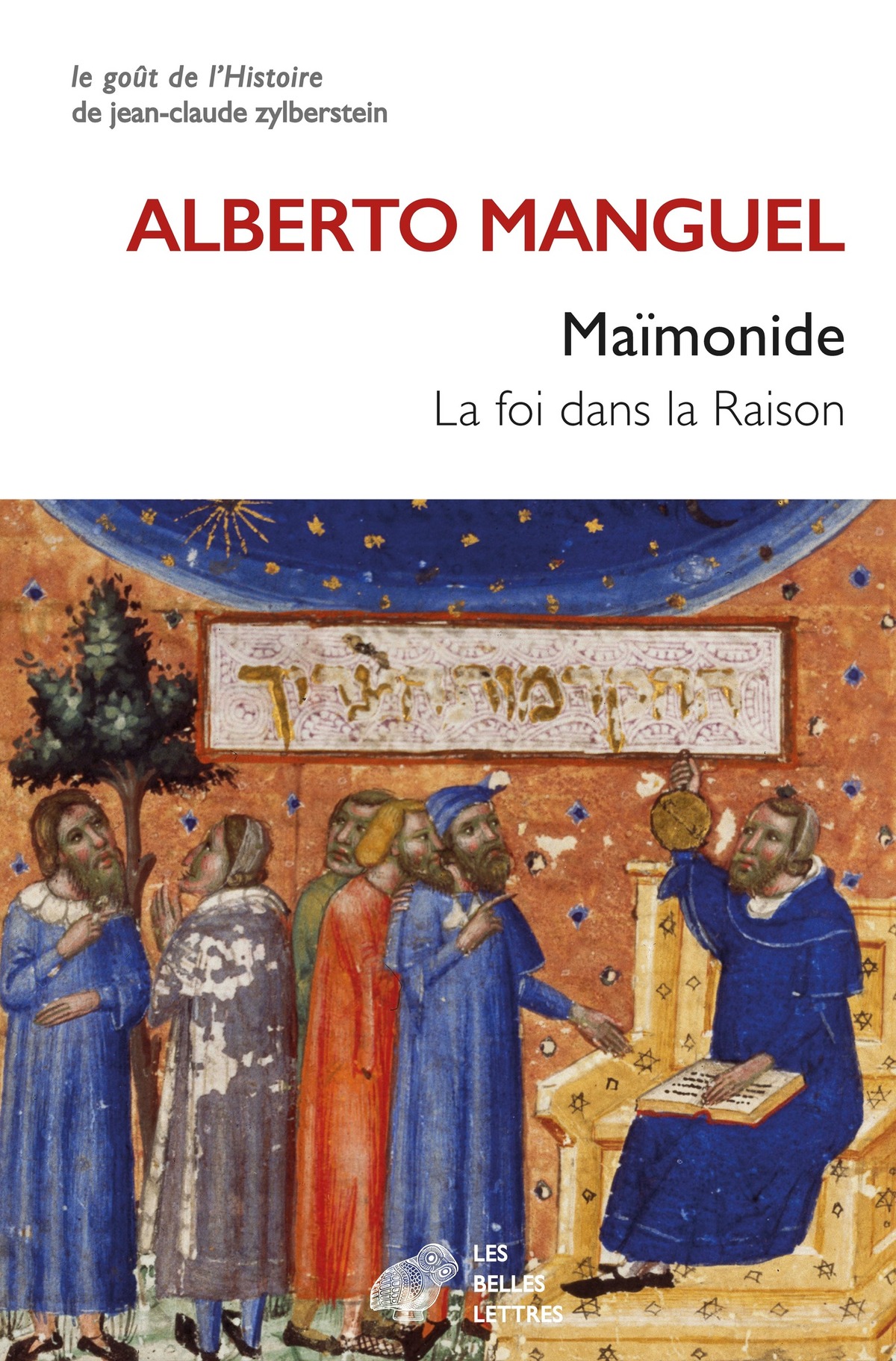
Maïmonide a marqué de sa présence emblématique les trois cultures, arabes, juives et chrétiennes, qui ont cohabité en al‑Andalus il y a près d’un millénaire. Tout au long d’une vie d’exil forcé, il a étendu l’influence de son intellect dans les domaines du droit, de la philosophie et de la médecine.
Son recours à la pensée aristotélicienne pour structurer de nouveaux systèmes d’exploration intellectuelle a changé la manière dont la philosophie judéo-chrétienne était considérée. Thomas d’Aquin, Albertus Magnus, Vincent de Beauvais, Duns Scot, Pic de la Mirandole, tous ont reconnu Maïmonide comme l’un de leurs maîtres essentiels.
La foi profonde de Maïmonide dans la capacité de l’esprit humain à saisir ce qui semble insaisissable, et sa tentative d’enrichir le langage de la théologie avec ceux de la science, du droit et de la logique, peuvent peut-être nous aider à restaurer aujourd’hui le prestige perdu de l’acte intellectuel.
Alberto Manguel est un écrivain, traducteur et éditeur qui se définit lui-même comme lecteur. Mais quel lecteur ! Il est l’auteur d’une célèbre Histoire de la lecture et d’une trentaine d’autres ouvrages (tous traduits en français) où se déploient son immense érudition et un humour mus par une curiosité encyclopédique.
Table des matières :
Préface
La figure de Maïmonide
Al-Andalus
Afrique du Nord et Palestine
En Égypte
Maïmonide médecin
Maïmonide lettré
Maïmonide philosophe
Maïmonide croyant
Comment se comporter dans l’adversité ?
Les leçons de l’Exode
Le Talmud
La Loi
Le Mishneh Torah
Le Guide des perplexes
Qu’est-ce que la vertu ?
Lire Maïmonide Conclusion Principales oeuvres de Maïmonide Remerciements
Informations pratiques :
Alberto Manguel, Maïmonide. La foi dans la Raison, Paris, Les Belles Lettres, 2024 ; 1 vol., 264 p. (Le Goût de l’Histoire). ISBN : 978-2-25145-601-0. Prix : € 15,50.
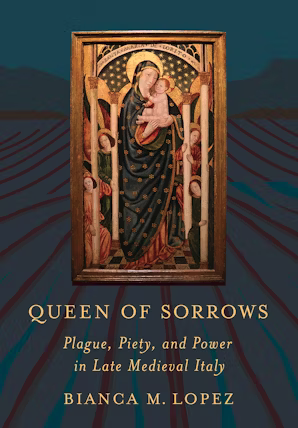
Queen of Sorrows takes an original approach to both late-medieval Italian history and the history of Christianity, using quantitative and qualitative analyses of a remarkable archive of 1,904 testaments to determine patterns in giving to the Virgin of Loreto shrine in the late fourteenth and early fifteenth centuries. Bianca M. Lopez argues that in central Italy, as elsewhere, the cult of the Virgin Mary gained new prominence at this time of unprecedented mortality. Individuals gave to Santa Maria di Loreto, which houses the structure in which Mary is believed to have lived, as an expression of their grief in the hope of strengthening family lineages beyond death and to care for loved ones believed to be languishing in purgatory.
Lopez establishes statistical correlations between different social groups and their donations to Loreto over time, uncovering informative new historical patterns such as the prominence of widow and migrant donors in the notarial record. The testaments also provide a social history of Recanati, revealing how its denizens venerated Mary as a saint with unrivaled spiritual power and uniquely sympathetic to grief, having lost her own son, Jesus. In the fourteenth century, plague survivors transformed their anguish into Marian devotion. The devastation of the plague brought the Virgin out of noble courts and monasteries and onto city streets. As Queen of Sorrows details, however, the popularity and growing wealth of Loreto’s Marian shrine attracted the attention of the papacy and peninsular seigneurial lords, who eventually brought Santa Maria di Loreto under the control of the Church.
Bianca M. Lopez is W. R. Nicholson Endowed Assistant Professor of Medieval and Renaissance Studies Southern Methodist University.
Informations pratiques :
Bianca M. Lopez, Queen of Sorrows. Plague, Piety, and Power in Late Medieval Italy, Ithaca (NY), Cornell University Press, 2024 ; 1 vol., 228 p. ISBN : 978-1-50177-591-8. Prix : USD 56,95.
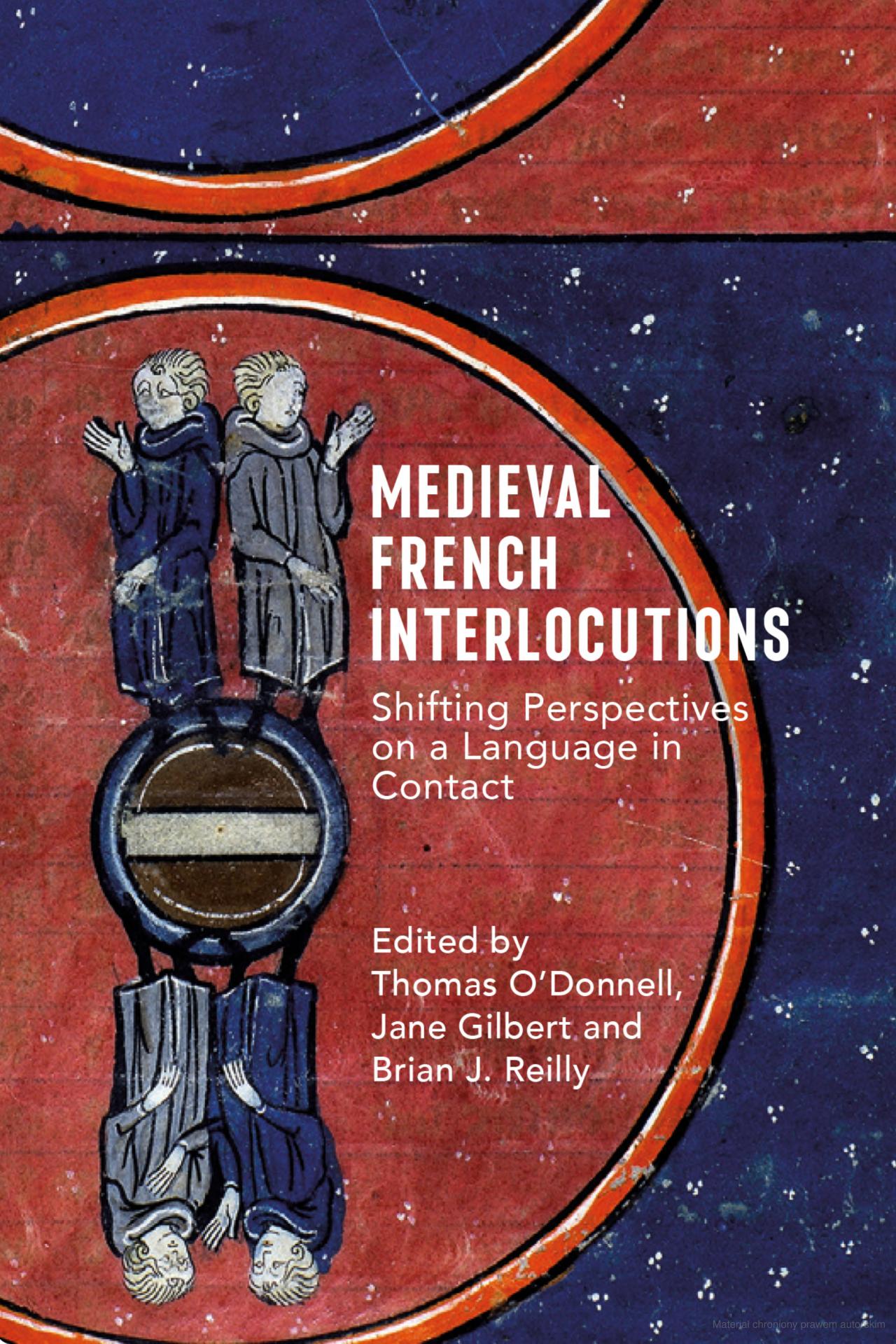
French came into contact with many other languages in the Middle Ages: not just English, Italian and Latin, but also Arabic, Dutch, German, Greek, Hebrew, Irish, Occitan, Sicilian, Spanish and Welsh. Its movement was impelled by trade, pilgrimage, crusade, migration, colonisation and conquest, and its contact zones included Muslim, Jewish and Christian communities, among others. Writers in these contact zones often expressed themselves and their worlds in French; but other languages and cultural settings could also challenge, reframe or even ignore French-users’ prestige and self-understanding.
The essays collected here offer cross-disciplinary perspectives on the use of French in the medieval world, moving away from canonical texts, well-known controversies and conventional framings. Whether considering theories of the vernacular in Outremer, Marco Polo and the global Middle Ages, or the literary patronage of aristocrats and urban patricians, their interlocutions throw new light on connected and contested literary cultures in Europe and beyond.
THOMAS O’DONNELL is Associate Professor of English and Medieval Studies at Fordham University, New York, USA.
JANE GILBERT is Professor of Medieval Literature and Critical Theory at University College London, UK.
BRIAN J. REILLY is Associate Professor of French at Fordham University, New York, USA.
Table des matières :
List of Illustrations Contributors Acknowledgements List of Abbreviations
Introduction – Thomas O’Donnell, Jane Gilbert and Brian J. Reilly
1. Our Language and the Others: Old French Glosses in Berekhiah Ha-Naqdan’s Uncle and Nephew and Commentary on the Book of Job – Ruth Nisse 2. From Liutprand of Cremona to Robert de Clari: Wonder and the Translation of Knowledge Before and After the Crusader Conquest of Constantinople – Teresa Shawcross 3. Mixed Metaphors, Mixed Forms: Across Medieval Hebrew and French Prosimetra – Isabelle Levy 4. Deeds and Dialogue from a French-Irish Medieval Cultural Sphere – Máire Ní Mhaonaigh 5. The Presence of French in German Courtly Literature c.1200 – Mark Chinca 6. Marco Polo and the Multilingual Middle Ages – Sharon Kinoshita 7. Romancing Allegory: Theories of the Vernacular in Outremer – Uri Zvi Shachar 8. ‘Dize en la estoria francesca’: The Circulation of Francophone Matter of Antiquity in Medieval Castile (c.1200-1369) – Clara Pascual-Argente 9. Anxiety in the Contact Zone: The Debate of the Body and the Soul in late-medieval French and Occitan poetry – Catherine Léglu 10. The Uses of French in Medieval Wales – Georgia Henley 11. In Between Dutch and French: Multilingual Literary Patronage of the Flemish Nobility in the Fifteenth Century – Bart Besamusca and Lisa Demets 12. Sicilian Multilingualism and Cosmopolitan French – Karla Mallette
Bibliography Index
Informations pratiques :
Medieval French Interlocutions. Shifting Perspectives on a Language in Contact, éd. Thomas O’Donnell, Jane Gilbert, Brian J. Reilly, Woodbridge, York Medieval Press, 2024 ; 1 vol., 368 p. ISBN : 9781914049149. Prix : GBP 90,00.
Avec le soutien du FNRS, du CRHiDI (UCLouvain – Saint-Louis, Bruxelles), d'INCAL (UCLouvain), de PraME (UNamur), de sociAMM (ULB) et de Transitions (ULiège)











 L'Agenda des Médiévistes
Vous devez être connecté pour poster un commentaire.