Publication – « La Poétique des passions à la Renaissance. Mélanges offerts à Françoise Charpentier », éd. François Lecercle, Simone Perrier

De la médecine à la philosophie et la littérature, il n’est guère de domaine où les passions ne posent question. Croisant les approches théoriques, historiques, esthétiques et stylistiques, ce recueil étudie aussi bien les spéculations des théoriciens que les modalités concrètes de l’expression des passions.

Table des matières : ici

Informations pratiques :

La Poétique des passions à la Renaissance. Mélanges offerts à Françoise Charpentier, éd. François Lecercle, Simone Perrier, Paris, Classiques Garnier, 2024 ; 1 vol., 427 p. (Rencontres, 197 ; Colloques, congrès et conférences sur la Renaissance européenne, 22). ISBN : 978-2-406-08901-8. Prix : € 48,00.

Source : Classiques Garnier

Publié dans Publications | Laisser un commentaire

Appel à contribution – (Re)Animating the Middle Ages: Adapting the Medieval in Animated Media

Co-organizers Michael A. Torregrossa, Karen Casey Casebier, and Carl B. Sell

Sponsored by Association for the Advancement of Scholarship and Teaching of the Medieval in Popular Culture

Call for Papers – Please Submit Proposals by 30 September 2024
56th Annual Convention of Northeast Modern Language Association (NeMLA)
Philadelphia Marriott Downtown (Philadelphia, PA)
On-site event: 6-9 March 2025

Our conception of the Middle Ages is usually formed by the versions of the medieval past we experienced as children, and, because they are considered suitable for young viewers, animated depictions of this world often represent our earliest exposure to the events, personages, and stories of this era. Consequently, the animated creations of the Walt Disney Company have played a huge part in shaping our collective image of the Middle Ages, but the corpus of medieval-themed animation is truly vast. It has been expanded greatly by the output of many other content producers across the globe through anime, cartoons, films, games, streaming videos, and theatrical shorts. (See our list of representative texts–at https://tinyurl.com/ReAnimatingtheMiddleAgesCFP–for examples.)

Despite animation’s important role in shaping how we perceive and receive the medieval past, the field of Medieval Animation Studies remains limited, especially compared to the fluorescence of Medieval Film Studies and Medieval Television Studies over the past four decades. In this panel, we seek in particular to build upon the pioneering work of medieval-animation scholar Michael N. Salda and provide additional insights into the ways medieval-themed animation has impacted our contemporary world. Presenters might explore anime, cartoons, films, games, shorts, and videos produced through traditional ink-and-paint, stop-motion, claymation, or computer-generated imagery. Selections should represent and/or engage with some aspect of the medieval, such as artifacts, characters, settings, themes, etc. These might be central to the narrative, tangential, or appearing solely as cameos. (For ideas and support, we have created a list of representative texts and a resource guide devoted to studies of medieval-themed animation. It can be accessed at https://tinyurl.com/ReAnimatingtheMiddleAgesCFP.)

Submission Instructions

In this panel, we seek in particular to build upon the pioneering work of medieval-animation scholar Michael N. Salda and provide additional insights into the ways medieval-themed animation has impacted our contemporary world. Presenters might explore anime, cartoons, films, games, shorts, and videos produced through traditional ink-and-paint, stop-motion, claymation, or computer-generated imagery. Selections should represent and/or engage with some aspect of the medieval, such as artifacts, characters, settings, themes, etc., presented as central to the narrative, tangential, or appearing solely as cameos.

For ideas and support, please see our list of representative texts and resource guide devoted to studies of medieval-themed animation at https://tinyurl.com/ReAnimatingtheMiddleAgesCFP.

All proposals must be submitted into the CFPList system at https://cfplist.com/nemla/Home/S/21105 by 30 September 2024. You will be prompted to create an account with NeMLA (if you do not already have one) and, then, to complete sections on Title, Abstract, and Media Needs.

Notification on the status of your submission will be made by 16 October 2024. If accepted, NeMLA asks you to confirm your participation with the session chairs by accepting their invitations and by registering for the event. The deadline for Registration/Membership is 9 December 2024.

Be advised of the following policies of the Convention: All participants must be members of NeMLA for the year of the conference. Participants may present on up to two sessions of different types (panels/seminars are considered of the same type). Submitters to the CFP site cannot upload the same abstract twice.(See the NeMLA Presenter Policies page, at https://www.nemla.org/convention/policies.html, for further details,)

NeMLA offers limited funding for travel to graduate students and to contingent faculty, adjunct instructors, independent scholars, and two-year college faculty. Details can be found at the NeMLA Travel Awards page at https://www.nemla.org/awards/travel.html.

Thank you for your interest in our session. Please address questions and/or concerns to the organizers at MedievalinPopularCulture@gmail.com.

For more information on the Association for the Advancement of Scholarship and Teaching of the Medieval in Popular Culture, please visit our website at https://MedievalinPopularCulture.blogspot.com/.

Source : The Medieval Academy Blog

Publié dans Appel à contributions | Laisser un commentaire

Bourse – AVISTA Graduate Student Research Grant

The application for the AVISTA Graduate Student Research Grant for the study of art and architecture across borders in the medieval world is now open!

This grant of $500 is intended to support an early-stage graduate student’s research on the theme of art that crosses the borders or peripheries of the medieval world. Funds should support research and/or dissemination of scholarship, which may include expenses for conference travel, site visits, or archive visits. The award includes a one-year gift membership to AVISTA.

We are grateful to Robert E. Jamison, Professor Emeritus of Mathematics, Clemson University, for underwriting this grant.

The deadline for submitting your application is October 15, 2024, 5:00pm ET.

For the full application instructions and guidelines please see the link below:
https://www.avista.org/opportunities-prizes-and-grants

Source : Medieval Art Research

Publié dans Bourse | Laisser un commentaire

Publication – « D’or, de fer et de terre. La collection mérovingienne des Archives départementales des Ardennes », éd. Lorraine Desart, Olivier Brun, Jean-Pierre Lémant, Éric Montat, Line Pastor, Patrick Périn, Ana Ribeiro, Florent Simonet, Caroline Trémeaud

Cette publication, fruit de la collaboration de plusieurs chercheurs, est le résultat du récolement de la collection d’objets mérovingiens conservée aux Archives départementales des Ardennes depuis 1966. Ce riche mobilier a été réuni par Henri Viot, fouilleur amateur, lors de l’exploration de nombreuses nécropoles mérovingiennes ardennaises.

L’ouvrage comporte deux parties présentant en premier lieu la collection « Viot », le contexte dans lequel elle a été rassemblée et son histoire, des années 1960 à nos jours et, en second lieu, le catalogue du mobilier mérovingien.

Informations pratiques :

D’or, de fer et de terre. La collection mérovingienne des Archives départementales des Ardennes, éd. Lorraine Desart, Olivier Brun, Jean-Pierre Lémant, Éric Montat, Line Pastor, Patrick Périn, Ana Ribeiro, Florent Simonet, Caroline Trémeaud, Reims, Société Archéologique Champenoise, 2024 ; 1 vol., 256 p. (Bulletin de la Société archéologique champenoise, 116, n°2).

Source : Librairie archéologique

Publié dans Publications | Laisser un commentaire

Appel à contribution – Plunder, Pillage and Spoils of War in History and Law

‘Looting’ or ‘plunder’ – the appropriation of material goods as the outcome of warfare – has received renewed attention in recent years. Interest has focused on both the immediate act of looting in contemporary warzones from Syria to the Ukraine, as well as its legacy in respect of the way in which Western museums acquired their collections. However, the urge not just to defeat an opponent but to strip them of their possessions has been consistent throughout history. The fact of being looted has often enhanced the status of particular objects, from the Roman practice of displaying spolia to the Native American practice of ‘counting coup’ through the acquisition of an opponent’s horse or weapons. Yet plunder also has a significant material component: the ashigaru soldiers, whose use of firearms revolutionised Japanese warfare, originated in groups of impoverished farmers following an army in order to systematically despoil the enemy. Whatever the motive, spoils of war of all kinds flowed from battlefields to the centres of civil and religious authority, traversing national boundaries and diverse geographies, communicating unexplored histories of cross-cultural contact.

This conference seeks to bring to bear on the topic the widest range possible of thematic, disciplinary, geographical, and chronological perspectives. Its goal is to disentangle specific manifestations of looting from their fundamental, underlying, anthropological motivations, allowing us to understand all aspects of plunder more effectively. It will explore how different societies have prohibited, regulated, and encouraged the phenomenon of loot, and the historical, social, legal, cultural, and political motivations which such practices reveal.

The conference will take place 28–29 of April at The Royal Armouries Museum, Leeds, UK. We welcome proposals by scholars at all stages, including PhD and early career. A number of bursaries will be available to assist with attendance expenses and we would especially like to be able to support traditionally underrepresented scholarship.

We welcome any of the four following types of proposal:

• Individual papers (20 minutes plus Q&A) (https://forms.office.com/e/UzQePkeJLg)

• Chaired panel proposals of three papers (20 minutes plus Q&A) including chair (https://forms.office.com/e/jfvuZwxkLD)

• ‘Lightning presentations’ (5 minutes plus Q&A) focused on a particular artefact. (https://forms.office.com/e/8jXXp8stYc)

• Poster presentation (https://forms.office.com/e/689yb2iKRC)

Follow the appropriate link to submit your proposal by 5pm GMT on Friday 11 October. 

For any queries please contact Connor Wilson (Connor.Wilson@mmu.ac.uk) and Mark Bennett (Mark.Bennett@armouries.org.uk)

Publié dans Appel à contributions | Laisser un commentaire

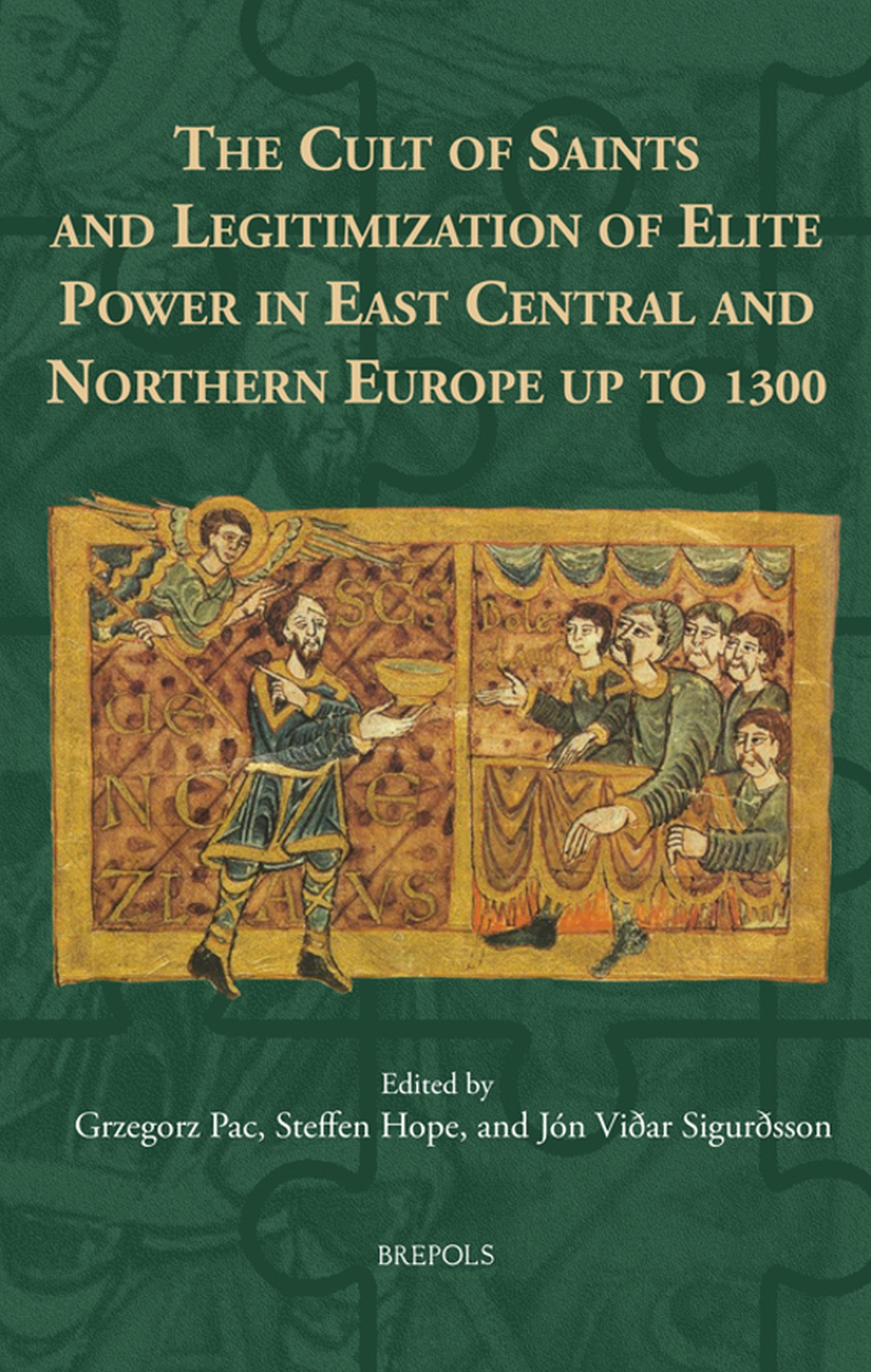
Publication – « The Cult of Saints and Legitimization of Elite Power in East Central and Northern Europe up to 1300 », éd. Grzegorz Pac, Steffen Hope, Jon Vidar Sigurdsson

While Northern and East Central Europe are often considered to have been peripheral parts of medieval Latin Christendom, they nevertheless embraced many of the same cultural impulses found in more central areas. Key among these was the way in which social elites, in the first centuries after the introduction of Christianity, recognized the potential to exploit the cult of saints as a way of legitimizing their own social standing. Taking this thematic focus as its starting point, this volume explores the intersection of religion, power, and the reception and development of new impulses from abroad within Northern and East Central Europe. It does so by comparing and contrasting cults that emerged locally with cults that were imported to the region. Through this comparative overview, the chapters of this volume not only contribute to a more nuanced understanding of these outlying regions, but also shed new light on Latin Christian Europe as a whole.

Table des matières :

List of Illustrations

Preface

Introduction

1. Saints and Elites on the Periphery: An Introduction
Steffen Hope, Grzegorz Pac, and Jón Viðar Sigurðsson

Part I. Non-native Saints

Non-native Saints: Introduction
Steffen Hope, Grzegorz Pac, and Jón Viðar Sigurðsson

2. The Authority of the Virgin. The Use of the Marian Cult in the Legitimization of Power in the Kingdom of Hungary before 1300
Karen Stark

3. Aegis of Aegidius — the Cult of St Giles in Eleventh- and Twelfth-Century Poland
Miłosz Sosnowski

4. The Apostles and Ecclesiastical Elites in Medieval Iceland. A Gregorian Hermeneutic Turn in the Medieval North
Haraldur Hreinsson

5. From St Florian to St Stanislaus. The Legitimization of Ducal and Episcopal Power in Kraków in the Late Twelfth and Early Thirteenth Century
Karolina Morawska

6. From St Olaf to the Relic of the Crown of Thorns. The Legitimization of Royal Power in Thirteenth-Century Norway
Jerzy Pysiak

7. Sanctity in Service. Saints in the Legitimation of the Presence of the Dominicans in Hungary
Eszter Konrád

Part II. Native Saints

Native Saints: Introduction
Steffen Hope, Grzegorz Pac, and Jón Viðar Sigurðsson

8. The Prague Nunnery and its Patroness, St Ludmila. Legitimization and Mutual Support
Grzegorz Pac

9. Many Lives of One Man. Strategies for Building Legitimacy through the Story of St Wenceslas in Early and High Medieval Hagiography (940s–1260s)
David Kalhous

10. The Cult of Saints in Elite Identity Construction in the Peripheries. The Cases of St Cnut of Denmark and St Wenceslas of Bohemia
Kacper Bylinka

11. The Canonization Accounts of St Stephen of Hungary, St Thorlak of Skálholt, and St Cnut of Odense. A Comparative Reading
Haki Antonsson

12. Legitimizing Episcopal Power in Twelfth-Century Denmark through the Cult of Saints
Steffen Hope

13. A Mutually Beneficial Relationship. Saints and the Legitimization of Elite Ecclesiastical Institutions in Sweden and Denmark before 1300
Sara Ellis Nilsson

14. The Liturgical Performance of Saints’ Offices in Medieval Sweden. Multimodal and Performative Event in a Legitimizing Context
Karin Lagergren

15. St Hedwig of Silesia. The First Dynastic Saint of the Piasts and the Legitimization of Power at a Time of Change in the Thirteenth Century
Anna Agnieszka Dryblak

16. The Legitimization of Papal Power through the Cults of Royal Women in Thirteenth-Century East Central Europe
Kirsty Day

Conclusions

17. The Cult of Saints and the Legitimization of Ecclesiastical and Secular Elites on the Periphery: Conclusions
Steffen Hope, Grzegorz Pac, and Jón Viðar Sigurðsson

Index

Informations pratiques :

The Cult of Saints and Legitimization of Elite Power in East Central and Northern Europe up to 1300, éd. Grzegorz Pac, Steffen Hope, Jon Vidar Sigurdsson, Turnhout, Brepols, 2024 ; 1 vol., 472 p. (Comparative Perspectives on Medieval History, 2). ISBN : 978-2-503-61108-2. Prix : € 100,00.

Source : Brepols

Publié dans Publications | Laisser un commentaire

Publication – « L’Humanisme dans les anciens Pays-Bas, XVIe – XVIIe siècles », éd. Laurence Baudoux-Rousseau, Charles Giry-Deloison

L’humanisme dans les anciens Pays-Bas, XVIe-XVIIe siècles interroge les diverses manifestations de ce mouvement en Artois, en Flandre et dans le Hainaut. Une attention particulière est portée aux personnalités – historiens, poètes, exégètes, chroniqueurs, voyageurs… qui ont gravité autour des principaux centres, tels que Saint-Omer, Arras, Mons –, à la circulation de la littérature humaniste dans ces régions, au rôle des libraires-imprimeurs dans la diffusion des idées humanistes et donc au marché du livre. L’ouvrage met également en lumière les réseaux internationaux créés ou entretenus par cette élite intellectuelle et leurs contributions aux transferts et échanges avec des pays plus ou moins lointains (Angleterre, Espagne, France, Italie, Portugal…).

Il rassemble neuf communications données au colloque international Les échanges humanistes dans les provinces du Nord pendant la Renaissance, tenu les 7 et 8 juin 2019 à la bibliothèque de Saint-Omer (Pas-de-Calais). Le colloque réunissait des universitaires et chercheurs du Canada, de Belgique, d’Espagne, de France, d’Italien, du Pays de Galles et des Pays-Bas. Il s’inscrivait dans la continuité des journées d’études annuelles organisées dans le cadre d’un programme de recherche pluridisciplinaire, La Renaissance dans les Provinces du Nord, coordonné de 2015 à 2020 par Laurence Baudoux-Rousseau et Charles Giry-Deloison, tous deux membres de l’UR 4027 CREHS de l’Université d’Artois. Cette publication complète celle parue en 2022 sur La Renaissance dans les anciens Pays-Bas, XVIe-XVIIe siècles qui reprenait la plupart des communications données lors des journées d’études.

Informations pratiques :

L’humanisme dans les anciens Pays-Bas, XVIe – XVIIe siècles, éd. Laurence Baudoux-Rousseau, Charles Giry-Deloison, Aire-sur-la-Lys, ateliergaleriéditions, 2024 ; 1 vol., 232 p. ISBN : 978-2-916601-93-9. Prix : € 29,00.

Source : ateliergaleriéditions

Publié dans Publications | Laisser un commentaire

Appel à contribution – “Spaces that Matter” at the International Medieval Congress in Leeds 2025

“Spaces that Matter: Enclosed and Secluded Places in Early and Middle Byzantine Hagiography” (P34478-G) is a four-year project funded by the Austrian Science Fund (FWF) and housed at the Austrian Academy of Sciences in Vienna. The project examines various aspects of spaces, with a focus
on enclosed spaces, in hagiographical texts.

The project has a twofold aim: first, to examine how places of confinement and seclusion are depicted in saints’ Lives on a literary-narrative level; and second, to study how the holy protagonists, often male and female ascetics and monastics, experience their stay in such places and to what extent this experience affects both the development of the narrative and the protagonists’ character, especially their spiritual progress (https://www.oeaw.ac.at/en/imafo/research/byzantine-research/language-text-and-
script/language-use-and-literature/spaces-that-matter).

In order to explore the project’s topic in a broader context with the aim to open new vistas for the study of space and sainthood in Byzantium and beyond, the Spaces that Matter project will organise a series of online sessions at the International Medieval Congress (IMC) 2025 at the University of Leeds, the largest scholarly gathering of its kind in Europe (7–10 July 2025, https://www.imc.leeds.ac.uk/imc-
2025/).

Confirmed speaker: Prof. Béatrice Caseau (Sorbonne Université)

We invite scholars at all career stages to submit proposals for twenty-minute papers connected with the main topics of “Spaces that Matter” that locate them in a wider comparative framework; particular focus should be on the hagiography of the Byzantine periphery and the Christian Orient (i.e. Palestinian, Italo-
Greek, Syriac, Georgian, Armenian, Coptic, Arabic, and Slavic hagiography), with or without a direct connection to the thematic strand of the 2025 IMC Leeds “Worlds of Learning”. We are particularly interested in research based on new material and novel interpretations on the theme of enclosed and secluded places in hagiographical texts and archaeological correlates. We expect that spaces, such as caves, graves, monastic cells, prisons, etc., in hagiographical narratives, visual culture, and archaeology
will be examined in relation to the respective saintly protagonists.

Scholars selected to present in the online “Spaces that Matter” sessions will have the Full Virtual Only
Registration Fees for the IMC (Standard rate or Student/Retired/Unwaged/Low-Waged rate) covered by
our FWF project. If accepted participants choose to attend the IMC Leeds 2025 in person, we expect
them to secure their own funding for travel and accommodation. However, the sessions “Spaces that
Matter” will be exclusively held virtually.

Please send paper proposals (title and an abstract of max. 300 words) in English, accompanied by a short biography (300 words max.) including affiliation, career stage and research interests, and a link to your professional/personal website or academic profile, by 13 September 2024 to Dr. Christodoulos Papavarnavas, christodoulos.papavarnavas@oeaw.ac.at. Papers will be selected by 20 September 2024
and successful candidates must confirm their participation by 23 September 2024.

Publié dans Appel à contributions | Laisser un commentaire

Appel à contribution – La peinture murale médiévale des églises de la Creuse

Depuis 2002 le Groupe de Recherches sur la Peinture Murale (GRPM) organise régulièrement en France des colloques pour faire le point des connaissances sur une thématique ou à l’échelle d’une région. Après la Bretagne en 2016, puis l’Alsace en 2019 et l’Occitanie en 2022, le prochain colloque du GRPM sera consacré en septembre 2025 pour la première fois à un département, celui de la Creuse.

Le choix de ce département paraît au premier abord surprenant, car les peintures murales de ses églises sont quasi-inconnues des spécialistes. En effet, la bibliographie sur ce sujet est des plus réduites. Le décor roman de Boussac-Bourg constitue l’unique site creusois mentionné dans les études nationales élaborées par Paul Deschamps et Marc Thibout entre 1952 et 1963. Plus récemment, les décors des ordres militaires conservés à Paulhac, La Croix-au-Bost ou Lavaufranche ont été l’objet de plusieurs articles de la part de Claude Andrault-Schmitt, Cécile Voyer et Christian Davy entre 1996 et 2020. Pourtant nombre d’églises, essentiellement paroissiales ou prieurales, conservent de la peinture murale sur leurs murs ou leurs voûtes. Le corpus des églises peintes approche la centaine et un grand nombre de leurs décors méritent une étude. L’exemple de l’église Saint-Sulpice de Banize récemment inaugurée est de ce point de vue exemplaire tant en matière de restauration que de valorisation.

Il importe donc au GRPM de faire découvrir ce patrimoine pictural à tous les publics lors de journées d’étude qui se tiendront en septembre 2025 à Guéret. Cette manifestation vise à réunir des spécialistes de différents domaines : archéologie, histoire, histoire de l’art, architecture, restauration, valorisation pour débattre et échanger leurs points de vue sur des questions d’iconographie, d’ornementation, d’histoire, de technique, de travaux de conservation-restauration ou encore de médiation et de valorisation… Ces interventions seront complétées par deux tables rondes. Une première permettra de mieux comprendre les enjeux d’un chantier de restauration, tandis que la seconde s’attachera à définir l’avenir des églises rurales, tant dans leur dimension religieuse en considérant le défi des nouveaux usages des lieux de culte que dans leur valorisation touristique en évoquant tous les outils de médiation.

Les communications sont ouvertes à tous et plus particulièrement aux jeunes chercheurs, mais aussi aux professionnels du patrimoine (architectes, conservateurs, conservateurs-restaurateurs, historiens de l’art…), propriétaires et affectataires ou membres d’associations patrimoniales. La communication portera sur un décor peint dans une église située dans la Creuse, sur une thématique concernant plusieurs églises creusoises ou sur un point de synthèse relatif à ce département. Elle peut aussi établir des comparaisons entre un ou plusieurs décors peints du département et d’autres situés hors de la Creuse.

Modalités de soumission 

Durée des communications : 20 minutes.

Les propositions de communication, d’un maximum de 1200 caractères espaces compris, seront accompagnées d’une illustration utilisable dans le cadre de la communication du colloque (affiche, flyer, diffusion en ligne…) et d’un court CV.

La photographie devra être accompagnée d’une légende et de l’indication du nom du photographe et de son institution.

Les propositions sont à envoyer à : contact@grpm.asso.fr

avant le 6 septembre 2024.

Le comité scientifique communiquera l’acceptation des propositions sélectionnées avant le 18 octobre 2024.

Calendrier

  • 6 septembre 2024 : réception des propositions
  • 18 octobre 2024 : notification d’acceptation de la communication
  • 28 mars 2025 : envoi des résumés par les auteurs
  • Juin 2025 : diffusion du programme
  • Septembre 2025 : journées d’étude
  • Février 2026 : date limite d’envoi des textes. Chaque auteur s’engage à fournir le texte de sa communication qui sera évalué par un comité de lecture et pourra être accepté ou refusé avec ou sans modifications. La publication sera électronique.

Frais

Seuls les repas de midi et les frais de déplacements (dans la limite de 150 euros pour un aller-retour) sont pris en charge par l’organisation du colloque.

Comité scientifique

  • Claire Boisseau, chargée de recherche au CNRS, Centre André Chastel (UMR8150), GRPM
  • Gaël Chenard, directeur des Archives départementales et du service culture du Conseil départemental de la Creuse
  • Christian Davy, chercheur honoraire de l’Inventaire, GRPM
  • Ilona Hans-Collas, chercheuse indépendante, GRPM
  • Christine Leduc-Gueye, chercheuse indépendante, GRPM
  • Amaëlle Marzais, maîtresse de conférences, Université Lumière Lyon 2, ArAr (UMR 5138), GRPM
  • Nicolas Védélago, Conservateur régional adjoint des Monuments historiques, DRAC Nouvelle-Aquitaine

Source : Calenda

Publié dans Appel à contributions | Laisser un commentaire

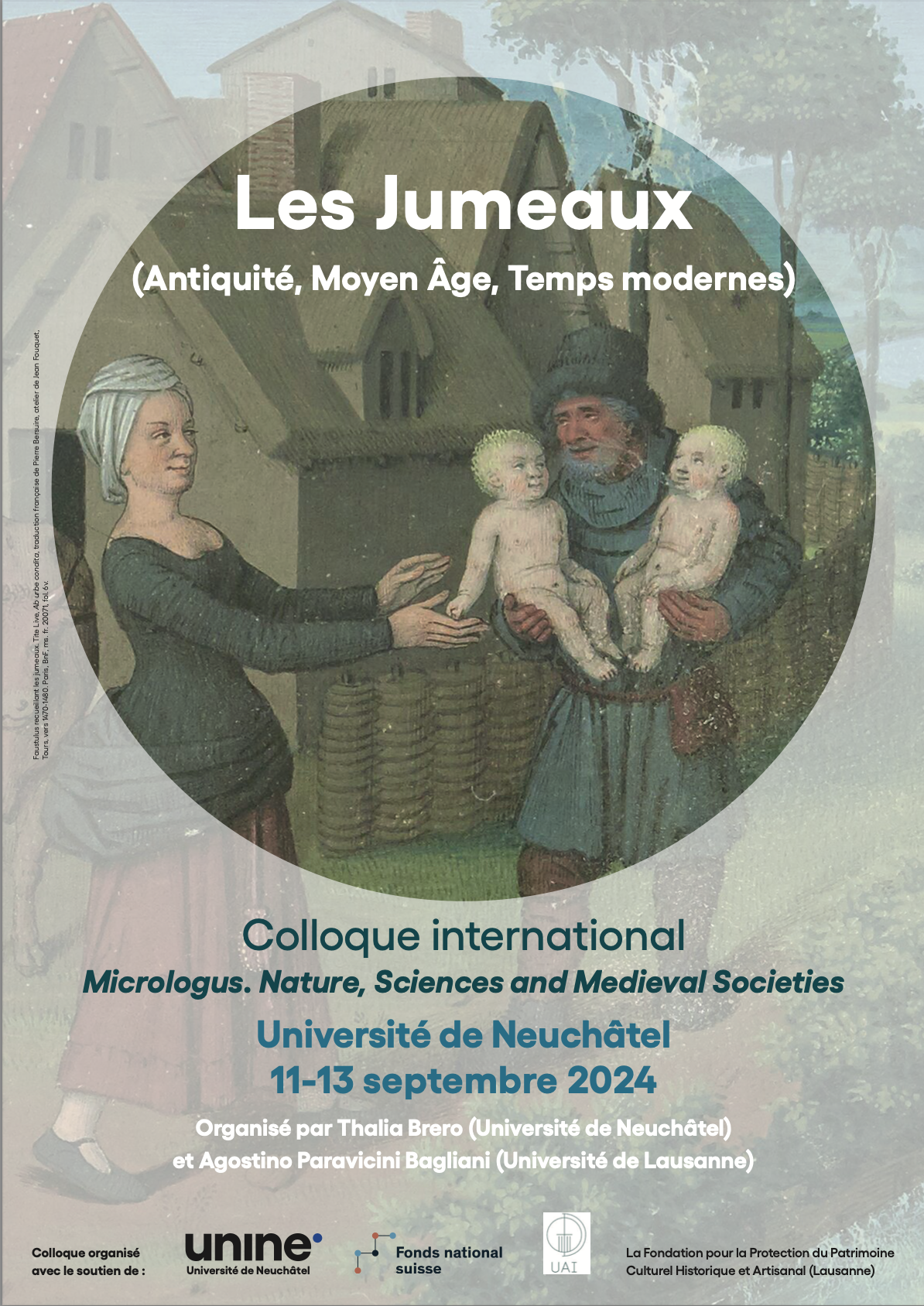
Colloque – Les jumeaux (Antiquité, Moyen Âge, Temps modernes)

Colloque international

Micrologus. Nature, Sciences and Medieval Societies
Université de Neuchâtel 11-13 septembre 2024
Organisé par Thalia Brero (Université de Neuchâtel) et Agostino Paravicini Bagliani (Université de Lausanne)

Mercredi 11 septembre
Université de Neuchâtel, Espace Tilo-Frey 1, salle RO14

Introductions

Thalia Brero (Université de Neuchâtel) – Introduction
David Baud (Université de Lausanne / CHUV) – Ce que la médecine moderne sait des jumeaux

15h45-16h00 : Pause

L’Antiquité et la Bible

Véronique Dasen (Université de Fribourg) et Fabio Spadini (Université de Lausanne) – Des jumeaux aux Gémeaux : itinéraire iconographique
Pierre Alain Mariaux (Université de Neuchâtel) – De quelques jumeaux bibliques : marquer la gémellité par l’image dans le premier Moyen Âge

Visite de la vieille ville et du château de Neuchâtel

Les jumeaux dans la société et la littérature médiévales

09h00-09h45 Didier Lett (Université Paris Cité) – Aussi excessifs et différents que des jumeaux. Considérations générales sur les jumeaux dans les textes et les images de la fin du Moyen Âge
09h45-10h30 Pierre-Louis Boyer (Le Mans Université) – Primus inter fratres. Une histoire juridique des jumeaux
10h30-10h45 Pause

Michel Pastoureau (École pratique des hautes études, Paris) L’ours et les jumeaux. De la mythologie à la chanson de geste

Jeroen Deploige (Université de Gand)
La gémellité dans les épopées et romans des XIIe et XIIIe siècles. Valeurs

sociales et règles de comportement dans le développement de la culture chevaleresque

Pause

12h15-14h15 Repas

Alain Corbellari (Universités de Lausanne et de Neuchâtel) – Olivier de Castille et Artus d’Algarbe : tradition gémellaire et roman dynastique
Claudius Sieber-Lehmann (Université de Bâle) – La diète de Worms, 1495 : Empereur & Empire, Anne & Catherine

Jean-Patrice Boudet (Université d’Orléans) – Les jumeaux dans la controverse sur l’astrologie dans l’Occident médiéval
Anna Caiozzo (Université d’Orléans) – Entre gémellité astrale et gémellité terrestre, le semblable, le différent et le complémentaire dans les représentations des mondes islamisés médiévaux

La médecine et les grossesses multiples

09h00-09h45 Mireille Ausécache (École pratique des hautes études, Paris) – Réflexions salernitaines sur les naissances gémellaires, entre théories médicales et cas cliniques complexes ou monstrueux
09h45-10h30 Gabriella Zuccolin (Université de Pavie) – Il problema dei gemelli di sesso opposto nella filosofia e nella medicina medievale

Danielle Jacquart (École pratique des hautes études, Paris) – La perte d’un jumeau in utero : les commentaires à l’aphorisme hippocratique V.38 (XIIe-XVe s.)
Concetta Pennuto (Université de Tours) – Un soignant de la Renaissance face à la superfétation : Caspar Bauhin narrateur d’histoires

Représentations – du Moyen Âge à l’époque moderne

13h30-14h15 Jan Blanc (Université de Lausanne) – Semblance et dissemblance : les représentations de jumeaux dans la peinture néerlandaise du XVIIe siècle
14h15-15h00 Francesco Paolo de Ceglia (Université de Bari Aldo Moro) – Il mio gemello vampiro. Doppi, in vita e morte, tra Medioevo ed età moderna

Conclusion

15h00-15h30 Agostino Paravicini Bagliani (Université de Lausanne) – Conclusion

Publié dans Colloque | Laisser un commentaire