Appel à contribution – Trans Sainthood in Translation, ca. 400–1500

22-23 May 2025

Organizers: Mariana Bodnaruk (Central European University, Budapest/Vienna), Stephan Bruhn (GHIL) and Michael Eber (Georg-August University, Göttingen)

Venue: German Historial Institute London

Trans saints – monachoparthenoi, saints who are initially described as female by their hagiographers, but transition to a male (often monastic) identity – are present in every late antique and medieval Christian tradition. The textual and artistic renderings of these figures offer a comparative key to conceptualizing trans bodies and trans souls across geographical and chronological boundaries. Binary cis-heteronormativity has long been portrayed as unchanging and unchangeable, as outside of the scope of history. This is a central plank in the playbook followed by transphobes worldwide, in the ever-escalating “culture war” against trans and queer people. Highlighting both the ubiquity and multivalence of premodern trans monks, and connecting across disciplinary divides to do so, is urgent work, not least because it provides a necessary counterpoint to such historically inaccurate rhetoric. 

Following the insights of the “performative turn” in queer and trans studies that underscores the enactment and negotiation of gender identity through lived experiences, social practices, and narratives, we welcome explorations of gender and sexuality in the textual traditions in both East and West and in their translation. We also take into consideration aspects related to the ”performative turn” in visual studies in the last decade, as relevant for both medieval Eastern and Western hagiographic iconographies of trans saints, focusing on visual representations actively shaping identities and power dynamics and incorporating the embodied experience of the ritual practices. 

While texts regarding fifteen trans saints are attested in the Eastern Mediterranean, this conference will focus on those whose vitae were available in Greek as well as in Latin: Eugenia*us, Euphrosyne*Smaragdus, Marina*us, Pelagia*us and Theodora*us. However, we particularly invite papers covering linguistic and artistic traditions beyond Greek and Latin, from Coptic to Old Norse. Taking seriously the connectivity of the Latin West, the Orthodox East, and the Islamic World in the Middle Ages, we adopt a trans-cultural comparative approach. Thus, contributions with a multilingual perspective are particularly welcome, as are those covering both textual and iconographic representations. Conference proceedings may be published as an edited volume. 

We invite proposals for 20-minute papers. Possible questions include – but are not limited to – the following: 

  • How are the trans saints described as performing their gender? What gendered language is used in different traditions of their vitae? 
  • What role does sexual desire play in the performance of gender? Who is desirable to whom, and in what context? 
  • What role do familial ties (biological and spiritual) play in the construction of the trans saint’s gender? 
  • How does the trans saint’s performance of gender intersect with other aspects of their identity – religion, ethnicity, social status, age? 
  • How are trans saints translated – as texts (between languages), as relics (between places), as visual representations (from text to image)? Does re-writing/translating/visualizing a vita change the way the saint is gendered? 
  • Do different linguistic traditions of these vitae engage differently with locally important intertexts/spaces/etc.? 
  • How are trans saints materialized – in manuscripts, sculpture, iconography, cult spaces? 

To apply, please send an abstract of up to 300 words, as well as your name, pronouns, and a short bio, to michael.eber@history.ox.ac.uk by September 30, 2024. We welcome applications from scholars at any stage of their career, but particularly encourage early career researchers to apply. We are currently in the process of acquiring funding to cover at least part of the participants’ travel expenses

Call for Papers (PDF file)

Source : German Historical Institute London
Publié dans Appel à contributions | Laisser un commentaire

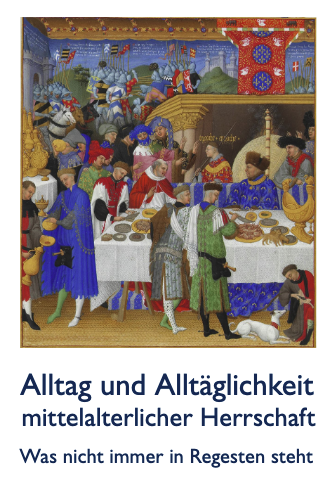
Colloque – Alltag und Alltäglichkeit der Herrschaft. Was nicht immer in den Regesten steht

„Herrschaft“ ist ein Begriff, der bei aller Umstrittenheit aus der Geschichtswissenschaft kaum wegzudenken ist. Für gewöhnlich findet er seine Anwendung im Bereich der politischen Geschichte, wo er die Überordnung von „Herrschenden“ über „Beherrschte“ bezeichnet, damit als Grund sozialer Hierarchien, als Mittel zur Durchsetzung politischer Konzepte oder politischen Willens, als Beschreibung für Zuordnungen und Einflusssphären gilt. So haben sich auch die Regesta Imperii zur Aufgabe gesetzt, Herrscherhandeln zu dokumentieren, also die praktische Umsetzung von Herrschaft durch einen König oder Kaiser zu verzeichnen. Doch spielt sich „Herrschaft“ auch auf Ebenen jenseits bewusster und reflektierter Aktionen ab. Elitenbasierte Gesellschaften verfügen in aller Regel über ein feingliedriges System von Kennzeichen, Verhaltensmustern und Ritualen, durch welche die Unterscheidung zwischen „oben“ und „unten“ bis in die Alltäglichkeit hinein sichtbar gemacht und aufrechterhalten wird. Es sind eben jene „social markers“, die eine bedeutende Rolle in der Resilienz dieser Gesellschaften spielen, zumal durch sie eine Art stillschweigender Konsens erzeugt wird, eine gelebte und immer wieder inszenierte Akzeptanz der bestehenden Verhältnisse.

Auswärtige Gäste sowie Mitarbeitende an den Regesta Imperii spüren in kurzen Statements den Phänomenen von „Alltag und Alltäglichkeit der Herrschaft“ über das gesamte Mittelalter hinweg nach. Thematisch geordnete Vorträge sollen am Ende Elemente des „typisch Mittelalterlichen“ in der Herrschaft von Königen und Päpsten zu erkennen geben.

Dienstag, 1. Oktober

13.00 Einleitende Bemerkungen

Moderation: Daniel Ziemann, Wien
13.30 Der Name der Herrschaft
– Eine epistolographische Relativitätstheorie – Adressaten und Absender in der päpstlichen Korrespondenz des Frühmittelalters (Veronika Unger, Erlangen)
– Namen, Titel, Epitheta: Herrscherbezeichnungen im Diskurs (Florian Hartmann, Aachen)

14.15 Zeiten der Herrschaft
– Kaiserwetter? Herrschaft und Klima in der Salierzeit (Matthias Weber, Bochum)
– Ein Sommer als Gesandter am Kaiserhof. Das Briefkonzeptbuch des Nürnbergers Jobst Tetzel V. von 1464 (Jörg Feuchter, Berlin)

15.00-15.30 Pause

15.30 Kommunikation der Herrschaft
– Der Erzbischof als Influencer? Der herrschaftliche Alltag Adalberts von Mainz im Spiegel seiner Urkunden und Briefe (Jan Lemmer, Köln)
– Der Kaiser und die sieben Söldner – administrative Quellen (Christina Abel, Saarbrücken)

16.15 Der Leib der Herrschaft
– „Mein Haus soll ein Haus der Trunkenheit sein“: Eine satirische Schilderung von Alltag und Herrschaft am Hof Urbans II. (Georg Strack, Marburg)
– Macht geht durch den Magen: Essbare Herrschaftsrepräsentation bei Kaiser Friedrich III. (Steffen Krieb, Mainz)

18.00 Abendvortrag:
Der Kaiser als Erbsenzähler? – Alltag, Personalia und Gender Pay Gap am Hof Maximilians I. (Andreas Zajic, Wien)

Mittwoch, 2. Oktober

Moderation: Sabine von Heusinger, Köln
9.00 Gezeigte Herrschaft
– Das Ellwanger Kästchen – wie wird Herrschaft sichtbar gemacht? (Magdalena Berkes, Marburg)
– Zehn Falken für den Kaiser. Geschenke, Betrug und Drohungen in der Kommunikation zwischen Ludwig IV. und den Reichsstädten Lübeck und Dortmund (Doris Bulach, München)

9.45 Ungesehene Herrschaft
– Pervenit ad aures nostras – aber nicht ins Regest. Das Beispiel des päpstlichen Hofes (Jochen Johrendt, Wuppertal)
– Ich sehe was, das Du nicht liest: Verborgene Botschaften aus Regesten zur Praxis des Herrschens (Miriam Weiss, Saarbrücken)

10.30 – 11.00 Pause

11.00 Recht und Herrschaft
– Der Alltag des Rechts: Kaiser Ludwig der Fromme als Richter (Karl Ubl, Köln)
– Ein Tag beim Kammergericht (Petra Heinicker, Berlin)

11.45 Umstände der Herrschaft
– Wenn’s mal wieder schnell gehen muss: Zur Reisegeschwindigkeit in der Salierzeit (Dirk Jäckel, Bochum)
– Wie der Vater, so der Sohn? Herrschen mit Emotionen am Beispiel Heinrichs VII. in Italien und Johanns von Luxemburg in Böhmen (Michel Margue, Luxemburg)

12.30 Schlussbemerkung
13.00 Ende der Tagung

Informations pratiques :

Oktober 2024, 1. und 2.

Akademie der Wissenschaften und der Literatur | Mainz Geschwister-Scholl-Straße 2 55131 Mainz

Anmeldung unter:
https://events.adwmainz.de/tagungri/

Source : Regesta Imperii

Publié dans Colloque | Laisser un commentaire

Offre d’emploi – Archéologie Alsace – Centre de conservation et d’étude Bas Rhin – Haut Rhin

Archéologie Alsace – Centre de conservation et d’étude Bas Rhin – Haut Rhin
11 rue Jean François Champollion
67600 SELESTAT

Dans la perspective de pouvoir répondre aux différents projets d’aménagement résultant de la loi Climat et Résilience – objectif ZAN – et des différents projets liés à des problématiques de transition écologique (développement des réseaux de chaleur ; réseaux photovoltaïques ; projets de déminéralisation de cours d’écoles ; projets de réaménagement et végétalisation d’espaces urbains et périurbains ; projets de linéaires urbains et mobilités douces ; réaménagement de dents creuses dans les centre villes ; réhabilitations de friches industrielles ; projets liés aux cadres « Petites Villes de Demain » ; « Action Cœur de Ville » et « Action Cœur de Ville 2 » ; et tout autre type de projet à impact environnemental), il est souhaité de pouvoir recruter deux responsables d’opérations dotés d’une solide expérience dans la conduite d’opération en milieu urbain et périurbain, sur le cadre du contrat de projet.


Missions :
Supervise, assure ou participe aux opérations d’archéologie préventive, diagnostics et fouilles, émanant de projets d’aménagements liés à la transition écologique, essentiellement en contexte urbain (projets de réaménagements urbains, déminéralisations, développement des mobilités douces, etc.) mais également en secteur rural (projets de production d’énergies renouvelables, zones de compensation, etc.).
Assure la coordination technique des chantiers avec les partenaires (aménageurs, INRAP, Collectivités, services internes de la Collectivité européenne d’Alsace)
Développement de la recherche scientifique et de méthodologie adaptée aux contextes urbains.

Missions / conditions d’exercice

Information :
Assure la mise à jour des évolutions méthodologiques concernant la fouille et les études de mobilier.
Assure la mise à jour des évolutions techniques opérationnelles et de traitement post fouilles.
Assure la constitution et l’animation d’un réseau de collaborations avec des partenaires scientifiques (Cnrs, Inrap, Université…).

Encadrement :
Dirige des opérations dans le respect de la réglementation archéologique, des règlements d’hygiène et de sécurité, du cahier des charges scientifique de l’État et du contrat de fouille de l’établissement (objectifs scientifiques, délais et coût, etc.).
Assure l’encadrement des équipes de chantier.
Est garant de la qualité des opérations archéologiques aux plans technique et scientifique et des délais de réalisation.

Technique :
Assure la coordination technique de mise en œuvre des opérations archéologique et, le cas échéant, de conduite et de remise en état finale des opérations d’archéologie préventive.
Participe et/ou coordonne la rédaction des rapports de fouille.

Recherches :
Propose les projets de publication dans le cadre de la politique scientifique de l’établissement.
Assure la diffusion et la publication des résultats de ses recherches.
Participe au développement de la recherche sur l’archéologie urbaine et/ou sa période de spécialité, en partenariat avec les institutions nationales et transfrontalières.

Autres activités :
Participe à l’ensemble des activités de l’établissement

Profils recherchés

Connaissances de la réglementation archéologiques
Aptitudes managériales (encadrement et motivation d‘équipe, conduite de réunion
accompagnement au changement, gestion de conflit…)
Aptitude à appliquer les règles d’hygiène et sécurité relatives aux opérations
Sens de l’organisation, méthode et rigueur
Qualités relationnelles, rédactionnelles, autonomie, initiative
Capacité à initier, conduire et assurer les suivis de projets

Source : Emploi Territorial

Publié dans Offre d'emploi | Laisser un commentaire

Appel à contribution – Houses of Enlightenment: Scriptoria, Schools, and Madrasas from the Caucasus to India (9th–14th century)

The role played by cultural centers and pedagogical institutions during the premodern period across Eurasia is well recognized since decades. From Armenian and Georgian monasteries on the coast of the Black Sea to Islamic madrasas in Delhi, complex networks of teaching, learning, and creativity were beacons of the diffusion of religious ideas, visual patterns, writing, technologies, and scientific knowledge. Surprisingly, they remain little known in part because they suffered from the compartmentalization between modern disciplines: scholars of manuscripts were interested in the role of monastic scriptoria and madrasas as workshops and places of production, scholars of architecture in the spatial and formal organization of these structures, while historians writ large analyzed cultural exchanges, the circulation of ideas, as well as the history of education and teaching. Furthermore, these spaces of learning have usually been studied exclusively in their respective religious contexts, i.e. Christian or Islamic.

Starting from material culture, these panels seek contributions stemming from a diversity of fields including art history, cultural history, archaeology, manuscript studies, and history of science. The goal is to decompartmentalize and understand the networks of these premodern spaces of learning in the broadest sense to highlight similitudes, exchanges and interactions, as well as their essential role in the production of art and knowledge from ca. the 9th to the 14th century.

We welcome proposals from academics at all career stages, including independent scholars, and particularly welcome proposals from scholars from the region and those from marginalized backgrounds. We will be seeking funding support to assist scholars who need it in attending the IMC.

Please email your proposal to Cassandre Lejosne (cassandre.lejosne@unil.ch) and Adrien Palladino (adrien.palladino@phil.muni.cz) by no later than 15 September 2024, with an abstract of no more than 250 words and a CV.

Source : Medieval Art Research

Publié dans Appel à contributions | Laisser un commentaire

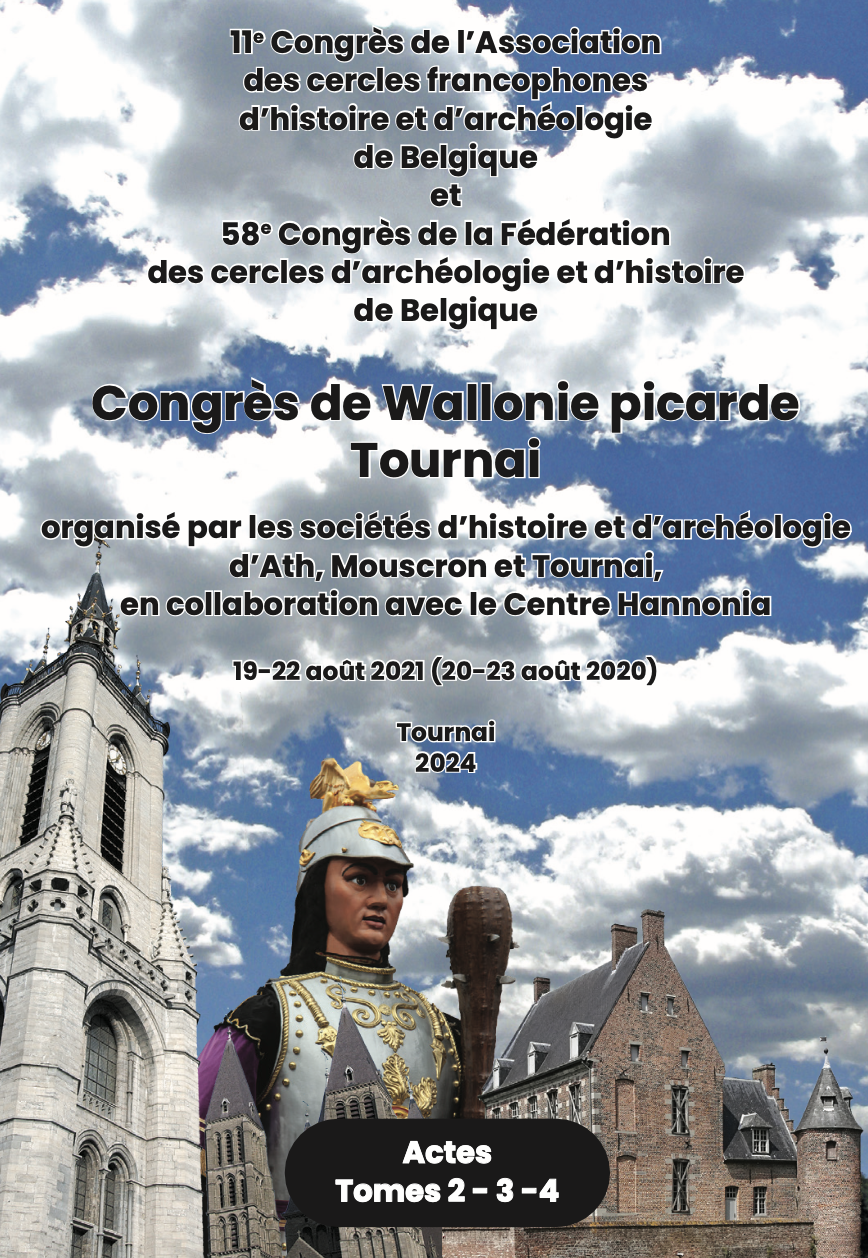
Publication – Actes du 11 du Congrès de l’Association des cercles francophones d’histoire et d’archéologie de Belgique et LVIIIe Congrès de la Fédération des cercles d’archéologie et d’histoire de Belgique

Du 19 au 22 août 2021 s’est déroulé à Tournai le 11e Congrès de l’Association des cercles francophones d’histoire et d’archéologie de Belgique, qui fut aussi le LVIIIe Congrès de la Fédération des cercles d’archéologie et d’histoire de Belgique.

Cette manifestation a été organisée par le Cercle royal d’histoire et d’archéologie d’Ath et de la région, la Société d’histoire de Mouscron et de la région et la Société royale d’histoire et d’archéologie de Tournai, avec la collaboration de Hannonia, Centre d’information et de contact des cercles d’histoire, d’archéologie et de folklore du Hainaut.

Elle a rassemblé plus de 300 participants venus écouter une ou plusieurs des 200 communications réparties en 11 sections, qui ont été présentées dans les locaux de l’Institut wallon de Formation en Alternance et des indépendants et Petites et Moyennes Entreprises (IFAPME).

88 de ces communications sont publiées dans les Actes du Congrès. Vous en trouverez la liste détaillée sur le site Internet du Congrès : congreswapi2020.be. Les références des communications publiées
isolément sont indiquées dans les Actes, pour autant qu’elles aient été portées à la connaissance du secrétaire de rédaction des Actes du Congrès.

Caractéristiques techniques
Forts de 3 volumes au format 16 x 24 cm, les Actes du Congrès de Tournai 2021 (2020) com-
prennent au total près de 1.300 pages, avec de nombreuses illustrations.

Table des matières : ici

Formulaire permettant l’acquisition des volumes : ici

Publié dans Publications | Laisser un commentaire

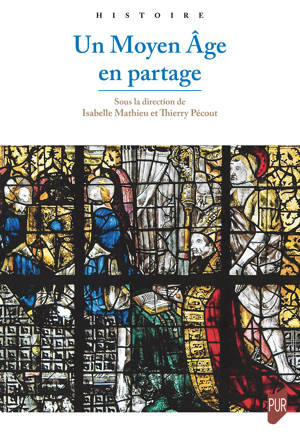
Publication – « Un Moyen Âge en partage », éd. Isabelle Mathieu, Thierry Pécout

La disparition de Jean-Michel Matz en 2020 a laissé un vide au sein de la communauté scientifique des médiévistes, tant dans le champ de l’histoire des pratiques religieuses et de la spiritualité, que dans celui des études angevines. L’hommage qui lui est ici rendu est l’occasion de dresser un bilan des savoirs dans les champs de l’histoire du Moyen Âge qui lui sont chers : l’histoire du clergé séculier et de son milieu, principalement celui des cathédrales, étudiés en réseau ; celle des pratiques de perfection et d’encadrement de la foi, tout particulièrement dans le domaine de la sainteté ; les méthodes de gouvernement, depuis la pastorale jusqu’à la communication politique, qui ouvrent une large réflexion sur l’aire de domination des deux maisons d’Anjou à l’échelle de l’Europe. En outre, ce livre met en avant les méthodes et les pratiques du chercheur et de l’enseignant. Il place la source de l’historien au cœur du propos. Chaque chapitre est l’occasion de mettre en œuvre une source principale en la commentant, en l’éditant ou en la présentant. Il s’agit ainsi de fournir des matériaux à la réflexion de l’historien et au pédagogue, qu’il s’agisse de documentation éditée, d’iconographie, de données archéologiques. La quarantaine d’études proposées par des chercheurs français ou étrangers est articulée autour de cinq thématiques : le clerc en son milieu, de la pastorale à la quête de perfection, gouverner les peuples et les terres, l’Anjou et ses princes, les horizons angevins.

Isabelle Mathieu est maîtresse de conférences en histoire médiévale, université d’Angers, TEMOS-UMR 9016.

Thierry Pécout est professeur en histoire médiévale à l’université Jean Monnet (Saint- Étienne), CERCOR-UMR 8584.

Table des matières : ici

Informations pratiques :

Un Moyen Âge en partage, éd. Isabelle Mathieu, Thierry Pécout, Rennes, Presses universitaires de Rennes, 2024 ; 1 vol., 482 p. (Histoire). ISBN : 978-2-75359-702-0. Prix : € 32,00.

Source : Presses universitaires de Rennes

Publié dans Publications | Laisser un commentaire

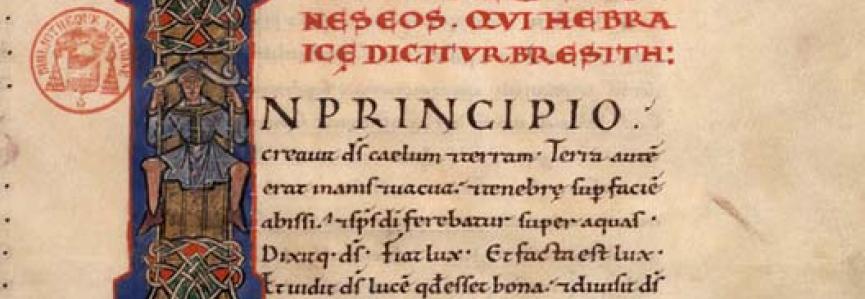
Séminaire – Lecture et critique des manuscrits latins : initiation

Le cours est ouvert à tous ceux qui ont la curiosité (ou la nécessité) de se reporter aux manuscrits qui nous ont transmis les œuvres de l’Antiquité et du Moyen Âge. Il ne suppose aucune connaissance préalable, si ce n’est une certaine familiarité avec la langue latine ; outre la formation de base nécessaire à l’édition des textes anciens (paléographie, codicologie, ecdotique, histoire des textes), il pourra inclure des visites de bibliothèques et des conférences faites par des intervenants extérieurs. Il se déroulera sur deux semestres, dont chacun pourra être validé dans le cadre de différents masters, ou suivi à titre d’auditeur libre.

Le séminaire reprendra le lundi 16 septembre 2024 au Centre d’études anciennes à l’École Normale Supérieure (45 rue d’Ulm, 75005 Paris). Il peut être validé dans le cadre du master de recherche « Etudes médiévales: littérature, textes, savoirs » (Paris-Sorbonne, Sorbonne Nouvelle, ENS, ENC), mais n’en demeure pas moins ouvert à tous, sans inscription préalable.

Tous les lundis de 18 h à 20 h. Accès libre.

Type d’événement: Séminaire

Conditions d’accès

Libre

Date des séances
16/09/2024 – 18:00
23/09/2024 – 18:00
30/09/2024 – 18:00
07/10/2024 – 18:00
14/10/2024 – 18:00
21/10/2024 – 18:00
28/10/2024 – 18:00

Lieu :

Centre d’études anciennes
École Normale Supérieure
45 rue d’Ulm, 75005 Paris
Salle Beckett

Source : IRHT

Publié dans Séminaire | Laisser un commentaire

Publication – « Principia on the Sentences of Peter Lombard. Exploring an Uncharted Scholastic Philosophical Genre Across Europe », éd. Monica Brinzei, William O. Duba

Principia were an obligatory step on the medieval university path to becoming a master of theology. As inaugural lectures on the four books of the Sentences of Peter Lombard, they provided the first opportunity for a scholastic to defend a philosophical-theological worldview. These lectures were also a way for the theologian, now a sententiarius, to present himself and to make a name for himself, initially by delivering in a speech an introduction to the course and by debating with his fellows. The present book takes a collective approach to offer a survey of the evolution of the genre, mapping the dissemination of this exercise during the fourteenth and fifteenth centuries across Europe.

As an academic exercise, principia bridge ideas, texts, authors, and institutions across time. Exploring the corpus of surviving principia illuminates the philosophical creativity cultivated in the faculties of theology. The papers in these volumes thus not only discuss the structural aspects of principia, but also treat the philosophical and theological ideas defended and attacked during the principial debates and the topics and imagery used in the speeches.

The various chapters delve into the surviving material in a common attempt, firstly, to assemble pieces of evidence from Paris and Oxford into an image portraying how, when, and by whom the principia were performed in the first European universities. The second part illustrates the spread of the genre to the new faculties of theology in Central Europe and Italy, with case studies from Bologna, Cracow, Florence, Heidelberg, Prague, and Vienna, highlighting the pan-European diffusion of the practice.

Contributors to Volume I: Alexandra Anisie, Pascale Bermon, Monica Brinzei, William J. Courtenay, William O. Duba, Michael Dunne, Christopher D. Schabel, Siegfried Wenzel, Florian Wöller

Contributors to Volume II: Wojciech Baran, Monica Brinzei, William O. Duba, Matteo Esu, Andrea Fiamma, Russell L. Friedman, Edit Anna Lukàcs, Ueli Zahnd

Volume I: Paris and Oxford

Monica Brinzei and William O. Duba, Introduction

Monica Brinzei, A Guide for Understanding Principia on the Sentences of Peter Lombard

Paris

William J. Courtenay, The Transformation of Sentential Principia in the Early Fourteenth Century

Florian Wöller, Inaugural Speeches by Bachelors of Theology Principial Collationes and their Transmission (1317–1319)

Chris Schabel, Francis of Marchia on Instrumental Causality: The Conclusion to Principium in IV in Question 2 on IV Sentences

Chris Schabel, The Genre Matures. Parisian Principia in the 1340s, from Gregory of Rimini to Pierre Ceffons

Chris Schabel, The Forgotten Principia of a Forgotten Theologian: Jean de Moyenneville, 1356-1357, and Parisian Theology in the Late 1350s

Alexandra Anisie, Mediated Knowledge and Beatific Vision in the First Principium of John of Brammart

William J. Courtenay, Principial Cohorts at Paris

Oxford

Siegfried Wenzel, Introductory Lectures on the Sentences by “Frisby”

Michael Dunne, Between Old and New at Oxford: The Introitus Sententiarum of Richard FitzRalph and the First Collatio of Adam Wodeham

Pascale Bermon, À la recherche des Principia aux Questions sur les Sentences de Robert Holcot O.P. († 1349)

Chris Schabel, The Oxford Franciscan Robert Halifax’s Principial Debate over Grace and Merit with His Pelagian Socius and Other Colleagues in 1332-133

Volume II: Blogona, Cracow, Florence, Heidelberg, Prague, and Vienna

Bologna

Chris Schabel, The Franciscan Guglielmo Centueri of Cremona’s Bologna Principium of 1368, with an Appendix on Whether God Can Make the Past Not to Have Been

Cracow

Wojciech Baran, Survey on Medieval Principia on Peter Lombard’s Sentences of Theologians from the University of Cracow

Florence

William O. Duba and Russell L. Friedman, A(nother) Florentine Principium on the Sentences. The Mystery of the Two « Prologues » in Peter of Trabibus’ I Sentences

Heidelberg

Andrea Fiamma, John Wenck’s Principia on the Sentences (1431)

Prague

Monica Brinzei, The Cistercian Matthew of Zbraslav (de Aula Regia / Königsaal), Socius of a Pre-Radical Jan Hus, and Their Prague Principial Debate

Vienna

Edit Anna Lukács,Prêcher sur les Sentences: sermons sur l’œuvre du Lombard à la bibliothèque des Dominicains de Vienne

Ueli Zahnd, Disputing without Socii: The Principium on Book I of Conrad of Rothenburg, Vienna 1408/09

Matteo Esu, Peter of Pirkenwart’s Textual Workshop from his Principium IV (1417)

Matteo Esu and Ueli Zahnd, A joint Edition of Conrad of Rothenburg’s and Peter of Pirchenwart’s Principia on Book IV of the Sentences

Index

Principia on the Sentences of Peter Lombard. Exploring an Uncharted Scholastic Philosophical Genre Across Europe, éd. Monica Brinzei, William O. Duba, Turnhout, Brepols, 2024 ; 1 vol., 1204 p. (Studia Sententiarum, 7). ISBN: 978-2-503-61208-9. Prix : € 120,00.

Source : Brepols

Publié dans Publications | Laisser un commentaire

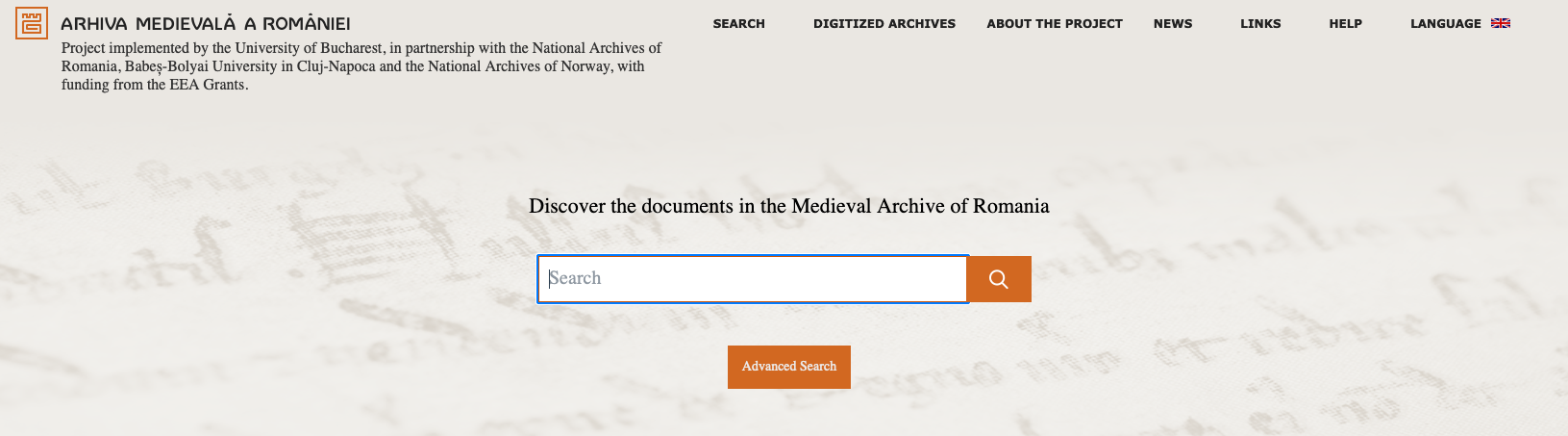
Web – Medieval Archive of Romania / Arhiva medievală a României

Accès aux archives numérisées : ici

THE MEDIEVAL ARCHIVE OF ROMANIA is a database created within the project “Digitization of the medieval documents from the National Archives of Romania”. The project was implemented by The University of Bucharest, in partnership with The National Archives of Romania, Babeș-Bolyai University in Cluj-Napoca and The National Archives of Norway , in the framework of the Programme PA16/RO12 “Conservation and revitalisation of cultural and natural heritage”, financed through the EEA 2009-2014 Financial Mechanism, contract PA16/RO12-LP-8/18.12.2014.

The database comprises the documents issued up to 1600, regardless of the preservation form, which are in the repositories of the National Archives and in other archives of Romania.

We invite all public institutions and individuals that possess medieval documents to contribute to the growth of this database.

The list of Romanian archives that have contributed with documents to The Medieval Archive of Romania:

1. The National Archives of Romania

2. “Lucian Blaga” Central University Library in Cluj-Napoca

This list is updated as new collaborators will join us!

Check back periodically for the updates, as new documents are being added to the database!

Source : Arhiva medievală a României

Publié dans Web | Laisser un commentaire

Séminaire – Les Ymagiers, 2024-2025

Fondé en 1972 à l’initiative du Père dominicain Philippe-Martin Hubert (1908-1976), le groupe des « Ymagiers » se proposait à l’origine de réunir « de temps à autre » les quelques chercheurs qui, au CNRS, à l’Université et dans les métiers de la conservation, s’intéressaient à « l’étude des documents non écrits ».

D’abord « amicales et informelles », ces réunions prirent un tour plus institutionnel à partir de 1976, lorsqu’elles bénéficièrent de l’hospitalité de l’IRHT. Sous l’impulsion de Gaston Duchet-Suchaux puis de Michel Pastoureau, elles se spécialisèrent dans les questions d’iconographie médiévale et contribuèrent à mieux faire connaître cette discipline. À partir de 1999, une nouvelle équipe, animée par Claudia Rabel et Patricia Stirnemann, ouvrit plus largement les séances, notamment vers le public étudiant, et leur donna une assise et une périodicité plus stables. Désormais les « Ymagiers » se réunissent cinq fois par an, d’octobre à juin, à l’École du Louvre, amphithéâtre Dürer (Palais du Louvre, place du Carroussel, porte Jaujard, 75001 Paris), pour entendre un orateur parler de ses recherches récentes ou en cours. L’exposé est suivi d’une discussion générale.

Les séances ont lieu le lundi à 17h30 à l’École du Louvre – Amphithéâtre Goya et durent environ deux heures ; elles réunissent de trente à cinquante personnes.

21 octobre 2024
Raphaël Guesuraga
Les quatre Animaux du tétramorphe et l’hypothèse socio-ecclésiale

16 décembre 2024
Laetitia Barou-Guichet
L’iconographie de Saül, premier roi d’Israël, en France et Angleterre du XIIe au XVe siècle : usages et enjeux de la représentation du rex unctus

10 févier 2025
Christian Heck
L’iconographie du Retable de l’Annonciation d’Aix : nouvelles propositions

7 avril 2025
Nicolas Sarzeaud
Sur les traces du Christ : reliques et vérité visuelle à la fin du Moyen Âge

16 juin 2025
Jeanne Alis
L’art médiéval au XIXe siècle en Bohême : l’aménagement du château de Sychrov par le prince Camille de Rohan

Publié dans Séminaire | Laisser un commentaire