Journée d’études, mardi 14 mai 2024, 9h15, INHA (salle Jullian) Actualités de la recherche en France et perspectives
Le nouveau collectif Trecento propose une journée d’études le mardi 14 mai à partir de 9h15 à l’INHA (salle Jullian) consacrée à l’actualité de la recherche sur l’art dans la péninsule italienne au XIVe siècle, dans une acception chronologique large. Le collectif Trecento, en cours de constitution, est né de l’intention de rassembler et de fédérer l’ensemble des spécialistes de l’étude de la production artistique italienne du XIVe siècle dispersés en France dans les musées, les bibliothèques, les centres de recherche, les universités et les laboratoires. La journée d’étude du 14 mai entend proposer un premier espace de discussion entre ces différents spécialistes et dresser un état des lieux des travaux réalisés en France.
9h15 : accueil des intervenants 9h30 : présentation du Collectif Trecento 10h-12h : présentation des travaux de recherches (première session) 14h-15h30 : présentation des travaux de recherches (seconde session) 15h30 : table ronde
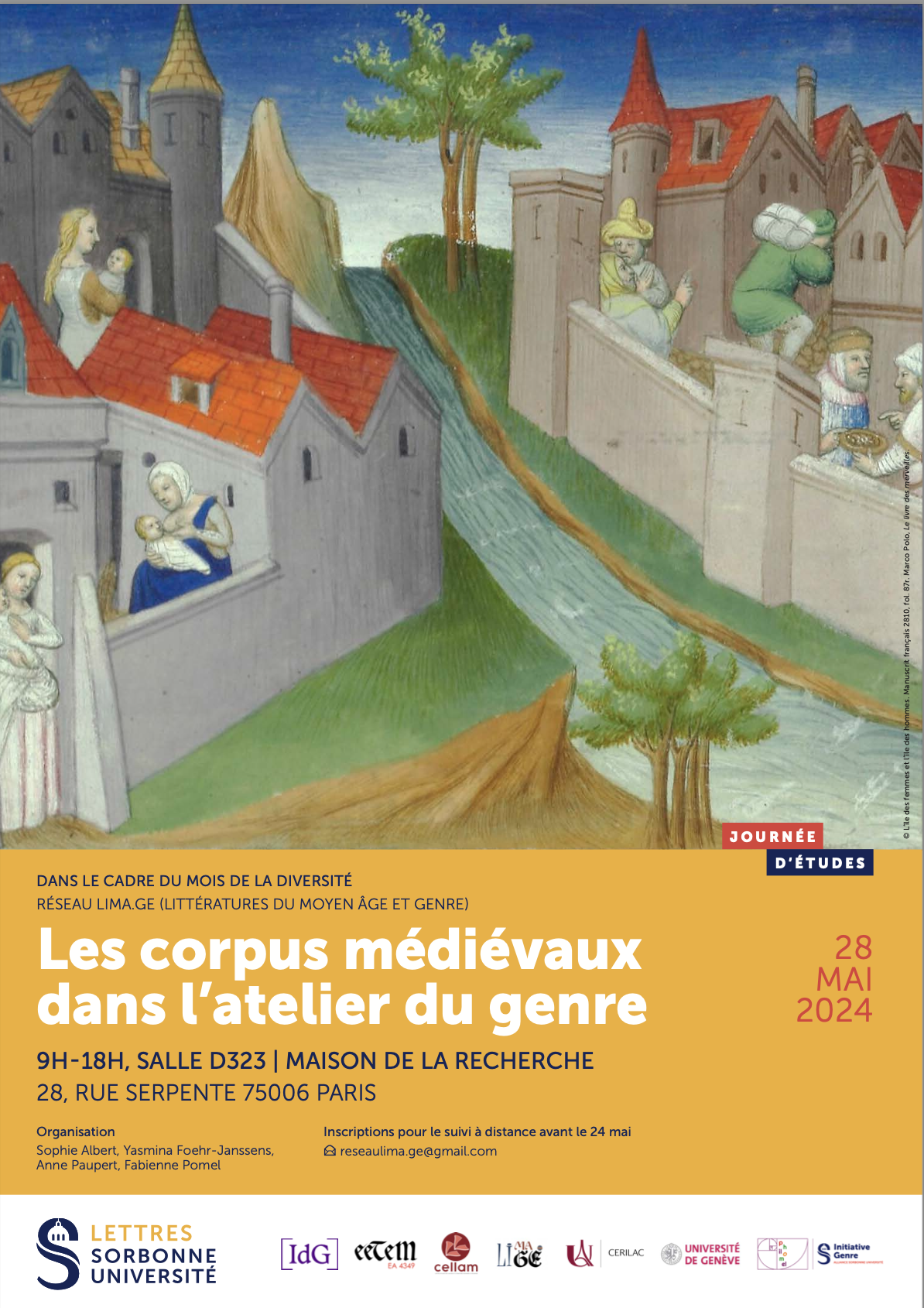
Journée d’études du groupe LIMA.GE (Littératures du Moyen Age et Genre) Mardi 28 mai, 9h-19h Maison de la Recherche de Sorbonne Université, 28 rue Serpente, 75006 Paris – salle D323 Contact : reseaulima.ge@gmail.com Organisatrices : Sophie Albert, Yasmina Foehr-Janssens, Anne Paupert, Fabienne Pomel
Cette journée d’études, organisée par le réseau LIMA.GE (Littératures du Moyen Age et Genre), s’intègre à un programme en deux volets dont le premier s’est tenu à l’Université Rennes 2 du 13 au 15 mars, sous la forme d’un colloque intitulé « Les littératures médiévales dans l’atelier du genre ». L’ensemble du programme a pour ambition, d’une part, de cerner ce qui fait la singularité et la fécondité d’une approche littéraire des textes médiévaux par le champ conceptuel du genre ; d’autre part, de dessiner une cartographie de notions susceptibles d’éclairer les textes médiévaux ; enfin, de proposer des démarches interprétatives qui puissent faire office sinon de modèles, du moins d’exemples propres à nourrir et à inspirer des recherches et des enseignements futur·es. Les interventions de la journée, appuyées sur des études de cas, se concentreront sur l’explicitation d’une méthodologie incluant le genre. Elles interrogeront, entre autres, l’usage des notions de performativité ou d’intersectionnalité, mais aussi les angles morts de l’histoire littéraire, afin de mettre en lumière les gains herméneutiques qui résultent de cette démarche.
Par-delà ce propos scientifique, la journée se veut ouverte à un public de non-spécialistes. A l’instar du colloque, elle articule formation, médiation culturelle et recherche-création : dix étudiant·es de master de Sorbonne Université et Rennes 2 liront les textes produits à l’occasion d’un atelier d’écriture organisé à la mi-mars ; une post-doctorante en recherche-création présentera son projet de réactualisation du mystère médiéval de sainte Barbe, ainsi qu’une lecture-performance d’extraits de la pièce. Les organisatrices espèrent par là prolonger la réflexion universitaire par une dynamique créative, et montrer la fécondité de la littérature médiévale pour les débats et les enjeux contemporains soulevés par les questions de genre.
Programme :
9h00 Accueil 9h15 Introduction – Anne Paupert (Université Paris Cité) et Yasmina Foehr-Janssens (Université de Genève)
9h30 Anne-Lise Staigre-Vacherot (Université Rennes 2) – Le roman d’aventures en vers au XIIIe siècle : vers une remise en question d’un « mâle Moyen Âge » littéraire ? 10h00 Giulia Parma (Université Sorbonne-Nouvelle) – La nouvelle médiévale au prisme de l’approche intersectionnelle : les personnages féminins du Décaméron de Boccace Discussion
10h45 Engendrer, déranger, dégenrer : lectures I présentées par Sophie Albert (Sorbonne Université) et Fabienne Pomel (Université Rennes 2)
11h00 Pause 11h15 Karine Etcheverry (Université de Bordeaux-Montaigne) – Pleurer ses mortes à la fin du Moyen Âge, Étude du chant funèbre « Milia Lasturko » Discussion
12h00 Engendrer, déranger, dégenrer : lectures II Répondante : Sophie Albert (Sorbonne Université)
12h30 Repas
14h00 Susanna Scavello (Université Paris Nanterre et ArTeC) – Faire de la recherche-création à partir des mystères hagiographiques au féminin : une actualisation risquée ? Avec la collaboration, pour la lecture, de Morgan Guillot-Noël (ArTeC) Discussion
Présidence : Nadège Le Lan (Université du Littoral Côte d’Opale)
15h00 Clémentine Girault (Université Paris Cité / EHESS), Jeanne Mousnier-Lompré (Université Grenoble-Alpes) – Les miroirs médiévaux : une approche générique et genrée Discussion 16h00 Pause 16h15 Sandy Maillard (Universités de Neuchâtel et Fribourg) – Lire le Champ fleury de Geoffroy Tory au prisme des études de genre Discussion
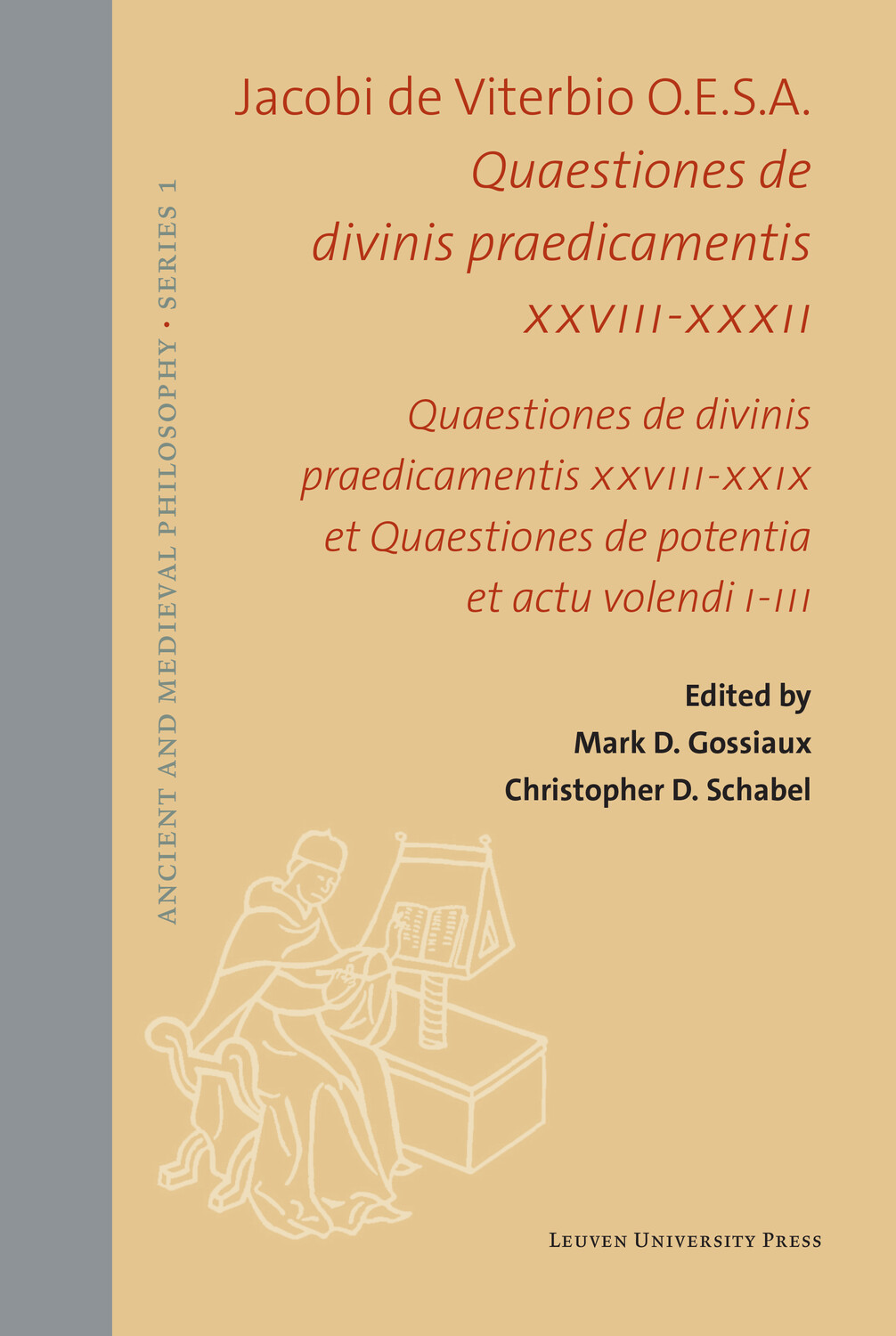
Critical edition of James of Viterbo’s final questions De divinis praedicamentis and his De potentia et actu volendi
James of Viterbo (ca. 1255–1307), Augustinian friar, master of theology at the University of Paris, and archbishop of Naples, was one of the leading philosophers and theologians of the later thirteenth century. This volume completes the critical edition of his academic works and presents his last two questions De divinis praedicamentis and his three annexed questions on the will (De potentia et actu volendi). These questions, deriving from disputations James held as Augustinian regent master of theology at the University of Paris (1293–1297), offer rich discussions of important topics: whether the plurality of divine persons and attributes entails an order of priority within God and how causality may be attributed to God. The questions on the will cover issues at the core of later medieval debates on human freedom: on the unity of the will as a power of the soul, whether the will is the primary agent in human action, and whether the will is free with respect to all its acts.
This publication is GPRC-labeled (Guaranteed Peer-Reviewed Content).
Informations pratiques :
Jacobus de Viterbio, Quaestiones de divinis praedicamentis XXVIII-XXIX et Quaestiones de potentia et actu volendi I-III, éd. Mark D. Gossiaux, Christopher D. Schabel, Louvain, Leuven University Press, 2024 ; 1 vol., 2024 (Ancient and Medieval Philosophy – Series 1). ISBN : 978-9-46270-391-9.
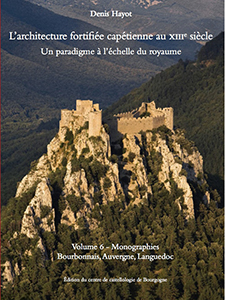
Le problème du « château philippien », avec ses tours rondes, ses flanquements systématiques et ses archères en sifflet, hante la castellologie européenne depuis plus de 50 ans. Pour faire avancer cette question, Denis Hayot n’a pas hésité à reprendre un à un tous les sites fortifiés du xiiie siècle dans le royaume de France. Il en est sorti une thèse éblouissante, dont beaucoup ont entendu parler, mais que peu ont pu lire. Le CeCaB a relevé le défi de publier in extenso ce monument de la castellologie française. L’édition comprend désormais six gros volumes : un de synthèse et cinq de monographies régionales. Le sixième volume contient 57 notices de fortifications du Bourbonnais, de l’Auvergne et du Languedoc.
Informations pratiques :
Denis Hayot, L’architecture fortifiée capétienne au XIIIe siècle. Un paradigme à l’échelle du royaume, t. 6, Monographies. Bourbonnais – Auvergne – Languedoc, Chagny, CeCaB, 2024 ; 1 vol., 570 p. ISBN : 979-10-95034-26-1. Prix : € 30,00.
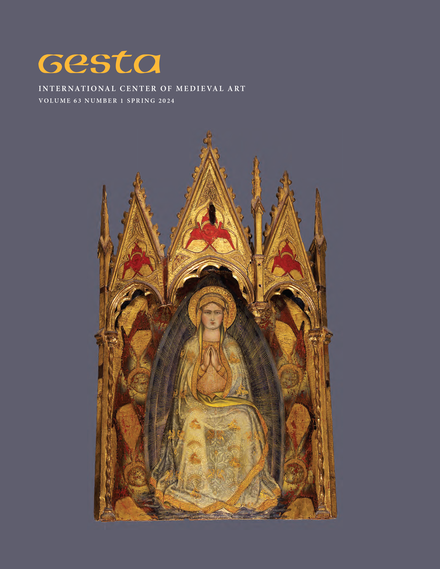
Gesta publishes original research on medieval art and architecture. The journal embraces all facets of artistic production from ca. 300 to ca. 1500 C.E. in every corner of the medieval world.
Gesta authors have three times been awarded the annual Van Courtlandt Elliott Prize of the Medieval Academy of America for a “first article in medieval studies judged . . . to be of outstanding quality.”
Table des matières :
Brave as a Lion, Fierce like a Griffin: Heraldic Devices and Aristocratic Identity in the Frescoes of St. Panteleimon, Nerezi – Carlo Berardi
Identifying a Literary Antecedent to the Siege of the Castle of Love in Gothic Ivories – Christopher Snow Hopkins
Singing the Magnificat from Prague to Siena: Altarpieces for the Feast of the Visitation, 1386–1423 – Juliette Calvarin
Monastic Imagination and Historical Preservation: The Role of Geoffrey Martel in the Translatio Scene on the Shrine of the Holy Tear at the Abbey of La Trinité, Vendôme – Anne Heath
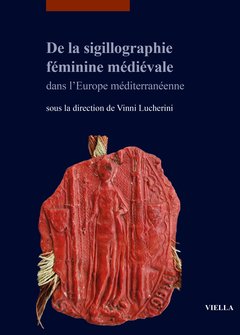
Cet ouvrage réunit une série d’essais consacrés aux sceaux féminins créés et utilisés pendant le Moyen Âge dans des territoires bordant la Méditerranée. Ces essais sont issus d’un colloque qui s’est tenu à Naples en novembre 2022, comme deuxième volet du grand congrès international La sigil·lografia medieval a Catalunya i a l’Europa mediterrània. Estudis comparatius, né de la collaboration entre l’Institut d’Estudis Catalans de Barcelone et l’Université de Naples Federico II. Malgré l’évolution généralisée des études historiennes avec une perspective de genre, force est de constater que de nombreuses questions concernant les sceaux féminins restent encore sans réponse. Les sceaux féminins sont-ils des objets commandés par les femmes pour elles-mêmes ou par les hommes pour les femmes? Les femmes avaient-elles le pouvoir de décider la nature des images à placer sur leurs sceaux? Les femmes choisissaient elles-mêmes les artistes et les formes de leurs sceaux? Selon la réponse que nous pouvons donner à ces questions, la perspective dans laquelle nous regardons les sceaux féminins du Moyen Âge change en conséquence.
Table des matières :
Xavier Barral i Altet, Introduction. Les femmes du Moyen Âge revendiquées par l’art des sceaux
Jean-Claude Cheynet, La place de la femme dans la sigillographie byzantine
Laurent Hablot, La dame, le sceau et l’armoirie. Regards sur les pratiques héraldiques des sigillantes (XIIe-XIVe siècle)
Clément Blanc-Riehl, Ambre Vilain, Princesses en architecture. Les orfèvres dans la création sigillaire à la fin du XIIIe siècle et pendant la première moitié du XIVe
Vinni Lucherini, I sigilli delle regine della maison d’Anjou-Naples (1266-1382)
Marta Serrano-Coll, Sigilat ab mon sagel. Signs of Identity in the Feminine Sigillography of the Catalan Territories in the Middle Ages (13th-14thCenturies)
Laurent Macé, Afficher le lignage pour affirmer son rang. Le sceau de Cécilia de Foix, comtesse d’Urgell (1264)
Gergely Kiss, Les sceaux de Clémence de Hongrie, reine de France et de Navarre, dans le contexte de la représentation des identités dynastiques
Imre Takács, The Seal of Mary of Anjou, Queen of Hungary (1382-1396), and the Representation of the Dynastic Protector
Emir O. Filipović, Three Sisters, Three Seals, Three Different Coats of Arms for Their Father. A Curious Sigillographic Case from Medieval Bosnia
Index des noms
Index des lieux
Les auteurs
Informations pratiques :
De la sigillographie féminine médiévale dans l’Europe méditerranéenne, éd. Vinni Lucherini, Rome, Viella, 2024 ; 1 vol., 208 p. (Quaderni napoletani di storia dell’arte medievale, 8). ISBN : 979-1-25469-567-8. Prix : € 36,00.
The Anglo-French war of 1294-1303 has not been the subject of a major study since the early 1900s. Recent histories tend to treat it as a sideshow compared to Edward I’s wars in Wales and Scotland, which gives a false impression. In reality the Welsh and Scottish campaigns were distractions, and Edward regarded the war against France as his main focus. The main issue at stake was the defence and recovery of Aquitaine, the last substantial piece of the so-called ‘Angevin empire’. To that end Edward spent enormous sums of money on recruiting allies in the Low Countries and the Holy Roman Empire. Edward’s rival, Philip IV, also recruited allies to counter Edward, until the conflict engulfed much of Western Europe.
The result was a series of military stalemates, demonstrating that neither England nor France could achieve outright victory in a head-to-head conflict. There were plenty of bloody incidents and much hard fighting: the hanging of Gascon prisoners from the walls of Rions in 1295, for instance, or the epic thirteen-week siege of Saint Sever.
David Pilling places the war in its proper context and argues it was a vital step on the road to the more famous conflict we remember as the Hundred Years War.
Informations pratiques :
David Pilling, Edward Longshanks’ Forgotten Conflict The Anglo-French War 1294-1303, Stroud, Amberley Publishing, 2024 ; 1 vol. 256 p. ISBN : 9781398113510. Prix : GBP 22,99.
Organized by Ethan Matt Kavaler (University of Toronto) and Yannis Hadjinicolaou (University of Bonn)
When the owner of Hieronymus Bosch’s Garden of Earthly Delights wished to celebrate his acquisition, he had it reconceived as a tapestry. What was gained and what was lost in this transformation? Such questions lead to the concepts of intermediality and synagonism. Intermediality has become newly fashionable in the humanities. Definitions of the term vary as widely as the media to which they refer. Intermediality takes its place alongside related concepts of transmediality, affordance, intertextuality, skeumorphism, interdiscourse and the Gesamtkunstwerk. We mean by intermediality the relations between visual media but also their relation to texts, rituals, and performances. As Eric Méchoulan has written, intermediality has the potential to redefine the purpose of art or of a specific medium. Synagonism (Greek: συναγωνισμός), on the other hand, has received little or only inadequate attention in art historical research.
For the area of research encompassed by the term ‘synagonism’, the focus is less on competition than on the complementary interplay between divergent art forms. It refers to the interactive, reciprocally beneficial cooperation between various forces, media, and modes of artistic presentation and representation, but also to collaborations that transgress boundaries between domains, for example in the form of artist’s networks or workshop practices involving multiple media or practitioners.
Whereas most investigations of intermediality have addressed cinema, photography, and literature, we wish to focus on the visual, literary, and musical arts along with ritual performances in Northern Europe between 1400 and 1700—a period in which several different media rose to prominence: not only the famous panel painting, manuscript illumination and prints of the era but also tapestry, stained glass, sculpture, metalwork, and architecture. Equally diverse is the panoply of literary genres and ritual performances. The role of drawing has been identified as key to these processes, but drawing was not one thing in this period—it comprised several distinct genres and was directed toward disparate functions.
We presume that the conference will cover the costs of air fare and hotel stay for 3 nights in Toronto.
We invite proposals for lectures of 20 minutes. Please submit an abstract of 300-400 words and a current curriculum vitae by May 20, 2024 to matt.kavaler@utoronto.ca and ghadjini@uni-bonn.de
Situées au cœur du bassin occidental de la Méditerranée, la Corse et la Sardaigne furent l’enjeu de multiples rivalités économiques et politiques pour le contrôle de la mer, aux derniers siècles du Moyen Âge. Derrière « l’écume des événements », cet ouvrage en restitue toute la complexité.
Vannina Marchi van Cauwelaert, Un royaume dans la mer. L’archipel corso-sarde du XIIIe au XVe siècle, Paris, Classiques Garnier, 2024 ; 1 vol., 563 p. (Bibliothèque d’histoire médiévale, 37). ISBN : 978-2-406-16518-7. Prix : € 35,00.
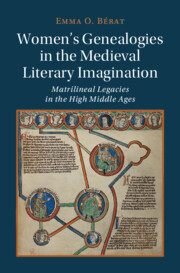
Uncovering the many striking female alternatives to patrilineal narratives in medieval texts, Emma O. Bérat explores strategies of writing and illustration that creatively and purposefully depict women’s legacies. Genealogy, used to justify a character’s present power and project it onto the future, was crucial to medieval political, literary, and historical thought. While patrilineage often limited women to exceptional or passive roles, other genealogical forms that represent and promote women’s claims are widespread in medieval texts. Female characters transmit power through book patronage and reading, enduring landmarks, and international travel, as well as childbearing and succession. These flexible – if messy – genealogies reflect the web of political, biological, and spiritual relations that frequently characterized elite women’s lives. Examining hagiography, chronicles, genealogical rolls, and French, English, and Latin romances, as well as associated codices and images, Bérat highlights the centrality of female characters and historical women to this fundamental aspect of medieval consciousness.
Emma O. Bérat is an independent scholar living and working in Artigat, France. She is co-editor of Relations of Power: Women’s Networks in the Middle Ages (2021), and has written extensively on women’s historiography, literary patronage, and cultural movement.
Table des matières :
The book as bloodline: the life of Queen Margaret of Scotland
Records on the landscape: landmarks in Audree, Osith, and Modwenne
Tracing mobility: royal genealogical diagrams and Trevet’s Les Cronicles
Mothers and messengers: violent transmission in Athelston Conclusion: Matrilineal legacies.
Informations pratiques :
Emma O. Bérat, Women’s Genealogies in the Medieval Literary Imagination. Matrilineal Legacies in the High Middle Ages, Cambridge, Cambridge University Press, 2024 ; 1 vol., 246 p. (Cambridge Studies in Medieval Literature). ISBN : 978-1-00943-475-1. Prix : GBP 85,00.
Avec le soutien du FNRS, du CRHiDI (UCLouvain – Saint-Louis, Bruxelles), d'INCAL (UCLouvain), de PraME (UNamur), de sociAMM (ULB) et de Transitions (ULiège)







 L'Agenda des Médiévistes
Vous devez être connecté pour poster un commentaire.