Appel à contribution – Communities of Production and Reception in Medieval Hagiography

Leeds IMC 2027
July 5th-8th

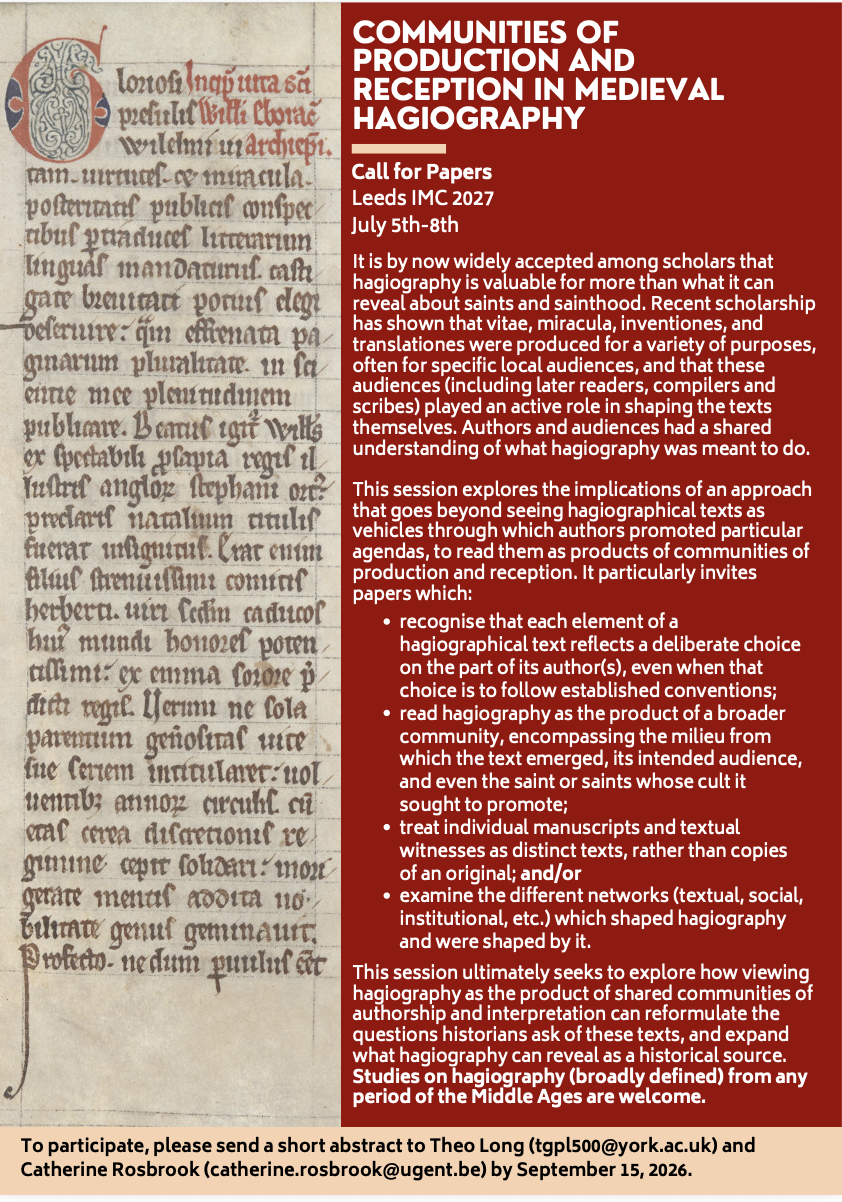
It is by now widely accepted among scholars that hagiography is valuable for more than what it can reveal about saints and sainthood. Recent scholarship has shown that vitae, miracula, inventiones, and translationes were produced for a variety of purposes, often for specific local audiences, and that these audiences (including later readers, compilers and scribes) played an active role in shaping the texts themselves. Authors and audiences had a shared understanding of what hagiography was meant to do.

This session explores the implications of an approach that goes beyond seeing hagiographical texts as vehicles through which authors promoted particular agendas, to read them as products of communities of production and reception. It particularly invites papers which:

  • recognise that each element of a hagiographical text reflects a deliberate choice on the part of its author(s), even when that choice is to follow established conventions;
  • read hagiography as the product of a broader community, encompassing the milieu from which the text emerged, its intended audience, and even the saint or saints whose cult it sought to promote;
  • treat individual manuscripts and textual witnesses as distinct texts, rather than copies of an original; and/or examine the different networks (textual, social, institutional, etc.) which shaped hagiography and were shaped by it.

This session ultimately seeks to explore how viewing hagiography as the product of shared communities of authorship and interpretation can reformulate the questions historians ask of these texts, and expand what hagiography can reveal as a historical source.

Studies on hagiography (broadly defined) from any period of the Middle Ages are welcome.

To participate, please send a short abstract to Theo Long (tgpl500@york.ac.uk) and Catherine Rosbrook (catherine.rosbrook@ugent.be) by September 15, 2026.

Publié dans Appel à contributions | Commentaires fermés sur Appel à contribution – Communities of Production and Reception in Medieval Hagiography

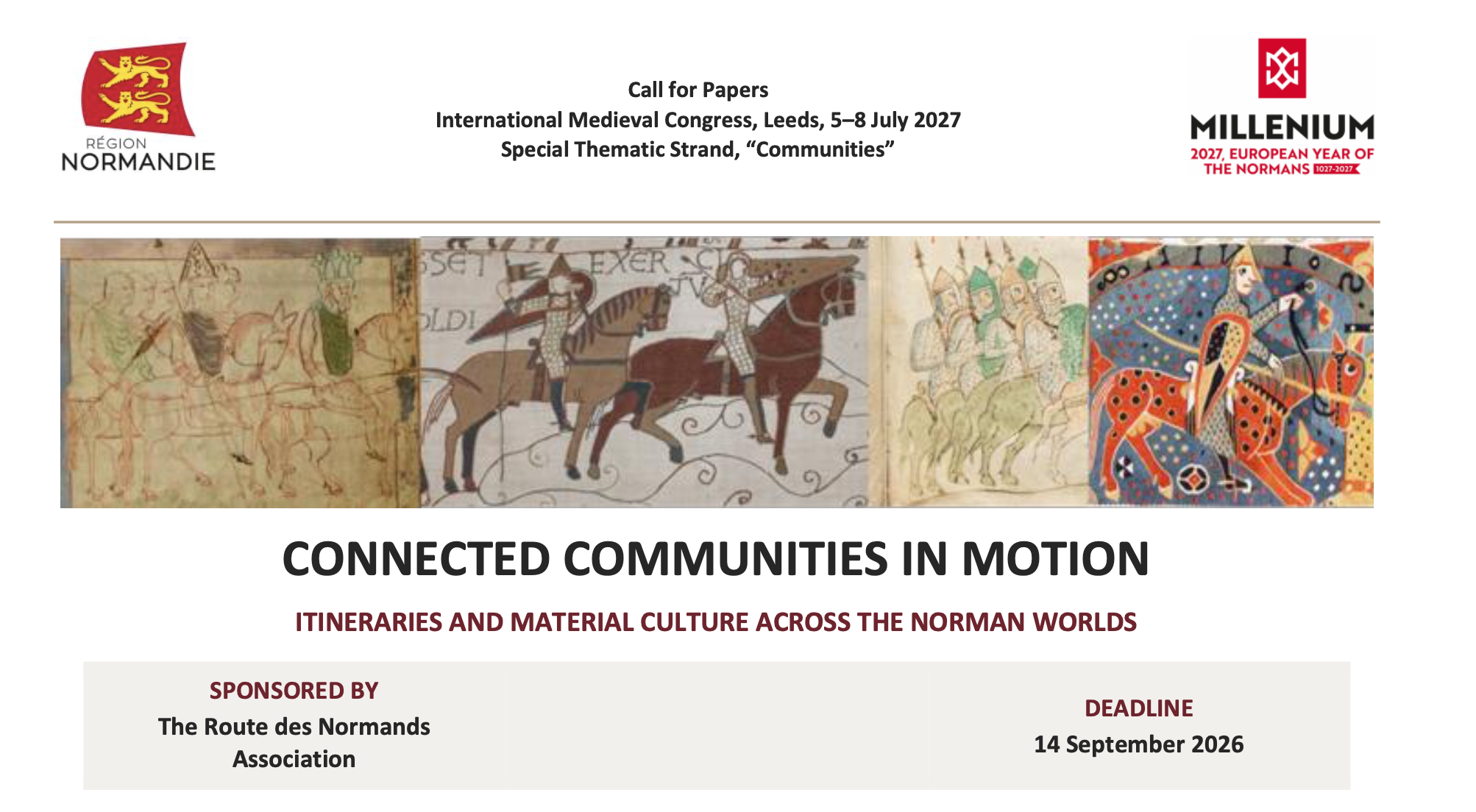
Appel à contribution – Connected Communities in Motion. Itineraries and Material Culture across the Norman World

SPONSORED BY : The Route des Normands
DEADLINE : 14 September 2026

IMC Leeds 2027

The mobility of Norman communities was one of the historical phenomena that most profoundly shaped medieval Europe. The sessions aim to reconstruct its material consequences by examining monuments and objects within a transregional and transnational framework and by identifying networks of patronage, religious devotion, production, and exchange. Through an interdisciplinary approach, they seek to reconsider the interconnected sites, forms of artistic and artisanal production, landscapes, and cultural practices that are essential to a fuller understanding of the establishment and development of Norman communities across Europe, from the Atlantic to the Mediterranean.

The sessions will focus on historically identifiable itineraries and networks, including court itineraries, monastic and episcopal connections, pilgrimage circuits, maritime routes, commercial exchanges, and diplomatic contacts.

They will explore how these connections shaped architectural patronage, artistic production, manuscript culture, liturgical and funerary practices, and the diffusion of transregional cults.

The sessions do not seek to define a homogeneous “Norman style” or to reconstruct a linear diffusion of forms from Normandy. Rather, they will examine how buildings, monumental complexes, manuscripts, liturgical furnishings, tombs, and portable objects were produced within specific local contexts while also responding to the circulation of patrons, ecclesiastical personnel, craftsmen, materials, texts, relics, rites, and technical knowledge.

This approach builds on recent research into the agents and mechanisms of cultural transfer, as well as the political, ritual, and social functions of material culture in the Norman worlds.

In keeping with the IMC theme of “Communities,” the sessions will examine networks of patronage associated with Norman communities and their role in the production, use, and circulation of material culture.

SESSION I – Architecture, Patronage, and Networks of Construction

This session will examine how political authority, ecclesiastical organisation, pilgrimage, and economic exchange shaped the foundation, transformation, and use of buildings and monumental complexes.

Possible topics include
• royal, aristocratic, episcopal, and monastic patronage;
• court itineraries and the geography of architectural commissions;
• the movement of builders, craftsmen, materials, and technical knowledge;
• construction sites and the organisation of labour;
• the relationship between land routes, maritime routes, shrines, settlements, and monumental foundations;
• the adaptation or reuse of Roman, Byzantine, Islamic, Anglo-Saxon, Lombard, and other local structures;
• the impact of political and economic networks on architectural production.

SESSION II – Images, Manuscripts, and Material Exchange

This session will investigate the circulation, adaptation, and local reworking of artistic and technical knowledge in sculpture, painting, manuscript production, monumental decoration, and the decorative arts.

Possible topics include
• architectural sculpture, mural painting, mosaics, pavements, and stained glass;
• illuminated manuscripts, liturgical books, cartularies, chronicles, and Exultet rolls;
• relationships between monumental decoration, manuscript illumination, and portable objects;
• the movement of scribes, illuminators, sculptors, painters, mosaicists, and specialised craftsmen;
• workshops, communities of practice, and the transmission of techniques;
• textiles, ivory carving, metalwork, reliquaries, seals, coins, and liturgical furnishings;
• artistic commissions prompted by diplomacy, dynastic marriage, trade, gift exchange, warfare, or the translation of relics;

• the movement and availability of stone, marble, timber, metals, pigments, parchment, and luxury materials.

SESSION III

Sacred Routes, Liturgy, Cult, and Monumental Memory

This session will consider how the movement of clergy, books, relics, rites, and devotional practices shaped religious buildings and the material organisation of worship, burial, and commemoration.

Possible topics include

• relationships between liturgical practice and the architectural arrangement of churches;
• altars, choirs, crypts, chapels, screens, ambulatories, and processional spaces;
• the circulation of liturgical books, chants, calendars, ceremonial practices, and monastic customs;
• episcopal and monastic networks as channels for the transmission of ritual and architectural practices;
• pilgrimage routes, relic translations, shrines, and transregional saints’ cults;
• the material consequences of devotion to saints such as Michael, Nicholas, Thomas Becket, and Catherine of Alexandria;
• royal, aristocratic, episcopal, and monastic burial practices;
• monumental tombs, mausolea, burial chapels, inscriptions, and funerary imagery;
• dynastic memoria, anniversaries, necrologies, commemorative foundations, and the liturgy of the dead.

The Route des Normands ssociation, founded at the initiative of the Normandy Region, is a French non-profit association governed by the Law of 1 July 1901, formally declared to the French prefectural authorities in mars 2026 and headquartered at the Abbaye-aux-Dames in Caen. Its founding members are the Normandy Region, the British Council, Ireland’s National Monuments Service, Jersey Heritage Trust, and Guernsey Museums. Building on Millennium 2027 – European Year of the Normans, the Association is establishing the historical, scientific, and institutional foundations of the Route des Normands, with a view to its certification as a Cultural Route of the Council of Europe. The initiative also benefits from the support and prospective involvement of regions in southern Italy, whose historical and cultural heritage forms an essential component of the wider Norman world. Its Scientific Committee brings together university professors with recognised expertise in Norman studies and related fields, drawn from participating institutions across France, England, Wales, Ireland, Northern Ireland, Scotland, and Italy.

The sessions will contribute to the historical and scholarly foundations of the Route des Normands as a network of interconnected sites, collections, sacred landscapes, and cultural practices.

Submission of Proposals

Proposals are invited from scholars working on the history, material culture, and religious life of the Norman worlds. Papers may focus on a building, work of art, manuscript, patron, institution, burial site, or cult, provided that the case study is situated within a clearly defined itinerary or network, or linked to a historically plausible mechanism of transmission.

Submissions should include a title, an abstract of no more than 350 words, a short biography of no more than 100 words, institutional affiliation, contact details, and four or five keywords.

Papers will be either 15 or 20 minutes long. Selected proposals will be organised into linked 90-minute sessions and submitted to the IMC Programming Committee.

Please send proposals by 14 September 2026 to:
Giacomo D’Andrea

Session Organiser :
Route des Normands Association, Normandy Region
giacomo.dandrea@normandie.fr

Publié dans Appel à contributions | Commentaires fermés sur Appel à contribution – Connected Communities in Motion. Itineraries and Material Culture across the Norman World

Exposition – Notre-Dame-la-Grande : icône de Poitiers

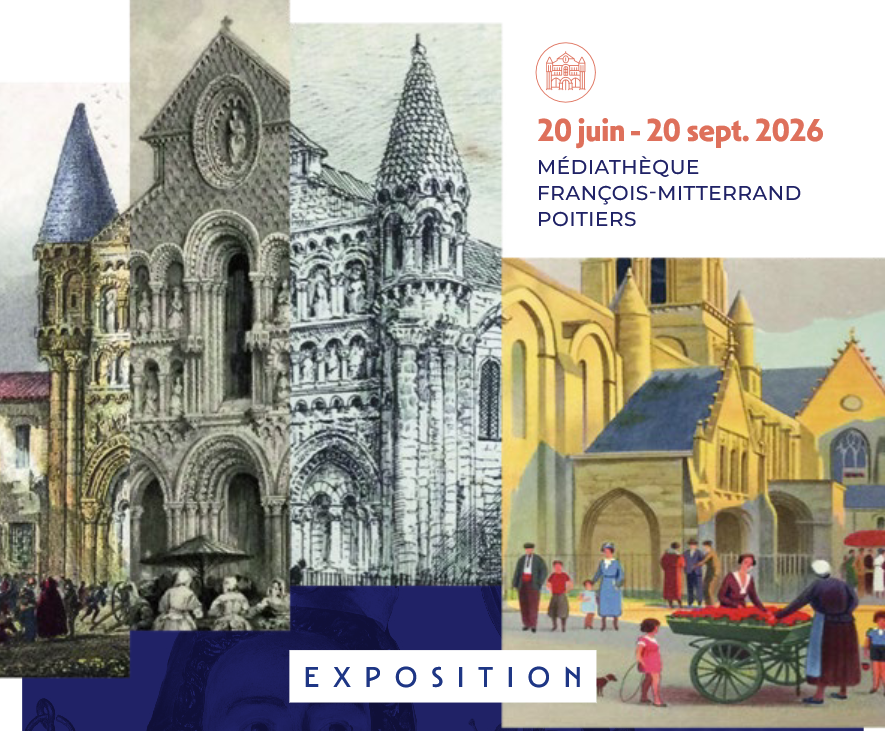
L’église Notre-Dame-la-Grande apparaît comme l’une des images les plus emblématiques de Poitiers. Avec sa façade sculptée, elle occupe une place centrale dans les représentations de la ville. Pourtant, cette évidence est le résultat d’une histoire longue, construite progressivement, au fil des siècles, à travers les usages de l’édifice, les transformations de la ville et l’évolution du regard porté sur le Moyen Âge.

L’exposition «  Notre-Dame-la-Grande, icône de Poitiers  » revient sur l’importance artistique de ce monument, sur son histoire, sur ses représentations et sur sa place primordiale dans l’histoire de la cité poitevine depuis sa construction à la fin du 11e siècle à aujourd’hui.

Exposition proposée par la Ville de Poitiers en partenariat avec la médiathèque François-Mitterrand, Les Musées de Poitiers, le CESCM et la Société des Antiquaires de l’Ouest (SAO) dans le cadre du chantier de restauration de l’église Notre-Dame-la-Grande. 

Informations pratiques :

20 juin-20 sept. 2026
Médiathèque François-Mitterrand – Poitiers

Entrée libre.

Du 20 au 30 juin, et du 1er au 19 septembre, ouvert le mardi et jeudi (11 h-19 h), le mercredi et vendredi (11 h-18 h) et le samedi (10 h-18 h).
Du 1er juillet au 29 août, ouvert du mardi au vendredi (13 h-18 h) et le samedi (10 h-18 h).

Source : CESCM

Publié dans Exposition | Commentaires fermés sur Exposition – Notre-Dame-la-Grande : icône de Poitiers

Publication – « Proclus and the Sciences. Approaches to Understanding the Divine », éd. Anna Motta, Daniela P. Taormina

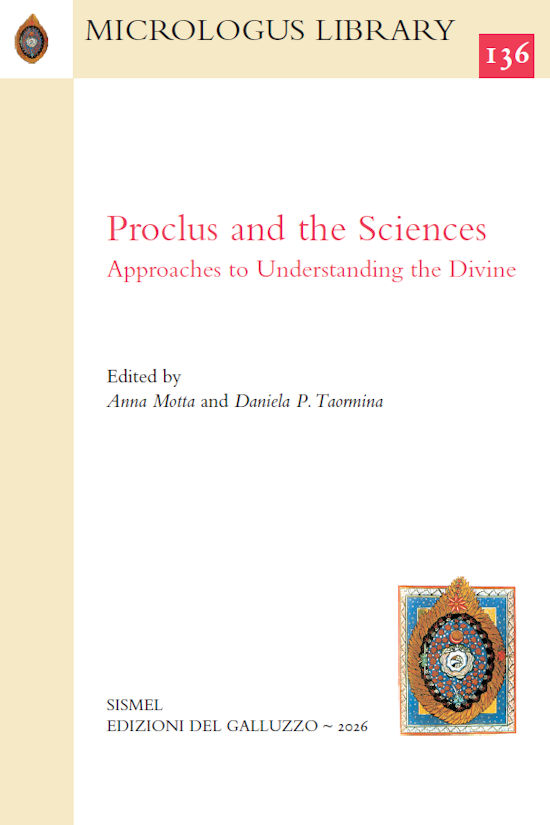
Proclus and the Sciences. Approaches to Understanding the Divine, éd. Anna Motta, Daniela P. Taormina, Florence, SISMEL–ED. del Galluzzo, 2026 ; 1 vol., X–373 p. (Micrologus Library, 136). ISBN : 978-88-9290-508-5. Prix : € 62,00.

Table des matières :

Proclus and the Sciences — A. Motta, D. P. Taormina

I. Mathematics: Branches, Ontological Status and Method

Syrianus and Proclus on Why True Mathematics Cannot Be Empirically Based — Dominic J. O’Meara

The Place of Music in Proclus’ Conception of Mathematical Exegesis — A. Sheppard

Incommensurability in Geometrical Entities in Proclus’ In Eucl. and In Prm. — D. Walter

The Unfolded Syntax of Intellect: Proclus on the Metaphysical Foundations of Elementary Arrangements — Á. J. Campillo Bo

Can the Will Ground Science? — A. Vargas

II. Mathematics: A Bridge to Theology

Proclus on the Usefulness of Mathematics for Theology — C. Steel

La mathématique générale chez Proclus — A. Lernould

Relations That Are Given and Established. Proclus’ Use of Analogical Reasoning in Theology — M. Martijn

L’Arithmos divino nel sistema metafisico di Proclo — M. Cutino

Les structures numériques des ordres divins dans la Théologie Platonicienne de Proclus. De la triade à l’hebdomade et à la dodécade — P. Hoffmann

III. Other Sciences and the Divine

Proclus’ Potamology: The Role of Rivers in Eschatology — G. Van Riel

Proclus’ “Theological” Spherical Cosmic Whole and His Scientific Innovative Astronomy — E. Kutash

IV. A Philological Proclean Appendix

Difformità storico-tradizionali in Proclo, Commento all’Alcibiade I e Commento al Timeo tra il periodo mediobizantino e l’età dei Paleologi: Giorgio Pachimere (Napoli, BN, III.E.17, In Alc.), Giovanni Catrario (Napoli, BN, III.D.28, In Ti.) e lo Upatos ton pilosopon Michele Psello (Patmos Eileton 897) — M. Menchelli

Source : SISMEL

Publié dans Publications | Commentaires fermés sur Publication – « Proclus and the Sciences. Approaches to Understanding the Divine », éd. Anna Motta, Daniela P. Taormina

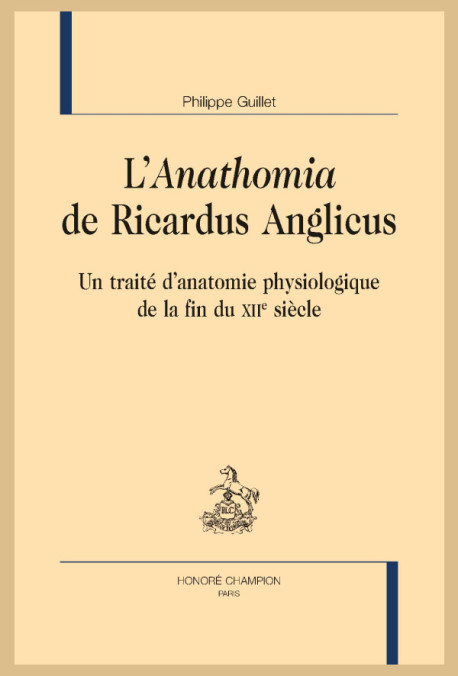
Publication – Philippe Guillet, « L’Anathomia de Ricardus Anglicus. Un traité d’anatomie physiologique de la fin du XIIe siècle »

Les bases médiévales de l’anatomie moderne, définie comme une connaissance approfondie de la structure et de l’organisation du corps humain essentielle à la médecine, émergent en Italie à la fin des XIIIe et XIVe siècles. Les textes médicaux des XIIe et XIIIe siècles s’intéressent précocement à l’anatomie, non pas dans le contexte de la chirurgie, qui n’a pas encore clairement manifesté d’intérêt pour cette discipline, mais plutôt dans une perspective naturaliste plus large, visant à comprendre l’organisation et le fonctionnement des différents membres du corps humain. Un texte notable illustrant cet intérêt est l’Anathomia Ricardi, également connue sous le nom d’Anathomia Ricardi Salernitani. Les historiens allemands de la médecine, qui en ont publié les premiers manuscrits à la fin du XIXe siècle, pensaient qu’il avait été écrit à Salerne.

Il s’agit de la première synthèse intégrant les informations anatomiques et physiologiques détaillées dans le Pantegni de Constantin l’Africain, mais organisée en suivant la classification des membres principaux de Galien dans le Tegni, version médiévale de son Art médical.

Les résultats de notre enquête présentés dans ce livre, révèlent que les copies successives de ce texte, écrit à la fin du XIIe siècle, se divisent en deux traditions distinctes, chacune ayant connu un succès certain. La première tradition, écrite par un médecin du nom de Ricardus anglicus, possiblement à Montpellier, diffuse rapidement dès le début du XIIIe siècle à travers le réseau abbatial, vers le nord et l’est de l’Europe (France, Angleterre, Allemagne, Pologne). La seconde tradition résulte d’une révision significative de ce texte initial, intégrant des éléments issus des œuvres biologiques d’Aristote peu après leur traduction au XIIIe siècle. Elle semble être enseignée à Montpellier, et ses copies gagnent également rapidement les mêmes régions géographiques que la première. Ces traditions furent l’objet d’adaptations en langue vernaculaire au XVe siècle, attestant leur intérêt persistant pendant trois siècles.

Philippe Guillet, médecin et historien des sciences et des techniques est actuellement chercheur associé à l’équipe SAPRAT (Savoirs et pratiques du Moyen Âge à l’époque moderne) de l’EPHE.

Table des matières : ici

Informations pratiques :

Philippe Guillet, L’Anathomia de Ricardus Anglicus. Un traité d’anatomie physiologique de la fin du XIIe siècle, Paris, Honoré Champion, 2026 ; 1 vol., 414 p. (Sciences, technique, 25). ISBN : 978-2-74536-629-0. Prix : € 45,00.

Source : Honoré Champion

Publié dans Publications | Commentaires fermés sur Publication – Philippe Guillet, « L’Anathomia de Ricardus Anglicus. Un traité d’anatomie physiologique de la fin du XIIe siècle »

Offre d’emploi – Lecturer in Medieval History (University of Glasgow)

Deadline : 5th August 2026

This post is full time (35 hours per week) and is open ended.

The History subject in the College of Arts and Humanities is seeking to appoint a Research and Teaching Track lecturer in Medieval History. The postholder will undertake field leading research in European medieval history (c.800 CE to 1500CE), ideally through either a comparative transnational perspective (e.g. Europe’s links with medieval Islam, non-Islamic Africa, and wider Eurasia), or through a set of interdisciplinary lenses that opens medieval history to substantive research collaborations beyond the traditional humanities (e.g. medical humanities, environmental humanities).

The post-holder’s research and teaching interests will complement rather than duplicate those of current staff on opened-ended contracts (these can be viewed on the History staff page). Through both individual and team-taught modules, and in collaboration with colleagues in the History subject areas, they will provide high-quality teaching and administrative service in a range of roles.

In any given year the post-holder can expect to be asked to contribute a mix of the following teaching activities:

  • Seminar teaching and lectures for History 1A (the core pre-Honours Medieval History course for the undergraduate degree in History).
  • A 60-credit fourth-year special subject across the entire academic year
  • 1 to 2 20-credit Honours modules for a class of up to 36 students,
  • Provide UG/PG dissertation supervision
  • PGT teaching (either as part of a team or as an individual), both in their own field of interest and in the skills and methodologies of medieval history scholarship.
  • The post-holder will also be expected to contribute to the ongoing development of cross-discipline Medieval research and teaching collaboration.

A core expectation of the post-holder will be to provide engaging and high-recruiting teaching and UG, PGT and PGR supervision on Medieval History.

The postholder will be expected to pursue their own research as a third of their contracted time.

For informal enquiries, please contact Prof. Andrew Mackillop:

Email Andrew.Mackillop@glasgow.ac.uk

For more about the History subject area at Glasgow, see www.gla.ac.uk/subjects/history

Closing date: 5th August 2026 at 23:45

We believe that we can only reach our full potential through the talents of all. Equality, diversity and inclusion are at the heart of our values. Applications are particularly welcome from across our communities and in particular people from the Black, Asian and Minority Ethnic (BAME) community, and other protected characteristics who are under-represented within the University. Read more on how the University promotes and embeds all aspects of equality and diversity within our community www.gla.ac.uk/myglasgow/humanresources/equalitydiversity.

We endorse the principles of Athena Swan www.gla.ac.uk/myglasgow/humanresources/equalitydiversity/athenaswan and hold bronze, silver and gold awards across the University.

Source : H-Soz-Kult

Publié dans Offre d'emploi | Commentaires fermés sur Offre d’emploi – Lecturer in Medieval History (University of Glasgow)

Podcast – Angélique Ferrand, « Du Zodiaque et des Hommes »

Hérités de l’Antiquité, les signes du zodiaque ont perduré au Moyen Âge au sein du lieu ecclésial, dans le décor monumental du portail, à l’intérieur des calendriers ornant les manuscrits ou bien encore sur les objets du mobilier liturgique. La dimension à la fois spatiale et temporelle du Zodiaque, inhérente à sa tradition scientifique située à la croisée de l’astronomie et de l’astrologie, sous-tend l’agencement de ses images, leur emplacement et le discours idéologique véhiculé.

Lors de cette conférence, Angélique Ferrand propose de nous intéresser à la resémantisation chrétienne du zodiaque dans les décors monumentaux ecclésiaux entre les XIe et XIIIe siècles. Il s’agira d’une part, d’observer comment le zodiaque contribue à l’évocation de la Porta coeli et à la médiation entre ciel et terre en relation avec de grands thèmes iconographiques. D’autre part, certaines occurrences des signes du zodiaque dans des décors des XIIe et XIIIe siècles, en particulier de la Vierge et de la Balance, ont fait l’objet d’une resémantisation plus prononcée comme nous le montrerons.

Source : École nationale des chartes – YouTube

Publié dans Podcast | Commentaires fermés sur Podcast – Angélique Ferrand, « Du Zodiaque et des Hommes »

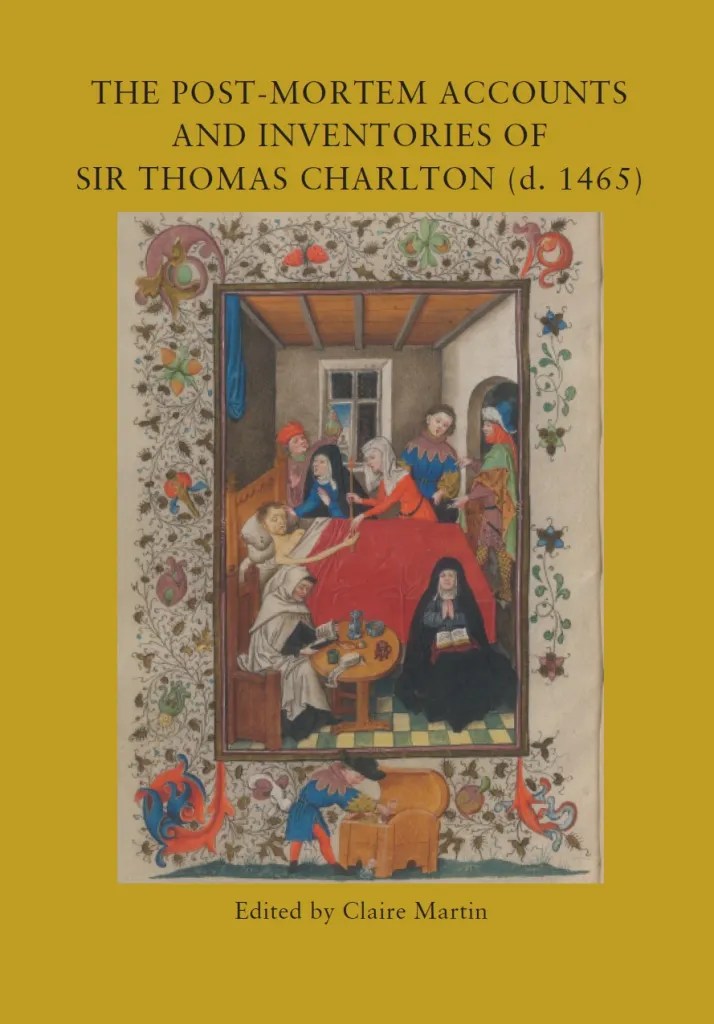
Publication – « The Post-Mortem Accounts and Inventories of Sir Thomas Charlton », éd. Claire Martin

A scion of one of the wealthiest families in Middlesex, Sir Thomas Charlton (c.1417-1465) could claim relatives among London’s mercantile elite as well as kinship with Alice, countess of Salisbury, and her son, the earl of Warwick. Over the course of his life he served his country diligently. From his position on the Middlesex bench of J.P.s and on local commissions, to years of parliamentary industry and, eventually, the speaker’s chair. In many respects he was an ‘everyman’ for the lives of England’s greater gentry and when he died, following a short illness, in February 1465 his story, like so many others, would have come to an end were it not for the remarkable survival of an extensive collection of inventories and associated post-mortem accounts.

In the former we can walk through the rooms, barns and stables of Sir Thomas’s houses and between the ‘little black ambling nag’ and the enamel livery collar of suns and roses, there lies a microcosm of fifteenth-century life. There are riches that may be mined for material wealth in all its forms, from clothing, plate and jewels to intellectual treasure in a small collection of books; the practicalities of stable, farm and household to the well-stocked armoury of a knight. The meticulously prepared accounts offer a window into the daily details of estate management and the efforts that went into purchasing the wardship of Charlton’s heir and in the daybook of Nicholas Mole we walk in the shoes of one overburdened steward, offering insight into what it meant to be a medieval executor.

In life, Sir Thomas Charlton’s story would have been familiar to many members of medieval gentry society. In death he left behind a collection of documents that would have been equally commonplace in their day but which are remarkable in their survival and, as such, invaluable to the historian.

The Post-Mortem Accounts and Inventories of Sir Thomas Charlton, éd. Claire Martin, York, The Yorkish History Trust, 2026 ; 1 vol., Prix : GBP 25,00.

Source : The Yorkish History Trust

Publié dans Publications | Commentaires fermés sur Publication – « The Post-Mortem Accounts and Inventories of Sir Thomas Charlton », éd. Claire Martin

Publication – Maximilian Lang, « Die Kanzlei Kaiser Friedrichs II. in den Jahren 1236 bis 1245. Diplomatische Studien zur hochmittelalterlichen Herrschaftspraxis in Zeiten des Konflikts »

Die Monographie von Maximilian Lang untersucht erstmals detailliert das Kanzlei- und Urkundenwesen des berühmten Stauferkaisers Friedrich II. in den Jahren 1236 bis 1245, also bis zu seiner Absetzung durch Innozenz IV. auf dem Konzil von Lyon. Der behandelte Zeitraum war vornehmlich geprägt von den militärischen Auseinandersetzungen mit den Städten des Lombardenbunds auf der einen und dem Konflikt mit dem Papsttum auf der anderen Seite. Ausgehend von umfangreichen Schrift- und Formularanalysen sowie umfassenden prosopographischen Studien bietet der Autor neue Erkenntnisse zur Funktionsweise der Kanzlei und zu ihrem Personal unter Friedrich II., das die kaiserlichen Diplome konzipierte, mundierte und schließlich an die jeweiligen Urkundenempfänger expedierte. Darüber hinaus liefert der Band vor dem Hintergrund der Kanzleiprodukte neue Ergebnisse zu Herrschaftsverständnis und -praxis Kaiser Friedrichs II. in einer besonders konfliktreichen Phase. Die kanzleigeschichtliche Abhandlung behandelt damit ein langwährendes Forschungsdesiderat der spätstaufischen Diplomatik und gibt Impulse für weiterführende Überlegungen zur Funktionalität von Herrschaft im Mittelalter.

Table des matières : ici

Informations pratiques :

Maximilian Lang, Die Kanzlei Kaiser Friedrichs II. in den Jahren 1236 bis 1245. Diplomatische Studien zur hochmittelalterlichen Herrschaftspraxis in Zeiten des Konflikts, Wiesbaden, Harrassowitz Verlag, 2026 ; 1 vol., LXV–1050 p. (Monumenta Germaniae Historica, Schriften, 86). ISBN : 978-3-447-12339-6. Prix : € 180,00.

Source : Harrassowitz Verlag

Publié dans Publications | Commentaires fermés sur Publication – Maximilian Lang, « Die Kanzlei Kaiser Friedrichs II. in den Jahren 1236 bis 1245. Diplomatische Studien zur hochmittelalterlichen Herrschaftspraxis in Zeiten des Konflikts »

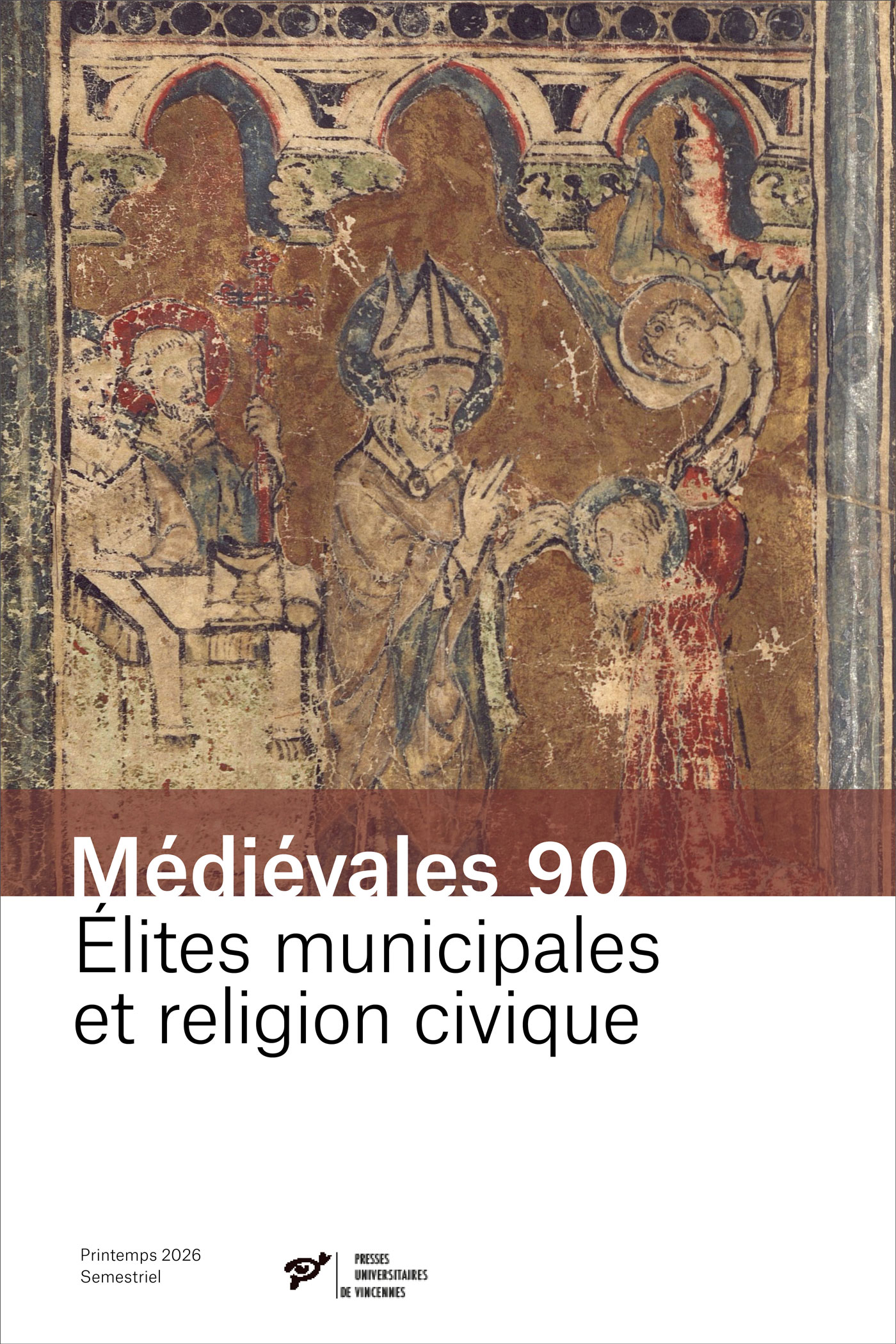
Publication – « Élites municipales et religion civique », éd. Adrien Ferré Thomas Schneider (Médiévales, t. 90, 2026)

Spiritualité des élites municipales au Moyen Âge : quoi de neuf ? Ce numéro de la revue Médiévales réinterroge leurs pratiques dévotionnelles et leur rôle dans la construction d’une identité urbaine singulière. Après une synthèse historiographique sur la « religion civique » et la spiritualité urbaine, l’ouvrage offre de nouveaux regards sur les pratiques dévotionnelles des élites urbaines au Moyen Âge, clercs comme laïcs, entre piété privée et dévotions publiques.
Paris et l’espace méridional (Limoges, Montpellier et Toulouse) entrent en résonance dans cinq contributions qui réexaminent comment bourgeois, consuls ou capitouls façonnent l’urbanité et le consensus religieux, notamment comme médiateurs entre le sacré et le pouvoir du prince.

Table des matières :

Adrien Ferré, Thomas Schneider
« Religion civique » ou spiritualité urbaine ? Nouveaux regards sur les pratiques dévotionnelles des élites municipales

Adrien Ferré
La Grande Confrérie Notre-Dame aux prêtres et aux bourgeois de Paris : facteur du consensus urbain ou club mondain pour l’élite urbaine ?

Thomas Schneider
Martial, patron du Château de Limoges, ou l’appropriation par le pouvoir bourgeois d’un apôtre ducal (XIe-XVIe siècle)

Lucie Laumonier
La Charité générale de Montpellier : du consulat aux métiers (XIIIe-XVIe siècles)

Vincent Challet
« Et pour le faire bayser aux bonnes gens qui ont dévotion au benoît saint corps » : rituels consulaires et dévotions ordinaires (Montpellier, XIIIe-XVe siècles)

Michelle Fournié
L’implication des magistrats urbains et des notables dans la religion civique à Toulouse

Essais et recherches

Philippe Josserand
Par-delà Ousâma et Saydnâyâ : pour une autre histoire des Templiers et de l’Autre

Aude Mairey
Troie en Angleterre à la fin du Moyen Âge : entre utopie et chaos

Points de vue

Patrick Henriet
Hagiologie, hagiographie, sainteté, reliques. Remarques à partir de quelques travaux récents

Didier Lett
Christiane Klapisch-Zuber : une historienne pragmatique de la famille et de la parenté

Informations pratiques :

Élites municipales et religion civique, éd. Adrien Ferré Thomas Schneider, Médiévales, t. 90, 2026 ; 1 vol., 240 p. ISBN : 978-2-37924-633-3. Prix : € 25,00.

Source : Presses universitaires de Vincennes

Publié dans Publications | Commentaires fermés sur Publication – « Élites municipales et religion civique », éd. Adrien Ferré Thomas Schneider (Médiévales, t. 90, 2026)