Publication – Philippe Maupeu, « L’iconographie du Séjour d’Honneur d’Octovien de Saint-Gelais »

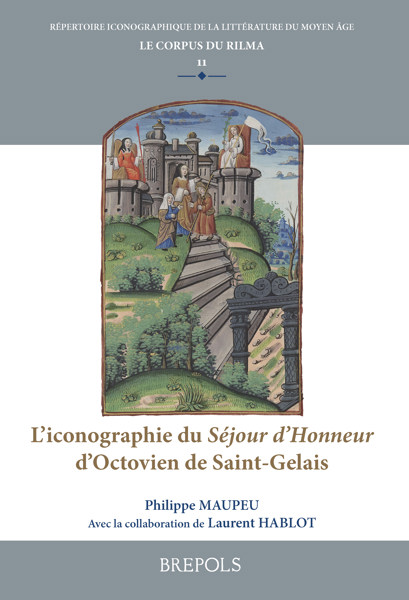
Le Séjour d’Honneur, écrit par Octovien de Saint-Gelais (c. 1468-1502) entre 1489 et 1494, au moment de son intronisation comme évêque d’Angoulême, est un prosimètre allégorique mêlant vers et prose, chef-d’œuvre de la « Grande rhétorique ». Le récit conte l’errance d’un pèlerin dévoyé, sous l’emprise de sa fausse guide Sensualité, qui parvient à la cour (le « séjour ») de Charles VIII, représenté par la figure d’Honneur, avant de trouver refuge en l’ermitage d’Entendement. Auparavant, le pèlerin aura parcouru le sentier de Fleurie Jeunesse, traversé la mer Mondaine, gagné l’île de Vaine Espérance et parcouru la forêt des Aventures où se lit un condensé de l’histoire du monde. Ce texte, s’il puise dans des modèles littéraires son invention et ses cadres formels – la Consolation de Philosophie de Boèce et le Pèlerinage de vie humaine de Guillaume de Deguileville en premier lieu – en renouvelle d’une manière originale et personnelle les conventions. La forme hybride du prosimètre permet d’articuler l’éloge politique du Souverain avec le propos édifiant de la conversion au bien et à la religion.

Le texte n’a été conservé que dans deux manuscrits dont un seul est illustré, et dans un petit nombre d’éditions imprimées. Le manuscrit BnF fr 12783, commandé par Edmond de Prie Buzançais et son épouse Avoye de Chabannes entre 1506 et 1510, présente une illustration abondante (56 miniatures) et riche, fidèle au texte, reproduite dans son intégralité ici, ainsi qu’un programme héraldique particulièrement élaboré. Il est probable que ce manuscrit soit la copie du manuscrit original de dédicace à Charles VIII, perdu, et que son programme iconographique, ait été conçu par l’auteur lui-même. On s’attache ici à mettre au jour ces relations complexes entre texte et image dans le programme iconographique et héraldique du manuscrit.

Philippe Maupeu est Professeur à l’Université Bordeaux 3-Montaigne en Littérature et Langue Médiévales. Ses travaux portent principalement sur l’allégorie et sur une approche rhétorique des rapports entre texte et image à la fin du Moyen Âge. Il a publié L’intention et l’empreinte. Rhétorique du manuscrit d’auteur à la fin du Moyen Âge (Paris, Champion, 2022), et a édité le Livre du Pèlerin de vie humaine de Guillaume de Deguileville en collaboration avec Robert G. Edwards (Livre de Poche, « Lettres gothiques », 2015).

Laurent Hablot, spécialiste d’héraldique, est Directeur d’études à l’École Pratique des Hautes Études où il occupe la chaire d’emblématique occidentale. Il enseigne à l’École nationale des Chartes et à l’École du Louvre. Il a publié, entre autres nombreux travaux, le Manuel d’héraldique et d’emblématique médiévale (PUFR, 2019).
Le Séjour d’Honneur : un pèlerinage allégorique
– Argument du Séjour d’Honneur
– Octovien de Saint-Gelais, évêque et poète
– Le Séjour d’Honneur et le genre du pèlerinage allégorique
– Autobiographie et allégorie
– Octovien de Saint-Gelais, écrivain et concepteur du programme iconographique ?
– Poétique de l’illustration
– Le manuscrit BnF fr. 12783 : attribution et programme iconographique
– Le programme héraldique du manuscrit BnF fr. 12783 (par Laurent Hablot)

Le cycle iconographique
– Avertissement au lecteur

Bibliographie
Index général
Planches

Informations pratiques :

Philippe Maupeu, L’iconographie du Séjour d’Honneur d’Octovien de Saint-Gelais, Turnhout, Brepols, 2025 ; 1 vol., 170 p. (Répertoire Iconographique de la Littérature du Moyen Âge, 11). ISBN : 978-2-503-61964-4. Prix : € 80,00.

Source : Brepols
Publié dans Publications | Commentaires fermés sur Publication – Philippe Maupeu, « L’iconographie du Séjour d’Honneur d’Octovien de Saint-Gelais »

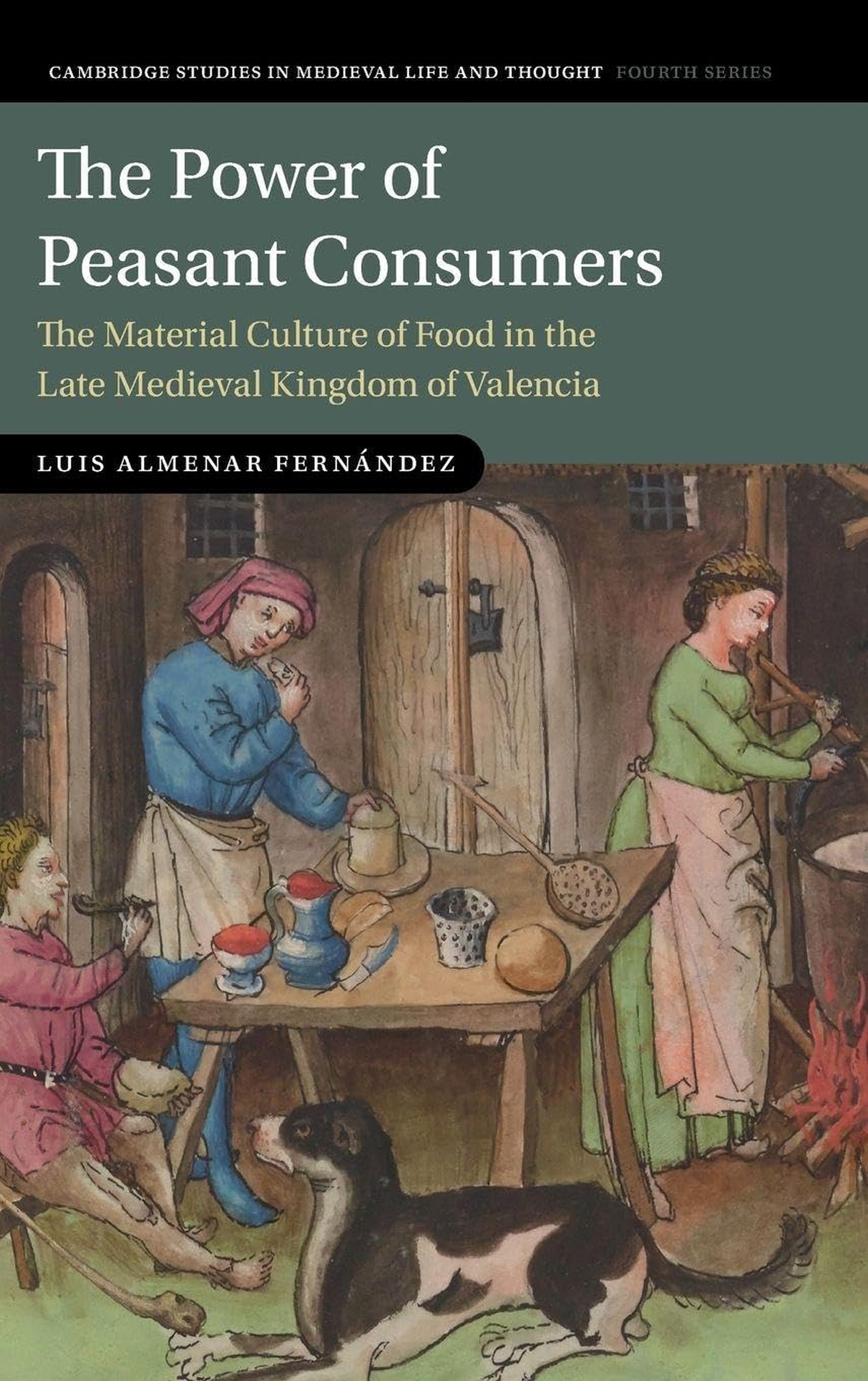
Publication – Luis Almenar Fernández, « The Power of Peasant Consumers. The Material Culture of Food in the Late Medieval Kingdom of Valencia »

The long-held view of the peasantry as a passive social group has gradually been replaced by a positive narrative that stresses peasant agency in economic, social, and even political terms. Contributing to this shift, Luis Almenar Fernández explores the objects that peasants used to store, cook, and serve their food in late medieval Valencia. Drawing on a range of archival, visual, material, and literary evidence from c. 1280 to c. 1460, the book examines the materiality of food to shed light on the consumer behaviour of agriculturalists during pivotal economic, social, and material transformation. It builds on discussions about changes in living standards, consumption patterns, and material culture in pre-industrial European societies. The materiality of food improved significantly among Valencian peasants during this period. This phenomenon had widespread implications for the economy and underpinned the development of new industries, contributing to the economic growth of this prominent Mediterranean polity.

Table des matières : ici

Informations pratiques :

Luis Almenar Fernández, The Power of Peasant Consumers. The Material Culture of Food in the Late Medieval Kingdom of Valencia, Cambridge, Cambridge University Press, 2025 ; 1 vol. ISBN : 9781009602440. Prix : 104,90.

Source : Cambridge University Press

Publié dans Publications | Commentaires fermés sur Publication – Luis Almenar Fernández, « The Power of Peasant Consumers. The Material Culture of Food in the Late Medieval Kingdom of Valencia »

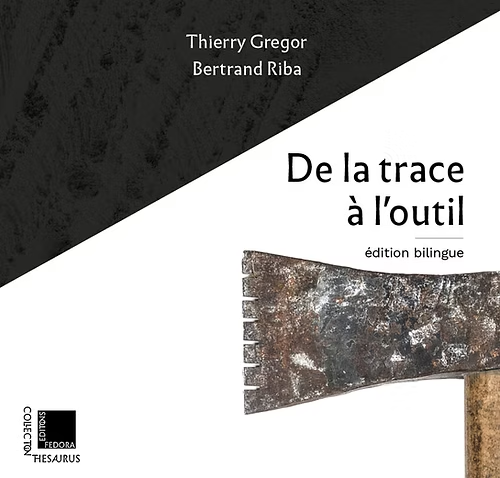
Publication – Thierry Gregor, Bertrand Riba, « De la trace à l’outil »

Les pierres des monuments racontent à leur manière les techniques de construction du passé. Encore faut-il savoir déchiffrer les marques laissées, il y a des siècles, par des artisans restés anonymes.
Ce manuel vous invite à lire ces empreintes du passé et à les relier aux outils qui les ont façonnées. Retrouver l’outil, c’est retrouver le geste, comprendre la chaîne opératoire qui a permis d’élever aussi bien les édifices les plus modestes que les constructions les plus imposantes.

Proposé en version bilingue français-anglais pour en faciliter l’accès, cet ouvrage présente les principaux outils employés durant l’Antiquité et le Moyen Âge. Richement illustré de photographies, il s’adresse autant aux spécialistes qu’aux passionnés d’histoire et d’archéologie, curieux de découvrir le savoir-faire et l’ingéniosité des bâtisseurs d’autrefois.

Informations pratiques :

Thierry Gregor, Bertrand Riba, De la trace à l’outil, Talence, Éditions Fedora, 2025 ; 1 vol., 180 p. (Thesaurus). ISBN : 979-10-96137-28-2. Prix : € 15,00.

Source : Éditions Fedora

Publié dans Publications | Commentaires fermés sur Publication – Thierry Gregor, Bertrand Riba, « De la trace à l’outil »

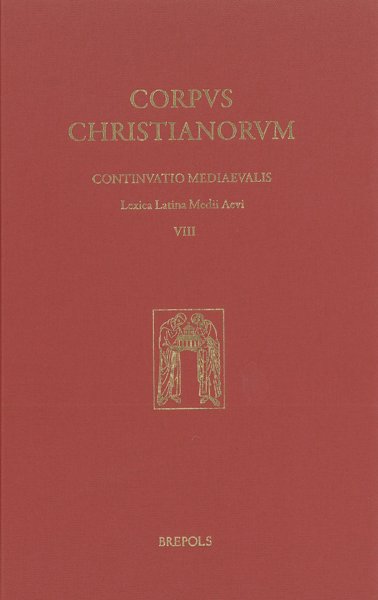
Publication – « The Werden A Glossary. Edition and Commentary », éd. Alger N. Doane

This is an edition of a key eighth century glossary, traditionally called « Werden A » after the abbey in Germany where its unique manuscript was probably written about 810, incorporating English materials of earlier date, It is one of an important set of early English glossaries usually associated with the school of Canterbury under Archbishop Theodore in the last quarter of the seventh century; this was the first important center of learning in England after the conversion to Christianity from ca. 600 and its alumni and scholarship spread out not only over England in the subsequent century but to north-east France and Germany in the so-called « Anglo-Saxon Mission » with the aim of bringing  Christianity to semi-pagan lands. Such glossaries played a big part in these campaigns and strongly influenced Old High German glossaries and literature for several centuries more. Werden A shows ample signs of its career on the continent with many entries that must have originated in Frisia, France, Saxony and the Rhineland.  Moreover, Werden A presents many difficult editorial challenges: it is very fragmentary, preserved as several mutilated and dispersed parts, most of which were destroyed in World War II and are only preserved in poor nineteenth century transcripts, and beyond that the text is often obscure and corrupt. This edition undertakes to reconstruct the codicology and contents of the original book before its dispersal, retrieval of the remaining text as originally written, establishment of the sources of the various items, and the deciphering and interpretation of individual entries that are often highly original and unparalleled in other glossaries.

Alger N. Doane is Professor of English, University of Wisconsin-Madison, Emeritus. His numerous contributions to Old English and Old Saxon language, literature and reception were the subject of a celebratory volume: The Genesis of Books: Studies in the Scribal Culture of Medieval England in Honour of A. N. Doane, ed. Matthew T. Hussey, John D. Niles (Brepols, 2012).

Introduction

Appendix 1. Index to Vernacular Interpretants

Appendix 2. Sources of Vernacular Items

Critical Edition of Werden A Glossary

Commentary

Bibliography

Indices

Informations pratiques :

The Werden A Glossary. Edition and Commentary, éd. Alger N. Doane, Turnhout, Brepols, 2025 ; 1 vol., 324 p. (Corpus Christianorum, Lexica Latina Medii Aevi, 8). ISBN : 978-2-503-61248-5. Prix : € 185,00.

Source : Brepols

Publié dans Publications | Commentaires fermés sur Publication – « The Werden A Glossary. Edition and Commentary », éd. Alger N. Doane

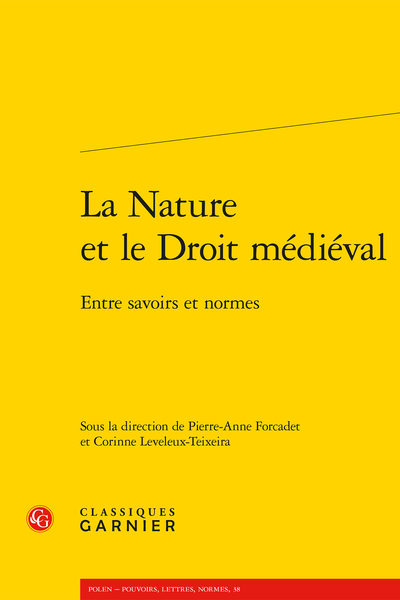
Publication – « La Nature et le Droit médiéval. Entre savoirs et normes », éd. Pierre-Anne Forcadet, Corinne Leveleux-Teixeira

Dans un article de 1967, Lynn White attribuait au christianisme médiéval une vision prédatrice du monde. Ce débat, relancé par la crise écologique, reste peu exploré par les juristes. Le présent ouvrage comble ce vide en étudiant les liens entre droit et nature au Moyen Âge.

Table des matières : ici

Informations pratiques :

La Nature et le Droit médiéval. Entre savoirs et normes, éd. Pierre-Anne Forcadet, Corinne Leveleux-Teixeira, Paris, Classiques Garnier, 2025 ; 1 vol., 322 p. (POLEN – Pouvoirs, lettres, normes, 38). ISBN : 978-2-406-18775-2. Prix : € 38,00.

Source : Classiques Garnier

Publié dans Publications | Commentaires fermés sur Publication – « La Nature et le Droit médiéval. Entre savoirs et normes », éd. Pierre-Anne Forcadet, Corinne Leveleux-Teixeira

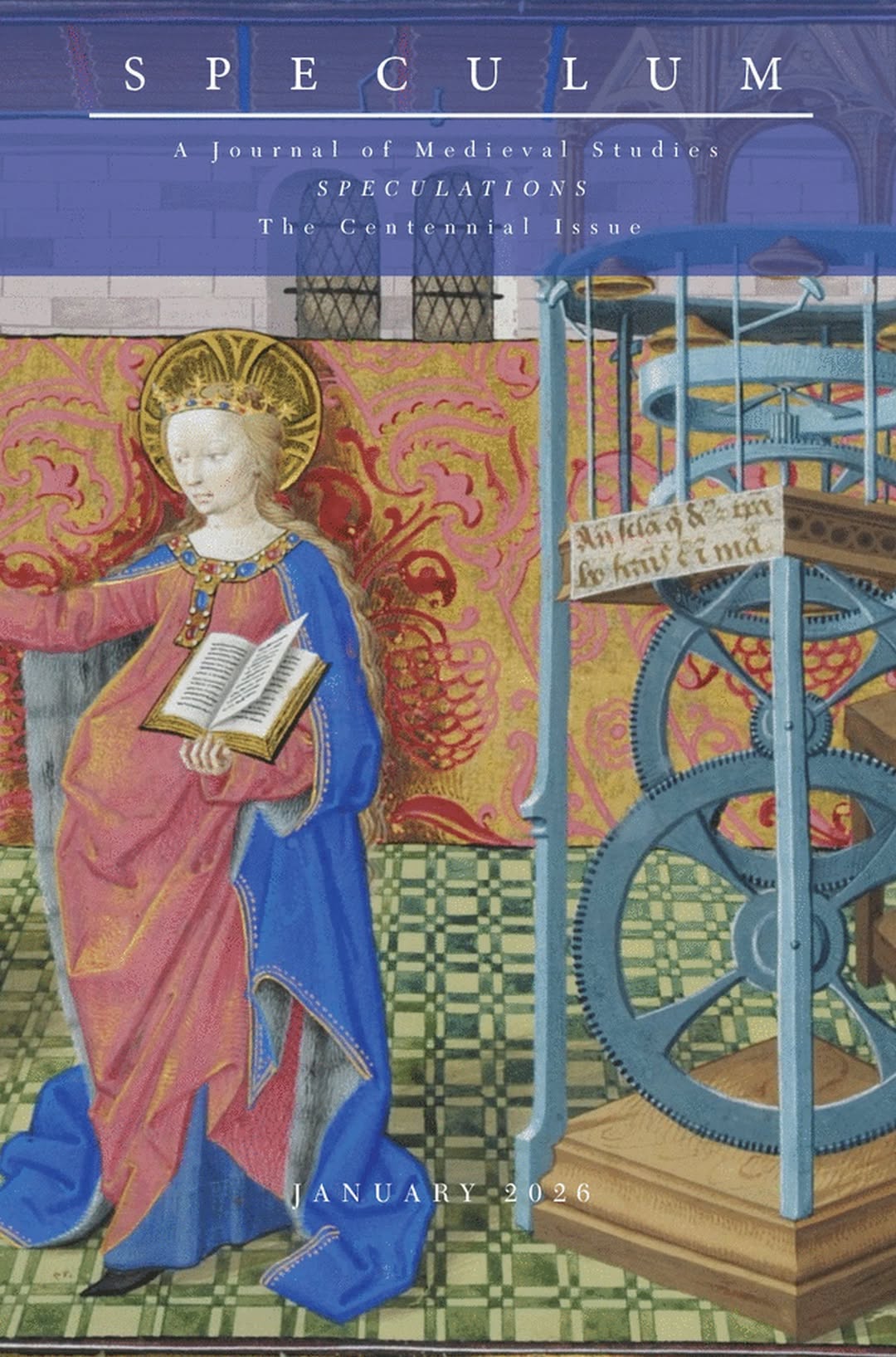
Publication – « Speculations: The Centennial Issue » (Speculum, 101, janv. 2026)

Speculations: The Centennial Issue, Speculum, t. 101, janv. 2026.

Editors’ Introduction — Mohamad Ballan, Cecily J. Hilsdale, Katherine L. Jansen, Sierra Lomuto, and Peggy McCracken

New Directions in Medieval Paleography: Everyday Traces of the Past — Elaine Treharne

Remembering the Normans in the South, from Somalia to Sicily: A Case Study in the Medieval Mediterranean’s Pasts, Presents, and Futures — Claire Dillon

Radical Reimagining and the Work of Queer and Trans History — Leah DeVun

Psychoanalytic Futures — Jessica Rosenfeld

Coloniality and Colonialism in Urban Customary Law: The View from Medieval Dublin — Esther Liberman Cuenca

Lareowas ond leornungcnihtas: Toward Inclusive and Global Futures for Teaching and Learning Old English — Michael D. J. Bintley, Donna Beth Ellard, Daria Izdebska, Emma Nuding, Emily Sun, Erin E. Sweany, and Trisha Teig

Medieval Studies and the History of Emotions: Possibilities and Pitfalls — Barbara H. Rosenwein

The Medieval Prehistory of the Carbon Economy — Spencer A. Strub

Stuck in the Dark Ages: Medieval Studies in the K–12 Classroom — Courtney Luckhardt, Julianne Bruneau, and Bradley Phillis

Enslavement and Global Medieval Cultures: Centering the Contributions of Enslaved People as an Approach to Medieval History — Lisa Nielson

Literacy, Diversity, and Workplace Skills in Community College Medieval Literature Courses — Aidan Holtan and Karen Campbell

Western Supremacy and “Byzantium” — Leonora Neville

Medieval Crosscurrents: More Once and Future Medievalisms — Matthew Vernon

Unquestionably Gay? Melancholia, Futurity, and John Boswell’s Aelred of Rievaulx — James C. Staples

Medievalism: A Reckoning — Raha Rafii

Literary History Is a Ghost Story: The Awntyrs off Arthure and Romance Speculations — Elizabeth Allen

The Past, Present, and Future Prospect of Islamicate Studies — Ross Brann

Toward a Medieval Theory of the Human: Literacy and Bede’s Parable of Cædmon — Jonathan F. Correa Reyes

Redefining “Medievalist” the Medieval Way: Toward a More Accessible Medieval Studies — Christopher D. Fletcher

Is Spain “Different”? Self-Segregation, Exclusion, and the Future of Medieval Iberian Studies — Pamela A. Patton

The Future of Medieval Ethnicity — Walter Pohl

Global Medieval Studies Is a Failure — Michelle C. Wang

Scandal, or Historical Dead Ends — Sarah Davis-Secord

Thinking (and Feeling) in Virtual Reality: Prospective Uses in Medieval Studies — Blair Apgar

Systems Thinking — Ingrid Nelson

Millennial Books — Michelle R. Warren

Anachronic Blackness: The Image of the Black ↔ Fingo of Re-presentation in the Late Medieval Low Countries — Dontay M. Givens II
The Medieval Wearable: In and Out of Time — Elizabeth Dospěl Williams and Ittai Weinryb

Reacting to the (Medieval) Past: Immersive Role-Playing Simulations and Medieval Studies at Access-Granting Institutions — Amy Brown Curry and Kyle C. Lincoln

“English Is Some Stockholm Sh!t”: An Indigenous Cultural History of Old English — Tarren Andrews

Affective Philology and Reading Machines — Sarah McNamer

Transforming the Digital Landscape: Towards a Medieval Knowledge Graph — Toby Burrows

Entanglement, Identity, and Difference: Medieval Jews in Christian Europe — Elisheva Baumgarten

Glass Ceilings? Transdisciplinary Work in Medieval Studies — Eva von Contzen, Julia von Ditfurth, Bastian E. Rapp, and Fabian Stroth

The Translation of Medieval Iberia — Claire Gilbert

A Fool’s Errand? Toward Decolonizing Gothic Architecture — Erik Gustafson

The Public Lens: Medieval Manuscripts and Museums — Lynley Anne Herbert and Elizabeth Morrison

Bound Together: A Collaborative Essay on the Formation of Future Medievalists — Will Beattie, Loren E. L. Cantrell, Chas Firestone East, Masha Goldin, Andrea Kate Klassen, and Maria S. Thomas

Digital Medieval Studies: Charting the Course — Laura K. Morreale

Researching Law in the Global Middle Ages: Byzantine and Chinese Legal History in Conversation — James Morton and Emily Cheng

Medieval Studies and STEM: Speculations of a Byzantino-Arabist — Maria Mavroudi

The Two Faces of Medieval Jewish Studies — Rachel Katz and Lucy K. Pick

Goitein, the Indian Ocean, and a Missed Opportunity to Make Medieval History Global — Marina Rustow

Biomolecular Archaeology and Medieval Studies: A Graphic Article — Janet E. Kay, Alexandra Johnson, Eleanor Farber, Megan Hanna Fry, and Sam Leggett

Medieval England’s Jewish Diaspora and Critical Archival Studies — Adrienne Williams Boyarin

Life Before Speculum — Caroline M. Barron and Joel T. Rosenthal

Where Now with Medieval Women Authors? Feminism for the Next Fifty Years — Holly Crocker and Laura Saetveit Miles

Medieval Transgender Studies: The Pasts and Futures of Trans Presents — Blake Gutt

Taking into Account: Lives behind Lists of Things, Thinking beyond Materiality — Anne E. Lester

An Ignored Archive, Accidental Archives, and Sacred Trash: Japan’s Shōsōin in the Comparative Middle Ages — Bryan D. Lowe

The Future of Time: Methodological Dialogues between Philology, Archaeology, and Genomics — Monica H. Green

Latin Europe through Ethiopian Eyes — Samantha Kelly

Mediterranean Studies and the Medieval West, or Never Trust a “Mediterraneanist” — Brian A. Catlos

Unwriting the History of Medieval Music — Marcel Camprubí

From Melancholy to Hope: The Future Use-Value of the Past via Medieval German Romance — Sara S. Poor

Reframing Quanzhou Mosques: Maritime Perspectives on a Marginalized Tradition in South China — Sylvia Wu

The Contingent Middle Ages — François·e Charmaille

Source : The University of Chicago Press

Publié dans Publications | Commentaires fermés sur Publication – « Speculations: The Centennial Issue » (Speculum, 101, janv. 2026)

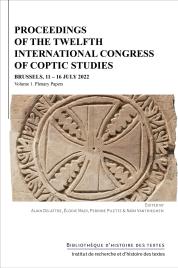
Publication – « Proceedings of the Twelfth International Congress of Coptic Studies (Brussels, 11–16 July 2022) », éd. Alain Delattre, Élodie Mazy, Perrine Pilette, Naïm Vanthieghem

Ce livre constitue le premier volume des actes du Douzième congrès international d’études coptes de l’IACS, qui s’est tenu à l’Université libre de Bruxelles du 11 au 16 juillet 2022. Il rassemble les rapports présentés en session plénière lors de cette manifestation. Les articles se composent d’un bilan critique et bibliographique des travaux récents dans chaque sous-discipline (monachisme, liturgie, codicologie et paléographie, histoire de l’art, études coptes contemporaines, linguistique, études nubiennes, archéologie, papyrologie, études copto-arabes, magie) et reflètent la richesse et la diversité des études coptes à l’aube du IIIe millénaire. Ce recueil offre une synthèse des avancées les plus significatives, notamment techniques et méthodologiques, et met en lumière les perspectives nouvelles qui s’ouvrent dans les domaines abordés. L’ouvrage, qui témoigne de la vitalité de ces disciplines, constituera une ressource précieuse pour toutes celles et ceux qui s’intéressent aux études coptes.

Alain Delattre est professeur de littérature grecque et de papyrologie à l’Université libre de Bruxelles (ULB) et directeur d’études en « langue et sources documentaires coptes » à l’École pratique des hautes études (EPHE). Ses recherches portent sur la papyrologie et l’épigraphie grecques et coptes ainsi que sur le monachisme égyptien. Il est notamment l’auteur de Papyrus coptes et grecs du monastère d’apa Apollô de Baouît conservés aux Musées royaux d’Art et d’Histoire de Bruxelles (2007) et, avec Jitse Dijkstra et Jacques van der Vliet de Christian Inscriptions from Egypt and Nubia. A Critical Bulletin (2013-2022) (2024).

Diplômée en Langues et lettres classiques et en Histoire de l’Antiquité (ULB), Élodie Mazy a rédigé une thèse intitulée « Temps, sociabilité et économie des fêtes en Égypte du ve au viiie siècle », soutenue en 2022. Ses recherches portent sur la papyrologie grecque et copte ainsi que l’histoire sociale, culturelle et économique de l’Égypte tardive. Plus particulièrement, elle est l’auteure de plusieurs articles sur les livres et les bibliothèques ainsi que sur des documents comptables et fiscaux ; sa thèse paraîtra dans la collection Studia Papyrologica et Aegyptiaca Parsinia en 2025.

Perrine Pilette est chercheuse au Centre national de la recherche scientifique (CNRS), rattachée au laboratoire Orient & Méditerranée (UMR 8167, équipe « Islam médiéval », Paris). Ses recherches portent principalement sur la littérature copto-arabe, l’histoire de l’Église copte à l’époque médiévale, la codicologie et le moyen arabe. Elle est l’autrice de nombreux articles dans ces domaines et travaille à l’édition critique de textes historiographiques copto-arabes (Histoire des Patriarches d’Alexandrie et Histoire des Églises et des Monastères d’Égypte).

Naïm Vanthieghem est chercheur au Centre national de la recherche scientifique (CNRS), rattaché à l’Institut de recherche et d’histoire des textes (IRHT). Ses recherches portent sur les sources documentaires de la vallée du Nil et leur importance pour l’histoire économique, sociale et intellectuelle du Moyen Âge. Il est notamment l’auteur, avec Mathieu Tillier, de The Book of the Cow: An Early Qurʾānic Codex on Papyrus (P. Hamb. Arab. 68) (2024) et Mariages et séparations en Égypte au Moyen Âge : Actes inédits sur papyrus, papier, parchemin et tissu (2024).

Acknowledgements

Alain Delattre, Élodie Mazy, Perrine Pilette et al.
Preface
Abbreviations & general bibliography

David Brakke
Presidential Address: Navigating Separationand Reunion with Athanasius of Alexandria’s Festal Letters
Appendix: IACS Resolution on the Handling of Cultural Heritage (16 July 2022)

María Jesús Albarrán Martínez
Research in Monasticism in Egypt (2016–2022): New perspectives from multi- and interdisciplinary fields

Diliana Atanassova
New Research on Coptic Liturgy (2012–2022)

Anne Boud’hors
Coptic Codicology and Paleography (2012–2022)

Florence Calament
L’art chrétien en égypte : études et muséographie (2016-2022)

Gaétan du Roy
The Emerging Field of Contemporary Coptic Studies

Matthias Müller
Coptic Linguistics (2016–2022)

Grzegorz Ochała
Christian Nubian Studies (2004–2018)

Gillian Pyke
The Archaeology of Christianity in Egypt (2016–2022)

Gesa Schenke
Coptic Papyrology (2016–2022): Primary Evidence of Egyptian Lives

Alin Suciu
Coptic Literature 2016–2022. Preliminary Bibliography

Mark Swanson
Copto-Arabic Studies (2016–2022)

Jacques van der Vliet
Magic in Christian Egypt (2012–2022)

Informations pratiques :

Proceedings of the Twelfth International Congress of Coptic Studies (Brussels, 11–16 July 2022), éd. Alain Delattre, Élodie Mazy, Perrine Pilette, Naïm Vanthieghem, Paris, OpenEditions Books, 2025 ; 1 vol., 348 p. (Bibliothèque d’Histoire des Textes). ISBN : 978-2-493209-11-5. En ligne.

Source : IRHT

Publié dans Publications | Commentaires fermés sur Publication – « Proceedings of the Twelfth International Congress of Coptic Studies (Brussels, 11–16 July 2022) », éd. Alain Delattre, Élodie Mazy, Perrine Pilette, Naïm Vanthieghem

Publication – « Pensée politique et Gouvernement dans l’Occident médiéval (XIe – début XIIIe siècle) », éd. Nicolas Michel, Romain Waroquier

Comment s’opèrent le dialogue et les conditions de la négociation permanente entre norme et pratique du politique au sein des différents niveaux de pouvoir qui structurent la société occidentale du « long XIIe siècle » ? Les contributions réunies dans ce volume offrent un éclairage important à cette question.

Table des matières : ici

Informations pratiques :

Pensée politique et Gouvernement dans l’Occident médiéval (XIe – début XIIIe siècle), éd. Nicolas Michel, Romain Waroquier, Paris, Classiques Garnier, 2025 ; 1 vol., 288 p. (Rencontres, 691 ; Civilisation médiévale, 66). ISBN : 978-2-406-18979-4.

Source : Classiques Garnier

Publié dans Publications | Commentaires fermés sur Publication – « Pensée politique et Gouvernement dans l’Occident médiéval (XIe – début XIIIe siècle) », éd. Nicolas Michel, Romain Waroquier

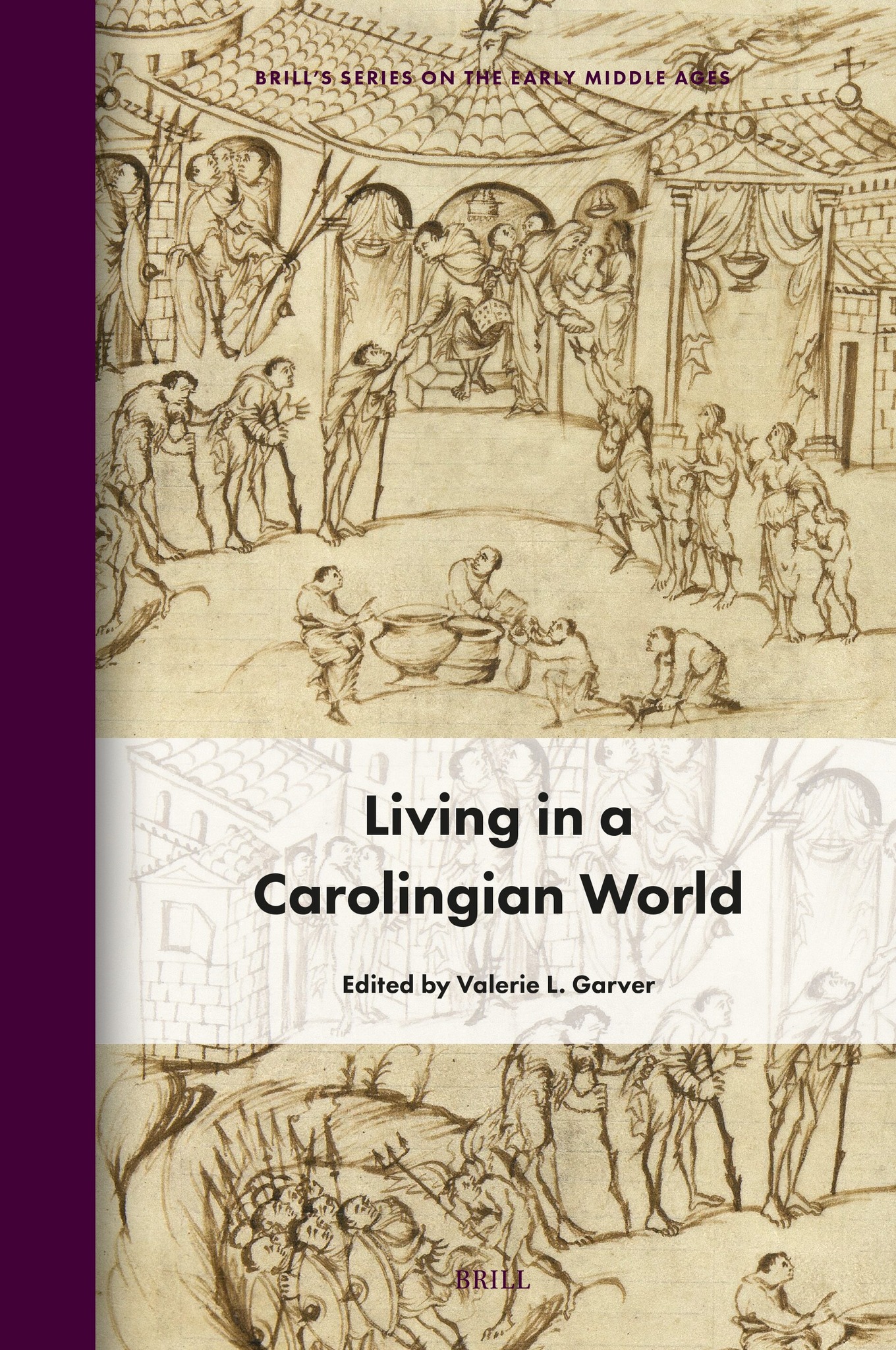
Publication – « Living in a Carolingian World », éd. Valerie L. Garver

Living in a Carolingian World invites you to look beyond kings, bishops, and court politics to explore the diverse historical experiences and conceptions of the Carolingian non-elite. Through case studies and new research, this volume presents a range of Carolingian worlds that demonstrate the diversity of early medieval society. From agricultural laborers to criminal priests, from ideas about how the non-elite understood weather magic to how they suffered from the abuses of Frankish officials and armed men, this volume offers a fresh exploration of the Carolingian Empire.

Contributors are: Alexandre Beaudet, Marios Costambeys, Simon Coupland, Jan van Doren, Valerie L. Garver, Kelly Gibson, Eric J. Goldberg, Thomas A. E. Greene, Laura A. Hohman, David Patterson, Martha Rampton, Carine van Rhijn, Elina Screen, Rachel Stone, and Josh Timmermann.

Table des matières : ici

Informations pratiques :

Living in a Carolingian World, éd. Valerie L. Garver, Boston–Leyde, Brill, 2025 ; 1 vol., XIV–450 p. (Brill’s Series on the Early Middle Ages, 33). ISBN : 978-90-04-74985-6. Prix : € 142,00.

Source : Brill

Publié dans Publications | Commentaires fermés sur Publication – « Living in a Carolingian World », éd. Valerie L. Garver

Publication – « Profili di copisti », éd. Teresa De Robertis, Dario Panno-Pecoraro

Profili di copisti, éd. Teresa De Robertis, Dario Panno-Pecoraro, Florence, SISMEL–Edizioni del Galluzzo, 2025 ; 1 vol., XVIII–252 p. (Manoscritti datati d’Italia, Strumenti, 4). ISBN : 978-88-9290-435-4. Prix : € 48,00.

Table des matières :

Premessa di T. De Robertis.
Abbreviazioni.

COPISTI.

D. Bianconi – A. Gioffreda, «Le ambizioni di un calligrafo». I libri e le scritture di Isidoro di Kiev
L. Boschetto, Sulle tracce di Francesco d’Amaretto Mannelli
E. Caldelli, Cristoforo da Rieti: chi era costui? – I. Ceccherini, Il giovane Antonio di Mario – L. Granata, Libri e scritture di funzionari della Serenissima nel Quattrocento
M. Lanza – D. Speranzi, Di Bese Ardinghelli, un paio di codici di Pistole e Andrea zoppo ricamatore
E.A. Lunelli, Un libro trasversale. Valerio Massimo e i suoi copisti
G.P. Mantovani, «Non di solo officium». Per Giovanni da Lusa
M. Marchiaro, Excerpta dal De sphaera mundi di Giovanni da Sacrobosco di mano di Pietro Crinito
D. Panno-Pecoraro, Notizia di Francesco Covoni (1430 – ante 1477?)
M. Pantarotto, Un copista, disegnatore, calligrafo: Giovanni di ser Niccolò da Fano.

PROGETTI.

U. Stampfer, Nomi dei copisti e normalizzazione dei dati nel Handschriftenportal. Uno sguardo dietro le quinte
E. A. Lunelli – D. Panno-Pecoraro, La banca dati ScribIt. Un repertorio digitale per i copisti italiani (secc. XIII-XV).

INDICI. Indice dei manoscritti. Indice dei nomi. Crediti fotografici.

TAVOLE.

Source : SISMEL

Publié dans Publications | Commentaires fermés sur Publication – « Profili di copisti », éd. Teresa De Robertis, Dario Panno-Pecoraro