Appel à contribution – La formule au Moyen Âge (6, 2024)

Pour sa sixième édition, le colloque bisannuel sur la formule au Moyen Âge aura lieu les 18, 19 et 20 juin 2024, sous l’égide de l’Université de Reims Champagne-Ardenne et en collaboration avec l’Université du Mans.

La manifestation se déroulera dans un haut-lieu du Moyen Âge champenois : la ville de Troyes. Elle sera l’occasion d’approfondir une réflexion interdisciplinaire sur la notion de formule et de s’interroger sur ce que ce terme recouvre dans les différents champs de recherche étudiés.

De façon générale, la formule se caractérise par un figement ou une régularité plus ou moins marqués laissant la place, en creux, à l’innovation. On sait qu’à travers la stabilité de la forme transparaît une volonté de permanence : la répétition délibérée d’une formule vise à assurer la continuité d’une tradition. Paradoxalement, celle-ci légitime et permet l’innovation ou la variation.

Les modes de pensée et de représentation médiévaux sont profondément marqués par l’usage de reprises et de régularités attendus et reconnaissables. Si la recherche ne conçoit plus les formules comme de simples coquilles vides ou des expressions ayant perdu leurs sens, il convient désormais d’analyser plus avant les mécanismes et les agents par lesquels le sens acquiert un surplus ou subit un glissement.

Ce colloque international et interdisciplinaire invite les médiévistes de toutes disciplines – histoire, littérature, linguistique, musicologie, droit, histoire de l’art, théologie, etc. – à contribuer à ces réflexions.

D’ailleurs la richesse du patrimoine local – Chrétien de Troyes, Rachi, les foires de Champagne, l’abbaye de Clairvaux, le vitrail, la statuaire, etc. – offre à elle seule matière à étudier les circulations, transmissions et diffusions des pratiques, des modèles et des savoirs dans l’ensemble du monde médiéval (Ve-XVe siècle).

Les propositions de communications (25 minutes) ne devront pas excéder 500 mots et sont à soumettre pour le 15 novembre 2023 sur le site du colloque : https://formulemedievale.wordpress.com/. Les langues acceptées sont le français, l’anglais et l’espagnol.

Les frais de transport et d’hébergement seront à la charge des participants ; les déjeuners seront pris en charge par le colloque. Des frais d’inscription modestes (inférieurs à 50 euros) seront demandés aux participants. Plus de détails seront communiqués ultérieurement.

Comité d’organisation :

Florence Dumora (florence.dumora@univ-lemans.fr)

Elise Louviot (elise.louviot@univ-reims.fr)

Axelle Neyrinck (axelle.neyrinck@univ-reims.fr)

Comité scientifique

Ahmed Djelida – CEJESCO

Florence Dumora – 3LAM

Elise Louviot – CIRLEP

Axelle Neyrinck – CERHiC
Publié dans Appel à contributions | Laisser un commentaire

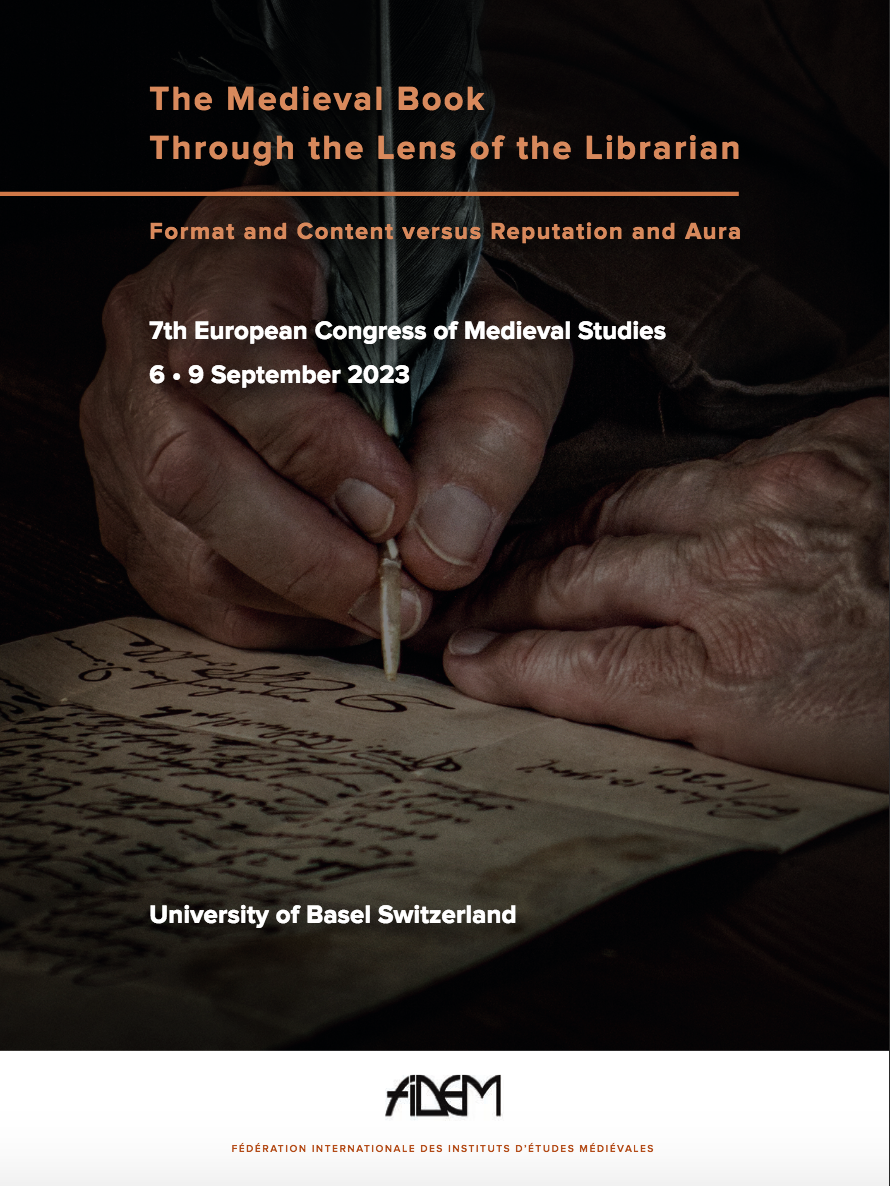
Colloque – The Medieval Book Through the Lens of the Librarian

7th European Congress of Medieval Studies
06-09 September 2023
University of Basel Switzerland

Programme : ici

The 7th European Congress of Medieval Studies of the Fédération Internationale des Instituts d’Études Médiévales (FIDEM) will be organized by the Department of Arts, Media, and Philosophy of the University of Basel, Switzerland.

Subject :

A book is first of all a book, with a physical appearance, a title, and a content. The content is perhaps the part that most of all determines the book’s impact. But also the title and the physical appearance have their share, and perhaps also other aspects, such as the reputation of the author, the period in which the book was written, and the reception it received. The impact of these latter aspects is more difficult to trace, but they may produce a recognized quality, an aura that materializes itself when books come together in a physical or imaginary room, when they have to compete for identification and differentiation. One such room is the medieval library with its ordered system of bookshelves and bookcases. Here, both content and aura guide the librarian when giving a call number to the book, when putting it together with other works in a convolute, or when naming it in the catalogue.

The Congress intends to focus on the interplay of content and aura of books in the Middle Ages and the way they are balanced and shaped through the work of medieval librarians. For example, when a medieval librarian in his catalogue calls all the volumes devoted to mysticism ‘opuscula’, not because of their small physical size, since some of them are huge, but because of their subject matter, which should make the reader humble. In this case, it is the common reputation of a devotional work that explains the decision of the librarian. More difficult to grasp, however, is what happens when the same librarian lists a devotional convolute not as usual under the title of the first work included, Thomas a Kempis’ Imitatio Christi, but of the third one contained, pseudo-Bonaventure’s Stimulus amoris. Or when he names Thomas a Kempis’ Imitatio Christi in that same volume the Liber Qui sequitur me, although the print bears the title De imitatione Christi. Clearly for him, there is something special about these titles which makes them more distinctive. But what is it?

The above examples are all taken from the catalogue of the Carthusian Library St. Margarethental in Basel, compiled about 1520 by George Carpentarius, who through his work as a librarian wanted to guide the monks, to illuminate their minds and to inflame their hearts. But many other cases from other medieval libraries and other fields of interest, such as medicine, law, history, philosophy, theology, and works of literature can help us understand how the different medieval librarians responded to the different auras of their books, how they enforced, changed or added to them. Besides the contents, how common and persistent are these reputations, how are they produced, what are the distinctive aspects, and is there a change from the early to the late Middle Ages?

These auras not only guided the medieval librarians when cataloguing and ordering content. They are still active today, when modern librarians or their algorithmic famuli produce networks that link medieval works through metadata, with the intention to serve the medievalists. Again an example from Basel: when searching for a specific manuscript, the digital catalogue of the University Library – which contains many books of the Carthusian Library St.Margarethental – produces a virtual bookshelf on which it puts the manuscript together with a number of volumes not searched for, some of which medieval, but others also modern. Obviously, here it is not the librarian, but an algorithm that does the work. What auras are effective here? How do they affect the minds and the research strategies of modern medievalists? Does this modern phenomenon help us understand the mechanisms of its medieval equivalent, or is there no such equivalent?

By way of plenary talks and discussion sessions, specialists from different fields of medieval studies will share with the audience their views about the special character of medieval books that transcends the immediate content and becomes visible most prominently in the special environment of the library with its catalogues, bookshelves and bookcases, and above all the active and reactive mind of the librarian.

Source : FIDEM

Publié dans Colloque | Laisser un commentaire

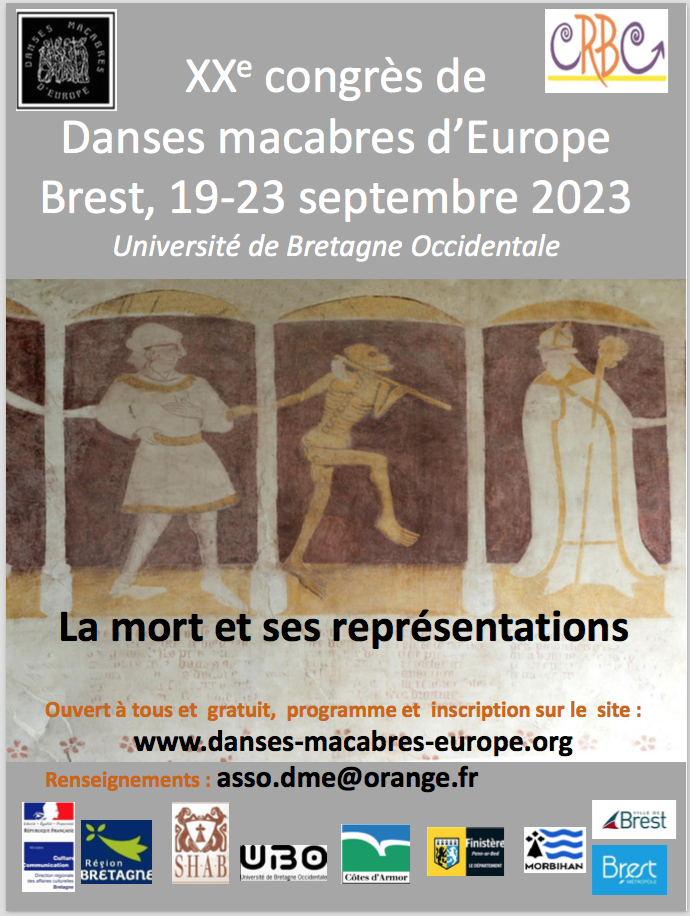
Colloque – XXe Congrès international de Danses macabres d’Europe

Du 19 au 23 septembre 2023
Brest, Université de Bretagne Occidentale

Programme : ici

L’association Danses macabres d’Europe (DME), qui a été créée en 1987, a pour objet l’étude des représentations de la mort dans l’art, la littérature et l’histoire depuis le Moyen Âge jusqu’à nos jours.

Les quatre derniers congrès de DME se sont tenus : à Turin (2014) organisé par l’Université de la ville, à Troyes (2016) co- organisé avec l’Université de Reims Champagne-Ardenne et la Médiathèque du Grand Troyes, à Paris (2019) en partenariat avec l’Institut de France, la Bibliothèque Mazarine, la Bibliothèque Sainte-Geneviève et l’École du Louvre, à Bucarest (2021) par la faculté des Lettres de l’Université de la ville.

Le XXe Congrès international de DME, qui rassemble les communications d’universitaires, de conservateurs, bibliothécaires, chercheurs, étudiants et amateurs, donne l’occasion de découvrir les études les plus récentes sur un sujet qui marque la Bretagne. Il est gratuit et ouvert à tou(te)s sur inscription préalable.

Le XXe congrès est organisé par Danses macabres d’Europe (DME) et le Centre de recherche bretonne et celtique (CRBC) en partenariat avec la Direction régionale des affaires culturelles de Bretagne (DRAC Bretagne).

Publié dans Colloque | Laisser un commentaire

Offre d’emploi – Langue et littérature Italiennes (littérature italienne du Moyen Âge à la Renaissance)

Université de Liège
Échéance : 01/07/2023

Une charge à temps plein (H/F/X), indivisible, dans le domaine « Langue et littérature Italiennes » rattachée au Département de Langues et littératures romanes. Cette charge comprend des activités d’enseignement (cours théoriques et pratiques, encadrement de stages), de recherche et de service à la Communauté. La charge comporte une part importante de cours de langue et de linguistique, mais aussi des enseignements relevant de la littérature italienne du Moyen Âge à la Renaissance.

Offre d’emploi au format PDF : ici

Source : ULiège

Publié dans Offre d'emploi | Laisser un commentaire

Offre d’emploi – Lecturer in Art History 1300-1700 (University of London)

Closes: 3rd July 2023

The University of London is a leading UK provider of distance and digital education internationally, offering programmes to 45,000 students in 190 countries around the world. Although proudly rooted in London, our community and impact are global.

We are a national leader in the humanities, and we promote their value to society and the economy through knowledge creation and exchange.

We are also a federation of 17 world class higher education institutions, with collaboration at the heart of our ethos. The University of London federation is a collective community of more than 240,000 learners and 50,000 staff, delivering world-leading research across all disciplines.

The Role

Lecturer in Art History 1300-1700 at the Warburg Institute

The Warburg Institute is seeking to appoint a lecturer in Art History in the period 1300-1700. The post-holder will serve as the convenor of the Master’s degree in Art History, Curating and Renaissance Culture and will contribute to the Institute’s taught programmes. In particular, they will convene the module ‘Image to Action: Art History and Renaissance Culture’ and will co-convene the ‘Curating at the National Gallery’ module, in collaboration with gallery staff. They will teach an option module relating to their own area of academic expertise and they will supervise and mark MA dissertations. In addition, the post-holder will contribute to the supervision of PhD students whose work falls within their area of expertise.

Applicants will hold a PhD in Art history on a topic relating to the period 1300-1700 and will have experience of teaching and assessing relevant materials. They will have excellent organisational and interpersonal skills and will be able to work collaboratively with staff at Warburg Institute and its partner institutions.

This position is a fixed-term, 12-month maternity leave cover.

For a full role profile, please refer to the job description below.

Further information

To be considered for this opportunity, please submit your application and CV (by clicking ‘apply for job’ at the bottom of this page) before the closing date at midnight on 3 July 2023. 

The University will be unable to sponsor candidates for a visa for this role. Successful applicants must be able to demonstrate their right to work in the UK for the duration of their employment.

The University currently operates a Hybrid Working framework involving a mix of working remotely and in the office. Typically, the majority of employees will be able to agree to work remotely for up to 60% of their working week, role dependent, however will be required to attend on specific days for training or team meetings. 

The University of London is committed to promoting a diverse and inclusive working environment where we can all be ourselves and succeed. We particularly encourage applications from members of Black, Asian, and Minority Ethnic communities as this group is currently under-represented at all levels within the University. All appointments will be made on merit, based on the criteria identified in the job description. 

Pursuing excellence in education and equal opportunities.

Source : Jobs.ac.uk

Publié dans Offre d'emploi | Laisser un commentaire

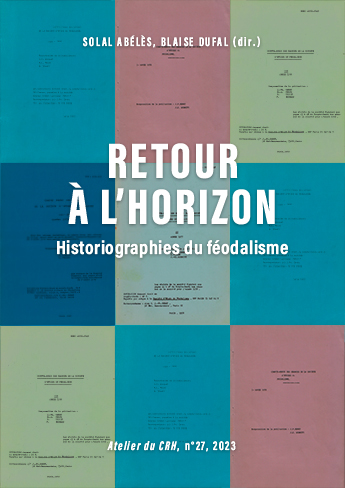
Publication (en ligne) – « Retour à l’horizon : historiographie du féodalisme », dir. Solal Abélès et Blaise Dufal

Les débats autour du concept de féodalisme ont profondément structuré l’historiographie européenne du Moyen Âge occidental au cours de la seconde moitié du xxe siècle. La Société d’Études du Féodalisme en fut l’un des lieux aussi informel qu’important : elle réunit en effet entre 1975 et 1983 plus de 250 participants – médiévistes et modernistes pour la plupart, mais aussi philosophes et anthropologues – dont les échanges oraux étaient transcrits et publiés sous forme de fascicules ; c’est également sous son impulsion qu’un grand colloque international fut organisé en mai 1981 à Trêves, lequel offrit une rare occasion de rencontres entre spécialistes français, allemands et est-européens sur le thème du féodalisme.

Témoins pour la discipline historique des vastes discussions qui agitaient alors les sciences humaines et sociales autour de l’usage des théories marxistes et du comparatisme, les résultats et l’impact de ces différents travaux demeurent encore mal connus aujourd’hui, principalement pour des raisons pratiques : la diffusion des fascicules est restée confidentielle tandis que l’édition des actes du colloque de Trêves n’a jamais été menée à bien. Le présent projet de publication entend donc donner une visibilité nouvelle à cet ensemble de contributions en répondant à un triple objectif :

– Rendre la consultation des contributions aisément accessible grâce à une édition numérique exhaustive [Section Archives].

– Documenter une pratique collective originale de la recherche aux frontières des institutions académiques par le recueil de témoignages rétrospectifs de ses acteurs [Section Témoignages].

– S’interroger sur la pertinence heuristique et les implications épistémologiques de l’usage du concept de féodalisme alors que celui-ci est aujourd’hui remis en cause par certains historiens, à travers un ensemble d’articles d’analyse qui mettront en perspective les documents de la Section 1 avec la recherche contemporaine et les grilles d’interprétation historiographiques actuelles [Section Analyses historiographiques]

Le volume propose ainsi à la fois des archives de la recherche et des analyses critiques pour constituer un ouvrage de référence sur la notion de féodalisme, utilisable tant par les chercheurs que par un public plus large. Sa réalisation a été rendue possible grâce à l’attention de Patrick Boucheron, qui le premier a pensé que les fascicules produits par la Société méritaient d’être relus ; la disponibilité d’Alain Guerreau, Jean-Philippe Genet, Jean-Claude Schmitt et Daniel Tollet, lesquels ont accepté de revenir sur leur expérience et nous ont donné accès à leurs archives : l’aide financière du LaMOP avec le soutien actif de Joseph Morsel ; l’habileté à transcrire de Marion Abélès, la patience de l’équipe éditoriale de L’Atelier du CRH, notamment de Antoine Roullet, et en particulier Cécile Soudan, dont l’inébranlable confiance et la remarquable réactivité ont été décisifs. À toutes et tous, nous adressons nos remerciements sincères et chaleureux.

Table des matières :

Informations pratiques :

Retour à l’horizon : historiographie du féodalisme, dir. Solal Abélès, Blaise Dufal, mis en ligne le 28 mai 2023. URL : http://journals.openedition.org/acrh/28299 ; DOI : https://doi.org/10.4000/acrh.23229

Source : L’Atelier du CRH

Publié dans Publications | Laisser un commentaire

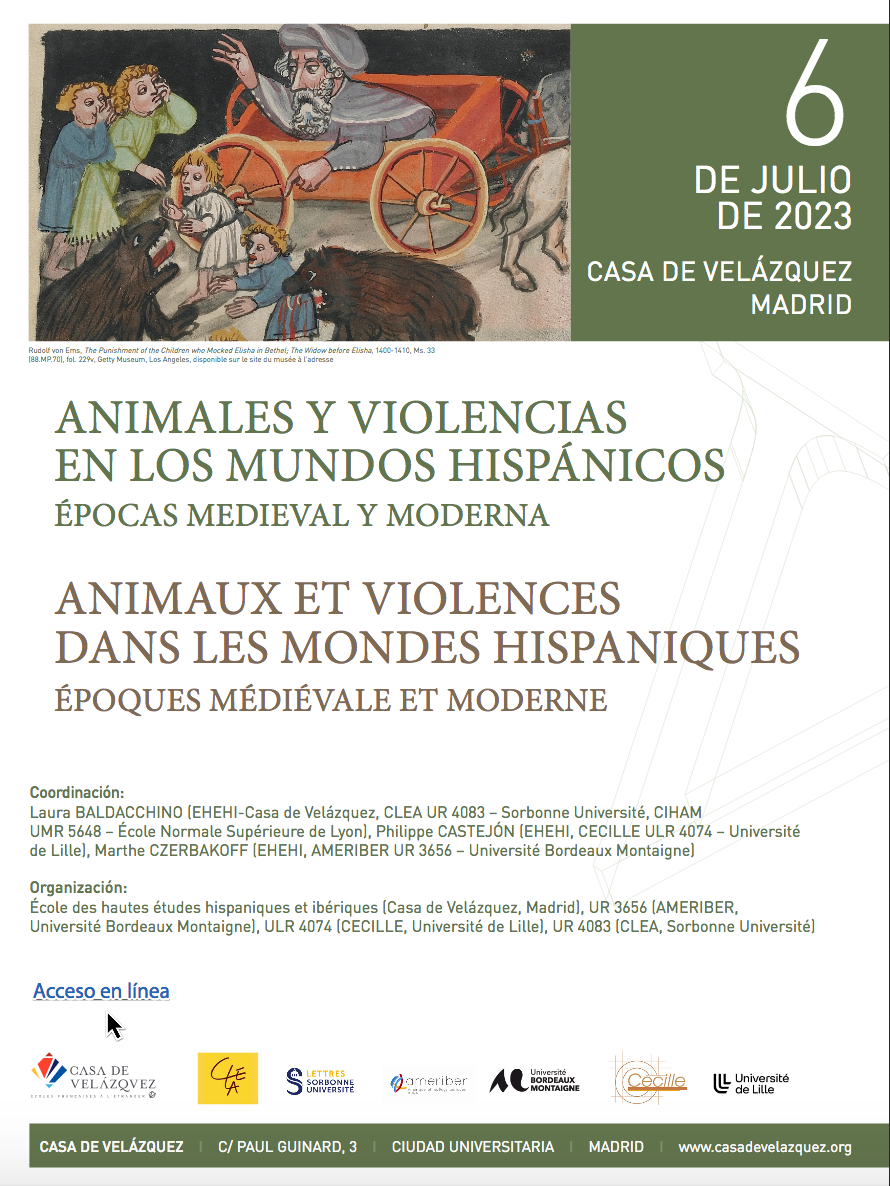
Colloque – Animaux et violences dans les mondes hispaniques. Époques médiévale et moderne

La conception du vivant qui prédomine en Occident se caractérise par une opposition ontologique entre l’homme et les autres animaux.

À partir d’approches plurielles (iconographiques, textuelles ou matérielles), cette journée prétend interroger l’une des dimensions inhérentes à cette vision, celle de la violence associée aux animaux.

L’objectif de la rencontre interdisciplinaire est ainsi d’explorer l’usage de l’animal en tant que symbole, objet ou instrument de la violence des hommes dans le monde hispanique médiéval et moderne. En étudiant les animaux, dans leurs réalités maté- rielles ou leurs représentations, à l’aune du concept de violence, la journée invite enfin à repenser leur place dans les sociétés du passé en accordant une importance aux continuités et aux ruptures.

Programme : ici

Informations pratiques :

6 juillet 2023

CASA DE VELÁZQUEZ
C/ Paul Guinard, 3 – 28040 – Madrid

COORD. : 

  • Laura BALDACCHINO
    EHEHI-Casa de Velázquez / UR 4083 (CLEA – Sorbonne Université), UMR 5648 (CIHAM – École normale supérieure de Lyon)
  • Philippe CASTEJÓN
    EHEHI-Casa de Velázquez / ULR 4074 (CECILLE – Université de Lille)
  • Marthe CZERBAKOFF
    EHEHI – Casa de Velázquez / UR 3656 (AMERIBER – Université Bordeaux Montaigne)
     

ORG. : École des hautes études hispaniques et ibériques (Casa de Velázquez, Madrid), UR 3656 (AMERIBER, Université Bordeaux Montaigne), ULR 4074 (CECILLE, Université de Lille), UR 4083 (CLEA, Sorbonne Université)

Source : Casa de Velázquez

Publié dans Colloque | Laisser un commentaire

Offre d’emploi – IMEMS Lecturer in Latin Palaeography of the European Middle Ages

Closes: 4th July 2023

IMEMS is one of the largest and most diverse concentrations of medieval and early modern studies worldwide, recognised as one of the leading UK institutes in this field. Our versatile ensemble of academics, curators, students, practitioners, and volunteers, are drawn across a wide range of disciplines, from Arts & Humanities, Social Sciences & Health, Science, Business, and Professional Services. We cover research areas from Late Antiquity to the late eighteenth century, across global geographies, including East Asia, South Asia, Indian Ocean, Islamicate regions, Europe, and North America.

IMEMS is seeking to appoint a talented individual to the role of Lecturer. The postholder will spend 40% of their time on research duties, with the remaining 60% used to provide advanced training in Latin Palaeography of the European Middle Ages. They will work alongside a second appointee in Early Modern English Palaeography (see separate vacancy).

This post offers an exciting opportunity to contribute to the development of excellent research and teaching within a progressive institution.

Applicants must demonstrate research excellence in the field of Latin Palaeography of the European Middle Ages, the ability to deliver online training courses in palaeography to an exceptional standard, and commitment to engage fully in the services, citizenship and values of the University. The University aims to provide a working and teaching environment that is inclusive and welcoming and where everyone is treated fairly with dignity and respect. Candidates will be expected to demonstrate these key principles as part of the assessment process.

The postholder will be employed by the Institute, but they will also be affiliated to the Department of the University with which their research interests are most closely aligned. They will be expected to report regularly to the Head of Department and Director of Research in that Department, as well as to the Institute Director.

Applicants should indicate the University Department with which their research interests are most closely aligned. Successful candidates will become members of their identified department and will benefit from departmental structures for research career development. We recognise that these posts may also be attractive to candidates who envisage careers as archivists or academic curators. Such candidates should interpret appropriately references below to their research and research plans, and they will, if appropriate, become members of Special Collections rather than an academic department.

We value your feedback on the quality of our adverts. If you have a comment to make about the overall quality of this advert, or its categorisation then please send us your feedback

Source : Jobs.ac.uk

Publié dans Offre d'emploi | Laisser un commentaire

Exposition – Saint Ursmer de Lobbes, 1200 ans de dévotion

La nouvelle exposition du CHASHa ouvrira prochainement ses portes dans l’espace muséal du CHASHa, après s’être déployée brièvement dans la prestigieuse collégiale Saint-Ursmer de Lobbes, qui fête en cette année 2023 un jubilé de 1200 ans.

Qui était saint Ursmer?

C’est en date du 26 mars 823 que les reliques de saint Ursmer sont élevées et qu’il est canonisé. La collégiale Saint-Ursmer de Lobbes date également pour ses parties les plus anciennes de cette époque. Fondateur du chapitre de l’abbaye et d’un oratoire dédié à la sainte Vierge sur la colline (emplacement actuel de la collégiale), saint Ursmer a une histoire étroitement liée à la ville de Lobbes. Il dirigea l’abbaye Saint-Pierre de Lobbes de 691 à 711, à la suite de saint Landelin (653-686), le fondateur. Saint Ermin sera son successeur à la tête de l’abbaye. Connu pour quelques miracles, saint Ursmer a rapidement impressionné par la rigueur de sa vie et de son dévouement. Mais qui était-il vraiment ?

Une exposition en trois parties

Le Centre d’Histoire et d’Art Sacré en Hainaut (CHASHa asbl) propose d’approfondir le sujet dans sa nouvelle exposition temporaire de 2023. Au départ des œuvres conservées représentant saint Ursmer, un parcours thématique explore les paroisses encore dédiées à saint Ursmer et les processions ayant existé ou encore présentes. Divers objets permettent d’appréhender l’ampleur de son culte par l’importance et la typologie des biens dédiés à saint Ursmer. La section sur l’iconographie offre un aperçu de toutes les représentations connues d’Ursmer, avec ses attributs ou les miracles qu’on lui attribue.

La seconde partie de l’exposition, s’interroge plus en profondeur sur qui était réellement saint Ursmer, ce qu’on en sait et ce qu’on en a dit. A travers des sources scientifiquement avérées, les œuvres exposées font parler la vie de saint Ursmer et le déploiement, voire l’instrumentalisation, de son culte. Souvent associée à des saints locaux, tels que Waudru, Vincent, Aldegonde, ou encore d’autres saints de son époque, la vie d’Ursmer est également remise dans un contexte plus large. Cette section sur la vie d’Ursmer se clôture par l’exposition de tous les reliquaires encore existants du saint. Enfin, l’exposition se termine par une dernière section abordant le lien entre Ursmer et la collégiale, ainsi qu’Ursmer et l’abbaye.

Avec des prêts d’églises du diocèse de Tournai, mais également de Flandre et du nord de la France (région d’origine d’Ursmer), cette exposition rassemble pour la première fois en un seul lieu toutes les pièces encore existantes et connues représentant saint Ursmer.

L’exposition s’est d’abord établie hors-les-murs dans la collégiale de Lobbes du 28 avril au 7 mai 2023. L’opportunité avec cette seconde présentation au CHASHa de revoir plus en détails certaines pièces de l’exposition prêtées pour l’occasion.

Infos pratiques :

CHASHa, du 18 juin au 8 octobre 2023, tous les dimanches de 14h30 à 18h sans réservation, 2.50€ (gratuit pour les moins de 12 ans) ;

du 18 juin au 31 décembre sur réservation pour les groupes de minimum 10 personnes en visite guidée (français et néerlandais), 5€ par personne ;

Visite guidée de l’abbaye de Bonne-Espérance et de l’exposition du CHASHa tous les dimanches à 15h du 18 juin au 8 octobre 2023, 10€ par personne, sans réservation.

Infos : CHASHa, 064/330.346, info@chasha.be.

Rue Grégoire Jurion 22, 7120 Vellereille-les-Brayeux.

Source : Conservatoire et Espace Muséal au coeur de l’abbaye de Bonne-Espérance

Publié dans Exposition | Laisser un commentaire

Colloque – Exclusion in the Middle Ages

The aim of our workshop is to discuss the historical moments in which mechanisms of religious, economic, social and political exclusion had a particular impact. With this research question, we are touching on the prominent research fields of otherness, race/racism, migration, national identities, etc. A lot of work has been done in all these fields of research in recent decades. Among other things, it has become clear that the variety of distinction mechanisms in the Middle Ages was very large (political, ethnic, social, religious and cultural). In all these fields, there was the potential for a process of « othering » to take place, and this could lead to exclusion, stigmatization and marginalization. However, our aim is to link the exclusion of individuals, groups and peoples with the concrete socio- economic contexts – in a more intensive way than has been done in the past. Thus, the intersections of ethnic/biological and social/economic discrimination will be examined in order to discuss the ways in which horizontal (ethnic) and vertical (social) categorizations interacted with, complemented, reinforced and contradicted each other, and how they reacted to socio-economic change. This is based on our conviction that it was, and still is, often socio-economic shifts that reinforce mechanisms of inclusion and exclusion. In our informal workshop, we will discuss and compare some case studies from various centuries and regions in medieval Europe.

Programme :

Thursday, Sept 28

17:00 Welcome and Introduction (Thomas Ertl and Milan Pajic)

17:30 Helmut Reimitz (Princeton):
The Danger of Binaries: the Study of Medieval Race and Ethnicity in Europe and the US

19:00 Dinner

Friday, Sept 29

Morning Session (Chair: Klaus Oschema)

09:00 Gerda Heydemann (Berlin):
The Curse of Ham: Race and Biblical Exegesis (Response Roy Flechner)

10:00 Coffee Break

10:30 Clara Almagro Vidal (Madrid):
Drawing Lines of Demarcation: Inclusion and Exclusion among Muslims under the Rule of Military Orders in Medieval Iberia (Response Jörn R. Christophersen)

11:30 Coffee Break

12:00 Nora Berend (Cambridge):
Triggers of Exclusion in Medieval Hungary (Response Julia Burkhardt)

13:00 Lunch

Afternoon Session (Chair: Roy Flechner)

15:00 Bart Lambert (Brussel) / Joshua Ravenhill (Independent Scholar):
Slander of Aliens in Late Medieval England (Response Tanja Skambraks)

16:00 Coffee Break

16:30 Cordelia Heß (Greifswald):
Meetings in the Margins. Constructions of Race and Religion in Greenland and Sápmi before 1550 (Response Christian Hoffarth)

17:30 Coffee Break

19:00 Dinner

Saturday, Sept 30

09:30 Jean-Frédéric Schaub on the History of Race and Racism: Round Table with Statements by Francisco Bethencourt, Thomas Ertl and Karl Ubl

11:00 Coffee Break

11:30 Final Discussion

Informations pratiques :

Veranstalter : Prof. Dr. Thomas Ertl, Dr. Milan Pajic (Friedrich-Meinecke-Institut, Freie Universität Berlin)

Ausrichter : Friedrich-Meinecke-Institut, Freie Universität Berlin

Veranstaltungsort : Holzlaube, Fabeckstr. 23-25, 2. OG, Room 2.2058

Gefördert durch : Alexander von Humboldt-Stiftung
PLZ
14195

Ort : Berlin

Land : Deutschland

Vom – Bis : 28.09.2023 – 30.09.2023

Source : H-Soz-Kult

Publié dans Colloque | Laisser un commentaire