
Journées d’étude organisées par Anne Weddigen et Naïs Virenque
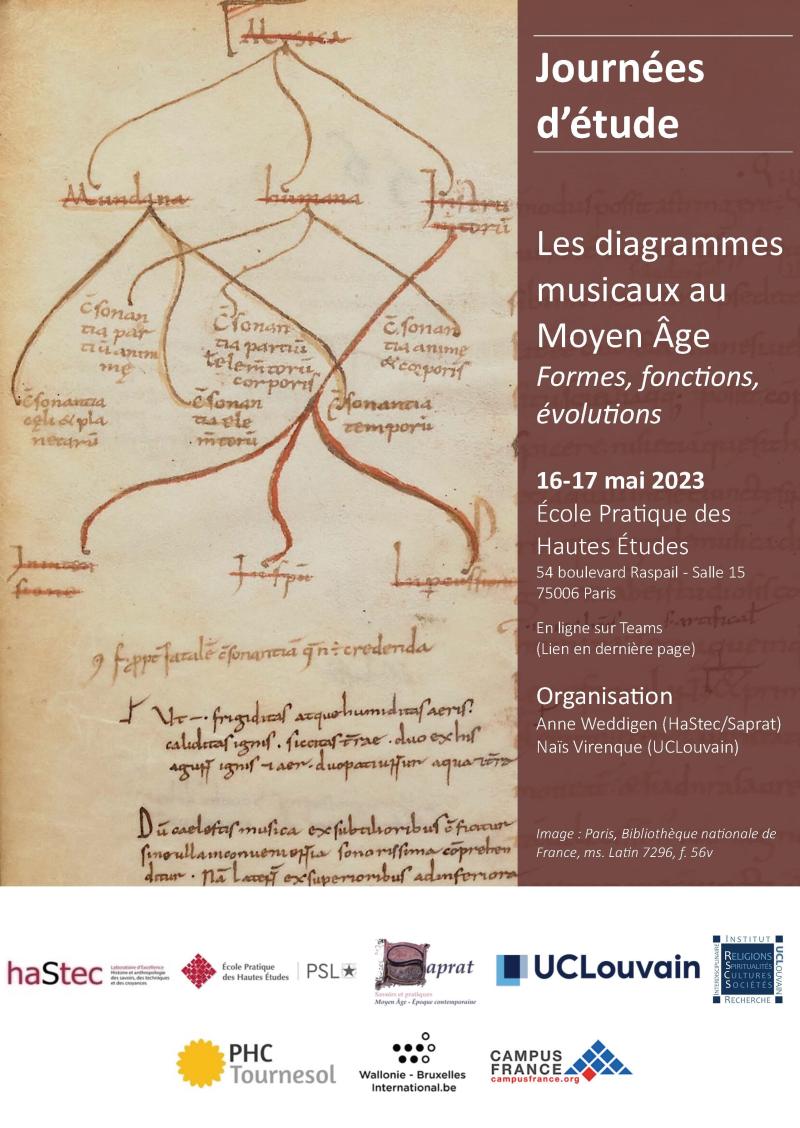
Date: 16 et 17 mai 2023
Lieu: MSH, 54 boulevard Raspail
Programme : ici
Journées d’étude organisées par Anne Weddigen et Naïs Virenque
Date: 16 et 17 mai 2023
Lieu: MSH, 54 boulevard Raspail
Programme : ici
Chastels et maisons fortes 7. Actes des journées de castellologie de Bourgogne, 2018-2022, éd. Yves Nouvellet, Patrice et Françoise Lhomme, CeCaB, 2023 ; 1 vol., 265 p. ISBN : 979-10-95034-28-5. prix : € 25,00.
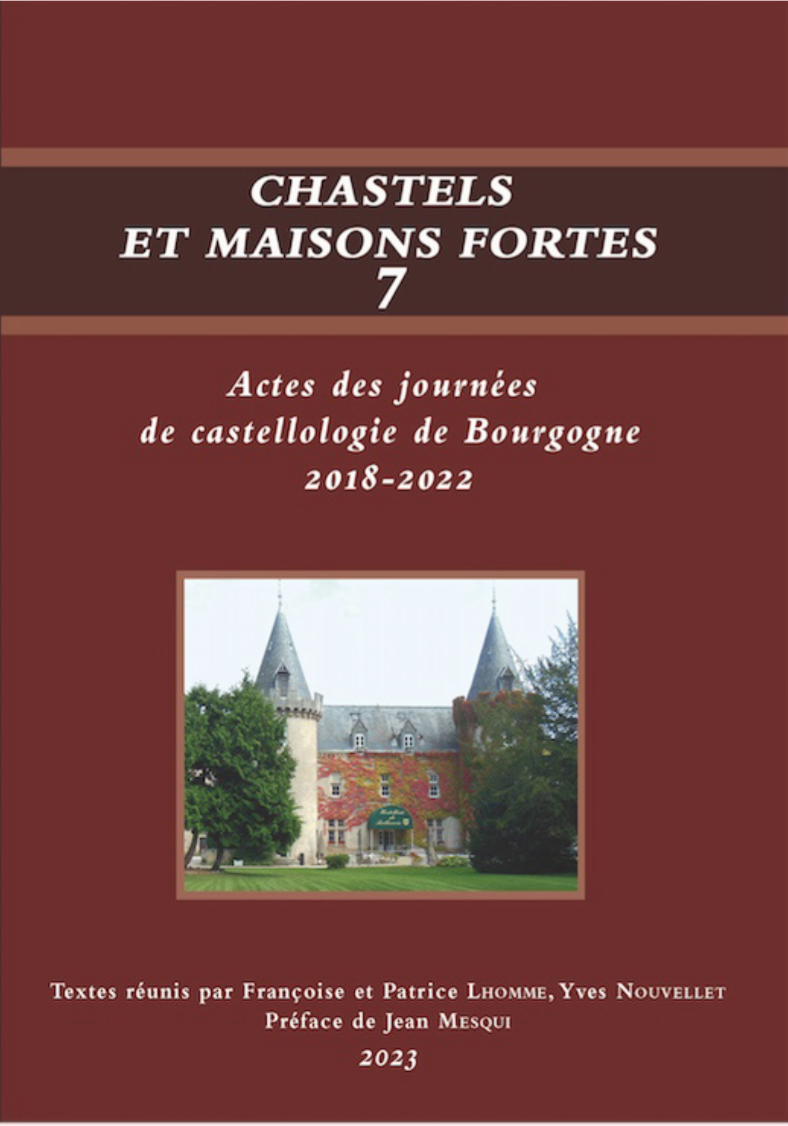
Table des matières :
Jean Mesqui – Préface
Valentin Chevassu – Du Néolithique au Moyen Âge une énigmatique forti cation de hauteur au sud du Morvan le mont Touleur (Larochemillay, Nièvre)
Gilles Auloy – Mottes médiévales disparues du Chalonnais : de l’intérêt de la prospection, de l’iconographie, de la cartographie, des plans et relevés anciens
Alain Kersuzan – Le décor peint de la maison des Montferrand à Lagnieu (Ain), une affaire politique
Brigitte Colas – Le château de Meauce (Nièvre) : éléments d’histoire Alain Guerreau – Le château de Commune (Martigny-le-Comte) : le château d’un prince-chevalier
Hervé MouillebouChe – De palais en châteaux : les déplacements des ducs dans le duché de Bourgogne
Bernard GueuGnon – Un nouveau terrier à Alone-Toulongeon Robert Chevrot, Françoise lhoMMe – La visite des feux de l’Auxerrois de 1597 : étude et transcription
Valérie visCusi – Le château d’Auxonne au travers des récents travaux de restauration
Gaëtan KoeniG – Les portes de la ville en Bourgogne, du prestige à l’oubli : étude du phénomène des destructions du XVIIe au XIXe siècle
Gil Fraisse, Éric Dessons – Histoire de consolidation structurelle et de boisement local d’étaiement appliqué à la chapelle de Bellecroix
Hervé Mouillebouche – Conclusion
This book explores the complete history of Serbian law in the Middle Ages, covering the 12th to the 15th centuries, which until now has been largely unstudied in international scholarship.
Firmly rooted in primary source research and showing strong awareness of the contemporary historical context, this comprehensive study examines different types of law – such as criminal law, constitutional law, and civil law – and the various legal systems and procedures in place during this time, offering a valuable synthesis while also presenting new views and novel interpretations of Serbian legal history.
Srđan Šarkić, Ph.D. (1980) University of Novi Sad, Faculty of Law, was Professor of Legal History at that university until his retirement in 2016. He has published monographs and many articles on Byzantine and Serbian mediaeval law.
Informations pratiques :
Srdjan Šarkić, A History of Serbian Mediaeval Law, Leyde–Boston, Brill, 2023 ; 1 vol. (Medieval Law and Its Practice, 39). ISBN : 978-90-04-52936-6.
Source : Brill
Le Moyen Âge que les sociétés américaines, chinoises, africaines réimaginent aujourd’hui, est-il le même ? Le médiévalisme valorise-t-il seulement les sociétéseuropéennes des Ve-XVe sicèles, ou la notion est-elle aussi pertinente pour d’autres régions du monde, d’autres périodes de l’histoire, qualifiées de « moyen âges » ? Les diverses formes d’appropriation du Moyen Âge aujourd’hui (création artistique, économie des loisirs, médiation culturelle) participent-elles à la à la domination mondiale de la culture anglo-saxonne ou sont-elles des vecteurs de valorisation pour des identités culturelles locales ?
L’école d’été « Médiévalismes des quatre coins du monde » questionnera les enjeux des receptions du Moyen Âge à l’heure de la mondialisation au cours d’une semaine de travail entre des moments de réflexion théorique (conférences, tables-rondes) et des travaux pratiques (ateliers d’expérimentation) en français et en anglais.
Date de l’école d’été : Lausanne, 11-15 septembre 2023

Programme :
9.00 Registration, welcome coffee
11.30-12.30 Experts’ round-table
12.30-14.00 Lunch
Coffee break
17.45-18.00 Collective feedback on the day’s activities
9.45-10.00 Presentation of the day’s activities
12.30-14.00 Lunch
Coffee break
17.45-18.00 Collective feedback on the day’s activities
9.30-9.45 Presentation of the day’s activities
Coffee break
Packed lunches
Departure for a site visit around 12.30 pm from Lausanne station.
Arrival around 1.30-2pm Visit and free time
9.30-9.45 Presentation of the day’s activities
12.30-14.00 Lunch
! 2 parallel workshops
Coffee break
17.30.-18.00 Collective feedback on the day’s activities
10.-11.30 Young researchers’ Round-table
11.30-12 Estelle Doudet & Filippo Fonio, Conclusions
Les candidatures doivent être envoyées à Mme Estelle Doudet : estelle.doudet@unil.ch et M. Filippo Fonio : filippo.fonio@unv-grenoble-alpes.fr
Elles doivent comporter un CV accompagné d’une lettre de motivation. Les compétences linguistiques en français et en anglais sont nécessaires.
Source : Calenda
Swansea University, Wales, UK
The process of colonisation at the European « peripheries » (e.g. Wales, Ireland, Prussia, Livonia, reconquest Spain, the Levant, etc.), increasing legal consciousness and categorisation, and growing self-awareness among literary, occupational and political communities transformed the social and political landscape of later medieval Europe’s core and peripheral areas alike.
This conference shall bring together exciting new perspectives on processes of group formation, group legal and social articulation, and interaction between groups and authorities, broadly conceived.
This will be an interdisciplinary conference welcoming historians, art historians, archaeologists, literary scholars and sociologists. It will discuss the complex relationships that existed between two or more of: formulations of ‘race’ (biological, ethnic, linguistic or proto-national), divisive laws and identity groups. We welcome perspectives incorporating, for example: colonisation, urbanisation, spiritual space, integration/assimilation, rebellion, minority experience, self-expression, material culture, contemporary group characterisations.
Proposals: We invite proposals for 20 minute student papers and 30 minute academic papers (abstracts of 250 words). Proposals should be emailed to Dr Rhiannon Sandy r.sandy@swansea.ac.uk (English language) or Dr Anna Maleszka annam@umk.pl (Polish or German) by 5pm on 01 July 2023.
Pre-register to attend: email r.sandy@swansea.ac.uk or annam@umk.pl
Languages: English and German (with English translation).
Costs: Funding is currently being organised, but speakers should expect it to comprise only a modest fixed contribution to travel and accommodation within the UK. Non-presenting delegates should expect to pay a modest conference fee, with a reduction or waiver for PhD Students.
Kontakt
Proposals should be emailed to Dr Rhiannon Sandy r.sandy@swansea.ac.uk (English language) or Dr Anna Maleszka annam@umk.pl (Polish or German) by 5pm on 01 July 2023.
Source : H-Soz-Kult
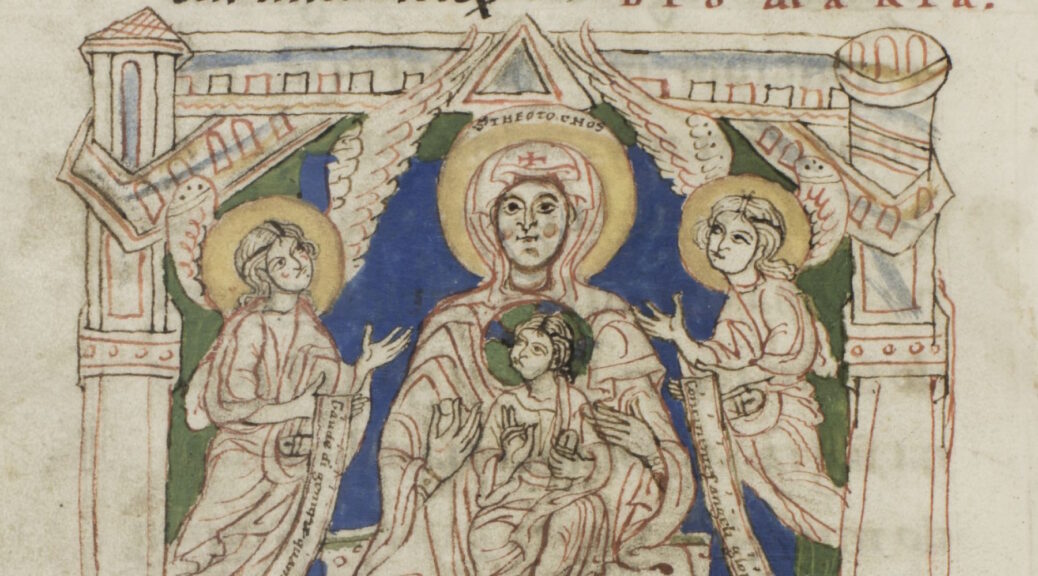
• Mardi 16 mai 2023 – 9h / 17h
• En présentiel à Poitiers et en visioconférence (voir fin du billet)
Hôtel Berthelot – salle Crozet – 24 rue de la chaîne – Bât. E13
Ouvert à toutes et tous
Programme :
9h / 12h20 – Session du matin
Présidence : Damien Boquet (Université d’Aix-en-Provence)
9h – Accueil
9h10 – Marcello ANGHEBEN (Université de Poitiers, CESCM) : Présentation de la journée.
10h – Nicolas BALZAMO (Université de Neuchâtel) : Condamner, justifier ou expliquer : les théologiens et la question des émotions suscitées par les images cultuelles.
10h40 – Pause
11h – Marielle LAMY (Sorbonne Université Lettres) : La dimension émotive et imaginative dans les méditations d’Étienne de Salwey, O. Cist. (début XIIIe siècle).
11h40 – Mathieu BEAUD (Université de Lille) : Impression visuelle et émotions : remarques sur l’enluminure de psautiers du XIIe siècle.
14h / 17h – Session de l’après-midi
14h – Catherine NICOLAS (Université Paul-Valéry Montpellier III) :
Compassion, componction, conversion : thématisation de la réception des semblances graaliennes par le texte et par l’image dans le Lancelot-Graal.
14h40 – Julia Maria GARCIA MORALES (Universidad de Murcia) : La Compassio Mariae dans la Péninsule ibérique.
15h20 – Pause
15h30 – Bertrand COSNET (Université de Lille, IRHiS) : L’iconographie de la tristesse aux XIIIe et XIVe siècles : entre acédie et componction.
16h10 – Anne-Laure IMBERT (Université Paris I Panthéon-Sorbonne) : Dévotion et émotion dans la peinture siennoise (Trecento, Quattrocento)
16h10 – Conclusion
Informations complémentaires
Contact : marcello.angheben@univ-poitiers.fr
Visioconférence
• Inscription préalable requise, par mail auprès de : marcello.angheben@univ-poitiers.fr
• Lien de connexion : https://univ-poitiers.webex.com/meet/marcello.angheben
Source : CESCM
Lunch Lecture by Dr. Erika Graham-Goering on medieval lordship
On Friday 9 June 2023 (12.30 pm), we have the pleasure of hosting Dr. Erika Graham-Goering, who will deliver an additional lunch lecture paper for the ’22-’23 Medieval Seminar Series cycle. Her paper will be entitled ‘There Can Be Only One? Rethinking the Exclusivity of Lordly Power in the Middle Ages‘. There will be time for Q&A afterwards. The lecture will take place in the « Camelot » room on the third floor of the Blandijn building.
This paper explores some of the many ways that medieval lords shared power with each other, and how these interacted with contemporary legal expectations. It argues that while lordship has traditionally been understood primarily in autocratic terms, these collaborative practices open up new analytical possibilities regarding aristocratic priorities and the hierarchies we ascribe to them.
Erika Graham-Goering is Lecturer in Late Medieval History at Durham University, and FWO Senior Postdoctoral Fellow at Ghent University on the project ‘Lordship as Corporative Government across Late Medieval France’. From September she will be Associate Professor of Medieval European History at the University of Oslo.
Informations pratiques :
When 09-06-2023 from 12:30 to 13:30
Where Ghent University, Campus Boekentoren: Blandijn Building, 3rd floor. Meeting Room 3.30 « Camelot »
Language English
Organizer Stefan Meysman
Contact Stefan.Meysman@UGent.be
Source : Universiteit Gent
Universität Regensburg, Fakultät für Katholische Theologie
23.11.2023 – 24.11.2023
Deadline : 31.05.2023
The conference aims at exploring the link between the readings of the Gospels during liturgical services and the calendars they are included in. First focused on liturgical calendars and prescriptions in Greek manuscripts (Tetraevangelia, Lectionaries, Typica,…) reflecting different rites (Hagiopolite Liturgy, Constantinopolitan Liturgy, transitional forms…), the conference gives the opportunity to enter into dialogue with specialists in other traditions from Christian East and West (Arabic, Armenian, Ethiopian, Latin, Old Slavonic, Syriac,…). This dialogue will enable to sketch, confirm, modify or precise main tendencies in the evolution of the pericope system and the liturgical calendars (Byzantinization / Constantinopolization,…), around what can be called the core or the crown of the Liturgy of the Word.
One main line is the constitution and the evolution of the calendars, of the different cycles (fixed and movable) and of the commemorations (through integration, replacement and disappearance of feasts). Were the Gospel readings themselves adapted to these changes, to new uses and practices? What were the criteria for the delimitation of the pericopes? What theological views and interpretations does the selection of these readings show, in relation to the feasts or the cycles they are associated with?
The other main line deals with the presentation and transmission of the pericope systems. How were the manuscript sources used to define and to find the Gospel readings, or to design new calendars and manuscripts? How do calendars, apparatuses and dividing systems work together? What other material (iconography, notes, instructions,…) accompanies the pericopes? Are there similarities in different rites and languages?
Links with hagiography, homiletics and hymnology are very welcome. The contributors can speak in English, German, French or Italian. The format is hybrid, but speakers are warmly invited to contribute in presence. The contributions should last between 20 and 30 minutes.
The conference takes place in the frame of my current postdoctoral research project “Evangelium und Liturgie in der byzantinischen Kirche. Das liturgische Kirchenjahr in griechischen Tetraevangelien”, funded since October 2021 by the Fritz Thyssen Stiftung and settled at the University of Munich (Ev.-theol. Fakultät, Lehrstuhl für Kirchengeschichte I / Ältere und weltweite Christentumsgeschichte, Prof. Martin Wallraff). The proceedings will be published as soon as possible after the conference, as the project ends at the latest in September 2024.
The conference is organized in collaboration with the Lehrstuhl für Liturgiewissenschaft (Prof. Harald Buchinger) from the University of Regensburg, Fakultät für Katholische Theologie, with the help of Simone Oelke and under the scientific supervision of Elena Velkovska.
If you want to participate, please submit a title and an abstract until May 31 at m.geiger@lmu.de.
The answer will be given not later than the beginning of July.
E-Mail: m.geiger@lmu.de
Source : H-Soz-Kult
Séminaire Moyen Âge 10h00 (07.06.) – 12h00 (07.06.) IHA
Séminaire de recherche organisé par l’IHA (R. Große) en coopération avec l’EPHE (L. Morelle).
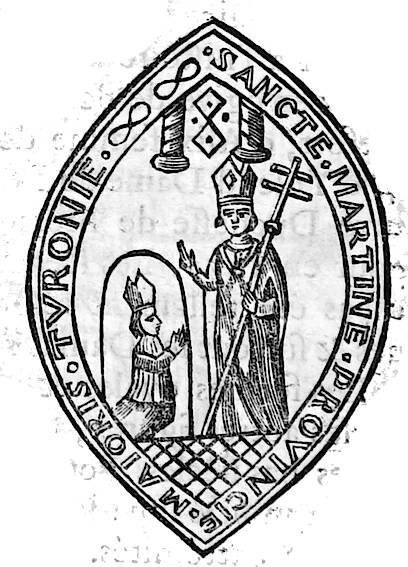
Claire Lamy (Sorbonne université), Enquêtes sur les dignitaires de l’abbaye de Marmoutier (XIe–début XIIe s.): circulation, carrières et administration des biens.
Présidence: Noëlle Deflou-Leca (Grenoble)
Inscription
Le séminaire se déroulera sous un format hybride. Pour participer à l’événement, en ligne ou sur place, veuillez vous inscrire auprès de Rolf Große au plus tard la veille du séminaire.
Pour la participation virtuelle, merci de vous inscrire ici: Zoom
Crédit photo: Sceau de l’abbaye, Wikimedia Commons.
L’IHA et l’École pratique des hautes études organisent en commun un séminaire d’histoire médiévale où des doctorantes et doctorants en thèse bien avancée, mais aussi de jeunes postdocs viennent présenter leurs recherches en voie d’achèvement ou un dossier de leur thèse. La prestation, toujours en langue française, dure environ 50 minutes. Le séminaire a lieu tous les deux mois, un mercredi matin de 10h à 12h.
Source : Institut historique allemand
13e journée d’étude de la Gallia Pontificia, organisée par l’École nationale des chartes et l’Institut historique allemand, avec le soutien des Archives de France.
La journée d’étude s’intéresse aux regestes numériques, à leur conception, à leurs apports et à leurs exploitations: sont-ils périmés par les éditions intégrales ou sauvés par une numérisation rétrospective ou immédiate? Quelles options se profilent derrière le choix de la langue de rédaction des regestes et de leurs commentaires? Regestes et éditions sont-ils en situation de concurrence ou de complémentarité? Le recours désormais courant aux analyses lexicographiques les condamne-t-il à brève échéance, ou leur reste-t-il un espace propre – celui en particulier d’une indexation, d’identifications poussées (personnes, lieux, glossaires,…)? Quelles utilisations se dessinent, et quels utilisateurs?
Organisé par Rolf Große (IHA) et Olivier Guyotjeannin (École nationale des chartes).

Le programme sera mis en ligne sous peu.
Inscription pour une participation sur place: auprès de Rolf Große
Inscription pour une participation en ligne: Zoom
Événement en français, allemand et anglais.
Crédit photo: Petrus Georgisch, Regesta chronologico-diplomatica dans quibus recensentur omnis generis monumenta et documenta publica, tomus 1, Francofurti 1740, Bayrische Staatsbibliothek.
Source : Institut historique allemand




 L'Agenda des Médiévistes
Vous devez être connecté pour poster un commentaire.